- Market Value (2025): USD 1.26 Bn
- Estimated Value (2026): USD 1.33 Bn
- Forecast Value (2036): USD 2.3 Bn
- CAGR (2026-2036): 5.6%
What is the Floral Scented Candles Market forecast to be worth by 2036?
USD 1.33 billion in 2026 to USD 2.3 billion by 2036, at a 5.6% CAGR.
- The floral scented candles market reached USD 1.26 billion in 2025.
- According to Fact.MR analysis, sales are forecast to move from USD 1.33 billion in 2026 to USD 2.3 billion by 2036.
- The market is projected to register a 5.6% CAGR from 2026 to 2036 as households purchase floral fragrances for home use and gifting.
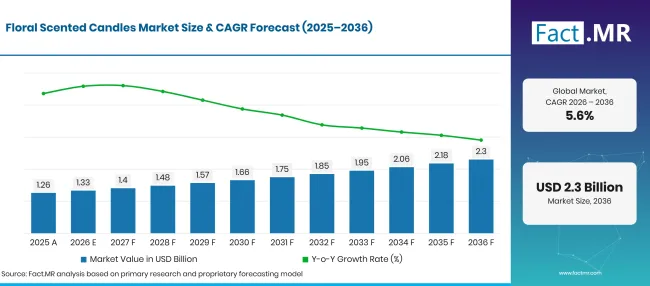
Floral Scented Candles Market Forecast Global | Source: Fact.MR
| Year | Basis | Market Value (USD billion) |
|---|---|---|
| 2025 | Actual | 1.26 |
| 2026 | Estimate | 1.33 |
| 2036 | Forecast | 2.3 |
| CAGR 2026 to 2036 | Forecast period | 5.6% |
Source: Fact.MR analysis. Updated Oct 23, 2026
What are the defining numbers behind Floral Scented Candles Market growth?
USD 1.0 billion absolute opportunity from 2026 to 2036, with jar candles and residential purchases at the center of sales.
- Demand Drivers in the Market
- People choosing a candle for the home look for floral scents that fit the room and their daily habits. The candle also becomes part of the decoration, so its appearance matters alongside its fragrance.
- Gift buyers often prefer candles in jars or boxes that are ready to give. Recognizable floral notes, including rose, make it easier to choose a fragrance for someone else.
- Online candle customers compare scent descriptions with reviews because they cannot smell the product before ordering.
- Small candle brands can test seasonal floral collections without committing to large production runs. Clear descriptions of the wax and simple burn instructions help customers compare these ranges with established products.
- Key Segments Analyzed
- By Product Type: Jar Candles hold 38.5% share in 2026, helped by their protected wax surface and familiar decorative format.
- By Wax Type: Paraffin Wax represents 39.1% share in 2026 as producers use it across established candle-making processes.
- By Distribution Channel: Online Retail captures 41.3% share in 2026 as shoppers compare floral ranges across brand websites and marketplaces.
- By End-User: Residential customers account for 67.8% share in 2026, reflecting the home-use focus of scented candles.
- Analyst Opinion at Fact.MR
- Shambhu Nath Jha, Principal Consultant at Fact.MR, states, “For floral scented candles, scent consistency is as important as the first fragrance impression. A shopper selecting a rose candle online needs a reliable product description and a burn experience that matches previous purchases. Brands that coordinate wax selection with fragrance testing and clear safety labels are likely to earn more repeat orders.”
- Strategic Implications
- Candle manufacturers should test each floral formula in the intended jar and wick combination. The same fragrance oil may perform differently when the wax blend or candle size changes, which makes product checks relevant before wider production.
- Retail teams should describe dominant floral notes in direct language and provide practical candle dimensions. Photographs showing the jar in a normal room can help shoppers judge scale and style.
- Online sellers should protect glass vessels during delivery and keep product descriptions consistent across their own websites and reseller listings. Breakage and mismatched fragrance expectations can reduce repeat purchases.
- Fragrance and wax suppliers should plan for small-batch seasonal orders alongside stable core ranges. Producers benefit from reliable lead times when a floral candle gains popularity during a short selling period.
Germany is forecast to post a 7.0% CAGR through 2036 as specialty home-fragrance collections reach established retail channels. The United Kingdom follows at 6.2% as online and gift-focused purchases support floral candles. Brazil is projected to expand at 5.7% through wider retail access, while the United States posts 5.4%.
How does the Floral Scented Candles Market break down by segment?
Jar Candles 38.5%; Paraffin Wax 39.1%; Online Retail 41.3%; Residential 67.8% in 2026.
Which Product Type leads floral candle sales?
Jar Candles holds 38.5% share in 2026.
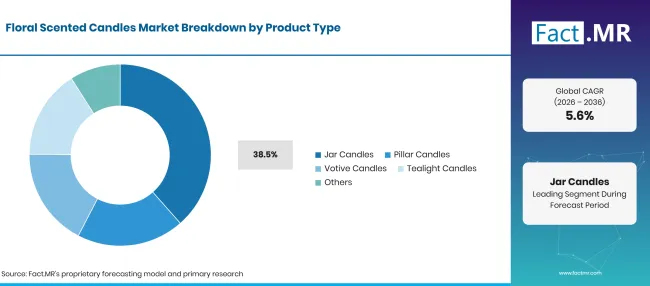
Floral Scented Candles Market Breakdown Product Type | Source: Fact.MR
| Product Type | Share (2026) |
|---|---|
| Jar Candles (Leading segment) | 38.5% |
| Other segments combined | 61.5% |
| Total | 100.0% |
Source: Fact.MR analysis. Updated Oct 23, 2026
Jar candles keep the wax inside a rigid vessel and often remain part of the room display after use. Pillar candles suit buyers seeking a standalone shape, while votive candles work with separate holders. Tealights are more commonly selected for small decorative arrangements or several light points. Glass containers add cost and require careful shipping, so makers balance presentation with package protection.
What leads the Wax Type segment?
Paraffin Wax accounts for 39.1% share in 2026.
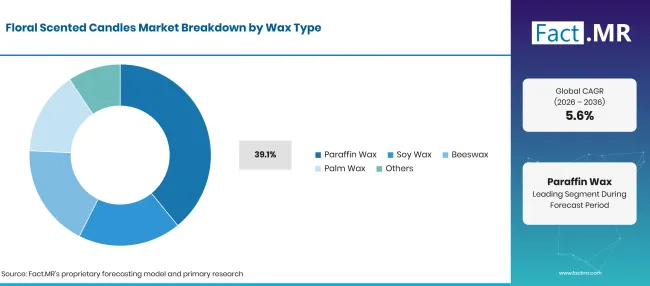
Floral Scented Candles Market Breakdown Wax Type | Source: Fact.MR
| Wax Type | Share (2026) |
|---|---|
| Paraffin Wax (Leading segment) | 39.1% |
| Other segments combined | 60.9% |
| Total | 100.0% |
Source: Fact.MR analysis. Updated Oct 23, 2026
Paraffin wax is used in many commercial candle processes because manufacturers can tune familiar formulas for color and fragrance release. Soy wax attracts shoppers who prefer plant-based wax descriptions. Beeswax serves products where the material identity is itself part of the purchase. Palm wax and other blends offer additional surface finishes and performance choices.
How does the Distribution Channel affect purchases?
Online Retail leads with 41.3% share in 2026.
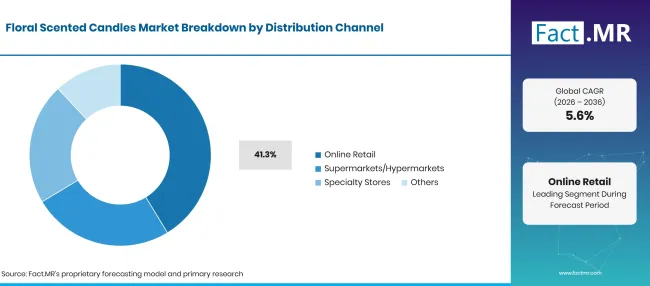
Floral Scented Candles Market Breakdown Distribution Channel | Source: Fact.MR
| Distribution Channel | Share (2026) |
|---|---|
| Online Retail (Leading segment) | 41.3% |
| Other segments combined | 58.7% |
| Total | 100.0% |
Source: Fact.MR analysis. Updated Oct 23, 2026
Online shops let customers browse floral notes and compare container sizes without visiting several stores. Reviews and photographs help them judge packaging and appearance, although the fragrance cannot be sampled before ordering. Physical specialty shops offer that chance, while supermarkets suit customers returning for a familiar scent.
Which End-User segment accounts for most purchases?
Residential holds 67.8% share in 2026.
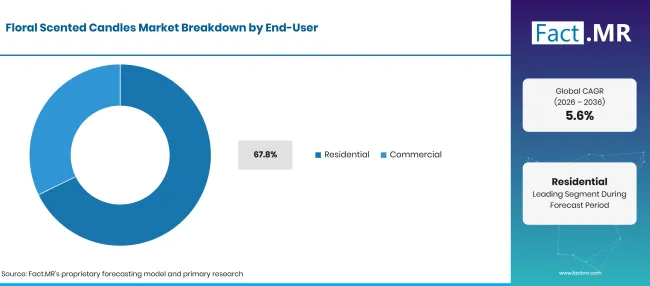
Floral Scented Candles Market Breakdown End User | Source: Fact.MR
| End-User | Share (2026) |
|---|---|
| Residential (Leading segment) | 67.8% |
| Other segments combined | 32.2% |
| Total | 100.0% |
Source: Fact.MR analysis. Updated Oct 23, 2026
Residential use covers candles purchased for living rooms, bedrooms and personal gifts. Customers may choose lighter flower notes for familiar indoor spaces or richer blends for evenings and occasions. Commercial purchasers use selected candles in hospitality and retail settings where appearance is part of the customer experience. Commercial users pay close attention to burning rules and staff supervision.
What is accelerating Floral Scented Candles Market adoption, and what is holding it back?
Home decoration and gifting support purchases, while ingredient costs and scent testing can limit product ranges.
Drivers Impact Analysis
| Driver | (~) % Impact on CAGR | Geographic Relevance | Impact Timeline |
|---|---|---|---|
| Gift-ready jar formats | +0.9% | Global | Medium term (2–4 years) |
| Online scent discovery | +0.8% | North America, Europe | Short term (≤2 years) |
| Seasonal floral collections | +0.7% | Europe, Japan | Medium term (2–4 years) |
| Home decoration | +0.5% | Global | Medium term (2–4 years) |
| Repeat fragrance buying | +0.4% | Global | Long term (≥4 years) |
Source: Fact.MR analysis. Updated Oct 23, 2026
Opportunity Impact Analysis
| Opportunit | (~) % Impact on CAGR | Geographic Relevance | Impact Timeline |
|---|---|---|---|
| Smaller floral sample sizes | +0.7% | Global | Medium term (2–4 years) |
| Gift and occasion bundles | +0.6% | Europe, Americas | Short term (≤2 years) |
| Direct brand websites | +0.5% | Global | Medium term (2–4 years) |
| Refill-compatible vessels | +0.3% | Selected markets | Long term (≥4 years) |
Source: Fact.MR analysis. Updated Oct 23, 2026
Restraints Impact Analysis
| Restraint | (~) % Impact on CAGR | Geographic Relevance | Impact Timeline |
|---|---|---|---|
| Fragrance consistency | -0.7% | Global | Short term (≤2 years) |
| Glass shipping breakage | -0.6% | Global | Short term (≤2 years) |
| Wax and fragrance costs | -0.5% | Global | Medium term (2–4 years) |
| Fire safety expectations | -0.4% | Global | Long term (≥4 years) |
Source: Fact.MR analysis. Updated Oct 23, 2026
Which countries are scaling the Floral Scented Candles Market through 2036?
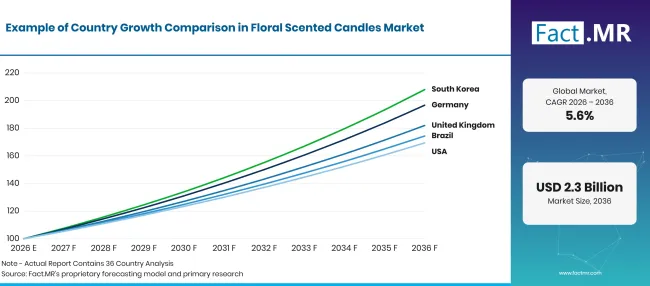
Floral Scented Candles Market Growth Index | Source: Fact.MR
| Country | CAGR (2026–2036) |
|---|---|
| Germany | 7.0% |
| United Kingdom | 6.2% |
| Brazil | 5.7% |
| United States | 5.4% |
| Japan | 4.5% |
Source: Fact.MR analysis. Updated Oct 23, 2026
Why is Germany expanding floral candle sales?
7.0% CAGR, linked to gift retail and established online shopping habits.
Germany has a well-established gift and home-accessory retail base where floral jar candles can be displayed beside decorative items. Stores can distinguish rose and jasmine fragrances through clear scent descriptions and attractive containers. Eurostat reported that 78% of EU internet users bought goods or services online in 2025 in its 2026 e-commerce figures [2]. The EU-wide measure provides context for online buying, including the route used by German retailers to sell home-fragrance products.
How is the United Kingdom developing floral candle demand?
6.2% CAGR, supported by gift occasions and digital shopping.
Floral scented candles in the United Kingdom are commonly positioned as home-fragrance gifts, so retailers need packaging that presents the scent clearly and protects the glass jar. The Office for National Statistics reported in July 2026 that online sales made up 29.4% of retail spending in Great Britain during June 2026 [3]. That share covers all retail categories and provides useful context for the digital channel available to candle sellers.
What shapes Brazil’s floral scented candle outlook?
5.7% CAGR, influenced by personal-gift purchases and wider retail access.
Brazilian floral candle makers can develop gift ranges that use familiar flower scents and colorful containers to stand out across specialty stores and online listings. The Brazilian Institute of Geography and Statistics reported in February 2026 that retail sales volume increased by 1.6% during 2025 [4].
Why do US shoppers buy floral scented candles?
5.4% CAGR, connected with home fragrance and multi-channel brand shopping.
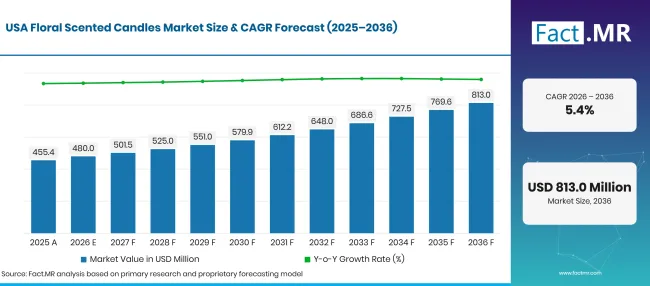
Floral Scented Candles Market Forecast Usa | Source: Fact.MR
Home-fragrance chains and independent candle makers in the United States offer floral candles through physical shops and brand websites. A recognizable vessel and a clear fragrance description help shoppers compare rose or jasmine candles across price points. The U.S. Census Bureau estimated in March 2026 that retail e-commerce sales reached USD 1,233.7 billion during 2025 [1]. That measure covers retail e-commerce as a whole and shows the scale of an established distribution route for candle brands.
What supports Japan’s floral candle market?
4.5% CAGR, influenced by thoughtful gifting and compact home displays.
Japanese floral candle ranges can appeal to gift shoppers through compact containers and careful presentation of scent and jar size. Limited display space favors products that are easy to show in small shops and suitable for modest gift packaging. Japan’s Ministry of Economy, Trade and Industry reported in August 2025 that the country’s business-to-consumer e-commerce market reached JPY 26.1 trillion in 2024 [5].
Who leads the Floral Scented Candles Market?
Yankee Candle and Bath & Body Works offer home fragrance collections sold through recognizable consumer channels. Diptyque and Jo Malone London serve fragrance-oriented customers whose purchases place weight on scent identity and presentation. Their candle ranges compete for gift spending as well as personal room fragrance use. Floral product suitability depends on the current collection and the individual fragrance, not a claim that all products carry flower notes.
NEST New York, Voluspa and LAFCO sell decorative home-fragrance products with distinctive vessels and scent ranges. Paddywax and Archipelago Botanicals also operate in scented home products, while Illume offers gift-oriented candle designs. Different container sizes and wax mixtures make direct price comparisons difficult. Stores and online buyers therefore compare the complete candle, including scent strength, size and how the jar is presented.
Which companies are the key providers?
Key companies include Yankee Candle; Bath & Body Works; Diptyque; Jo Malone London; NEST New York; Voluspa; LAFCO; Paddywax; Archipelago Botanicals; and Illume Candles.
- Yankee Candle
- Bath & Body Works
- Diptyque
- Jo Malone London
- NEST New York
- Voluspa
- LAFCO
- Paddywax
- Archipelago Botanicals
- Illume Candles
Bibliography
- [1] U.S. Census Bureau. (2026, March 10). Quarterly retail e-commerce sales: Fourth quarter 2025.
- [2] Eurostat. (2026, February). E-commerce statistics for individuals.
- [3] Office for National Statistics. (2026, July 24). Retail sales, Great Britain: June 2026.
- [4] Instituto Brasileiro de Geografia e Estatística. (2026, February 13). Retail sales close 2025 with rise of 1.6%.
- [5] Ministry of Economy, Trade and Industry. (2025, August 26). Results of FY2024 E-Commerce Market Survey Compiled.
This Report Answers
- The report compares floral candle formats and explains the importance of container design for everyday home use.
- Wax type analysis considers paraffin alongside soy, beeswax and palm wax options within finished scented candles.
- Channel analysis explains how online descriptions and physical scent testing affect buying decisions.
- Country comparisons cover Germany, Brazil, the United States, the United Kingdom and Japan.
- Competitive review covers ten branded candle providers across broad and premium home-fragrance ranges.
What does the Floral Scented Candles Market cover?
The market includes finished candles with floral notes such as rose or jasmine. It covers home and commercial settings. Wax and jars count as parts of finished candles, while separately sold raw materials are excluded.
What is included in the scope?
Coverage includes jar, pillar, votive and tealight candles sold with a floral scent as the primary fragrance identity. Finished candles may use paraffin, soy, beeswax, palm wax or other suitable blends. Sales through online stores and physical outlets are part of the scope. Residential purchases cover self-use and gifts, while commercial purchases include suitable hospitality or decorative settings. The fragrance description, vessel and finished candle are assessed as one retail product.
What is excluded from the scope?
Unscented candles and candles sold mainly with non-floral scents fall outside the core comparison. Fragrance oils sold on their own are ingredients rather than finished candles. Electric diffusers and room sprays provide adjacent ways to fragrance a room but are separate product categories. Standalone wax, wick and jar component sales are also excluded unless sold as part of a completed floral scented candle.
How Was the Analysis Built?
The analysis draws on 120+ sources, 35+ company portfolios, 25+ countries, and more than 20 industry interviews.
- Primary Research: Primary research includes discussions with manufacturers, service providers, technology developers, distributors, end users, and subject-matter experts. These conversations examine purchasing priorities, product adoption, operational challenges, approval requirements, competitive positioning, and the factors that influence wider market acceptance.
- Desk Research: Desk research covers government statistics, regulatory publications, company filings, trade data, technical studies, industry associations, standards, public policy, and other authoritative sources. Every source used in the analysis is documented in the bibliography.
- Market Sizing and Forecasting: Market estimates combine historical performance, demand indicators, pricing and volume trends, segment shares, company participation, country-level growth, adoption patterns, investment activity, and barriers to market expansion.
- Data Validation and Update Cycle: Findings are validated by comparing primary interviews with public data, company activity, regulatory changes, trade patterns, and industry developments. Regular updates review new product launches, capacity changes, partnerships, approvals, and shifts in commercial adoption.
Segmentation
What is the report’s scope and coverage?
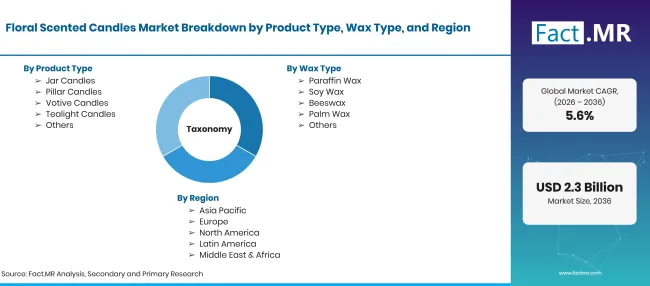
Floral Scented Candles Market Taxonomy | Source: Fact.MR
| Attribute | Details |
|---|---|
| Quantitative Units | USD billion in 2026 to USD billion by 2036 at CAGR |
| Market Definition | Finished candles with floral fragrance notes such as rose or jasmine, sold for residential and commercial use |
| Product Type | Jar Candles; Pillar Candles; Votive Candles; Tealight Candles; Others |
| Wax Type | Paraffin Wax; Soy Wax; Beeswax; Palm Wax; Others |
| Distribution Channel | Online Retail; Supermarkets/Hypermarkets; Specialty Stores; Others |
| End-User | Residential; Commercial |
| Regions Covered | North America; Latin America; Western Europe; Eastern Europe; East Asia; South Asia & Pacific; Middle East & Africa |
| Countries Covered | Germany; Brazil; United States; United Kingdom; Japan |
| Companies Profiled | Yankee Candle; Bath & Body Works; Diptyque; Jo Malone London; NEST New York; Voluspa; LAFCO; Paddywax; Archipelago Botanicals; Illume Candles |
| Forecast Period | 2026 to 2036 |
| Approach | Assessment of candle formats, wax types, sales channels, end-user purchasing, country outlook, and branded home-fragrance activity |
Source: Fact.MR analysis. Updated Oct 23, 2026
How is the market segmented?
-
By Product Type
- Jar Candles
- Pillar Candles
- Votive Candles
- Tealight Candles
- Others
-
By Wax Type
- Paraffin Wax
- Soy Wax
- Beeswax
- Palm Wax
- Others
-
By Distribution Channel
- Online Retail
- Supermarkets/Hypermarkets
- Specialty Stores
- Others
-
By End-User
- Residential
- Commercial
-
By Region
- North America
- Latin America
- Western Europe
- Eastern Europe
- East Asia
- South Asia & Pacific
- Middle East & Africa
Frequently Asked Questions
How big is the Floral Scented Candles Market in 2026?
What is the CAGR of the Floral Scented Candles Market from 2026 to 2036?
Which product type leads the Floral Scented Candles Market?
Which wax type leads the Floral Scented Candles Market?
Who are the leading companies in the Floral Scented Candles Market?
Who worked on this report


Preview the report firsthand - request a free sample
Free SampleGet the brochure for pricing and purchase details
Download PDF