- Base Value(2025): 18.2 Bn
- Estimated Value(2026): 19.1 Bn
- Forecast Value (2036): 31.4 Bn
- CAGR (2026 - 2036): 5.1%
Global Floral Flavor Market Forecast and Outlook By Fact.MR
In 2025, the global floral flavor market was valued at USD 18.2 billion. Based on Fact.MR analysis, demand for floral flavors is estimated to grow to USD 19.1 billion in 2026 and USD 31.4 billion by 2036. Fact.MR projects a CAGR of 5.1% during the forecast period.
Between 2026 and 2036, the market is expected to create USD 12.3 billion in new opportunity. Growth remains steady and structural. Demand is driven by rising preference for botanical and clean-label flavors. Beverages and confectionery are key applications. Artisan food trends are expanding in emerging markets. Regulations are also favoring natural over synthetic flavors. This supports long-term demand. Floral raw material supply is volatile, especially for rose and jasmine. Organic variants have higher production costs. This puts pressure on margins for mid-sized players.
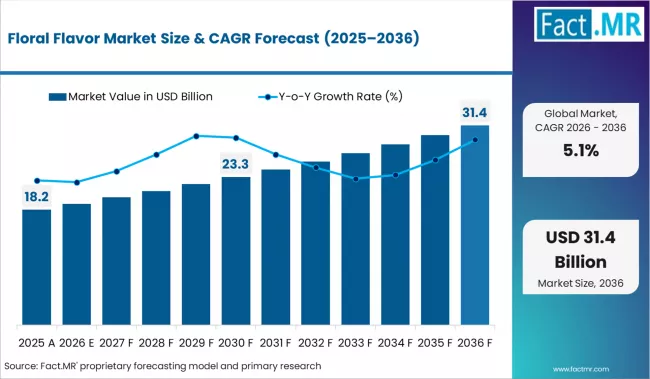
Floral Flavor Market Market Value Analysis | Source: Fact.MR
Summary of Floral Flavor Market
- Market Definition
- The market covers natural and synthetic floral flavoring compounds derived from botanical flowers, used as taste and aroma inputs in food and beverage manufacturing globally.
- Demand Drivers
- Floral botanical beverages including hibiscus-infused drinks and lavender lattes are expanding in cafes and ready-to-drink formats across North America and Europe, accelerating organic extract procurement.
- Clean-label regulatory pressure in the EU and growing consumer rejection of artificial flavors in the United States are compelling food manufacturers to reformulate with certified natural floral ingredients.
- India's expanding organized confectionery and bakery retail sector is driving high-volume procurement of rose and jasmine floral flavors from domestic and imported sources through 2036.
- Key Segments Analyzed
- By Raw Material: Hibiscus leads with approximately 25% share in 2026 driven by its widespread use across beverages, confectionery, and functional food.
- By Product Type: Organic variants lead with approximately 63% share in 2026, reflecting strong regulatory and consumer preference.
- By Application: Beverages lead the application segment in 2026.
- Analyst Opinion at FACT.MR
- Shambhu Nath Jha, Principal Consultant at Fact.MR, opines, 'CXOs operating in the floral flavor space will find that organic botanical sourcing capability and clean-label compliance infrastructure will be the primary differentiators determining market share through 2036, as premium beverage and confectionery brands consolidate supplier relationships around certified natural flavor partners.'
- Strategic Implications
- Secure long-term supply of hibiscus and rose from organic farms. This reduces sourcing risk and supports clean-label demand.
- Invest in floral flavors for dairy and bakery. These segments offer untapped growth potential.
- Develop localised blends for India and China. Align with regional taste preferences like rose and jasmine.
- Methodology
- Based on company revenues, volume data, and pricing. Validated with 2024–2025 procurement inputs.
- Uses EU, USDA, and FSSAI regulatory data. Supports demand analysis by product type.
- Forecasts include organic retail growth and product launch trends. Includes expert insights.
Floral Flavor Market Key Takeaways
| Metric | Value |
|---|---|
| Estimated Value in 2026 | USD 19.1 billion |
| Forecast Value in 2036 | USD 31.4 billion |
| Forecast CAGR (2026 to 2036) | 5.1% |
Source: Fact.MR analysis. Updated Apr 1, 2026
Country growth reflects regulatory posture on natural ingredients, premiumization intensity in food and beverage, and organized retail and hospitality sector expansion. India leads at 6.4% CAGR through 2036 driven by rapid expansion of flavored beverages, organized confectionery retail, and government support for food processing exports. China follows at 5.9% supported by premiumization in functional beverages and rapid growth in floral tea and specialty drink categories. The United States records 5.2% growth driven by botanical cocktail, health beverage, and artisan bakery applications where clean-label demand is strongest. Japan posts 4.6% through steady demand in confectionery and dairy categories anchored by domestic flavor specialists. Germany records 4.4%, sustained by organic food retail strength and regulatory preference for EU-approved natural flavoring standards.
Segmental Analysis
Global Floral Flavor Market Analysis by Raw Material
Floral Flavor Market Analysis By Raw Material | Source: Fact.MR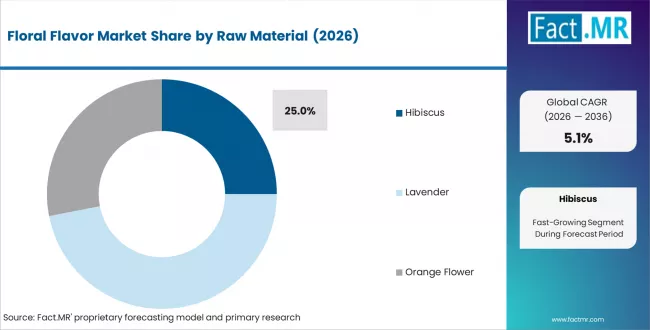
Hibiscus-based flavors hold 25% share in 2026 due to versatility across beverages, confectionery, and functional foods. Strong consumer familiarity and competitive pricing vs. rose and jasmine support its position as the volume anchor globally.
- Givaudan Botanical Investment: Expanded extraction capacity in 2024 at its Switzerland facility. Focus on hibiscus, lavender, and chamomile for clean-label beverage demand. [2]
- Symrise Rose Partnership: Secured multi-year organic rose sourcing in 2024. Supports traceable supply for premium dairy and confectionery segments. [3]
- Lavender Expansion: Launched lavender flavor line in 2025. Targets bakery and savory applications beyond beverages. [4]
Global Floral Flavor Market Analysis by Product Type
Floral Flavor Market Analysis By Product Type | Source: Fact.MR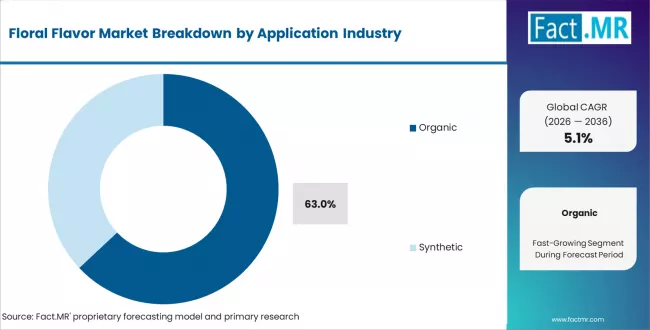
Organic floral flavors hold 63% share in 2026. Growth is driven by regulatory pressure, clean-label demand, and premiumization across North America and Europe.
- Firmenich Expansion: Added certified organic botanical flavors in 2024. Targets EU-compliant beverage and confectionery markets. [5]
- EU Regulatory Pressure: EFSA review continues to restrict synthetic flavors. This accelerates adoption of natural alternatives. [6]
- Organic Growth: U.S. organic food sales reached USD 67.6 billion. Demand for flavored products is expanding. [7]
Global Floral Flavor Market Analysis by Application
Floral Flavor Market Analysis By Application | Source: Fact.MR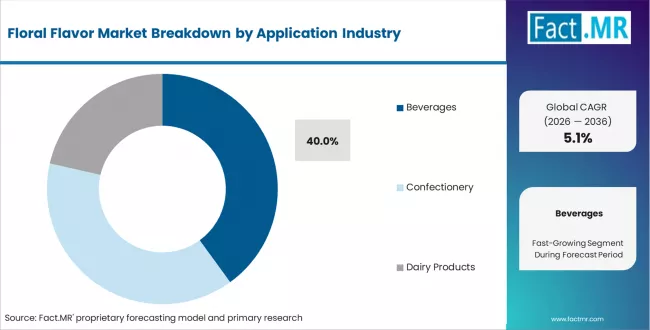
Beverages lead in 2026, driven by teas, sparkling drinks, cocktails, and wellness beverages. This is the highest-growth application segment.
- Sensient Launch: Introduced botanical beverage flavors in 2024. Targets RTD tea, carbonated drinks, and energy beverages. [8]
- Confectionery Trend: Floral flavors are rising in chocolates and candies. Growth is driven by premium gifting demand. [9]
- Dairy Development: Floral flavors are expanding in dairy and ice cream. Growth is strong in India and Southeast Asia. [10]
Drivers, Restraints, and Opportunities
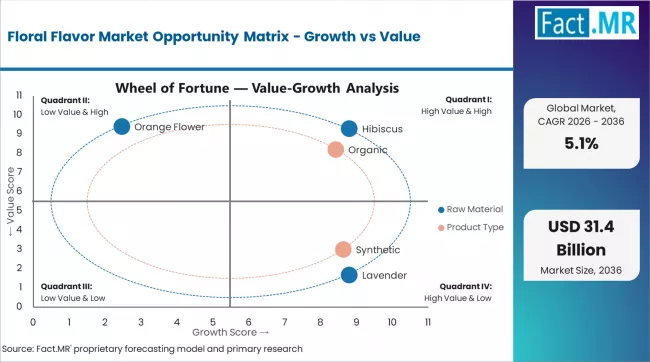
Floral Flavor Market Opportunity Matrix Growth Vs Value | Source: Fact.MR
FACT.MR notes the market has shifted to a mainstream natural flavor segment, valued at USD 18.2 billion in 2025. Growth is driven by clean-label demand, premiumization, and regulatory shifts away from synthetics.
The market shows clear bifurcation. Synthetic flavors face pricing pressure and regulatory limits. Natural variants command 20–35% price premiums and are gaining volume across beverages and confectionery. Higher-value natural formats sustain overall revenue growth.
- EU Natural Flavoring Transition: EFSA regulations continue to restrict synthetic flavors through 2026. This drives reformulation toward natural floral extracts across Europe’s food market.
- India Food Processing Incentives: Government incentives support domestic flavor production and exports. This drives supply growth in a 6.4% CAGR environment.
- Botanical Beverage Expansion: Floral beverage launches grew 18% annually (2022–2024). Hibiscus, lavender, and elderflower lead demand in premium beverage categories.
Regional Analysis
The global floral flavor market is analysed across North America, Europe, Asia Pacific, Latin America, and Middle East and Africa, covering key countries with distinct demand profiles shaped by regulatory frameworks, organized retail penetration, food manufacturing ecosystem depth, and premiumization intensity. The full report offers market attractiveness analysis across regulatory compliance intensity, botanical sourcing infrastructure, and application-specific demand trajectories.
.webp "Top Country Growth Comparison Floral Flavor Market Cagr (2026 2036)")
Top Country Growth Comparison Floral Flavor Market Cagr (2026 2036) | Source: Fact.MR
| Country | CAGR (2026 to 2036) |
|---|---|
| India | 6.4% |
| China | 5.9% |
| USA | 5.2% |
| Japan | 4.6% |
| Germany | 4.4% |
Source: Fact.MR analysis. Updated Apr 1, 2026
Source: Fact.MR (FACT.MR) analysis, based on proprietary forecasting model and primary research
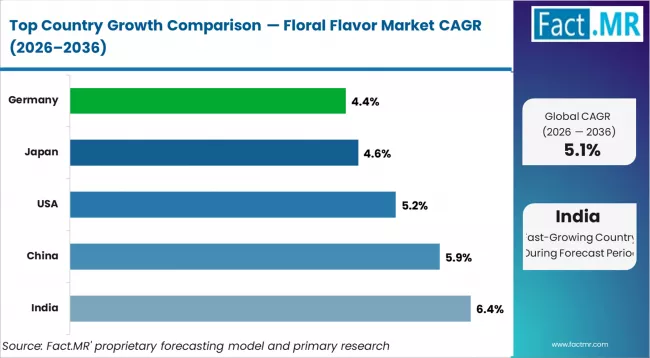
Floral Flavor Market Cagr Analysis By Country | Source: Fact.MR
Asia Pacific Global Floral Flavor Market
Asia Pacific is the highest-growth region for floral flavors, anchored by large-scale organized food manufacturing in China and India, deep cultural affinity for floral botanical ingredients in tea and confectionery, and rising middle-class premiumization of packaged food and beverage products. Givaudan, Takasago, and S H Kelkar and Company hold established regional positions across key application segments.
- India: Demand for floral flavors in India is projected to rise at 6.4% CAGR through 2036, the fastest among all countries in the global forecast. Growth is driven by rapid expansion of flavored packaged beverages, organized confectionery, and premium dairy products across modern retail and e-commerce channels. India's Production Linked Incentive scheme for food processing, extended through 2026, incentivizes domestic flavor manufacturers to scale production. S H Kelkar and Company Limited's February 2025 commercial deployment of rose and jasmine flavors in dairy and ice cream applications reflects the maturation of floral ingredients across adjacent food categories beyond traditional sweet and beverage formats.
- China: China's floral flavor market is forecast to grow at 5.9% CAGR through 2036, underpinned by the country's dominant position in jasmine green tea production and the rapid expansion of premium functional and botanical beverage categories across Tier 1 and Tier 2 cities. Domestic players and multinational flavor houses are competing to supply jasmine, osmanthus, and rose flavor systems to China's fast-growing RTD tea and flavored milk segments.
FACT.MR's analysis of the floral flavor market in Asia Pacific consists of country-wise assessment including China, Japan, India, ASEAN, and Australia and New Zealand. Readers can find botanical ingredient sourcing dynamics, premiumization data, food processing incentive analysis, and organized retail expansion benchmarks.
North America Global Floral Flavor Market
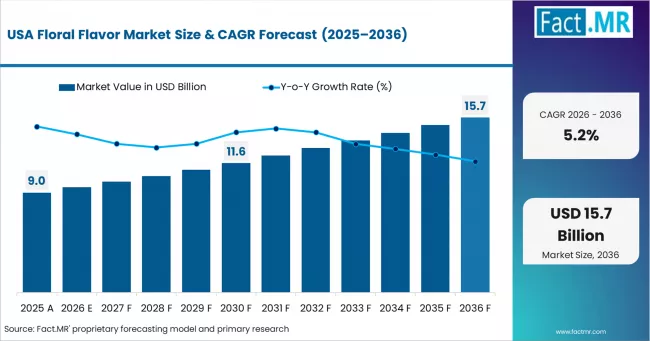
Floral Flavor Market Country Value Analysis | Source: Fact.MR
North America is a premium-led floral flavor market defined by clean-label consumer demand, rapid botanical beverage category growth, and strong regulatory alignment toward natural ingredient certification. IFF, Sensient Technologies, and Givaudan supply the dominant share of floral flavor inputs to North American food and beverage manufacturers.
- USA: The floral flavor market in the United States is expected to grow at 5.2% CAGR through 2036. Growth is driven by accelerating adoption of floral notes in botanical RTD beverages, craft spirits, artisan bakery products, and functional wellness drinks across premium retail and foodservice channels. In April 2024, Sensient Technologies Corporation launched its FlavorTek botanical beverage range featuring hibiscus, lavender, and elderflower systems targeting RTD and functional drink manufacturers reformulating for clean-label compliance.
FACT.MR's analysis of the floral flavor market in North America consists of country-wise assessment including the United States, Canada, and Mexico. Readers can find clean-label reformulation trend data, organic certification penetration benchmarks, botanical beverage category growth statistics, and regional flavor procurement channel analysis.
Europe Global Floral Flavor Market
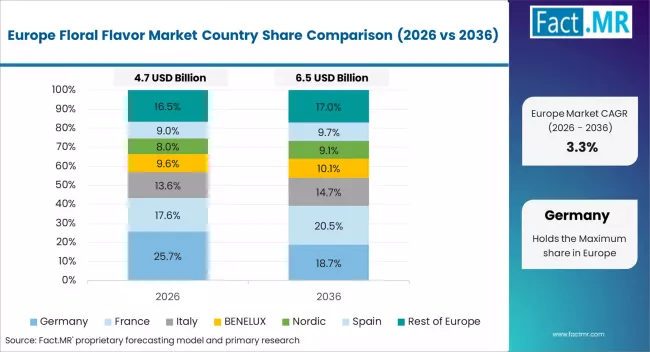
Floral Flavor Market Europe Country Market Share Analysis, 2026 & 2036 | Source: Fact.MR
Europe is defined by its stringent regulatory environment and advanced consumer preference for certified natural and organic botanical ingredients. Symrise AG, Givaudan, and Firmenich (now dsm-firmenich) lead supply to European food manufacturers, while the EU Flavouring Regulation creates a structural procurement preference for natural floral flavors over synthetic alternatives.
- Germany: Germany's floral flavor market is projected to grow at 4.4% CAGR through 2036, the most measured pace among covered markets, reflecting a mature organic food retail base with established floral ingredient adoption and limited new-category acceleration relative to emerging markets. Symrise AG's September 2024 formalization of long-term rose extract sourcing agreements from Bulgarian certified farms supports stable input supply aligned with Germany-based food manufacturer reformulation timelines under EU Flavouring Regulation compliance cycles.
- Japan: Japan's floral flavor market is set to record a 4.6% CAGR through 2036. Demand is sustained by stable confectionery and premium dairy applications where floral notes including cherry blossom and yuzu-floral blends are embedded in seasonal product lines by major domestic food brands. Unlike Germany's regulatory-driven transition, Japan's procurement is governed by consumer aesthetic preference for delicate botanical flavors in premium gift confectionery, convenience store desserts, and specialty tea categories.
FACT.MR's analysis of the floral flavor market in Europe consists of country-wise assessment including Germany, France, the United Kingdom, Italy, Spain, and Rest of Western Europe. Readers can find regulatory compliance timelines, organic retail penetration benchmarks, synthetic-to-natural reformulation trend data, and country-level procurement channel analysis.
Competitive Aligners for Market Players
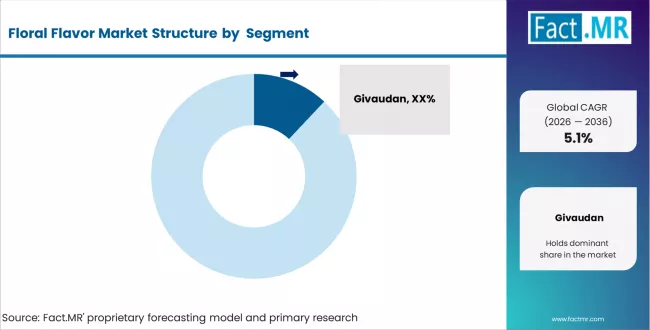
Floral Flavor Market Analysis By Company | Source: Fact.MR
The global floral flavor market is moderately concentrated. A few large companies dominate the industry. Key players include Givaudan, Symrise, dsm-firmenich, IFF, and Takasago. Together, they account for around 55–60% of total revenue. Competition goes beyond scale. It depends on sourcing strength and certification. Companies must secure reliable botanical raw materials. Organic certification and regulatory compliance are also critical. This is especially important in EU and U.S. markets.
Leading companies have strong sourcing networks. They work directly with farmers for key ingredients. Rose comes from Bulgaria and Turkey. Jasmine is sourced from Egypt and India. Lavender is mainly from France. These partnerships ensure traceability and quality. Smaller players find it hard to match this level of control. These companies also invest heavily in R&D. They develop application-specific flavors for beverages, dairy, and confectionery. This helps them meet changing consumer preferences. It also supports premium product positioning.
Large food and beverage companies manage supplier risk carefully. They usually follow dual sourcing strategies. Global flavor houses act as primary suppliers. Regional players like Robertet and S H Kelkar act as secondary suppliers. This ensures supply continuity and flexibility. This structure limits pricing power for bulk suppliers. At the same time, it creates opportunities for niche players. Specialty extract producers can compete through unique sourcing or advanced technologies. These include fermentation-based production methods.
Key Players
- Givaudan
- Symrise AG
- Firmenich SA
- International Flavors and Fragrances Inc.
- Sensient Technologies Corporation
- Takasago International Corporation
- Frutarom Industries Ltd.
- Robertet Group
- S H Kelkar and Company Limited
- Dohler GmbH
Bibliography
- Givaudan. (2024). 2024 Annual Results: Taste and Wellbeing Divisional Performance and Botanical Flavor Demand Commentary. February 2024. givaudan.com
- [2] Givaudan. (2024). Kemptthal Botanical Extraction Expansion for Hibiscus, Lavender, and Chamomile Clean-Label Beverage Portfolio. March 2024. givaudan.com
- [3] Symrise AG. (2024). Diana Food Division Certified Organic Rose Extract Multi-Year Sourcing Agreement, Kazanlak Valley, Bulgaria. September 2024. symrise.com
- [4] International Flavors and Fragrances Inc. (2025). ProTaMax Lavender Flavor Line Launch for Bakery and Savory Applications. January 2025. iff.com
- [5] dsm-firmenich. (2024). Natural First Platform: Sixteen New Certified Organic Botanical Flavor Compounds Including Jasmine, Orange Flower, and Chamomile. June 2024. dsm-firmenich.com
- [6] European Food Safety Authority. (2023). Interim Suspension of Synthetic Flavouring Substances Under Regulation EC No 1334/2008 — Update. 2023–2025. efsa.europa.eu
- [7] Organic Trade Association. (2024). US Organic Industry Survey: Organic Food Sales Reach USD 67.6 Billion in 2023. 2024. ota.com
- [8] Sensient Technologies Corporation. (2024). FlavorTek Botanical Beverage Range Launch for RTD Tea, Carbonated Water, and Functional Energy Drink Applications. April 2024. sensient.com
- [9] Robertet Group. (2024). Jardin Botanique Confectionery Flavor Collection: Violet, Rose, and Cherry Blossom Profiles for Premium Chocolate and Gummy Applications. November 2024. robertet.com
This Report Addresses
- Strategic intelligence on floral flavor demand across botanical beverages, premium confectionery, dairy, bakery, and savory product categories globally.
- Market forecast from USD 19.1 billion in 2026 to USD 31.4 billion by 2036 at a CAGR of 5.1%.
- Growth opportunity mapping across organic botanical extracts, hibiscus-infused beverages, rose and jasmine confectionery applications, and lavender bakery formats.
- Segment-wise analysis by raw material (hibiscus, rose, jasmine, lavender, chamomile, others), product type (organic, synthetic), and application (beverages, confectionery, dairy, bakery, savory).
- Regional outlook covering Asia Pacific premiumization growth, North America clean-label demand, and European regulatory-driven natural flavor transition.
- Competitive landscape of leading players including Givaudan, Symrise AG, dsm-firmenich, IFF, Sensient, Takasago, Robertet, and S H Kelkar.
- Regulatory impact analysis covering EU Flavouring Regulation EC No 1334/2008 synthetic substance suspensions, USDA organic certification growth, and India FSSAI natural flavor standards.
- Report delivery in PDF, Excel datasets, and presentation formats supported by primary interviews, regulatory databases, manufacturer revenue disclosures, and botanical trade data.
Floral Flavor Market Definition
The global floral flavor market covers natural and synthetic flavoring agents derived from or designed to replicate botanical flowers including rose, jasmine, lavender, hibiscus, and chamomile. These are used as functional taste and aroma inputs in food and beverage manufacturing across beverages, confectionery, bakery, dairy, and savory applications globally.
Floral Flavor Market Inclusions
Includes global and regional market sizes from 2026 to 2036 segmented by raw material, product type, and application. Covers both organic and synthetic floral flavor formats used in beverages, bakery, confectionery, dairy, and savory products. Regional analysis spans North America, Europe, Asia Pacific, Latin America, and the Middle East and Africa.
Floral Flavor Market Exclusions
Excludes non-floral botanical extracts such as vanilla, citrus, and herbal unless blended with primary floral notes. Also excludes finished branded food and beverage products, fragrances, and personal care flavoring applications. Focus is strictly on floral flavor ingredients and compounds supplied to food and beverage manufacturers and contract formulators.
Floral Flavor Market Research Methodology
- Primary Research: Interviews with flavor chemists, product development managers, procurement heads at food manufacturers, and specialty ingredient distributors across key markets.
- Desk Research: Analysis of USDA organic certification data, EU flavoring regulation (EC No 1334/2008), FAO food additive databases, and company annual reports from 2024 to 2025.
- Market-Sizing and Forecasting: Hybrid model integrating top-down revenue estimates from flavor company disclosures with bottom-up application-level volume forecasts by raw material and product type.
- Data Validation and Update Cycle:Validated using flavor manufacturer revenues, food industry procurement data, regulatory databases, and expert interviews with regular annual updates.
Segmentation
Floral Flavor Market by Segments
-
By Raw Material:
- Hibiscus
- Lavender
- Orange Flower
- Rose
- Jasmine
- Cherry Blossom
- Chamomile
- Violette
- Others
-
By Product Type:
- Organic
- Synthetic
-
By Application:
- Beverages
- Confectionery
- Dairy Products
- Bakery Products
- Savory Products
-
By Region:
- North America
- United States
- Canada
- Mexico
- Latin America
- Brazil
- Mexico
- Argentina
- Chile
- Rest of Latin America
- Western Europe
- Germany
- United Kingdom
- France
- Italy
- Spain
- Nordic Countries
- BENELUX
- Rest of Western Europe
- Eastern Europe
- Russia
- Poland
- Hungary
- Balkan and Baltic
- Rest of Eastern Europe
- East Asia
- China
- Japan
- South Korea
- South Asia and Pacific
- India
- ASEAN
- Australia and New Zealand
- Rest of South Asia and Pacific
- Middle East and Africa
- Kingdom of Saudi Arabia
- Other GCC Countries
- Turkey
- South Africa
- Rest of Middle East and Africa
- North America
Scope of Report
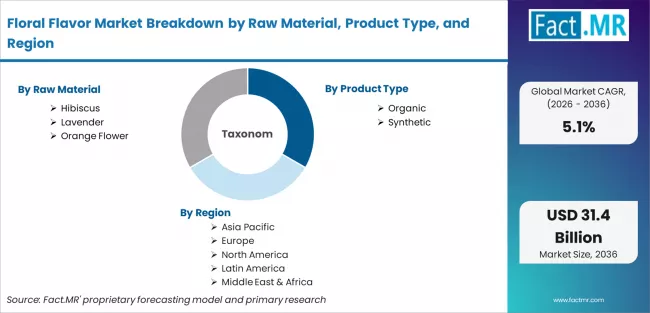
Floral Flavor Market Breakdown By Raw Material, Product Type, And Region | Source: Fact.MR
| Attribute | Details |
|---|---|
| Quantitative Units | USD 19.1 billion (2026) to USD 31.4 billion (2036), at a CAGR of 5.1% |
| Market Definition | Natural and synthetic floral flavoring compounds derived from botanical flowers including hibiscus, rose, jasmine, lavender, and chamomile, used as taste and aroma inputs in food and beverage manufacturing. |
| Raw Material Segmentation | Hibiscus, Lavender, Orange Flower, Rose, Jasmine, Cherry Blossom, Chamomile, Violette, Others |
| Product Type Segmentation | Organic, Synthetic |
| Application Segmentation | Beverages, Confectionery, Dairy Products, Bakery Products, Savory Products |
| Regions Covered | North America, Europe, Asia Pacific, Latin America, Middle East and Africa |
| Countries Covered | USA, Canada, Mexico, Germany, UK, France, Italy, Spain, Nordic, BENELUX, China, Japan, South Korea, India, ASEAN, Australia and New Zealand, Brazil, Argentina, Chile, Saudi Arabia, GCC, Turkey, South Africa, Rest of MEA |
| Key Companies Profiled | Givaudan, Symrise AG, Firmenich SA, International Flavors and Fragrances Inc., Sensient Technologies Corporation, Takasago International Corporation, Frutarom Industries Ltd., Robertet Group, S H Kelkar and Company Limited, Dohler GmbH |
| Forecast Period | 2026 to 2036 |
| Approach | Hybrid top-down and bottom-up model using application-level volume estimates, average ingredient prices by raw material, organic certification data, regulatory compliance records, and primary interviews with flavor chemists and food product development managers. |
Source: Fact.MR analysis. Updated Apr 1, 2026
Frequently Asked Questions
How large is the global floral flavor market in 2025?
What will the global floral flavor market size be by 2036?
What is the expected CAGR for the floral flavor market from 2026 to 2036?
Which raw material segment is poised to lead the global floral flavor market?
Which product type is expected to dominate the floral flavor market?
How significant is Asia Pacific in the global floral flavor market?
Who worked on this report


Preview the report firsthand - request a free sample
Free SampleGet the brochure for pricing and purchase details
Download PDF