- Market Value (2025): USD 89.2 Bn
- Estimated Value (2026): USD 93.4 Bn
- Forecast Value (2036): USD 147.3 Bn
- CAGR (2026-2036): 4.7%
What is the Stationary Sofas Market forecast to be worth by 2036?
USD 93.4 billion in 2026 to USD 147.4 billion by 2036, at a 4.7% CAGR.
- As per Fact.MR analysis, stationary sofa sales reached USD 89.2 billion in 2025.
- Sales are projected to move from USD 93.4 billion in 2026 to USD 147.3 billion by 2036.
- The market is forecast to achieve a 4.7% CAGR during 2026 to 2036 as households replace worn seating and furnish living rooms.
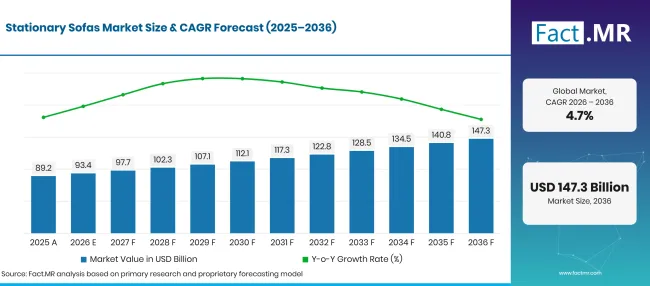
Stationary Sofas Market Forecast Global | Source: Fact.MR
| Year | Basis | Market Value (USD billion) |
|---|---|---|
| 2025 | Actual | 89.2 |
| 2026 | Estimate | 93.4 |
| 2036 | Forecast | 147.3 |
| CAGR 2026 to 2036 | Forecast period | 4.7% |
Source: Fact.MR analysis. Updated Oct 23, 2026
What are the defining numbers behind Stationary Sofas Market growth?
An additional USD 54.0 billion in market value between 2026 and 2036, led by fabric upholstery and residential use.
- Demand Drivers in the Market
- Households replacing worn seating look closely at cushion support and upholstery durability because both affect everyday comfort.
- Furniture showrooms give shoppers a chance to test seat firmness and inspect stitching before deciding which sofa to buy.
- Online shoppers depend on clear photographs and accurate dimensions when choosing a sofa. Practical fabric descriptions also help them narrow their options before visiting a store or booking home delivery.
- Key Segments Analyzed
- By Material: Fabric is projected to hold 42.3% share in 2026 because its range of colours and textures gives households practical decorating choices.
- By Design: Traditional sofas are forecast to represent 31.2% share in 2026 as familiar shapes fit established living-room styles.
- By End-User: Residential customers are expected to account for 73.8% share in 2026 because of everyday household seating purchases.
- By Distribution Channel: Offline Retail is expected to capture 64.8% share in 2026 since shoppers often prefer a physical comfort test.
- Analyst Opinion at Fact.MR
- Shambhu Nath Jha, Principal Consultant at Fact.MR, states, “Appearance attracts attention, but sofa buyers also need a comfortable seat and a frame that fits their home. Clear fabric choices and reliable delivery information help retailers answer the questions that often determine a purchase.”
- Strategic Implications
- Sofa manufacturers should publish useful information on frame construction and cushion care so retailers can explain product differences without relying on broad quality claims.
- Furniture retailers should connect showroom trials to digital stock records because shoppers often review dimensions again before placing an order.
- Upholstery suppliers should help manufacturers compare fabric durability and cleaning requirements for everyday family use.
- Delivery partners should communicate access measurements and handling requirements before dispatch to reduce unsuccessful home deliveries.
Germany is forecast to achieve 5.3% CAGR, followed by Brazil at 4.8% and the United States at 4.4%. The United Kingdom follows at 3.9%, while Japan is projected to expand at 3.5%. Household replacement cycles and the different pace of residential construction shape purchasing conditions across these five markets.
How does the Stationary Sofas Market break down by segment?
Fabric 42.3%; Traditional 31.2%; Residential 73.8%; Offline Retail 64.8% in 2026.
Which Material dominates?
Fabric holds 42.3% share in 2026.
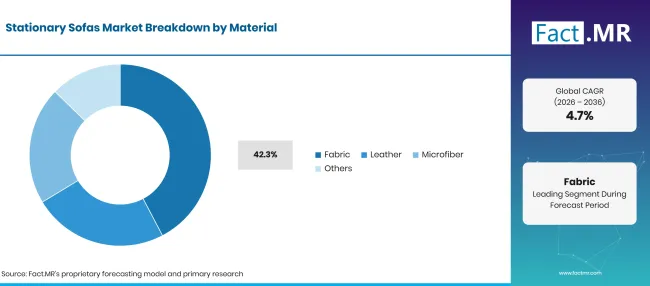
Stationary Sofas Market Breakdown Material | Source: Fact.MR
| Material | Share (2026) |
|---|---|
| Fabric (Leading segment) | 42.3% |
| Other segments combined | 57.7% |
| Total | 100.0% |
Source: Fact.MR analysis. Updated Oct 23, 2026
Fabric sofas give households a choice of textures and colours, but buyers also consider how easy the upholstery is to clean. Material affects comfort in warm rooms and how visible daily wear becomes. Microfiber can appeal to buyers looking for straightforward care, while other fabrics suit more specific design preferences. Customers typically balance comfort, appearance, and upkeep before making a final choice.
What leads the Design segment?
Traditional accounts for 31.2% share in 2026.
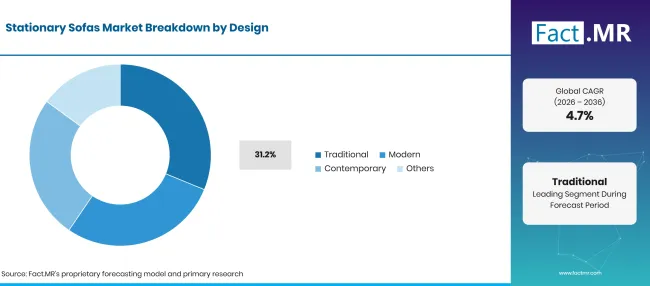
Stationary Sofas Market Breakdown Design | Source: Fact.MR
| Design | Share (2026) |
|---|---|
| Traditional (Leading segment) | 31.2% |
| Other segments combined | 68.8% |
| Total | 100.0% |
Source: Fact.MR analysis. Updated Oct 23, 2026
Traditional sofas suit rooms built around a fixed furniture layout and familiar decor. Their proportions and arm shapes make it easier to picture them beside existing chairs and tables. Contemporary designs offer different colours and silhouettes, so the choice depends on the room and the seating experience as well as price.
How does End-User purchasing shape sales?
Residential leads with 73.8% share in 2026.
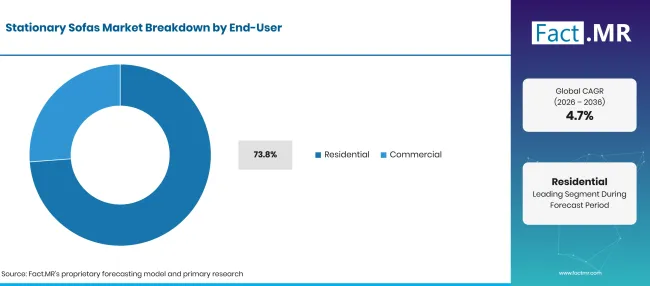
Stationary Sofas Market Breakdown End User | Source: Fact.MR
| End-User | Share (2026) |
|---|---|
| Residential (Leading segment) | 73.8% |
| Other segments combined | 26.2% |
| Total | 100.0% |
Source: Fact.MR analysis. Updated Oct 23, 2026
Households buy stationary sofas for daily seating, and moving home or worn upholstery can prompt a replacement. Commercial customers often give more weight to cleaning requirements and dependable repeat purchasing.
Which Distribution Channel serves the largest share?
Offline Retail represents 64.8% share in 2026.
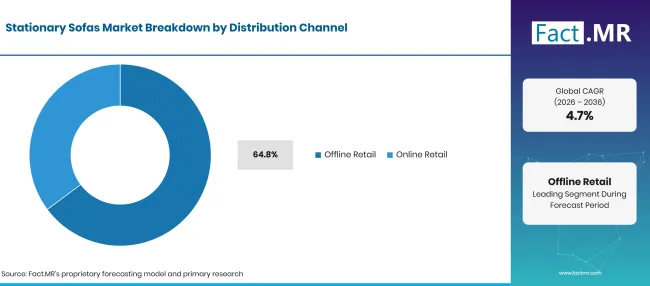
Stationary Sofas Market Breakdown Distribution Channel | Source: Fact.MR
| Distribution Channel | Share (2026) |
|---|---|
| Offline Retail (Leading segment) | 64.8% |
| Other segments combined | 35.2% |
| Total | 100.0%\ |
Source: Fact.MR analysis. Updated Oct 23, 2026
Furniture stores let shoppers test seat height, back support, and fabric colour on an actual sofa. Staff can also explain delivery access, packaging dimensions, and return conditions. Some shoppers begin with an online shortlist before visiting a store to check comfort, then decide where to complete the purchase.
What is accelerating Stationary Sofas Market adoption, and what is holding it back?
Home furnishing purchases support sales; price pressure and delivery complexity restrain them.
Drivers Impact Analysis
| DRIVER | (~) % IMPACT ON CAGR | GEOGRAPHIC RELEVANCE | IMPACT TIMELINE |
|---|---|---|---|
| Household sofa replacement | +0.9% | Global | Medium term (2–4 years) |
| Residential moves | +0.7% | North America, Europe | Medium term (2–4 years) |
| Showroom comfort trials | +0.5% | Global | Short term (≤ 2 years) |
| Fabric choice | +0.4% | Global | Medium term (2–4 years) |
| Omnichannel browsing | +0.3% | Global | Long term (≥ 4 years) |
Source: Fact.MR analysis. Updated Oct 23, 2026
Opportunity Impact Analysis
| OPPORTUNITY | (~) % IMPACT ON CAGR | GEOGRAPHIC RELEVANCE | IMPACT TIMELINE |
|---|---|---|---|
| Room-size guidance | +0.6% | Urban markets | Short term (≤ 2 years) |
| Repair and cover services | +0.5% | Europe, North America | Medium term (2–4 years) |
| Better delivery scheduling | +0.4% | Global | Medium term (2–4 years) |
| Digital fabric selection | +0.3% | Global | Long term (≥ 4 years) |
Source: Fact.MR analysis. Updated Oct 23, 2026
Restraints Impact Analysis
| RESTRAINT | (~) % IMPACT ON CAGR | GEOGRAPHIC RELEVANCE | IMPACT TIMELINE |
|---|---|---|---|
| Household spending pressure | -0.7% | Global | Short term (≤ 2 years) |
| Housing completion delays | -0.5% | Europe | Medium term (2–4 years) |
| Bulky-goods delivery costs | -0.4% | Global | Short term (≤ 2 years) |
| Returns and upholstery upkeep | -0.3% | Global | Medium term (2–4 years) |
Source: Fact.MR analysis. Updated Oct 23, 2026
Which countries are scaling the Stationary Sofas Market through 2036?
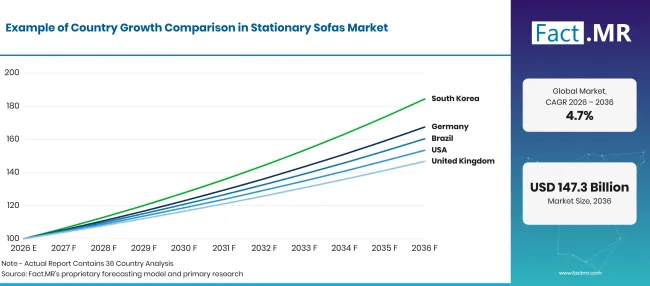
Stationary Sofas Market Growth Index | Source: Fact.MR
| Country | CAGR (2026–2036) |
|---|---|
| Germany | 5.3% |
| Brazil | 4.8% |
| United States | 4.4% |
| United Kingdom | 3.9% |
| Japan | 3.5% |
Source: Fact.MR analysis. Updated Oct 23, 2026
Why does Germany lead the country growth comparison?
5.3% CAGR, influenced by existing household stock and careful replacement spending.
Germany's established housing stock gives stationary sofa sellers a sizeable replacement market. In July 2026, Destatis reported approximately 44.0 million dwellings in Germany at the end of 2025, a rise of 0.4% from 2024 [2]. Furniture showrooms can help shoppers compare fixed-frame designs against the measurements of existing rooms and the feel of different upholstery fabrics.
How is Brazil shaping stationary sofa purchasing?
4.8% CAGR, reflecting urban household furnishing and retail price comparisons.
Brazilian sofa shopping is closely tied to household spending and the cost of furnishing a living room. In February 2026, IBGE reported that the furniture retail category contracted by 4.3% during 2025 [3]. This market condition gives retailers a reason to explain the value of upholstery options and make total delivery charges clear before a sale.
What shapes stationary sofa sales in the United States?
4.4% CAGR, linked to residential purchases and mature furniture retail networks.
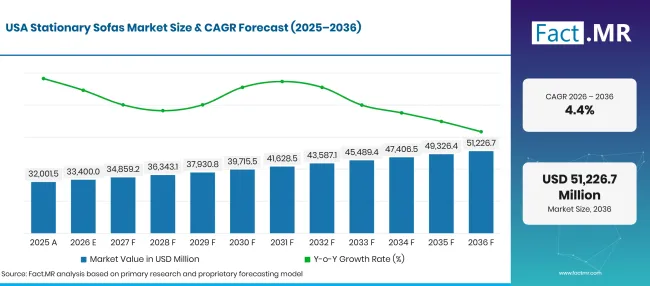
Stationary Sofas Market Forecast Usa | Source: Fact.MR
Home completions and replacement purchases both influence stationary sofa sales in the United States. The U.S. Census Bureau reported in July 2026 that 1,005,000 single-family homes were completed during 2025 [1]. A move into a new home creates a possible furnishing occasion, and established households also replace seating when fabric wears or a room layout changes.
How do United Kingdom shoppers select stationary sofas?
3.9% CAGR, shaped by room fit and replacement decisions.
Room size and furniture replacement needs shape stationary sofa purchases across the United Kingdom. The Ministry of Housing, Communities and Local Government reported that England had approximately 25.8 million dwellings as of 31 March 2025 [4]. Furniture retailers serve this broad household base through showrooms that let shoppers test cushions and compare upholstery finishes.
Why is Japan a measured growthmarket for stationary sofas?
3.5% CAGR, reflecting household size and detailed room planning.
Japanese consumers often weigh sofa dimensions against the usable floor space of their living rooms. The Statistics Bureau of Japan reported 57.125 million households in its 2025 census results, released in June 2026 [5]. This household base includes customers seeking low-profile fixed sofas and compact seating that fits existing furniture arrangements. Store demonstrations can make fabric care and cushion comfort easier to compare before a purchase.
Who leads the Stationary Sofas Market?
Ashley Furniture Industries and IKEA operate broad furniture assortments that include fixed sofas. La-Za-Boy also sells stationary upholstered seating alongside its better-known motion furniture. Natuzzi offers upholstered sofa ranges with a distinct emphasis on materials and design. Each company reaches customers through a different combination of branded retail and distribution partners.
Williams-Sonoma markets sofa collections through its furnishing brands, while Havertys serves consumers through furniture retail. American Leather and Flexsteel compete with seating designed around construction and comfort features. Man Wah offers sofa products across multiple seating formats. Dorel Industries has participated in home furnishing categories, although its current relevance should be judged by the particular sofa brand or business rather than the parent name alone.
Which companies are the key providers?
Key companies include Ashley Furniture Industries; IKEA; La-Z-Boy Incorporated; Williams-Sonoma, Inc.; Natuzzi S.p.A.; Haverty Furniture Companies, Inc.; American Leather; Flexsteel Industries, Inc.; Dorel Industries Inc.; and Man Wah Holdings Limited.
- Ashley Furniture Industries
- IKEA
- La-Z-Boy Incorporated
- Williams-Sonoma Inc.
- Natuzzi S.p.A.
- Haverty Furniture Companies Inc.
- American Leather
- Flexsteel Industries Inc.
- Dorel Industries Inc.
- Man Wah Holdings Limited
Bibliography
- [1] U.S. Census Bureau. (2026, July 1). Highlights of 2025 Characteristics of New Housing.
- [2] Statistisches Bundesamt (Destatis). (2026, July 16). 44,0 Millionen Wohnungen in Deutschland zum Jahresende 2025.
- [3] Instituto Brasileiro de Geografia e Estatística. (2026, February 13). Retail sales close 2025 with rise of 1.6%.
- [4] Ministry of Housing, Communities and Local Government. (2026, May 21). Dwelling stock estimates, England: 31 March 2025.
- [5] Statistics Bureau of Japan. (2026, June 25). News bulletin June 25, 2026 (No. 380).
This Report Answers
- The report compares fabric upholstery and traditional sofa designs across household purchasing conditions.
- Segment analysis explains the residential customer base and the role of offline furniture stores.
- The country outlook compares Germany and Brazil with the United States, United Kingdom and Japan.
- Competitive analysis reviews manufacturers and furniture retailers serving the stationary sofa category.
- Material and channel analysis covers product inspection, care requirements and large-item delivery.
What does the Stationary Sofas Market cover?
The market covers finished stationary sofas designed for fixed seating positions. It includes products upholstered in fabric, leather, microfiber and other materials for homes and suitable commercial interiors.
What is included in the scope?
The scope includes ready-made and selected custom stationary sofas sold by furniture retailers and manufacturers. Residential living rooms form the main use case, while reception areas and other commercial rooms provide additional sales. It includes purchases completed in a showroom and those placed through an online retail platform. Material choice and delivery practicality remain relevant across both routes.
What is excluded from the scope?
Recliners and motion seating sold as powered or manually moving furniture sit outside the strict stationary definition. Separate chairs, ottomans and sofa accessories are also excluded when sold independently. Repair work and second-hand resale are not counted as new stationary sofa sales. Adjacent furniture categories are discussed only where they help explain consumer shopping decisions.
How Was the Analysis Built?
The analysis draws on 120+ sources, 35+ company portfolios, 25+ countries, and more than 20 industry interviews.
- Primary Research: Primary research includes discussions with manufacturers, service providers, technology developers, distributors, end users, and subject-matter experts. These conversations examine purchasing priorities, product adoption, operational challenges, approval requirements, competitive positioning, and the factors that influence wider market acceptance.
- Desk Research: Desk research covers government statistics, regulatory publications, company filings, trade data, technical studies, industry associations, standards, public policy, and other authoritative sources. Every source used in the analysis is documented in the bibliography.
- Market Sizing and Forecasting: Market estimates combine historical performance, demand indicators, pricing and volume trends, segment shares, company participation, country-level growth, adoption patterns, investment activity, and barriers to market expansion.
- Data Validation and Update Cycle: Findings are validated by comparing primary interviews with public data, company activity, regulatory changes, trade patterns, and industry developments. Regular updates review new product launches, capacity changes, partnerships, approvals, and shifts in commercial adoption.
Segmentation
What is the report’s scope and coverage?
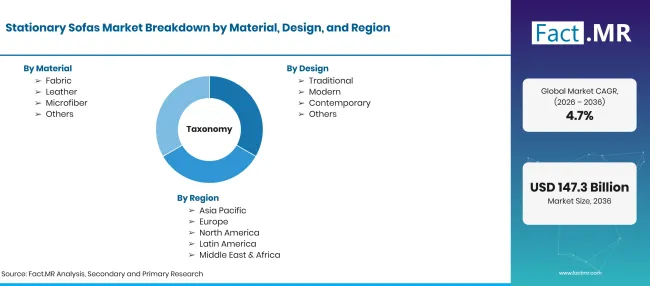
Stationary Sofas Market Taxonomy | Source: Fact.MR
| Attribute | Details |
|---|---|
| Quantitative Units | USD billion in 2026 to USD billion by 2036, at CAGR |
| Market Definition | Fixed, non-reclining upholstered sofas for residential and commercial seating. |
| Material | Fabric; Leather; Microfiber; Others |
| Design | Traditional; Modern; Contemporary; Others |
| End-User | Residential; Commercial |
| Distribution Channel | Offline Retail; Online Retail |
| Regions Covered | North America; Latin America; Western Europe; Eastern Europe; East Asia; South Asia & Pacific; Middle East & Africa |
| Countries Covered | Germany; Brazil; United States; United Kingdom; Japan |
| Companies Profiled | Ashley Furniture Industries; IKEA; La-Z-Boy Incorporated; Williams-Sonoma, Inc.; Natuzzi S.p.A.; Haverty Furniture Companies, Inc.; American Leather; Flexsteel Industries, Inc.; Dorel Industries Inc.; and Man Wah Holdings Limited. |
| Forecast Period | 2026 to 2036 |
| Approach | Market segmentation, official housing and consumer evidence, and company portfolio review |
Source: Fact.MR analysis. Updated Oct 23, 2026
How is the market segmented?
-
By Material
- Fabric
- Leather
- Microfiber
- Others
-
By Design
- Traditional
- Modern
- Contemporary
- Others
-
By End-User
- Residential
- Commercial
-
By Distribution Channel
- Offline Retail
- Online Retail
-
By Region
- North America
- Latin America
- Western Europe
- Eastern Europe
- East Asia
- South Asia & Pacific
- Middle East & Africa
Frequently Asked Questions
How big is the stationary sofas market in 2026?
What is the CAGR from 2026 to 2036?
Which material leads?
Which design leads?
Who are the main companies in the stationary sofas market?
Who worked on this report


Preview the report firsthand - request a free sample
Free SampleGet the brochure for pricing and purchase details
Download PDF