- Market Value (2025): USD 2.52 Bn
- Estimated Value (2026): USD 2.69 Bn
- Forecast Value (2036): USD 5.19 Bn
- CAGR (2026-2036): 6.8%
What is the Foam Core Materials Market forecast to be worth by 2036?
USD 2.69 billion in 2026 to USD 5.19 billion by 2036, at a 6.79% CAGR.
- Foam core materials generated an estimated USD 2.52 billion in sales in 2025.
- Fact.MR puts the market at USD 2.69 billion for 2026, rising to USD 5.19 billion in 2036.
- The implied 2026–2036 CAGR is 6.8%. Demand is moving toward prepared core kits that save labour during composite manufacturing.
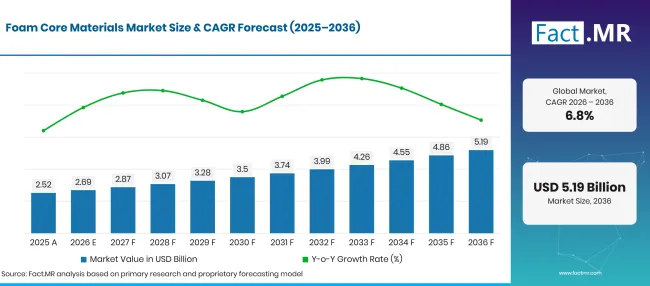
Factmr Foam Core Materials Market Forecast Global | Source: Fact.MR
| Year | Basis | Market Value (USD billion) |
|---|---|---|
| 2025 | Historical estimate | 2.52 |
| 2026 | Estimate | 2.69 |
| 2036 | Forecast | 5.19 |
| CAGR 2026 to 2036 | Forecast period | 6.8% |
Source: Fact.MR analysis. Updated Oct 21, 2026
What are the defining numbers behind Foam Core Materials Market growth?
The additional USD 2.50 billion in forecast annual sales will not all come from shipping more uncut foam. Wind Energy makes up 28.7% of application revenue in 2026, and blade factories increasingly buy shaped material ready for infusion. Suppliers that help reduce resin use, scrap and preparation time have a stronger case for higher-priced products.
- Demand Drivers in the Market
- Fraunhofer IWES's OptiFoam project explored glass-fibre reinforcement in foam cores as a way to address balsa's variable properties and supply concerns. [4] The wind turbine material market includes several competing core solutions, and a blade does not face the same loads at every point. Reinforced foam may replace balsa in selected high-load areas if it reaches the required performance without adding excessive weight or processing cost.
- Core purchases increasingly include the preparation needed for infusion. Grooves help resin move through a panel and improve the bond with its skins. Excess resin also raises weight and consumes a more expensive material. A 2025 PET-core study examined this trade-off through groove and perforation design. [8] The purchasing implication is clear: delivered cost should include resin uptake and panel output. A low sheet price has limited appeal if the production line needs more resin or experiences longer filling times.
- Fire performance opens some building applications and closes others. A 2025 study of polyurethane and PET sandwich panels found that internal webs and protective boards materially changed performance under a standard fire exposure. The tested assembly determined the outcome. [9] Buyers consequently need evidence for the complete panel they intend to install. This supports partnerships between foam suppliers and panel manufacturers. It also keeps fire protection within the product-development budget instead of treating it as a minor finishing expense after the core has been selected.
- A marine structure cannot be assessed from a foam data sheet alone. A 2025 fatigue study considered the different ways sandwich skins and the core can fail when they work together. [12] Boatbuilders therefore need tests that resemble the finished part and its repeated loading. This creates a place for technical foam suppliers that can explain where fatigue damage is likely to begin and how the proposed core addresses it.
- Key Segments Analyzed
- Polyurethane Foam represents 38.5% of Type revenue in 2026. Its position reflects demand across a broad panel market rather than a claim that polyurethane dominates every wind-blade specification.
- Wind Energy contributes 28.7% of Application revenue in 2026. Blade designs create recurring core purchases after material and infusion processes have been approved.
- Aerospace accounts for 24.6% of End-User revenue in 2026. Weight-sensitive structures support specialist grades while competing core constructions keep qualification demanding.
- Analyst Opinion at Fact.MR
- Shambhu Nath Jha, Lead Consultant, Fact.MR
- The best customer is often the one that can show exactly what a different core will change on the production line. A material saving may disappear if the new grade requires more resin or slows infusion. Core manufacturers should compare finished-panel cost, weight and scrap rather than start with density and price alone. Gurit and other kit suppliers also show the value of delivering pieces that arrive ready for assembly. New cutting capacity is sensible when there is a qualified programme behind it, not merely an encouraging forecast for wind or aerospace output.
- Strategic Implications
- Sell the prepared kit, not just the sheet. A production buyer needs predictable cut geometry, agreed drawing revisions and material that arrives in the correct sequence. Gurit highlighted progress with OptiCore in its 2025 annual report. [5] That is a useful direction for suppliers: show how the kit cuts handling time or waste during a normal production shift. Prototype savings have little value unless they can be repeated at factory scale.
- Be precise about recycling claims. The U.S. Department of Energy identified composite turbine blades as a difficult recycling problem in 2025. [13] Recycled polymer in a foam sheet does not mean the finished bonded blade can be recovered economically. Customers in the wider foam market may ask for recycled inputs and end-of-life plans, but those are separate specifications. Suppliers should be ready to explain both.
- Join aircraft development before the core shape is fixed. The UK's HALOS programme used a thermoformed multi-part core with automated fibre overbraiding. [10] Its value to a foam producer is straightforward: the aerospace composites customer needs a form that works with the manufacturing process, not simply a material with attractive test results. Early trials offer the chance to influence tooling and select the right grade before redesign becomes costly.
- Charge a premium for a demonstrated benefit, not a fashionable additive. A 2025 study found improvements in some mechanical properties after adding carbon nanotubes to polyurethane foam, but little gain in low-velocity impact resistance because the aluminium skins absorbed most of the energy. [7] An improvement measured in foam alone may not change the assembled panel. Product teams should decide which test result matters to the customer before investing in a modified grade.
Germany has the fastest forecast growth among the five countries at 7.82%. Its opportunity centres on engineered core development. Brazil offers a different route through wind-equipment demand. The USA combines domestic supply with multiple applications. Specialist aircraft work shapes the UK opportunity while Japan presents demanding alternatives to foam-based construction.
How does the Foam Core Materials Market break down by segment?
Type describes the foam chemistry. Application records the structure in which the core is used. End-User identifies the purchasing industry's principal activity. These are separate views of the same revenue and should be read independently. A material's overall share does not establish its position in every application.
Why does Polyurethane Foam lead the material mix?
Polyurethane Foam holds 38.5% of Type revenue in 2026 across the covered foam-core applications.
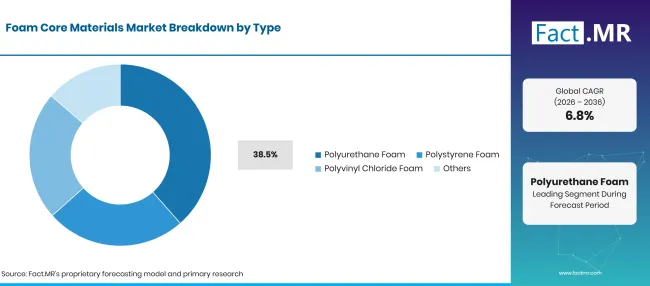
Factmr Foam Core Materials Market Breakdown Type | Source: Fact.MR
| Type | Share (2026) |
|---|---|
| Polyurethane Foam | 38.5% |
| Other segments combined | 61.5% |
| Total | 100.0% |
Source: Fact.MR analysis. Updated Oct 21, 2026
Polyurethane's commercial position rests on the breadth of panels in which its density and processing can be matched to a particular requirement. A purchaser building a protected construction panel evaluates a different combination of loads and costs from a wind-blade manufacturer. The 2025 fire tests demonstrate why the skins and internal structure remain central to that decision. [9] A single chemistry label cannot replace an assembly specification. Sales teams need to understand which property limits the customer's design before proposing a higher-priced grade. The Others category includes specialist foam chemistries such as PET and PMI where applicable. Their opportunity is strongest when heat tolerance or manufacturing compatibility carries enough value to justify qualification. Commercial comparisons should keep the same panel thickness and required performance. Otherwise a nominal price difference between foam sheets can conceal a much larger difference in finished-part cost.
How does Wind Energy turn a core specification into repeat orders?
Wind Energy contributes 28.7% of Application revenue in 2026.
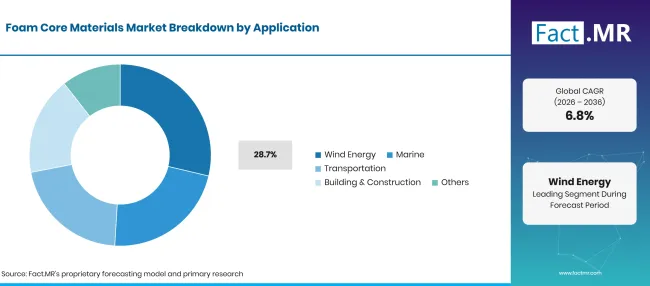
Factmr Foam Core Materials Market Breakdown Application | Source: Fact.MR
| Application | Share (2026) |
|---|---|
| Wind Energy | 28.7% |
| Other segments combined | 71.3% |
| Total | 100.0% |
Source: Fact.MR analysis. Updated Oct 21, 2026
A blade contains several loading conditions within one manufactured structure. A core suitable for a lightly loaded shell area may need reinforcement near a more demanding location. OptiFoam's focus on strengthening foam for higher loads illustrates this segmentation within the product itself. [4] After the blade design is released the core supplier needs to repeat its geometry and material properties across successive kits. Growth therefore follows approved blade programmes and their actual factory output. Nameplate capacity at a wind farm is an indirect indicator of those purchases. A useful contract also deals with model changes and unused kit stock. Manufacturers may alter blade lengths or production locations during a supply agreement. Core vendors with flexible cutting capacity can respond without holding excessive finished inventory. This operational flexibility can be worth more than a small reduction in the quoted price per cubic metre.
Why does Aerospace command the largest end-user share?
Aerospace represents 24.6% of End-User revenue in 2026.
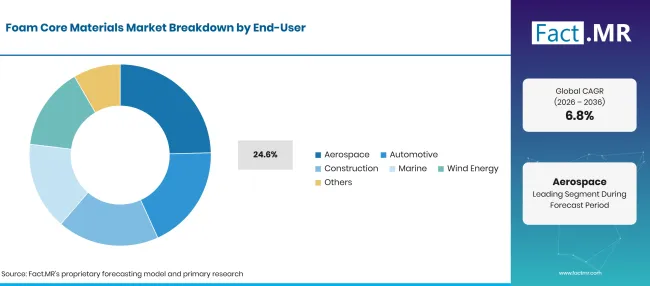
Factmr Foam Core Materials Market Breakdown End User | Source: Fact.MR
| End-User | Share (2026) |
|---|---|
| Aerospace | 24.6% |
| Other segments combined | 75.4% |
| Total | 100.0% |
Source: Fact.MR analysis. Updated Oct 21, 2026
Aircraft customers have strong reasons to reduce mass, but foam is competing with honeycomb and newer sandwich designs. Japan's NEDO programme included corrugated thermoplastic structures for aircraft floor panels. [11] A foam supplier has to prove why a specific part is better made with its material, considering tooling, processing and structural performance. Lower weight alone rarely settles the purchase. Early engagement helps the vendor anticipate machining requirements and local reinforcements around attachments. Small design details can change the labour needed to prepare a core. They can also determine whether a supplier wins the production work after completing the prototype. This favours a disciplined handover between the materials engineer and the factory that will deliver the recurring orders.
What is accelerating Foam Core Materials Market adoption, and what is holding it back?
Higher panel output can increase foam sales while leaving a supplier with lower margins. Large programmes bring tooling requirements, cutting scrap, safety stock and expensive schedule changes. Engineered kits offer better pricing power when they remove work from the customer's factory. Standard sheets remain more exposed to price competition, particularly where a buyer can change supplier without redesigning the panel.
Drivers Impact Analysis
| DRIVER | (~) % IMPACT ON CAGR | GEOGRAPHIC RELEVANCE | IMPACT TIMELINE |
|---|---|---|---|
| Repeat core-kit orders on approved blade programmes | +1.4% | Europe; USA; Brazil | Medium term (2 to 4 years) |
| Lower resin consumption through controlled surface preparation | +0.9% | Global composite manufacturing | Short term (up to 2 years) |
| Structural reinforcement of foam in higher-load locations | +1.1% | Germany; European wind supply chains | Medium term (2 to 4 years) |
| Weight-sensitive aircraft and transport structures | +0.8% | USA; UK; Japan | Long term (4 years or more) |
| Demand for qualified marine sandwich panels | +0.6% | European and Asian marine producers | Medium term (2 to 4 years) |
Source: Fact.MR analysis. Updated Oct 21, 2026
Opportunity Impact Analysis
| OPPORTUNITY | (~) % IMPACT ON CAGR | GEOGRAPHIC RELEVANCE | IMPACT TIMELINE |
|---|---|---|---|
| Automated manufacture around shaped foam preforms | +0.7% | UK; USA; Japan | Medium term (2 to 4 years) |
| Integrated foam panels for floating structures | +0.5% | Germany; European offshore development | Long term (4 years or more) |
| Recycled PET grades with verified processing performance | +1.0% | Europe; North America | Medium term (2 to 4 years) |
| Local cutting and kit replenishment near assembly plants | +0.4% | Brazil; USA; Asian production centres | Short term (up to 2 years) |
Source: Fact.MR analysis. Updated Oct 21, 2026
Restraints Impact Analysis
| RESTRAINT | (~) % IMPACT ON CAGR | GEOGRAPHIC RELEVANCE | IMPACT TIMELINE |
|---|---|---|---|
| Delayed release of customer blade and panel programmes | -1.0% | Global | Short term (up to 2 years) |
| Resin uptake that erodes weight and cost advantages | -0.6% | Infused sandwich structures | Short term (up to 2 years) |
| Fire protection and assembly qualification costs | -0.8% | Construction; transport; aerospace | Medium term (2 to 4 years) |
| Substitution by honeycomb and core-free constructions | -0.7% | High-performance aircraft and industrial panels | Long term (4 years or more) |
Source: Fact.MR analysis. Updated Oct 21, 2026
Which countries are scaling the Foam Core Materials Market through 2036?
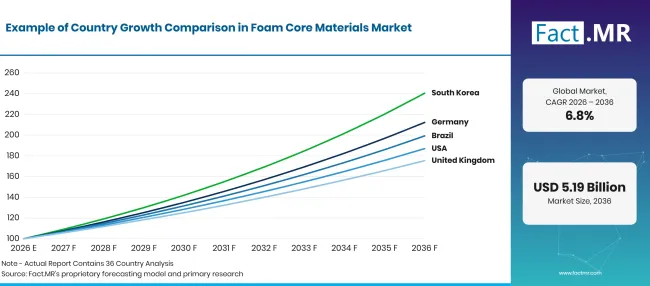
Factmr Foam Core Materials Market Growth Index | Source: Fact.MR
| Country | CAGR (2026 to 2036) |
|---|---|
| Germany | 7.82% |
| Brazil | 7.14% |
| United States | 6.46% |
| United Kingdom | 5.78% |
| Japan | 5.10% |
Source: Fact.MR analysis. Updated Oct 21, 2026
Can Germany turn reinforced foam research into larger structures?
7.82% CAGR. Process development is expanding the range of structures that suppliers can address.
Germany's MoGeSa project, running from April 2025 to March 2028, is developing large fibre-reinforced sandwich panels with integrated foam cores for floating structures. [3] It is a more specific opportunity than the broad expansion of renewable energy: engineers are working on the panel, the joining method and how it could be manufactured at size.
Germany carries a 7.82% forecast CAGR, but these programmes will not become volume orders simply because a demonstrator works. Core producers need to follow structural tests, equipment-builder approval and the economics of producing large modules. Early technical orders can be worthwhile; dedicated industrial capacity should follow evidence of repeat production.
Where does Brazil's wind activity create a practical sales route?
7.14% CAGR. Blade-production relationships matter more than national generation totals.
Brazil had 34,689 MW of centralised wind capacity in 2025, according to its Energy Research Office. [2] The figure establishes the importance of wind equipment, not how many new foam cores factories will purchase. Demand for foam follows blade production, repair work and the particular core designs used by those manufacturers.
At a 7.14% CAGR, Brazil offers a case for regional cutting and conversion close to wind-equipment customers. Importing large sheets is one option, but finished kits can be costly to transport and difficult to change at short notice. A local partner can shorten that response time. The decision to invest should still rest on actual blade orders rather than national generating capacity.
Why does local foam conversion matter in the USA?
6.46% CAGR. Domestic production and conversion support customers with different batch requirements.
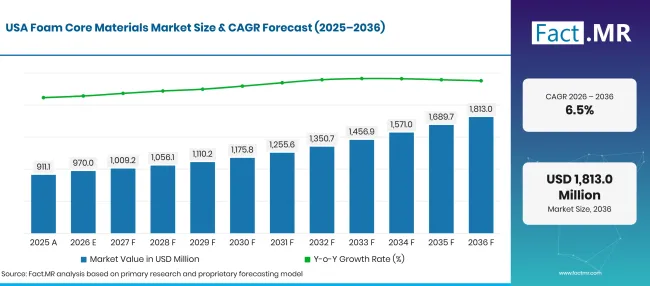
Factmr Foam Core Materials Market Forecast Usa | Source: Fact.MR
3A Composites identifies PET foam manufacturing at Glasgow and core conversion at High Point. [1] The distinction matters in the United States: a customer ordering a shaped kit needs more than domestic polymer production. Drawing changes, cutting accuracy and delivery to the assembly site are separate parts of the purchase.
The U.S. market is forecast to grow 6.46% annually. Large panel programmes may justify dedicated conversion equipment, while smaller aircraft and industrial customers need flexible short runs. Mixing the two without suitable scheduling can raise costs for both. Suppliers that price preparation work transparently are better placed to protect margins.
What can the UK gain from foam preforms in aircraft blades?
5.78% CAGR. Automated processing gives specialist foam geometry a commercial role.
The National Composites Centre reported its HALOS work in January 2025. A thermoformed multi-part foam core was integrated with a braided aircraft blade concept. [10] For a UK supplier, the sale begins with machining and forming to the required shape. A catalogue grade alone will not secure an account built around automated fibre placement.
The UK's 5.78% CAGR reflects technically specialised work rather than an immediate surge in standard sheet consumption. Development volumes may be small and revisions frequent. Tooling ownership, prototype charges and the point at which a programme becomes a production order deserve attention before the supplier commits resources.
How can foam retain a place against Japan's alternative sandwich designs?
5.10% CAGR. Component-level advantages will determine material selection.
Japan's NEDO programme examined lightweight aircraft floor structures made with corrugated thermoplastic sandwich materials. [11] These designs compete directly with some foam-core uses. A Japanese aircraft programme may choose a non-foam construction if it offers a better manufacturing or structural result.
Japan's 5.10% CAGR therefore depends on targeted design wins, not blanket substitution. Foam suppliers have a better chance when complex shapes, local reinforcement or straightforward processing give them a clear advantage. Qualification tends to be lengthy; the reward is the subsequent production programme, not the test order.
Who leads the Foam Core Materials Market?
Competition is moving toward the relationship between core material and prepared kit. Gurit's 2025 report records a long-term agreement for its OptiCore core-kit technology and a multi-year Corecell supply agreement for subsea applications. [5] These company developments illustrate two different routes to defensible revenue. One embeds the vendor in blade production. The other connects a specialist grade with an application that has demanding performance requirements. Neither removes the need to control the cost of conversion and delivery.
Corporate structure matters when comparing capacity. Airex AG is part of 3A Composites and its AIREX foams belong within that group's core-material business. [1] Treating the two names as unrelated competitors would overstate the number of independent supply options. Customers should examine the actual manufacturing site and conversion location behind an offer. A second commercial name may still depend on the same production assets or raw-material stream.
The competitive review also covers adjacent sandwich-core suppliers. Hexcel's HexWeb portfolio is a honeycomb offering and represents an alternative core construction. [6] Its honeycomb revenue is outside the foam-core market boundary. Buyers compare foam vendors against those alternatives when selecting a panel design. Once the architecture is fixed the more immediate contest concerns the approved foam grade and the supplier's ability to reproduce finished-core dimensions at the required delivery rate.
Which companies are the key providers?
- Gurit Holding AG
- 3A Composites / Airex AG
- Diab Group
- Armacell International
- Evonik Industries
- Changzhou Tiansheng New Materials
- Hexcel Corporation
- Plascore Incorporated
- Euro-Composites
Bibliography
- [1] 3A Composites. (n.d.). Core materials.
- [2] Empresa de Pesquisa Energética. (2026). Balanço energético nacional 2026: Análise energética e dados agregados [Brazilian energy balance 2026: Energy analysis and aggregated data].
- [3] Fraunhofer Institute for Wind Energy Systems IWES. (n.d.). MoGeSa: Modular large-scale structures made of joined sandwich pultruded profiles - Design and manufacturing.
- [4] Fraunhofer Institute for Wind Energy Systems IWES. (n.d.). OptiFoam: Potential investigation of fiber-reinforced foams for use in wind energy.
- [5] Gurit Holding AG. (2026). Annual report 2025.
- [6] Hexcel Corporation. (n.d.). HexWeb honeycomb.
- [7] Iqbal, N., Mubashar, A., Ahmad, S., Arif, N., & Ud Din, E. (2025). Improving mechanical properties and ballistic limit of polyurethane foam cores in sandwich panels through multi-walled carbon nanotube reinforcement. Journal of Sandwich Structures & Materials, 27(6), 1220-1239.
- [8] Li, J., Lin, G., & Chen, X. (2025). Optimization of hierarchical groove-perforation structures in PET foam cores for wind turbine blade applications. Materials, 18(12), 2876.
- [9] Mazzuca, P., Firmo, J. P., Correia, J. R., & Rosa, I. C. (2025). Fire behaviour of vacuum-infused glass fibre reinforced polymer sandwich panels: The role of polyurethane and polyethylene terephthalate foam cores and panel architecture. Engineering Structures, 345, 121411.
- [10] National Composites Centre. (2025, January 16). HALOS: Braided composite blades for eVTOL aircraft.
- [11] New Energy and Industrial Technology Development Organization. (n.d.). Development of new innovative composite materials and forming technologies.
- [12] Qiu, Y., Yan, R., Lei, J., Xu, L., Shen, W., & Xu, S. (2025). Fatigue performance prediction methodology for marine foam core sandwich composite structures based on progressive damage theory. Ocean Engineering, 340, 122147.
- [13] U.S. Department of Energy. (2025, January 6). America can recycle 90% of wind turbine mass, according to new DOE report.
This Report Answers
- Which costs determine whether a cheaper core produces a cheaper panel?
- Where can reinforced foam replace balsa in wind structures?
- How do prepared core kits change a supplier's position?
- Why does fire performance need to be assessed at panel level?
- How do aircraft and marine requirements alter grade selection?
- Which country opportunities depend on research qualification or actual production orders?
What does the Foam Core Materials Market cover?
The report covers the global foam core materials market through 2036 with five country forecasts. Chemistry and application are assessed separately from the principal industry of the purchasing customer. Competitive coverage includes direct foam suppliers and the adjacent core systems that customers consider during structural design. Adjacent products are excluded from market revenue.
What is included in the scope?
Included products comprise polyurethane and polystyrene foam cores alongside PVC and other specialist foam chemistries. Sheets and blocks are covered when intended for sandwich-core applications. Prepared core shapes and integrated kit conversion are included in the supplied core's value. Wind and marine applications sit alongside transport and construction uses within the stated segmentation.
What is excluded from the scope?
The market excludes balsa and honeycomb cores. It also excludes finished aircraft parts and wind blades. General cushioning and insulation products are outside scope unless supplied specifically as the core of a sandwich structure. Separate engineering fees and complete panel-system revenues are excluded to keep the assessment at the foam-core product level.
How Was the Analysis Built?
The analysis draws on 120+ sources, 35+ company portfolios, 25+ countries, and more than 20 industry interviews.
- Primary Research: Primary research includes discussions with manufacturers, service providers, technology developers, distributors, end users, and subject-matter experts. These conversations examine purchasing priorities, product adoption, operational challenges, approval requirements, competitive positioning, and the factors that influence wider market acceptance.
- Desk Research: Desk research covers government statistics, regulatory publications, company filings, trade data, technical studies, industry associations, standards, public policy, and other authoritative sources. Every source used in the analysis is documented in the bibliography.
- Market Sizing and Forecasting: Market estimates combine historical performance, demand indicators, pricing and volume trends, segment shares, company participation, country-level growth, adoption patterns, investment activity, and barriers to market expansion.
- Data Validation and Update Cycle: Findings are validated by comparing primary interviews with public data, company activity, regulatory changes, trade patterns, and industry developments. Regular updates review new product launches, capacity changes, partnerships, approvals, and shifts in commercial adoption.
Segmentation
What is the report’s scope and coverage?
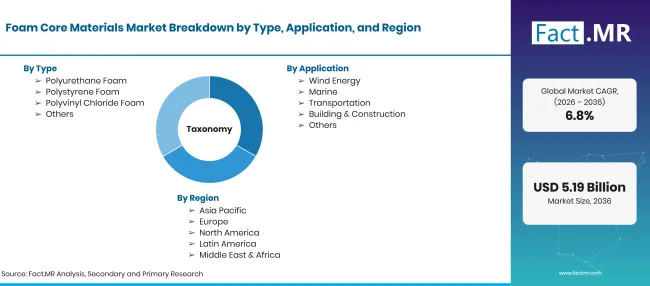
Factmr Foam Core Materials Market Taxonomy | Source: Fact.MR
| Attribute | Details |
|---|---|
| Quantitative Units | USD billion in 2025, 2026 and 2036; CAGR for 2026 to 2036 |
| Market Definition | Foam core materials are cellular polymer materials supplied as sheets, blocks or prepared shapes for use within sandwich structures. Revenue covers the core product and its integrated conversion into a supplied core kit. Honeycomb and balsa revenues are excluded even when sold by the same supplier. |
| Type | Polyurethane Foam; Polystyrene Foam; Polyvinyl Chloride Foam; Others |
| Application | Wind Energy; Marine; Transportation; Building & Construction; Others |
| End-User | Aerospace; Automotive; Construction; Marine; Wind Energy; Others |
| Regions Covered | North America; Latin America; Western Europe; Eastern Europe; East Asia; South Asia & Pacific; Middle East & Africa |
| Countries Covered | Germany; Brazil; United States; United Kingdom; Japan |
| Companies Profiled | Gurit Holding AG; 3A Composites / Airex AG; Diab Group; Armacell International; Evonik Industries; Changzhou Tiansheng New Materials; Hexcel Corporation; Plascore Incorporated; Euro-Composites |
| Forecast Period | 2026 to 2036 |
| Approach | Assessment of foam chemistry and prepared-core supply across panel applications. Commercial comparisons consider resin compatibility and structural qualification alongside customer production schedules and regional conversion capacity. |
Source: Fact.MR analysis. Updated Oct 21, 2026
How is the market segmented?
-
By Type
- Polyurethane Foam
- Polystyrene Foam
- Polyvinyl Chloride Foam
- Others
-
By Application
- Wind Energy
- Marine
- Transportation
- Building & Construction
- Others
-
By End-User
- Aerospace
- Automotive
- Construction
- Marine
- Wind Energy
- Others
-
By Region
- North America
- Latin America
- Western Europe
- Eastern Europe
- East Asia
- South Asia & Pacific
- Middle East & Africa
Frequently Asked Questions
How large is the Foam Core Materials Market in 2026?
What is the forecast for 2036?
Which material type leads the market?
Which application and end-user segments lead?
What determines a supplier's commercial advantage?
Who worked on this report


Preview the report firsthand - request a free sample
Free SampleGet the brochure for pricing and purchase details
Download PDF