- Base Value(2026): 0.9 Bn
- Estimated Value(2026): 0.9 Bn
- Forecast Value (2036): 1.4 Bn
- CAGR (2026 - 2036): 4.3%
Foam Mixing Machine Market Forecast and Outlook 2026 to 2036
Valuation of the global foam mixing machine market is projected to increase from approximately USD 0.89 billion in 2026 to around USD 1.37 billion by 2036, reflecting a compound annual growth rate (CAGR) of about 4.3% during the forecast period. Market expansion is supported by rising demand for polyurethane-based foams across furniture, bedding, automotive interiors, insulation, packaging, and industrial applications, alongside increasing automation in foam production lines.
Key Takeaways from the Foam Mixing Machine Market
- Foam Mixing Machine Market Value (2026): USD 0.89 billion
- Foam Mixing Machine Market Forecast Value (2036): USD 1.37 billion
- Foam Mixing Machine Market Forecast CAGR 2026 to 2036: 4.3%
- Leading Foam Chemistry: PU - Flexible Foam (32%)
- Key Players: Hennecke GmbH; KraussMaffei Technologies GmbH; Cannon S.p.A. (Cannon Group); Graco Inc.; SAIP Equipment S.p.A.; Polytec EMC Engineering GmbH; BASF Polyurethane Systems GmbH (Machinery Division); Linden Industries, LLC; Höfer Presstechnik GmbH; Larius S.r.l.
- Key Growth Regions: Europe, Asia Pacific, North America
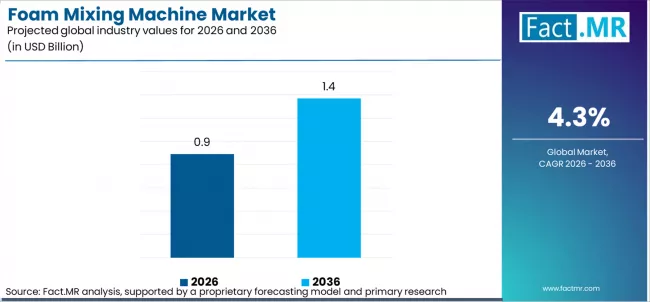
Foam Mixing Machine Market Industry Value Analysis | Source: Fact.MR
Foam mixing machines enable precise metering, mixing, and dispensing of reactive foam chemicals, ensuring consistent cell structure, density, and mechanical performance. These systems are essential for producing high-quality flexible, rigid, and specialty foams while minimizing material waste and improving process control. Advancements in digital dosing, closed-loop control systems, and energy-efficient mixing technologies continue to strengthen adoption across both large-scale and specialty foam manufacturers.
Foam Mixing Machine Market
| Metric | Value |
|---|---|
| Estimated Value in (2026E) | USD 0.89 billion |
| Forecast Value in (2036F) | USD 1.37 billion |
| Forecast CAGR 2026 to 2036 | 4.3% |
Source: Fact.MR analysis. Updated Jan 28, 2026
Category
| Category | Segments |
|---|---|
| Foam Chemistry | PU - Flexible, PU - Rigid, Silicone/Epoxy, Phenolic & Others |
| Metering/Mix | Metering/Mix-High-Pressure Meter Mix, Low-Pressure Mix, Static Mixers, Vacuum-Assisted |
| Application | Automotive Seating/Trim, Appliances/Insulation, Construction Panels, Packaging/Gasketing/Other |
| Automation Level | Batch/Manual Assist, Semi-Automatic, Fully Automatic |
| Region | North America; Europe; Asia Pacific; Latin America; Middle East & Africa |
Source: Fact.MR analysis. Updated Jan 28, 2026
Segmental Analysis
By Foam Chemistry, Which Segment Holds the Dominant Share in the Foam Mixing Machine Market?
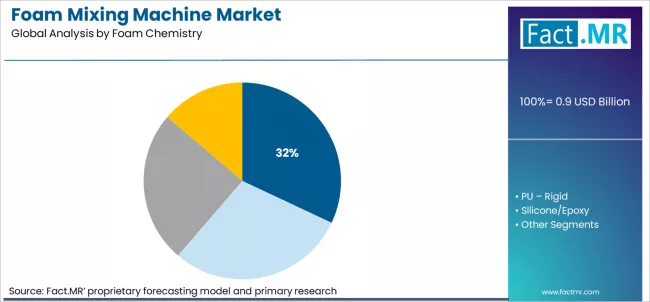
Foam Mixing Machine Market Analysis By Foam Chemistry | Source: Fact.MR
In terms of foam chemistry, PU - flexible foam systems lead the foam mixing machine market, accounting for the 32% share in 2026. Manufacturers across furniture, bedding, and automotive seating increasingly rely on flexible polyurethane foams due to their comfort characteristics, durability, and formulation versatility. Foam mixing machines designed for PU-flexible applications enable precise metering and homogeneous mixing, which are critical for achieving consistent density and cell structure.
- Investments in high-pressure mixing technology and formulation control systems continue to strengthen adoption among large-scale foam producers.
- As manufacturers prioritize product consistency, material efficiency, and high-throughput production, PU-flexible foam processing remains the core driver of equipment demand.
By Metering/Mix Type, Which Segment Registers the Highest Share in the Foam Mixing Machine Market?
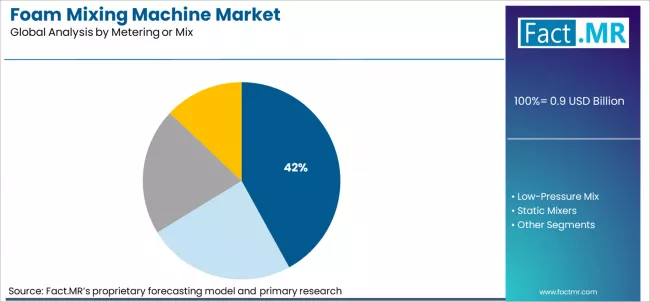
Foam Mixing Machine Market Analysis By Metering Or Mix | Source: Fact.MR
By metering and mixing type, high-pressure meter mix systems dominate the market, reflecting 42% market share. Industrial processing studies highlight high-pressure systems for their superior mixing quality, reduced material waste, and ability to handle fast-reacting polyurethane formulations.
- Producers are increasingly upgrading to high-pressure systems to improve process stability and support automated production environments.
- As foam formulations become more performance-driven and production efficiency gains importance, high-pressure metering and mixing solutions are expected to remain the preferred choice.
What are the Drivers, Restraints, and Key Trends of the Foam Mixing Machine Market?
- Drivers: Rising demand for polyurethane foams across furniture, automotive interiors, insulation, and construction materials is driving adoption of advanced foam mixing machines that offer precise dosing, repeatable quality, and high production efficiency.
- Restraint: High capital investment requirements and technical complexity associated with installing and maintaining advanced foam mixing systems can limit adoption among small and mid-sized foam manufacturers.
- Trend 1: Increasing shift toward fully automated and digitally controlled foam mixing machines to enhance formulation accuracy, reduce operator dependency, and improve production traceability.
- Trend 2: Development of energy-efficient mixing technologies and modular system designs that support flexible foam chemistries and scalable production requirements across diverse applications.
Analysis of the Foam Mixing Machine Market by Key Country
| Country | CAGR 2026 to 2036 |
|---|---|
| China | 5.5% |
| Brazil | 5.1% |
| U.S. | 7.9% |
| UK | 4.0% |
| UK | 4.0% |
| Germany | 3.9% |
| South Korea | 3.5% |
| Japan | 2.8% |
Source: Fact.MR analysis. Updated Jan 28, 2026
How Is Rapid Industrial Expansion Influencing Foam Mixing Machine Demand in China?
Foam mixing machine demand in China is projected to expand at a CAGR of 5.5% during 2026 to 2036, driven by rapid industrialization and large-scale growth in polyurethane foam production. Furniture, bedding, automotive interiors, and building insulation sectors are expanding capacity to meet both domestic and export demand. Manufacturing research highlights strong investment in automated, high-pressure mixing systems to support high-volume, consistent foam output. China’s well-developed machinery manufacturing ecosystem and continuous production line upgrades further accelerate adoption across industrial foam processing facilities.
What Is Driving Strong Growth in the Brazilian Foam Mixing Machine Market?
The Brazilian foam mixing machine market is expected to grow at a CAGR of 5.1%, supported by expanding furniture manufacturing, rising construction activity, and growing appliance insulation demand. Industry modernization initiatives are encouraging producers to replace manual and low-efficiency systems with automated foam mixing technologies. Residential housing growth and export-oriented furniture production continue to increase foam consumption. Additionally, demand for cost-efficient and durable mixing systems suited to regional manufacturing conditions supports steady investment in new equipment.
Why Is the United States Experiencing Steady Growth in Foam Mixing Machine Adoption?
The U.S. foam mixing machine market is projected to expand at a CAGR of 4.0%, driven by furniture, bedding, automotive interiors, and appliance insulation manufacturing. Producers increasingly prioritize automation, consistency, and traceability to meet quality and regulatory requirements. Replacement of aging equipment with high-precision metering and digitally controlled systems is a key growth driver. Ongoing investments in domestic manufacturing capacity and efficiency improvement initiatives support steady, technology-led market expansion.
What Factors Support Foam Mixing Machine Demand in the U.K.?
Foam mixing machine sales in the U.K. are expected to grow at a CAGR of 4.0%, supported by construction insulation demand, specialty foam applications, and furniture manufacturing. Manufacturers are increasingly adopting compact, automated foam mixing systems suitable for small- and medium-scale production environments. Growth in renovation activity and energy-efficient building materials supports foam usage. Additionally, emphasis on compliance with environmental and safety standards is driving gradual modernization of foam processing facilities.
How Is Germany Maintaining a Stable Foam Mixing Machine Market?
The German foam mixing machine market is projected to grow at a CAGR of 3.9%, reflecting strong engineering standards and consistent demand from automotive, insulation, and industrial foam producers. German manufacturers prioritize precision metering, equipment reliability, and seamless integration with automated production lines. Growth is driven more by technological upgrades and efficiency improvements than by new capacity additions. Continuous focus on quality assurance, sustainability, and process optimization sustains steady market performance.
What Is Driving Moderate Growth in South Korea’s Foam Mixing Machine Market?
Foam mixing machine demand in South Korea is forecast to grow at a CAGR of 3.5%, driven by automotive interiors, electronics protection foams, and bedding manufacturing. Export-oriented production and strong emphasis on manufacturing automation support adoption of high-quality foam mixing systems. However, market maturity and limited large-scale capacity expansion keep growth moderate. Investments primarily focus on upgrading existing lines to improve consistency, reduce waste, and meet global customer quality standards.
Why Is Growth Measured in the Japanese Foam Mixing Machine Market?
The Japanese foam mixing machine market is expected to expand at a CAGR of 2.8%, reflecting a highly mature manufacturing environment. Demand is largely driven by equipment replacement, precision foam applications, and stringent quality requirements rather than new capacity expansion. Japanese manufacturers emphasize long equipment life, reliability, and process stability. Growth remains measured as production volumes are stable, but continued investment in high-accuracy and automation-ready systems supports incremental market development.
Competitive Landscape of the Foam Mixing Machine Market
The foam mixing machine market is shaped by intense competition among global polyurethane processing equipment manufacturers, precision dosing technology specialists, and integrated automation solution providers serving furniture, automotive, construction, insulation, and industrial foam producers. Competitive positioning is increasingly defined by technical performance rather than pricing, with manufacturers focusing on metering accuracy, mixing homogeneity, repeatability, and process stability. High-pressure mixing capability, precise ratio control, and reliable handling of fast-reacting formulations are key differentiators in both flexible and rigid foam applications.
Leading suppliers continue to invest in advanced digital control systems, PLC- and SCADA-based automation, and real-time monitoring solutions to improve production consistency and reduce material waste. Customization plays a critical role, as foam producers require equipment tailored to specific chemistries, throughput levels, and application requirements. Energy efficiency and sustainability considerations are also gaining importance, prompting development of optimized pump designs and low-loss mixing technologies. Beyond equipment performance, strong after-sales service, preventive maintenance programs, and process optimization support are essential competitive factors.
Key Players in the Foam Mixing Machine Market
- Hennecke GmbH
- KraussMaffei Technologies GmbH
- Cannon S.p.A. (Cannon Group)
- Graco Inc.
- SAIP Equipment S.p.A.
- Polytec EMC Engineering GmbH
- BASF Polyurethane Systems GmbH (Machinery Division)
- Linden Industries, LLC
- Höfer Presstechnik GmbH
- Larius S.r.l.
Foam Mixing Machine Market by Segment
-
Foam Chemistry :
- PU - Flexible
- PU - Rigid
- Silicone / Epoxy
- Phenolic & Others
-
Metering / Mixing Technology :
- High-Pressure Meter Mix
- Low-Pressure Mix
- Static Mixers
- Vacuum-Assisted Mixing
-
Application :
- Automotive Seating/Trim
- Appliances/Insulation
- Construction Panels
- Packaging/Gasketing/Other
-
Automation Level :
- Batch/Manual Assist
- Semi‑Automatic
- Fully Automatic
-
Region :
- Asia Pacific
- Japan
- South Korea
- China
- Australia
- New Zealand
- Rest of Asia Pacific
- North America
- United States
- Canada
- Mexico
- Europe
- France
- Italy
- Spain
- Norway
- UK
- Rest of Europe
- Latin America
- Chile
- Peru
- Argentina
- Rest of Latin America
- Asia Pacific
Bibliography
- International Organization for Standardization. (2023). Plastics and rubber processing machinery: Requirements for polyurethane mixing, metering accuracy, and process control in foam production systems (ISO Technical Report). ISO.
- European Committee for Standardization. (2022). Machinery for polymer processing: Evaluation of foam mixing equipment performance, safety, and energy efficiency in industrial applications (EN Technical Report). CEN.
- Society of Plastics Engineers. (2024). Advances in polyurethane foam processing, high-pressure mixing systems, and automation technologies. Society of Plastics Engineers.
- Journal of Cellular Plastics Editorial Board. (2024). Mixing technology, process optimization, and quality control in flexible and rigid polyurethane foam manufacturing. Journal of Cellular Plastics, 60(3), 289-307.
- Global Polyurethane Industry Council. (2023). Developments in foam mixing, metering systems, and sustainable polyurethane processing technologies. GPUIC.
Segmentation
Scope of Report
| Items | Values |
|---|---|
| Quantitative Units (2026) | USD 0.89 Billion |
| Foam Chemistry | PU - Flexible, PU - Rigid, Silicone/Epoxy, Phenolic & Others |
| Metering/Mix | Metering/Mix-High-Pressure Meter Mix, Low-Pressure Mix, Static Mixers, Vacuum-Assisted |
| Application | Automotive Seating/Trim, Appliances/Insulation, Construction Panels, Packaging/Gasketing/Other |
| Automation Level | Batch/Manual Assist, Semi-Automatic, Fully Automatic |
| Regions Covered | North America, Europe, Asia Pacific, Latin America, Middle East & Africa |
| Countries Covered | U.S., Canada, Germany, Italy, UK, France, Japan, Australia, and other countries |
| Key Companies Profiled | TechnipFMC plc; MODEC, Inc.; SBM Offshore N.V.; Aker Solutions ASA; Saipem S.p.A.; McDermott International, Ltd.; Hyundai Heavy Industries Co., Ltd.; Samsung Heavy Industries Co., Ltd.; Hanwha Ocean Co., Ltd. (formerly DSME); Kiewit Offshore Services, Ltd. |
| Additional Attributes | Dollar revenue by foam chemistry, mixing technology, application, automation level, end user, distribution channel, and region; regional demand trends driven by furniture manufacturing expansion, automotive interior production, construction insulation activity, and appliance manufacturing; competitive landscape characterized by global polyurethane processing equipment manufacturers and automation solution providers. |
Source: Fact.MR analysis. Updated Jan 28, 2026
Frequently Asked Questions
How big is the foam mixing machine market in 2026?
What will be the size of foam mixing machine market in 2036?
How much will be the foam mixing machine market growth between 2026 and 2036?
What are the key product types in the foam mixing machine market?
Which metering or mix segment to contribute significant share in the foam mixing machine market in 2026?
Who worked on this report


Preview the report firsthand - request a free sample
Free SampleGet the brochure for pricing and purchase details
Download PDF