- Market Value (2025): USD 506.0 Mn
- Estimated Value (2026): USD 556.4 Mn
- Forecast Value (2036): USD 1437.9 Mn
- CAGR (2026-2036): 10.0%
Foam-Reducing Batter Systems Market Forecast and Outlook 2026 to 2036
Valued at USD 506.0 million in 2025, the global foam-reducing batter systems market reached USD 556.4 million in 2026. The market outlook places its 2036 value at USD 1,437.9 million, with growth running at a 10.0% CAGR from 2026 to 2036.
Controlled shear holds the largest position in the batter defoaming approach segment with a 24.7% share in 2026, while granulate and agglomerate formats account for 33.7% of commercial ingredient demand. Dairy and alternatives contributes 26.8% of application revenue, with nutrition and label considerations influencing 32.3% of purchasing decisions. Food processors are focusing on foam control because excess air can affect batter texture, coating uniformity and production consistency across dairy, bakery, meat and confectionery applications.
Key Takeaways from the Foam-Reducing Batter Systems Market
- Foam-Reducing Batter Systems Market Value (2025): USD 506.0 million
- Foam-Reducing Batter Systems Market Value (2026): USD 556.4 million
- Foam-Reducing Batter Systems Market Forecast Value (2036): USD 1,437.9 million
- Foam-Reducing Batter Systems Market Forecast CAGR (2026–2036): 10.0%
- Leading Batter Defoaming Approach: Controlled Shear (24.7%)
- Leading Commercial Ingredient Form: Granulate / Agglomerate (33.7%)
- Leading Food Application: Dairy / Alternatives (26.8%)
- Leading Functional Purchasing Driver: Nutrition / Label (32.3%)
- Key Market Participants: GEA, JBT Marel, Heat and Control, Gpi Process Equipment, FMT Food Processing Equipment, Nothum Food Processing Systems and Rosenqvists Food Technologies
- Key Growth Regions: Germany, United States, China, Italy and Netherlands
Dairy and alternative food processing accounts for 26.8% of the market in 2026, driven by the need to maintain consistent batter quality across liquid and coating applications. Controlled shear holds a 24.7% share, while granulate and agglomerate formats account for 33.7%. In October 2026, GEA introduced its ProCoater wet-coating machine with a guided batter return-flow system designed to cut air entrainment and foam formation by up to 80%, addressing a key challenge in coating consistency.
Foam-Reducing Batter Systems Market
| Metric | Value |
|---|---|
| Estimated Value in (2025) | USD 506.0 million |
| Estimated Value in (2026) | USD 556.4 million |
| Forecast Value in (2036) | USD 1,437.9 million |
| Forecast CAGR (2026 to 2036) | 10.0% |
Source: Fact.MR analysis. Updated Nov 17, 2026
Source: Fact.MR analysis. Updated 14 Nov 2026
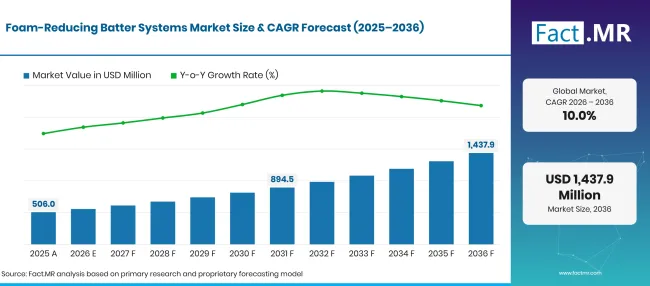
Foam Reducing Batter Systems Forecast Global | Source: Fact.MR
Category
| Category | Segments |
|---|---|
| Batter Defoaming Approach | Controlled Shear, Food-Grade Antifoam, Vacuum Mixing, Mechanical Deaeration, Inline Bubble Separation |
| Commercial Ingredient Form | Granulate / Agglomerate, Liquid Concentrate, Powder, Encapsulated Bead, Ready-to-Use Premix |
| Food Application | Dairy / Alternatives, Bakery, Beverage, Meat / Savory, Confectionery / Snacks |
| Functional Purchasing Driver | Nutrition / Label, Process Stability, Texture / Mouthfeel, Flavor / Color, Shelf-Life |
| Region | Germany, United States, China, Italy, Netherlands |
Source: Fact.MR analysis. Updated Nov 17, 2026
Source: Fact.MR analysis. Updated 14 Nov 2026
Segmental Analysis
Why does controlled shear lead the batter defoaming approach in the Foam-Reducing Batter Systems Market?
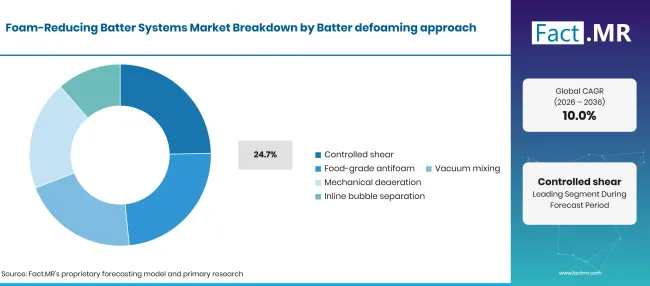
Foam Reducing Batter Systems Breakdown Batter Defoaming Approach | Source: Fact.MR
Controlled shear holds a 24.7% share in 2026 because it limits air incorporation during mixing while maintaining batter consistency. Inline bubble separation follows closely at 24.1%, while food-grade antifoams account for 18.1%, serving processors that prefer chemical foam control. In December 2025, Alsiano highlighted precision-dosing systems for Struktol food-grade antifoams and defoamers to improve foam management and reduce processing interruptions. These alternatives address different production needs, from controlling foam during mixing to removing bubbles after processing.
Why do granulate and agglomerate formats lead commercial ingredient form in the Foam-Reducing Batter Systems Market?
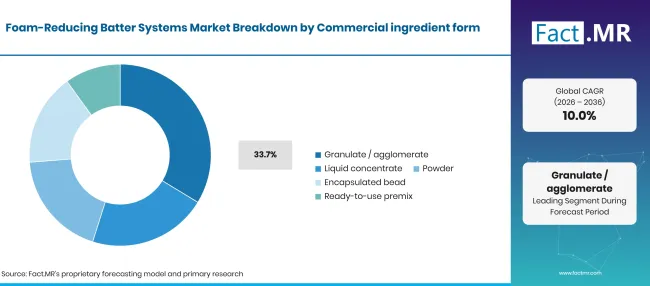
Foam Reducing Batter Systems Breakdown Commercial Ingredient Form | Source: Fact.MR
In July 2026, Galactic introduced Galimax Flavor V-100 Pearls, a low-dust granulated vinegar format designed for easier handling and accurate dosing. Granulate and agglomerate formats hold the largest position at 33.7% because their free-flowing structure simplifies ingredient handling and incorporation. Liquid concentrates follow at 26.0%, offering direct dosing, while ready-to-use premixes account for 17.5% by reducing preparation steps. Powder formats hold 11.9%, and encapsulated beads 10.9%, serving applications that need fine dispersion or controlled release.
Why does dairy and alternatives lead food application in the Foam-Reducing Batter Systems Market?
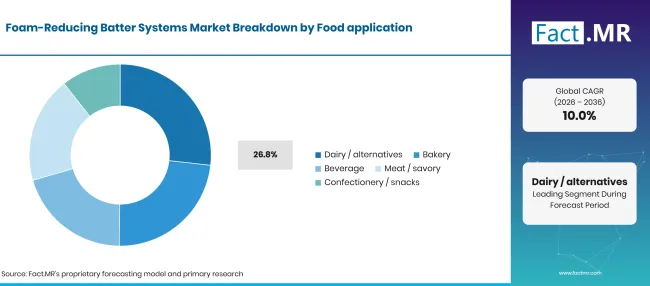
Foam Reducing Batter Systems Breakdown Food Application | Source: Fact.MR
In June 2025, Novonesis launched Vertera Velvet to improve foam quality, texture and stability in oat, soy and pea-based drinks. Dairy and alternatives hold the leading application position at 26.8% in 2026 because manufacturers need reliable foam control and consistent texture across dairy and plant-based formulations.
Meat and savoury applications follow at 22.1%, driven by uniform batter circulation and coating coverage, while confectionery and snacks account for 24.6%, with surface finish influencing product quality. Bakery holds 14.3% and beverage 12.2%, where batter handling and foam control during liquid processing shape ingredient choices.
Why does nutrition and label lead functional purchasing drivers in the Foam-Reducing Batter Systems Market?
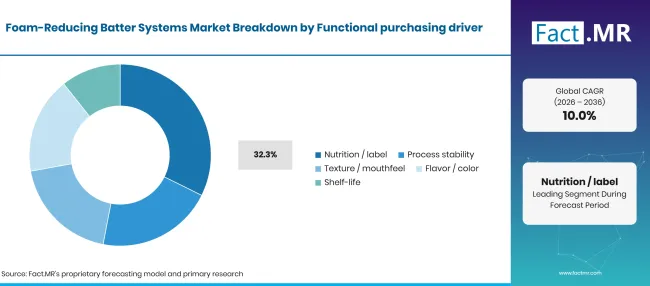
Foam Reducing Batter Systems Breakdown Functional Purchasing Driver | Source: Fact.MR
In August 2025, FSSAI’s updated processing-aid provisions specified permitted antifoaming agents and applicable residue limits across food categories, reinforcing the importance of regulatory and label checks.
Nutrition and label considerations lead purchasing drivers at 32.3% in 2026 because manufacturers assess ingredient declarations and product-positioning requirements before selecting foam-control solutions. Shelf-life considerations follow at 24.5%, while texture and mouthfeel account for 17.4%. Flavor and color represent 15.6%, compared with process stability at 10.2%, as each addresses a distinct product-quality concern.
Foam-Reducing Batter Systems Market-Drivers, Restraints & Trends
Drivers: Increasing Need for Consistent Batter Quality in Food Processing
Food manufacturers are investing in foam-reducing batter systems because excess air can create uneven coatings, surface defects and inconsistent product texture, leading to material waste and production delays. In October 2026, GEA introduced its ProCoater wet-coating machine, whose guided return-flow system reduces air entrainment and foam formation by up to 80%. This development highlights the value of better batter-flow control as processors expand coated convenience foods and plant-based product lines.
Restraints: Formulation Compatibility and Equipment Integration Costs
Foam-reducing batter systems can become expensive when food manufacturers need specialised mixing equipment, vacuum arrangements, inline separation units or food-grade antifoam formulations. Buyers must evaluate ingredient compatibility, processing temperatures, viscosity and product-contact requirements before selecting a suitable solution. Smaller food processors may find the cost of specialised equipment, process validation and maintenance difficult to accommodate within limited investment budgets. These factors can slow adoption where conventional mixing and production arrangements continue to meet basic processing requirements.
- Trend: Rising Preference for Integrated Foam Management Across Food Processing Operations: Food processors are moving towards coordinated foam-control practices because unwanted air and foam can affect mixing efficiency, batter circulation and coating consistency at different stages of production. In October 2026, GEA introduced its ProCoater wet-coating system with guided batter return flow, adjustable scrapers and air knives to improve batter handling during coating operations. Such equipment developments point to a wider industry focus on managing foam-related processing issues through better production-line design. This creates an opportunity for antifoam manufacturers to address application-specific requirements across food processing categories.
- Trend: Greater Importance of Regulatory Compliance and Application-Specific Foam Control: Food manufacturers are placing greater emphasis on regulatory compliance and processing suitability because antifoam selection depends on permitted use, food category and operating conditions. In September 2025, TER Ingredients became Momentive's distribution partner for its food and beverage foam-control portfolio across 14 European countries, widening regional access to specialised foam-management solutions. This commercial expansion highlights the importance of distribution networks and regulatory documentation in supplier selection. Going forward, opportunities exist for manufacturers to expand their market presence through regional partnerships, application testing and compliance-led customer relationships
Foam-Reducing Batter Systems Market by Analysis by Key Country
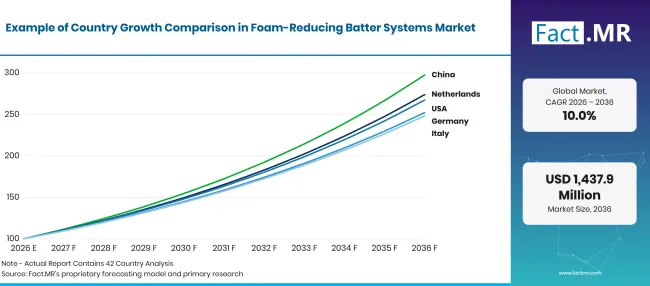
Foam Reducing Batter Systems Growth Index | Source: Fact.MR
| Country | CAGR (2026–2036) |
|---|---|
| Germany | 9.7% |
| United States | 10.3% |
| China | 11.5% |
| Italy | 9.5% |
| Netherlands | 10.6% |
Source: Fact.MR analysis. Updated Nov 17, 2026
Source: Fact.MR analysis. Updated 14 Nov 2026
What is driving foam-reducing batter systems market growth in Germany?
Germany's strong food-processing machinery base creates opportunities for foam-reducing batter systems, particularly where manufacturers prioritise consistent mixing and coating quality.
The market will expand at a CAGR of 9.7% during 2026–2036. In May 2026, VDMA reported that German food-processing and packaging machinery production increased 4.9% in 2025, reaching nearly EUR 17 billion. This investment activity is creating sales opportunities for integrated foam-control solutions as food manufacturers upgrade processing lines and improve production consistency.
What is supporting foam-reducing batter systems market growth in the United States?
Expansion of prepared-food and dairy manufacturing is strengthening the commercial scope for foam-reducing batter systems in the United States.
The market will register a CAGR of 10.3% through 2036. In March 2026, Dainty Foods announced an investment of up to USD 150 million in its first US manufacturing facility for rice and ready-to-heat meal products. Such capacity additions are creating opportunities for foam-control solutions across mixing, ingredient handling and coating operations. Sales are being driven by food manufacturers seeking consistent processing performance across high-volume production lines.
What is driving foam-reducing batter systems market growth in China?
China's extensive food-processing network provides a strong foundation for foam-reducing batter system adoption.
The market is set to advance at a CAGR of 11.5% between 2026 and 2036. According to the USDA Foreign Agricultural Service's April 2026 report, China had more than 100,000 registered food-processing companies, while its food-service sector reached USD 812 billion in 2025. This manufacturing scale creates sales opportunities for foam-control systems used in ingredient preparation, batter mixing and processed-food production.
What is supporting foam-reducing batter systems market growth in Italy?
Italy's food manufacturing industry is creating opportunities for foam-reducing batter systems across bakery, dairy, confectionery and prepared-food applications.
The market will grow at a CAGR of 9.5% over 2026–2036. The University of Gastronomic Sciences and Ceresio Investors reported in June 2026 that Italian food-sector revenues increased 3.3% in 2025. This expansion is encouraging processors to improve formulation consistency and production efficiency. Sales opportunities are particularly relevant where continuous mixing and coating operations need better control over foam formation.
What is sustaining foam-reducing batter systems market growth in Netherlands?
Investment in large-scale dairy processing is strengthening the market opportunity for foam-reducing batter systems in the Netherlands.
The country will record a CAGR of 10.6% during 2026–2036. In June 2026, St. Paul announced a EUR 75 million processed-cheese facility in St. Jansteen, designed for annual production exceeding 100 million kilograms. Such industrial expansion creates opportunities for foam-control solutions across liquid ingredient handling and food preparation. Sales are being driven by processors seeking stable production conditions, reduced processing losses and consistent finished-product quality.
Competitive Landscape for Foam-Reducing Batter Systems Market
The foam-reducing batter systems market is shaped by manufacturers' ability to address foam formation, maintain batter consistency and accommodate different food-processing conditions. GEA, JBT Marel, Heat and Control, Gpi Process Equipment, FMT Food Processing Equipment, Nothum Food Processing Systems and Rosenqvists Food Technologies serve different requirements across batter preparation, mixing and coating.
GEA's ProCoater uses a guided batter return-flow arrangement to limit air entrainment, while JBT Marel's Stein ProMix automatic batter mixer allows operators to adjust mixing ratios and manage batter viscosity. These capabilities influence purchasing decisions among food processors seeking uniform coating, controlled batter circulation and fewer production interruptions. Equipment flexibility, process integration and suitability for specific food applications also shape manufacturers' market positioning.
Recent Developments
- On October 21, 2026, GEA introduced its ProCoater wet-coating machine with a guided batter return-flow system designed to reduce air entrainment and foam formation by up to 80%.
- On May 11, 2026, JBT Marel entered an exclusive partnership with Aurum Process Technology to expand its aseptic processing and flexible-packaging solutions for ready meals and premium pet food.
- Heat and Control disclosed its purchase of Fabcon Food Systems on June 4, 2025, adding customised food-processing and product-handling equipment to its portfolio.
- On June 22, 2026, Gpi Process Equipment adopted the new name Gpi Process Technology as part of its transition from a machinery manufacturer towards a specialist in international food-processing solutions.
- On August 20, 2026, Nothum Food Processing Systems announced its collaboration with Provisur Technologies to develop integrated chicken nugget production lines covering grinding, forming, battering, breading and frying.
Key Players in Foam-Reducing Batter Systems Market
Key companies profiled include GEA; JBT Marel; Heat and Control; Gpi Process Equipment; FMT Food Processing Equipment; Nothum Food Processing Systems; and Rosenqvists Food Technologies.
- GEA
- JBT Marel
- Heat and Control
- Gpi Process Equipment
- FMT Food Processing Equipment
- Nothum Food Processing Systems
- Rosenqvists Food Technologies
Bibliography
- Alsiano. (2025, December 9). Antifoams and defoamers for food and non-food industries.
- Ceresio Investors. (2026, June 19). Food Industry Monitor 2026.
- Federal Reserve Bank of St. Louis. (2026). Sectoral output for manufacturing: Food manufacturing (NAICS 311) in the United States. FRED.
- Food and Agriculture Organization of the United Nations. (2025). Food processing and food manufacturing.
- Food Safety and Standards Authority of India. (2025). Appendix C: Processing aids categories and use of processing aids in food products (Version 2, August 1, 2025).
- GEA Group. (2026). GEA ProCoater: Wet coating machine for consistent results.
- JBT Marel. (n.d.). Stein ProMix™ automatic batter mixer and viscosity control.
- National Bureau of Statistics of China. (2026). Statistical communiqué of the People's Republic of China on the 2025 national economic and social development.
- Novonesis. (2025, May 21). Novonesis introduces Vertera® Velvet to bring better foam, texture and stability to plant-based drinks.
- St. Paul. (2026, June 30). St. Paul invests €75 million in state-of-the-art processed cheese factory.
- TER Group. (2025, July 14). TER Group and Momentive expand partnership to include food & beverage foam control solutions across 14 European countries.
- U.S. Department of Agriculture, Foreign Agricultural Service. (2026a, March 30). Food processing ingredients annual: Germany (Report No. GM2026-0007).
- U.S. Department of Agriculture, Foreign Agricultural Service. (2026b, April 1). Food processing ingredients annual: China (Report No. CH2026-0042).
- VDMA. (2026, May 8). Food processing and packaging machinery review 2025: Industry in good shape.
Segmentation
Scope of Report
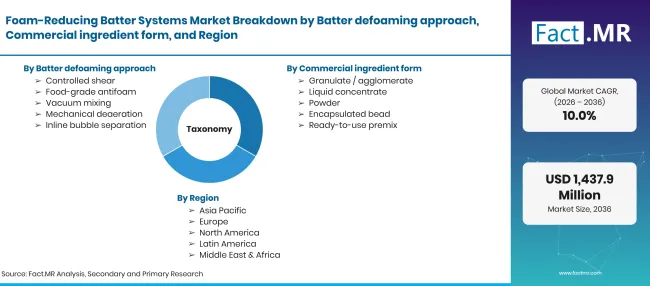
Foam Reducing Batter Systems Taxonomy | Source: Fact.MR
| Items | Values |
|---|---|
| Quantitative Units (2026) | USD 556.4 Million |
| Batter Defoaming Approach | Controlled Shear, Food-Grade Antifoam, Vacuum Mixing, Mechanical Deaeration, Inline Bubble Separation |
| Commercial Ingredient Form | Granulate / Agglomerate, Liquid Concentrate, Powder, Encapsulated Bead, Ready-to-Use Premix |
| Food Application | Dairy / Alternatives, Bakery, Beverage, Meat / Savory, Confectionery / Snacks |
| Functional Purchasing Driver | Nutrition / Label, Process Stability, Texture / Mouthfeel, Flavor / Color, Shelf-Life |
| Regions Covered | North America, Latin America, Europe, Asia Pacific, Middle East & Africa |
| Countries Covered | Germany, United States, China, Italy, Netherlands, and other countries |
| Key Companies Profiled | GEA, JBT Marel, Heat and Control, Gpi Process Equipment, FMT Food Processing Equipment, Nothum Food Processing Systems, Rosenqvists Food Technologies |
| Additional Attributes | Dollar revenue in the Foam-Reducing Batter Systems Market is segmented by batter defoaming approach, commercial ingredient form, food application and functional purchasing driver. |
Source: Fact.MR analysis. Updated Nov 17, 2026
Foam-Reducing Batter Systems Market by Segments
-
Batter Defoaming Approach
- Controlled Shear
- Food-Grade Antifoam
- Vacuum Mixing
- Mechanical Deaeration
- Inline Bubble Separation
-
Commercial Ingredient Form
- Granulate / Agglomerate
- Liquid Concentrate
- Powder
- Encapsulated Bead
- Ready-to-Use Premix
-
Food Application
- Dairy / Alternatives
- Bakery
- Beverage
- Meat / Savory
- Confectionery / Snacks
-
Functional Purchasing Driver
- Nutrition / Label
- Process Stability
- Texture / Mouthfeel
- Flavor / Color
- Shelf-Life
-
Region:
- North America
- United States
- Canada
- Mexico
- Europe
- Germany
- United Kingdom
- France
- Italy
- Netherlands
- Rest of Europe
- Asia Pacific
- China
- India
- Japan
- South Korea
- Australia
- Rest of Asia Pacific
- Latin America
- Brazil
- Mexico
- Argentina
- Rest of Latin America
- Middle East & Africa
- GCC Countries
- South Africa
- Rest of Middle East & Africa
- North America
Frequently Asked Questions
How big is the global Foam-Reducing Batter Systems Market in 2026?
What will be the size of the Foam-Reducing Batter Systems Market by 2036?
How fast will the Foam-Reducing Batter Systems Market grow during the forecast period?
Which batter defoaming approach holds the largest share of the Foam-Reducing Batter Systems Market?
Which commercial ingredient form leads the Foam-Reducing Batter Systems Market?
Which food application leads the Foam-Reducing Batter Systems Market?
Who are the key companies operating in the Foam-Reducing Batter Systems Market?
Who worked on this report


Preview the report firsthand - request a free sample
Free SampleGet the brochure for pricing and purchase details
Download PDF