- Market Value (2025): USD 400.3 Mn
- Estimated Value (2026): USD 437.4 Mn
- Forecast Value (2036): USD 1060.5 Mn
- CAGR (2026-2036): 9.3%
Controlled-Release Encapsulated Acids Market Forecast and Outlook 2026 to 2036
The controlled-release encapsulated acids market recorded USD 400.3 million in 2025 and is valued at USD 437.4 million in 2026. Its value is projected to reach USD 1,060.5 million by 2036, representing a 9.3% CAGR over the 2026–2036 assessment period.
Citric acid leads encapsulated acid chemistry with a 32.5% share in 2026, while ready-to-use premixes hold 25.8% of the commercial ingredient form segment. Beverages account for 25.2% of food applications, and process stability influences 25.3% of purchasing decisions. Food manufacturers use encapsulation to control acid release, manage ingredient interactions and maintain consistent acidity. These functions make encapsulated acids relevant across beverage, bakery, dairy and confectionery production, where processing conditions influence product quality and shelf-life.
Key Takeaways from the Controlled-Release Encapsulated Acids Market
- Controlled-Release Encapsulated Acids Market Value (2025): USD 400.3 million
- Controlled-Release Encapsulated Acids Market Value (2026): USD 437.4 million
- Controlled-Release Encapsulated Acids Market Forecast Value (2036): USD 1,060.5 million
- Controlled-Release Encapsulated Acids Market Forecast CAGR (2026–2036): 9.3%
- Leading Encapsulated Acid Chemistry: Citric Acid (32.5%)
- Leading Commercial Ingredient Form: Ready-to-use Premix (25.8%)
- Leading Food Application: Beverage (25.2%)
- Leading Functional Purchasing Driver: Process Stability (25.3%)
- Key Market Participants: International Flavors & Fragrances Inc. (IFF), Kerry Group plc, dsm-firmenich AG, Givaudan SA, Symrise AG, BASF SE and Cargill, Incorporated
- Key Growth Regions: India, China, Germany, United States and France
Food processors use controlled-release encapsulated acids to manage acidity, prevent unwanted ingredient interactions and maintain formulation consistency during production. Citric acid holds a 32.5% share of the chemistry segment, while ready-to-use premixes account for 25.8% of commercial ingredient forms. Beverages represent 25.2% of food applications, as manufacturers use acidulants to balance flavor and regulate pH. These requirements are encouraging the use of encapsulation formats that preserve ingredient performance during processing and storage.
Controlled-Release Encapsulated Acids Market
| Metric | Value |
|---|---|
| Estimated Value in (2026) | USD 437.4 million |
| Forecast Value in (2036) | USD 1,060.5 million |
| Forecast CAGR (2026 to 2036) | 9.3% |
Source: Fact.MR analysis. Updated Nov 17, 2026
Source: Fact.MR analysis. Updated 14 Nov 2026
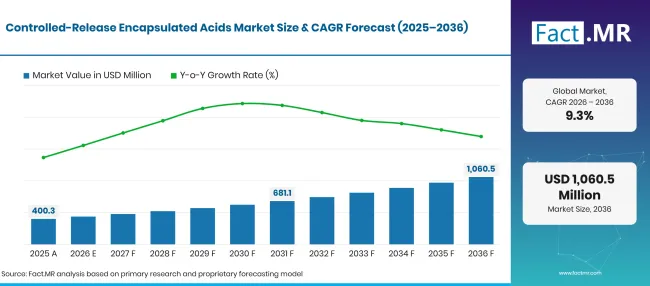
Controlled Release Encapsulated Acids Forecast Global | Source: Fact.MR
Category
| Category | Segments |
|---|---|
| Encapsulated Acid Chemistry | Citric Acid, Lactic Acid, Fumaric Acid, Malic Acid, Blended Organic Acids |
| Commercial Ingredient Form | Ready-to-use Premix, Liquid Concentrate, Granulate / Agglomerate, Encapsulated Bead, Powder |
| Food Application | Beverage, Bakery, Dairy / Alternatives, Meat / Savory, Confectionery / Snacks |
| Functional Purchasing Driver | Process Stability, Shelf-life, Texture / Mouthfeel, Flavor / Color, Nutrition / Label |
| Region | United States, China, Germany, India, France |
Source: Fact.MR analysis. Updated Nov 17, 2026
Source: Fact.MR analysis. Updated 14 Nov 2026
Segmental Analysis
Why does citric acid lead encapsulated acid chemistry in the Controlled-Release Encapsulated Acids Market?
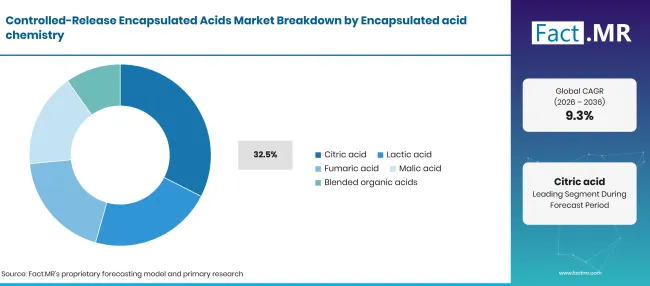
Controlled Release Encapsulated Acids Breakdown Encapsulated Acid Chemistry | Source: Fact.MR
In November 2026, Wenda Ingredients launched its SafeRelease™ range, including three encapsulated citric acid products and a heat-triggered lactic acid formulation for processed meat applications. Citric acid leads the chemistry segment at 32.5%, followed by malic acid at 26.6%, as its wider use across beverages, bakery and confectionery supports adoption. Malic acid serves more specific sourness and flavor requirements. Lactic acid holds 15.9%, blended organic acids 14.2% and fumaric acid 10.8%, with each serving distinct formulation needs.
Why do ready-to-use premixes lead commercial ingredient form in the Controlled-Release Encapsulated Acids Market?
In November 2026, Wenda Ingredients launched its SafeRelease™ range, including encapsulated citric acid and heat-triggered lactic acid for controlled acidification in processed meat products.
Citric acid leads the chemistry segment at 32.5%, as its use across beverages, bakery and confectionery creates wider formulation opportunities. Malic acid accounts for 26.6%, supported by its role in sour confectionery and flavour adjustment. Lactic acid gains traction in processed meat for controlled acidification, while fumaric acid suits bakery and tortilla formulations because of its acidity and processing characteristics. Blended organic acids serve manufacturers combining multiple acid properties to achieve specific formulation results.
PHS Life Sciences+1
Why do beverages lead food application in the Controlled-Release Encapsulated Acids Market?
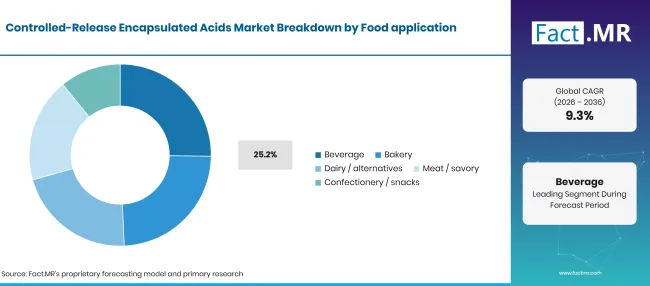
Controlled Release Encapsulated Acids Breakdown Food Application | Source: Fact.MR
In February 2026, a US patent application disclosed coated citric acid particles for improving moisture resistance and stability in effervescent powdered beverages. Beverages lead food applications at 25.2%, followed by bakery at 21.9%, where controlled acid release helps manage leavening reactions and dough performance.
Confectionery and snacks account for 21.1%, driven by demand for consistent sourness and flavour release. Dairy alternatives hold 19.8%, with acidity control supporting texture, while meat and savory applications (12.0%) use encapsulated acids for controlled acidification and preservation. Powdered beverages benefit from improved storage stability compared with ready-to-drink formulations.
Why does process stability lead functional purchasing drivers in the Controlled-Release Encapsulated Acids Market?
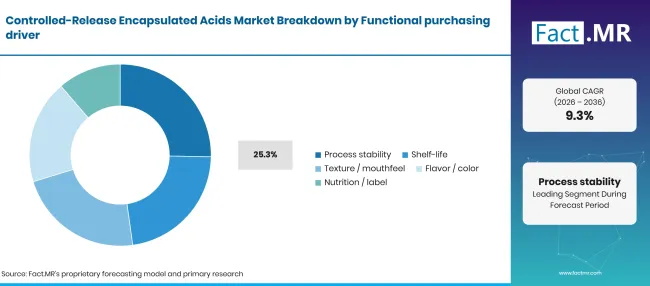
Controlled Release Encapsulated Acids Breakdown Functional Purchasing Driver | Source: Fact.MR
In 2025, the FDA updated its guidance on food allergen labeling and ingredient declarations, reinforcing manufacturers' attention to formulation accuracy and product consistency. Process stability leads purchasing priorities at 25.3%, as food processors need predictable acid performance during mixing, heating and storage.
Nutrition and label considerations also influence ingredient selection, particularly as manufacturers reformulate products to meet clean-label preferences. Texture and mouthfeel matter in dairy and confectionery, while shelf-life considerations focus on moisture protection. Flavor and color preservation guide acid selection in products sensitive to formulation changes.
Controlled-Release Encapsulated Acids Market-Drivers, Restraints & Trends
Drivers: Increasing Use of Controlled Acid Release in Food Processing: In November 2026, Wenda Ingredients launched its SafeRelease™ range, including encapsulated lactic and citric acids that release during cooking to control acidification in fermented-style meat products. This launch highlights a key reason behind market expansion: food processors want better control over acid reactions without compromising flavor, texture or production consistency. Controlled-release formats help prevent premature ingredient interactions, making them useful across meat, bakery, confectionery and other processed food applications.
Restraints: Formulation Complexity and Encapsulation Costs
High formulation costs and process adjustments can limit the use of encapsulated acids, particularly among smaller food processors with limited production budgets. Unlike conventional acidulants, these ingredients need carefully selected coatings and processing methods to achieve the desired release. Changes in moisture, temperature, pH and mixing conditions can also affect coating stability and acid release, making quality checks more demanding. Lower production volumes further increase the per-unit cost of specialised encapsulated ingredients.
Trend: Greater Attention to Ingredient Compatibility: In 2025, the continued expansion of plant-based food formulations highlighted the importance of managing ingredient interactions. Managing interactions between acids and other food ingredients has become an important consideration for manufacturers working with complex formulations. This is creating opportunities for encapsulation suppliers to serve food categories where ingredient stability and controlled reactions influence formulation decisions. Going forward, wider use of complex food formulations could open additional commercial opportunities for encapsulated acid manufacturers.
Trend: Rising Demand for Application-Led Encapsulation Solutions: In 2026, food manufacturers' focus on processing efficiency and formulation consistency added commercial relevance to specialised acid encapsulation. Differences in processing conditions across food categories are pushing manufacturers towards more customised ingredient solutions. This creates room for market expansion through specialised encapsulation requirements and broader industrial adoption. Similar movement towards customised food ingredient solutions is strengthening this trend.
Controlled-Release Encapsulated Acids Market by Analysis by Key Country
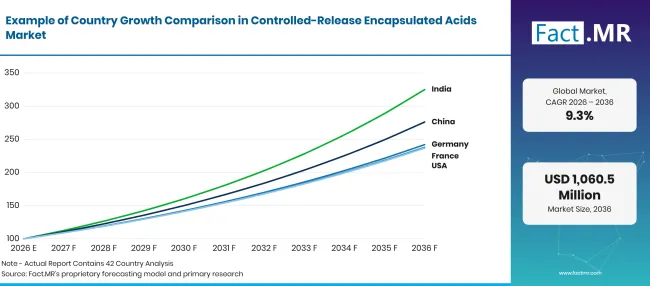
Controlled Release Encapsulated Acids Growth Index | Source: Fact.MR
| Country | CAGR (2026–2036) |
|---|---|
| India | 12.5% |
| China | 10.7% |
| Germany | 9.2% |
| United States | 9.0% |
| France | 9.1% |
Source: Fact.MR analysis. Updated Nov 17, 2026
Source: Fact.MR analysis. Updated 14 Nov 2026
What is driving controlled-release encapsulated acids market growth in India?
India's food processing industry is gaining commercial strength, with processing capacity increasing by 34 lakh metric tonnes per annum under government-supported initiatives, according to a PIB update published in April 2026.
This expansion is creating opportunities for encapsulated acid ingredients across packaged foods, beverages and processed dairy. At a CAGR of 12.5% between 2026 and 2036, India offers strong market potential. Rising processed food exports, investments in manufacturing infrastructure and the need for better acidity management are contributing to sales growth.
What is supporting controlled-release encapsulated acids market growth in China?
China's food processing industry recorded a 5.6% increase in value added during 2025, as reported by the National Bureau of Statistics in February 2026.
\Such industrial activity creates a substantial customer base for encapsulated acid ingredients across packaged foods, bakery products, confectionery and beverages. The country is set to register a CAGR of 10.7% through 2036. Large manufacturing volumes, wider use of processed ingredients and the need to manage acidity without affecting other formulation components are creating commercial opportunities for market participants.
What is driving controlled-release encapsulated acids market growth in Germany?
Quality consistency across a large food manufacturing base is an important factor behind Germany's market expansion.
The German food industry generated EUR 240.8 billion in annual revenue across approximately 6,100 businesses, according to the BVE's July 2026 statistics. This industrial base creates opportunities for encapsulated acids in bakery, dairy, confectionery and processed food production. With a CAGR of 9.2% from 2026 to 2036, sales are gaining support from specialised food formulations, export-oriented manufacturing and processors' attention to ingredient stability and controlled acidity.
What is supporting controlled-release encapsulated acids market growth in the United States?
The scale of American food manufacturing gives encapsulated acid suppliers access to a broad industrial customer base.
US food manufacturing recorded USD 1,054.3 billion in shipments and employed approximately 1.7 million people in 2024, according to Census Bureau data released in 2026. This creates opportunities across beverage, dairy, bakery and packaged food applications. The market is advancing at a CAGR of 9.0% between 2026 and 2036. Sales are being driven by large-scale production, formulation complexity and manufacturers' interest in consistent acidity and controlled ingredient interactions.
What is driving controlled-release encapsulated acids market growth in France?
France's strong food export base and diverse manufacturing activity are creating room for specialised food ingredients.
ANIA reported that the country's food industry generated EUR 250 billion in revenue and employed 520,000 people in 2025. These activities create potential applications for encapsulated acids in dairy, bakery, confectionery and beverage production. Growing at a CAGR of 9.1% through 2036, the market is gaining commercial traction as processors place greater emphasis on flavour consistency, ingredient compatibility and product stability. Export-focused food production is another factor encouraging the use of specialised acid formulations.
Competitive Landscape for Controlled-Release Encapsulated Acids Market
Competition in the controlled-release encapsulated acids market depends on how effectively manufacturers address formulation challenges across food applications. Balchem Corporation has relevant microencapsulation capabilities covering citric, malic, fumaric and lactic acids, giving it a direct connection to this market. IFF, Kerry Group, dsm-firmenich, Givaudan, Symrise, BASF and Cargill participate in the wider food ingredient industry through their formulation and ingredient portfolios.
Buyers compare manufacturers on coating materials, acid compatibility, particle characteristics and release consistency rather than acid composition alone. The ability to adapt encapsulation methods to beverage, bakery, dairy and confectionery processing conditions influences supplier selection and creates room for specialised ingredient manufacturers.
Recent Developments
- On May 29, 2026, International Flavors & Fragrances Inc. (IFF) agreed to sell its Food Ingredients business to CVC Capital Partners in a transaction valued at approximately USD 4.3 billion.
- On April 20, 2026, Kerry Group plc opened an expanded biotechnology manufacturing facility in Carrigaline, Ireland, to increase its production capacity for lactase enzymes used in lactose-free and reduced-sugar dairy products.
- On October 2, 2025, dsm-firmenich AG inaugurated its Van Marken Food Innovation Center in Delft, the Netherlands, to advance food innovation across bakery, cheese, brewing and plant-based applications.
- On March 10, 2026, Cargill, Incorporated showcased new food ingredient solutions for bakery, snacks and chocolate manufacturers at AAHAR 2026 in New Delhi, including protein fortification, oil reduction and ready-to-use mixes.
- On December 10, 2025, Balchem Corporation announced plans to build a high-capacity microencapsulation manufacturing facility in Orange County, New York. The facility is scheduled to open in 2027 and will expand production of its BakeShure®, ConfecShure® and MeatShure® solutions
Key Players in Controlled-Release Encapsulated Acids Market
Key companies profiled include International Flavors & Fragrances Inc. (IFF); Kerry Group plc; dsm-firmenich AG; Givaudan SA; Symrise AG; BASF SE; Cargill, Incorporated; and Balchem Corporation.
- International Flavors & Fragrances Inc. (IFF)
- Kerry Group plc
- dsm-firmenich AG
- Givaudan SA
- Symrise AG
- BASF SE
- Cargill, Incorporated
- Balchem Corporation
Bibliography
- ANIA. (n.d.). Nos forces, nos freins et nos chiffres clés.
- Bundesvereinigung der Deutschen Ernährungsindustrie. (2026, July 9). Statistikbroschüre 2026.
- Food Infotech. (2026, November 4). Wenda Ingredients launches SafeRelease encapsulated ingredient technology.
- National Bureau of Statistics of China. (2026, February 28). Statistical communiqué of the People's Republic of China on the 2025 national economic and social development
- Press Information Bureau. (2026, April 21). Strengthening India's food processing ecosystem. Government of India.
- U.S. Census Bureau. (2026, September 3). Census Bureau releases new Annual Integrated Economic Survey data.
- Wang, P.-H., & Yatcilla, M. T. (2025). Compositions and methods for effervescent systems with improved stability (International Patent Application Publication No. WO 2025/235402 A1). World Intellectual Property Organization.
- Wang, P.-H., & Yatcilla, M. T. (2026). Compositions and methods for effervescent systems with improved stability (U.S. Patent Application Publication No. US 2026/0191234 A1). United States Patent and Trademark Office.
Segmentation
Scope of Report
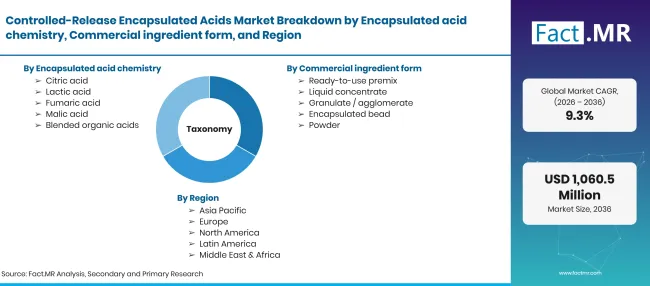
Controlled Release Encapsulated Acids Taxonomy | Source: Fact.MR
| Items | Values |
|---|---|
| Quantitative Units (2026) | USD 437.4 Million |
| Encapsulated Acid Chemistry | Citric Acid, Lactic Acid, Fumaric Acid, Malic Acid, Blended Organic Acids |
| Commercial Ingredient Form | Ready-to-use Premix, Liquid Concentrate, Granulate / Agglomerate, Encapsulated Bead, Powder |
| Food Application | Beverage, Bakery, Dairy / Alternatives, Meat / Savory, Confectionery / Snacks |
| Functional Purchasing Driver | Process Stability, Shelf-life, Texture / Mouthfeel, Flavor / Color, Nutrition / Label |
| Regions Covered | North America, Latin America, Europe, Asia Pacific, Middle East & Africa |
| Countries Covered | United States, China, Germany, India, France, and other countries |
| Key Companies Profiled | International Flavors & Fragrances Inc. (IFF), Kerry Group plc, dsm-firmenich AG, Givaudan SA, Symrise AG, BASF SE, Cargill, Incorporated, Balchem Corporation |
| Additional Attributes | Dollar revenue in the Controlled-Release Encapsulated Acids Market is segmented by encapsulated acid chemistry, commercial ingredient form, food application, functional purchasing driver and region. |
Source: Fact.MR analysis. Updated Nov 17, 2026
Controlled-Release Encapsulated Acids Market by Segments
-
Encapsulated Acid Chemistry
- Citric Acid
- Lactic Acid
- Fumaric Acid
- Malic Acid
- Blended Organic Acids
-
Commercial Ingredient Form
- Ready-to-use Premix
- Liquid Concentrate
- Granulate / Agglomerate
- Encapsulated Bead
- Powder
-
Food Application
- Beverage
- Bakery
- Dairy / Alternatives
- Meat / Savory
- Confectionery / Snacks
-
Functional Purchasing Driver
- Process Stability
- Shelf-life
- Texture / Mouthfeel
- Flavor / Color
- Nutrition / Label
-
Region:
- North America
- United States
- Canada
- Mexico
- Europe
- Germany
- United Kingdom
- France
- Italy
- Spain
- Rest of Europe
- Asia Pacific
- China
- India
- Japan
- South Korea
- Australia
- Rest of Asia Pacific
- Latin America
- Brazil
- Mexico
- Argentina
- Rest of Latin America
- Middle East & Africa
- GCC Countries
- South Africa
- Rest of Middle East & Africa
- North America
Frequently Asked Questions
How big is the global Controlled-Release Encapsulated Acids Market in 2026?
What will be the size of the Controlled-Release Encapsulated Acids Market by 2036?
How fast will the Controlled-Release Encapsulated Acids Market grow during the forecast period?
Which encapsulated acid chemistry segment holds the largest share of the Controlled-Release Encapsulated Acids Market?
Which commercial ingredient form leads the Controlled-Release Encapsulated Acids Market?
Which food application segment leads the Controlled-Release Encapsulated Acids Market?
Who are the key companies operating in the Controlled-Release Encapsulated Acids Market?
Who worked on this report


Preview the report firsthand - request a free sample
Free SampleGet the brochure for pricing and purchase details
Download PDF