- Market Value (2025): USD 368.9 Mn
- Estimated Value (2026): USD 401.0 Mn
- Forecast Value (2036): USD 922.7 Mn
- CAGR (2026-2036): 8.7%
Enzyme-Modified Functional Starches Market Forecast and Outlook 2026 to 2036
The enzyme-modified functional starches market was worth USD 368.9 million in 2025 and is estimated at USD 401.0 million for 2026. A 8.7% CAGR over 2026–2036 would take the market to USD 922.7 million by the end of the period.
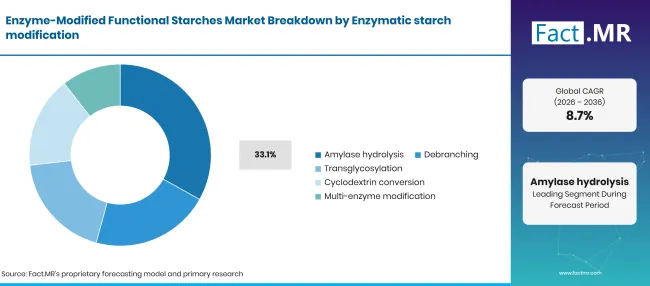
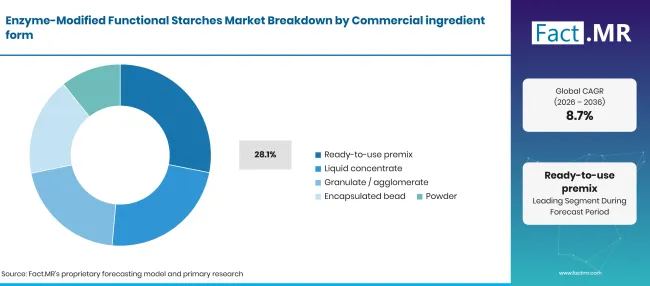
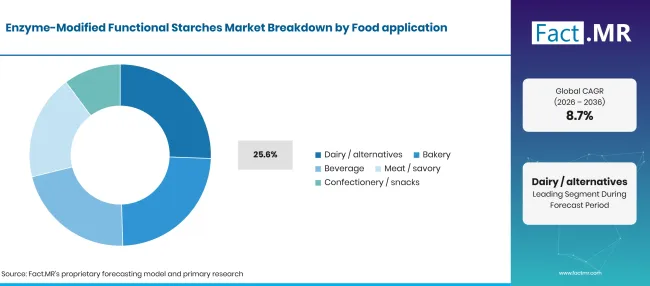
Amylase hydrolysis leads the enzymatic modification segment with a 33.1% share in 2026, as food manufacturers use enzyme treatment to achieve specific viscosity and texture requirements. Ready-to-use premixes hold 28.1%, while dairy and alternatives account for 25.6% of food applications. Nutrition and label considerations rank first among purchasing priorities at 33.7%. Wider use of plant-based foods, beverages and specialised nutrition products is creating opportunities for starch manufacturers to develop ingredients suited to varied formulation needs.
Key Takeaways from the Enzyme-Modified Functional Starches Market
- Enzyme-Modified Functional Starches Market Value (2025): USD 368.9 million
- Enzyme-Modified Functional Starches Market Value (2026): USD 401.0 million
- Enzyme-Modified Functional Starches Market Forecast Value (2036): USD 922.7 million
- Enzyme-Modified Functional Starches Market Forecast CAGR (2026–2036): 8.7%
- Leading Enzymatic Modification: Amylase Hydrolysis (33.1%)
- Leading Commercial Ingredient Form: Ready-to-Use Premix (28.1%)
- Leading Food Application: Dairy and Dairy Alternatives (25.6%)
- Leading Functional Purchasing Driver: Nutrition and Label (33.7%)
- Key Market Participants: Ingredion Incorporated, Cargill, Incorporated, Tate & Lyle PLC, Archer Daniels Midland Company, Roquette Frères and AGRANA Beteiligungs-AG
- Key Growth Regions: India, China, France, Germany and the United States
Dairy and dairy alternatives hold a 25.6% share in 2026, as manufacturers use functional starches to achieve consistent texture, mouthfeel and product stability. Amylase hydrolysis leads modification methods at 33.1%, while ready-to-use premixes account for 28.1% of ingredient forms. AGRANA’s modified starch portfolio covers dairy products, plant-based alternatives, chilled desserts and fruit preparations, illustrating the role of starch functionality in meeting varied food formulation needs.
Enzyme-Modified Functional Starches Market
| Metric | Value |
|---|---|
| Estimated Value in (2026) | USD 401.0 million |
| Forecast Value in (2036) | USD 922.7 million |
| Forecast CAGR (2026 to 2036) | 8.7% |
Source: Fact.MR analysis. Updated Nov 17, 2026
Source: Fact.MR analysis. Updated 14 Nov 2026
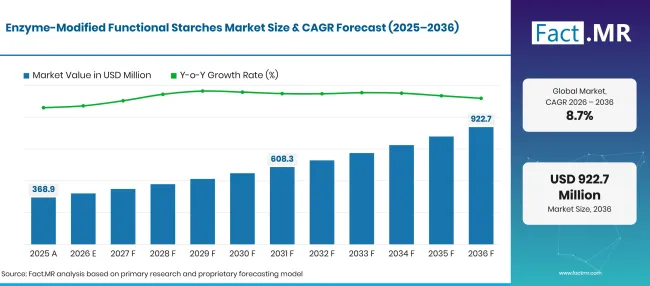
Enzyme Modified Functional Starches Forecast Global | Source: Fact.MR
Category
| Category | Segments |
|---|---|
| Enzymatic Starch Modification | Amylase Hydrolysis, Debranching, Transglycosylation, Cyclodextrin Conversion, Multi-Enzyme Modification |
| Commercial Ingredient Form | Ready-to-Use Premix, Liquid Concentrate, Granulate / Agglomerate, Encapsulated Bead, Powder |
| Food Application | Dairy / Alternatives, Bakery, Beverage, Meat / Savory, Confectionery / Snacks |
| Functional Purchasing Driver | Nutrition / Label, Process Stability, Texture / Mouthfeel, Flavor / Color, Shelf-Life |
| Region | North America, Latin America, Europe, Asia Pacific, Middle East & Africa |
Source: Fact.MR analysis. Updated Nov 17, 2026
Segmental Analysis
Why does amylase hydrolysis lead enzymatic modification in the Enzyme-Modified Functional Starches Market?
Enzyme Modified Functional Starches Breakdown Enzymatic Starch Modification | Source: Fact.MR
EFSA’s May 2026 assessment of an alpha-amylase enzyme included its use in plant-based milk alternatives and fruit and vegetable products, highlighting wider food-processing applications for enzyme treatment. Amylase hydrolysis holds the largest modification share at 33.1%, because controlled starch breakdown gives manufacturers greater control over viscosity and texture. Multi-enzyme modification follows at 21.8%, offering combined functional adjustments, while transglycosylation accounts for 17.1% and debranching 15.1%, serving more specific starch-structure needs.
Why do ready-to-use premixes lead commercial ingredient forms in the Enzyme-Modified Functional Starches Market?
Enzyme Modified Functional Starches Breakdown Commercial Ingredient Form | Source: Fact.MR
A November 2025 study in Food Chemistry developed modified kudzu starch gel beads for improved encapsulation and controlled release of functional compounds, illustrating the potential of specialised starch formats. Ready-to-use premixes hold the largest share at 28.1%, as manufacturers value easier handling and direct integration into existing recipes. Encapsulated beads follow closely at 28.0%, with interest centred on ingredient protection and controlled release. Powder formats account for 18.8%, while liquid concentrates hold 14.4% and granulates 10.7%, serving more specific dosing, blending and dispersion needs.
Why do dairy and alternatives lead food applications in the Enzyme-Modified Functional Starches Market?
Enzyme Modified Functional Starches Breakdown Food Application | Source: Fact.MR
Ingredion’s December 2025 product-development feature highlighted functional native starches for improving texture and stability in plant-based yogurt, illustrating the need for dairy-like consistency in alternative formulations.
Dairy and alternatives lead food applications at 25.6%, narrowly ahead of beverages at 24.7%, as both categories depend on starches for smooth mouthfeel and stable texture. Confectionery and snacks follow at 23.3%, where starches serve more specific gelling and filling functions. Within dairy alternatives, yogurt-style products need spoonable thickness, while plant-based drinks favour smooth flow and suspension.
Why does nutrition and label lead functional purchasing drivers in the Enzyme-Modified Functional Starches Market?
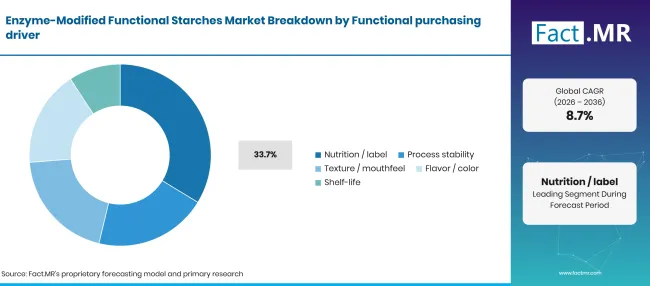
Enzyme Modified Functional Starches Breakdown Functional Purchasing Driver | Source: Fact.MR
Roquette launched AMYSTA™ L 123 in October 2025, a soluble pea starch designed to combine clear ingredient labelling with texturising performance in food formulations. This reflects the importance of label considerations, which lead purchasing priorities at 33.7%. Texture and mouthfeel follow at 28.3%, as manufacturers also need familiar sensory qualities in finished foods. Within this priority, smooth mouthfeel matters in beverages, while gel formation and creaminess are important in dairy alternatives. Process stability accounts for 12.0%, below both formulation and label considerations.
Enzyme-Modified Functional Starches Market-Drivers, Restraints & Trends
Drivers: Cargill Introduces Modified-Starch Solutions for Diverse Food Applications at AAHAR 2025 Cargill showcased new modified-starch solutions for bakery, snacks, confectionery and dairy applications at AAHAR 2025, including bake-stable fillings and starch-based systems that improve snack crispiness. Such product introductions highlight the food industry's interest in starch ingredients with more precise functional properties. Enzyme modification helps manufacturers adjust viscosity, texture and processing behaviour to suit specific formulation needs without relying solely on conventional chemical treatments. Wider adoption across processed food categories is creating opportunities for specialised starch ingredients designed around individual recipes and production conditions.
Restraints: Enzyme Processing Costs and Formulation Complexity: Enzyme-modified starch production can become costly because manufacturers must carefully control enzyme selection, concentration, temperature and processing time to achieve the desired texture and viscosity. Differences in raw starch quality can further affect consistency, making routine quality checks and formulation adjustments necessary. Food manufacturers may also need repeated trials to determine how these ingredients perform alongside other recipe components. For smaller processors, investment in specialised equipment and testing can add to production expenses, making conventional starch a more economical choice for price-sensitive applications.
Trend: Rising Preference for Plant-Based and Functional Food Formulations: Food manufacturers are exploring starch ingredients that improve texture, mouthfeel and stability in dairy alternatives and beverages. AGRANA's 2025 launch of AGENAPURE clean-label starches highlights this shift. Wider reformulation of plant-based foods creates opportunities for starch manufacturers to address changing ingredient requirements.
Trend: Greater Emphasis on Clean-Label Ingredient Choices: Food brands are reconsidering ingredient lists while trying to maintain the taste, texture and shelf stability consumers expect. This is encouraging manufacturers to explore starch ingredients that can replace multiple additives while performing thickening, binding and moisture-control functions. AGRANA's clean-label starch portfolio addresses applications across sauces, dressings, bakery fillings, dairy products and convenience foods. The trend also creates opportunities for starch manufacturers to develop ingredients suited to sugar-reduced, fat-reduced and minimally processed food formulations, opening wider commercial applications across the processed food industry.
Enzyme-Modified Functional Starches Market by Analysis by Key Country
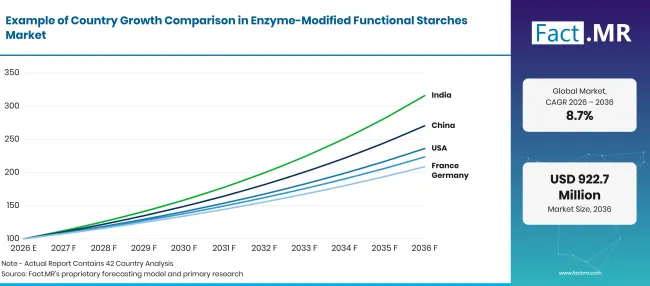
Enzyme Modified Functional Starches Growth Index | Source: Fact.MR
| Country | CAGR (2026–2036) |
|---|---|
| India | 12.2% |
| China | 10.5% |
| United States | 9.0% |
| France | 8.4% |
| Germany | 7.6% |
Source: Fact.MR analysis. Updated Nov 17, 2026
Source: Fact.MR analysis. Updated 14 Nov 2026
Country-wise Growth Outlook for Enzyme-Modified Functional Starches Market
Why is India becoming an important market for Enzyme-Modified Functional Starches?
India's shift towards packaged foods and large-scale food processing is opening new avenues for enzyme-modified starch manufacturers.
The market is set to expand at a CAGR of 12.2% during 2026–2036. In 2025, processed food exports accounted for 20.4% of India's agri-food exports, according to the Ministry of Food Processing Industries. This expansion is encouraging manufacturers to use specialised starch ingredients in bakery products, dairy preparations, snacks and convenience foods. Higher production volumes and the need for consistent texture and viscosity are driving market sales.
What factors are accelerating Enzyme-Modified Functional Starches Market growth in China?
China's extensive packaged food and beverage industry is creating a wider customer base for functional starch ingredients. The market is projected to register a CAGR of 10.5% through 2036. China's National Bureau of Statistics reported a 9.3% increase in retail sales of grain, oil and food products in 2025.
The expansion of prepared meals, confectionery, sauces and ready-to-drink beverages is increasing the use of starch ingredients for texture, thickness and stability. Higher processed food production and changing consumption patterns are providing fresh sales opportunities for ingredient manufacturers.
How are food industry investments influencing the US Enzyme-Modified Functional Starches Market?
Investment in food processing infrastructure is strengthening the commercial scope for enzyme-modified functional starches in the United States. The market is set to record a CAGR of 9.0% between 2026 and 2036.
US food and beverage processing machinery shipments reached USD 6.2 billion in 2025, according to industry figures reported in 2026 by PMMI and FPSA. Greater processing capacity across prepared foods, dairy, bakery and beverages is driving sales of starch ingredients that help manufacturers maintain texture, binding properties and formulation consistency.
What makes France a promising market for Enzyme-Modified Functional Starches?
France's established bakery, dairy and confectionery industries create varied applications for enzyme-modified starch ingredients. The market is projected to advance at an 8.4% CAGR from 2026 to 2036.
A USDA Foreign Agricultural Service report published in 2026 estimated that the French food industry generated EUR 200–210 billion in revenue during 2025, across approximately 17,000 companies. Manufacturers are using specialised ingredients to maintain product texture, improve processing performance and adapt recipes. This activity is driving starch sales across sauces, desserts, bakery fillings and convenience foods.
Where are the key growth opportunities emerging in Germany's Enzyme-Modified Functional Starches Market?
Germany's food manufacturers are creating opportunities for functional starch ingredients through their focus on formulation consistency and production efficiency. The market is anticipated to grow at a CAGR of 7.6% during 2026–2036. The German Federation of Food and Drink Industries reported that the country's food industry generated EUR 240.8 billion in revenue in 2025. Bakery goods, dairy preparations, confectionery and processed meals are important application areas. Sales are being driven by manufacturers' need for reliable thickening, binding and texture-control ingredients across high-volume food production.
Competitive Landscape for Enzyme-Modified Functional Starches Market
The competitive landscape reflects differences in starch modification expertise, product versatility and the ability to meet changing food formulation needs. Ingredion Incorporated, Cargill, Incorporated, Tate & Lyle PLC, Archer Daniels Midland Company, Roquette Frères and AGRANA Beteiligungs-AG compete through their starch portfolios and food ingredient expertise.
Cargill recognises enzymatic treatment as a starch modification method, while AGRANA serves applications such as dairy products, beverages, sauces and plant-based foods. Roquette's CLEARAM® and CLEARGUM® ranges address texture, viscosity and gelling requirements. Buyers also consider ingredient consistency, raw material quality and technical assistance when selecting manufacturers, giving companies with strong application knowledge an advantage across diverse food categories.
Recent Developments
- On May 28, 2026, Ingredion announced a strategic partnership with Sanstar Limited through a joint venture and an equity investment. The partnership aims to expand access to food and pharmaceutical ingredient markets in India.
- On March 10, 2025, Cargill inaugurated a new corn milling plant in Gwalior, Madhya Pradesh, established through a business arrangement with Saatvik Agro Processors. The facility will manufacture starch derivatives for confectionery, infant formula and dairy applications.
- On July 7, 2025, Tate & Lyle presented an expanded ingredient portfolio at IFT FIRST 2025 in Chicago. The showcase included modified starches, gellan gum, pectin and citrus fibre solutions for food texture and formulation requirements.
- On May 20, 2026, ADM launched eight new soy and pea protein ingredients across North America and Europe. The products target applications such as nutritional beverages, dairy alternatives and meat products.
- On April 6, 2026, Roquette inaugurated a new starch and polyol pilot centre at its Lianyungang facility in China. The centre covers more than 1,000 square metres and will strengthen research, product development and industrial processing capabilities.
- On June 2, 2025, AGRANA and Ingredion received regulatory approval for their Romanian starch production joint venture. The companies planned a EUR 35 million investment to expand production capacity, improve cost efficiency and strengthen competitiveness.
Key Players in Enzyme-Modified Functional Starches Market
Key companies profiled include Ingredion Incorporated; Cargill, Incorporated; Tate & Lyle PLC; Archer Daniels Midland Company (ADM); Roquette Frères; and AGRANA Beteiligungs-AG.
- Ingredion Incorporated
- Cargill, Incorporated
- Tate & Lyle PLC
- Archer Daniels Midland Company (ADM)
- Roquette Frères
- AGRANA Beteiligungs-AG
Bibliography
- AGRANA Beteiligungs-AG. (n.d.). Clean label starches.
- AGRANA Beteiligungs-AG. (n.d.). AGENAPURE: Clean-label cook-up and pregelatinized starches.
- Bundesvereinigung der Deutschen Ernährungsindustrie. (2026). Jahreszahlen 2025: Angespannte wirtschaftliche Lage setzt Ernährungsindustrie weiter unter Druck.
- Bundesvereinigung der Deutschen Ernährungsindustrie. (2026). Statistikbroschüre 2026.
- European Food Safety Authority Panel on Food Enzymes. (2026). Safety evaluation of an extension of use of the food enzyme α-amylase from the genetically modified Bacillus licheniformis strain NZYM-BC. EFSA Journal, 24(5), e10087. https://doi.org/10.2903/j.efsa.2026.10087
- National Bureau of Statistics of China. (2026). Statistical communiqué of the People's Republic of China on the 2025 national economic and social development
- National Bureau of Statistics of China. (2026). Total retail sales of consumer goods in December 2025.
- Ministry of Food Processing Industries. (2026). Annual report 2025–26. Government of India.
- Ministry of Food Processing Industries. (2026, February 6). Status and progress of food processing sector. Press Information Bureau, Government of India.
- PMMI, The Association for Packaging and Processing Technologies, & Food Processing Suppliers Association. (2026). 2026 processing state of the industry report.
- Roquette Frères. (2025, October 31). AMYSTA™ L 123, the new label-friendly soluble pea starch.
- Roquette Frères. (n.d.). Starch solutions for food formulation.
- USDA Foreign Agricultural Service. (2026). Food processing ingredients annual: France (Report No. FR2026-0003).
- Zhu, W., Liu, M., Chi, H., Li, L., Zheng, Z., & Zhang, B. (2025). Preparation, structural characterization, and controlled release of puerarin-loaded complex and gel beads based on native/modified kudzu starch. Food Chemistry, 493(Part 2), Article 145787.
Segmentation
Scope of Report
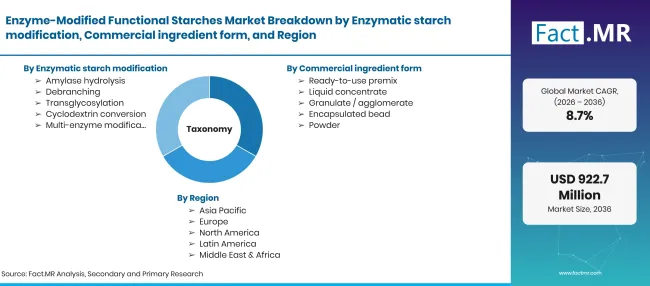
Enzyme Modified Functional Starches Taxonomy | Source: Fact.MR
| Items | Values |
|---|---|
| Quantitative Units (2026) | USD 401.0 Million |
| Enzymatic Starch Modification | Amylase Hydrolysis, Debranching, Transglycosylation, Cyclodextrin Conversion, Multi-Enzyme Modification |
| Commercial Ingredient Form | Ready-to-Use Premix, Liquid Concentrate, Granulate / Agglomerate, Encapsulated Bead, Powder |
| Food Application | Dairy / Alternatives, Bakery, Beverage, Meat / Savory, Confectionery / Snacks |
| Functional Purchasing Driver | Nutrition / Label, Process Stability, Texture / Mouthfeel, Flavor / Color, Shelf-Life |
| Regions Covered | North America, Latin America, Europe, Asia Pacific, Middle East & Africa |
| Countries Covered | United States, China, Germany, India, France, and other countries |
| Key Companies Profiled | Ingredion Incorporated, Cargill, Incorporated, Tate & Lyle PLC, Archer Daniels Midland Company, Roquette Frères, AGRANA Beteiligungs-AG |
| Additional Attributes | Dollar revenue in the Enzyme-Modified Functional Starches Market is segmented by enzymatic starch modification, commercial ingredient form, food application, functional purchasing driver and region. |
Source: Fact.MR analysis. Updated Nov 17, 2026
Enzyme-Modified Functional Starches Market by Segments
-
Enzymatic Starch Modification
- Amylase Hydrolysis
- Debranching
- Transglycosylation
- Cyclodextrin Conversion
- Multi-Enzyme Modification
-
Commercial Ingredient Form
- Ready-to-Use Premix
- Liquid Concentrate
- Granulate / Agglomerate
- Encapsulated Bead
- Powder
-
Food Application
- Dairy / Alternatives
- Bakery
- Beverage
- Meat / Savory
- Confectionery / Snacks
-
Functional Purchasing Driver
- Nutrition / Label
- Process Stability
- Texture / Mouthfeel
- Flavor / Color
- Shelf-Life
-
Region:
- North America
- United States
- Canada
- Mexico
- Europe
- Germany
- United Kingdom
- France
- Italy
- Spain
- Rest of Europe
- Asia Pacific
- China
- India
- Japan
- South Korea
- Australia
- Rest of Asia Pacific
- Latin America
- Brazil
- Mexico
- Argentina
- Rest of Latin America
- Middle East & Africa
- GCC Countries
- South Africa
- Rest of Middle East & Africa
- North America
Frequently Asked Questions
How big is the global Enzyme-Modified Functional Starches Market in 2026?
What will be the size of the Enzyme-Modified Functional Starches Market by 2036?
How fast will the Enzyme-Modified Functional Starches Market grow during the forecast period?
Which enzymatic modification segment holds the largest share of the Enzyme-Modified Functional Starches Market?
Which commercial ingredient form leads the Enzyme-Modified Functional Starches Market?
Which food application segment leads the Enzyme-Modified Functional Starches Market?
Who are the key companies operating in the Enzyme-Modified Functional Starches Market?
Who worked on this report


Preview the report firsthand - request a free sample
Free SampleGet the brochure for pricing and purchase details
Download PDF