
- Market Value (2025): USD 920.0 Mn
- Estimated Value (2026): USD 970.6 Mn
- Forecast Value (2036): USD 1738.2 Mn
- CAGR (2026-2036): 6.0%
Noise Blocking Earmuffs Market Forecast and Outlook 2026 to 2036
Fact.MR studies, the noise blocking earmuff market crossed a valuation of USD 920.0 million in 2025 and is projected to grow from USD 970.6 million in 2026 to USD 1738.2 million by 2036. Demand for noise blocking earmuffs is likely to grow at a CAGR of 6.0% over the forecast period.
Demand for noise blocking earmuffs is rising as employers meet hearing-protection rules, and as consumers use ear defenders for shooting, home projects and for children in loud settings. The key players are offering passive earmuffs, level-dependent electronic models and versions with Bluetooth or communication features in a range of attenuation ratings.
Key Takeaways from the Noise Blocking Earmuffs Market
- Noise Blocking Earmuffs Market Value (2025): USD 920.0 million
- Noise Blocking Earmuffs Market Value (2026): USD 970.6 million
- Noise Blocking Earmuffs Market Forecast Value (2036): USD 1738.2 million
- Noise Blocking Earmuffs Market Forecast CAGR (2026-2036): 6.0%
- Leading Type: Passive (62.0%)
- Key Market Participants: 3M, Honeywell, MSA Safety, Moldex-Metric, Uvex Safety Group
- Key Growth Countries: China, South Korea, United Kingdom, United States, France
Demand for hearing protection and noise-monitoring solutions is expected to strengthen through 2036 as industrial safety requirements, construction activity and awareness of occupational hearing loss increase. According to the US National Institute for Occupational Safety and Health (NIOSH), updated government statistics published in April 2026 show that 38% of manufacturing workers and 37% of construction workers experienced hazardous workplace noise exposure during the preceding year. Additionally, approximately 12% of manufacturing workers and 13% of construction workers reported hearing difficulties. These findings reinforce the importance of workplace noise assessments, hearing conservation programmes and protective equipment, supporting demand for industrial hearing protection solutions.
Noise Blocking Earmuffs Market
| Metric | Value |
|---|---|
| Estimated Value in (2026) | USD 970.6 million |
| Forecast Value in (2036) | USD 1738.2 million |
| Forecast CAGR (2026 to 2036) | 6.0% |
Source: Fact.MR analysis.
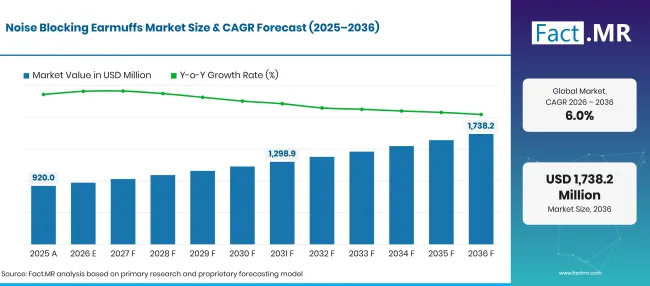
Noise Blocking Earmuffs Market Forecast Global | Source: Fact.MR
Category
| Category | Segments |
|---|---|
| Type | Passive, Electronic level-dependent, Bluetooth and communication, Active noise cancelling |
| Headband Style | Over-the-head, Helmet and cap mounted, Behind-the-neck, Foldable |
| Noise Reduction | 27 to 30 dB, 23 to 26 dB, Above 30 dB, Up to 22 dB |
| End Use | Manufacturing, Construction, Children and consumer, Shooting and hunting, Mining, oil and energy |
| Region | China; South Korea; United Kingdom; United States; France |
Source: Fact.MR analysis.
Segmental Analysis
What is sustaining demand and sales of passive noise blocking earmuffs?
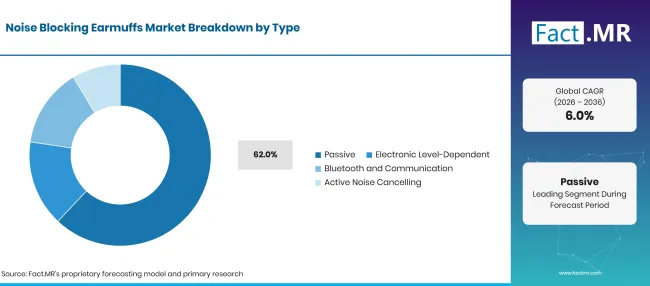
Noise Blocking Earmuffs Market Breakdown Type | Source: Fact.MR
Demand for passive earmuffs is supported by their simple construction, affordability and suitability for continuous workplace protection. The segment accounts for 62.0% of market revenue in 2026, about USD 601.8 million. According to the US National Institute for Occupational Safety and Health (NIOSH), its April 2026 manufacturing statistics show that 38% of manufacturing workers experienced hazardous noise exposure, while 28% of noise-exposed manufacturing workers reported not wearing hearing protection. This highlights an opportunity for employers to increase purchases of reliable, battery-free protective equipment for large workforces, particularly in manufacturing and industrial operations.
Which workplace requirements are supporting sales of over-the-head earmuffs?
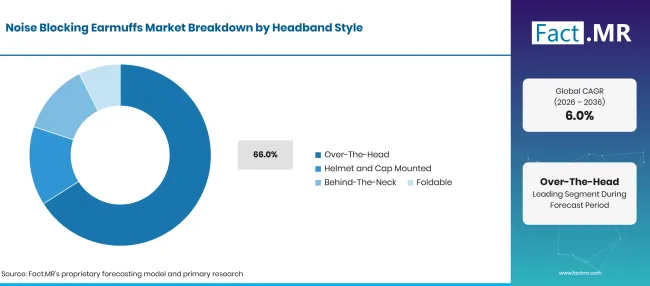
Noise Blocking Earmuffs Market Breakdown Headband Style | Source: Fact.MR
Sales of over-the-head earmuffs remains strong because this familiar design offers convenient fitting, adjustable headbands and compatibility with different workplace environments. The segment represents 66.0% of market revenue in 2026, about USD 640.6 million. The US Occupational Safety and Health Administration (OSHA) requires employers to implement hearing conservation programmes when average employee exposure reaches 85 dBA over an eight-hour workday. These programmes include providing hearing protection, employee training and evaluating the effectiveness of protective devices. Such requirements encourage employers to procure comfortable, properly fitted earmuffs for employees working extended shifts in noisy facilities.
How are industrial noise exposure levels influencing demand for 27 to 30 dB earmuffs?
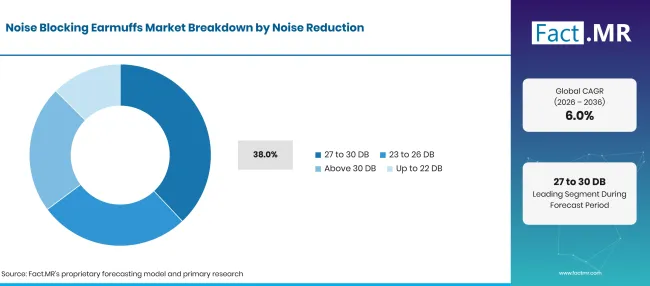
Noise Blocking Earmuffs Market Breakdown Noise Reduction | Source: Fact.MR
Demand for earmuffs offering 27 to 30 dB noise reduction is supported by industrial workplaces requiring appropriate attenuation against machinery and production noise. This segment accounts for 38.0% of market revenue in 2026, about USD 368.8 million. According to OSHA, approximately 22 million US workers are exposed to potentially damaging workplace noise annually, while its hearing conservation requirements apply at exposures of 85 dBA or higher over eight hours. This creates recurring purchasing opportunities for manufacturers supplying different attenuation ratings. Employers increasingly evaluate noise measurements, equipment compatibility and worker comfort before selecting suitable protective products.
What is driving manufacturing-sector demand and sales of noise blocking earmuffs?
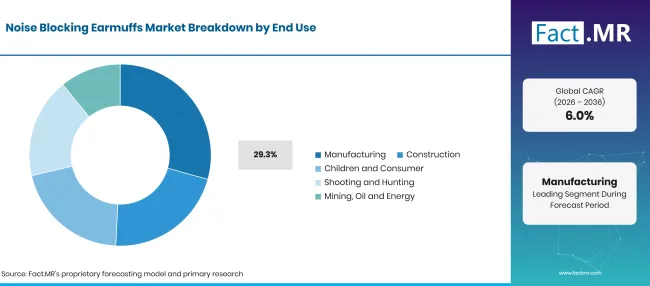
Noise Blocking Earmuffs Market Breakdown End Use | Source: Fact.MR
Demand from manufacturing represents 29.3% of market revenue in 2026, about USD 284.4 million, supported by continuous exposure to machinery, fabrication, metalworking and production-line noise. NIOSH reported in April 2026 that 12% of manufacturing workers experience hearing difficulty, while approximately 11% experience tinnitus. Furthermore, around 20% of noise-exposed manufacturing workers tested had material hearing impairment. These occupational risks encourage manufacturers to strengthen workplace hearing-protection programmes and purchase appropriate earmuffs for production personnel. Replacement requirements, employee safety policies and regulatory compliance continue to support purchasing activity across industrial manufacturing facilities.
Noise Blocking Earmuffs Market-Drivers, Restraints & Trends
Drivers:
Occupational Noise Exposure and Workplace Safety Demand for noise blocking earmuffs is rising as occupational safety rules require hearing protection above set exposure levels and as employers invest in comfort to encourage consistent use. According to the US National Institute for Occupational Safety and Health (NIOSH), approximately 27 million workers (16% of the workforce) were exposed to hazardous workplace noise during the previous year. Its April 2026 surveillance report also found that approximately 11% of workers experienced hearing difficulties. OSHA requires employers to implement hearing conservation programmes when exposure reaches or exceeds 85 dBA over an eight-hour time-weighted average. These requirements encourage employers in manufacturing, construction, mining and other noisy industries to provide certified hearing protection, including noise blocking earmuffs.
Restraints:
Inconsistent Hearing Protection Usage-: Demand is constrained by low unit prices, inconsistent use and enforcement in some regions, and by competition from earplugs and custom-molded protectors. NIOSH reported in April 2026 that 53% of noise-exposed workers do not wear hearing protection. This highlights a significant adoption challenge for occupational hearing protection manufacturers. Inconsistent usage, inadequate product selection and incorrect fitting can reduce the effectiveness of workplace safety programmes. Employers must also balance protective performance with equipment costs and worker comfort. Competition from earplugs and custom-moulded protectors further influences purchasing decisions, particularly among businesses managing large workforces and recurring personal protective equipment expenditure.
Opportunity: Electronic and Communication Features
Level-dependent listening, Bluetooth and radio-ready earmuffs are growing among workers who need to hear speech and alarms while staying protected. OSHA's February 2026 Safety and Health Information Bulletin identifies hearing protector fit testing as an important method for measuring actual noise reduction and improving worker protection. The guidance also highlights the importance of maintaining communication and awareness of workplace warning signals. This creates opportunities for electronic earmuffs featuring level-dependent listening, Bluetooth connectivity and communication systems. Such products can help workers remain aware of speech and alarms while maintaining appropriate hearing protection, particularly in manufacturing, construction and industrial maintenance environments.
Trend: Comfort and Hygiene Improvements
The manufacturing companies are offering lighter shells, replaceable cushions and hygiene kits to improve comfort and increase wearing time. The UK Health and Safety Executive reported in its 2025–26 annual report that it completed more than 2,613 assessments relating to noise control and hearing-loss risks and issued over 150 Improvement Notices. Its enforcement approach specifically considered the condition, use, fit to ear and suitability of hearing protection. This reinforces the importance of comfortable, properly fitted and well-maintained earmuffs. Manufacturers offering replaceable cushions, lighter designs, hygiene kits and adjustable headbands can address workplace requirements for consistent protection and longer wearing periods.
Noise Blocking Earmuffs Market Analysis by Key Country
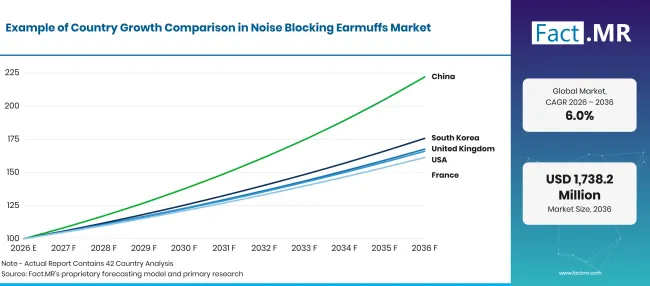
Noise Blocking Earmuffs Market Growth Index | Source: Fact.MR
| Country | CAGR (2026-2036) |
|---|---|
| China | 8.3% |
| South Korea | 5.8% |
| United Kingdom | 5.3% |
| United States | 5.2% |
| France | 4.9% |
Source: Fact.MR analysis.
Why is China the fastest-growing market for noise blocking earmuffs?
Demand for noise blocking earmuffs in China is forecast to rise at an 8.3% CAGR through 2036, the fastest among the five countries.
Expanding manufacturing, mining and industrial equipment production is supporting workplace hearing-protection requirements. China's National Bureau of Statistics reported that manufacturing value added increased by 5.4% year-on-year in October 2026, while mining output grew by 0.7%. High-technology manufacturing expanded by 17.6% during the same month. These developments indicate continued industrial activity and a broadening workforce requiring occupational protection. Earmuff suppliers can benefit from bulk procurement by factories, mining operators and construction contractors.
How is demand for noise blocking earmuffs developing in South Korea?
Sales of noise blocking earmuffs in South Korea is likely to increase at a 5.8% CAGR through 2036, below the global rate of 6.0%.
A large manufacturing base with growing attention to worker safety supports demand for imported and locally made hearing protection. Electronics, automotive, shipbuilding and machinery manufacturing continue to provide purchasing opportunities for workplace hearing protection. South Korea's Ministry of Employment and Labor reported 366 occupational accident fatalities during January–September 2026, with manufacturing accounting for 132 deaths. The ministry also reported continuing workplace safety initiatives and industrial accident monitoring. Manufacturers offering certified hearing protection and comfortable products can target industrial employers seeking stronger worker-protection programmes.
What is driving noise blocking earmuffs demand in United Kingdom?
Demand for noise blocking earmuffs in United Kingdom is estimated to advance at a 5.3% CAGR through 2036, below the global rate of 6.0%.
Strong health-and-safety regulation and active construction and industrial sectors sustain demand for certified hearing protection. The Office for National Statistics reported that Great Britain's construction output increased by 0.8% in September 2026, while repair and maintenance activity rose by 0.6%. Construction new orders also increased by 1.2% during the third quarter of 2026. These activities sustain demand for protective equipment among contractors and industrial maintenance teams. Employers must comply with the Control of Noise at Work Regulations, creating recurring purchasing opportunities for certified earmuffs, particularly for workers exposed to machinery and construction noise.
What is shaping noise blocking earmuffs demand in United States?
Sales of noise blocking earmuffs in United States is set to expand at a 5.2% CAGR through 2036, below the global rate of 6.0%.
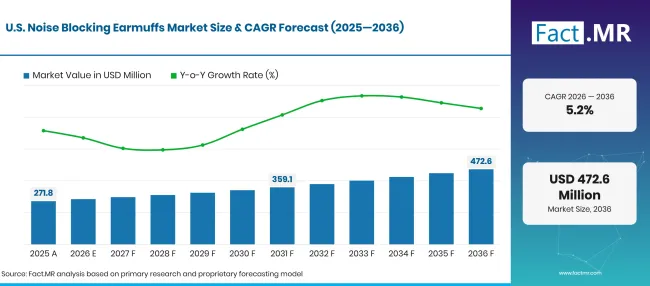
Noise Blocking Earmuffs Market Forecast Usa | Source: Fact.MR
Industrial, construction and shooting-sports use support a large market, with buyers placing weight on certification and brand reliability. According to the US Bureau of Labor Statistics, private manufacturing employment stood at approximately 8.75 million workers in September 2026, while construction employment reached 6.08 million. These substantial employment bases represent potential users of workplace hearing-protection equipment. OSHA's occupational noise standards also require hearing conservation measures at exposure levels of 85 dBA over eight hours. These conditions support recurring sales through industrial safety distributors and protective-equipment suppliers.
Why is growth slower for noise blocking earmuffs in France?
Demand for noise blocking earmuffs in France is projected to grow at a 4.9% CAGR through 2036, the slowest among the five countries.
Manufacturing, aviation and construction sectors support steady demand, with employers following established noise-exposure rules. Manufacturing, aviation, construction and industrial maintenance provide a stable replacement market, although established workplace safety practices moderate incremental demand. France's National Institute of Statistics and Economic Studies (INSEE) reported that manufacturing output increased by 0.5% month-on-month in September 2026, while electrical, electronic and computer equipment production rose by 2.6%. These activities support continued demand for protective equipment across industrial workplaces. The manufacturing companies can strengthen sales through comfortable designs, certified attenuation performance and replacement programmes for employers.
Competitive Landscape for Noise Blocking Earmuffs Market
The noise blocking earmuff market is relatively concentrated, with 3M, Honeywell, MSA Safety, Moldex-Metric and Uvex Safety Group together hold about 66% of 2026 revenue, based on Fact.MR estimates. Competition centers on certified attenuation, comfort, durability, electronic features and distribution through safety suppliers. Global safety-equipment groups lead, with specialist hearing-protection brands competing in consumer and communication models.
Recent Developments
- On January 28, 2026, 3M announced updates to its PELTOR Optime earmuff portfolio, including standardized replacement cushions, revised noise attenuation specifications and laser-etched product markings. The company also introduced refreshed packaging with standardized hearing-protection guidance. These changes support product consistency, durability and easier maintenance across industrial hearing-protection applications.
- On May 22, 2025, PIP Global Safety completed its acquisition of Honeywell's Personal Protective Equipment business, bringing the Howard Leight hearing-protection brand into its portfolio. The transaction expanded PIP's occupational safety offering and strengthened its position in hearing protection, including products designed for industrial noise exposure.
- On May 21, 2026, JSP Limited published updated technical specifications for its Sonis 3 ear defenders. The product offers a sound insulation rating of 37 dB SNR, adjustable earcups, replaceable hygiene kits and compatibility with workplace hearing-protection requirements. These specifications demonstrate continued development and support of JSP's industrial earmuff portfolio.
- In October 2026, 3M published a revised technical data sheet for its PELTOR X Series Earmuffs P3. The updated documentation covers headband and helmet-mounted configurations, replaceable cushions and foam inserts, and multiple attenuation options. This development reflects continued portfolio maintenance for industrial hearing-protection applications.
Key Players in Noise Blocking Earmuffs Market
Key companies operating in the market include 3M, MSA Safety, Moldex-Metric, uvex Safety Group, PIP Global Safety (Howard Leight), JSP Limited, Delta Plus Group, and Hellberg Safety.
- 3M
- MSA Safety
- Moldex-Metric
- uvex Safety Group
- PIP Global Safety (Howard Leight)
- JSP Limited
- Delta Plus Group
- Hellberg Safety
Bibliography
- Centers for Disease Control and Prevention, National Institute for Occupational Safety and Health. (2026, April 13). Manufacturing statistics.
- Health and Safety Executive. (2026, November 4). HSE annual report and accounts 2025 to 2026.
- Institut national de la statistique et des études économiques. (2026, November 5). In September 2026, manufacturing output increased by 0.5%.
- Ministry of Employment and Labor, Republic of Korea. (2026, October 20). 2026년 3분기(누적) 산업재해 현황 부가통계 [Supplementary statistics on industrial accidents, cumulative third quarter of 2026].
- National Bureau of Statistics of China. (2026, November 17). Industrial production operation in October 2026.
- Office for National Statistics. (2026, November 12). Construction output in Great Britain: September 2026, new orders and construction output price indices, July to September 2026.
- Occupational Safety and Health Administration. (n.d.). Hearing conservation program. U.S. Department of Labor.
- Occupational Safety and Health Administration. (n.d.). Occupational noise exposure (29 CFR § 1910.95). U.S. Department of Labor.
- Occupational Safety and Health Administration. (2021, June 1). Regional emphasis program for exposure to noise hazards in the workplace (CPL 04-00-27). U.S. Department of Labor.
- U.S. Bureau of Labor Statistics. (2026, October 2). The employment situation: September 2026.
Segmentation
Scope of Report
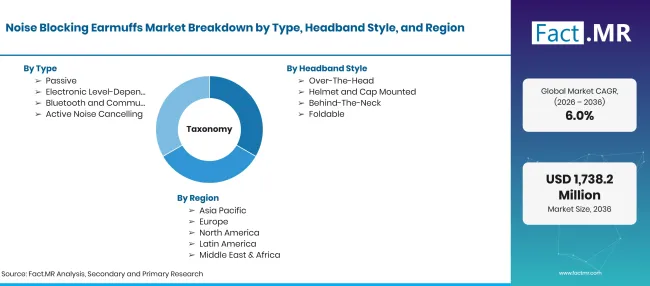
Noise Blocking Earmuffs Market Taxonomy | Source: Fact.MR
| Items | Values |
|---|---|
| Quantitative Units (2026) | USD 970.6 Million |
| Type | Passive, Electronic level-dependent, Bluetooth and communication, Active noise cancelling |
| Headband Style | Over-the-head, Helmet and cap mounted, Behind-the-neck, Foldable |
| Noise Reduction | 27 to 30 dB, 23 to 26 dB, Above 30 dB, Up to 22 dB |
| End Use | Manufacturing, Construction, Children and consumer, Shooting and hunting, Mining, oil and energy |
| Regions Covered | North America, Latin America, Europe, Asia Pacific, Middle East & Africa |
| Countries Covered | China, South Korea, United Kingdom, United States, France, and other countries |
| Key Companies Profiled | • 3M • MSA Safety • Moldex-Metric • uvex Safety Group • PIP Global Safety (Howard Leight) • JSP Limited • Delta Plus Group • Hellberg Safety |
| Additional Attributes | Dollar revenue in the Noise Blocking Earmuffs Market is segmented by type, headband style, noise reduction and end use and region. |
Source: Fact.MR analysis.
Noise Blocking Earmuffs Market by Segments
-
Type
- Passive
- Electronic level-dependent
- Bluetooth and communication
- Active noise cancelling
-
Headband Style
- Over-the-head
- Helmet and cap mounted
- Behind-the-neck
- Foldable
-
Noise Reduction
- 27 to 30 dB
- 23 to 26 dB
- Above 30 dB
- Up to 22 dB
-
End Use
- Manufacturing
- Construction
- Children and consumer
- Shooting and hunting
- Mining, oil and energy
-
Region:
- North America
- United States
- Canada
- Mexico
- Europe
- Germany
- United Kingdom
- France
- Italy
- Spain
- Rest of Europe
- Asia Pacific
- China
- India
- Japan
- South Korea
- Australia and New Zealand
- Rest of Asia Pacific
- Latin America
- Brazil
- Argentina
- Rest of Latin America
- Middle East & Africa
- GCC Countries
- South Africa
- Rest of Middle East & Africa
- North America
Table of Contents
Key Takeaways
- Market Size and CAGR
- Top Growth Driver
- Fastest Growing Segment
- Leading Region
- Key Companies
- Emerging Opportunities

