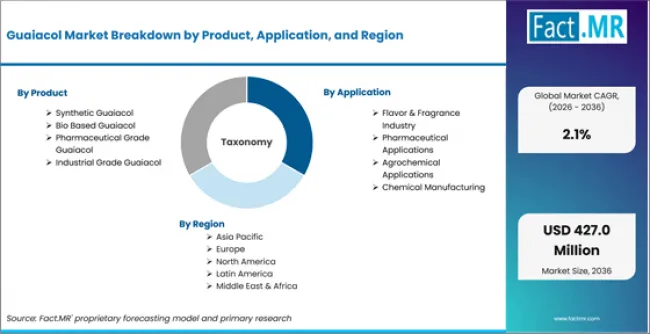
Guaiacol Market Size, Share, Growth and Forecast (2026 - 2036)
Guaiacol Market is segmented by Product (Synthetic Guaiacol, Bio Based Guaiacol, Pharmaceutical Grade Guaiacol, Industrial Grade Guaiacol), Application (Flavor & Fragrance Industry, Pharmaceutical Applications, Agrochemical Applications, Chemical Manufacturing), End Use (Pharmaceutical Companies, Chemical Industry, Food & Beverage Industry, Agrochemical Industry), and Region. Forecasts from 2026 to 2036.
Guaiacol Market Analysis and Forecast by Fact.MR
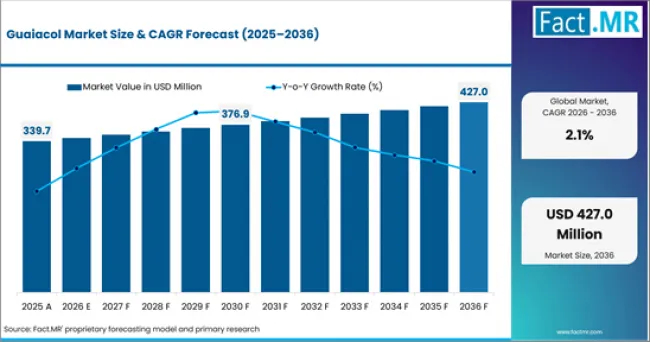
- The Guaiacol Market is expected to grow from USD 346.9 million in 2026 to USD 427.0 million by 2036, at a CAGR of 2.1% during the forecast period.
- Market growth is driven by steady expansion in vanillin production, where guaiacol serves as a key feedstock, along with increasing pharmaceutical intermediate demand and continued use in flavor formulations.
- The share of synthetic guaiacol is 68.4% and flavor and fragrance applications account for 44.6% share of the total market, as chemical producers focus on synthesis efficiency, purity consistency, and regulatory compliance for food grade and pharmaceutical grade material.
Summary of Guaiacol Market
- Market Snapshot
- In 2025, the global Guaiacol Market was valued at approximately USD 339.7 million.
- The market is estimated to reach USD 346.9 million in 2026 and is projected to attain USD 427.0 million by 2036.
- The market is likely to expand at a CAGR of 2.1% during the forecast period.
- The market is anticipated to create an absolute dollar opportunity of USD 80.1 million between 2026 and 2036.
- Synthetic guaiacol account for 68.4% of product segment share in 2026.
- China (2.8%) and India (2.6%) are the key growth markets during the forecast period.
- Demand and Growth Drivers
- Guaiacol is one of the largest single consumption channels for the production of vanillin. Approximately 85% of the worldwide synthetic vanillin is produced from guaiacol in a multi-step oxidation process .
- Guaiacol and its glyceryl ether derivative, guaifenesin, are used in cough and cold medicines, and pharmaceutical expectorant production peaks cyclically with seasonal respiratory illness patterns.
- Guaiacol has a smoky woody and phenolic flavor note that is used by the flavor industry in processed food, meat flavoring and beverage formulations.
- The fragrance industry is in need of aroma chemical intermediates with woody and balsamic profiles as it utilizes guaiacol derived compounds.
- Antioxidant synthesis from guaiacol-derived compounds creates a specialty chemical consumption channel in polymer stabilization and food preservation applications.
- Geography and Competitive Outlook
- China at 2.8% reflects strong market fundamentals and expanding demand.
- India at 2.6% reflects strong market fundamentals and expanding demand.
- Germany at 2.4% reflects strong market fundamentals and expanding demand.
- Key players include Solvay, Cayman Chemical, Merck KGaA, LGC Limited, TCI America, Jiaxing Zhonghua Chemical Co. Ltd.
- Analyst Opinion
- Shambhu Nath Jha, Principal Consultant at Fact.MR, says 'The guaiacol market is structurally linked to vanillin production, which consumes the majority of global guaiacol output. Vanillin demand grows steadily at 3 to 4% annually, driven by food and beverage industry expansion and clean-label reformulation that favors vanillin as a natural-identical flavoring over artificial alternatives. The market is mature with low growth because guaiacol consumption per tonne of vanillin is fixed by stoichiometry, and vanillin production efficiency improvements reduce guaiacol waste. Solvay and a small number of Chinese producers control the majority of synthetic guaiacol capacity. Price dynamics are stable because the guaiacol-to-vanillin value chain is vertically integrated at major producers.'
Key Growth Drivers, Constraints, and Opportunities
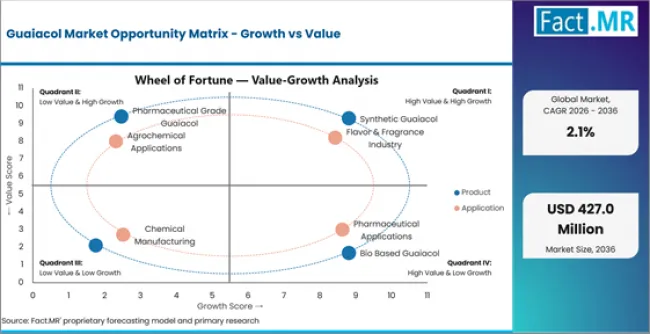
Key Factors Driving Growth
- Structural trends of industrial consumption leading to lasting procurement requirements and primary demand expansion.
- Product capability and application scope are expanding with technology advancement across existing and emerging end-use categories.
- Regulatory frameworks in key markets leading to demand for compliance and quality specification.
Key Market Constraints
- The concentration of supply or the volatility of feedstock costs exposes the downstream consumers to procurement risk .
- The operating cost for manufacturers serving multiple jurisdictions is increased by the complexity of regulatory compliance.
- Competitive pressure from other materials or processes limits pricing power in commodity segments.
Key Opportunity Areas
- High purity and specialty grades command price premiums that differentiate margins.
- Emerging market industrial capacity expansion represents a large untapped demand pool.
- Sustainability and circular economy requirements create differentiated product positioning.
Segment-wise Analysis of the Guaiacol Market
- Synthetic guaiacol hold 68.4% of the product segment in 2026.
The guaiacol market is segmented by product type, application, end use, technology, formulation, distribution channel, and region.
Which Product Segment Dominates the Guaiacol Market?
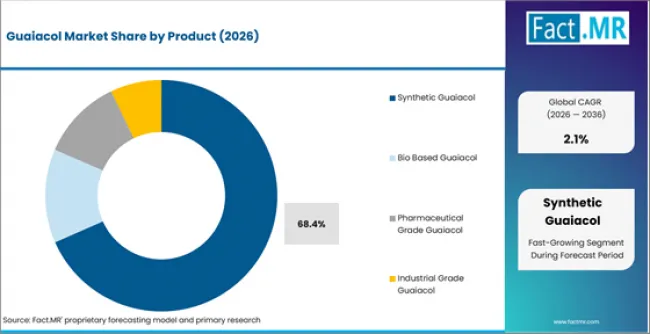
Synthetic guaiacol account for 68.4% of the product segment in 2026. Their leadership is in line with established industrial consumption patterns, broad application compatibility and primary end-use procurement requirements.
Complementary product categories meet specific needs and niche applications. The leading segment is projected to dominate the market through 2036.
Which Application Segment Dominates the Guaiacol Market?
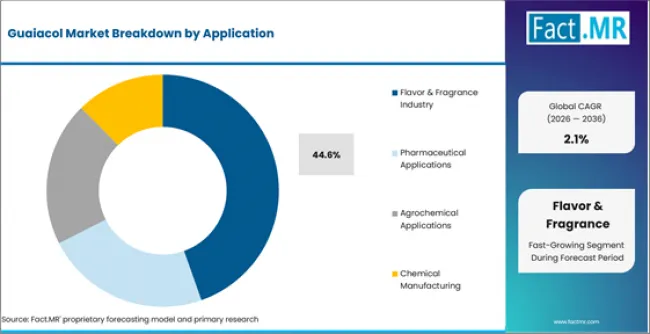
The top application anchors demand through structural consumption from primary industrial end-use sectors underpinned by production volume trends and regulatory specifications.
Growing use cases are driven by increasing demand from secondary applications. The main driver of demand still remains the main application.
Which Trend is Shaping the Next Phase of Growth in the Guaiacol Market?
Lignin-derived guaiacol from biorefinery operations represents the most significant production technology evolution. Traditional synthetic guaiacol is produced from petroleum-derived catechol. Lignin, a byproduct of pulp and paper manufacturing and cellulosic ethanol production, contains guaiacol as a natural structural component that can be extracted through thermochemical depolymerization. Several biorefinery developers are advancing lignin-to-guaiacol processes that would create a renewable, non-petroleum production route.
The commercial impact is that bio-derived guaiacol from lignin would carry sustainability credentials valued by downstream vanillin producers and flavor companies seeking natural-origin supply chains. The technology is pre-commercial but advancing, with pilot-scale demonstrations showing economic viability at lignin feedstock costs available from integrated pulp operations. If commercialized, lignin-derived guaiacol would diversify supply beyond petroleum-dependent synthetic routes and create a new product category for bio-based chemical intermediate markets.
Regional Outlook Across Key Markets
- China at 2.8% reflects expanding demand driven by regional industrial and regulatory fundamentals.
- India at 2.6% reflects expanding demand driven by regional industrial and regulatory fundamentals.
- Germany at 2.4% reflects expanding demand driven by regional industrial and regulatory fundamentals.
- Brazil at 2.2% reflects expanding demand driven by regional industrial and regulatory fundamentals.
.webp)
| Country | CAGR (%) |
|---|---|
| China | 2.8% |
| India | 2.6% |
| Germany | 2.4% |
| Brazil | 2.2% |
| USA | 2.0% |
Source: Fact.MR analysis, based on proprietary forecasting model and primary research.
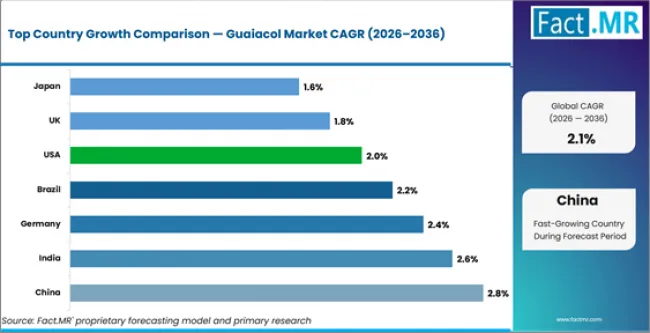
Guaiacol Market Growth Assessment in China
Through 2036, Chinese domestic guaiacol capacity from multiple producers for local vanillin manufacturing and export markets enjoys a 2.8% CAGR. The growing food processing industry, which generates parallel demand, meets the increased domestic consumption of vanillin. Chinese producers are establishing the world benchmark price for industrial grade material with their competitive pricing.
- The competitive pricing of worldwide industrial-grade guaiacol is determined by the domestic manufacturing capability of several manufacturers.
- Parallel guaiacol demand is fueled by domestic vanillin production for food industry consumption vs. established export supply channels.
Guaiacol Market Demand Trends in India
India market to grow at 2.6% CAGR through 2036 as pharma guaifenesin production, vanillin consumption drive growth. Guaiacol is used by Camlin Fine Sciences and other Indian specialty chemical manufacturers in the production of antioxidants and pharmaceutical derivatives. The pharmaceutical incentives of the PLI scheme promote the increase in domestic consumption of guaiacol for API intermediate production.
- Pharmaceutical guaifenesin production for cough and cold medication manufacturing creates stable guaiacol consumption linked to seasonal respiratory treatment demand.
- PLI scheme pharmaceutical incentives support domestic production expansion that increases guaiacol intermediate consumption for API manufacturing.
Guaiacol Market Analysis in Germany
EU food additive regulation and EFSA safety standards define guaiacol procurement specifications for the German flavor and fragrance market, expected to grow at a CAGR of 2.4% through 2036. Solvay’s European operations supply German vanillin producers and flavor houses. EU REACH compliance documentation requirements create quality barriers favoring existing European and certified Asian suppliers.
- Regulatory frameworks such as EU REACH, EFSA, etc. specify requirements for quality documentation for procurement of food-grade and fragrance-grade guaiacol.
- Solvay’s European production can offer German flavor and vanillin producers regional supply that complies with EU regulatory requirements.
Guaiacol Market Opportunity in Brazil
Brazil guaiacol market is expected to grow at a CAGR of 2.2% through 2036, supported by food processing industry expansion and growing pharmaceutical manufacturing. Primary guaiacol demand derives from vanillin consumption for confectionery, bakery and dairy flavoring. Brazilian chemical distributors need supply chain management due to dependence on synthetic guaiacol imports.
- Food processing industry growth generates vanillin demand that drives proportional guaiacol consumption for local and imported vanillin production.
- Import dependency for synthetic guaiacol creates distribution opportunities for international producers establishing Brazilian supply channels.
Guaiacol Market Outlook in USA
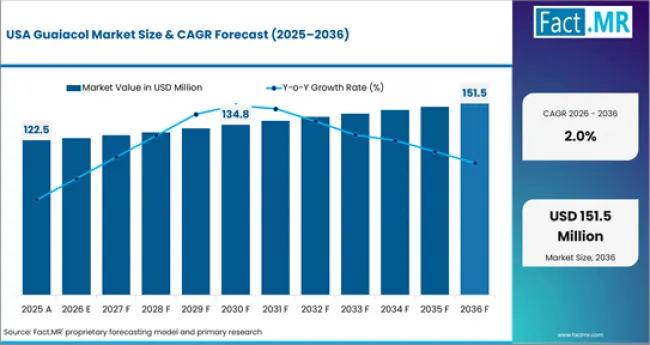
The existing vanillin production, pharmaceutical manufacturing and flavor chemical operations support the U.S. market at a CAGR of 2.0% through 2036. The FDA GRAS status for guaiacol derived flavoring substances lends support for applications in the food industry. Pharmaceutical guaifenesin demand is a stable secondary consumption channel with seasonal demand variation tied to the cold and flu season.
- Guaiacol derived flavoring compounds have been granted GRAS status by the FDA, allowing their continued use in the food industry without further regulatory approval.
- Guaifenesin demand for pharmaceuticals provides a stable secondary channel of consumption, with seasonal spikes during periods of respiratory illness.
Competitive Benchmarking and Company Positioning
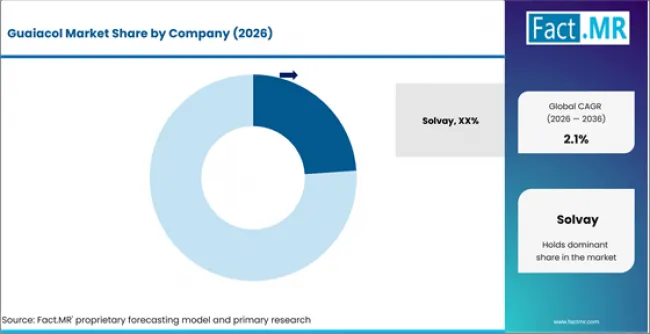
Guaiacol Market Analysis By Company
- Solvay, Cayman Chemical, Merck KGaA hold leading positions through established presence and production scale.
- LGC Limited, TCI America, Jiaxing Zhonghua Chemical Co. Ltd compete across specific grades, regional markets, and application niches.
- Production capability, supply reliability, and technical service depth create primary competitive differentiators.
The competitive landscape features Solvay and Cayman Chemical leading through scale and expertise.
Competition is intensifying as market growth and regulatory evolution create new product requirements.
Key Companies in the Guaiacol Market
- Cayman Chemical, Merck KGaA, LGC Limited, TCI America are among the leading players.
- Jiaxing Zhonghua Chemical Co. Ltd, Camlin Fine Sciences, Rhodia, Shanghai Baihe Chemicals, Linyi Mingpin Chemical compete across specific segments and markets.
Recent Industry Developments
- Syensqo – Reopening of Synthetic Vanillin Manufacturing Facility in France (September 2025)
- In September 2025, Syensqo reopened its synthetic vanillin manufacturing facility in France. Since guaiacol is a key feedstock for synthetic vanillin production, the investment strengthens downstream demand for guaiacol across flavor and fragrance applications.
- Indesso – Second Vanillin Manufacturing Plant Commissioning (December 2024)
- In December 2024, Indesso announced the launch of its second vanillin manufacturing plant in Central Java, Indonesia. The project involved approximately USD 20 million in investment and is expected to double the company's vanillin manufacturing capacity, increasing demand for guaiacol feedstocks.
- Clean Science and Technology – Expansion of Guaiacol Supply to FMCG and Pharmaceutical Applications (2025)
- During 2025, Clean Science and Technology continued commercial supply of guaiacol produced through its proprietary anisole hydroxylation process. The company highlighted applications in pharmaceutical intermediates, cough syrup APIs, vanillin production, and fragrance ingredients.
Leading Companies Shaping the Guaiacol Market
- Camlin Fine Sciences
- Jiaxing Zhonghua Chemical Co. Ltd
- Syensqo
- Anhui Haihua Chemical Technology Co., Ltd.
- Nanjing Chemlin Chemical Industry Co., Ltd.
Sources and Research References
- Syensqo. (2025, September 24). Syensqo to reopen synthetic vanillin production unit in Saint-Fons, France.
- Indesso. (2024, December 4). Indesso expands vanillin production with new Ungaran facility.
- Clean Science and Technology Ltd. (2025). Guaiacol.
This bibliography is provided for reader reference and is not exhaustive. The full report contains the complete reference list and detailed citations.
Key Questions This Report Addresses
- What is the current and future size of the Guaiacol Market?
- How fast is the Guaiacol Market expected to grow between 2026 and 2036?
- Which product type is likely to lead the market by 2026?
- Which application segment is expected to account for the highest demand?
- What factors are driving demand globally?
- How is technology evolution reshaping competitive dynamics?
- Why are China and India the fastest-growing markets?
- Which countries are projected to show the fastest growth through 2036?
- Who are the key companies active in the Guaiacol Market?
- How does Fact.MR estimate and validate the market forecast?
Guaiacol Market Definition
The guaiacol market covers the core products, materials, and chemicals within the defined scope across global and regional markets.
Guaiacol Market Inclusions
- The scope covers global and regional market size and forecasts for 2026 to 2036 across product type, application, end use, technology, formulation, distribution channel, and region.
- It includes regional demand analysis based on primary demand drivers, regulatory frameworks, and end-use consumption patterns.
- The report covers pricing analysis across major product grades and delivery configurations.
Guaiacol Market Exclusions
- The scope excludes adjacent categories and general-purpose materials not specifically designed for the defined market application.
- It excludes consulting and financial services not directly linked to market-specific procurement.
Guaiacol Market Research Methodology
- The methodology combines secondary research, primary interviews, and forecast modelling.
- It draws on 100+ secondary sources and benchmarks 40+ company portfolios.
- Market sizing covers 25+ countries through a demand-side model with top-down validation.
- Primary validation includes 20+ interviews with manufacturers, providers, end users and partners.
- Final estimates are validated using cross-validation, procurement-cycle analysis and sensitivity testing.
Scope of Analysis

| Parameter | Details |
|---|---|
| Quantitative Units | USD 346.9 million to USD 427.0 million, at a CAGR of 2.1% |
| Market Definition | The Guaiacol Market covers the primary products and materials within the defined scope. |
| Regions Covered | North America, Latin America, Europe, East Asia, South Asia and Pacific, Middle East and Africa |
| Countries Covered | China, India, Germany, Brazil, USA, 25 plus countries |
| Key Companies | Cayman Chemical, Merck KGaA, LGC Limited, TCI America, Jiaxing Zhonghua Chemical Co. Ltd, Camlin Fine Sciences, Rhodia, Shanghai Baihe Chemicals, Linyi Mingpin Chemical |
| Forecast Period | 2026 to 2036 |
| Approach | Hybrid demand-side and top-down methodology with primary interviews and cross-validation |
Guaiacol Market Segmentation
-
Guaiacol Market Segmented by Product:
- Synthetic Guaiacol
- Petrochemical Derived Guaiacol
- Benzene Based Synthesis Route
- Toluene Based Derivatives Route
- Phenol Based Synthesis
- Catalytic Conversion Processes
- Oxidation Based Production Routes
- Petrochemical Derived Guaiacol
- Bio Based Guaiacol
- Lignin Derived Guaiacol
- Wood Biomass Extraction Methods
- Agricultural Waste Conversion Routes
- Biorefinery Produced Guaiacol
- Enzymatic Conversion Processes
- Green Chemistry Synthesis Routes
- Lignin Derived Guaiacol
- Pharmaceutical Grade Guaiacol
- API Intermediate Grade
- Cough Suppressant Formulations
- Expectorant Active Ingredients
- High Purity Medical Grade
- Sterile Processing Grades
- Regulatory Compliant APIs
- API Intermediate Grade
- Industrial Grade Guaiacol
- Flavor & Fragrance Grade
- Vanillin Production Feedstock
- Aroma Chemical Blends
- Chemical Intermediate Grade
- Resin Production Inputs
- Specialty Chemical Synthesis
- Flavor & Fragrance Grade
- Synthetic Guaiacol
-
Guaiacol Market Segmented by Application:
- Flavor & Fragrance Industry
- Vanillin Production Applications
- Synthetic Vanillin Manufacturing
- Natural Flavor Enhancement Systems
- Aroma Chemical Production
- Perfume Base Formulation
- Fragrance Modifier Compounds
- Vanillin Production Applications
- Pharmaceutical Applications
- Cough Suppressant Formulations
- Expectorant Drug Manufacturing
- Syrup Formulation Inputs
- Antiseptic Drug Applications
- Topical Antiseptic Formulations
- Oral Therapeutic Preparations
- Cough Suppressant Formulations
- Agrochemical Applications
- Pesticide Intermediate Use
- Herbicide Formulation Inputs
- Fungicide Chemical Synthesis
- Plant Protection Chemicals
- Crop Protection Additives
- Agricultural Spray Formulations
- Pesticide Intermediate Use
- Chemical Manufacturing
- Resin Production Applications
- Epoxy Resin Manufacturing
- Phenolic Resin Synthesis
- Industrial Chemical Synthesis
- Polymer Additive Production
- Specialty Chemical Intermediates
- Resin Production Applications
- Flavor & Fragrance Industry
-
Guaiacol Market Segmented by End Use:
- Pharmaceutical Companies
- Drug Manufacturing Firms
- OTC Medicine Producers
- Prescription Drug Manufacturers
- API Manufacturing Units
- Bulk API Production Facilities
- Specialty API Producers
- Drug Manufacturing Firms
- Chemical Industry
- Specialty Chemical Producers
- Aroma Chemical Manufacturers
- Industrial Chemical Firms
- Petrochemical Companies
- Downstream Chemical Units
- Refinery Based Chemical Plants
- Specialty Chemical Producers
- Food & Beverage Industry
- Flavor Manufacturing Companies
- Food Additive Producers
- Beverage Flavor Companies
- Processed Food Manufacturers
- Packaged Food Producers
- Confectionery Manufacturers
- Flavor Manufacturing Companies
- Agrochemical Industry
- Crop Protection Companies
- Pesticide Manufacturers
- Herbicide Producers
- Agricultural Input Suppliers
- Farming Chemical Distributors
- Agri Solution Providers
- Crop Protection Companies
- Pharmaceutical Companies
-
Guaiacol Market Segmented by Technology:
- Catalytic Synthesis Technology
- Metal Catalysis Systems
- Palladium Catalyzed Reactions
- Nickel Based Catalytic Systems
- Oxidation Reaction Technology
- Controlled Oxidation Processes
- Selective Oxidation Systems
- Metal Catalysis Systems
- Bioconversion Technology
- Enzymatic Conversion Systems
- Microbial Biotransformation Routes
- Lignin Breakdown Enzymes
- Fermentation Based Systems
- Biomass Conversion Fermentation
- Green Chemistry Platforms
- Enzymatic Conversion Systems
- Separation & Purification Technology
- Distillation Systems
- Fractional Distillation Units
- Vacuum Distillation Systems
- Chromatography Systems
- Industrial Purification Columns
- High Precision Separation Systems
- Distillation Systems
- Process Optimization Technology
- AI Controlled Synthesis Systems
- Predictive Yield Optimization
- Automated Reaction Control Systems
- Digital Chemical Monitoring
- Real Time Reaction Analytics
- Smart Process Control Units
- AI Controlled Synthesis Systems
- Catalytic Synthesis Technology
-
Guaiacol Market Segmented by Formulation:
- Liquid Formulations
- Solvent Based Solutions
- Organic Solvent Mixtures
- Aqueous Dispersion Systems
- High Purity Liquid Grades
- Pharmaceutical Liquid Intermediates
- Ultra Pure Chemical Solutions
- Solvent Based Solutions
- Solid Formulations
- Crystalline Powder Forms
- Microcrystalline Guaiacol Powders
- Refined Solid Granules
- Encapsulated Forms
- Controlled Release Particles
- Stabilized Solid Blends
- Crystalline Powder Forms
- Blended Formulations
- Multi Component Blends
- Aroma Chemical Blends
- Industrial Chemical Mixtures
- Functional Chemical Blends
- Flavor Enhancer Blends
- Pharmaceutical Blend Systems
- Multi Component Blends
- Specialty Formulations
- High Stability Formulations
- Thermal Stable Chemical Forms
- Long Shelf Life Solutions
- Customized Formulations
- Application Specific Grades
- Industry Tailored Chemical Systems
- High Stability Formulations
- Liquid Formulations
-
Guaiacol Market Segmented by Distribution Channel:
- Direct Chemical Sales
- B2B Industrial Contracts
- Pharmaceutical Supply Agreements
- Chemical Manufacturing Contracts
- Enterprise Procurement Deals
- Large Scale Bulk Orders
- Long Term Supply Contracts
- B2B Industrial Contracts
- Chemical Distributors
- Regional Chemical Distributors
- Aroma Chemical Suppliers
- Industrial Chemical Traders
- Global Distribution Networks
- International Chemical Exporters
- Multi Region Supply Chains
- Regional Chemical Distributors
- Online Chemical Platforms
- Digital B2B Marketplaces
- Industrial Chemical Portals
- Bulk Procurement Platforms
- Manufacturer Direct Portals
- OEM Supply Platforms
- Digital Ordering Systems
- Digital B2B Marketplaces
- Specialty Suppliers
- Niche Chemical Suppliers
- High Purity Chemical Vendors
- Research Grade Suppliers
- Custom Synthesis Providers
- Made to Order Chemical Producers
- Contract Manufacturing Providers
- Niche Chemical Suppliers
- Direct Chemical Sales
-
Guaiacol Market by Region:
- North America
- USA
- Canada
- Mexico
- Latin America
- Brazil
- Chile
- Rest of Latin America
- Western Europe
- Germany
- UK
- Italy
- Spain
- France
- Nordic
- BENELUX
- Rest of Western Europe
- Eastern Europe
- Russia
- Poland
- Hungary
- Balkan & Baltic
- Rest of Eastern Europe
- East Asia
- China
- Japan
- South Korea
- South Asia and Pacific
- India
- ASEAN
- Australia & New Zealand
- Rest of South Asia and Pacific
- Middle East & Africa
- Kingdom of Saudi Arabia
- Other GCC Countries
- Turkiye
- South Africa
- Other African Union
- Rest of Middle East & Africa
- North America
- Frequently Asked Questions -
How big is the guaiacol market in 2026?
The global guaiacol market is estimated to be valued at USD 346.9 million in 2026.
What will be the size of guaiacol market in 2036?
The market size for the guaiacol market is projected to reach USD 427.0 million by 2036.
How much will be the guaiacol market growth between 2026 and 2036?
The guaiacol market is expected to grow at a 2.1% CAGR between 2026 and 2036.
What are the key products in the guaiacol market?
The key products in guaiacol market are Synthetic Guaiacol, Bio Based Guaiacol, Pharmaceutical Grade Guaiacol and Industrial Grade Guaiacol.
Which application segment is expected to contribute significant share in the guaiacol market in 2026?
In terms of application, flavor & fragrance industry segment is expected to command 44.6% share in the guaiacol market in 2026.
Table of Content
- Key Takeaways
- Market Size and CAGR
- Top Growth Driver
- Fastest Growing Segment
- Leading Region
- Key Companies
- Emerging Opportunities
- Executive Summary
- Global Market Outlook
- Demand-side Trends
- Supply-side Trends
- Technology Roadmap Analysis
- Analysis and Recommendations
- Analyst Perspective (What is happening? Why now? What should investors know?)
- Key Questions Answered
- How large is the market?
- What is the CAGR?
- What are key trends?
- Which region dominates?
- Who are the leaders?
- Market Overview
- Market Coverage / Taxonomy
- Market Definition / Scope / Limitations
- Research Methodology
- Chapter Orientation
- Analytical Lens and Working Hypotheses
- Market Structure, Signals, and Trend Drivers
- Benchmarking and Cross-market Comparability
- Market Sizing, Forecasting, and Opportunity Mapping
- Research Design and Evidence Framework
- Desk Research Programme (Secondary Evidence)
- Expert Input and Fieldwork (Primary Evidence)
- Tooling, Models, and Reference Databases
- Data Engineering and Model Build
- Quality Assurance and Audit Trail
- Market Background
- Market Dynamics (Drivers, Restraints, Opportunity, Trends)
- Scenario Forecast (Optimistic, Likely, Conservative)
- Impact Analysis
- AI Impact
- Sustainability Impact
- Regulatory Impact
- Technology Impact
- Consumer / Buyer Analysis
- Purchase Drivers
- Adoption Barriers
- Buyer Journey
- Opportunity Map Analysis
- Product Life Cycle Analysis
- Supply Chain Analysis
- Investment Feasibility Matrix
- Value Chain Analysis
- PESTLE and Porter's Analysis
- Regulatory Landscape
- Regional Parent Market Outlook
- Production and Consumption Statistics
- Import and Export Statistics
- Global Market Analysis and Forecast, 2021 to 2036
- Historical Market Size Value (USD Million) Analysis, 2021 to 2025
- Current and Future Market Size Value (USD Million) Projections, 2026 to 2036
- Y-o-Y Growth Trend Analysis
- Absolute $ Opportunity Analysis
- Global Market Pricing Analysis, 2021 to 2036
- Global Market Analysis and Forecast, By Product, 2021 to 2036
- Introduction / Key Findings
- Historical Market Size Value (USD Million) Analysis By Product, 2021 to 2025
- Current and Future Market Size Value (USD Million) Analysis and Forecast By Product, 2026 to 2036
- Synthetic Guaiacol
- Petrochemical Derived Guaiacol
- Phenol Based Synthesis
- Bio Based Guaiacol
- Lignin Derived Guaiacol
- Biorefinery Produced Guaiacol
- Pharmaceutical Grade Guaiacol
- API Intermediate Grade
- High Purity Medical Grade
- Industrial Grade Guaiacol
- Flavor & Fragrance Grade
- Chemical Intermediate Grade
- Synthetic Guaiacol
- Y-o-Y Growth Trend Analysis By Product, 2021 to 2025
- Absolute $ Opportunity Analysis By Product, 2026 to 2036
- Global Market Analysis and Forecast, By Application, 2021 to 2036
- Introduction / Key Findings
- Historical Market Size Value (USD Million) Analysis By Application, 2021 to 2025
- Current and Future Market Size Value (USD Million) Analysis and Forecast By Application, 2026 to 2036
- Flavor & Fragrance Industry
- Vanillin Production Applications
- Aroma Chemical Production
- Pharmaceutical Applications
- Cough Suppressant Formulations
- Antiseptic Drug Applications
- Agrochemical Applications
- Pesticide Intermediate Use
- Plant Protection Chemicals
- Chemical Manufacturing
- Resin Production Applications
- Industrial Chemical Synthesis
- Flavor & Fragrance Industry
- Y-o-Y Growth Trend Analysis By Application, 2021 to 2025
- Absolute $ Opportunity Analysis By Application, 2026 to 2036
- Global Market Analysis and Forecast, By End Use, 2021 to 2036
- Introduction / Key Findings
- Historical Market Size Value (USD Million) Analysis By End Use, 2021 to 2025
- Current and Future Market Size Value (USD Million) Analysis and Forecast By End Use, 2026 to 2036
- Pharmaceutical Companies
- Drug Manufacturing Firms
- API Manufacturing Value (USD Million)s
- Chemical Industry
- Specialty Chemical Producers
- Petrochemical Companies
- Food & Beverage Industry
- Flavor Manufacturing Companies
- Processed Food Manufacturers
- Agrochemical Industry
- Crop Protection Companies
- Agricultural Input Suppliers
- Pharmaceutical Companies
- Y-o-Y Growth Trend Analysis By End Use, 2021 to 2025
- Absolute $ Opportunity Analysis By End Use, 2026 to 2036
- Global Market Analysis and Forecast, By Technology, 2021 to 2036
- Introduction / Key Findings
- Historical Market Size Value (USD Million) Analysis By Technology, 2021 to 2025
- Current and Future Market Size Value (USD Million) Analysis and Forecast By Technology, 2026 to 2036
- Catalytic Synthesis Technology
- Metal Catalysis Systems
- Oxidation Reaction Technology
- Bioconversion Technology
- Enzymatic Conversion Systems
- Fermentation Based Systems
- Separation & Purification Technology
- Distillation Systems
- Chromatography Systems
- Process Optimization Technology
- AI Controlled Synthesis Systems
- Digital Chemical Monitoring
- Catalytic Synthesis Technology
- Y-o-Y Growth Trend Analysis By Technology, 2021 to 2025
- Absolute $ Opportunity Analysis By Technology, 2026 to 2036
- Global Market Analysis and Forecast, By Formulation, 2021 to 2036
- Introduction / Key Findings
- Historical Market Size Value (USD Million) Analysis By Formulation, 2021 to 2025
- Current and Future Market Size Value (USD Million) Analysis and Forecast By Formulation, 2026 to 2036
- Liquid Formulations
- Solvent Based Solutions
- High Purity Liquid Grades
- Solid Formulations
- Crystalline Powder Forms
- Encapsulated Forms
- Blended Formulations
- Multi Component Blends
- Functional Chemical Blends
- Specialty Formulations
- High Stability Formulations
- Customized Formulations
- Liquid Formulations
- Y-o-Y Growth Trend Analysis By Formulation, 2021 to 2025
- Absolute $ Opportunity Analysis By Formulation, 2026 to 2036
- Global Market Analysis and Forecast, By Distribution Channel
- Introduction / Key Findings
- Historical Market Size Value (USD Million) Analysis By Distribution Channel, 2021 to 2025
- Current and Future Market Size Value (USD Million) Analysis and Forecast By Distribution Channel, 2026 to 2036
- Direct Chemical Sales
- B2B Industrial Contracts
- Enterprise Procurement Deals
- Chemical Distributors
- Regional Chemical Distributors
- Global Distribution Networks
- Online Chemical Platforms
- Digital B2B Marketplaces
- Manufacturer Direct Portals
- Specialty Suppliers
- Niche Chemical Suppliers
- Custom Synthesis Providers
- Direct Chemical Sales
- Y-o-Y Growth Trend Analysis By Distribution Channel, 2021 to 2025
- Absolute $ Opportunity Analysis By Distribution Channel, 2026 to 2036
- Global Market Analysis and Forecast, By Region, 2021 to 2036
- Introduction
- Historical Market Size Value (USD Million) Analysis By Region, 2021 to 2025
- Current Market Size Value (USD Million) Analysis and Forecast By Region, 2026 to 2036
- North America
- Latin America
- Western Europe
- Eastern Europe
- East Asia
- South Asia and Pacific
- Middle East & Africa
- Market Attractiveness Analysis By Region
- North America Market Analysis and Forecast, By Country, 2021 to 2036
- Historical Market Size Value (USD Million) Trend Analysis By Market Taxonomy, 2021 to 2025
- Market Size Value (USD Million) Forecast By Market Taxonomy, 2026 to 2036
- By Country
- USA
- Canada
- Mexico
- By Product
- By Application
- By End Use
- By Technology
- By Formulation
- By Distribution Channel
- By Country
- Market Attractiveness Analysis
- By Country
- By Product
- By Application
- By End Use
- By Technology
- By Formulation
- By Distribution Channel
- Key Takeaways
- Latin America Market Analysis and Forecast, By Country
- Historical Market Size Value (USD Million) Trend Analysis By Market Taxonomy, 2021 to 2025
- Market Size Value (USD Million) Forecast By Market Taxonomy, 2026 to 2036
- By Country
- Brazil
- Chile
- Rest of Latin America
- By Product
- By Application
- By End Use
- By Technology
- By Formulation
- By Distribution Channel
- By Country
- Market Attractiveness Analysis
- By Country
- By Product
- By Application
- By End Use
- By Technology
- By Formulation
- By Distribution Channel
- Key Takeaways
- Western Europe Market Analysis and Forecast, By Country
- Historical Market Size Value (USD Million) Trend Analysis By Market Taxonomy, 2021 to 2025
- Market Size Value (USD Million) Forecast By Market Taxonomy, 2026 to 2036
- By Country
- Germany
- UK
- Italy
- Spain
- France
- Nordic
- BENELUX
- Rest of Western Europe
- By Product
- By Application
- By End Use
- By Technology
- By Formulation
- By Distribution Channel
- By Country
- Market Attractiveness Analysis
- By Country
- By Product
- By Application
- By End Use
- By Technology
- By Formulation
- By Distribution Channel
- Key Takeaways
- Eastern Europe Market Analysis and Forecast, By Country
- Historical Market Size Value (USD Million) Trend Analysis By Market Taxonomy, 2021 to 2025
- Market Size Value (USD Million) Forecast By Market Taxonomy, 2026 to 2036
- By Country
- Russia
- Poland
- Hungary
- Balkan & Baltic
- Rest of Eastern Europe
- By Product
- By Application
- By End Use
- By Technology
- By Formulation
- By Distribution Channel
- By Country
- Market Attractiveness Analysis
- By Country
- By Product
- By Application
- By End Use
- By Technology
- By Formulation
- By Distribution Channel
- Key Takeaways
- East Asia Market Analysis and Forecast, By Country
- Historical Market Size Value (USD Million) Trend Analysis By Market Taxonomy, 2021 to 2025
- Market Size Value (USD Million) Forecast By Market Taxonomy, 2026 to 2036
- By Country
- China
- Japan
- South Korea
- By Product
- By Application
- By End Use
- By Technology
- By Formulation
- By Distribution Channel
- By Country
- Market Attractiveness Analysis
- By Country
- By Product
- By Application
- By End Use
- By Technology
- By Formulation
- By Distribution Channel
- Key Takeaways
- South Asia and Pacific Market Analysis and Forecast, By Country
- Historical Market Size Value (USD Million) Trend Analysis By Market Taxonomy, 2021 to 2025
- Market Size Value (USD Million) Forecast By Market Taxonomy, 2026 to 2036
- By Country
- India
- ASEAN
- Australia & New Zealand
- Rest of South Asia and Pacific
- By Product
- By Application
- By End Use
- By Technology
- By Formulation
- By Distribution Channel
- By Country
- Market Attractiveness Analysis
- By Country
- By Product
- By Application
- By End Use
- By Technology
- By Formulation
- By Distribution Channel
- Key Takeaways
- Middle East & Africa Market Analysis and Forecast, By Country
- Historical Market Size Value (USD Million) Trend Analysis By Market Taxonomy, 2021 to 2025
- Market Size Value (USD Million) Forecast By Market Taxonomy, 2026 to 2036
- By Country
- Kingdom of Saudi Arabia
- Other GCC Countries
- Turkiye
- South Africa
- Other African Union
- Rest of Middle East & Africa
- By Product
- By Application
- By End Use
- By Technology
- By Formulation
- By Distribution Channel
- By Country
- Market Attractiveness Analysis
- By Country
- By Product
- By Application
- By End Use
- By Technology
- By Formulation
- By Distribution Channel
- Key Takeaways
- Key Countries Market Analysis
- USA
- Pricing Analysis
- Market Share Analysis, 2025
- By Product
- By Application
- By End Use
- By Technology
- By Formulation
- By Distribution Channel
- Canada
- Pricing Analysis
- Market Share Analysis, 2025
- By Product
- By Application
- By End Use
- By Technology
- By Formulation
- By Distribution Channel
- Mexico
- Pricing Analysis
- Market Share Analysis, 2025
- By Product
- By Application
- By End Use
- By Technology
- By Formulation
- By Distribution Channel
- Brazil
- Pricing Analysis
- Market Share Analysis, 2025
- By Product
- By Application
- By End Use
- By Technology
- By Formulation
- By Distribution Channel
- Chile
- Pricing Analysis
- Market Share Analysis, 2025
- By Product
- By Application
- By End Use
- By Technology
- By Formulation
- By Distribution Channel
- Germany
- Pricing Analysis
- Market Share Analysis, 2025
- By Product
- By Application
- By End Use
- By Technology
- By Formulation
- By Distribution Channel
- UK
- Pricing Analysis
- Market Share Analysis, 2025
- By Product
- By Application
- By End Use
- By Technology
- By Formulation
- By Distribution Channel
- Italy
- Pricing Analysis
- Market Share Analysis, 2025
- By Product
- By Application
- By End Use
- By Technology
- By Formulation
- By Distribution Channel
- Spain
- Pricing Analysis
- Market Share Analysis, 2025
- By Product
- By Application
- By End Use
- By Technology
- By Formulation
- By Distribution Channel
- France
- Pricing Analysis
- Market Share Analysis, 2025
- By Product
- By Application
- By End Use
- By Technology
- By Formulation
- By Distribution Channel
- India
- Pricing Analysis
- Market Share Analysis, 2025
- By Product
- By Application
- By End Use
- By Technology
- By Formulation
- By Distribution Channel
- ASEAN
- Pricing Analysis
- Market Share Analysis, 2025
- By Product
- By Application
- By End Use
- By Technology
- By Formulation
- By Distribution Channel
- Australia & New Zealand
- Pricing Analysis
- Market Share Analysis, 2025
- By Product
- By Application
- By End Use
- By Technology
- By Formulation
- By Distribution Channel
- China
- Pricing Analysis
- Market Share Analysis, 2025
- By Product
- By Application
- By End Use
- By Technology
- By Formulation
- By Distribution Channel
- Japan
- Pricing Analysis
- Market Share Analysis, 2025
- By Product
- By Application
- By End Use
- By Technology
- By Formulation
- By Distribution Channel
- South Korea
- Pricing Analysis
- Market Share Analysis, 2025
- By Product
- By Application
- By End Use
- By Technology
- By Formulation
- By Distribution Channel
- Russia
- Pricing Analysis
- Market Share Analysis, 2025
- By Product
- By Application
- By End Use
- By Technology
- By Formulation
- By Distribution Channel
- Poland
- Pricing Analysis
- Market Share Analysis, 2025
- By Product
- By Application
- By End Use
- By Technology
- By Formulation
- By Distribution Channel
- Hungary
- Pricing Analysis
- Market Share Analysis, 2025
- By Product
- By Application
- By End Use
- By Technology
- By Formulation
- By Distribution Channel
- Kingdom of Saudi Arabia
- Pricing Analysis
- Market Share Analysis, 2025
- By Product
- By Application
- By End Use
- By Technology
- By Formulation
- By Distribution Channel
- Turkiye
- Pricing Analysis
- Market Share Analysis, 2025
- By Product
- By Application
- By End Use
- By Technology
- By Formulation
- By Distribution Channel
- South Africa
- Pricing Analysis
- Market Share Analysis, 2025
- By Product
- By Application
- By End Use
- By Technology
- By Formulation
- By Distribution Channel
- USA
- Market Structure Analysis
- Competition Dashboard
- Competition Benchmarking
- Market Share Analysis of Top Players
- By Regional
- By Product
- By Application
- By End Use
- By Technology
- By Formulation
- By Distribution Channel
- Emerging Startups
- Innovation Benchmarking
- Competition Analysis
- Competition Deep Dive
- Solvay
- Overview
- Product Portfolio
- Profitability by Market Segments (Product/Age /Sales Channel/Region)
- Sales Footprint
- Strategy Overview
- Marketing Strategy
- Product Strategy
- Channel Strategy
- Cayman Chemical
- Merck KGaA
- LGC Limited
- TCI America
- Jiaxing Zhonghua Chemical Co., Ltd
- Anhui Bayi Chemical Industry Co., Ltd
- Central Drug House
- Jiangsu Lycra Chemical Technology Co., Ltd.
- Derek Clarke
- Tianyuan Chemical
- Helly Chem
- Hubei Ju Sheng
- Solvay
- Competition Deep Dive
- Case Studies
- Success Stories
- Recent Developments
- Assumptions & Acronyms Used
List Of Table
- Table 1: Global Market Value (USD Million) Forecast by Region, 2021 to 2036
- Table 2: Global Market Value (USD Million) Forecast by Product, 2021 to 2036
- Table 3: Global Market Value (USD Million) Forecast by Application, 2021 to 2036
- Table 4: Global Market Value (USD Million) Forecast by End Use, 2021 to 2036
- Table 5: Global Market Value (USD Million) Forecast by Technology, 2021 to 2036
- Table 6: Global Market Value (USD Million) Forecast by Formulation, 2021 to 2036
- Table 7: Global Market Value (USD Million) Forecast by Distribution Channel, 2021 to 2036
- Table 8: Global Market rma_anu Forecast by rma_anu, 2021 to 2036
- Table 9: North America Market Value (USD Million) Forecast by Country, 2021 to 2036
- Table 10: North America Market Value (USD Million) Forecast by Product, 2021 to 2036
- Table 11: North America Market Value (USD Million) Forecast by Application, 2021 to 2036
- Table 12: North America Market Value (USD Million) Forecast by End Use, 2021 to 2036
- Table 13: North America Market Value (USD Million) Forecast by Technology, 2021 to 2036
- Table 14: North America Market Value (USD Million) Forecast by Formulation, 2021 to 2036
- Table 15: North America Market Value (USD Million) Forecast by Distribution Channel, 2021 to 2036
- Table 16: Latin America Market Value (USD Million) Forecast by Country, 2021 to 2036
- Table 17: Latin America Market Value (USD Million) Forecast by Product, 2021 to 2036
- Table 18: Latin America Market Value (USD Million) Forecast by Application, 2021 to 2036
- Table 19: Latin America Market Value (USD Million) Forecast by End Use, 2021 to 2036
- Table 20: Latin America Market Value (USD Million) Forecast by Technology, 2021 to 2036
- Table 21: Latin America Market Value (USD Million) Forecast by Formulation, 2021 to 2036
- Table 22: Latin America Market Value (USD Million) Forecast by Distribution Channel, 2021 to 2036
- Table 23: Western Europe Market Value (USD Million) Forecast by Country, 2021 to 2036
- Table 24: Western Europe Market Value (USD Million) Forecast by Product, 2021 to 2036
- Table 25: Western Europe Market Value (USD Million) Forecast by Application, 2021 to 2036
- Table 26: Western Europe Market Value (USD Million) Forecast by End Use, 2021 to 2036
- Table 27: Western Europe Market Value (USD Million) Forecast by Technology, 2021 to 2036
- Table 28: Western Europe Market Value (USD Million) Forecast by Formulation, 2021 to 2036
- Table 29: Western Europe Market Value (USD Million) Forecast by Distribution Channel, 2021 to 2036
- Table 30: Eastern Europe Market Value (USD Million) Forecast by Country, 2021 to 2036
- Table 31: Eastern Europe Market Value (USD Million) Forecast by Product, 2021 to 2036
- Table 32: Eastern Europe Market Value (USD Million) Forecast by Application, 2021 to 2036
- Table 33: Eastern Europe Market Value (USD Million) Forecast by End Use, 2021 to 2036
- Table 34: Eastern Europe Market Value (USD Million) Forecast by Technology, 2021 to 2036
- Table 35: Eastern Europe Market Value (USD Million) Forecast by Formulation, 2021 to 2036
- Table 36: Eastern Europe Market Value (USD Million) Forecast by Distribution Channel, 2021 to 2036
- Table 37: East Asia Market Value (USD Million) Forecast by Country, 2021 to 2036
- Table 38: East Asia Market Value (USD Million) Forecast by Product, 2021 to 2036
- Table 39: East Asia Market Value (USD Million) Forecast by Application, 2021 to 2036
- Table 40: East Asia Market Value (USD Million) Forecast by End Use, 2021 to 2036
- Table 41: East Asia Market Value (USD Million) Forecast by Technology, 2021 to 2036
- Table 42: East Asia Market Value (USD Million) Forecast by Formulation, 2021 to 2036
- Table 43: East Asia Market Value (USD Million) Forecast by Distribution Channel, 2021 to 2036
- Table 44: South Asia and Pacific Market Value (USD Million) Forecast by Country, 2021 to 2036
- Table 45: South Asia and Pacific Market Value (USD Million) Forecast by Product, 2021 to 2036
- Table 46: South Asia and Pacific Market Value (USD Million) Forecast by Application, 2021 to 2036
- Table 47: South Asia and Pacific Market Value (USD Million) Forecast by End Use, 2021 to 2036
- Table 48: South Asia and Pacific Market Value (USD Million) Forecast by Technology, 2021 to 2036
- Table 49: South Asia and Pacific Market Value (USD Million) Forecast by Formulation, 2021 to 2036
- Table 50: South Asia and Pacific Market Value (USD Million) Forecast by Distribution Channel, 2021 to 2036
- Table 51: Middle East & Africa Market Value (USD Million) Forecast by Country, 2021 to 2036
- Table 52: Middle East & Africa Market Value (USD Million) Forecast by Product, 2021 to 2036
- Table 53: Middle East & Africa Market Value (USD Million) Forecast by Application, 2021 to 2036
- Table 54: Middle East & Africa Market Value (USD Million) Forecast by End Use, 2021 to 2036
- Table 55: Middle East & Africa Market Value (USD Million) Forecast by Technology, 2021 to 2036
- Table 56: Middle East & Africa Market Value (USD Million) Forecast by Formulation, 2021 to 2036
- Table 57: Middle East & Africa Market Value (USD Million) Forecast by Distribution Channel, 2021 to 2036
List Of Figures
- Figure 1: Global Market Pricing Analysis
- Figure 2: Global Market Value (USD Million) Forecast 2021 to 2036
- Figure 3: Global Market Value Share and BPS Analysis by Product, 2026 and 2036
- Figure 4: Global Market Y-o-Y Growth Comparison by Product, 2026 to 2036
- Figure 5: Global Market Attractiveness Analysis by Product
- Figure 6: Global Market Value Share and BPS Analysis by Application, 2026 and 2036
- Figure 7: Global Market Y-o-Y Growth Comparison by Application, 2026 to 2036
- Figure 8: Global Market Attractiveness Analysis by Application
- Figure 9: Global Market Value Share and BPS Analysis by End Use, 2026 and 2036
- Figure 10: Global Market Y-o-Y Growth Comparison by End Use, 2026 to 2036
- Figure 11: Global Market Attractiveness Analysis by End Use
- Figure 12: Global Market Value Share and BPS Analysis by Technology, 2026 and 2036
- Figure 13: Global Market Y-o-Y Growth Comparison by Technology, 2026 to 2036
- Figure 14: Global Market Attractiveness Analysis by Technology
- Figure 15: Global Market Value Share and BPS Analysis by Formulation, 2026 and 2036
- Figure 16: Global Market Y-o-Y Growth Comparison by Formulation, 2026 to 2036
- Figure 17: Global Market Attractiveness Analysis by Formulation
- Figure 18: Global Market Value Share and BPS Analysis by Distribution Channel, 2026 and 2036
- Figure 19: Global Market Y-o-Y Growth Comparison by Distribution Channel, 2026 to 2036
- Figure 20: Global Market Attractiveness Analysis by Distribution Channel
- Figure 21: Global Market Value (USD Million) Share and BPS Analysis by Region, 2026 and 2036
- Figure 22: Global Market Y-o-Y Growth Comparison by Region, 2026 to 2036
- Figure 23: Global Market Attractiveness Analysis by Region
- Figure 24: North America Market Incremental Dollar Opportunity, 2026 to 2036
- Figure 25: Latin America Market Incremental Dollar Opportunity, 2026 to 2036
- Figure 26: Western Europe Market Incremental Dollar Opportunity, 2026 to 2036
- Figure 27: Eastern Europe Market Incremental Dollar Opportunity, 2026 to 2036
- Figure 28: East Asia Market Incremental Dollar Opportunity, 2026 to 2036
- Figure 29: South Asia and Pacific Market Incremental Dollar Opportunity, 2026 to 2036
- Figure 30: Middle East & Africa Market Incremental Dollar Opportunity, 2026 to 2036
- Figure 31: North America Market Value Share and BPS Analysis by Country, 2026 and 2036
- Figure 32: North America Market Value Share and BPS Analysis by Product, 2026 and 2036
- Figure 33: North America Market Y-o-Y Growth Comparison by Product, 2026 to 2036
- Figure 34: North America Market Attractiveness Analysis by Product
- Figure 35: North America Market Value Share and BPS Analysis by Application, 2026 and 2036
- Figure 36: North America Market Y-o-Y Growth Comparison by Application, 2026 to 2036
- Figure 37: North America Market Attractiveness Analysis by Application
- Figure 38: North America Market Value Share and BPS Analysis by End Use, 2026 and 2036
- Figure 39: North America Market Y-o-Y Growth Comparison by End Use, 2026 to 2036
- Figure 40: North America Market Attractiveness Analysis by End Use
- Figure 41: North America Market Value Share and BPS Analysis by Technology, 2026 and 2036
- Figure 42: North America Market Y-o-Y Growth Comparison by Technology, 2026 to 2036
- Figure 43: North America Market Attractiveness Analysis by Technology
- Figure 44: North America Market Value Share and BPS Analysis by Formulation, 2026 and 2036
- Figure 45: North America Market Y-o-Y Growth Comparison by Formulation, 2026 to 2036
- Figure 46: North America Market Attractiveness Analysis by Formulation
- Figure 47: North America Market Value Share and BPS Analysis by Distribution Channel, 2026 and 2036
- Figure 48: North America Market Y-o-Y Growth Comparison by Distribution Channel, 2026 to 2036
- Figure 49: North America Market Attractiveness Analysis by Distribution Channel
- Figure 50: Latin America Market Value Share and BPS Analysis by Country, 2026 and 2036
- Figure 51: Latin America Market Value Share and BPS Analysis by Product, 2026 and 2036
- Figure 52: Latin America Market Y-o-Y Growth Comparison by Product, 2026 to 2036
- Figure 53: Latin America Market Attractiveness Analysis by Product
- Figure 54: Latin America Market Value Share and BPS Analysis by Application, 2026 and 2036
- Figure 55: Latin America Market Y-o-Y Growth Comparison by Application, 2026 to 2036
- Figure 56: Latin America Market Attractiveness Analysis by Application
- Figure 57: Latin America Market Value Share and BPS Analysis by End Use, 2026 and 2036
- Figure 58: Latin America Market Y-o-Y Growth Comparison by End Use, 2026 to 2036
- Figure 59: Latin America Market Attractiveness Analysis by End Use
- Figure 60: Latin America Market Value Share and BPS Analysis by Technology, 2026 and 2036
- Figure 61: Latin America Market Y-o-Y Growth Comparison by Technology, 2026 to 2036
- Figure 62: Latin America Market Attractiveness Analysis by Technology
- Figure 63: Latin America Market Value Share and BPS Analysis by Formulation, 2026 and 2036
- Figure 64: Latin America Market Y-o-Y Growth Comparison by Formulation, 2026 to 2036
- Figure 65: Latin America Market Attractiveness Analysis by Formulation
- Figure 66: Latin America Market Value Share and BPS Analysis by Distribution Channel, 2026 and 2036
- Figure 67: Latin America Market Y-o-Y Growth Comparison by Distribution Channel, 2026 to 2036
- Figure 68: Latin America Market Attractiveness Analysis by Distribution Channel
- Figure 69: Western Europe Market Value Share and BPS Analysis by Country, 2026 and 2036
- Figure 70: Western Europe Market Value Share and BPS Analysis by Product, 2026 and 2036
- Figure 71: Western Europe Market Y-o-Y Growth Comparison by Product, 2026 to 2036
- Figure 72: Western Europe Market Attractiveness Analysis by Product
- Figure 73: Western Europe Market Value Share and BPS Analysis by Application, 2026 and 2036
- Figure 74: Western Europe Market Y-o-Y Growth Comparison by Application, 2026 to 2036
- Figure 75: Western Europe Market Attractiveness Analysis by Application
- Figure 76: Western Europe Market Value Share and BPS Analysis by End Use, 2026 and 2036
- Figure 77: Western Europe Market Y-o-Y Growth Comparison by End Use, 2026 to 2036
- Figure 78: Western Europe Market Attractiveness Analysis by End Use
- Figure 79: Western Europe Market Value Share and BPS Analysis by Technology, 2026 and 2036
- Figure 80: Western Europe Market Y-o-Y Growth Comparison by Technology, 2026 to 2036
- Figure 81: Western Europe Market Attractiveness Analysis by Technology
- Figure 82: Western Europe Market Value Share and BPS Analysis by Formulation, 2026 and 2036
- Figure 83: Western Europe Market Y-o-Y Growth Comparison by Formulation, 2026 to 2036
- Figure 84: Western Europe Market Attractiveness Analysis by Formulation
- Figure 85: Western Europe Market Value Share and BPS Analysis by Distribution Channel, 2026 and 2036
- Figure 86: Western Europe Market Y-o-Y Growth Comparison by Distribution Channel, 2026 to 2036
- Figure 87: Western Europe Market Attractiveness Analysis by Distribution Channel
- Figure 88: Eastern Europe Market Value Share and BPS Analysis by Country, 2026 and 2036
- Figure 89: Eastern Europe Market Value Share and BPS Analysis by Product, 2026 and 2036
- Figure 90: Eastern Europe Market Y-o-Y Growth Comparison by Product, 2026 to 2036
- Figure 91: Eastern Europe Market Attractiveness Analysis by Product
- Figure 92: Eastern Europe Market Value Share and BPS Analysis by Application, 2026 and 2036
- Figure 93: Eastern Europe Market Y-o-Y Growth Comparison by Application, 2026 to 2036
- Figure 94: Eastern Europe Market Attractiveness Analysis by Application
- Figure 95: Eastern Europe Market Value Share and BPS Analysis by End Use, 2026 and 2036
- Figure 96: Eastern Europe Market Y-o-Y Growth Comparison by End Use, 2026 to 2036
- Figure 97: Eastern Europe Market Attractiveness Analysis by End Use
- Figure 98: Eastern Europe Market Value Share and BPS Analysis by Technology, 2026 and 2036
- Figure 99: Eastern Europe Market Y-o-Y Growth Comparison by Technology, 2026 to 2036
- Figure 100: Eastern Europe Market Attractiveness Analysis by Technology
- Figure 101: Eastern Europe Market Value Share and BPS Analysis by Formulation, 2026 and 2036
- Figure 102: Eastern Europe Market Y-o-Y Growth Comparison by Formulation, 2026 to 2036
- Figure 103: Eastern Europe Market Attractiveness Analysis by Formulation
- Figure 104: Eastern Europe Market Value Share and BPS Analysis by Distribution Channel, 2026 and 2036
- Figure 105: Eastern Europe Market Y-o-Y Growth Comparison by Distribution Channel, 2026 to 2036
- Figure 106: Eastern Europe Market Attractiveness Analysis by Distribution Channel
- Figure 107: East Asia Market Value Share and BPS Analysis by Country, 2026 and 2036
- Figure 108: East Asia Market Value Share and BPS Analysis by Product, 2026 and 2036
- Figure 109: East Asia Market Y-o-Y Growth Comparison by Product, 2026 to 2036
- Figure 110: East Asia Market Attractiveness Analysis by Product
- Figure 111: East Asia Market Value Share and BPS Analysis by Application, 2026 and 2036
- Figure 112: East Asia Market Y-o-Y Growth Comparison by Application, 2026 to 2036
- Figure 113: East Asia Market Attractiveness Analysis by Application
- Figure 114: East Asia Market Value Share and BPS Analysis by End Use, 2026 and 2036
- Figure 115: East Asia Market Y-o-Y Growth Comparison by End Use, 2026 to 2036
- Figure 116: East Asia Market Attractiveness Analysis by End Use
- Figure 117: East Asia Market Value Share and BPS Analysis by Technology, 2026 and 2036
- Figure 118: East Asia Market Y-o-Y Growth Comparison by Technology, 2026 to 2036
- Figure 119: East Asia Market Attractiveness Analysis by Technology
- Figure 120: East Asia Market Value Share and BPS Analysis by Formulation, 2026 and 2036
- Figure 121: East Asia Market Y-o-Y Growth Comparison by Formulation, 2026 to 2036
- Figure 122: East Asia Market Attractiveness Analysis by Formulation
- Figure 123: East Asia Market Value Share and BPS Analysis by Distribution Channel, 2026 and 2036
- Figure 124: East Asia Market Y-o-Y Growth Comparison by Distribution Channel, 2026 to 2036
- Figure 125: East Asia Market Attractiveness Analysis by Distribution Channel
- Figure 126: South Asia and Pacific Market Value Share and BPS Analysis by Country, 2026 and 2036
- Figure 127: South Asia and Pacific Market Value Share and BPS Analysis by Product, 2026 and 2036
- Figure 128: South Asia and Pacific Market Y-o-Y Growth Comparison by Product, 2026 to 2036
- Figure 129: South Asia and Pacific Market Attractiveness Analysis by Product
- Figure 130: South Asia and Pacific Market Value Share and BPS Analysis by Application, 2026 and 2036
- Figure 131: South Asia and Pacific Market Y-o-Y Growth Comparison by Application, 2026 to 2036
- Figure 132: South Asia and Pacific Market Attractiveness Analysis by Application
- Figure 133: South Asia and Pacific Market Value Share and BPS Analysis by End Use, 2026 and 2036
- Figure 134: South Asia and Pacific Market Y-o-Y Growth Comparison by End Use, 2026 to 2036
- Figure 135: South Asia and Pacific Market Attractiveness Analysis by End Use
- Figure 136: South Asia and Pacific Market Value Share and BPS Analysis by Technology, 2026 and 2036
- Figure 137: South Asia and Pacific Market Y-o-Y Growth Comparison by Technology, 2026 to 2036
- Figure 138: South Asia and Pacific Market Attractiveness Analysis by Technology
- Figure 139: South Asia and Pacific Market Value Share and BPS Analysis by Formulation, 2026 and 2036
- Figure 140: South Asia and Pacific Market Y-o-Y Growth Comparison by Formulation, 2026 to 2036
- Figure 141: South Asia and Pacific Market Attractiveness Analysis by Formulation
- Figure 142: South Asia and Pacific Market Value Share and BPS Analysis by Distribution Channel, 2026 and 2036
- Figure 143: South Asia and Pacific Market Y-o-Y Growth Comparison by Distribution Channel, 2026 to 2036
- Figure 144: South Asia and Pacific Market Attractiveness Analysis by Distribution Channel
- Figure 145: Middle East & Africa Market Value Share and BPS Analysis by Country, 2026 and 2036
- Figure 146: Middle East & Africa Market Value Share and BPS Analysis by Product, 2026 and 2036
- Figure 147: Middle East & Africa Market Y-o-Y Growth Comparison by Product, 2026 to 2036
- Figure 148: Middle East & Africa Market Attractiveness Analysis by Product
- Figure 149: Middle East & Africa Market Value Share and BPS Analysis by Application, 2026 and 2036
- Figure 150: Middle East & Africa Market Y-o-Y Growth Comparison by Application, 2026 to 2036
- Figure 151: Middle East & Africa Market Attractiveness Analysis by Application
- Figure 152: Middle East & Africa Market Value Share and BPS Analysis by End Use, 2026 and 2036
- Figure 153: Middle East & Africa Market Y-o-Y Growth Comparison by End Use, 2026 to 2036
- Figure 154: Middle East & Africa Market Attractiveness Analysis by End Use
- Figure 155: Middle East & Africa Market Value Share and BPS Analysis by Technology, 2026 and 2036
- Figure 156: Middle East & Africa Market Y-o-Y Growth Comparison by Technology, 2026 to 2036
- Figure 157: Middle East & Africa Market Attractiveness Analysis by Technology
- Figure 158: Middle East & Africa Market Value Share and BPS Analysis by Formulation, 2026 and 2036
- Figure 159: Middle East & Africa Market Y-o-Y Growth Comparison by Formulation, 2026 to 2036
- Figure 160: Middle East & Africa Market Attractiveness Analysis by Formulation
- Figure 161: Middle East & Africa Market Value Share and BPS Analysis by Distribution Channel, 2026 and 2036
- Figure 162: Middle East & Africa Market Y-o-Y Growth Comparison by Distribution Channel, 2026 to 2036
- Figure 163: Middle East & Africa Market Attractiveness Analysis by Distribution Channel
- Figure 164: Global Market - Tier Structure Analysis
- Figure 165: Global Market - Company Share Analysis