- Base Value(2025): 0.9 Bn
- Estimated Value(2026): 0.9 Bn
- Forecast Value (2036): 1.6 Bn
- CAGR (2026 - 2036): 5.9%
Heptaldehyde Market Analysis and Forecast by Fact.MR
- The Heptaldehyde Market is expected to grow from USD 0.9 billion in 2026 to USD 1.6 billion by 2036, at a 5.9% CAGR.
-
The market is driven by expanding fragrance and flavor chemical production, growing demand for pharmaceutical intermediates, and increasing use of heptaldehyde in lubricant additive synthesis.
-
Industrial grade heptaldehyde accounts for 62.9% of the product segment, while fragrance and perfumery applications contribute 41.6% of market demand as manufacturers prioritize consistent purity, reliable supply, and cost-efficient feedstock sourcing.
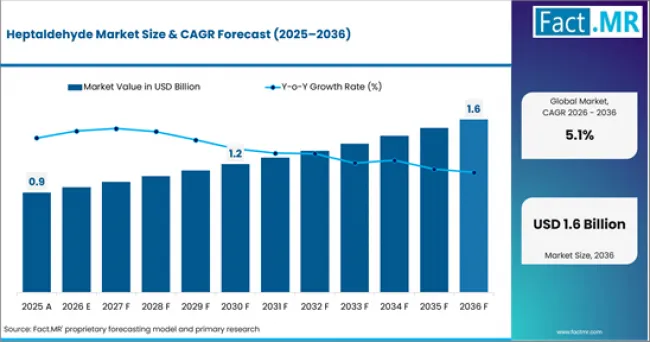
Heptaldehyde Market Value Analysis | Source: Fact.MR
Summary of Heptaldehyde Market
- Market Snapshot
- In 2025, the global Heptaldehyde Market was valued at approximately USD 0.8 billion.
- The market is estimated to reach USD 0.9 billion in 2026 and is projected to attain USD 1.6 billion by 2036.
- The market is likely to expand at a CAGR of 5.9% during the forecast period.
- The market is anticipated to create an absolute dollar opportunity of USD 0.7 billion between 2026 and 2036.
- Industrial grade heptaldehyde account for 62.9% of product segment share in 2026.
- China (6.9%) and India (6.4%) are the key growth markets during the forecast period.
- Demand and Growth Drivers
- Growth in the fragrance industry supports demand for heptaldehyde, a fatty aldehyde intermediate used in the synthesis of green, oily and citrus notes for fine fragrances, personal care and household cleaning products.
- Heptaldehyde is used in pharmaceutical intermediate synthesis for the manufacture of drug compounds that require C7 aldehyde building blocks. Growing demand for intermediates is being driven by oncology and anti-infective pipelines.
- Heptaldehyde is used as a lubricant additive manufacturing component in the production of friction modifiers and extreme pressure additives for automotive and industrial lubricant formulations.
- In plasticizer production, heptaldehyde-derived alcohols are used in ester plasticizer formulations for PVC and other polymer processing applications.
- The progress of oxo synthesis technology is increasing the heptaldehyde yield from hexene feedstock, reducing the production cost and enabling capacity expansion at a lower capital intensity.
- Geography and Competitive Outlook
- China at 6.9% reflects strong market fundamentals and expanding demand.
- India at 6.4% reflects strong market fundamentals and expanding demand.
- Germany at 5.9% reflects strong market fundamentals and expanding demand.
- Key players include Merck KGaA, Arkema Group, Acme Synthetic Chemicals, TCI Chemicals, Kalpsutra Chemicals Pvt. Ltd..
- Analyst Opinion
- Shambhu Nath Jha, Principal Consultant at Fact.MR, says "The heptaldehyde market is a specialty aldehyde category where demand spans fragrance chemicals, pharmaceutical intermediates, lubricant additives, and plasticizer precursors. Fragrance applications dominate because heptaldehyde's characteristic green and oily note profile makes it an essential building block for perfumery compositions. Supply is concentrated among oxo chemistry producers that manufacture heptaldehyde through hydroformylation of hexene. China and India represent the fastest growth because their fragrance chemical, pharmaceutical, and specialty chemical manufacturing sectors are expanding at rates above global averages. Purity grade differentiation creates pricing stratification between industrial and pharmaceutical grades."
Key Growth Drivers, Constraints, and Opportunities
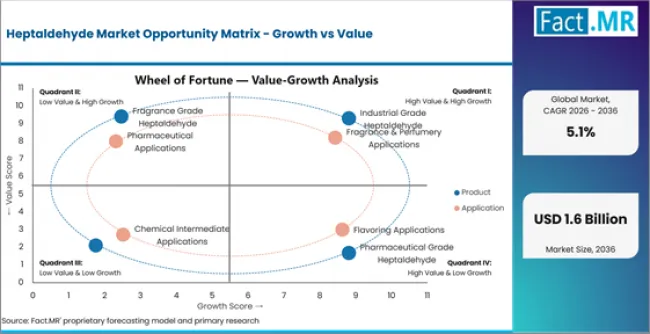
Heptaldehyde Market Opportunity Matrix Growth Vs Value | Source: Fact.MR
Key Factors Driving Growth
- Structural industrial consumption trends creating sustained procurement requirements driving primary demand expansion.
- Technology advancement broadening product capability and application scope across existing and emerging end use categories.
- Regulatory frameworks that create compliance driven demand and quality specification requirements in key markets.
Key Market Constraints
- Downstream consumers are exposed to procurement risk from concentration of supply or volatility in feedstock costs.
- The need to comply with regulations in many jurisdictions adds to the cost of doing business for manufacturers.
- In commodity segments, competitive pressure from alternative materials or processes limits price power.
Key Opportunity Areas
- High-purity and specialty grades command pricing premiums that create margin differentiation.
- Emerging market industrial capacity expansion represents a large untapped demand pool.
- Sustainability and circular economy requirements create differentiated product positioning.
Segment-wise Analysis of the Heptaldehyde Market
- Industrial grade heptaldehyde hold 62.9% of the product segment in 2026.
The heptaldehyde market is segmented by product type, application, end use, technology, formulation, distribution channel, and region.
Which Product Segment Dominates the Heptaldehyde Market?
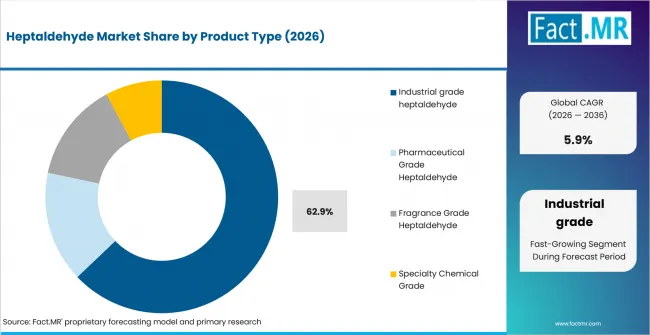
Heptaldehyde Market Analysis By Product Type | Source: Fact.MR
Industrial grade heptaldehyde account for 62.9% of the product segment in 2026. Their leadership reflects established industrial consumption patterns, broad application compatibility, and alignment with primary end-use procurement requirements.
Complementary product categories serve specialized requirements and niche applications. The leading segment is expected to retain dominance through 2036.
Which Application Segment Dominates the Heptaldehyde Market?
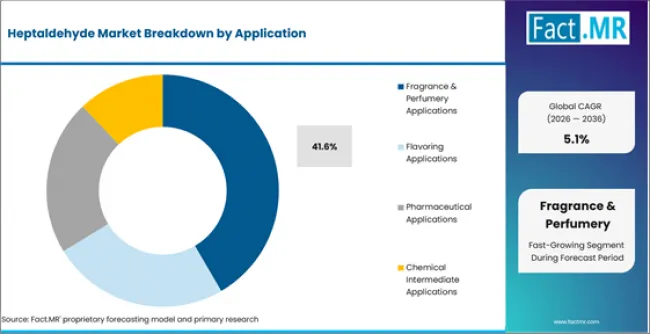
Heptaldehyde Market Analysis By Application | Source: Fact.MR
The leading application anchors demand through structural consumption from primary industrial end-use segments, supported by production volume trends and regulatory specifications.
Secondary applications contribute to the increasing demand from growing use cases. The leading application is still the main driver of demand.
Which Trend is Shaping the Next Phase of Growth in the Heptaldehyde Market?
The most important production technology development is the production of bio-based heptaldehyde from renewable feedstock. Traditional heptaldehyde is made by oxo synthesis of petroleum-based hexene. Producers are exploring bio-based routes that use fatty acid oxidation or fermentation-derived intermediates to deliver sustainability-certified aldehyde products for fragrance and food-grade applications where downstream customers require documented bio-based content.
The commercial impact is that bio-based certification creates pricing premium opportunity in fragrance and food applications where consumer brands seek natural-origin and sustainability-certified ingredient supply chains. Producers that establish bio-based production routes first will capture the growing segment of sustainability-differentiated downstream demand, particularly in European and North American markets where ESG reporting requirements extend to ingredient sourcing.
Regional Outlook Across Key Markets
- China at 6.9% reflects expanding demand driven by regional industrial and regulatory fundamentals.
- India at 6.4% reflects expanding demand driven by regional industrial and regulatory fundamentals.
- Germany at 5.9% reflects expanding demand driven by regional industrial and regulatory fundamentals.
- Brazil at 5.4% reflects expanding demand driven by regional industrial and regulatory fundamentals
.webp "Top Country Growth Comparison Heptaldehyde Market Cagr (2026 2036)")
Top Country Growth Comparison Heptaldehyde Market Cagr (2026 2036) | Source: Fact.MR
| Country | CAGR (%) |
|---|---|
| China | 6.9% |
| India | 6.4% |
| Germany | 5.9% |
| Brazil | 5.4% |
| USA | 4.8% |
Source: Fact.MR analysis. Updated Jun 13, 2026
Source: Fact.MR analysis, based on proprietary forecasting model and primary research.
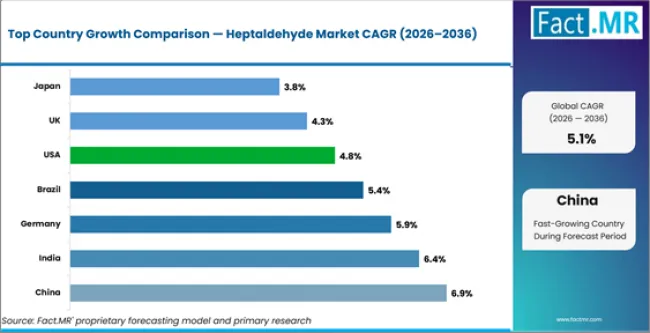
Heptaldehyde Market Cagr Analysis By Country | Source: Fact.MR
Heptaldehyde Market Growth Assessment in China
The scale of China's fragrance chemical and pharmaceutical intermediate manufacturing positions the market at a 6.9% CAGR through 2036. Domestic oxo synthesis capacity serves both local consumption and export demand for heptaldehyde across Asia Pacific markets. Growing fine fragrance market penetration in Chinese consumer products is expanding domestic aroma chemical consumption.
- Domestic oxo synthesis capacity serves local fragrance chemical producers and pharmaceutical intermediate manufacturers at competitive pricing.
- Growing fine fragrance penetration in Chinese consumer personal care products is expanding domestic heptaldehyde consumption beyond industrial and export channels.
Heptaldehyde Market Demand Trends in India
Expanding pharmaceutical intermediate production and growing fragrance chemical manufacturing drive the India market at a 6.4% CAGR through 2036. PLI scheme incentives for pharmaceutical and chemical manufacturing are encouraging domestic heptaldehyde production capacity. Kalpsutra Chemicals and other Indian producers serve both domestic consumption and export markets.
- PLI scheme pharmaceutical manufacturing incentives are generating growing demand for C7 aldehyde intermediates used in API synthesis pathways.
- The growing domestic fragrance chemical manufacturing industry is creating parallel demand for heptaldehyde for use in aroma chemical production as well as pharmaceutical applications.
Heptaldehyde Market Analysis in Germany
EU REACH chemical registration and IFRA fragrance safety standards define heptaldehyde procurement specifications for the German market at a 5.9% CAGR through 2036.
- Quality documentation safety standards for heptaldehyde for fragrance and cosmetics applications are defined by EU REACH and IFRA.
- German fragrance houses have established long-term supply relationships for heptaldehyde of consistent quality to support fine fragrance production.
Heptaldehyde Market Opportunity in Brazil
Brazil heptaldehyde market to grow at 5.4% CAGR through 2036, driven by increasing personal care and household products manufacturing. Brazil is one of the world’s largest personal care markets in volume, which creates a steady demand for fragrance chemical intermediates. Regional distribution partnerships are created by import dependency of specialty aldehyde grades.
- Position as one of the world's largest personal care markets by volume creates structural demand for fragrance chemical intermediates including heptaldehyde.
- Import dependency for pharmaceutical and specialty grades creates distribution opportunities for international producers establishing Brazilian supply channels.
Heptaldehyde Market Outlook in USA
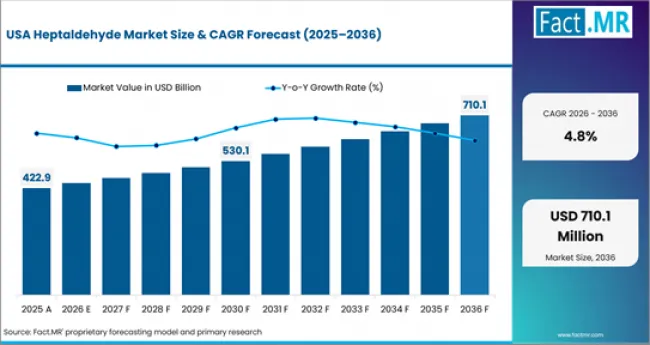
Heptaldehyde Market Country Value Analysis | Source: Fact.MR
The U.S. market is supported by an installed base of fragrance, pharmaceutical and specialty chemical manufacturing, which sustains a CAGR of 4.8% through 2036. FDA defines pharmaceutical intermediate quality standards for procurement specifications of GMP grade material.
- In the U.S. fragrance operations have a steady procurement of heptaldehyde to support aldehyde-based perfumery compositions.
- Pharmaceutical Intermediate Procurement: FDA Quality Standards GMP-grade heptaldehyde sourcing requires purity and documentation standards.
Competitive Benchmarking and Company Positioning
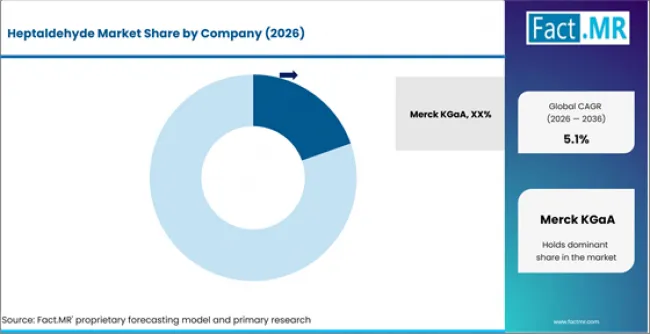
Heptaldehyde Market Analysis By Company | Source: Fact.MR
Heptaldehyde Market Analysis By Company
- Merck KGaA, Arkema Group hold leading positions through established presence and production scale.
- Acme Synthetic Chemicals, TCI Chemicals, Kalpsutra Chemicals Pvt. Ltd. compete in specific grades, regional markets and application niches.
- Primary competitive differentiators are defined by production capability, supply reliability and depth of technical service.
Merck KGaA and Arkema Group are the key players in the competitive landscape, based on their size and expertise.
Regulatory evolution and market growth are creating new product requirements and increasing competition.
Key Companies in the Heptaldehyde Market
- Merck KGaA, Arkema Group, Acme Synthetic Chemicals, TCI Chemicals are among the leading players.
- Kalpsutra Chemicals Pvt. Ltd. compete across specific segments and markets.
Recent Industry Developments
- March 2024 | Arkema Group | Product Certification: Oleris Bio-Based Aldehyde Portfolio
- Arkema continued to promote its Oleris range of advanced bio-based oleochemicals, including renewable n-heptaldehyde produced from castor oil. The product is utilized as a sustainable intermediate in fragrance, flavor, agrochemical, and specialty chemical applications, supporting the industry's increasing focus on bio-based raw materials.
Key Companies in the Heptaldehyde Market
- Merck KGaA
- Arkema Group
- Acme Synthetic Chemicals
- TCI Chemicals
- Kalpsutra Chemicals Pvt. Ltd.
Sources and Research References
- Arkema. (2024, March 25). Arkema awarded USDA BioPreferred® product label for its entire Oleris® range. Arkema.
- Arkema. (2026). Oleris® n-Heptaldehyde: Bio-based linear aldehyde. Arkema.
- Aurochemicals. (2025, August 15). Heptanal (Aldehyde C-7) (n-Heptaldehyde), natural: Product specification. Aurochemicals.
- FEMA. (2026). Heptanal. Flavor & Extract Manufacturers Association.
- Nova Industries. (2026). Heptaldehyde. Nova Industries.
This bibliography is provided for reader reference and is not exhaustive. The full report contains the complete reference list and detailed citations.
Key Questions This Report Addresses
- What is the current and future size of the Heptaldehyde Market?
- How fast is the Heptaldehyde Market expected to grow between 2026 and 2036?
- Which product type is likely to lead the market by 2026?
- Which application segment is expected to account for the highest demand?
- What factors are driving demand globally?
- How is technology evolution reshaping competitive dynamics?
- Why are China and India the fastest-growing markets?
- Which countries are projected to show the fastest growth through 2036?
- Who are the key companies active in the Heptaldehyde Market?
- How does Fact.MR estimate and validate the market forecast?
Heptaldehyde Market Definition
The heptaldehyde market covers the core products, materials, and chemicals within the defined scope across global and regional markets.
Heptaldehyde Market Inclusions
- The scope covers global and regional market size and forecasts for 2026 to 2036 across product type, application, end use, technology, formulation, distribution channel, and region.
- It includes regional demand analysis based on primary demand drivers, regulatory frameworks, and end-use consumption patterns.
- The report covers pricing analysis across major product grades and delivery configurations.
Heptaldehyde Market Exclusions
- The scope excludes adjacent categories and general-purpose materials not specifically designed for the defined market application.
- It excludes consulting and financial services not directly linked to market-specific procurement.
Heptaldehyde Market Research Methodology
- The methodology combines secondary research, primary interviews, and forecast modelling.
- It draws on 100+ secondary sources and benchmarks 40+ company portfolios.
- Market sizing covers 40+ countries through a demand-side model with top-down validation.
- Primary validation includes 20+ interviews across manufacturers, providers, end users and partners.
- Final estimates are cross-validated, examined in the context of the procurement cycle, and tested for sensitivity.
Segmentation
Scope of Analysis
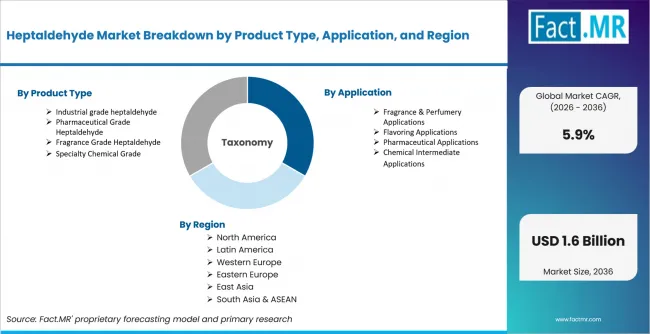
Heptaldehyde Market Breakdown By Product Type, Application, And Region | Source: Fact.MR
| Parameter | Details |
|---|---|
| Quantitative Units | USD billion to USD billion, at a CAGR |
| Market Definition | The Heptaldehyde Market covers the primary products and materials within the defined scope. |
| Product | Industrial Grade Heptaldehyde, Pharmaceutical Grade Heptaldehyde, Fragrance Grade Heptaldehyde, Specialty Chemical Grade |
| Application |
Source: Fact.MR analysis. Updated Jun 13, 2026 Fragrance & Perfumery Applications, Flavoring Applications, Pharmaceutical Applications, Chemical Intermediate Applications |
| End use |
Source: Fact.MR analysis. Updated Jun 13, 2026 Chemical Manufacturing Companies, Pharmaceutical Companies, Fragrance & Flavor Companies, Cosmetics Industry |
| Technology |
Source: Fact.MR analysis. Updated Jun 13, 2026 Catalytic Synthesis Technology, Distillation Technology, Purification Technology, Process Automation Technology |
| Formulation |
Source: Fact.MR analysis. Updated Jun 13, 2026 Liquid Formulations, Solvent Based Formulations, Stabilized Formulations, Blended Formulations |
| Distribution Channel | Direct Chemical Sales, Chemical Distributors, Online Chemical Platforms |
| Regions Covered | North America, Latin America, Europe, East Asia, South Asia and Pacific, Middle East and Africa |
| Countries Covered | China, India, Germany, Brazil, USA, 40 plus countries |
| Key Companies | Merck KGaA, Arkema Group, Acme Synthetic Chemicals, TCI Chemicals, Kalpsutra Chemicals Pvt. Ltd. |
| Forecast Period | 2026 to 2036 |
| Approach | Hybrid demand-side and top-down methodology with primary interviews and cross-validation |
Source: Fact.MR analysis. Updated Jun 13, 2026
Heptaldehyde Market Segmentation
-
Heptaldehyde Market Segmented by Product:
- Industrial Grade Heptaldehyde
- Bulk Chemical Grade
- High Purity Industrial Grade
- Standard Industrial Grade
- Technical Grade
- Process Intermediate Grade
- Low Purity Commercial Grade
- Bulk Chemical Grade
- Pharmaceutical Grade Heptaldehyde
- API Intermediate Grade
- Fine Chemical Synthesis Grade
- Lab Reagent Grade
- High Purity Pharmaceutical Grade
- Sterile Synthesis Grade
- Controlled Purity Grade
- API Intermediate Grade
- Fragrance Grade Heptaldehyde
- Aroma Chemical Grade
- Perfumery Intermediate Grade
- Flavoring Ingredient Grade
- Cosmetic Grade
- Personal Care Formulation Grade
- Skin Safe Fragrance Grade
- Aroma Chemical Grade
- Specialty Chemical Grade
- Research Grade Chemicals
- Analytical Testing Grade
- R&D Formulation Grade
- Custom Synthesis Grade
- Tailored Molecular Grade
- Application Specific Grade
- Research Grade Chemicals
- Industrial Grade Heptaldehyde
-
Heptaldehyde Market Segmented by Application:
- Fragrance & Perfumery Applications
- Fine Fragrance Production
- Luxury Perfume Manufacturing
- Designer Fragrance Blending
- Industrial Fragrance Applications
- Air Freshener Formulations
- Household Fragrance Products
- Fine Fragrance Production
- Flavoring Applications
- Food Flavor Additives
- Processed Food Flavoring
- Beverage Flavor Enhancement
- Confectionery Flavor Systems
- Sweet Flavor Compounds
- Baked Goods Flavoring Agents
- Food Flavor Additives
- Pharmaceutical Applications
- Drug Intermediate Synthesis
- API Manufacturing Processes
- Active Compound Development
- Medicinal Chemistry Applications
- Therapeutic Compound Research
- Formulation Development Studies
- Drug Intermediate Synthesis
- Chemical Intermediate Applications
- Organic Synthesis Applications
- Aldehyde Based Reactions
- Complex Molecule Synthesis
- Industrial Chemical Production
- Resin Manufacturing Inputs
- Plastic Additive Production
- Organic Synthesis Applications
- Fragrance & Perfumery Applications
-
Heptaldehyde Market Segmented by End Use:
- Chemical Manufacturing Companies
- Bulk Chemical Producers
- Commodity Chemical Plants
- Specialty Chemical Plants
- Fine Chemical Manufacturers
- High Purity Chemical Producers
- Custom Synthesis Companies
- Bulk Chemical Producers
- Pharmaceutical Companies
- Drug Manufacturing Firms
- Generic Drug Producers
- Branded Drug Manufacturers
- Research Laboratories
- Pharma R&D Centers
- Clinical Development Labs
- Drug Manufacturing Firms
- Fragrance & Flavor Companies
- Perfumery Manufacturers
- Luxury Fragrance Brands
- Industrial Scent Producers
- Food Flavor Companies
- Beverage Flavor Producers
- Confectionery Flavor Firms
- Perfumery Manufacturers
- Cosmetics Industry
- Personal Care Manufacturers
- Skincare Product Companies
- Haircare Product Brands
- Cosmetic Ingredient Suppliers
- Fragrance Ingredient Blenders
- Formulation Service Providers
- Personal Care Manufacturers
- Chemical Manufacturing Companies
-
Heptaldehyde Market Segmented by Technology:
- Catalytic Synthesis Technology
- Oxidation Reaction Systems
- Selective Oxidation Reactors
- Controlled Reaction Chambers
- Dehydrogenation Systems
- Thermal Catalytic Units
- Metal Catalyst Reactors
- Oxidation Reaction Systems
- Distillation Technology
- Fractional Distillation Systems
- High Precision Separation Units
- Multi Stage Distillation Columns
- Vacuum Distillation Systems
- Low Pressure Separation Units
- Thermal Sensitive Distillation Systems
- Fractional Distillation Systems
- Purification Technology
- Molecular Filtration Systems
- Nano Filtration Units
- Solvent Removal Systems
- Crystallization Systems
- Controlled Cooling Crystallizers
- Purity Enhancement Systems
- Molecular Filtration Systems
- Process Automation Technology
- AI Controlled Reactors
- Predictive Reaction Systems
- Automated Quality Control Systems
- Smart Chemical Processing Units
- Real Time Monitoring Systems
- Digital Twin Reaction Models
- AI Controlled Reactors
- Catalytic Synthesis Technology
-
Heptaldehyde Market Segmented by Formulation:
- Liquid Formulations
- Neat Liquid Chemical Form
- High Stability Liquid Grades
- Bulk Liquid Storage Form
- Solvent Based Formulations
- Diluted Industrial Solutions
- Reactive Solvent Mixtures
- Neat Liquid Chemical Form
- Stabilized Formulations
- Antioxidant Stabilized Systems
- Shelf Stable Chemical Grades
- Controlled Reactivity Formulations
- Preservative Enhanced Systems
- Long Shelf Life Formulations
- Degradation Resistant Grades
- Antioxidant Stabilized Systems
- Blended Formulations
- Multi Component Blends
- Custom Chemical Blending Systems
- Application Specific Mixtures
- Performance Optimized Blends
- High Efficiency Reaction Blends
- Industrial Grade Blend Systems
- Multi Component Blends
- Liquid Formulations
-
Heptaldehyde Market Segmented by Distribution Channel:
- Direct Chemical Sales
- Manufacturer Direct Supply
- Bulk Industrial Contracts
- Long Term Supply Agreements
- Enterprise Procurement Sales
- Large Scale Chemical Buyers
- OEM Chemical Supply Programs
- Manufacturer Direct Supply
- Chemical Distributors
- Regional Distributors
- Local Chemical Supply Chains
- Industrial Trading Companies
- Global Distributors
- International Chemical Traders
- Cross Border Supply Networks
- Regional Distributors
- Online Chemical Platforms
- B2B Chemical Marketplaces
- Digital Procurement Portals
- E Commerce Chemical Platforms
- Manufacturer E Portals
- Direct Ordering Systems
- Subscription Chemical Supply Platforms
- B2B Chemical Marketplaces
- Direct Chemical Sales
-
Heptaldehyde Market by Region:
- North America
- USA
- Canada
- Latin America
- Brazil
- Chile
- Mexico
- Rest of Latin America
- Western Europe
- Germany
- UK
- Italy
- Spain
- France
- Nordic
- BENELUX
- Rest of Western Europe
- Eastern Europe
- Russia
- Poland
- Hungary
- Balkan & Baltic
- Rest of Eastern Europe
- East Asia
- China
- Japan
- South Korea
- South Asia and Pacific
- India
- ASEAN
- Australia & New Zealand
- Rest of South Asia and Pacific
- Middle East & Africa
- Kingdom of Saudi Arabia
- Other GCC Countries
- Turkiye
- South Africa
- Other African Union
- Rest of Middle East & Africa
- North America
Frequently Asked Questions
What are the key product in the heptaldehyde market?
Which application segment is expected to contribute significant share in the heptaldehyde market in 2026?
Which product segment holds the largest share of the Heptaldehyde Market?
Which application segment dominates the Heptaldehyde Market?
What is driving the growth of the Heptaldehyde Market?
Who worked on this report


Preview the report firsthand - request a free sample
Free SampleGet the brochure for pricing and purchase details
Download PDF