- Base Value(2025): 370.0 Mn
- Estimated Value(2026): 391.1 Mn
- Forecast Value (2036): 680.8 Mn
- CAGR (2026 - 2036): 5.7%
Force Feed Loader Market Overview, Growth Outlook, and Forecast
- In 2025, the force feed loader market was valued at USD 370.0 million.
- Demand for force feed loaders is projected to grow to USD 391.1 million in 2026 and reach USD 680.8 million by 2036.
- The market is expected to expand at a CAGR of 5.7% during the forecast period.
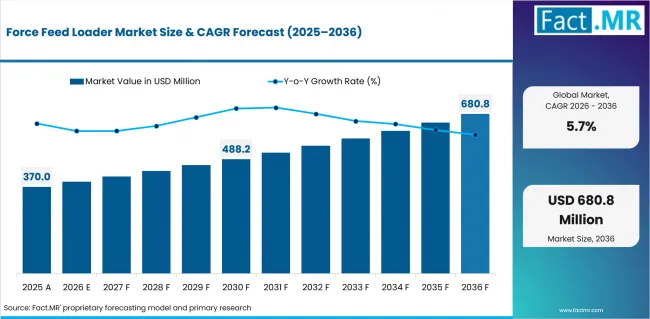
Force Feed Loader Market Value Analysis | Source: Fact.MR
Summary of the Force Feed Loader Market
- Market Snapshot
- Global Force Feed Loader market revenue stood at USD 391.1 million in 2026 and is forecast to reach USD 680.8 million by 2036.
- At a 5.7% CAGR from 2026 to 2036, the market is expected to expand ~1.7x in value, creating an absolute dollar opportunity of USD 289.7 million.
- The growth of the market will be driven by the growing investment in construction of highway infrastructure, increasing road restoration works, and upsurge in application of advanced asphalt paving and material transfer machinery across the world.
- Among the key trends which accelerates the market demand across the globe is the growing adoption of automated and smart feed loader systems and for continuous material feed solutions for high throughput paving operations.
- Growth in airport runway extension projects, smart city infrastructure, and recycled asphalt pavement (RAP) processing activities is also contributing to market growth.
- Demand and Growth Drivers
- The global investments in highway construction and highway renovation are increasing
- Growing demand of automated pavers and material transfer units
- Increasing application of recycled asphalt pavement (RAP) and green road building techniques
- Demand for seamless and high-volume feeding of materials, in asphalt-paving processes
- Advancement in intelligent paving, IoT based monitoring, and automated conveyor system facility is also anticipated.
- Demand for solutions in:
- Continuous and high-volume asphalt material transfer
- Reduced material segregation during paving operations
- Improved paving efficiency and operational productivity
- High-capacity and mobile material feeding systems
- Enhanced durability in abrasive operating environments
- Product and Segment View
- Mechanical Force Feed Loaders account for 54.8% of product type share in 2026, emerging as the leading segment due to their operational reliability, cost efficiency, and widespread usage in asphalt paving and highway maintenance applications.
- Medium Capacity systems hold 45.4% of loading capacity share in 2026, driven by extensive adoption across municipal road projects, highway rehabilitation, and mid-scale infrastructure operations.
- Cement Industry accounts for 23.8% of end-use industry share in 2026, supported by increasing infrastructure development and large-scale construction activities worldwide.
- Geography and Competitive Outlook
- Rising investments in transportation infrastructure, highway rehabilitation, and smart road development are driving strong market growth across North America, East Asia, and South Asia & Pacific.
- Major growth markets in the Force Feed Loader market include India (8.5% CAGR), Japan (7.2% CAGR), China (6.9% CAGR), Canada (6.2% CAGR), United States (5.1% CAGR), France (4.7% CAGR), and Germany (4.2% CAGR) during the forecast period.
- Market growth is supported by:
- Expansion of highway and expressway networks
- Rising investments in airport runway and municipal road projects
- Increasing adoption of automated paving technologies
- Growth in recycled asphalt pavement (RAP) processing
- Rising demand for high-capacity mobile feed loader systems
- Prominent players in the market include LeeBoy, Weiler Products, ASTEC, Bomag, Vögele (Wirtgen Group), Dynapac, and Caterpillar.
- Analyst Opinion
- Shambhu Nath Jha, Principal Consultant at Fact.MR, opines, “The Force Feed Loader manufacturers' capability to innovate high capacity, fuel efficiency and automation force feed system that enhance paving productivity and operation efficiency will determine their future competitiveness in the Force Feed Loader market. Increasing investments in road restoration, intelligent infrastructure initiatives, and processing of recycled asphalt pavement (RAP) are also anticipated to boost demand for sophisticated mobile feeders and continuous material transfer techniques in road construction worldwide."
Force Feed Loader Market — At a Glance
| Attribute | Details |
|---|---|
| Market Value 2025 | USD 370.0 Million |
| Market Value 2026 | USD 391.1 Million |
| Market Value 2036 | USD 680.8 Million |
| Absolute Dollar Opportunity | USD 289.7 Million |
| Total Growth | 74.07% |
| CAGR | 5.70% |
| Growth Multiple | 1.7x |
| Key Demand Theme | Rising investments in highway infrastructure development, increasing road rehabilitation activities, growing adoption of automated paving systems, rising deployment of mobile material transfer equipment, expansion of recycled asphalt pavement (RAP) processing, and increasing demand for efficient continuous material feeding technologies |
| Leading Product Type Segment | Mechanical Force Feed Loaders |
| Product Type Segment Share | 54.8% |
| Leading Loading Capacity Segment | Medium Capacity |
| Loading Capacity Share | 45.4% |
| Leading Material Handled Segment | Dry Bulk Materials |
| Material Handled Share | 42.6% |
| Leading Mobility Segment | Mobile/Portable Feed Loaders |
| Mobility Share | 64.2% |
| Leading End-Use Industry | Cement Industry |
| End-Use Industry Share | 23.8% |
| Key Growth Regions | North America, East Asia, South Asia & Pacific |
| Key Companies | LeeBoy, Weiler Products, ASTEC, Bomag, Vögele (Wirtgen Group), Dynapac, Caterpillar |
| Segmentation by Product Type | Mechanical Force Feed Loaders, Hydraulic Force Feed Loaders, Pneumatic Force Feed Systems, Automated/Smart Feed Loaders |
| Segmentation by Loading Capacity | Low Capacity, Medium Capacity, High Capacity |
| Segmentation by Material Handled | Dry Bulk Materials, Wet/Sticky Materials, Abrasive Materials, Recyclable/Waste Materials |
| Segmentation by Mobility | Stationary Force Feed Loaders, Mobile/Portable Feed Loaders |
| Segmentation by End-Use Industry | Mining & Minerals, Cement Industry, Power Generation, Steel & Metallurgy, Chemical Industry, Agriculture & Feed Processing, Waste Management & Recycling, Food Processing |
Source: Fact.MR analysis. Updated Jun 13, 2026
Force feed loader market is projected to create an absolute dollar opportunity of USD 289.7 million between 2026 and 2036. Market growth is driven by increasing investments in highway infrastructure development, rising road rehabilitation and asphalt paving activities, and growing demand for efficient material transfer equipment in large-scale construction projects globally. Increasing adoption of automated and smart feed loader systems, along with rising deployment of high-capacity mobile feed loaders for continuous paving operations and recycled asphalt material handling, is further supporting market expansion worldwide.
Key Growth Drivers, Constraints, and Opportunities
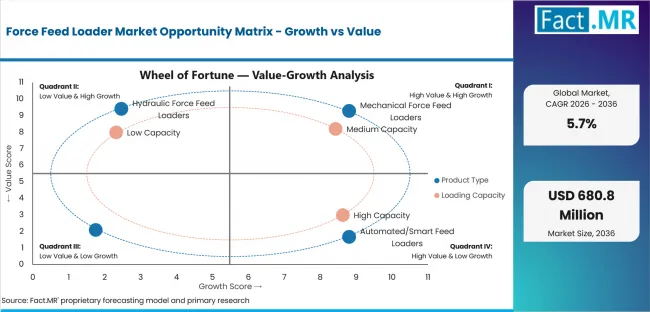
Force Feed Loader Market Opportunity Matrix Growth Vs Value | Source: Fact.MR
Key Factors Driving Growth
- Growing expenditures on upgrading of road infrastructures and road maintenance projects are positively influencing the demand for force feed loaders worldwide.
- Adoption of automated paving technology and continuous material transfer system technology is driving the application of advanced mobile feed loader machinery in major infrastructure projects.
- An expanding utilization of recycled asphalt pavement (RAP) for sustainable road construction application is driving the need for more efficient and high capacity material feeding systems that can efficiently work with recycled paving materials.
| Growth Driver | Demand Impact | Time Horizon | Key Impact Area | Fact.MR Insight |
|---|---|---|---|---|
| Rising global investments in highway infrastructure and road rehabilitation projects | High | Short–Mid Term | Demand for high-capacity force feed loaders & paving support equipment | Expansion of highway modernization programs, airport runway projects, and municipal road rehabilitation activities is significantly driving demand for advanced force feed loader systems globally. |
| Increasing adoption of automated paving and material transfer technologies | High | Mid–Long Term | Automated feed optimization & operational productivity | Contractors are increasingly deploying automated and smart feed loader systems to improve paving efficiency, reduce material segregation, and support continuous high-volume asphalt paving operations. |
| Growing use of recycled asphalt pavement (RAP) and sustainable road construction practices | Medium-High | Mid–Long Term | Efficient recycled material handling & continuous feed systems | Rising focus on sustainable infrastructure and recycled asphalt utilization is accelerating demand for force feed loaders capable of handling RAP materials efficiently during paving operations. |
| Expansion of Industry 4.0 technologies in construction equipment | Medium-High | Mid–Long Term | IoT-enabled monitoring & predictive maintenance | Increasing integration of SCADA systems, telematics, predictive maintenance, and remote diagnostics is improving operational efficiency and supporting modernization of force feed loader fleets worldwide. |
| Rising investments in smart city infrastructure and transportation modernization | Medium-High | Long Term | Mobile paving systems & infrastructure productivity | Growing investments in smart transportation infrastructure, expressway networks, and urban mobility projects are creating long-term opportunities for advanced mobile and automated force feed loader systems globally. |
Source: Fact.MR analysis. Updated Jun 13, 2026
Key Market Constraints
- The need for a large initial investment due to the automated and high-capacity force feed loader systems may hinder adoption for smaller and mid-sized contractors.
- The coordination issues between paving machine, material transfer system and conveyor feed optimization may also have result in an inefficient overall project.
- Fleet operators face increased maintenance and equipment wear from severe conditions, abrasive materials, and nonstop heavy-duty paving.
Key Opportunity Areas
- A surge in smart city infrastructure, airport runway construction, and expressway development activities is poised to open up long term growth avenues for force feed loader equipment manufacturers.
- Increasing adoption of Industry 4.0-based technologies such as IoT-enabled monitoring, predictive maintenance, SCADA integration, and automated feed optimization is creating potential prospects for solution vendors with higher levels of automation.
- Growing emphasis on fuel efficiency, low maintenance, high productivity of paving machinery is driving the development of next generation mobile force feed loader machines with high operation efficiency and low lifecycle cost.
Segment-wise Analysis of the Force Feed Loader Market
- Mechanical Force Feed Loaders account for 54.8% share of the product type segment in 2026, driven by their operational reliability, continuous material feeding capability, cost efficiency, and extensive usage across asphalt paving, highway rehabilitation, and road maintenance applications globally.
- Medium Capacity systems account for 45.4% share of the loading capacity segment in 2026, supported by their balanced throughput capability, operational flexibility, and widespread deployment across municipal road construction and mid-scale infrastructure projects.
The Force Feed Loader market is segmented by product type, loading capacity, material handled, mobility, end-use industry, and region.
Which Product Type Segment Topped the Force Feed Loader Market?

Force Feed Loader Market Analysis By Product Type | Source: Fact.MR
Mechanical Force Feed Loaders are projected to lead the product type segment with 54.8% share in 2026. This dominance is driven by their operational reliability, continuous material feeding capability, lower maintenance requirements, and extensive usage across asphalt paving, highway rehabilitation, and road construction projects. These systems are widely preferred because they provide efficient material transfer, reduce asphalt segregation, and improve paving productivity during continuous infrastructure operations.
Which Loading Capacity Segment Accounts for the Highest Share in the Market?
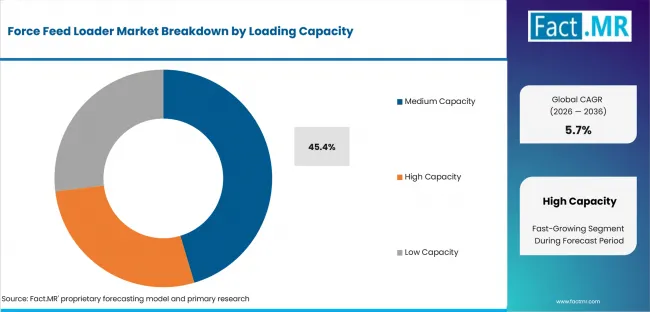
Force Feed Loader Market Analysis By Loading Capacity | Source: Fact.MR
Medium Capacity systems are expected to hold the largest share of 45.4% in the loading capacity segment in 2026. This leadership is attributed to their balanced throughput capability, operational flexibility, cost efficiency, and suitability for municipal road construction, highway rehabilitation, and mid-scale infrastructure projects. Medium capacity force feed loaders provide optimized material handling performance while maintaining manageable operating and maintenance costs compared to high-capacity industrial systems.
Which Material Handled Segment Leads the Market?
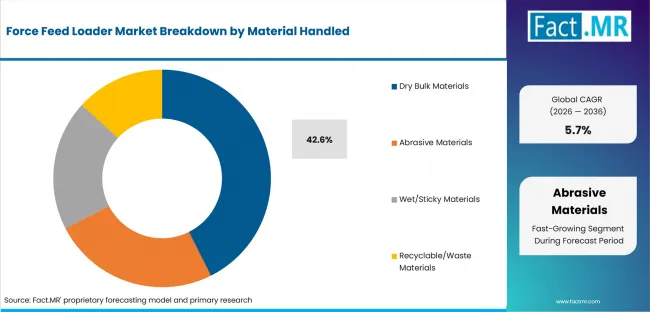
Force Feed Loader Market Analysis By Material Handled | Source: Fact.MR
Dry Bulk Materials are anticipated to lead the material handled segment with 42.6% share in 2026, owing to strong demand for asphalt mix, aggregates, cement materials, and bulk paving material transfer applications. Increasing road construction activities, rising highway modernization projects, and growing deployment of continuous asphalt paving systems are supporting segment growth. These materials require uninterrupted and controlled feeding systems to maintain paving consistency and operational productivity.
Which Mobility Segment Holds the Largest Share in the Market?
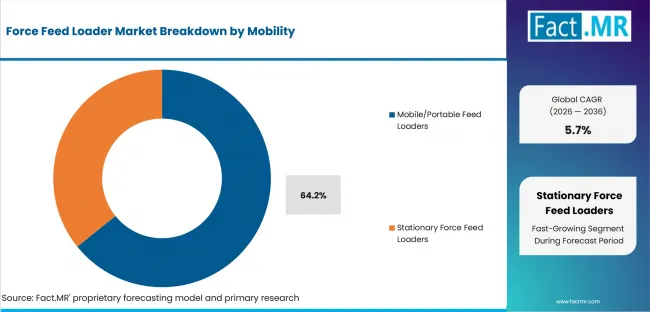
Force Feed Loader Market Analysis By Mobility | Source: Fact.MR
Mobile/Portable Feed Loaders are projected to lead the mobility segment with 64.2% share in 2026. This leadership is driven by increasing demand for flexible, easily deployable, and high-productivity paving support equipment across large-scale infrastructure projects. Mobile systems provide operational advantages such as faster transportation between job sites, reduced setup time, and improved material transfer efficiency during highway construction, airport runway paving, and municipal road maintenance operations.
Which End-Use Industry Segment Holds the Largest Share in the Market?
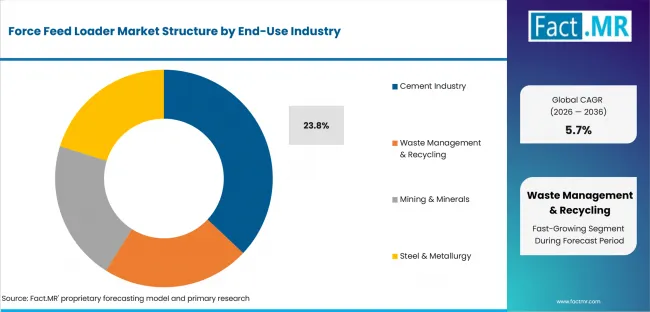
Force Feed Loader Market Analysis By End Use Industry | Source: Fact.MR
Cement Industry is expected to lead the end-use industry segment, accounting for 23.8% share in 2026. This dominance is driven by rising infrastructure investments, increasing cement production activities, and growing deployment of automated material handling systems in construction-related operations. Force feed loaders are extensively used for continuous transfer of cement materials, clinker, aggregates, and other dry bulk materials, supporting efficient processing and uninterrupted industrial material flow across large-scale construction and paving applications globally.
Regional Outlook Across Key Markets
North America, Latin America, Western Europe, Eastern Europe, East Asia, South Asia & Pacific, and Middle East & Africa are the major geographies considered in this report. This section provides a comprehensive assessment of highway infrastructure investments, road rehabilitation activities, adoption of automated paving technologies, growth in asphalt paving operations, expansion of transportation modernization projects, penetration of Industry 4.0-enabled construction equipment, and increasing deployment of mobile material transfer systems across global infrastructure development activities.
.webp "Top Country Growth Comparison Force Feed Loader Market Cagr (2026 2036)")
Top Country Growth Comparison Force Feed Loader Market Cagr (2026 2036) | Source: Fact.MR
CAGR Table
| Country | CAGR (%) |
|---|---|
| China | 6.9% |
| France | 4.7% |
| Japan | 7.2% |
| United States | 5.1% |
| Germany | 4.2% |
| India | 8.5% |
| Canada | 6.2% |
Source: Fact.MR analysis. Updated Jun 13, 2026
Source: Fact.MR analysis, based on proprietary forecasting model and primary research.
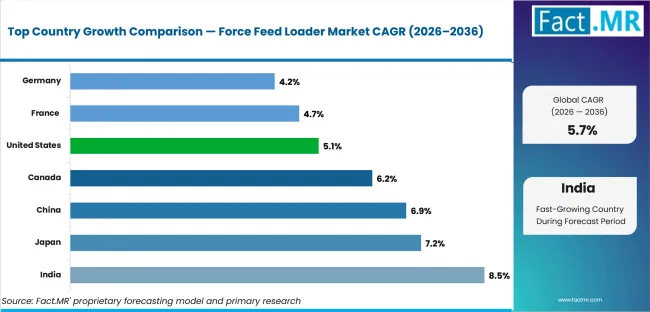
Force Feed Loader Market Cagr Analysis By Country | Source: Fact.MR
North America Force Feed Loader Market
North America is developing as a key force feed loader region on account of growing investments in road reconstruction, airport landings strip expansion, and road infrastructure retrofit projects in the large scale. The region is experiencing robust penetration of automated paver machines, mobile feed loader units, and intelligent material transfer systems. Major players are extending their geographic presence through high capacity force feed systems, IoT based monitoring solutions, and automated paver assistance solutions for uninterrupted infrastructure operation.
- United States: Demand for force feed loaders in the United States is projected to rise at 5.1% CAGR through 2036. Growth is driven by increasing highway rehabilitation spending, expansion of municipal road maintenance programs, and growing adoption of automated asphalt paving technologies.
- Canada: Demand for force feed loaders in Canada is projected to grow at 6.2% CAGR through 2036, supported by rising transportation infrastructure investments, airport modernization projects, and increasing deployment of mobile paving support equipment.
Europe Force Feed Loader Market
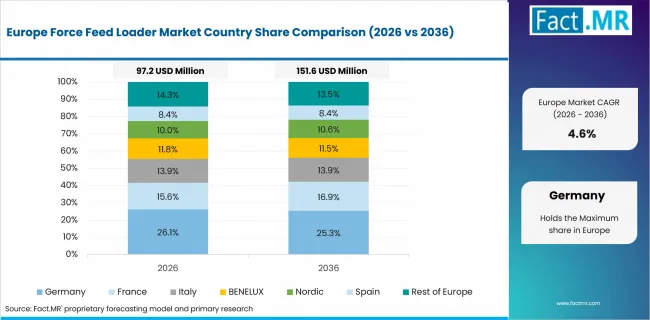
Force Feed Loader Market Europe Country Market Share Analysis, 2026 & 2036 | Source: Fact.MR
The European market provides a high-tech environment for force feed loaders with increasing investments toward sustainable road construction, automated paving systems and infrastructure upgrades. Advanced allow material transfer systems are gaining traction driven by increased attention on recycled asphalt pavement (RAP) utilization and energy saving paving solutions in the region. Producers are developing intelligent feed optimization systems, energy efficient paving machines and automated conveyor solutions.
- Germany: Demand for force feed loaders in Germany is projected to rise steadily at 4.2% CAGR through 2036, driven by increasing highway rehabilitation projects, automated paving technology adoption, and growth in sustainable infrastructure development initiatives.
- France: Demand for force feed loaders in France is projected to expand at 4.7% CAGR through 2036, supported by transportation infrastructure upgrades, rising municipal road maintenance investments, and increasing deployment of automated road construction equipment.
East Asia Force Feed Loader Market

Force Feed Loader Market Japan Market Share Analysis By Product Type | Source: Fact.MR
East Asia is anticipated to account for a significant share in the force feed loader market on account of large infrastructure development, high expressway construction, and growing utilization of smart paving technologies. Regional contractors continue to utilize high-capacity mobile feed loader systems, increasingly automated, to maximize paving productivity and efficiency of operations.
- China: Demand for force feed loaders in China is projected to rise at 6.9% CAGR through 2036, driven by rapid transportation infrastructure development, expansion of highway networks, and increasing investments in smart road construction technologies.
- Japan: Demand for force feed loaders in Japan is expected to grow at 7.2% CAGR through 2036 due to increasing investments in advanced paving systems, road maintenance modernization, and automated construction equipment technologies.
South Asia & Pacific Force Feed Loader Market
South Asia & Pacific is expected to observe the highest growth in the force feed loader market, due to growing urbanization, rising highway construction activities, and increasing government expenditure towards infrastructure. Regional contractors are now turning to medium- and high-capacity mobile feed loader units for major paving and transportation infrastructure work.
- India: Demand for force feed loaders in India is projected to rise at 8.5% CAGR through 2036, driven by large-scale highway expansion programs, smart city infrastructure initiatives, and increasing adoption of automated paving and material transfer technologies.
Latin America Force Feed Loader Market
The force feed loader market in Latin America is witnessing steady growth due to rising investments in transportation infrastructure, road rehabilitation activities, and modernization of paving operations. Growing adoption of mobile paving support systems and increasing government investments in infrastructure development are supporting regional market expansion.
- Brazil: Demand for force feed loaders in Brazil is projected to rise steadily through 2036, supported by increasing road modernization projects, expansion of highway infrastructure, and growing use of advanced asphalt paving equipment.
Middle East & Africa Force Feed Loader Market
The Middle East & Africa market is gradually expanding due to rising investments in transportation infrastructure, airport construction projects, and smart urban development initiatives. Increasing focus on durable and high-capacity paving equipment is supporting demand for advanced force feed loader systems across infrastructure development projects in the region.
The Fact.MR report analyzes market trends, automated paving technology adoption, infrastructure development investments, competitive benchmarking, smart construction equipment innovation, and long-term growth opportunities across individual countries in North America, Latin America, Europe, East Asia, South Asia & Pacific, and Middle East & Africa. Readers gain detailed insights into highway modernization trends, paving equipment demand, Industry 4.0 adoption, and future opportunities across global road construction and infrastructure development industries.
Competitive Benchmarking and Company Positioning
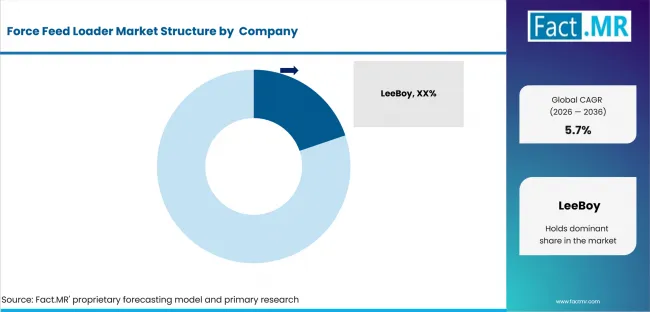
Force Feed Loader Market Analysis By Company | Source: Fact.MR
Leading Companies Shaping the Force Feed Loader Market
The Force Feed Loader industry remains a bit competitive and the top players such as LeeBoy, Weiler Products, ASTEC, Bomag, Vögele (Wirtgen Group), Dynapac, and Caterpillar are leading the global competition. Material transfer efficiency, automation, mobility, feed consistency, equipment longevity and productivity are some of the competitive factors in the market.
Top firms are investing in automated paving support systems, IoT-enabled monitoring, predictive maintenance, and fuel-efficient mobile feed loaders to strengthen market positions. Local manufacturers compete on customized equipment solutions, regional dealer networks, competitive pricing and after sales support in growing infrastructure buildup and road rehabilitation projects worldwide.
Recent Industry Developments
- In September 2025, FAYAT Group completed the acquisition of LeeBoy to expand its North American road equipment business. The deal is relevant to force feed loaders because LeeBoy markets the 3000C Force Feed Loader for high-capacity loading of soil, snow, millings, and other windrowed materials in roadway applications.
- In April 2025, Dynapac showcased its next-generation road paving equipment at bauma 2025 in Munich. The company highlighted new highway pavers, connected machine technologies, compaction equipment, and electric equipment for road construction operations.
- In January 2025, Dynapac and SMT Africa formed a partnership to expand road construction equipment access across West and Central Africa. The collaboration strengthens distribution and support for Dynapac soil compactors, asphalt compactors, and paving machines across 17 African markets.
Leading Companies Shaping the Force Feed Loader Market
- LeeBoy
- Weiler Products
- ASTEC
- Caterpillar
- Bomag
- Vögele (Wirtgen Group)
- Dynapac
Sources and Research References
- FAYAT Group. (2025, September 4). Acquisition of LeeBoy by the FAYAT Group.
- LeeBoy. (n.d.). 3000C Force Feed Loader.
- Dynapac. (2025, February 21). Meet Dynapac in Munich at bauma 2025, April 7–13.
- Dynapac. (2025, January 24). SMT & Dynapac forge strategic partnership to strengthen road construction across Africa.
Force Feed Loader Market Definition
Force feed loader is part of road construction and material handling equipment industry, which deals in specialized machinery for loading, transferring, and feeding of asphalt, aggregates, and bulk materials of construction continuously during operation of paving and infrastructure equipment. These loaders employ conveyor-based and mechanized feeding systems to maintain a consistent flow of material, minimizing the risk of segregation and thus enhancing paving efficiencies. Force feed loaders are used extensively in highway construction and maintenance, airport runway work, and in major infrastructure development works.
Force Feed Loader Market Inclusions
The force feed loader market report covers a comprehensive analysis of the global and regional market over the period 2026 – 2036. By product type, loading volume, handled material, mobility type, end-user, and region, as well as technology adoption trends, competitive landscape, infrastructure advancement, and automated pavers equipment progress. In addition, the report highlights emerging trends including smart feed loader systems, automated material transfer technologies, mobile high-capacity paving support equipment, recycled asphalt pavement (RAP) handling solutions, and increasing investments in highway rehabilitation and road infrastructure projects across the globe.
Force Feed Loader Market Exclusions
This study covers force feed loaders used in road construction, asphalt paving, material transfer, and infrastructure rehabilitation applications. However, conventional wheel loaders, skid steer loaders, excavators, generic conveyor systems, mining haulage equipment, agricultural feed machinery, and non-specialized material handling equipment without continuous forced feeding capability are outside the scope of this study. Also excluded from the report are stationary industrial bulk handling systems unrelated to paving operations, warehouse conveyor equipment, and compact construction loaders unless specifically designed for continuous asphalt material transfer and force feed paving applications.
Force Feed Loader Market Research Methodology
- Primary Research
- Fact.MR has utilized the top-down and bottom-up approaches to size and validate the size of the global Force Feed Loader market. Primary interviews were conducted with force feed loader manufacturers, asphalt paver equipment suppliers, road construction contractors, infrastructure developers, material handling system providers, distributors, and industry consultants. These engagements enabled corroboration of market trends, prices, product existence, automation infiltration, infrastructure investments, capacity expansion, and future growth potential in highway, road grinding/highway/paving projects and material transfer applications in all regions.
- Desk Research
- The report includes information collected from company annual reports, investor presentations, construction equipment magazines, asphalt paving industry journals, government infrastructure statistics, trade databases, transportation development reports, and road construction white papers. There are amendments such as research on intelligent paving (IP) technologies, recycled asphalt pavement (RAP) processing technology, highway renewal programs, automated material transfer systems, trends in construction equipment demand, and worldwide development in transport infrastructure and road rehabilitation initiatives influencing the full force of the loader market globally.
- Market-Sizing and Forecasting
- Fact.MR’s market estimation methodology evaluates revenues generated by force feed loader manufacturers, paving equipment suppliers, and material transfer system providers through a bottom-up approach, further validated using a top-down assessment of the global road construction equipment industry. Forecasting considers infrastructure spending trends, highway rehabilitation activities, adoption of automated paving technologies, growth in recycled asphalt pavement processing, rising deployment of mobile feed loader systems, and increasing investments in airport runway expansion and large-scale transportation infrastructure development globally during the forecast period.
- Data Validation and Update Cycle
- Market estimates were confirmed by triangulating industry interviews, analysis of company financials, infrastructure investment trends, construction equipment demand studies, and historical growth rates in the paver and road construction equipment industries. Projections are revised periodically to account for changes in government spending on infrastructure and road rehabilitation programs, demand for asphalt paving, uptake of smart construction equipment, technological enhancements to automated feed systems, trends in raw material pricing, and regulations concerning construction equipment efficiency and emissions, and sustainable practices in infrastructure development globally.
Segmentation
Scope of Analysis

Force Feed Loader Market Breakdown By Product Type, Loading Capacity, And Region | Source: Fact.MR
Parameter |
Details | |
|---|---|---|
| Quantitative Units | USD million (2025) to USD million (2036), at a CAGR | |
| Market Definition | The Force Feed Loader market covers specialized material transfer and continuous feeding equipment designed for asphalt paving, road construction, infrastructure rehabilitation, and bulk material handling applications. These systems include mechanical force feed loaders, hydraulic feed systems, pneumatic feed systems, and automated/smart feed loaders integrated with conveyor systems, automated feed controls, IoT-enabled monitoring, and high-capacity material transfer technologies for continuous paving and industrial material handling operations. | |
| Product Type | Mechanical Force Feed Loaders, Hydraulic Force Feed Loaders, Pneumatic Force Feed Systems, Automated/Smart Feed Loaders | |
| Loading Capacity | Low Capacity, Medium Capacity, High Capacity | |
| Material Handled | Dry Bulk Materials, Wet/Sticky Materials, Abrasive Materials, Recyclable/Waste Materials | |
| Mobility |
Source: Fact.MR analysis. Updated Jun 13, 2026 Stationary Force Feed Loaders, Mobile/Portable Feed Loaders |
|
| End Use Industry |
Source: Fact.MR analysis. Updated Jun 13, 2026 Mining & Minerals, Cement Industry, Power Generation, Steel & Metallurgy, Chemical Industry, Agriculture & Feed Processing, Waste Management & Recycling, Food Processing |
|
| Regions Covered | North America, Eastern Europe, Western Europe, East Asia, South Asia & Pacific, Latin America, Middle East & Africa | |
| Countries Covered | USA, Canada, Germany, China, Japan, India, France, Brazil, UK, Italy, Australia, UAE, South Africa, Indonesia, South Korea, and 40+ countries | |
| Key Companies | LeeBoy, Weiler Products, ASTEC, Bomag, Vögele (Wirtgen Group), Dynapac, Caterpillar | |
| Forecast Period | 2026 to 2036 | |
| Approach | Hybrid demand-side and top-down methodology based on highway infrastructure expansion, road rehabilitation activities, asphalt paving equipment demand, automated material transfer technology adoption, smart paving system penetration, recycled asphalt pavement (RAP) processing growth, and transportation infrastructure investments, validated through primary interviews with force feed loader manufacturers, paving equipment suppliers, infrastructure contractors, material handling system providers, distributors, automation solution providers, and construction industry experts across key global regions. |
Source: Fact.MR analysis. Updated Jun 13, 2026
Analysis by Product Type, Loading Capacity, Material Handled, Mobility, End-Use Industry, and Region
-
Force Feed Loader Market by Product Type
- Mechanical Force Feed Loaders
- Screw/Auger Based Systems
- Belt-Driven Systems
- Paddle Feeders
- Chain Conveyor Loaders
- Hydraulic Force Feed Loaders
- Pneumatic Force Feed Systems
- Automated/Smart Feed Loaders
- PLC-Controlled Systems
- Sensor-Integrated Feeding Systems
- IoT-Enabled Monitoring Systems
- Mechanical Force Feed Loaders
-
Force Feed Loader Market by Loading Capacity
- Low Capacity
- Medium Capacity
- High Capacity
-
Force Feed Loader Market by Material Handled
- Dry Bulk Materials
- Cement
- Powder
- Grain
- Ash
- Wet/Sticky Materials
- Sludge
- Biomass
- Clay
- Abrasive Materials
- Ore
- Coal
- Clinker
- Recyclable/Waste Materials
- Industrial Waste
- Scrap
- Refuse-Derived Fuel (RDF)
- Dry Bulk Materials
-
Force Feed Loader Market by Mobility
- Stationary Force Feed Loaders
- Mobile/Portable Feed Loaders
-
Force Feed Loader Market by End-Use Industry
- Mining & Minerals
- Cement Industry
- Power Generation
- Steel & Metallurgy
- Chemical Industry
- Agriculture & Feed Processing
- Waste Management & Recycling
- Food Processing
-
Force Feed Loader Market by Region
- North America
- USA
- Canada
- Latin America
- Brazil
- Mexico
- Chile
- Rest of LATAM
- East Asia
- China
- Japan
- South Korea
- Taiwan
- South Asia & Pacific
- India
- Singapore
- Australia
- ASEAN
- Western Europe
- Germany
- France
- U.K.
- Italy
- Spain
- BENELUX
- Nordic
- Rest of Western Europe
- Eastern Europe
- Poland
- Hungary
- Czech Republic
- Balkan & Baltics
- Rest of Eastern Europe
- Middle East and Africa
- Kingdom of Saudi Arabia
- United Arab Emirates
- South Africa
- Rest of Middle East and Africa
- North America
Frequently Asked Questions
How large is the demand for Force Feed Loaders in the global market in 2025?
What will be the market size of the Force Feed Loader Market by 2036?
What is the expected demand growth for the Force Feed Loader Market between 2026 and 2036?
How significant is the growth outlook for India in this market?
Which company is identified as a leading player in the Force Feed Loader Market?
Who worked on this report


Preview the report firsthand - request a free sample
Free SampleGet the brochure for pricing and purchase details
Download PDF