- Forecast Value (2036): 2.1 Bn
- CAGR (2036): 6.6%
Fresh Water Generator Market Forecast and Outlook 2026 to 2036
Global demand is projected to advance from USD 1.1 billion in 2026 to approximately USD 2.1 billion by 2036, progressing at a CAGR of 6.6%.
Key Takeaways from the Fresh Water Generator Market
- Fresh Water Generator Market Value (2026): USD 1.1 billion
- Fresh Water Generator Market Forecast Value (2036): USD 2.1 billion
- Fresh Water Generator Market Forecast CAGR (2026-2036): 6.6%
- Leading Application: Commercial Shipping (44%)
- Key Market Participants: Alfa Laval, Wärtsilä, Hatenboer-Water, Evac, Sasakura Engineering, Aquatech, Thermax, IDE Technologies, Veolia Water Technologies, Xylem
- Key Growth Regions: Asia Pacific (India, China, Vietnam, Indonesia), Middle East (UAE), North America (United States), Europe (Germany), Japan
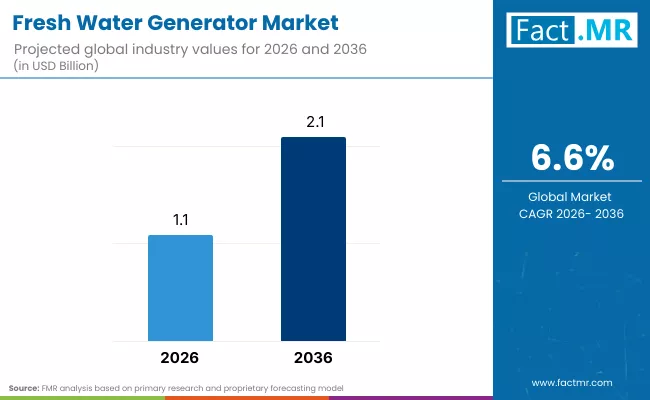
Fresh Water Generator Market By Industry | Source: Fact.MR
This reflects escalating maritime activity, naval fleet modernization initiatives, and heightened regulatory frameworks governing onboard water sustainability through optimized thermal recovery designs. Fresh water generator solutions address fundamental operational needs by targeting potable water independence challenges, ballast water compliance requirements, and emission control area compatibility through advanced membrane and distillation technologies.
As noted by Mark Henderson, Maritime Technology Analyst at Marine Systems Research, the shipping and offshore industries are experiencing a fundamental shift toward systems that eliminate shore-based water dependency and minimize environmental discharge. Modern vacuum distillation designs have evolved from basic thermal evaporation to precision-engineered components ensuring complete waste heat integration while meeting stringent maritime standards including zero-discharge performance and validated energy efficiency metrics. Companies successfully integrating advanced membrane technologies, automated monitoring systems, and material innovations will capture disproportionate market share in the coming years. By combining thermal engineering expertise, Industry 4.0 connectivity, and regulatory compliance capabilities, leading manufacturers align with contemporary maritime decarbonization culture. This momentum is reinforced by strong growth in hybrid system applications, reflecting industry demand for operational flexibility, energy optimization, and validated freshwater quality protocols.
Fresh Water Generator Market
| Metric | Value |
|---|---|
| Estimated Value in (2026) | USD 1.1 billion |
| Forecast Value in (2036) | USD 2.1 billion |
| Forecast CAGR (2026 to 2036) | 6.6 % |
Source: Fact.MR analysis. Updated Feb 6, 2026
Category
| Category | Segments |
|---|---|
| Technology | Evaporation (Vacuum Distillation), Reverse Osmosis (Marine RO), Hybrid Systems, Other |
| Vessel Type | Commercial Shipping, Naval/Defense, Offshore Platforms, Cruise & Ferries, Other |
| Capacity | Up to 10 m³/day, 10-50 m³/day, Above 50 m³/day, Other |
| Region | North America; Europe; Asia Pacific; Latin America; Middle East & Africa |
Source: Fact.MR analysis. Updated Feb 6, 2026
Segmental Analysis
Which technology dominates the fresh water generator market and why?
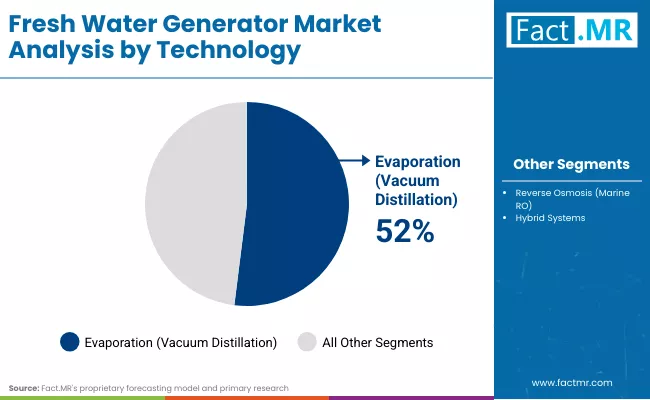
Fresh Water Generator Market By Technology | Source: Fact.MR
Evaporation technology, mainly vacuum distillation, leads the market with a 52.0% share in 2026. Its biggest advantage is how well it works with marine engines. These systems reuse waste heat from engine exhaust, turning it into fresh water without burning extra fuel. This makes vacuum distillation highly attractive for large commercial vessels. Bulk carriers, tankers, and container ships operate engines with exhaust temperatures above 350°C for long periods. That steady heat allows continuous water production at very low operating cost. On long ocean routes, this efficiency adds up quickly. For ship operators, vacuum distillation becomes a reliable and cost-effective solution rather than just an optional system.
Why does commercial shipping lead vessel type applications?
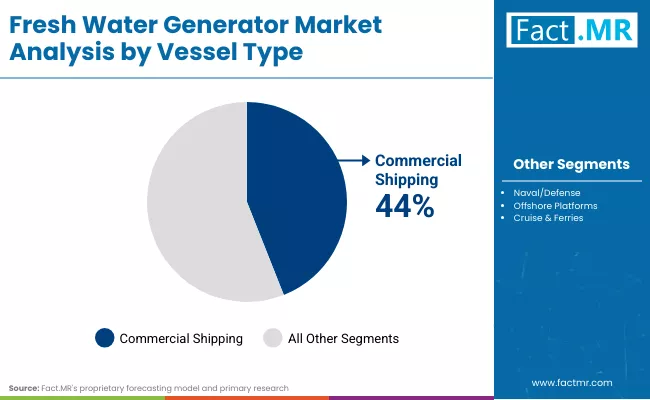
Fresh Water Generator Market By Vessel Type | Source: Fact.MR
Commercial shipping represents 44.0% of fresh water generator installations because of continued fleet growth and tighter maritime regulations. Modern merchant vessels can no longer rely on seawater for crew consumption.
The International Maritime Organization’s ballast water management rules restrict the use of untreated seawater onboard. As a result, ships must generate their own potable water. This makes onboard desalination systems essential rather than optional. Long-distance container routes often last 30 to 45 days. Crews typically include 20 to 25 people, creating daily freshwater demand of 400 to 500 liters. A dependable onboard water supply is critical for health and safety.
Market Dynamics: Drivers, Restraints, and Trends
- Drivers: Maritime decarbonization is reshaping how fresh water generators are designed and selected. New emission control rules push shipbuilders to reduce auxiliary power use. As a result, waste heat recovery is no longer optional. The International Maritime Organization’s Energy Efficiency Design Index encourages systems that convert exhaust heat into useful output. Vacuum distillation now plays a compliance role rather than a supporting one. Naval fleet modernization is another strong driver. Countries such as India, China, and several Southeast Asian nations are investing in domestically built vessels. These programs prioritize onboard desalination systems with advanced materials and automation. Offshore wind development also supports demand. Service vessels and offshore platforms need reliable freshwater supply. Self-contained generation systems reduce dependence on shore-based logistics.
- Restraints: High upfront cost remains a key barrier. Compact reverse osmosis units can cost around USD 75,000. High-capacity vacuum distillation systems can exceed USD 300,000 once integration is included. Retrofits add complexity. Older vessels often lack space for modern desalination equipment. Reverse osmosis systems also face operational challenges. Membrane fouling and scaling require pretreatment and frequent cleaning. This increases maintenance workload. Environmental regulations add further cost. Brine discharge limits require monitoring and dilution systems. In some coastal routes, shore-based water bunkering remains more economical.
- Trend 1: Hybrid system integration Manufacturers are increasingly offering hybrid desalination systems. These combine vacuum distillations with reverse osmosis. Vessels use waste heat during high-speed sailing. During port stays or low-speed operation, systems switch to RO. This flexibility improves efficiency across different operating conditions.
- Trend 2: IoT-enabled predictive maintenance Fresh water generators are becoming smarter. IoT sensors track water quality, pressure, and system load. Predictive algorithms estimate membrane replacement and descaling needs. Data is shared with shore-based teams through cloud platforms. This reduces onboard workload and improves fleet-wide maintenance planning.
Fresh Water Generator Market Analysis by Key Countries
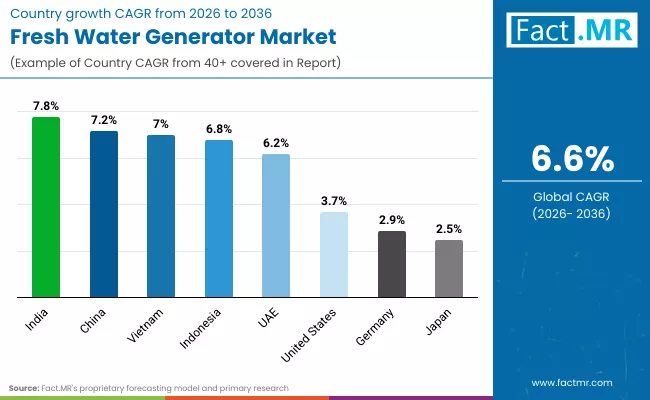
Fresh Water Generator Market By Country | Source: Fact.MR
| Country | CAGR (2026-2036) |
|---|---|
| India | 7.8% |
| China | 7.2% |
| Vietnam | 7.0% |
| Indonesia | 6.8% |
| UAE | 6.2% |
| United States | 3.7% |
| Germany | 2.9% |
| Japan | 2.5% |
Source: Fact.MR analysis. Updated Feb 6, 2026
What factors position India as the fastest-growing fresh water generator market?
India leads growth with a 7.8% CAGR. The main driver is naval modernization. New submarines and surface vessels require onboard freshwater systems for long patrols in the Indian Ocean. Government policies also push defense equipment localization. This encourages domestic shipyards to source fresh water generators locally. Offshore energy growth adds momentum. Gas platforms in the Krishna-Godavari basin need reliable desalination systems for offshore crews. Manufacturers are responding by expanding marine-focused production capacity, reinforcing India’s position as a high-growth market.
How does China’s shipbuilding dominance influence its market trajectory?
China grows at 7.2% CAGR, anchored by its position as the world’s largest shipbuilder. Fresh water generators are now treated as standard equipment on newbuilds across bulk carriers, tankers, and container ships. Modern Chinese yards routinely integrate waste-heat-based vacuum distillation systems at the design stage, taking advantage of high exhaust temperatures from dual-fuel engines. In parallel, fleet expansion tied to Belt and Road trade routes is driving retrofits of older vessels. China’s strong focus on energy efficiency and emissions reduction further accelerates adoption of high-capacity, low-energy freshwater systems.
What drives adoption in Vietnam’s maritime sector?
Vietnam expands at 7.0% CAGR as shipbuilding capacity shifts from China under supply-chain diversification strategies. International owners placing orders with Vietnamese yards require freshwater systems that meet global crew welfare and efficiency standards. A large share of demand comes from retrofits, where compact reverse osmosis (RO) units suit aging vessels. Fleet upgrades by national operators and fast growth in maritime manufacturing reinforce steady market expansion.
How do Indonesia’s inter-island needs shape the market?
Indonesia’s fresh water generator market grows at 6.8% CAGR, shaped by the country’s unique geography. With more than 17,000 islands, ferry services and coastal shipping are essential for passenger transport and goods movement. Many of these vessels operate on short routes with frequent port calls, making compact and energy-efficient freshwater systems a priority. Operators prefer low-power reverse osmosis (RO) units that can function reliably without large engine loads. On remote routes, solar-assisted RO systems are gaining traction, especially where shore-based water bunkering is unavailable. Demand is concentrated on mid-capacity systems that balance reliability, low maintenance, and sufficient output for ferries and island logistics vessels serving local communities.
What distinguishes the UAE market?
The UAE market grows at 6.2% CAGR and is defined by its strong focus on innovation and water security. National sustainability programs encourage adoption of advanced desalination and atmospheric water generation technologies. Offshore oil platforms, naval bases, and coastal infrastructure act as test environments for high-capacity and hybrid systems. Unlike volume-driven markets, the UAE prioritizes performance, resilience, and technological sophistication. Operators are willing to invest in premium solutions that reduce dependency on freshwater imports and support long-term strategic water resilience.
How do decarbonization mandates affect the United States market?
The United States market expands at 3.7% CAGR, largely influenced by environmental regulation rather than fleet size growth. Offshore wind farms and energy platforms require self-contained freshwater systems that meet strict zero-discharge standards. Advanced brine management and containerized solutions are becoming standard. At the same time, naval modernization programs specify smart RO systems with predictive maintenance features. These systems improve reliability while reducing crew workload and environmental impact, aligning with broader decarbonization goals.
What role does decarbonization play in Germany’s market?
Germany records 2.9% CAGR, shaped by strict European Union emissions and efficiency mandates. Vessel operators favor hybrid RO-distillation systems that minimize auxiliary power consumption. Compliance and energy reporting drive equipment selection more than scale. German suppliers focus on premium, energy-optimized systems that deliver measurable efficiency gains. The market values precision engineering and regulatory alignment over rapid volume expansion.
How does Industry 5.0 automation influence Japan’s market?
Japan’s market grows at 2.5% CAGR, driven by the shift toward automation and reduced-crew vessels. Fresh water generators must operate autonomously with minimal human oversight. AI-monitored RO systems support continuous operation through automated cleaning and remote diagnostics. Japan prioritizes reliability, long service life, and technological innovation. Even with modest growth, the country remains a leader in next-generation marine desalination systems designed for highly automated maritime operations.
Competitive Landscape
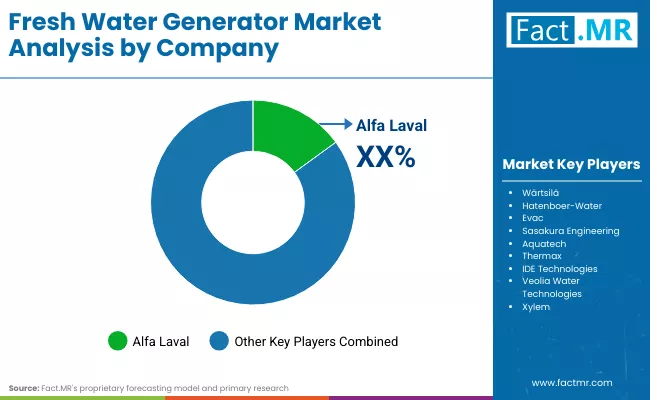
Fresh Water Generator Market By Company | Source: Fact.MR
The fresh water generator market is shaped by a mix of long-established marine equipment leaders and specialized desalination technology providers. Large players such as Alfa Laval and Wärtsilä hold strong positions thanks to their broad product portfolios. They offer vacuum distillation, reverse osmosis, and hybrid systems, which allows shipowners to select solutions tailored to different vessel types and operating profiles. Their long-standing relationships with global shipyards and fleet operators also provide a major advantage. Just as important, these companies maintain extensive global service networks, which is critical in maritime operations where equipment downtime can disrupt voyages and increase costs.
Recent strategic moves highlight this positioning. Wärtsilä has expanded modular production platforms in Europe to meet rising demand linked to emission control regulations. Alfa Laval, meanwhile, continues to focus on waste-heat recovery solutions that support decarbonization goals and fuel efficiency targets. Alongside these leaders, specialized providers play an important role. Companies such as Hatenboer-Water, Sasakura Engineering, and IDE Technologies compete by focusing on specific applications. Compact RO systems appeal to offshore platforms and naval vessels where space is limited. Asian manufacturers benefit from regional production and service proximity. Industrial specialists such as Thermax and Aquatech target large offshore installations with integrated water and wastewater treatment solutions.
Across the market, digitalization is becoming a key differentiator. IoT-enabled monitoring, predictive maintenance, and partnerships with membrane technology specialists are reshaping competition, while high service expectations continue to limit large-scale consolidation.
Key Market Players in Fresh Water Generator Market
- Alfa Laval
- Wärtsilä
- Hatenboer-Water
- Evac
- Sasakura Engineering
- Aquatech
- Thermax
- IDE Technologies
- Veolia Water Technologies
- Xylem
Bibliography
- Alfa Laval. 2026. Marine fresh water generator systems and waste heat recovery desalination solutions. Corporate product documentation and sustainability disclosures.
- Wärtsilä. 2026. Hybrid fresh water generation platforms for emission control area compliance. Official company press releases and marine technology briefings.
- International Maritime Organization (IMO). 2025. Energy Efficiency Design Index (EEDI) and ballast water management requirements. IMO regulatory framework and technical guidelines.
- Hatenboer-Water. 2025. Compact reverse osmosis systems for offshore and naval applications. Corporate technical literature and project case studies.
- Sasakura Engineering Co., Ltd. 2025. Vacuum distillation fresh water generators for commercial and naval vessels. Product catalogs and Asian maritime market updates.
- Government of India. 2026. Naval modernization and indigenous marine equipment procurement programs. Ministry of Defence and Ministry of Shipping policy publications.
- European Union. 2026. Marine decarbonization and emission control area regulations. Official EU maritime transport and environmental compliance documentation.
- Asian Development Bank (ADB). 2025. Maritime infrastructure development and onboard water generation requirements for island nations. Infrastructure financing reports.
Segmentation
Scope of Report
| Items | Values |
|---|---|
| Quantitative Units (2026) | USD 1.1 Billion |
| Technology | Evaporation (Vacuum Distillation), Reverse Osmosis (Marine RO), Hybrid Systems, Other |
| Vessel Type | Commercial Shipping, Naval/Defense, Offshore Platforms, Cruise & Ferries, Other |
| Capacity | Up to 10 m³/day, 10-50 m³/day, Above 50 m³/day, Other |
| Regions Covered | North America, Europe, Asia Pacific, Latin America, Middle East & Africa |
| Countries Covered | U.S., Canada, Germany, Italy, UK, France, Japan, Australia, and other countries |
| Key Companies Profiled | Alfa Laval, Wärtsilä, Hatenboer-Water, Evac, Sasakura Engineering, Aquatech, Thermax, IDE Technologies, Veolia Water Technologies, Xylem |
| Additional Attributes | Dollar revenue in the fresh water generator market is segmented by technology (vacuum distillation, reverse osmosis, hybrid systems, atmospheric water generation), application (commercial shipping, naval vessels, offshore oil & gas platforms, ferries and coastal vessels, industrial and offshore installations), capacity range (below 5 m³/day, 5-20 m³/day, above 20 m³/day), and region. |
Source: Fact.MR analysis. Updated Feb 6, 2026
Fresh Water Generator Market by Segments
-
Technology :
- Evaporation (Vacuum Distillation)
- Reverse Osmosis (Marine RO)
- Hybrid Systems
-
Vessel Type :
- Commercial Shipping
- Naval/Defense
- Offshore Platforms
- Cruise & Ferries
-
Capacity :
- Up to 10 m³/day
- 10-50 m³/day
- Above 50 m³/day
-
Region :
- Asia Pacific
- China
- India
- Japan
- South Korea
- Vietnam
- Indonesia
- Rest of Asia Pacific
- North America
- United States
- Canada
- Mexico
- Europe
- Germany
- France
- UK
- Italy
- Spain
- Rest of Europe
- Latin America
- Brazil
- Mexico
- Argentina
- Asia Pacific
Frequently Asked Questions
How big is the global fresh water generator market in 2026?
What will be the size of the fresh water generator market by 2036?
How fast will the fresh water generator market grow during the forecast period?
Which technology dominates the fresh water generator market?
Which vessel type represents the largest application segment?
Who worked on this report


Preview the report firsthand - request a free sample
Free SampleGet the brochure for pricing and purchase details
Download PDF