- Base Value(2026): 1.1 Bn
- Estimated Value(2026): 1.1 Bn
- Forecast Value (2036): 2.0 Bn
- CAGR (2026 - 2036): 6.0%
Water Hammer Control System Market Forecast Outlook 2026 to 2036
The water hammer control system market is likely to be valued at USD 1.1 billion in 2026 and is projected to reach USD 2.1 billion by 2036, reflecting a CAGR of 6%.
Key Takeaways from Water Hammer Control System Market
- Water Hammer Control System Market Value (2026): USD 1.1 billion
- Water Hammer Control System Market Forecast Value (2036): USD 2.1 billion
- Water Hammer Control System Market Forecast CAGR 2026 to 2036: 6%
- Leading Segment in Water Hammer Control System Market: New Installations (58%)
- Key Growth Region in Water Hammer Control System Market: Asia Pacific
- Key Players in Water Hammer Control System Market: Watts Water Technologies, Zurn, A.R.I. Flow Control Accessories, Cla-Val, Bermad, Singer Valve, Dorot, Emerson (surge control/controls), AVK Group (air valves), Xylem
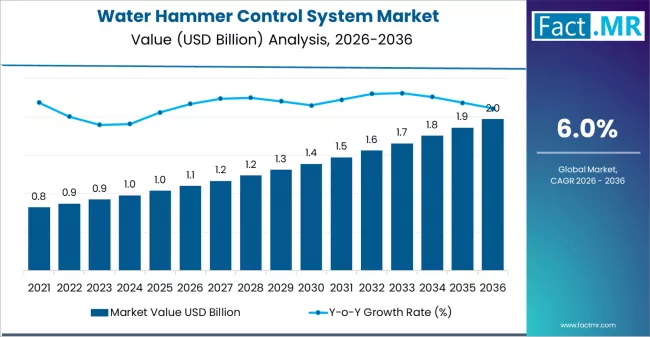
Water Hammer Control System Market Market Value Analysis | Source: Fact.MR
Dominant players in this market leverage strong brand recognition and technological leadership to defend their pricing power, often offering integrated solutions that customers perceive as more reliable and efficient. These leaders maintain significant entry barriers through intellectual property, proprietary technology, and long-standing relationships with key industry players.
As a result, the market remains relatively concentrated, with new entrants facing substantial challenges in scaling operations. While the market still exhibits a degree of fragmentation, the trend is expected to narrow as larger players consolidate their position through acquisitions and strategic partnerships. Smaller companies will continue to find niches, but overall market share distribution will shift as the demand for specialized systems grows and the need for reliability and consistency increases.
Water Hammer Control System Market
| Metric | Value |
|---|---|
| Estimated Value in (2026E) | USD 1.1 billion |
| Forecast Value in (2036F) | USD 2.1 billion |
| Forecast CAGR 2026 to 2036 | 6% |
Source: Fact.MR analysis. Updated Jan 21, 2026
Category
| Category | Segments |
|---|---|
| Solution Type | Water Hammer Arrestors; Surge Tanks and Vessels; Air Release or Combination Valves; Surge Relief or Anticipator Valves; Controls and Monitoring |
| Application | Municipal Water Networks; High-Rise Buildings; Industrial Process Water; Irrigation; HVAC or Chilled Water |
| Installation | New Installations; Retrofit or Upgrades |
| Region | North America; Europe; Asia Pacific; Latin America; Middle East & Africa |
Source: Fact.MR analysis. Updated Jan 21, 2026
Segmental Analysis
What Is the Impact of Solution Type on the Water Hammer Control System Market?
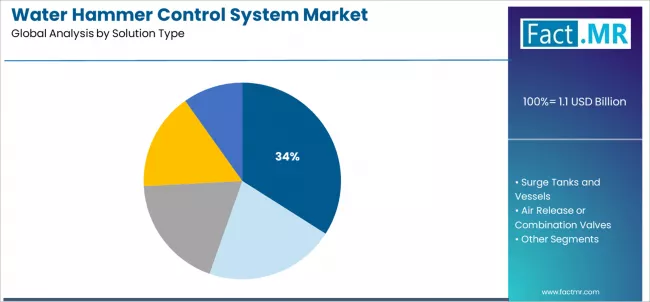
Water Hammer Control System Market Analysis By Solution Type | Source: Fact.MR
In the water hammer control system market, the solution type is key to determining the effectiveness and application of the technology. Water hammer arrestors lead the market with a 34% share, as they are specifically designed to absorb the pressure surges caused by water hammer, reducing the impact on the piping system. These devices are widely used in residential, commercial, and industrial applications to ensure the safety and longevity of water distribution systems. As the demand for reliable water distribution systems increases, the need for water hammer arrestors will continue to be a critical factor in minimizing system damage and maintaining performance.
How Does Installation Influence the Water Hammer Control System Market?
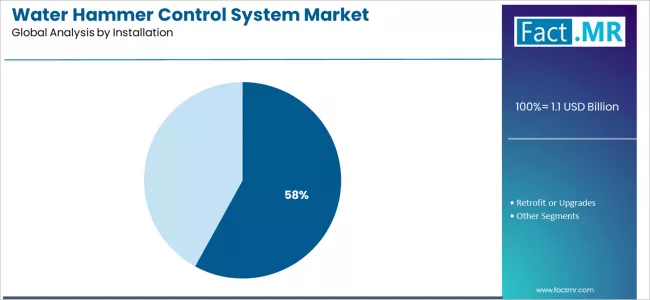
Water Hammer Control System Market Analysis By Installation | Source: Fact.MR
Installation type significantly influences market dynamics, with new installations holding a 58% share. Water hammer control systems are often integrated into new construction projects, where systems are designed to manage pressure surges effectively from the start. As building and infrastructure projects continue to grow, especially in industries like utilities and manufacturing, the demand for water hammer control systems in new installations will remain strong. Additionally, retrofit or upgrade installations will see growth as existing systems are updated to meet modern standards and regulations for pressure management and water system protection.
What are the Drivers, Restraints, and Key Trends in the Water Hammer Control System Market?
- Drivers: Demand for water hammer control systems is shaped by the need to protect piping networks and rotating equipment from pressure surges that cause mechanical stress and unplanned outages. End users in oil and gas, power generation, municipal water utilities, and industrial process plants specify these systems to improve asset reliability, reduce maintenance costs, and support continuous operations. Selection criteria often include response speed, compatibility with fluid characteristics, and integration with existing control architectures.
- Restraints: High capital and installation costs constrain deployment where budgets are limited or where legacy practices rely on manual mitigation methods. Some facilities face technical challenges aligning control system parameters with varied pipeline hydraulics, which requires detailed engineering and testing. Availability of skilled technicians for configuration and tuning of surge control systems remains a barrier in certain regions, affecting implementation timelines.
- Trend 1: Adoption of digital surge analysis tools that model transient events and support specification of optimal control hardware and logic.
- Trend 2: Development of integrated control units with remote monitoring and diagnostic capabilities that enable condition based adjustments and reduce on site maintenance demands.
Analysis of the Water Hammer Control System Market by Key Country
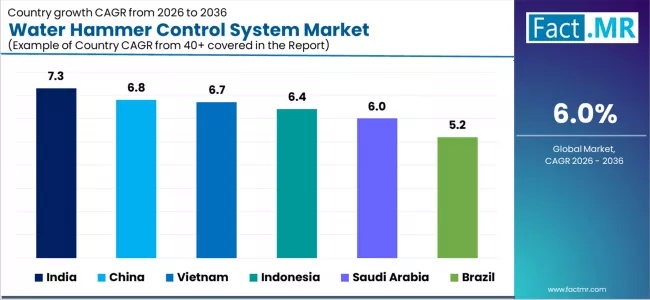
Water Hammer Control System Market Cagr Analysis By Country | Source: Fact.MR
| Country | CAGR (2026-2036) |
|---|---|
| India | 7.3% |
| China | 6.8% |
| Vietnam | 6.7% |
| Indonesia | 6.4% |
| Saudi Arabia | 6% |
| Brazil | 5.2% |
Source: Fact.MR analysis. Updated Jan 21, 2026
The report covers an in-depth analysis of 40+ countries; top-performing countries are highlighted below.
What is the Outlook on the Water Hammer Control System Market in India?
India market in water hammer control systems is projected to grow at a CAGR of 7.3% from 2026 to 2036. Demand for water hammer control systems in India is increasing due to the growing need for efficient fluid flow management in industries such as water treatment, oil and gas, and power generation. These systems are critical for preventing the damaging effects of water hammer, ensuring the longevity and safety of piping systems. With India’s expanding infrastructure, industrial activities, and focus on modernizing water management, the market for water hammer control systems is expected to continue growing steadily.
What is the Demand for Water Hammer Control Systems in China?
China sales of water hammer control systems are expected to grow at a CAGR of 6.8% from 2026 to 2036. China’s demand for water hammer control systems is increasing as the country’s industrial base grows, particularly in energy, manufacturing, and water treatment sectors. These systems are crucial for preventing pressure surges and protecting pipelines and equipment from damage caused by water hammer. With China’s ongoing focus on industrial modernization and the need for advanced fluid management technologies, the water hammer control system market is expected to grow steadily, supported by both local and international industrial demand.
What is the Sales Outlook on Water Hammer Control Systems in Vietnam?
Vietnam demand for water hammer control systems is projected to grow at a CAGR of 6.7% from 2026 to 2036. The water hammer control system market in Vietnam is expanding as the country’s industrial and infrastructure sectors continue to develop, particularly in water treatment, manufacturing, and energy. These systems are essential in maintaining the integrity of industrial piping systems by preventing pressure surges and ensuring smooth fluid flow. With Vietnam’s growing focus on modernizing its infrastructure and improving industrial efficiency, the market for water hammer control systems is set to continue expanding steadily, driven by both local industrial growth and global trends in fluid management.
What is the Growth Potential for Water Hammer Control System Market in Indonesia?
Indonesia industry in water hammer control systems is forecast to grow at a CAGR of 6.4% from 2026 to 2036. As Indonesia’s industrial and energy sectors expand, particularly in water treatment, petrochemical, and power generation industries, the demand for water hammer control systems is increasing. These systems are crucial for preventing the destructive effects of water hammer on pipes and equipment, ensuring safety and operational efficiency. With Indonesia’s focus on industrial development, infrastructure modernization, and automation, the water hammer control system market will continue to grow, supported by both local demand and regional industrial growth.
What is the Demand for Water Hammer Control Systems in Saudi Arabia?
Saudi Arabia market in water hammer control systems is set to grow at a CAGR of 6% from 2026 to 2036. Saudi Arabia’s demand for water hammer control systems is driven by the country’s significant oil, gas, and energy sectors, which require reliable fluid management systems. These systems are essential for controlling pressure surges and ensuring the safe operation of industrial systems, particularly in the energy and petrochemical industries. With the country’s ongoing focus on infrastructure development, automation, and industrial efficiency, the water hammer control system market is expected to continue growing steadily, supported by both domestic and regional industrial demands.
What is the Market Expansion Outlook for Water Hammer Control Systems in Brazil?
Brazil sales of water hammer control systems are projected to grow at a CAGR of 5.2% from 2026 to 2036. As Brazil’s industrial sectors continue to grow, particularly in water treatment, oil and gas, and manufacturing, the demand for water hammer control systems is increasing. These systems are vital for protecting industrial equipment and pipelines from the damaging effects of water hammer, ensuring smooth and safe operations. With Brazil’s focus on industrial modernization, sustainability, and process optimization, the water hammer control system market is expected to expand steadily, driven by both local demand and international trends in industrial fluid management.
How is Competition Structured in the Water Hammer Control System Market?
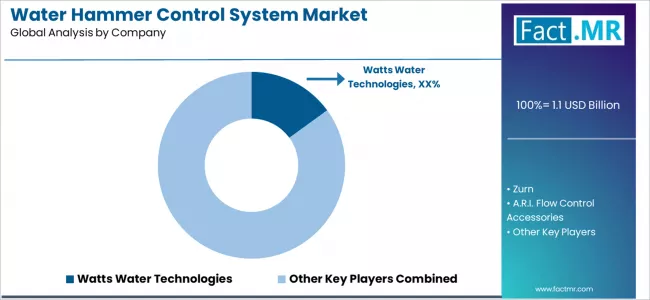
Water Hammer Control System Market Analysis By Company | Source: Fact.MR
Competition in the water hammer control system market is defined by engineering effectiveness, reliability under transient events, and compatibility with varied fluid networks. Watts Water Technologies and Zurn compete with broad portfolios of surge suppressors and control valves that mitigate pressure spikes in municipal and industrial systems. Cla Val and Bermad emphasize precision valve systems that balance rapid response with flow stability.
A.R.I. Flow Control Accessories and Singer Valve position offerings focused on accessory components that enhance system damping and pressure control. Dorot and AVK Group (air valves) compete with air release and vacuum solutions that reduce water hammer risk through pressure management. Emerson, through its surge control and automation technologies, integrates predictive control and real time monitoring to address transient pressures proactively. Xylem leverages fluid handling expertise to offer integrated systems combining surge control, pressure regulation, and diagnostics. Competitive differentiation arises from documented performance under dynamic conditions, ease of installation, and compliance with industry standards. Buyers assess suppliers based on reliability in field applications, service support availability, and alignment with system design requirements.
Key Players in the Water Hammer Control System Market
- Watts Water Technologies
- Zurn
- A.R.I. Flow Control Accessories
- Cla Val
- Bermad
- Singer Valve
- Dorot
- Emerson (surge control/controls)
- AVK Group (air valves)
- Xylem
Bibliographies
- International Organization for Standardization. (2024). ISO 17776: Petroleum and natural gas industries - Major accident hazard management. ISO.
- American Water Works Association. (2023). M11: Steel pipe-A guide for design and installation. AWWA.
- American Society of Civil Engineers. (2024). Pipeline surge analysis and control: Design considerations. ASCE.
- U.S. Bureau of Reclamation. (2023). Water hammer and surge analysis for pumping plants and pipelines.
- U.S. Environmental Protection Agency. (2024). Water distribution system design and operational resilience. EPA.
Segmentation
Scope of the Report
| Items | Values |
|---|---|
| Quantitative Units (2026) | USD Billion |
| Solution Type | Water Hammer Arrestors, Surge Tanks and Vessels, Air Release or Combination Valves, Surge Relief or Anticipator Valves, Controls and Monitoring |
| Application | Municipal Water Networks, High-Rise Buildings, Industrial Process Water, Irrigation, HVAC or Chilled Water |
| Installation | New Installations, Retrofit or Upgrades |
| Regions Covered | North America, Europe, Asia Pacific, Latin America, Middle East & Africa |
| Countries Covered | United States, Canada, Mexico, Brazil, Germany, United Kingdom, France, Italy, Spain, China, Japan, South Korea, India, Australia & New Zealand |
| Key Companies Profiled | Watts Water Technologies, Zurn, A.R.I. Flow Control Accessories, Cla-Val, Bermad, Singer Valve, Dorot, Emerson (surge control/controls), AVK Group (air valves), Xylem |
| Additional Attributes | Dollar revenue by solution type, application, and installation; regional demand trends, competitive landscape, technological advancements in water hammer control systems, and innovations in surge relief and monitoring technologies |
Source: Fact.MR analysis. Updated Jan 21, 2026
Water Hammer Control System Market Key Segments
-
Solution Type :
- Water Hammer Arrestors
- Surge Tanks and Vessels
- Air Release or Combination Valves
- Surge Relief or Anticipator Valves
- Controls and Monitoring
-
Application :
- Municipal Water Networks
- High-Rise Buildings
- Industrial Process Water
- Irrigation
- HVAC or Chilled Water
-
Installation :
- New Installations
- Retrofit or Upgrades
-
Region :
- North America
- U.S.
- Canada
- Mexico
- Europe
- Germany
- UK
- France
- Italy
- Spain
- Nordic Countries
- BENELUX
- Rest of Europe
- Asia Pacific
- China
- Japan
- South Korea
- India
- Australia
- Rest of Asia Pacific
- Latin America
- Brazil
- Argentina
- Rest of Latin America
- Middle East and Africa
- Kingdom of Saudi Arabia
- United Arab Emirates
- South Africa
- Rest of Middle East and Africa
- Other Regions
- Oceania
- Central Asia
- Other Markets
- North America
Frequently Asked Questions
How big is the water hammer control system market in 2026?
What will be the size of water hammer control system market in 2036?
How much will be the water hammer control system market growth between 2026 and 2036?
What are the key product types in the water hammer control system market?
Which application segment to contribute significant share in the water hammer control system market in 2026?
Who worked on this report


Preview the report firsthand - request a free sample
Free SampleGet the brochure for pricing and purchase details
Download PDF