- Base Value(2026): 313.6 Bn
- Estimated Value(2026): 313.6 Bn
- Forecast Value (2036): 575.4 Bn
- CAGR (2026 - 2036): 6.3%
Fruit & Vegetable Juice Market Forecast and Outlook 2026 to 2036
The global fruit & vegetable juice market is projected to reach USD 575.4 billion by 2036. The market is valued at USD 313.6 billion in 2026 and is set to rise at a CAGR of 6.3% during the assessment period. Consumption and sales are expected to grow 1.8x during the same period, supported by increasing demand from health-conscious consumers and expanding applications in functional beverage formulations across both developed and emerging markets.
Key Takeaways from the Fruit & Vegetable Juice Market
- Fruit & Vegetable Juice Market Value (2026): USD 313.6 billion
- Fruit & Vegetable Juice Market Forecast Value (2036): USD 575.4 billion
- Fruit & Vegetable Juice Market Forecast CAGR: 6.3%
- Leading Product in Fruit & Vegetable Juice Market: Fruit Juices (43.3%)
- Key Growth Regions in Fruit & Vegetable Juice Market: North America, Asia Pacific, and Europe
- Top Players in Fruit & Vegetable Juice Market: The Coca-Cola Company, PepsiCo, Fresh Del Monte, Bolthouse Farms, Inc., Lakewood Organic Juices, Welch's, Ocean Spray, Keurig Dr Pepper Inc., The Kraft Heinz Company, Dole Packaged Foods, LLC
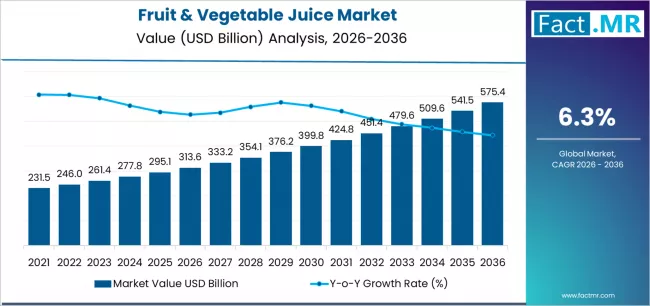
Fruit & Vegetable Juice Market Market Value Analysis | Source: Fact.MR
Rising health awareness in urban populations globally, coupled with expanding retail infrastructure through supermarket chains and online grocery platforms, further accelerate market penetration across diverse consumer segments. The growing global emphasis on preventive nutrition and natural beverage alternatives, particularly in developed economies and emerging middle-class populations, generates sustained requirements for fruit-based beverages and vegetable juice consumption.
Technical advancements in processing technologies demonstrating measurable improvements in nutrient retention, extended shelf life, and flavor preservation reinforce manufacturer confidence in juice production economics, while wellness trends toward detoxification programs and immunity-boosting formulations expand addressable market opportunities beyond traditional fruit juice categories into functional vegetable blends and therapeutic beverage applications.
Fruit & Vegetable Juice Market
| Metric | Value |
|---|---|
| Market Value (2026) | USD 313.6 billion |
| Market Forecast Value (2036) | USD 575.4 billion |
| Forecast CAGR (2026-2036) | 6.3% |
Source: Fact.MR analysis. Updated Dec 20, 2025
Category
| Category | Segments |
|---|---|
| Product | Fruit Juices; Fruit and Vegetable Blends; Vegetable Juices |
| Distribution Channel | Supermarkets and Hypermarkets; Convenience Stores; Online; Others |
| Region | North America; Asia Pacific; Europe; Latin America; Middle East & Africa |
Source: Fact.MR analysis. Updated Dec 20, 2025
Segmental Analysis
What Makes Fruit Juices the Dominant Product Segment in the Fruit & Vegetable Juice Market?
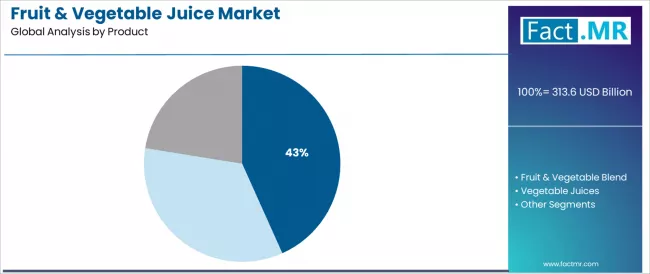
Fruit & Vegetable Juice Market Analysis By Product | Source: Fact.MR
Fruit juice represents the dominant force in the fruit & vegetable juice market, capturing 43.3% of the total market share in 2026. This established product category encompasses solutions featuring essential refreshment functionality for breakfast consumption, snacking occasions, and daily nutrition supplementation, including orange juice, apple juice, and tropical fruit varieties that enable taste satisfaction, vitamin delivery, and versatile consumption applications across all meal occasions.
Which Distribution Channel Category Leads Market Consumption in the Fruit & Vegetable Juice Market?
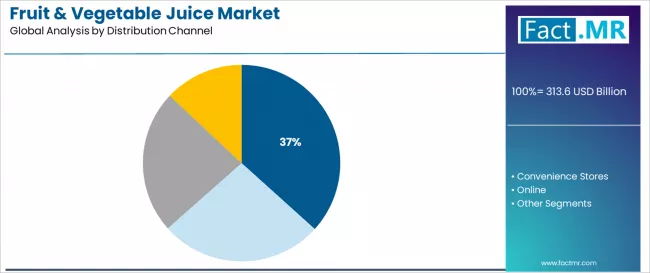
Fruit & Vegetable Juice Market Analysis By Distribution Channel | Source: Fact.MR
The supermarkets/hypermarkets segment represents the dominant distribution channel in the fruit & vegetable juice market, capturing 36.7% of the total market share in 2026. This leading channel category encompasses large-format retail stores, grocery chains, and warehouse clubs providing comprehensive juice selections for household shopping and bulk purchasing across diverse product varieties.
Which Region Dominates in the Fruit & Vegetable Juice Market?
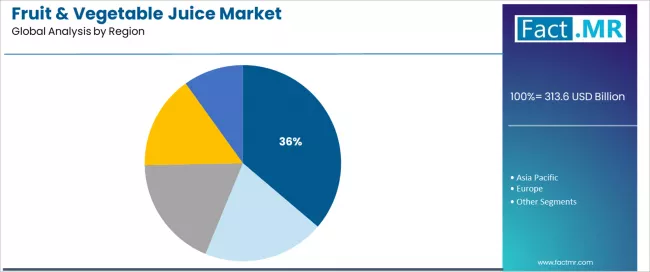
Fruit & Vegetable Juice Market Analysis By Region | Source: Fact.MR
North America represents the dominant regional category in the fruit & vegetable juice market, capturing 36.2% of the total market share in 2026. This leading regional category encompasses USA and Canada markets with established juice consumption traditions, premium product preferences, and comprehensive retail distribution supporting diverse juice category development.
What are the Drivers, Restraints, and Key Trends of the Fruit & Vegetable Juice Market?
The market is driven by rising consumer focus on health and wellness, which is increasing demand for nutritious and convenient beverage options. Growing penetration of e-commerce platforms and specialty health retailers is improving product accessibility and supporting wider adoption across urban and semi-urban markets. Technological advances in cold-pressed and high-pressure processing (HPP) are further strengthening demand by preserving nutrients, taste, and freshness while extending shelf life.
Market restraints include concerns over natural sugar content and alignment with dietary guidelines, which can limit regular juice consumption among health-conscious consumers. Competition from alternative healthy beverages, such as functional waters and fortified drinks, is intensifying category pressure. Volatility in fruit concentrate prices and agricultural supply fluctuations also affect cost structures and margin stability.
Key trends include accelerating demand for organic and clean-label juices in developed markets, driven by ingredient transparency and sustainability preferences. Adoption of cold-pressed processing, nutrient fortification, and functional ingredient integration is enabling product differentiation, though evolving dietary guidance favoring whole fruits may influence long-term consumption patterns.
Analysis of the Fruit & Vegetable Juice Market by Key Countries
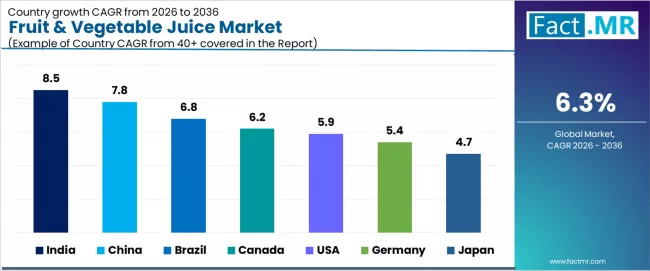
Fruit & Vegetable Juice Market Cagr Analysis By Country | Source: Fact.MR
| Country | CAGR (2026-2036) |
|---|---|
| India | 8.5% |
| China | 7.8% |
| Brazil | 6.8% |
| Canada | 6.2% |
| USA | 5.9% |
| Germany | 5.4% |
| Japan | 4.7% |
Source: Fact.MR analysis. Updated Dec 20, 2025
Why is India Leading Global Market Expansion in Fruit & Vegetable Juices?
India demonstrates the strongest growth potential in the fruit and vegetable juice market, registering a CAGR of 8.5% through 2036. Growth is driven by rapid adoption of packaged juice products, large-scale urbanization, and expanding middle-class purchasing power. Demand is concentrated in metropolitan regions such as Mumbai, Delhi, Bangalore, and Hyderabad, where modern retail penetration and rising disposable incomes support convenience-oriented and nutrition-focused consumption.
Expansion of organized retail, e-commerce grocery platforms, and distribution networks is improving product availability across urban households. Increasing health awareness and gradual dietary westernization continue to reinforce demand for packaged juice products as part of everyday consumption.
How Is China Emerging as a Premiumization Leader in Juice Consumption?
China records a 7.8% CAGR, driven by rising demand for premium fruit and vegetable juices among health-conscious urban consumers. Major cities including Beijing, Shanghai, Guangzhou, and Shenzhen account for a significant share of consumption, supported by income growth and strong retail modernization.
Consumers increasingly associate juice products with wellness, nutrition, and preventive health, aligning with national health initiatives. Expansion of supermarkets and e-commerce grocery platforms enhances access to premium offerings, while nutritional messaging and quality positioning support higher-value purchases in affluent demographics.
What is Driving Brazil’s Juice Market amid a Middle-Class Population Expansion?
Brazil’s juice market grows at a 6.8% CAGR, supported by rising middle-class incomes and improving retail penetration in urban centers such as São Paulo and Rio de Janeiro. Modern grocery formats are expanding access to packaged juices, enabling broader adoption beyond traditional consumption patterns.
Growing preference for natural beverages and tropical fruit varieties supports steady demand, while retail modernization and income growth strengthen long-term category expansion in urban regions.
How does Canada Demonstrate Health-Conscious Leadership in Juice Consumption?
Canada expands at a 6.2% CAGR, driven by strong consumer focus on health, wellness, and premium nutrition. Demand is concentrated in cities such as Toronto, Vancouver, and Montreal, where organic and cold-pressed juice products gain traction among quality-focused consumers.
Specialty retailers and health food stores play a central role in distribution, supporting premium positioning through traceability, organic certification, and sustainable sourcing. Innovation in cold-pressed processing continues to reinforce Canada’s premium juice segment.
Why does the USA Continue to Lead through Product Innovation?
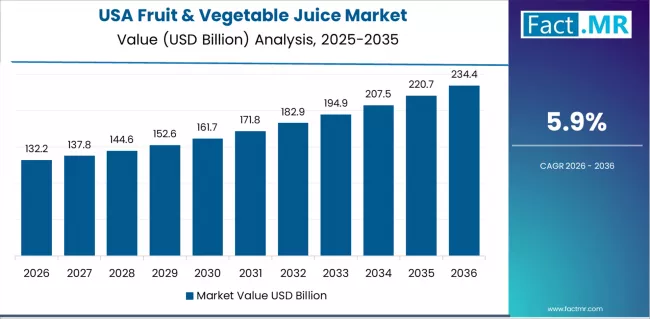
Fruit & Vegetable Juice Market Country Value Analysis | Source: Fact.MR
The USA records a 5.9% CAGR, supported by a large, mature consumption base and continuous product innovation. Consumers in regions such as California, New York, Texas, and Florida maintain established juice consumption habits while increasingly seeking clean-label formulations and functional benefits.
Brands focus on cold-pressed technologies, added nutrients, and transparency in sourcing to meet evolving health expectations. The mature retail ecosystem sustains demand through innovation-led premiumization rather than volume expansion.
How does Germany Maintain Leadership in Organic Juice Consumption?
Germany grows at a 5.4% CAGR, driven by strong preference for organic, low-sugar juice products. Consumers prioritize certified organic sourcing, transparent labeling, and sustainability, reinforcing trust in premium juice offerings. Organic supermarket chains and health-focused retailers dominate distribution, supporting steady demand for quality-assured products. Emphasis on reduced sugar content and clean-label formulations continues to differentiate the German juice market within Europe.
Why Is Japan Focused on Functional Juice Innovation?
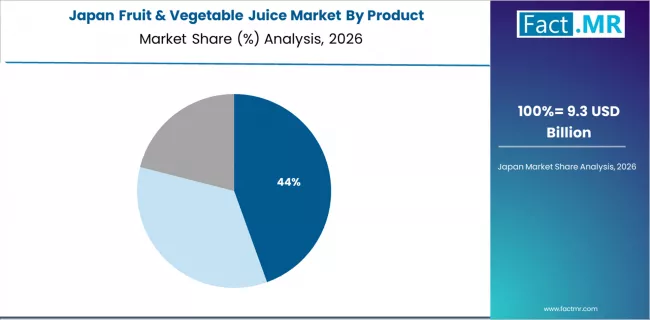
Fruit & Vegetable Juice Market Japan Market Share Analysis By Product | Source: Fact.MR
Japan’s fruit & vegetable juice market grows at a 4.7% CAGR, shaped by strong demand for functional beverages that support daily health maintenance. Consumers favor low-sugar, nutrient-fortified juice products aligned with preventive healthcare practices. Extensive distribution through convenience stores, vending machines, and specialty retailers ensures wide accessibility. Health claim validation and evidence-based communication remain central to consumer acceptance, supporting steady growth in a mature market.
Competitive Landscape of the Fruit & Vegetable Juice Market
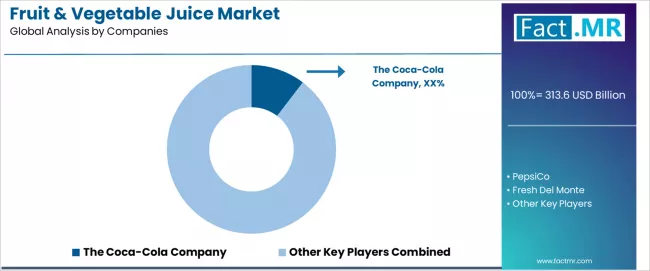
Fruit & Vegetable Juice Market Analysis By Company | Source: Fact.MR
The fruit and vegetable juice market is moderately concentrated. Competition is shaped by brand strength, distribution scale, product diversification, and sourcing reliability rather than price alone. Large beverage companies benefit from extensive retail and foodservice penetration, while smaller players compete through premium positioning and product differentiation.
The Coca-Cola Company, PepsiCo, and Keurig Dr Pepper Inc. lead the market, supported by broad juice brand portfolios, global bottling and distribution infrastructure, and strong relationships with retailers and foodservice operators. These companies continue to defend market positions through product reformulation, functional juice innovation, and expansion into premium and health-oriented segments.
Challengers such as Fresh Del Monte, Dole Packaged Foods, and Ocean Spray leverage integrated agricultural supply chains and fruit-centric branding to compete effectively. Specialty producers including Bolthouse Farms, Lakewood Organic Juices, and Welch’s focus on organic, cold-pressed, or varietal-specific offerings. Regional and craft juice brands add competitive pressure through localized production, clean-label positioning, and strong appeal in urban and specialty retail channels.
Key Players in the Fruit & Vegetable Juice Market
- The Coca-Cola Company
- PepsiCo
- Fresh Del Monte
- Bolthouse Farms, Inc.
- Lakewood Organic Juices
- Welch's
- Ocean Spray
- Keurig Dr Pepper Inc.
- The Kraft Heinz Company
- Dole Packaged Foods, LLC
Segmentation
Scope of the Report
| Items | Values |
|---|---|
| Quantitative Units | USD 313.6 Billion |
| Product | Fruit Juices, Fruit & Vegetable Blend, Vegetable Juices |
| Distribution Channel | Supermarkets/Hypermarkets, Convenience Stores, Online, Others |
| Regions Covered | North America, Asia Pacific, Europe, Latin America, MEA |
| Country Covered | India, China, Brazil, Canada, USA, Germany, Japan, and 40+ countries |
| Key Companies Profiled | The Coca-Cola Company, PepsiCo, Fresh Del Monte, Bolthouse Farms, Inc., Lakewood Organic Juices, Welch's, Ocean Spray, Keurig Dr Pepper Inc., The Kraft Heinz Company, Dole Packaged Foods, LLC |
| Additional Attributes | Dollar sales by product and distribution channel categories, regional consumption trends across North America, Asia Pacific, and Europe, competitive landscape with beverage companies and fruit processors, product specifications and quality requirements, integration with retail grocery systems and foodservice operations. |
Source: Fact.MR analysis. Updated Dec 20, 2025
Fruit & Vegetable Juice Market by Segments
-
Product :
- Fruit Juices
- Fruit & Vegetable Blend
- Vegetable Juices
-
Distribution Channel :
- Supermarkets/Hypermarkets
- Convenience Stores
- Online
- Others
-
Region :
- North America
- USA
- Canada
- Mexico
- Asia Pacific
- China
- India
- Japan
- South Korea
- Australia & New Zealand
- ASEAN
- Rest of Asia Pacific
- Europe
- Germany
- UK
- France
- Spain
- Italy
- Rest of Europe
- Latin America
- Brazil
- Rest of Latin America
- MEA
- Kingdom of Saudi Arabia
- Other GCC Countries
- Turkey
- South Africa
- Rest of MEA
- North America
Frequently Asked Questions
How big is the fruit & vegetable juice market in 2026?
What will be the size of fruit & vegetable juice market in 2036?
How much will be the fruit & vegetable juice market growth between 2026 and 2036?
What are the key product types in the fruit & vegetable juice market?
Which distribution channel segment to contribute significant share in the fruit & vegetable juice market in 2026?
Who worked on this report


Preview the report firsthand - request a free sample
Free SampleGet the brochure for pricing and purchase details
Download PDF