- Base Value(2025): 6.9 Bn
- Estimated Value(2026): 7.5 Bn
- Forecast Value (2036): 15.9 Bn
- CAGR (2026 - 2036): 7.8%
Fruit Snacks Market Forecast and Outlook Fact.MR
In 2025, the fruit snacks market was valued at USD 6.9 billion. Based on Fact MR analysis, demand for fruit snacks is estimated to grow to USD 7.5 billion in 2026 and USD 15.9 billion by 2036. FMR projects a CAGR of 7.8% during the forecast period.
The absolute dollar growth from 2026 to 2036 is USD 8.4 billion. This indicates a meaningful but largely incremental expansion rather than a structural transformation of the snack industry. Demand is expected to rise steadily as packaged fruit snacks gain wider shelf presence across supermarkets, convenience stores, and online grocery platforms. Growth momentum remains supported by consumer preference for portion controlled snack formats and products perceived as fruit based alternatives to traditional confectionery. At the same time, several structural constraints moderate expansion, including volatility in fruit puree and concentrate feedstock prices, reformulation costs tied to sugar labeling rules, and substitution pressure from other packaged snack categories.
Germany records the fastest expansion with an expected CAGR of 8.1%, supported by strong retail penetration of fruit based confectionery and continued demand for reduced sugar snack options. India follows with a CAGR of 7.9%, reflecting expanding packaged snack consumption and broader access through organized retail and modern trade networks. The United Kingdom shows a CAGR of 7.8% as manufacturers introduce reformulated fruit snack products positioned as lower sugar alternatives to traditional sweets. The United States is projected to grow at 6.8%, supported by steady demand for convenient snack packs and continued innovation in fruit puree based formats. China shows the slowest growth at 6.2%, reflecting a large but increasingly competitive packaged snack sector. Mature markets such as the United States and parts of Western Europe generate a significant share of replacement demand rather than rapid new consumption growth. Retail price competition and private label expansion act as structural constraints in these established markets.
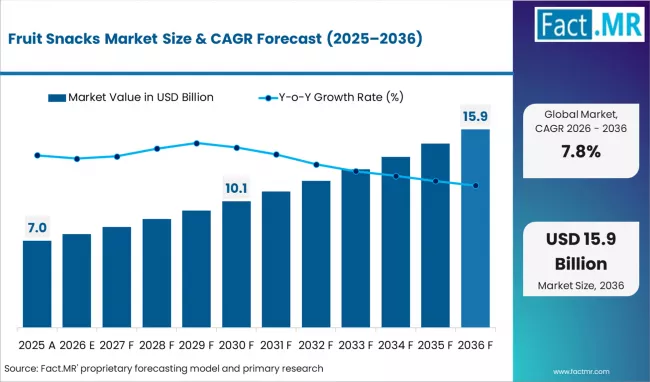
Fruit Snacks Market Market Value Analysis | Source: Fact.MR
| Metric | Details |
|---|---|
| Industry Size (2026E) | USD 7.5 billion |
| Industry Value (2036F) | USD 15.9 billion |
| CAGR (2023 to 2033) | 7.8% |
Source: Fact.MR analysis. Updated Mar 16, 2026
Fruit Snacks Market Definition
The Fruit Snacks Market covers packaged snack products made primarily from fruit ingredients such as fruit puree, juice concentrates, or dried fruit. These products are processed into convenient forms including gummies, fruit bars, fruit leather, and dried fruit pieces. They are designed for portable consumption and extended shelf life while maintaining fruit flavor and sweetness. Fruit snacks are commonly used as ready to eat snack items in retail food channels and convenience food categories. Key end uses include packaged snack foods for children and adults, distributed through supermarkets, convenience stores, and food service outlets.
Market Inclusions
This report covers global and regional market sizes for fruit snacks along with forecast analysis for the study period. The market is segmented by product type such as gummies, fruit bars, fruit leather, and dried fruit snacks. Segmentation by application and end user includes retail snack consumption, convenience food products, and institutional distribution channels. The report also evaluates pricing patterns, supply structures, and selected trade flow analysis across major production and consumption regions.
Market Exclusions
The report excludes fresh fruit, frozen fruit products, and fruit juice beverages since these belong to separate food categories. Traditional confectionery products such as chocolate candies and sugar-based sweets are also excluded unless fruit ingredients form the primary base. The study does not include bakery goods containing fruit fillings, dairy desserts with fruit flavoring, or nutraceutical supplements derived from fruit extracts. Agricultural cultivation of fruits and industrial fruit juice processing are outside the defined market scope.
Research Methodology
- Primary Research: Interviews were conducted with executives, product managers, and procurement specialists from food processing companies and packaged snack manufacturers.
- Desk Research: Public information was gathered from food industry publications, government statistics, company reports, and trade databases.
- Market-Sizing and Forecasting: A hybrid model combining top down demand analysis and bottom up company revenue assessment was applied.
- Data Validation and Update Cycle: Findings were cross verified through multiple data sources and industry expert reviews, with updates conducted as new market information becomes available.
Summary of the Fruit Snacks Market
- Market Definition
- The market comprises packaged snack products made primarily from fruit ingredients such as fruit puree, juice concentrates, and dried fruit. These products are processed into convenient formats including gummies, fruit bars, fruit leather, and dried fruit pieces designed for portable consumption and extended shelf life across retail snack channels.
- Demand Drivers
- Expansion of packaged snack consumption across supermarkets, convenience stores, and online grocery platforms.
- Consumer preference for portion controlled snack formats positioned as fruit based alternatives to traditional confectionery products.
- Wider retail shelf presence for fruit snacks supported by established packaged food distribution networks.
- Product reformulation using fruit puree concentrates and plant based gelling agents responding to labeling and ingredient disclosure requirements.
- Key Segments Analyzed
- Nature: Conventional fruit snacks lead with about 70% share due to large scale production systems and broad retail availability.
- Product Type: Sweets and savories dominate with about 55% share, including fruit gummies, fruit chews, and fruit leather formats.
- Distribution Channel: Modern trade and convenience retail channels account for the majority of product placement and consumer access.
- Geography: Germany shows the fastest expansion, while India records strong growth supported by expanding packaged snack consumption.
- Analyst Opinion at Fact MR
- Shambhu Nath Jha, Principal Consultant, Fact MR, opines, "In this updated edition of the Fruit Snacks Market report, industry participants will observe that the category continues to operate at the intersection of confectionery manufacturing and fruit processing supply chains. Growth remains linked to the scale of packaged snack distribution networks and the availability of fruit puree and concentrate inputs. Companies that strengthen sourcing relationships with fruit processors and maintain cost control across large scale snack production will retain structural advantages. Market competition remains shaped by shelf presence in supermarkets and convenience retail networks."
- Strategic Implications or Executive Takeaways
- Strengthen supply chain integration with fruit puree and concentrate suppliers to stabilize ingredient availability.
- Expand product portfolios across fruit gummies, fruit bars, and dried fruit snack formats to address diverse consumer preferences.
- Increase retail shelf presence through partnerships with supermarket chains and convenience store networks.
- Invest in product reformulation strategies aligned with evolving ingredient labeling and sugar disclosure regulations.
- Methodology
- Primary interviews conducted with executives, product managers, and procurement specialists from packaged snack manufacturers.
- Desk research based on food industry publications, government statistics, company financial reports, and trade databases.
- Market sizing developed through a hybrid top down demand model combined with bottom up company revenue assessment.
- Findings validated through multiple data sources and industry expert reviews under Fact MR internal modeling standards.
Segmental Analysis
Fruit Snacks Market Analysis by Nature
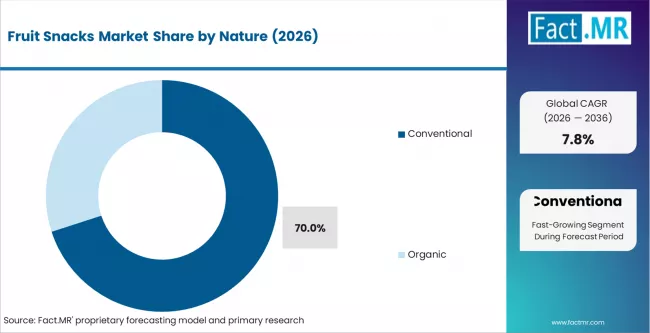
Fruit Snacks Market Analysis By Nature | Source: Fact.MR
- Market Overview: Conventional fruit snacks are projected to hold around 70% share of the fruit snacks market by 2026. The segment dominance is supported by large scale manufacturing capacity, consistent availability of processed fruit ingredients, and strong retail penetration across supermarkets and convenience outlets. Conventional fruit snack formulations allow producers to maintain competitive pricing and stable shelf life, which supports distribution across global supply chains. Organic fruit snacks represent a smaller portion of the market, largely due to higher certification costs and limited organic fruit supply within large scale snack production systems.
- Demand Drivers:
- Manufacturing Scale: Conventional fruit snacks are produced through standardized processing systems that allow manufacturers to maintain consistent output and product quality across global markets.
- Retail Accessibility: Supermarkets, hypermarkets, and convenience stores widely stock conventional fruit snack products due to their high turnover and broad consumer familiarity.
- Shelf Life Advantage: Conventional fruit snack formulations maintain longer shelf stability, supporting efficient distribution across regional and international retail networks.
Fruit Snacks Market Analysis by Product Type
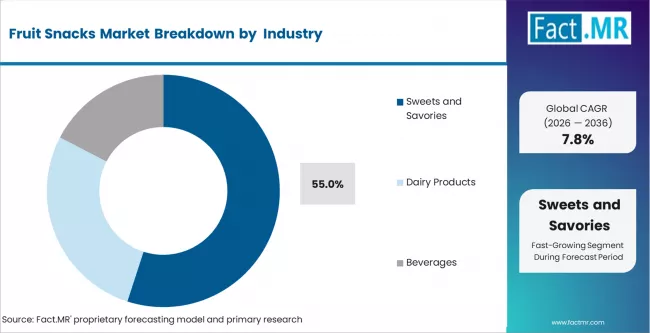
Fruit Snacks Market Analysis By Product Type | Source: Fact.MR
- Market Overview: Sweets and savories are expected to account for approximately 55% share of the fruit snacks market in 2026. This category includes fruit gummies, fruit chews, fruit leather, and flavored fruit bites designed for convenient snacking. The segment benefits from strong consumer demand among children and young adults seeking portable snack options. Standardized production techniques and established brand recognition have helped manufacturers expand distribution across grocery stores, convenience outlets, and institutional food programs. Dairy based fruit snacks and fruit beverages serve smaller segments focused on functional snacks and refreshment products.
- Demand Drivers:
- Convenient Snack Formats: Fruit gummies, chews, and fruit bites offer portable snack options suitable for school, travel, and workplace consumption.
- Standardized Production: Large scale snack manufacturers utilize efficient processing technologies that support consistent quality and cost control in fruit based sweet snacks.
- Retail Shelf Expansion: Growth of convenience retail networks and supermarket snack aisles has increased shelf availability for packaged fruit snack products.
Fruit Snacks Market Drivers, Restraints, and Opportunities
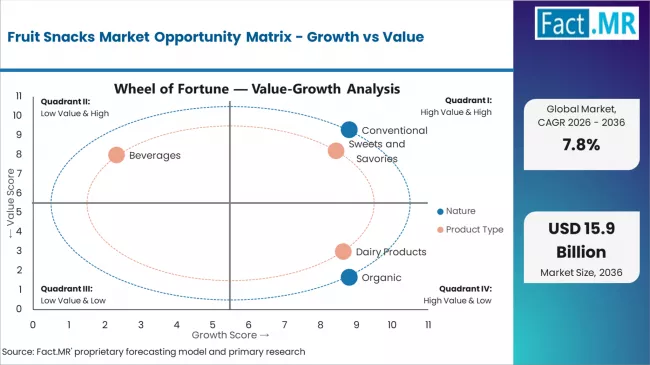
Fruit Snacks Market Opportunity Matrix Growth Vs Value | Source: Fact.MR
FMR analysts observe that the fruit snacks market developed alongside the expansion of packaged snack foods and large-scale fruit processing industries. Early fruit snack products emerged as shelf-stable alternatives to fresh fruit, using fruit puree concentrates, pectin gels, and drying techniques to extend storage life. The present market valuation reflects the scale of global snack food distribution networks where fruit-based snacks serve as convenient portable products for retail and school consumption. Demand persists because fruit snacks combine perceived fruit content with the manufacturing efficiencies of confectionery and processed snack production.
A structural shift is occurring as traditional gelatin-based fruit snacks gradually lose share to products formulated with higher fruit content and plant-based gelling agents. Conventional low-cost fruit snacks remain widely distributed through mass retail channels where price sensitivity remains high. Premium fruit snacks made from freeze-dried fruit pieces or higher fruit puree concentration carry higher per-unit prices despite lower production volumes. This pricing differential supports market value growth even as commodity fruit snack formats experience slower expansion in mature retail markets.
- Clean Label Reformulation: Food manufacturers increasingly reformulate fruit snacks using pectin and fruit-derived ingredients to replace gelatin-based confectionery textures.
- Food Labeling Regulation: Standards such as the U.S. Food and Drug Administration Nutrition Facts labeling rules and European Union Regulation (EU) No 1169/2011 on food information to consumers shape ingredient disclosure and product positioning.
- Asia Snack Expansion: China and India show rising demand for packaged fruit snacks as modern retail distribution and organized snack manufacturing expand across urban consumer markets.
Regional Analysis
The market analysis covers key global regions, including East Asia, South Asia, North America, and Western Europe. It is segmented geographically, with specific market dynamics for each region. The full report provides a detailed market attractiveness analysis.
.webp "Top Country Growth Comparison Fruit Snacks Market Cagr (2026 2036)")
Top Country Growth Comparison Fruit Snacks Market Cagr (2026 2036) | Source: Fact.MR
| Country | CAGR (2026-2036) |
|---|---|
| China | 6.2% |
| India | 7.9% |
| USA | 6.8% |
| United Kingdom | 7.8% |
| Germany | 8.1% |
Source: Fact.MR analysis. Updated Mar 16, 2026
Source: Fact MR (FMR) analysis, based on proprietary forecasting model and primary research
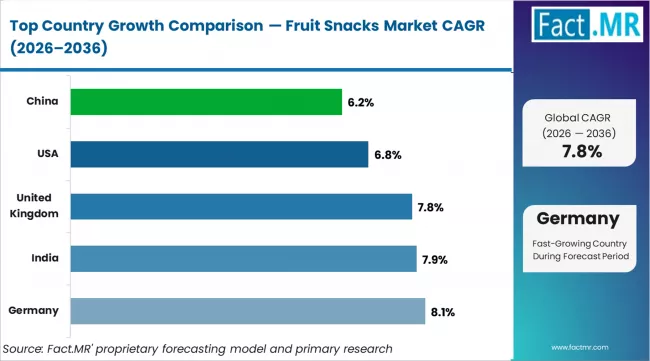
Fruit Snacks Market Cagr Analysis By Country | Source: Fact.MR
East Asia
China is a major market supported by packaged snack consumption, retail expansion, and product innovation in fruit based snacks. Key companies include PepsiCo, Inc., General Mills, Inc., and SunOpta Inc..
- China: Demand for fruit snacks in China is projected to rise at 6.2% CAGR through 2036. Growth is supported by packaged food consumption programs promoted by the Ministry of Commerce (03-2025) and expansion of fruit snack product lines by PepsiCo, Inc. (08-2025).
South Asia
India is a rapidly growing market supported by demand for convenient snacks, rising retail penetration, and increasing consumption of packaged fruit products.
- India: Demand for fruit snacks in India is projected to rise at 7.9% CAGR through 2036. Growth is supported by food processing initiatives promoted by the Ministry of Food Processing Industries (05-2025) and expansion of snack product distribution by General Mills, Inc. (09-2025).
North America
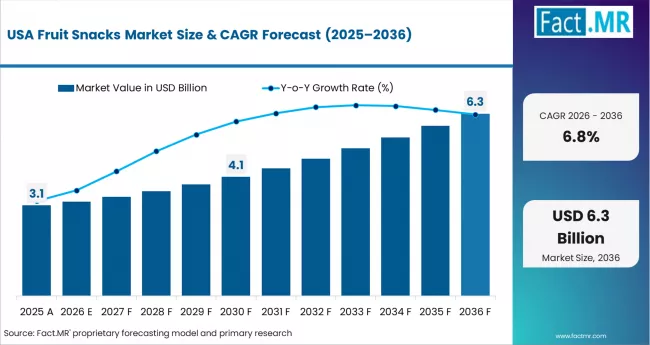
Fruit Snacks Market Country Value Analysis | Source: Fact.MR
The USA represents a key market supported by consumer preference for natural snacks, convenient food products, and retail distribution networks.
- USA: Demand for fruit snacks in the U.S. is projected to rise at 6.8% CAGR through 2036. Growth is supported by school snack nutrition programs (04-2025) and expansion of fruit snack production by General Mills, Inc. (08-2025).
Western Europe
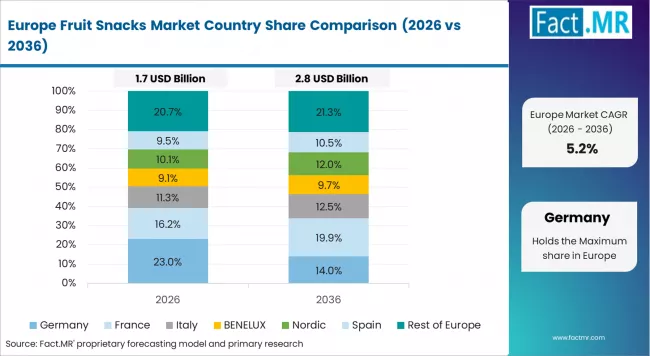
Fruit Snacks Market Europe Country Market Share Analysis, 2026 & 2036 | Source: Fact.MR
The United Kingdom and Germany are major markets supported by retail expansion, consumer demand for natural snacks, and innovation in fruit based confectionery.
- United Kingdom: Demand for fruit snacks in the UK is projected to rise at 7.8% CAGR through 2036. Growth is supported by retail chain expansion programs (03-2025) and product launches by PepsiCo, Inc. (07-2025).
- Germany: Demand for fruit snacks in Germany is projected to rise at 8.1% CAGR through 2036. Growth is supported by packaged snack production expansion (02-2025) and ingredient sourcing initiatives by SunOpta Inc. (06-2025).
Fact MR's analysis of the fruit snacks market in East Asia, South Asia, North America, and Western Europe consists of country-wise assessments that include China, India, the USA, the United Kingdom, and Germany. Readers can find detailed trends, regulatory updates, and company-specific investments shaping market growth in these countries.
Competitive Structure and Buyer Dynamics in the Fruit Snacks Market
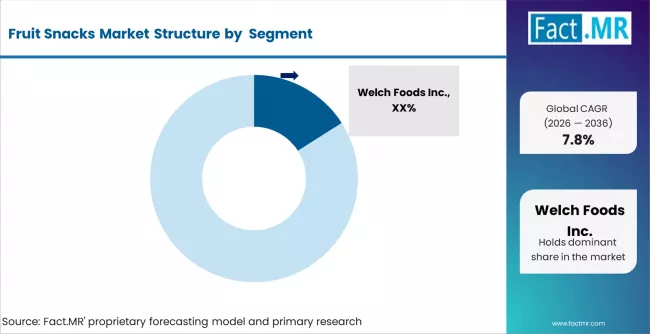
Fruit Snacks Market Analysis By Company | Source: Fact.MR
The competitive structure of the Fruit Snacks Market is moderately fragmented, with a mix of global food manufacturers and specialized snack producers participating in the supply chain. Large multinational companies operate alongside niche producers that focus on freeze dried or natural fruit snack formats. Leading companies including Welch Foods Inc., SunOpta Inc., Kellanova, General Mills, Inc., and PepsiCo, Inc. account for a significant share of global sales through established brands and broad distribution networks. Smaller firms such as Crispy Green Inc., Crunchies Food Company, Nutty Goodness, LLC, Flaper S.A., Chaucer Foods Ltd., Mount Franklin Foods, LLC, and Sunkist Growers, Inc. serve specific product niches or regional markets. Competition in the sector is primarily shaped by product formulation, brand recognition, and distribution access. Shelf presence in supermarkets and convenience stores strongly influences sales performance. Companies also compete through flavor innovation, packaging formats, and expansion into organic or clean label snack options. Established distribution partnerships with retail chains provide larger companies with stronger market visibility and consistent product placement.
Several companies maintain structural advantages through vertically integrated supply chains and established fruit sourcing networks. Firms with direct relationships with fruit growers or processing facilities benefit from stable raw material availability and cost control. SunOpta Inc. and Chaucer Foods Ltd. possess specialized capabilities in fruit processing and freeze drying technologies that support differentiated product offerings. Large consumer packaged goods companies such as PepsiCo, Inc., Kellanova, and General Mills, Inc. benefit from extensive retail distribution infrastructure and strong brand portfolios. Retail buyers often diversify suppliers to reduce dependency on a single brand and maintain competitive pricing across snack categories. Supermarket chains and large distributors use private label alternatives and multi supplier procurement strategies to strengthen negotiation leverage. This purchasing behavior limits supplier pricing power across the category, though strong brands and differentiated product formulations retain moderate influence in shelf space negotiations.
Key Players of the Fruit Snacks Market
- Welch Foods Inc.
- SunOpta Inc.
- Kellanova
- Flaper S.A.
- Chaucer Foods Ltd.
- General Mills, Inc.
- Crispy Green Inc.
- Sunkist Growers, Inc.
- Nutty Goodness, LLC
- Crunchies Food Company
- Mount Franklin Foods, LLC
- PepsiCo, Inc.
Report Scope
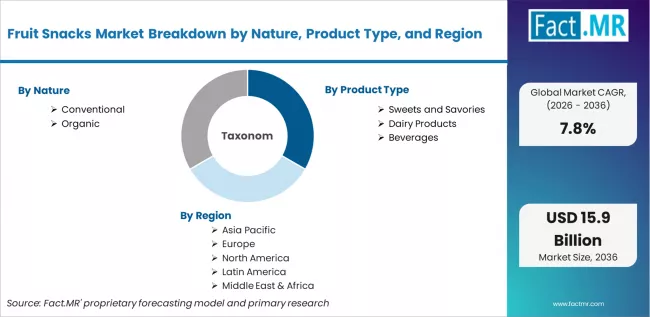
Fruit Snacks Market Breakdown By Nature, Product Type, And Region | Source: Fact.MR
| Metric | Value |
|---|---|
| Quantitative Units | USD 7.5 billion (2026) to USD 15.9 billion (2036), at a CAGR of 7.8% |
| Market Definition | The fruit snacks market includes production, processing, and sale of fruit-based snack products such as freeze-dried fruit pieces, extruded fruit strips, fruit-based dairy snacks, and fruit beverages distributed through multiple retail channels. |
| Nature Segmentation | Organic, Conventional |
| Distribution Channel | Modern Trade, Specialty Stores, Convenience Stores, Online Stores, Departmental Stores/Mom & Pop Stores, Drug Stores & Pharmacies, Travel Retail |
| Product Type | Sweets & Savories (Freeze-Dried, Extruded Strips, Others), Dairy Products, Beverages |
| Key Companies Profiled | Welch Foods Inc., SunOpta Inc., Kellanova, Flaper S.A., Chaucer Foods Ltd., General Mills, Inc., Crispy Green Inc., Sunkist Growers, Inc., Nutty Goodness, LLC, Crunchies Food Company, Mount Franklin Foods, LLC, PepsiCo, Inc. |
| Forecast Period | 2026 to 2036 |
| Approach | Hybrid top-down and bottom-up market modeling validated through interviews with fruit snack manufacturers and distributors, supported by production benchmarking, retail channel analysis, and trade data assessment. |
Source: Fact.MR analysis. Updated Mar 16, 2026
Bibliographies
- [1] U.S. Food and Drug Administration. (2025). Nutrition Facts labeling rules for fruit snacks.
- [2] European Union. (2023). Regulation (EU) No 1169/2011 on food information to consumers.
- [3] Ministry of Food Processing Industries, India. (2025). Food processing initiatives.
- [4] Ministry of Commerce, China. (2025). Packaged food consumption programs.
- [5] PepsiCo, Inc. (2025). Fruit snack product line expansion.
- [6] General Mills, Inc. (2025). Snack product distribution expansion.
- [7] SunOpta Inc. (2025). Ingredient sourcing initiatives.
- [8] Kellanova. (2025). Product launches.
- [9] Welch Foods Inc. (2025). Fruit snack production.
This Report Addresses
- Market size estimation and revenue forecasts for the Fruit Snacks Market from 2026 to 2036, supported by validated production capacity and packaged snack trade benchmarks.
- Growth opportunity mapping across freeze dried fruit snacks, extruded fruit strips, and other fruit based snack formats within the sweets and savories product category.
- Segment and regional revenue forecasts covering organic and conventional fruit snacks, multiple retail distribution channels, and major consumption regions including North America, Europe, and Asia Pacific.
- Competition strategy assessment of leading companies such as General Mills, Inc., PepsiCo, Inc., Welch Foods Inc., SunOpta Inc., and Kellanova, including supply chain integration and distribution capability benchmarking.
- Regulatory impact analysis covering food labeling standards, ingredient disclosure rules, and product formulation requirements affecting fruit snack manufacturing and marketing.
- Market report delivery in PDF, Excel, PPT, and interactive dashboard formats designed for strategic planning, investment evaluation, and operational decision support.
- Supply chain vulnerability assessments examining fruit puree sourcing, concentrate processing capacity, and regional raw material availability risks affecting global fruit snack production.
Segmentation
Fruit Snacks Market Key Segments
-
Nature :
- Organic
- Conventional
-
Distribution Channel :
- Modern Trade
- Specialty Stores
- Convenience Stores
- Online Stores
- Departmental Stores or Mom and Pop Stores
- Drug Stores and Pharmacies
- Travel Retail
-
Product Type :
- Sweets and Savories
- Freeze Dried
- Extruded Strips
- Others
- Dairy Products
- Beverages
- Sweets and Savories
-
Region :
- North America
- USA
- Canada
- Mexico
- Europe
- Germany
- UK
- France
- Italy
- Spain
- Nordic Countries
- BENELUX
- Rest of Europe
- Asia Pacific
- China
- Japan
- South Korea
- India
- Australia
- Rest of Asia Pacific
- Latin America
- Brazil
- Argentina
- Rest of Latin America
- Middle East and Africa
- Kingdom of Saudi Arabia
- United Arab Emirates
- South Africa
- Rest of Middle East and Africa
- Other Regions
- Oceania
- Central Asia
- Other Markets
- North America
Frequently Asked Questions
How large is the demand for Fruit Snacks in the global market in 2026?
What will be the market size of Fruit Snacks in the global market by 2036?
What is the expected demand growth for Fruit Snacks in the global market between 2026 and 2036?
Which Nature Segment is poised to lead global sales by 2026?
Which Company is Identified as a Leading Participant in the Fruit Snacks Market?
What is Driving Fruit Snacks Demand in the United States?
What is the United States Growth Outlook in this Report?
What Factors Support Fruit Snacks Consumption in the United Kingdom?
What is the United Kingdom Growth Outlook in this Report?
Why is Germany Considered a Key Market in Europe for Fruit Snacks?
What is the Germany Growth Outlook in this Report?
Why is China an Important Market for Fruit Snacks in Asia?
What is the China Growth Outlook in this Report?
What Factors Support Fruit Snacks Demand in India?
What is the India Growth Outlook in this Report?
What are Fruit Snacks and What are They Mainly Consumed For?
What does Fruit Snacks Market Mean in this Report?
What is Included in the Scope of this Fruit Snacks Market Report?
What is Excluded from the Scope of this Report?
What does Market Forecast Mean on this Page?
How is the Fruit Snacks Market Forecast Developed in this Report?
Who worked on this report


Preview the report firsthand - request a free sample
Free SampleGet the brochure for pricing and purchase details
Download PDF