- Market Value (2025): USD 4.5 Bn
- Estimated Value (2026): USD 4.9 Bn
- Forecast Value (2036): USD 10.6 Bn
- CAGR (2026-2036): 8.1%
What is the Full-Barrier Alu-Free Structures Market forecast to be worth by 2036?
USD 1.3 billion in 2026 to USD USD 3.1 billion by 2036 at an 8.9% CAGR.
- The Full-Barrier Alu-Free Structures Market is estimated at USD 1.2 billion in 2025.
- Demand is projected to increase from USD 1.3 billion in 2026 to USD 3.1 billion by 2036.
- The market is forecast to record an 8.9% CAGR from 2026 to 2036 as carton converters and food manufacturers qualify aluminium-free barrier structures for ambient and chilled formats.
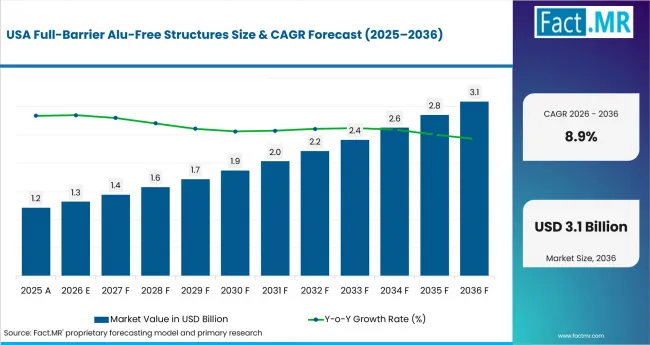
Full Barrier Alu Free Structures Country Value Analysis | Source: Fact.MR
What are the defining numbers behind Full-Barrier Alu-Free Structures Market growth?
An absolute opportunity of USD 5.7 billion is expected between 2026 and 2036.
- Demand Drivers in the Market
- Aseptic beverage producers need oxygen and light protection without an aluminium foil layer so they can simplify material structures while retaining long shelf life. SIG commercially launched Terra Alu-free + Full barrier for multi-serve cartons in May 2025 with shelf life of up to 12 months.
- Carton converters need higher paper content and recyclable structures as European rules move toward design-for-recycling requirements. The European Commission confirmed in February 2025 that Regulation (EU) 2025/40 on packaging and packaging waste had entered into force and establishes recyclability requirements for packaging, with detailed design-for-recycling requirements phased in from 2030.
- Juice and dairy brands need barrier alternatives that fit familiar filling systems. Tetra Pak introduced a paper-based barrier for juice in December 2025 that replaces the aluminium foil layer and raises paper content in the pack to up to 80%.
- Dry-food and specialty packaging converters need paper-based structures that handle oxygen, water-vapour and grease exposure. Mondi expanded FunctionalBarrier Paper Ultimate in August 2025 following a EUR 16 million technology investment at its Solec plant.
- Key Segments Analyzed
- By Barrier Architecture: Polymer-coated paperboard is expected to hold 34.0% share in 2026 because established board-converting routes allow barrier layers to be added without changing the structural role of fiber.
- By Pack Format: Aseptic beverage carton is projected to account for 37.0% share in 2026 as ambient dairy and juice packs require combined oxygen and light protection.
- By Barrier Requirement: Oxygen + light is anticipated to capture 33.0% share in 2026 owing to the protection needs of juice, flavored milk and plant-based beverages.
- By End-use: Dairy / alternatives is estimated to represent 36.0% share in 2026 as long-life milk and plant-based drinks remain established users of aseptic carton systems.
- Analyst Opinion at Fact.MR
- Shambhu Nath Jha, Principal Consultant at Fact.MR, states, “Alu-free structures have to preserve shelf life and sealing performance while giving recyclers a simpler material mix. Commercial uptake is expected to follow solutions that combine verified barrier performance with filling-line compatibility.”
- Strategic Implications
- Carton system suppliers should prove barrier stability across oxygen-sensitive and light-sensitive products before extending one structure across beverage categories.
- Board and coating producers should document coat weight and sealability alongside recovery performance. Eurostat reported in October 2025 that paper and cardboard represented 40.4% of EU packaging waste generated in 2023.
- Food manufacturers should compare line modifications and throughput requirements before changing a commercial pack structure.
- Recyclers and producer-responsibility organizations should test fiber yield and non-fiber separation as paper-rich structures move into larger commercial volumes.
China is expected to record 9.4% CAGR through 2036 as dairy and beverage manufacturing support carton conversion. The USA is projected at 8.9% through food-manufacturing scale and packaging redesign. Germany is anticipated at 8.7% under recycling rules. France is estimated at 8.2% as paper-carton recovery requirements rise. Japan is forecast at 7.0% as paper-packaging collection expands.
How does the Full-Barrier Alu-Free Structures Market break down by segment?
Aseptic beverage carton is projected to lead Pack Format at 37.0% share in 2026; Dairy / alternatives is estimated to lead End-use at 36.0%.
Which Barrier Architecture leads?
Polymer-coated paperboard is expected to hold 34.0% share in 2026.
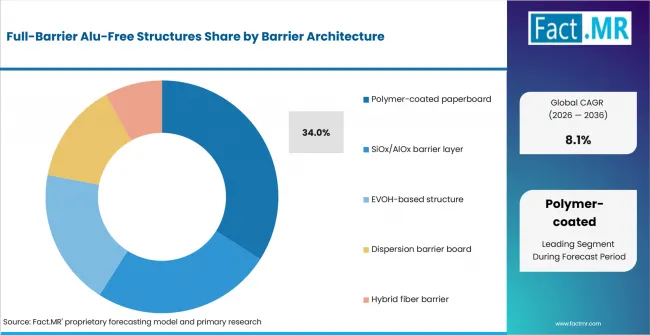
Full Barrier Alu Free Structures Analysis By Barrier Architecture | Source: Fact.MR
Polymer-coated paperboard combines a fiber structural layer with thin functional coatings or films. It fits established carton converting while keeping paperboard as the main structural material. Commercial value depends on barrier consistency and compatibility with recycling processes. Converters are expected to favor structures that preserve stiffness and print quality while keeping the functional layer thin enough for efficient material recovery.
What leads the Pack Format segment?
Aseptic beverage carton is projected to account for 37.0% share in 2026.
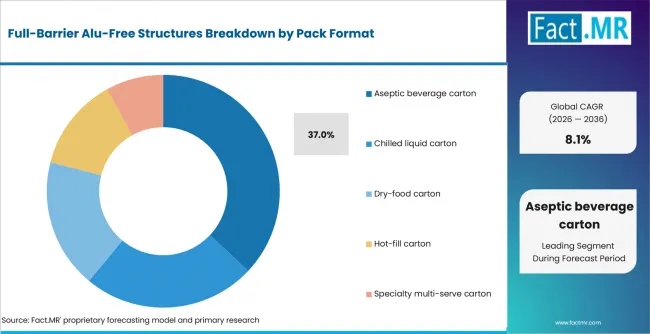
Full Barrier Alu Free Structures Analysis By Pack Format | Source: Fact.MR
Aseptic beverage cartons need barriers that limit oxygen and light during ambient storage. Removing aluminium shifts more protective work to coated films or paper-based functional layers.
How does Barrier Requirement shape demand?
Oxygen + light is anticipated to capture 33.0% share in 2026.
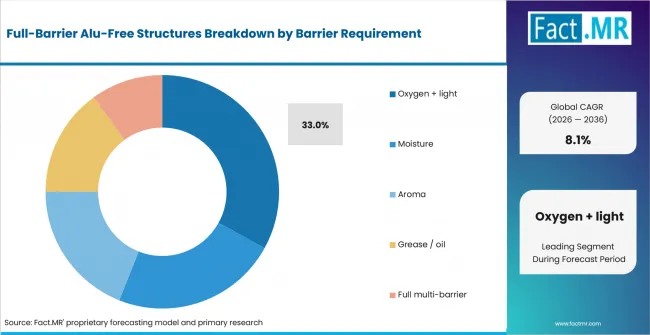
Full Barrier Alu Free Structures Analysis By Barrier Requirement | Source: Fact.MR
Combined oxygen and light protection is central to full-barrier substitution for sensitive beverages. Alu-free designs must maintain protection across storage and distribution without relying on an aluminium foil layer. Qualification is expected to focus on transmission control over the intended shelf life because a weak barrier can alter flavor stability and package performance.
What supports Dairy / alternatives within End-use?
Dairy / alternatives is estimated to represent 36.0% share in 2026.
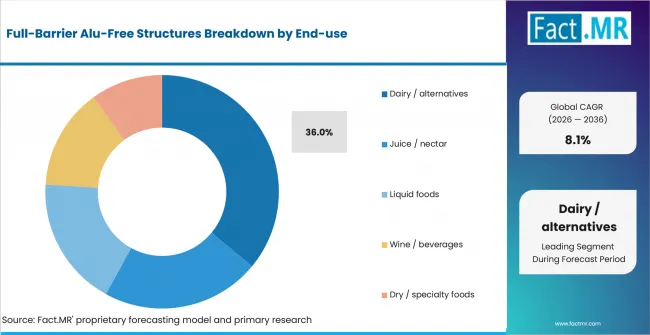
Full Barrier Alu Free Structures Analysis By End Use | Source: Fact.MR
Long-life dairy provides a practical qualification route because aseptic cartons are established for ambient milk. Once a barrier design meets filling and shelf-life requirements, converters can extend the platform to related liquid-food formats. Dairy producers are expected to prioritize stable sealing and predictable line behavior before widening an alu-free structure across multiple pack sizes.
What is accelerating Full-Barrier Alu-Free Structures Market adoption, and what is holding it back?
Demand is expected to rise through recyclability rules and commercial proof of alu-free barrier performance. Adoption is constrained by qualification work, recycling variability and tight shelf-life requirements.
Drivers Impact Analysis
| FACTOR | (~) % IMPACT ON CAGR | GEOGRAPHIC RELEVANCE | IMPACT TIMELINE |
|---|---|---|---|
| EU design-for-recycling requirements | +1.4% | Europe | Medium term (2-4 years) |
| Commercial alu-free aseptic carton launches | +1.2% | Global | Short term (<= 2 years) |
| Paper-rich barrier structure development | +0.9% | Europe, East Asia | Medium term (2-4 years) |
| Food and beverage packaging volume | +0.7% | Global | Long term (>= 4 years) |
Opportunity Impact Analysis
| FACTOR | (~) % IMPACT ON CAGR | GEOGRAPHIC RELEVANCE | IMPACT TIMELINE |
|---|---|---|---|
| Aseptic juice conversion | +1.0% | Europe, East Asia | Short term (<= 2 years) |
| Paper-based barrier scaling | +0.8% | Europe | Medium term (2-4 years) |
| Dry-food barrier board | +0.6% | Global | Medium term (2-4 years) |
Restraints Impact Analysis
| FACTOR | (~) % IMPACT ON CAGR | GEOGRAPHIC RELEVANCE | IMPACT TIMELINE |
|---|---|---|---|
| Shelf-life validation burden | -0.7% | Global | Short term (<= 2 years) |
| Different recycling infrastructures | -0.5% | Global | Medium term (2-4 years) |
| Line and sealing qualification | -0.4% | Global | Medium term (2-4 years) |
Which countries are scaling the Full-Barrier Alu-Free Structures Market through 2036?
- China is expected to record 9.4% CAGR, as dairy output and beverage manufacturing create a large base for high-barrier cartons.
- The USA is projected at 8.9% CAGR, supported by a large food-manufacturing base and continuing investment needs across packaging recovery infrastructure.
- Germany is anticipated at 8.7% CAGR as packaging-recycling performance and EU design rules place material structure under closer review.
- France is estimated at 8.2% CAGR as recycling targets for paper, carton and composite paper packaging tighten.
- Japan is forecast at 7.0% CAGR as separate collection plans continue to cover beverage cartons and paper packaging across municipalities.
Comparable growth rates create different entry conditions across the five profiled countries. Full report coverage spans North America, Latin America, Western Europe, Eastern Europe, East Asia, South Asia & Pacific, and Middle East & Africa.
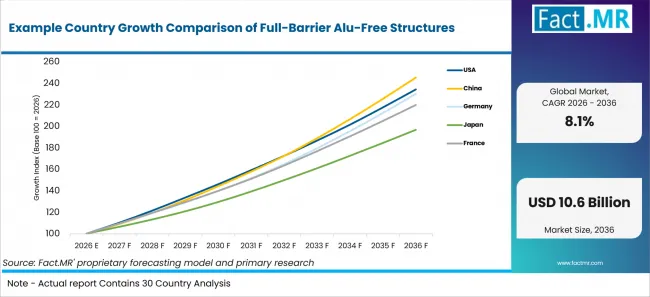
Example Country Growth Comparison Of Full Barrier Alu Free Structures | Source: Fact.MR
Country CAGR (2026-2036)
| Country | CAGR |
|---|---|
| China | 9.4% |
| United States | 8.9% |
| Germany | 8.7% |
| France | 8.2% |
| Japan | 7.0% |
What supports USA adoption?
8.9% CAGR, supported by food-manufacturing scale and packaging material redesign.
U.S. food manufacturers evaluate shelf-life protection and filling-line stability before approving a change in carton structure. The U.S. Census Bureau reported in September 2026 that U.S. Food Manufacturing (NAICS 311) generated an estimated USD 1,054.3 billion in value of shipments in 2024. That production base is expected to support alu-free qualification where converters preserve barrier performance and line efficiency.
How is China scaling demand?
9.4% CAGR, led by high dairy output and manufacturing scale.
China combines large dairy output with domestic converting capacity for aseptic and shelf-stable formats. The National Bureau of Statistics of China reported in February 2026 that milk output reached 40.91 million tonnes in 2025. That scale is anticipated to support full-barrier carton conversion as brands qualify aluminium-free structures for liquid dairy and related beverages.
What shapes Germany’s outlook?
8.7% CAGR, reinforced by packaging recycling requirements and early commercial juice adoption.
Germany places strong emphasis on packaging recovery performance alongside food-protection requirements. In January 2026, the German Environment Agency and Central Agency Packaging Register reported that around 5.5 million tonnes of packaging waste collected by Germany’s dual systems were recovered in 2024. Alu-free structures are expected to gain relevance when barrier layers support established sorting and fiber-recovery routes.
How is France developing demand?
8.2% CAGR, supported by paper-carton recycling targets and a large food base.
France has a sizable liquid-dairy base that gives converters recurring demand for protective carton structures. Agreste reported in April 2026 that French cow-milk collection reached approximately 1.936 billion litres in February 2026. Paper-rich full-barrier formats are projected to benefit where dairies can retain sealing performance and shelf-life protection while simplifying the material structure.
How does Japan perform?
7.0% CAGR, shaped by municipal collection coverage and careful packaging qualification.
Japan combines established carton use with municipal collection systems that shape end-of-life design choices. The Ministry of the Environment reported in March 2026 that 904 municipalities planned separate collection of paper packaging in fiscal 2026. Aluminium-free structures are forecast to advance where converters can align barrier performance with local collection and recycling practices.
Who leads the Full-Barrier Alu-Free Structures Market?
SIG is directly active in aluminium-free full-barrier aseptic carton structures through SIG Terra Alu-free + Full barrier. Tetra Pak participates through paper-based barrier technology that replaces the traditional aluminium-foil barrier layer in aseptic cartons. Elopak is active in aluminium-free aseptic cartons through Pure-Pak® eSense. Mondi and Stora Enso provide adjacent barrier-paper and paperboard technologies, while Amcor supplies high-barrier paper-based packaging through its AmFiber™ platform.
Elopak reported in April 2025 that Malo Dairy introduced UHT milk in Pure-Pak® Sense aseptic cartons on a filling line capable of processing carton structures with or without an aluminium barrier. The installation demonstrates filling-system flexibility across different aseptic carton structures.
Stora Enso launched Performa Nova in April 2025 for food and consumer-packaging applications. The folding boxboard can be combined with barrier coatings when additional product protection is required, positioning Stora Enso within the fiber-based substrate and barrier-board segment rather than direct aseptic-carton system supply.
Amcor reported in June 2025 that AmFiber™ Performance Paper had demonstrated recyclability in Brazil’s mixed-paper recycling stream. Mondi provides FunctionalBarrier Paper Ultimate for high-barrier applications requiring protection against oxygen, water vapor and grease. Competitive differentiation across these technologies includes barrier performance, compatibility with converting and filling equipment, and documented recycling performance.
Which companies are the key providers?
Key companies include SIG; Tetra Pak; Elopak; Mondi; Stora Enso; and Amcor.
- SIG
- Tetra Pak
- Elopak
- Mondi
- Stora Enso
- Amcor
Bibliography
- European Commission, Directorate-General for Environment. (2025, February 11). New rules enter into force for a more sustainable and competitive packaging economy.
- European Parliament & Council of the European Union. (2025, January 22). Regulation (EU) 2025/40 of the European Parliament and of the Council of 19 December 2024 on packaging and packaging waste, amending Regulation (EU) 2019/1020 and Directive (EU) 2019/904, and repealing Directive 94/62/EC. Official Journal of the European Union.
- SIG. (2025, May 20). SIG launches world’s-first alu layer-free full barrier solution for multi-serve aseptic cartons, further reducing carbon footprint by up to 61%.
- Tetra Pak. (2025, December 10). Tetra Pak launches world-first paper-based barrier for juice packaging with García Carrión and advances new packaging material development.
- Mondi. (2025, August 14). Mondi ramps up FunctionalBarrier Paper Ultimate to meet growing demand for sustainable high-barrier paper-based packaging.
- Eurostat. (2025, October 22). Plastic packaging waste in the EU: 35.3 kg per person.
- SIG. (2026, March 17). 24% sales growth: SIG’s alu-layer-free aseptic cartons gained widespread adoption in 2025.
- U.S. Census Bureau. (2026, September 3). Census Bureau releases new Annual Integrated Economic Survey data.
- National Bureau of Statistics of China. (2026, February 28). Statistical communiqué of the People’s Republic of China on the 2025 national economic and social development.
- German Environment Agency & Central Agency Packaging Register. (2026, January 27). Facts against myths: Packaging waste recycling in Germany is working.
- Touati-Houari, N. (2026, April 15). Lait. Février 2026 : la collecte de lait de vache toujours en hausse. Agreste.
- Elopak. (2025, April 1). New aseptic filling facility enables Malo to introduce milk in cartons.
- Stora Enso Oyj. (2025, April 29). Stora Enso launches Performa Nova, a high-yield folding boxboard for consumer packaging.
- Amcor. (2025, June 5). Turning the page on packaging waste: Amcor’s AmFiber™ Performance Paper proves recyclability in Brazil.
- SIG. (2025, July 14). Now on shelves: SIG launches world's first aseptic 1-liter carton pack offering full barrier protection without an aluminum layer.
- SIG. (2025, September 4). Berglandmilch pioneers SIG’s alu-layer-free full barrier aseptic carton in Austria, cutting CO₂.
- SIG. (2025, September 23). SIG launches first recyclable aluminum-layer free aseptic carton in South Korea.
This Report Answers
- The report compares alu-free full-barrier structures in liquid and aseptic cartons, focusing on barrier performance and filling-line compatibility.
- Material analysis covers barrier paper and coating functions for oxygen, moisture and grease control.
- Technology coverage reviews paper barrier coatings and thin functional layers that replace metal barriers.
- Regulatory analysis covers recyclability and material simplification in sustainable packaging.
- Application analysis covers dry-food structures and oxygen-barrier paper formats.
- Food-contact and recovery requirements are assessed for sustainable food packaging.
- Beverage applications are compared with ready-to-drink packaging alternatives.
What does the Full-Barrier Alu-Free Structures Market cover?
The market covers packaging structures that remove aluminium foil while retaining oxygen, light, moisture, aroma or grease protection. It includes paperboard, coated films and dispersion-coated boards used in cartons and other fiber-rich formats.
What is included in the scope?
The scope includes polymer-coated paperboard, SiOx/AlOx layers, EVOH structures, dispersion barrier board and hybrid fiber barriers without an aluminium foil barrier.
Thin polymer or coated functional layers may remain for sealing and protection.
What is excluded from the scope?
The scope excludes aluminium-foil laminates, metal containers, non-barrier paperboard and films without a full-barrier use case.
How Was the Analysis Built?
The analysis draws on 120+ sources, 35+ company portfolios, 25+ countries, and more than 20 industry interviews.
- Primary Research: Primary research includes discussions with manufacturers, service providers, technology developers, distributors, end users, and subject-matter experts. These conversations examine purchasing priorities, product adoption, operational challenges, approval requirements, competitive positioning, and the factors that influence wider market acceptance.
- Desk Research: Desk research covers government statistics, regulatory publications, company filings, trade data, technical studies, industry associations, standards, public policy, and other authoritative sources. Every source used in the analysis is documented in the bibliography.
- Market Sizing and Forecasting: Market estimates combine historical performance, demand indicators, pricing and volume trends, segment shares, company participation, country-level growth, adoption patterns, investment activity, and barriers to market expansion.
- Data Validation and Update Cycle: Findings are validated by comparing primary interviews with public data, company activity, regulatory changes, trade patterns, and industry developments. Regular updates review new product launches, capacity changes, partnerships, approvals, and shifts in commercial adoption.
What is the report’s scope and coverage?
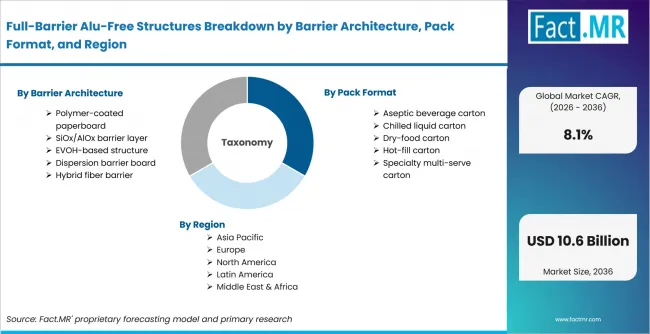
Full Barrier Alu Free Structures Breakdown By Barrier Architecture, Pack Format, And Region | Source: Fact.MR
| Attribute | Details |
|---|---|
| Quantitative Units | USD billion |
| Market Definition | High-barrier packaging structures that achieve required oxygen, light, moisture, aroma or grease protection without an aluminium foil layer. |
| Barrier Architecture | Polymer-coated paperboard; SiOx/AlOx barrier layer; EVOH-based structure; Dispersion barrier board; Hybrid fiber barrier |
| Pack Format | Aseptic beverage carton; Chilled liquid carton; Dry-food carton; Hot-fill carton; Specialty multi-serve carton |
| Barrier Requirement | Oxygen + light; Moisture; Aroma; Grease / oil; Full multi-barrier |
| End-use | Dairy / alternatives; Juice / nectar; Liquid foods; Wine / beverages; Dry / specialty foods |
| Regions Covered | North America; Latin America; Western Europe; Eastern Europe; East Asia; South Asia & Pacific; Middle East & Africa |
| Countries Covered | United States; China; Germany; Japan; France |
| Key Companies Profiled | SIG; Tetra Pak; Elopak; Mondi; Stora Enso; Amcor |
| Forecast Period | 2026 to 2036 |
| Approach | Hybrid top-down and bottom-up assessment using packaging applications, barrier requirements, country evidence, company portfolio review and regulatory analysis. |
How is the market segmented?
-
By Barrier Architecture
- Polymer-coated paperboard
- SiOx/AlOx barrier layer
- EVOH-based structure
- Dispersion barrier board
- Hybrid fiber barrier
-
By Pack Format
- Aseptic beverage carton
- Chilled liquid carton
- Dry-food carton
- Hot-fill carton
- Specialty multi-serve carton
-
By Barrier Requirement
- Oxygen + light
- Moisture
- Aroma
- Grease / oil
- Full multi-barrier
-
By End-use
- Dairy / alternatives
- Juice / nectar
- Liquid foods
- Wine / beverages
- Dry / specialty foods
-
By Region
- North America
- Latin America
- Western Europe
- Eastern Europe
- East Asia
- South Asia & Pacific
- Middle East & Africa