- Market Value (2025): USD 1.1 Bn
- Estimated Value (2026): USD 1.2 Bn
- Forecast Value (2036): USD 2.6 Bn
- CAGR (2026-2036): 8.0%
What is the Embedded Performance Fiber Additives Market forecast to be worth by 2036?
USD 1.2 billion in 2026 to USD 2.6 billion by 2036, at 8.0% CAGR.
- The Embedded Performance Fiber Additives Market reached USD 1.1 billion in 2025.
- Demand is projected to increase from USD 1.2 billion in 2026 to USD 2.6 billion by 2036.
- The market is forecast to record an 8.0% CAGR from 2026 to 2036 as nonwoven converters and fiber producers seek repeatable wetting performance inside the polymer system.
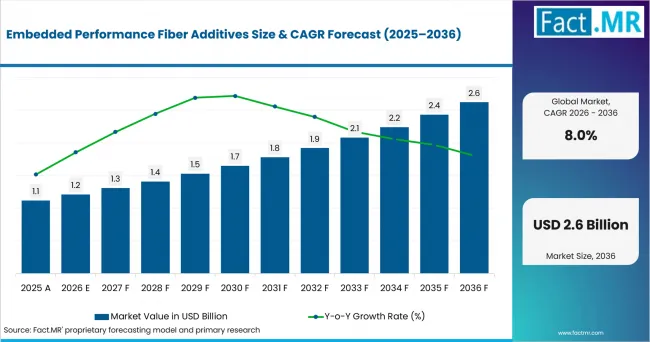
Embedded Performance Fiber Additives Value Analysis | Source: Fact.MR
What are the defining numbers behind Embedded Performance Fiber Additives Market growth?
USD 1.4 billion absolute opportunity by 2036 led by Nonwovens and PP; Migratory surfactant masterbatch leads the additive platform.
- Demand Drivers in the Market
- Nonwoven converters need controlled wetting across hygiene and medical webs. In September 2026, the U.S. Bureau of Labor Statistics reported a preliminary, seasonally adjusted employment level of 78,300 workers in U.S. textile mills in August 2026.
- Fiber producers need moisture-management functionality that survives melt processing. Embedded dosing aligns with established masterbatch systems because the additive enters the polymer before spinning.
- Medical and hygiene manufacturers need low-extractable formulations with clear sterilization data. Medical-grade polypropylene applications place similar emphasis on material purity and controlled processing.
- Industrial textile processors need embedded performance that survives handling and repeated use. Textile chemicals show how functional treatment requirements extend beyond basic fiber formation.
- Key Segments Analyzed
- By Embedded Additive Platform: Migratory surfactant masterbatch is expected to hold 32.0% share in 2026. Its dosing route fits additive masterbatch practice and gives converters a familiar way to build wetting behavior into polymer processing.
- By Host Polymer: PP is projected to account for 40.0% share in 2026. Its broad use in spunbond and meltblown webs aligns with plastic antioxidant and other additive systems designed for polyolefin processing.
- By Application: Nonwovens are anticipated to capture 45.0% share in 2026. Hygiene and medical constructions depend on controlled surface properties across the same conversion base addressed by functional textile coating.
- By Performance: Wicking speed is estimated to represent 35.0% share in 2026. Fast liquid transfer is considered alongside charge-control requirements found in anti-static polymer compounds used across sensitive polymer applications.
- Analyst Opinion at Fact.MR
- Shambhu Nath Jha is Principal Consultant at Fact.MR and states: “Commercial value depends on performance after conversion. Demand is expected to favor systems that pair repeatable wetting with clean processing. Suppliers should support each polymer platform with application testing and clear qualification data.”
- Strategic Implications
- Masterbatch suppliers should document dosage windows across PP and PE as well as PET and PA. Testing should show how wetting behavior changes after extrusion and fiber formation.
- Nonwoven converters should validate wicking after thermal bonding and storage. The test plan should reflect the actual web process and expected service conditions.
- Medical and hygiene manufacturers should screen extractables and sterilization response early. Qualification plans should connect additive dosage with the finished article and the intended sterilization route.
- Fiber producers should compare permanent and migratory technologies against required service life. Permanent routes can be considered alongside anti-static polymer compounds where retained functionality is central to material selection.
The USA is forecast at 8.8% CAGR through 2036. South Korea follows at 8.4% and Japan records 7.8%. Germany reaches 6.9% and Finland posts 6.2%.
How does the Embedded Performance Fiber Additives Market break down by segment?
Nonwovens lead Application at 45.0%; PP leads Host Polymer at 40.0%.
Which Embedded Additive Platform leads?
Migratory surfactant masterbatch holds 32.0% share in 2026.
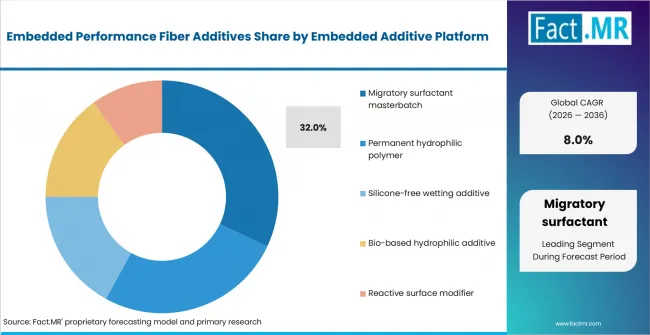
Embedded Performance Fiber Additives Analysis By Embedded Additive Platform | Source: Fact.MR
Migratory surfactant masterbatch is expected to lead because converters can meter a concentrated wetting package into the polymer stream. Permanent hydrophilic polymers suit longer service life. Silicone-free and bio-based options serve narrower formulation needs. Extrusion aids show how processing additives are selected around melt behavior and line stability.
What leads the Host Polymer segment?
PP accounts for 40.0% share in 2026.
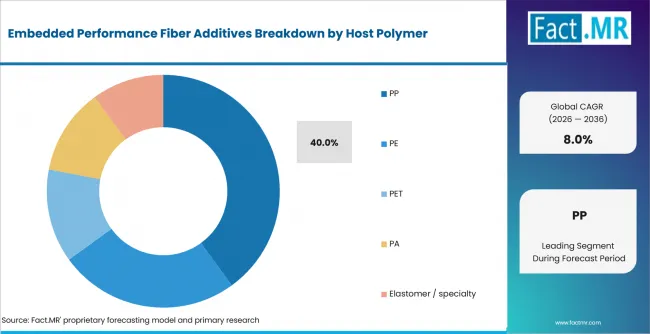
Embedded Performance Fiber Additives Analysis By Host Polymer | Source: Fact.MR
PP is projected to lead because spunbond and meltblown converters can dose additive masterbatch during extrusion. PE serves softer structures. PET and PA support durable synthetic fibers. Heat stabilizers illustrate the broader need to protect polymer performance during high-temperature processing.
How does Application shape demand?
Nonwovens lead with 45.0% share in 2026.
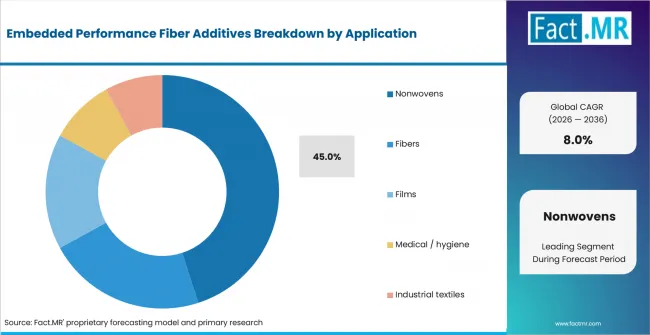
Embedded Performance Fiber Additives Analysis By Application | Source: Fact.MR
Nonwovens are anticipated to lead because liquid handling and surface behavior directly affect hygiene and medical structures. Fibers and films use related moisture-management or antistatic functions. Avient’s Cesa™ Fiber Additives portfolio includes functional additive concentrates for synthetic fibers and nonwovens, including antistatic and hydrophobic solutions. In August 2025, Avient expanded the portfolio with bi-functional cool-feeling and antimicrobial additives specifically formulated for polyester and polyamide fibers.
What supports Wicking speed within Performance?
Wicking speed represents 35.0% share in 2026.
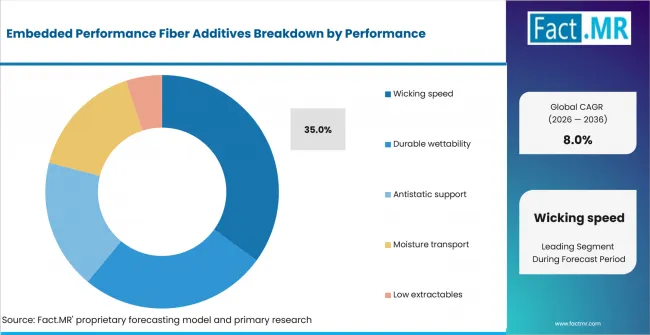
Embedded Performance Fiber Additives Analysis By Performance | Source: Fact.MR
Wicking speed is estimated to lead because liquid transfer is directly measurable in absorbent and moisture-management structures. Durable wettability supports longer service life. Antistatic support limits charge buildup. In September 2025, Techmer PM announced a collaboration with Premix Group to launch a non-PFAS low-retention additive technology that is incorporated directly into the polymer matrix and modifies surface energy at the molecular level to enable clean fluid release.
What is accelerating Embedded Performance Fiber Additives Market adoption, and what is holding it back?
Nonwoven performance requirements drive it; formulation durability and qualification demands restrain it.
Drivers Impact Analysis
| DRIVER | (~) % IMPACT ON CAGR | GEOGRAPHIC RELEVANCE | IMPACT TIMELINE |
|---|---|---|---|
| Expansion of hygiene and medical nonwovens | +1.5% | North America, Europe, East Asia | Short term (<= 2 years) |
| Need for durable moisture management | +1.1% | Global | Medium term (2-4 years) |
| Masterbatch dosing in polyolefin processing | +0.9% | Global | Short term (<= 2 years) |
| Antistatic and low-extractable performance | +0.6% | North America, Europe, East Asia | Medium term (2-4 years) |
Source: Fact.MR analysis. Updated Sep 21, 2026
Opportunity Impact Analysis
| OPPORTUNITY | (~) % IMPACT ON CAGR | GEOGRAPHIC RELEVANCE | IMPACT TIMELINE |
|---|---|---|---|
| Permanent hydrophilic polymer systems | +1.0% | Global | Medium term (2-4 years) |
| Bio-based hydrophilic additives | +0.7% | Europe, North America | Long term (>= 4 years) |
| Medical and hygiene qualification support | +0.6% | North America, Europe, Japan | Short term (<= 2 years) |
| Recycled-fiber compatible formulations | +0.5% | Europe, East Asia | Medium term (2-4 years) |
Source: Fact.MR analysis. Updated Sep 21, 2026
Restraints Impact Analysis
| RESTRAINT | (~) % IMPACT ON CAGR | GEOGRAPHIC RELEVANCE | IMPACT TIMELINE |
|---|---|---|---|
| Loss of surface effect after aging or washing | -0.7% | Global | Short term (<= 2 years) |
| Regulatory and extractables qualification | -0.5% | North America, Europe, Japan | Medium term (2-4 years) |
| Polymer and process compatibility limits | -0.4% | Global | Short term (<= 2 years) |
| Cost pressure in commodity nonwovens | -0.3% | Global | Long term (>= 4 years) |
Source: Fact.MR analysis. Updated Sep 21, 2026
Which countries are scaling Embedded Performance Fiber Additives Market fastest?
- The country comparison spans 2.6 percentage points and forms three practical growth bands across the forecast period.
- The USA remains 0.4 percentage point above South Korea through its established textile-processing base, nonwoven conversion capacity, and healthcare-related demand.
- South Korea remains 0.6 percentage point above Japan as polymer manufacturing capability and textile-circularity investment support specialty additive applications.
- Japan remains 0.9 percentage point above Germany through its established polymer-processing base and demand for hygiene and medical materials requiring stable wetting and antistatic performance.
- Germany remains 0.7 percentage point above Finland as medical consumption and textile-material qualification requirements support embedded additive adoption.
- Finland closes the displayed range as its chemical-manufacturing capability and specialty textile development provide a technically relevant base for functional fiber additives.
Comparable CAGRs can create different entry conditions due to nonwoven conversion capacity, polymer-processing capability, healthcare demand, textile circularity, material qualification requirements, and specialty chemical infrastructure. Full report coverage includes North America, Latin America, Western Europe, Eastern Europe, East Asia, South Asia & Pacific, and Middle East & Africa.
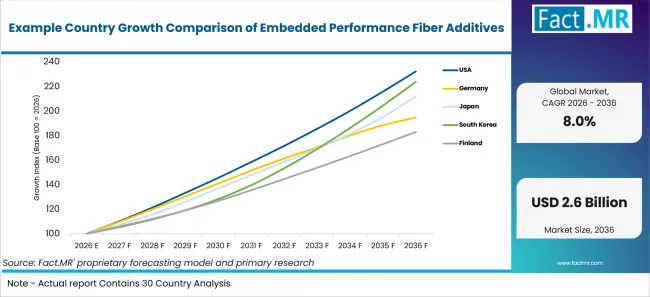
Example Country Growth Comparison Of Embedded Performance Fiber Additives | Source: Fact.MR
| Country | CAGR (2026-2036) |
|---|---|
| USA | 8.8% |
| South Korea | 8.4% |
| Japan | 7.8% |
| Germany | 6.9% |
| Finland | 6.2% |
Source: Fact.MR analysis. Updated Sep 21, 2026
What supports USA adoption?
8.8% CAGR, supported by nonwoven conversion and healthcare demand.
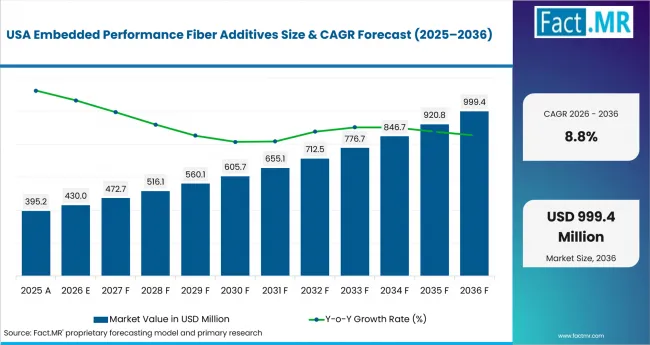
Embedded Performance Fiber Additives Country Value Analysis | Source: Fact.MR
The U.S. conversion base gives additive suppliers access to established textile processing. In September 2026, the U.S. Census Bureau reported that U.S. textile mills recorded an estimated USD 23.95 billion in value of shipments in 2024. Embedded performance additives fit this base when converters need controlled wetting inside PP webs or synthetic fibers. Qualification still depends on the exact polymer and web process. Suppliers that document dosage response after thermal bonding are better aligned with medical and hygiene development programs.
How is South Korea scaling demand?
8.4% CAGR, shaped by polymer manufacturing and textile circularity investment.
South Korea combines polymer manufacturing capability with active textile recycling research. The Ministry of Climate, Energy and Environment announced in July 2026 that KRW 73 billion would be invested in R&D for higher-quality recycling of waste clothing and tires. Fiber additives therefore face a wider material range that can include virgin and recycled feedstocks. Formulators are expected to gain where wetting or antistatic performance remains stable after conversion and where local testing can resolve polymer behavior.
How does Japan perform?
7.8% CAGR, led by established polymer processing and hygiene-material requirements.
Japan offers a mature polymer-processing base for embedded additive development. METI reported in January 2026 that the 2025 production index for plastic products was 98.0 on a 2020 base of 100. Fiber and film processors can use embedded wetting or antistatic additives when a separate surface treatment adds another production step. Medical and hygiene programs place additional value on stable processing and clear qualification data across PET, PA and polyolefin systems.
What supports Germany adoption?
6.9% CAGR, supported by medical use and textile-material qualification.
Germany combines medical consumption with a technically demanding textile and polymer sector. Destatis reported in November 2025 that German hospitals treated 17.5 million inpatients in 2024. This supports a broad medical-material environment where nonwovens and polymer articles require repeatable surface behavior. Embedded additives can reduce reliance on separate finishing steps when durability is required. Suppliers still need use-case evidence because sterilization and extractable requirements vary across finished products.
How is Finland developing demand?
6.2% CAGR, driven by chemical capability and specialty textile development.
Finland has a meaningful chemical-manufacturing base for specialty formulation work. Statistics Finland reported in July 2026 that sold chemical-industry output reached EUR 18.2 billion in 2025. That capability supports additive development for technical fibers and nonwovens where wetting or moisture transport must survive processing. Commercial scale is smaller than in the larger profiled countries. Suppliers are therefore expected to focus on applications where measurable performance supports the added formulation cost.
Who leads the Embedded Performance Fiber Additives Market?
Avient has directly relevant fiber-additive offerings. The company’s Cesa™ Fiber Additives portfolio includes functional additive concentrates formulated for synthetic fibers and nonwovens, including antistatic systems and hydrophobic additives that impart durable water repellency to polypropylene nonwovens. Ampacet supplies medical-grade masterbatches and additive solutions for healthcare plastics, including antistatic and antimicrobial products; however, its documented healthcare portfolio does not specifically establish moisture-management or wetting functionality for textile fibers. Techmer PM provides an adjacent example of polymer-integrated functionality through additive technology that modifies surface energy from within the polymer matrix.
Clariant provides adjacent polypropylene additive technology through AddWorks™ LXR 548, a phenol-free processing-stabilizer system intended particularly for polypropylene used in medical, healthcare, and hygiene applications. The product provides resistance to gamma irradiation and heat sterilization and supports color stability during processing and sterilization.
BASF introduced Ultramid® H33 L in September 2025 as a thermoplastic polyamide combining mechanical strength with high water permeability. BASF positions the material for artificial sausage casings, where its hydrophilic properties allow smoke aromas and moisture to pass through the polyamide casing. The product therefore represents adjacent hydrophilic-polymer technology rather than an additive incorporated into a host polymer.
Techmer PM announced a non-PFAS low-retention additive technology with Premix Group in September 2025 for pipette tips, microplates, and diagnostic devices. Techmer PM states that the additive is embedded directly into the polymer matrix and modifies surface energy at the molecular level to enable clean fluid release. This demonstrates polymer-integrated surface-energy modification, although the documented application is precision labware rather than textile fibers.
Croda supplies fiber-finishing technology including Cirrasol™ PE113, which it describes as a durable hydrophilic finish providing soil-release and antistatic effects for polyester fibers, fabrics, and nonwovens. Because Cirrasol PE113 is documented as a fiber finish rather than a polymer-embedded additive, it is best treated as adjacent moisture-management technology.
Competition across these technologies is influenced by polymer compatibility, durability of the functional effect, processing requirements, and application-specific qualification.
Which companies are the key providers?
Key companies include Avient; Ampacet; Clariant; BASF; Croda; and Techmer PM.
- Avient
- Ampacet
- Clariant
- BASF
- Croda
- Techmer PM
Bibliography
- U.S. Census Bureau. (2026, September 3). Census Bureau releases new Annual Integrated Economic Survey data.
- Ministry of Climate, Energy and Environment, Republic of Korea. (2026, July 2). Discarded clothing and tires to return as valuable resource materials.
- Ministry of Economy, Trade and Industry. (2026, January 30). Indices of industrial production.
- Statistisches Bundesamt (Destatis). (2025, November 6). 2,0 % mehr stationäre Krankenhausbehandlungen im Jahr 2024 [2.0% more inpatient hospital treatments in 2024].
- Statistics Finland. (2026, July 2). Value of sold output made an upturn in 2025.
- U.S. Bureau of Labor Statistics. (2026, September 4). The employment situation – August 2026 (USDL-26-1435).
- European Commission, Directorate-General for Environment. (2025, October 16). Revised Waste Framework Directive enters into force to boost circularity of textile sector and slash food waste.
- Clariant. (2025, August 7). Clariant advances plastics stabilizer technology with expanded production and new applications.
- Avient Corporation. (2025, August 29). Cool feeling & antimicrobial solutions for fibers.
- BASF. (2025, September 9). BASF launches the world’s first thermoplastic polyamide with high water permeability.
- Techmer PM. (2025, September 23). Techmer PM partners with Premix to deliver non-PFAS low retention solutions for precision labware.
- Clariant. (2025, October 9). AddWorks™ LXR 548.
This Report Addresses
- The report explains where embedded performance fiber additives are used by additive platform and host polymer. It also covers application and performance requirements.
- Segment analysis identifies the leading subsegments and explains the processing or end-use conditions that support each 2026 share.
- Country analysis compares the USA and Germany with Japan. It also covers South Korea and Finland through local processing, healthcare and material-development conditions.
- Competitive analysis reviews Avient’s directly relevant fiber-additive capabilities alongside masterbatch or embedded-polymer technologies from Ampacet and Techmer PM, with Clariant, BASF and Croda treated as adjacent processing-stabilizer, hydrophilic-material or fiber-finishing examples where appropriate.
What does the Embedded Performance Fiber Additives Market cover?
The market covers additives incorporated into polymer systems before fiber, nonwoven or film conversion. It includes masterbatch and polymeric approaches that modify wetting, liquid transport or charge behavior. Related odour control textiles provide adjacent context for performance-driven textile material design.
Coverage extends to downstream performance in nonwoven fabrics, technical textiles and specialty polymers. The market boundary stays focused on functionality delivered from inside the polymer or fiber system.
What is included in the scope?
The scope includes migratory surfactant masterbatches; permanent hydrophilic polymers; silicone-free wetting additives; bio-based hydrophilic additives; and reactive surface modifiers. It also includes embedded antistatic functionality.
Host polymers include PP; PE; PET; PA; and specialty systems. Applications include nonwovens; fibers; films; medical or hygiene products; and industrial textiles.
What is excluded from the scope?
The scope excludes standalone topical finishes applied only after fabric formation; color-only pigments; strength-only reinforcement fibers; and raw polymer sold without performance additives.
General stabilizers fall outside scope when their function is limited to base polymer protection. Processing equipment is outside scope.
How Was the Analysis Built?
The analysis draws on 120+ sources, 35+ company portfolios, 25+ countries, and more than 20 industry interviews.
- Primary Research: Primary research includes discussions with manufacturers, service providers, technology developers, distributors, end users, and subject-matter experts. These conversations examine purchasing priorities, product adoption, operational challenges, approval requirements, competitive positioning, and the factors that influence wider market acceptance.
- Desk Research: Desk research covers government statistics, regulatory publications, company filings, trade data, technical studies, industry associations, standards, public policy, and other authoritative sources. Every source used in the analysis is documented in the bibliography.
- Market Sizing and Forecasting: Market estimates combine historical performance, demand indicators, pricing and volume trends, segment shares, company participation, country-level growth, adoption patterns, investment activity, and barriers to market expansion.
- Data Validation and Update Cycle: Findings are validated by comparing primary interviews with public data, company activity, regulatory changes, trade patterns, and industry developments. Regular updates review new product launches, capacity changes, partnerships, approvals, and shifts in commercial adoption.
Segmentation
What is the report’s scope and coverage?
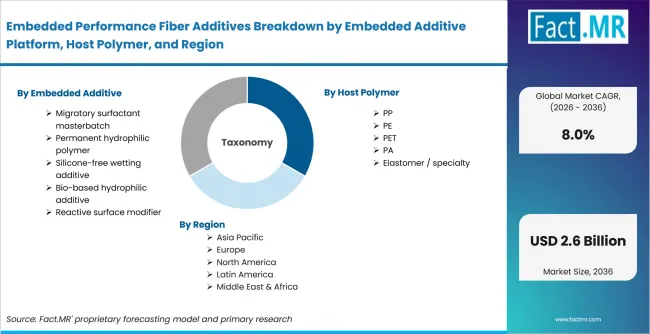
Embedded Performance Fiber Additives Breakdown By Embedded Additive Platform, Host Polymer, And Region | Source: Fact.MR
| Attribute | Details |
|---|---|
| Quantitative Units | USD billion |
| Market Definition | Additives incorporated into polymer formulations before fiber, film or nonwoven conversion to deliver wetting, wicking, moisture-transport, antistatic or low-extractable performance. |
| Embedded Additive Platform | Migratory surfactant masterbatch; Permanent hydrophilic polymer; Silicone-free wetting additive; Bio-based hydrophilic additive; Reactive surface modifier |
| Host Polymer | PP; PE; PET; PA; Elastomer / specialty |
| Application | Nonwovens; Fibers; Films; Medical / hygiene; Industrial textiles |
| Performance | Wicking speed; Durable wettability; Antistatic support; Moisture transport; Low extractables |
| Regions Covered | North America; Latin America; Western Europe; Eastern Europe; East Asia; South Asia & Pacific; Middle East & Africa |
| Countries Profiled | USA; Germany; Japan; South Korea; Finland |
| Key Companies Profiled | Avient; Ampacet; Clariant; BASF; Croda; Techmer PM |
| Forecast Period | 2026 to 2036 |
| Approach | Hybrid top-down and bottom-up review using polymer-processing activity, nonwoven and fiber applications, additive portfolios, country demand indicators and supplier validation. |
Source: Fact.MR analysis. Updated Sep 21, 2026
How is the market segmented?
-
By Embedded Additive Platform
- Migratory surfactant masterbatch
- Permanent hydrophilic polymer
- Silicone-free wetting additive
- Bio-based hydrophilic additive
- Reactive surface modifier
-
By Host Polymer
- PP
- PE
- PET
- PA
- Elastomer / specialty
-
By Application
- Nonwovens
- Fibers
- Films
- Medical / hygiene
- Industrial textiles
-
By Performance
- Wicking speed
- Durable wettability
- Antistatic support
- Moisture transport
- Low extractables
-
By Region
- North America
- Latin America
- Western Europe
- Eastern Europe
- East Asia
- South Asia & Pacific
- Middle East & Africa
Frequently Asked Questions
How big is the Embedded Performance Fiber Additives Market in 2026?
What is the CAGR of the Embedded Performance Fiber Additives Market from 2026 to 2036?
Which host polymer leads the market?
Which application leads the market?
Which companies are profiled in the report?
Who worked on this report


Preview the report firsthand - request a free sample
Free SampleGet the brochure for pricing and purchase details
Download PDF