- Market Value (2025): USD 1.7 Bn
- Estimated Value (2026): USD 1.8 Bn
- Forecast Value (2036): USD 3.7 Bn
- CAGR (2026-2036): 7.2%
What is the Functional Food Texture Systems Market forecast to be worth by 2036?
USD 1.8 billion to USD 3.7 billion by 2036 at a 7.2% CAGR.
- The functional food texture systems market reached approximately USD 1.7 billion in 2025.
- Demand is projected to increase from USD 1.8 billion in 2026 to USD 3.7 billion by 2036. 7.2% CAGR
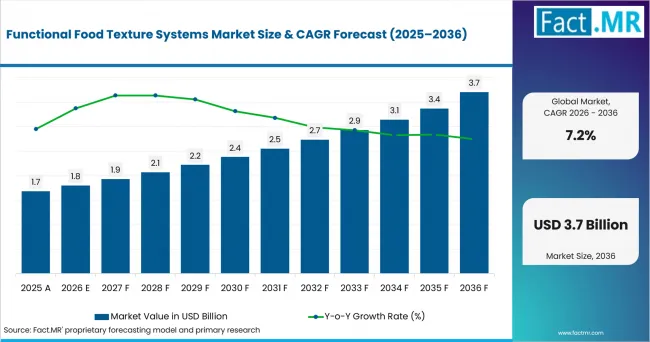
Functional Food Texture Systems Market Value Analysis | Source: Fact.MR
What are the defining numbers behind Functional Food Texture Systems Market growth?
An absolute opportunity of approximately USD 1.86 billion is expected between 2026 and 2036.
- Demand Drivers in the Market
- Food manufacturers are handling a wider range of formulation objectives within the same product, including texture, stability, shelf life, and nutritional reformulation. The U.S. Food and Drug Administration identifies stabilizers and thickeners as functional ingredient classes used to maintain product consistency and texture, making these systems integral to many processed-food formulations rather than optional sensory additives.
- Reformulation to reduce saturated fat, trans fat, or sugar changes bulk, lubrication, viscosity, and mouthfeel. The World Health Organization continues to support reformulation of the food supply to replace industrially produced trans fat. When fat or sugar is reduced, manufacturers often need starches, gums, fibres, or emulsifier systems to rebuild body and structure while keeping the product acceptable to consumers.
- Dairy, desserts, bakery products, sauces, dressings, and beverages require texture systems that remain stable through heat, shear, freezing, thawing, acid conditions, or storage. Modified starches and hydrocolloids are selected because they can thicken, gel, stabilize emulsions, bind water, and maintain texture under different processing conditions. This creates recurring demand during new-product development and recipe changes.
- Growth in plant-derived formulations is widening the need for texture engineering. Replacing dairy fat, egg, gluten, or other animal-derived structuring components can alter firmness, creaminess, suspension, and water binding. Ingredient suppliers therefore combine starches, hydrocolloids, proteins, fibres, and emulsifiers to reproduce the texture required by dairy alternatives, bakery products, sauces, and other formulated foods.
- The scale of food processing supports a broad installed demand base. USDA data show that food and beverage manufacturing accounts for a material share of U.S. manufacturing activity, while Eurostat identifies food, beverages, and tobacco among the major manufacturing activities in Europe. A large processing base increases the number of production lines that require repeatable texture and stability across high-volume recipes.
- Key Segments Analyzed
- Modified starches account for 29.0% of Ingredient Type in 2026 because they provide controlled thickening and process stability across dairy, bakery, sauces, and other formulated foods.
- Thickening represents 31.0% of Function in 2026 as viscosity control is required across liquid, semi-solid, and spoonable products to maintain handling and sensory consistency.
- Dairy & desserts hold 30.0% of Application in 2026 because manufacturers must manage creaminess, suspension, melt behaviour, gel strength, and freeze-thaw stability across several product formats.
- Plant-derived systems account for 48.0% of Source in 2026, supported by the availability of starches, fibres, and plant-origin hydrocolloids used for thickening, binding, and texture modification.
- Powder systems represent 64.0% of Form in 2026 because they are easier to transport, meter, blend, and store across dry-mix and industrial food-processing operations.
- Analyst Opinion at Fact.MR
- Shambhu Nath Jha, Principal Consultant at Fact.MR, states, “Functional food texture systems are selected against the complete formulation and process, not a single ingredient specification. Buyers need the target viscosity, mouthfeel, stability, and processing tolerance to remain consistent at production scale. Suppliers that can translate those requirements into application-specific starch, hydrocolloid, emulsifier, protein, or fibre systems are better placed to become embedded in customer reformulation cycles.”
- Strategic Implications
- Suppliers should organize portfolios by texture function and processing condition so formulators can narrow options according to thickening, gelling, stabilising, or fat-replacement requirements.
- Dairy and dessert customers should qualify texture systems under the actual heat, shear, acid, freezing, and storage conditions used in production because laboratory viscosity alone does not predict finished-product performance.
- Plant-derived systems should be supported with clear source documentation and application data. Buyers increasingly need to understand how a starch, fibre, or gum behaves within the full label and processing environment.
- Powder-system suppliers can reduce adoption friction by providing dispersion, hydration, and dosing guidance for industrial mixing. Poor incorporation can create lumps or inconsistent viscosity even when the ingredient is technically suitable.
How does the Functional Food Texture Systems Market break down by segment?
The market is segmented by Ingredient Type, Function, Application, Source and Form.
Why do Modified Starches lead Ingredient Type?
Modified starches are projected to account for a 29.0% share in 2026.
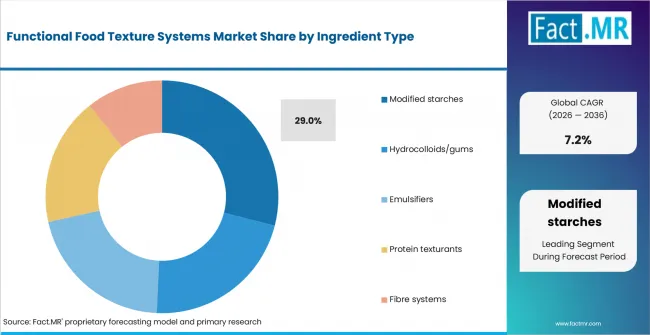
Functional Food Texture Systems Market Analysis By Ingredient Type | Source: Fact.MR
Modified starches lead because they can be tailored for viscosity, gel formation, water binding, and stability under demanding processing conditions. Food manufacturers use them where native starch alone may lose viscosity under heat, acid, shear, freezing, or extended storage.
Their application range is broad. Cargill and ADM both position starch systems for dairy, sauces, dressings, bakery, frozen foods, and other formulations where texture must remain stable through processing. This allows buyers to use a familiar ingredient platform across several product families while adjusting the starch specification to the process.
The commercial advantage is repeatability. A manufacturer can specify a target viscosity or mouthfeel and select a starch system designed to preserve that behaviour through the production line, reducing reformulation risk when volumes scale.
Why does Thickening lead Function?
Thickening is projected to account for a 31.0% share in 2026.
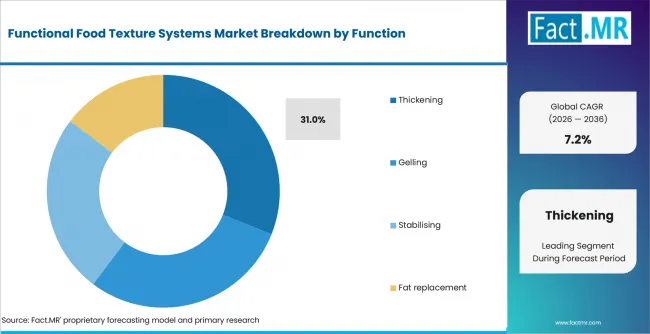
Functional Food Texture Systems Market Analysis By Function | Source: Fact.MR
Thickening leads because viscosity affects processing, filling, suspension, pour behaviour, coating, and the way a product is perceived in the mouth. The same requirement appears in sauces, dressings, dairy desserts, beverages, fillings, and many other formulated foods.
Hydrocolloids and starches can increase viscosity at relatively low use levels, while combinations can be adjusted for hot or cold processing. The FDA lists stabilizers and thickeners among common functional food-ingredient classes, reflecting their established role in maintaining consistency and texture.
Buyers therefore treat thickening as a core formulation function. Gelling and fat replacement are more application-specific, while viscosity management is required across a wider range of recipes and processing stages.
Why do Dairy & Desserts lead Application?
Dairy & desserts are projected to account for a 30.0% share in 2026.
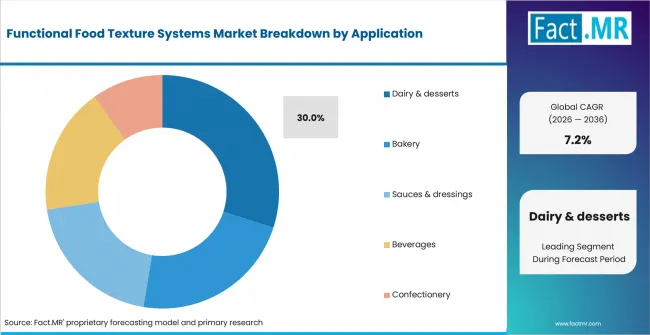
Functional Food Texture Systems Market Analysis By Application | Source: Fact.MR
Dairy and dessert formulations place several demands on texture systems at the same time. Yogurt, ice cream, puddings, dairy alternatives, and spoonable desserts may require body, creaminess, suspension, gel control, melt resistance, and stability during refrigerated or frozen storage.
Texture ingredients also help when fat or sugar is reduced. Removing these components can lower body or change melt and mouthfeel, requiring formulators to rebuild structure with starches, gums, fibres, or emulsifier systems. Cargill specifically positions texturizers and emulsifiers for ice cream where sugar reduction requires recovery of body and sensory performance.
The category therefore generates repeated formulation work across conventional dairy, frozen desserts, and dairy alternatives, supporting steady demand for both single ingredients and blended texture systems.
Why do Plant-derived Systems lead Source?
Plant-derived systems are projected to account for a 48.0% share in 2026.
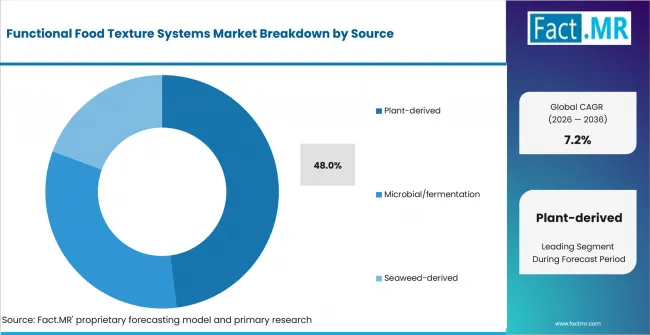
Functional Food Texture Systems Market Analysis By Source | Source: Fact.MR
Plant-derived systems lead because several widely used texture ingredients originate from corn, tapioca, potato, wheat, citrus, seeds, or other botanical sources. These materials can deliver thickening, binding, emulsification support, or fibre-based structure across a broad range of food applications.
They also give formulators flexibility when label positioning matters. ADM and Ingredion market plant-derived starches and hydrocolloids for texture and stability while offering options aligned with non-GMO, gluten-free, or other formulation requirements.
Microbial and seaweed-derived systems remain important where specific gelling or suspension behaviour is required. Plant-derived systems hold a broader base because starches and fibres can be used in high-volume formulations across bakery, dairy, sauces, and prepared foods.
Why do Powder Systems lead Form?
Powder systems are projected to account for a 64.0% share in 2026.
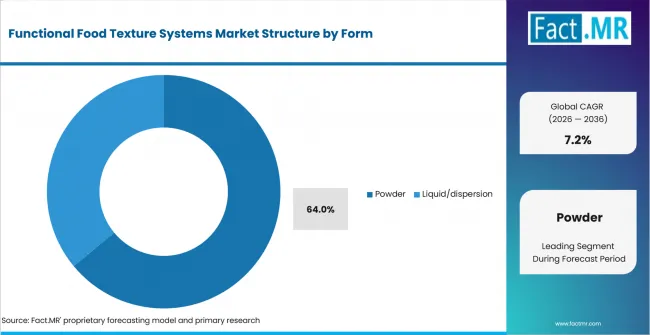
Functional Food Texture Systems Market Analysis By Form | Source: Fact.MR
Powder systems lead because most starches, gums, fibres, and blended texturizers can be shipped and stored in dry form before being dispersed during production. This reduces transport weight compared with liquid systems and fits existing dry-ingredient handling in food plants.
Powders also allow manufacturers to meter ingredients according to batch size and combine them with other dry components before hydration. The trade-off is that dispersion must be controlled because some hydrocolloids hydrate rapidly and can form lumps if they are introduced incorrectly.
Liquid or dispersion systems remain useful when manufacturers prioritize fast incorporation or pre-dispersed functionality, but powder systems fit a wider range of plants and product formats.
What is accelerating Functional Food Texture Systems Market adoption, and what is holding it back?
Drivers Impact Analysis
| Factor | (~) % Impact on CAGR | Geographic Relevance | Impact Timeline |
|---|---|---|---|
| Reformulation for reduced fat and sugar while preserving mouthfeel | +1.3% | Global | Short term (<= 2 years) |
| Growth in processed dairy, bakery, sauces and prepared foods | +1.0% | USA; Europe; Brazil | Short term (<= 2 years) |
| Need for texture stability under heat, shear and freeze-thaw processing | +0.8% | Global | Medium term (2-4 years) |
| Demand for plant-derived and label-flexible texture systems | +0.7% | USA; Europe; Japan | Medium term (2-4 years) |
| Expansion of technically complex plant-based formulations | +0.5% | Global | Long term (>= 4 years) |
Opportunity Impact Analysis
| Factor | (~) % Impact on CAGR | Geographic Relevance | Impact Timeline |
|---|---|---|---|
| Customized multi-ingredient texturizing systems | +0.8% | Global | Medium term (2-4 years) |
| Plant-derived texture systems for label-sensitive formulations | +0.7% | USA; Italy; Germany; France | Medium term (2-4 years) |
| Fat-replacement and sugar-reduction formulation support | +0.6% | Global | Long term (>= 4 years) |
| Application-specific technical service for dairy and bakery processors | +0.5% | Brazil; Italy; France | Medium term (2-4 years) |
Restraints Impact Analysis
| Factor | (~) % Impact on CAGR | Geographic Relevance | Impact Timeline |
|---|---|---|---|
| Raw-material availability and input-cost volatility | -0.9% | Global | Short term (<= 2 years) |
| Reformulation risk when texture changes alter consumer acceptance | -0.7% | Global | Short term (<= 2 years) |
| Regulatory review and labelling requirements for food additives | -0.6% | USA; European Union; Japan | Medium term (2-4 years) |
| Performance variability across recipes and processing conditions | -0.4% | Global | Long term (>= 4 years) |
Which countries are scaling the Functional Food Texture Systems Market?
- Brazil: Brazilian dairy processing expanded in 2025, with IBGE reporting 27.51 billion litres of raw milk acquired by inspected dairies, up 8.5% from 2024. Higher milk throughput expands the production base for yogurts, dairy desserts, beverages, and other products that use starches, gums, and stabilizer systems.
- USA: The United States has a broad food and beverage manufacturing base spanning bakery, dairy, beverages, prepared foods, and other categories. USDA reports that the sector accounts for a material share of U.S. manufacturing sales and employment, creating recurring demand for texture ingredients used across high-volume formulations.
- Italy: Italy’s agri-food sector generated EUR 89 billion in value added in 2025, with volume growth led by the food, beverage, and tobacco industry. Continued processing activity supports demand for texture systems across bakery, dairy, confectionery, and sauces.
- France: France maintains a substantial food-processing sector. Agreste reported that food-industry production increased in 2024, supporting demand for formulation ingredients that help manufacturers control texture, stability, and shelf performance across processed foods.
- Germany: Germany combines a large manufacturing base with established production of dairy, bakery, sauces, confectionery, and packaged foods. Texture-system demand is supported by the need to maintain consistent quality across industrial-scale recipes and by the broader European shift toward reformulated and label-conscious products.
- Japan: Japan’s food manufacturing industry employs about 1.3 million people according to the Ministry of Agriculture, Forestry and Fisheries. A large processing base, combined with demand for consistent sensory quality in packaged foods, supports use of starches, hydrocolloids, emulsifiers, and other texture systems.
Country CAGR (2026-2036)
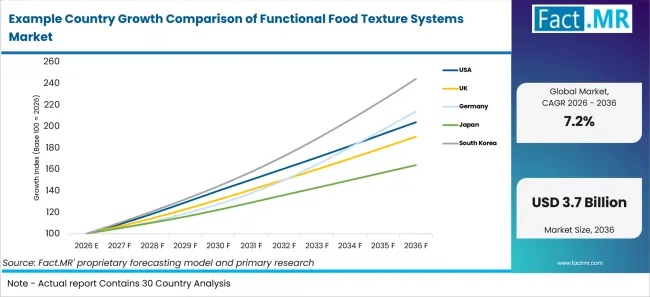
Example Country Growth Comparison Of Functional Food Texture Systems Market | Source: Fact.MR
| Country | CAGR 2026-2036 |
|---|---|
| Brazil | 9.61% |
| United States | 8.34% |
| Italy | 7.79% |
| France | 7.58% |
| Germany | 7.37% |
| Japan | 7.31% |
What is driving Brazil’s growth through 2036?
Brazil is forecast to expand at a 9.61% CAGR from 2026 to 2036.
Growth is supported by expanding dairy and food-processing throughput. IBGE reported that inspected dairies acquired 27.51 billion litres of raw milk in 2025, an increase of 8.5% from 2024. More dairy processing increases the volume of products that require viscosity control, gel formation, suspension, and freeze-thaw stability.
The mechanism extends beyond raw volume. As processors turn milk into yogurt, desserts, flavoured dairy products, and other value-added formats, formulators need texture systems that keep body and stability consistent through filling, refrigeration, and distribution.
What is driving United States’s growth through 2036?
United States is forecast to expand at a 8.34% CAGR from 2026 to 2036.
The USA has a broad and diversified food-manufacturing base. USDA reports that food and beverage manufacturing accounts for a substantial share of national manufacturing activity, while total U.S. food spending reached USD 2.51 trillion in 2025. This scale supports continuous reformulation across bakery, dairy, sauces, prepared foods, and beverages.
Manufacturers also face pressure to adjust nutritional profiles without losing sensory performance. Texture systems become part of the formulation response when fat, sugar, or other structuring ingredients are reduced, creating demand for starches, gums, fibres, and emulsifier blends that rebuild viscosity and mouthfeel.
What is driving Italy’s growth through 2036?
Italy is forecast to expand at a 7.79% CAGR from 2026 to 2036.
Italy’s agri-food sector generated EUR 89 billion in value added in 2025, up from EUR 83.4 billion in 2024. Istat reported that volume growth was led by the food, beverage, and tobacco industry, which increased 1.4%. This supports demand for functional ingredients used in processed foods and beverages.
Italian manufacturers operate across bakery, dairy, confectionery, sauces, and prepared foods where texture is central to product identity. Suppliers that can preserve familiar sensory profiles while supporting reformulation have a practical route into recurring customer development projects.
What is driving France’s growth through 2036?
France is forecast to expand at a 7.58% CAGR from 2026 to 2036.
French food processors continue to operate at substantial industrial scale. Agreste reported that production in food industries increased 1.2% in 2024, even as sector turnover softened. Higher physical output supports ingredient demand tied to production volume, including starches, gums, emulsifiers, and stabilizer blends.
French manufacturers also serve categories where texture and shelf stability are closely linked, such as dairy desserts, bakery products, sauces, and prepared foods. Application support that reduces reformulation risk can therefore influence supplier selection.
What is driving Germany’s growth through 2036?
Germany is forecast to expand at a 7.37% CAGR from 2026 to 2036.
Germany’s large industrial food base supports steady demand for texture systems used in dairy, bakery, sauces, confectionery, and beverages. Eurostat identifies food, beverages, and tobacco as one of the major manufacturing activity groups in Europe, while Germany remains a central manufacturing market within the region.
Demand is reinforced by the need for repeatable performance across automated production. Ingredient systems that remain stable under heat, shear, storage, and filling conditions can reduce process variation and help manufacturers maintain product specifications across large batches.
What is driving Japan’s growth through 2036?
Japan is forecast to expand at a 7.31% CAGR from 2026 to 2036.
Japan’s food manufacturing industry employs around 1.3 million people, according to MAFF, creating a substantial domestic base for ingredient demand. Manufacturers must deliver consistent texture across packaged foods while operating under tight quality and sanitation controls.
The market also benefits from technical formulation needs in beverages, confectionery, sauces, bakery, and dairy-style products. Powdered texture systems fit established industrial handling, while microbial and seaweed-derived hydrocolloids remain relevant for precise gelling and suspension functions.
Who leads the Functional Food Texture Systems Market?
Cargill, Incorporated is positioned as a leading supplier through its portfolio of starches, hydrocolloids, emulsifiers, fibres, and custom texturizing systems. Its ability to combine individual ingredients into application-specific systems supports customers working across dairy, sauces, bakery, beverages, and other formulated foods.
Ingredion Incorporated competes through specialty starches and hydrocolloids used for viscosity, stability, mouthfeel, and process tolerance. ADM also supplies starches, emulsifiers, hydrocolloids, and blended texturant solutions across dairy, bakery, confectionery, sauces, and alternative-food applications.
Tate & Lyle PLC expanded its texture portfolio through the acquisition of CP Kelco in November 2024. The combined business includes pectin, specialty gums, starches, fibres, and other mouthfeel solutions. CP Kelco is therefore treated within Tate & Lyle rather than as a separate corporate competitor in this assessment.
Kerry Group plc competes through hydrocolloid and texturant systems designed for reformulation and application-specific texture challenges. Competition is shaped by formulation expertise, breadth of ingredient technologies, regional technical support, and the ability to deliver consistent performance under customer processing conditions.
Supplier selection is often made at the formulation level. A processor may require a system to meet a target viscosity after heat treatment, retain water during storage, survive freezing and thawing, or rebuild mouthfeel after fat or sugar reduction. Providers that can demonstrate performance in the customer’s actual recipe and process are more likely to secure repeat business.
Which companies are the key providers?
Key companies include Cargill, Incorporated; Ingredion Incorporated; ADM; Tate & Lyle PLC (including CP Kelco); and Kerry Group plc.
- Cargill, Incorporated
- Ingredion Incorporated
- ADM
- Tate & Lyle PLC (including CP Kelco)
- Kerry Group plc
Bibliography
- U.S. Food and Drug Administration. (2023). Types of Food Ingredients.
- U.S. Department of Agriculture, Economic Research Service. (2025). Food and Beverage Manufacturing.
- U.S. Department of Agriculture, Economic Research Service. (2026). Total Food Spending Reached USD 2.51 Trillion in 2025.
- Eurostat. (2025). Industrial Production Statistics.
- Eurostat. (2025). Key Figures on the European Food Chain, 2025 Edition.
- Istat. (2026). Economic Accounts for Agriculture, Year 2025.
- Agreste, French Ministry of Agriculture. (2025). Food Processing Industries: 2024 Production and Turnover.
- Brazilian Institute of Geography and Statistics. (2026). Quarterly Surveys of Livestock Production: 2025 Results.
- Ministry of Agriculture, Forestry and Fisheries, Japan. (2024). Sanitation Management Guidelines for Food Manufacturing and Food Distribution Industries.
- World Health Organization. (2024). Trans Fat.
- European Food Safety Authority. (2017). Re-evaluation of Pectin (E 440i) and Amidated Pectin (E 440ii) as Food Additives.
- Cargill. (2026). Texturizing Solutions.
- Ingredion. (2026). Hydrocolloid Ingredients for Clean-Label Formulation and Texture.
- ADM. (2026). Food and Beverage Texturants.
- Tate & Lyle PLC. (2024). Completion of Combination of Tate & Lyle and CP Kelco.
- Kerry. (2026). Texturants.
This Report Answers
- The report explains which ingredient types and texture functions are shaping demand in the Functional Food Texture Systems Market.
- Segment analysis identifies the leading 2026 categories across Ingredient Type, Function, Application, Source and Form.
- Country analysis reviews the listed markets and the mechanisms supporting their projected growth through 2036.
- Competitive analysis examines current suppliers and consolidates CP Kelco within Tate & Lyle following the completed acquisition.
- Application analysis covers dairy and desserts, bakery, sauces and dressings, beverages, and confectionery with attention to formulation and processing requirements.
What does the Functional Food Texture Systems Market cover?
The Functional Food Texture Systems Market covers ingredient systems whose primary commercial role is to create, modify, or preserve texture in food and beverage products. These systems influence viscosity, gel structure, mouthfeel, suspension, emulsion stability, water binding, and process tolerance.
The assessment covers modified starches, hydrocolloids and gums, emulsifiers, protein texturants, and fibre systems. Applications include dairy and desserts, bakery, sauces and dressings, beverages, and confectionery, with products supplied in powder and liquid or dispersion form.
What is included in the scope?
The scope includes texture systems used for thickening, gelling, stabilising, and fat replacement within the supplied segmentation. It covers plant-derived, microbial or fermentation-derived, and seaweed-derived systems where texture modification is the primary functional purpose.
Both single-ingredient and blended systems are included when they are sold to food and beverage manufacturers for the stated texture functions. Demand from industrial processors and formulators is assessed across the listed applications and global regions.
What is excluded from the scope?
The scope excludes ingredients used primarily for flavour, sweetness, colour, preservation, fortification, or other non-texture purposes. Enzymes, cultures, isolated nutritional ingredients, and processing aids are excluded unless their primary commercial role within the product is texture modification.
Food-processing equipment, standalone mixing systems, and finished consumer foods are outside the market. Adjacent ingredients are included only when sold specifically as part of a functional texture system within the stated segmentation.
How Was the Analysis Built?
The analysis draws on more than 120 sources, over 35 company portfolios and more than 20 industry interviews across at least 25 countries.
- Primary Research: Interviews with texture-ingredient suppliers, food formulators, product-development teams, procurement managers, and application specialists examine ingredient selection, processing constraints, formulation priorities, and supplier qualification.
- Desk Research: The review covers official food-manufacturing statistics, regulatory publications, food-additive guidance, company technical literature, and application information relevant to starches, hydrocolloids, emulsifiers, proteins, and fibres. Sources used in the analysis are recorded in the bibliography.
- Market Sizing and Forecasting: Estimates combine food-processing output, ingredient use across target applications, texture-function mix, formulation intensity, pricing, and country-level growth. The model also considers reformulation activity and changes in source and form preferences.
- Data Validation and Update Cycle: Findings are cross-checked against supplier portfolios, public statistics, application evidence, and industry interviews. Updates account for acquisitions, formulation trends, regulatory changes, and shifts in food-processing output.
What is the report's scope and coverage?
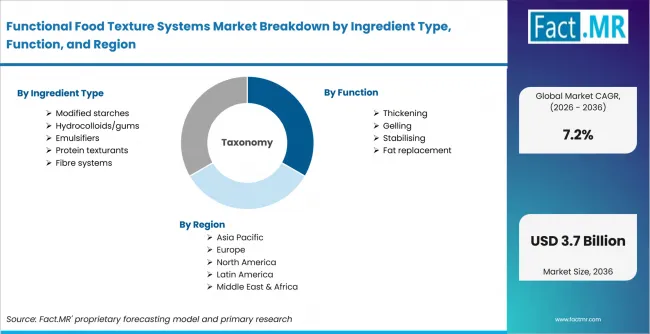
Functional Food Texture Systems Market Breakdown By Ingredient Type, Function, And Region | Source: Fact.MR
| Attribute | Details |
|---|---|
| Quantitative Units | USD billion |
| Market Definition | Functional food texture systems used primarily to modify or maintain texture, viscosity, mouthfeel, structure, emulsion stability or gel performance in food and beverage formulations |
| Segments Covered | Ingredient Type; Function; Application; Source; Form |
| Regions Covered | North America; Latin America; Europe; East Asia; South Asia and Pacific; Middle East and Africa |
| Countries Covered | Brazil; United States; Italy; France; Germany; Japan |
| Key Companies Profiled | Cargill, Incorporated; Ingredion Incorporated; ADM; Tate & Lyle PLC; Kerry Group plc |
| Forecast Period | 2026 to 2036 |
| Approach | Hybrid top-down and bottom-up approach using ingredient demand, application mix, food-processing output, formulation requirements, pricing and supplier portfolio review |
How is the market segmented?
-
By Ingredient Type
- Modified starches
- Hydrocolloids/gums
- Emulsifiers
- Protein texturants
- Fibre systems
-
By Function
- Thickening
- Gelling
- Stabilising
- Fat replacement
-
By Application
- Dairy & desserts
- Bakery
- Sauces & dressings
- Beverages
- Confectionery
-
By Source
- Plant-derived
- Microbial/fermentation
- Seaweed-derived
-
By Form
- Powder
- Liquid/dispersion