Modified Starch Market

Modified Starch Market Size and Share Forecast Outlook 2026 to 2036

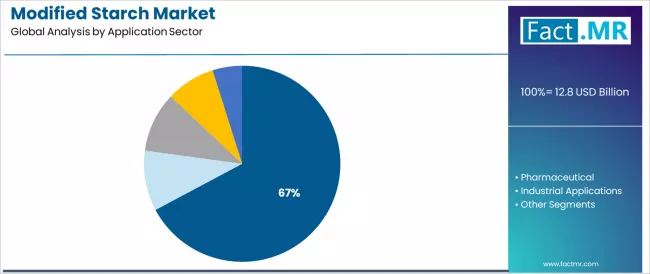
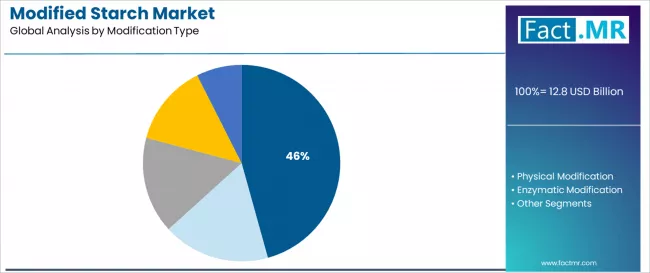
Modified starch market is projected to grow from USD 12.8 billion in 2026 to USD 19.7 billion by 2036, at a CAGR of 4.4%. Food and Beverage will dominate with a 67.2% market share, while chemical modification will lead the modification type segment with a 45.7% share.

Modified Starch Market Forecast and Outlook 2026 to 2036

The global modified starch market is valued at USD 12.8 billion in 2026 and is set to reach USD 19.7 billion by 2036, recording a compound annual growth rate (CAGR) of 4.4% between 2026 and 2036. In 2026, the food and beverage application segment is projected to hold a 67.2% share, while chemical modification accounts for 45.7% of the total market by modification type.

Key Takeaways from the Modified Starch Market Report

  • Market Value (2026): USD 12.8 Billion
  • Market Forecast Value (2036): USD 19.7 Billion
  • Forecast CAGR (2026-2036): 4.4%
  • Leading Application Segment: Food & Beverage (67.2%)
  • Leading Modification Type: Chemical Modification (45.7%)
  • Key Growth Regions: North America, Europe, Asia Pacific, Latin America, MEA
  • Key Players: Cargill Incorporated, Archer Daniels Midland Company, Ingredion Incorporated, Tate & Lyle PLC, Roquette Frères
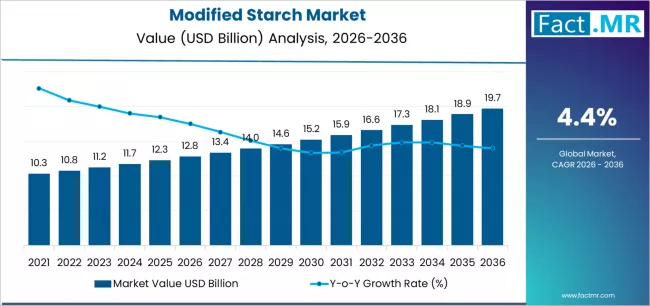
Modified Starch Market Market Value Analysis

Market expansion is driven by the food industry's dual demand for improved functionality and cleaner labels. Modified starches provide essential texture, stability, and processing benefits, such as thickening, gelling, and moisture retention, that are critical in modern food manufacturing. Simultaneously, the shift toward consumer-preferred clean label ingredients is pushing innovation in physical and enzymatic modification techniques that meet natural labeling requirements while maintaining high performance.

Advancements in modification technology and application-specific solutions will define growth over the forecast period. Innovations in enzymatic processes and controlled physical treatments allow for starches with superior functionality and label-friendly status. The growing demand for plant-based and gluten-free products further expands the role of modified starches as essential texturizers and stabilizers in alternative food formulations, driving R&D toward more specialized and sustainable starch solutions.

Modified Starch Market Key Takeaways

Metric Value
Estimated Value in (2026E) USD 12.8 billion
Forecast Value in (2036F) USD 19.7 billion
Forecast CAGR (2026 to 2036) 4.4%

Category

Category Segments
Modification Type Chemical, Physical, Enzymatic, Cross-linked, Others
Application Sector Food & Beverage, Pharmaceutical, Industrial, Textile, Others
Source Material Corn, Potato, Wheat, Tapioca, Others
Processing Method Wet Processing, Dry Processing, Spray Drying, Others
Region North America, Europe, Asia Pacific, Latin America, MEA

Segmental Analysis

Why does the Food & Beverage dominate by Application?
Modified Starch Market Analysis By Application Sector

The food and beverage segment commands a 67.2% market share in 2026, as modified starches are fundamental functional ingredients across nearly every processed food category. They are indispensable for providing viscosity in soups and sauces, improving texture in dairy products and baked goods, and ensuring stability in ready-to-eat meals. The sector's growth is closely tied to the expansion of processed and convenience food consumption globally, alongside the continuous need for cost-effective ingredients that enhance shelf-life and product quality.

  • The clean label movement is particularly influential, driving demand for starches modified through physical or enzymatic methods that can be listed as starch or modified food starch without chemical-sounding additives.
  • The rise of plant-based meat and dairy alternatives creates new, high-value applications for modified starches as binders, texturizers, and moisture-management agents.

Why is Chemical Modification the Leading Segment by Modification Type?
Modified Starch Market Analysis By Modification Type

Chemical modification is projected to hold a 45.7% share in 2026. This dominance is due to its ability to produce starches with highly specific, robust, and versatile functional properties such as cross-linked starches for extreme heat and acid stability, or acetylated starches for freeze-thaw stability. These attributes are essential for demanding industrial food processing and non-food applications. While clean label trends pressure this segment, its cost-effectiveness and unparalleled performance in certain applications ensure its continued leading position.

  • Chemical modification allows for precise engineering of starch properties, making it irreplaceable for applications in the paper, textile, and pharmaceutical industries where specific technical performance is required.
  • Innovation within chemical modification focuses on efficiency and developing next-generation chemistries that offer improved functionality with potential labeling advantages.

What are the Drivers, Restraints, and Key Trends of the Modified Starch Market?

The market is driven by the global growth in consumption of processed and packaged foods, which rely on modified starches for texture and stability. Secondary drivers include the expansion of the pharmaceutical industry where starch is used as an excipient and the demand for sustainable bio-based materials in industrial applications. Key restraints include volatility in the price and supply of raw materials such as corn, tapioca, and the increasing consumer and regulatory pressure for clean-label, minimally processed ingredients.

The market is trending towards the development of clean-label modified starches using physical and enzymatic methods. Another key trend is the customization of starch solutions for specific applications, such as gluten-free baking or plant-based meats, and the exploration of novel starch sources beyond traditional corn and tapioca to ensure supply chain diversification and sustainability.

Analysis of the Modified Starch Market by Key Countries
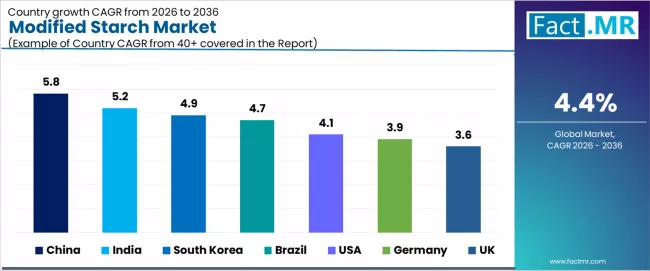
Modified Starch Market Cagr Analysis By Country

Country CAGR (2026-2036)
China 5.8%
India 5.2%
Germany 3.9%
Brazil 4.7%
USA 4.1%
UK 3.6%
South Korea 4.9%

What is Propelling China’s Leadership in Starch Processing?

The market in China is projected to grow at a leading CAGR of 5.8% through 2036. This is driven by its massive and modernizing food processing industry, which serves both a vast domestic market and global export channels. China is a major producer of native and modified starches, particularly from corn and tapioca. Government support for agricultural processing and industrial modernization, combined with strong domestic demand for convenience foods, ensures continuous investment and capacity expansion in starch modification facilities.

How is India's Growing Food Processing Sector Driving Demand?

The market in India is forecast to grow at a CAGR of 5.2%. Growth is fueled by a rapidly organized food processing sector, rising disposable incomes, and changing consumption patterns favoring packaged foods. Government initiatives like "Make in India" and investment in food park infrastructure are attracting global ingredient manufacturers. The diverse local cuisine also presents opportunities for tailored starch solutions in traditional food industrialisation.

How does South Korea's Advanced Food Tech Industry Influence the Market?
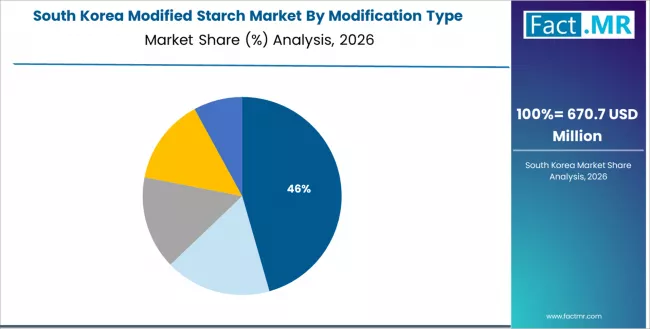
Modified Starch Market South Korea Market Share Analysis By Modification Type

The market in South Korea is projected to grow at a CAGR of 4.9%. The country's sophisticated food manufacturing sector, with its emphasis on premium processed foods, instant noodles, and innovative sauces, demands high-performance, specialized starch ingredients. South Korean consumers' keen interest in food quality and label transparency drives innovation in clean-label modification techniques among both global suppliers and local starch producers.

Why is Brazil a Significant Market in Latin America?

The market in Brazil is set to grow at a CAGR of 4.7%. As an agricultural powerhouse and a major consumer market, Brazil has a strong base in native starch production (especially from cassava/tapioca). Growth is driven by the expansion of its processed meat, bakery, and dairy industries. The region's economic recovery and growing middle class are expected to further boost demand for convenience foods containing modified starches.

What Underpins Steady Innovation in USA’s Market?
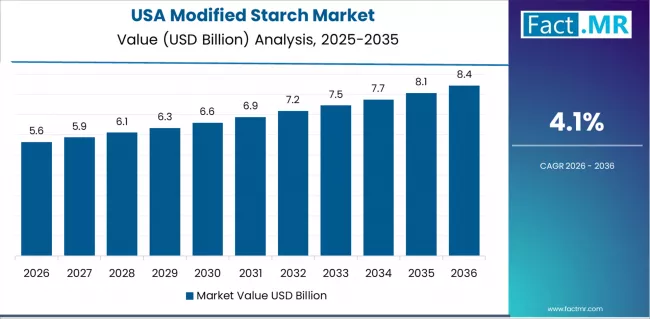
Modified Starch Market Country Value Analysis

The market in the USA is expected to grow at a CAGR of 4.1%. The large, mature market is characterized by a high level of processed food consumption and intense innovation in food products. Growth is driven by the need for starches that enable reduced fat, sugar, and allergen-free formulations, as well as the booming plant-based food sector. US-based global players are at the forefront of R&D in clean-label and application-specific starch solutions.

How does Germany's High Standards Shape its Starch Market?

The market in Germany is forecast to grow at a CAGR of 3.9%. Germany's large and technically advanced food processing industry, particularly in meat, confectionery, and dairy, requires precise and reliable starch functionalities. The strong consumer preference for natural and organic products in the DACH region places significant emphasis on the development and adoption of physically and enzymatically modified clean-label starches.

What Supports the UK’s Focus on Clean Label and Reformulation?

The market in the UK is projected to grow at a CAGR of 3.6%. The UK food industry is a leader in clean-label reformulation, driven by stringent retailer requirements and informed consumers. This creates robust demand for starches that can replace synthetic hydrocolloids and chemically modified ingredients without compromising performance, particularly in ready meals, sauces, and bakery products. The market is highly responsive to trends in health and wellness.

Competitive Landscape of the Modified Starch Market
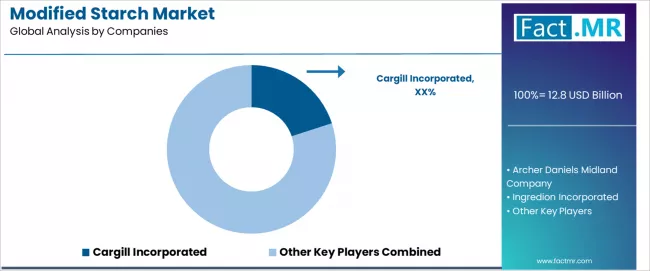
Modified Starch Market Analysis By Company

The competitive landscape is dominated by large, global agribusiness and ingredient corporations with integrated operations from raw material sourcing to application development. Competition centers on R&D capability to innovate for clean-label trends, cost-competitive and secure supply chains for key raw materials such as corn, tapioca, potato, and technical service teams that can co-develop solutions with food manufacturers. Success depends on a deep portfolio catering to both cost-sensitive and value-added segments, and the ability to pivot production toward in-demand modification technologies.

Key Players in the Modified Starch Market

  • Cargill Incorporated
  • Archer Daniels Midland Company
  • Ingredion Incorporated
  • Tate & Lyle PLC
  • Roquette Frères
  • Avebe U.A.
  • Emsland-Stärke GmbH
  • Grain Processing Corporation
  • AGRANA Beteiligungs-AG
  • SMS Corporation Co., Ltd.
  • Global Bio-chem Technology Group Company Limited
  • Tereos S.A.
  • BENEO GmbH
  • KMC Kartoffelmelcentralen AMBA
  • Penford Corporation

Scope of the Report

Items Values
Quantitative Units (2026) USD 12.8 Billion
Modification Type Chemical Modification, Physical Modification, Enzymatic Modification, Cross-linked Starches, Other Modification Configurations
Application Sector Food and Beverage, Pharmaceutical, Industrial Applications, Textile Manufacturing, Others
Source Material Corn, Potato, Wheat, Tapioca, Other Source Platforms
Processing Method Wet Processing, Dry Processing, Spray Drying, Other Processing Services
Regions Covered North America, Europe, Asia Pacific, Latin America, MEA, Other Regions
Countries Covered China, India, Germany, Brazil, USA, UK, South Korea, and 40+ countries
Key Companies Profiled Cargill Incorporated, Archer Daniels Midland Company, Ingredion Incorporated, Tate & Lyle PLC, Roquette Frères, and other leading modified starch companies
Additional Attributes Dollar sales by modification type, application sector, source material, processing method, and region; regional demand trends, competitive landscape, technological advancements in modification engineering, operational performance optimization initiatives, functional enhancement programs, and premium product development strategies

Modified Starch Market by Segments

  • Modification Type :

    • Chemical Modification
    • Physical Modification
    • Enzymatic Modification
    • Cross-linked Starches
    • Other Modification Configurations
  • Application Sector :

    • Food and Beverage
    • Pharmaceutical
    • Industrial Applications
    • Textile Manufacturing
    • Others
  • Source Material :

    • Corn
    • Potato
    • Wheat
    • Tapioca
    • Other Source Platforms
  • Processing Method :

    • Wet Processing
    • Dry Processing
    • Spray Drying
    • Other Processing Services
  • Region :

    • North America

      • USA
      • Canada
      • Mexico
    • Europe

      • Germany
      • UK
      • France
      • Italy
      • Spain
      • Nordic Countries
      • BENELUX
      • Rest of Europe
    • Asia Pacific

      • China
      • India
      • Japan
      • South Korea
      • Australia
      • Rest of Asia Pacific
    • Latin America

      • Brazil
      • Argentina
      • Rest of Latin America
    • MEA

      • Saudi Arabia
      • UAE
      • South Africa
      • Rest of MEA

Table of Content

  1. Executive Summary
    • Global Market Outlook
    • Demand to side Trends
    • Supply to side Trends
    • Technology Roadmap Analysis
    • Analysis and Recommendations
  2. Market Overview
    • Market Coverage / Taxonomy
    • Market Definition / Scope / Limitations
  3. Market Background
    • Market Dynamics
      • Drivers
      • Restraints
      • Opportunity
      • Trends
    • Scenario Forecast
      • Demand in Optimistic Scenario
      • Demand in Likely Scenario
      • Demand in Conservative Scenario
    • Opportunity Map Analysis
    • Product Life Cycle Analysis
    • Supply Chain Analysis
    • Investment Feasibility Matrix
    • Value Chain Analysis
    • PESTLE and Porter’s Analysis
    • Regulatory Landscape
    • Regional Parent Market Outlook
    • Production and Consumption Statistics
    • Import and Export Statistics
  4. Global Market Analysis 2021 to 2025 and Forecast, 2026 to 2036
    • Historical Market Size Value (USD Million) Analysis, 2021 to 2025
    • Current and Future Market Size Value (USD Million) Projections, 2026 to 2036
      • Y to o to Y Growth Trend Analysis
      • Absolute $ Opportunity Analysis
  5. Global Market Pricing Analysis 2021 to 2025 and Forecast 2026 to 2036
  6. Global Market Analysis 2021 to 2025 and Forecast 2026 to 2036, By Application Sector
    • Introduction / Key Findings
    • Historical Market Size Value (USD Million) Analysis By Application Sector, 2021 to 2025
    • Current and Future Market Size Value (USD Million) Analysis and Forecast By Application Sector, 2026 to 2036
      • Food and Beverage
      • Pharmaceutical
      • Industrial Applications
      • Textile Manufacturing
      • Others
    • Y to o to Y Growth Trend Analysis By Application Sector, 2021 to 2025
    • Absolute $ Opportunity Analysis By Application Sector, 2026 to 2036
  7. Global Market Analysis 2021 to 2025 and Forecast 2026 to 2036, By Modification Type
    • Introduction / Key Findings
    • Historical Market Size Value (USD Million) Analysis By Modification Type, 2021 to 2025
    • Current and Future Market Size Value (USD Million) Analysis and Forecast By Modification Type, 2026 to 2036
      • Chemical Modification
      • Physical Modification
      • Enzymatic Modification
      • Cross-linked Starches
      • Other Modification Configurations
    • Y to o to Y Growth Trend Analysis By Modification Type, 2021 to 2025
    • Absolute $ Opportunity Analysis By Modification Type, 2026 to 2036
  8. Global Market Analysis 2021 to 2025 and Forecast 2026 to 2036, By Region
    • Introduction
    • Historical Market Size Value (USD Million) Analysis By Region, 2021 to 2025
    • Current Market Size Value (USD Million) Analysis and Forecast By Region, 2026 to 2036
      • North America
      • Latin America
      • Western Europe
      • Eastern Europe
      • East Asia
      • South Asia and Pacific
      • Middle East & Africa
    • Market Attractiveness Analysis By Region
  9. North America Market Analysis 2021 to 2025 and Forecast 2026 to 2036, By Country
    • Historical Market Size Value (USD Million) Trend Analysis By Market Taxonomy, 2021 to 2025
    • Market Size Value (USD Million) Forecast By Market Taxonomy, 2026 to 2036
      • By Country
        • USA
        • Canada
        • Mexico
      • By Application Sector
      • By Modification Type
    • Market Attractiveness Analysis
      • By Country
      • By Application Sector
      • By Modification Type
    • Key Takeaways
  10. Latin America Market Analysis 2021 to 2025 and Forecast 2026 to 2036, By Country
    • Historical Market Size Value (USD Million) Trend Analysis By Market Taxonomy, 2021 to 2025
    • Market Size Value (USD Million) Forecast By Market Taxonomy, 2026 to 2036
      • By Country
        • Brazil
        • Chile
        • Rest of Latin America
      • By Application Sector
      • By Modification Type
    • Market Attractiveness Analysis
      • By Country
      • By Application Sector
      • By Modification Type
    • Key Takeaways
  11. Western Europe Market Analysis 2021 to 2025 and Forecast 2026 to 2036, By Country
    • Historical Market Size Value (USD Million) Trend Analysis By Market Taxonomy, 2021 to 2025
    • Market Size Value (USD Million) Forecast By Market Taxonomy, 2026 to 2036
      • By Country
        • Germany
        • UK
        • Italy
        • Spain
        • France
        • Nordic
        • BENELUX
        • Rest of Western Europe
      • By Application Sector
      • By Modification Type
    • Market Attractiveness Analysis
      • By Country
      • By Application Sector
      • By Modification Type
    • Key Takeaways
  12. Eastern Europe Market Analysis 2021 to 2025 and Forecast 2026 to 2036, By Country
    • Historical Market Size Value (USD Million) Trend Analysis By Market Taxonomy, 2021 to 2025
    • Market Size Value (USD Million) Forecast By Market Taxonomy, 2026 to 2036
      • By Country
        • Russia
        • Poland
        • Hungary
        • Balkan & Baltic
        • Rest of Eastern Europe
      • By Application Sector
      • By Modification Type
    • Market Attractiveness Analysis
      • By Country
      • By Application Sector
      • By Modification Type
    • Key Takeaways
  13. East Asia Market Analysis 2021 to 2025 and Forecast 2026 to 2036, By Country
    • Historical Market Size Value (USD Million) Trend Analysis By Market Taxonomy, 2021 to 2025
    • Market Size Value (USD Million) Forecast By Market Taxonomy, 2026 to 2036
      • By Country
        • China
        • Japan
        • South Korea
      • By Application Sector
      • By Modification Type
    • Market Attractiveness Analysis
      • By Country
      • By Application Sector
      • By Modification Type
    • Key Takeaways
  14. South Asia and Pacific Market Analysis 2021 to 2025 and Forecast 2026 to 2036, By Country
    • Historical Market Size Value (USD Million) Trend Analysis By Market Taxonomy, 2021 to 2025
    • Market Size Value (USD Million) Forecast By Market Taxonomy, 2026 to 2036
      • By Country
        • India
        • ASEAN
        • Australia & New Zealand
        • Rest of South Asia and Pacific
      • By Application Sector
      • By Modification Type
    • Market Attractiveness Analysis
      • By Country
      • By Application Sector
      • By Modification Type
    • Key Takeaways
  15. Middle East & Africa Market Analysis 2021 to 2025 and Forecast 2026 to 2036, By Country
    • Historical Market Size Value (USD Million) Trend Analysis By Market Taxonomy, 2021 to 2025
    • Market Size Value (USD Million) Forecast By Market Taxonomy, 2026 to 2036
      • By Country
        • Kingdom of Saudi Arabia
        • Other GCC Countries
        • Turkiye
        • South Africa
        • Other African Union
        • Rest of Middle East & Africa
      • By Application Sector
      • By Modification Type
    • Market Attractiveness Analysis
      • By Country
      • By Application Sector
      • By Modification Type
    • Key Takeaways
  16. Key Countries Market Analysis
    • USA
      • Pricing Analysis
      • Market Share Analysis, 2025
        • By Application Sector
        • By Modification Type
    • Canada
      • Pricing Analysis
      • Market Share Analysis, 2025
        • By Application Sector
        • By Modification Type
    • Mexico
      • Pricing Analysis
      • Market Share Analysis, 2025
        • By Application Sector
        • By Modification Type
    • Brazil
      • Pricing Analysis
      • Market Share Analysis, 2025
        • By Application Sector
        • By Modification Type
    • Chile
      • Pricing Analysis
      • Market Share Analysis, 2025
        • By Application Sector
        • By Modification Type
    • Germany
      • Pricing Analysis
      • Market Share Analysis, 2025
        • By Application Sector
        • By Modification Type
    • UK
      • Pricing Analysis
      • Market Share Analysis, 2025
        • By Application Sector
        • By Modification Type
    • Italy
      • Pricing Analysis
      • Market Share Analysis, 2025
        • By Application Sector
        • By Modification Type
    • Spain
      • Pricing Analysis
      • Market Share Analysis, 2025
        • By Application Sector
        • By Modification Type
    • France
      • Pricing Analysis
      • Market Share Analysis, 2025
        • By Application Sector
        • By Modification Type
    • India
      • Pricing Analysis
      • Market Share Analysis, 2025
        • By Application Sector
        • By Modification Type
    • ASEAN
      • Pricing Analysis
      • Market Share Analysis, 2025
        • By Application Sector
        • By Modification Type
    • Australia & New Zealand
      • Pricing Analysis
      • Market Share Analysis, 2025
        • By Application Sector
        • By Modification Type
    • China
      • Pricing Analysis
      • Market Share Analysis, 2025
        • By Application Sector
        • By Modification Type
    • Japan
      • Pricing Analysis
      • Market Share Analysis, 2025
        • By Application Sector
        • By Modification Type
    • South Korea
      • Pricing Analysis
      • Market Share Analysis, 2025
        • By Application Sector
        • By Modification Type
    • Russia
      • Pricing Analysis
      • Market Share Analysis, 2025
        • By Application Sector
        • By Modification Type
    • Poland
      • Pricing Analysis
      • Market Share Analysis, 2025
        • By Application Sector
        • By Modification Type
    • Hungary
      • Pricing Analysis
      • Market Share Analysis, 2025
        • By Application Sector
        • By Modification Type
    • Kingdom of Saudi Arabia
      • Pricing Analysis
      • Market Share Analysis, 2025
        • By Application Sector
        • By Modification Type
    • Turkiye
      • Pricing Analysis
      • Market Share Analysis, 2025
        • By Application Sector
        • By Modification Type
    • South Africa
      • Pricing Analysis
      • Market Share Analysis, 2025
        • By Application Sector
        • By Modification Type
  17. Market Structure Analysis
    • Competition Dashboard
    • Competition Benchmarking
    • Market Share Analysis of Top Players
      • By Regional
      • By Application Sector
      • By Modification Type
  18. Competition Analysis
    • Competition Deep Dive
      • Cargill Incorporated
        • Overview
        • Product Portfolio
        • Profitability by Market Segments (Product/Age /Sales Channel/Region)
        • Sales Footprint
        • Strategy Overview
          • Marketing Strategy
          • Product Strategy
          • Channel Strategy
      • Archer Daniels Midland Company
      • Ingredion Incorporated
      • Tate & Lyle PLC
      • Roquette Frères
      • Avebe U.A.
      • Emsland-Stärke GmbH
      • Grain Processing Corporation
      • AGRANA Beteiligungs-AG
      • SMS Corporation Co., Ltd.
      • Global Bio-chem Technology Group Company Limited
      • Tereos S.A.
      • BENEO GmbH
      • KMC Kartoffelmelcentralen AMBA
      • Penford Corporation
  19. Assumptions & Acronyms Used
  20. Research Methodology

List Of Table

  • Table 1: Global Market Value (USD Million) Forecast by Region, 2021 to 2036
  • Table 2: Global Market Value (USD Million) Forecast by Application Sector, 2021 to 2036
  • Table 3: Global Market Value (USD Million) Forecast by Modification Type, 2021 to 2036
  • Table 4: North America Market Value (USD Million) Forecast by Country, 2021 to 2036
  • Table 5: North America Market Value (USD Million) Forecast by Application Sector, 2021 to 2036
  • Table 6: North America Market Value (USD Million) Forecast by Modification Type, 2021 to 2036
  • Table 7: Latin America Market Value (USD Million) Forecast by Country, 2021 to 2036
  • Table 8: Latin America Market Value (USD Million) Forecast by Application Sector, 2021 to 2036
  • Table 9: Latin America Market Value (USD Million) Forecast by Modification Type, 2021 to 2036
  • Table 10: Western Europe Market Value (USD Million) Forecast by Country, 2021 to 2036
  • Table 11: Western Europe Market Value (USD Million) Forecast by Application Sector, 2021 to 2036
  • Table 12: Western Europe Market Value (USD Million) Forecast by Modification Type, 2021 to 2036
  • Table 13: Eastern Europe Market Value (USD Million) Forecast by Country, 2021 to 2036
  • Table 14: Eastern Europe Market Value (USD Million) Forecast by Application Sector, 2021 to 2036
  • Table 15: Eastern Europe Market Value (USD Million) Forecast by Modification Type, 2021 to 2036
  • Table 16: East Asia Market Value (USD Million) Forecast by Country, 2021 to 2036
  • Table 17: East Asia Market Value (USD Million) Forecast by Application Sector, 2021 to 2036
  • Table 18: East Asia Market Value (USD Million) Forecast by Modification Type, 2021 to 2036
  • Table 19: South Asia and Pacific Market Value (USD Million) Forecast by Country, 2021 to 2036
  • Table 20: South Asia and Pacific Market Value (USD Million) Forecast by Application Sector, 2021 to 2036
  • Table 21: South Asia and Pacific Market Value (USD Million) Forecast by Modification Type, 2021 to 2036
  • Table 22: Middle East & Africa Market Value (USD Million) Forecast by Country, 2021 to 2036
  • Table 23: Middle East & Africa Market Value (USD Million) Forecast by Application Sector, 2021 to 2036
  • Table 24: Middle East & Africa Market Value (USD Million) Forecast by Modification Type, 2021 to 2036

List Of Figures

  • Figure 1: Global Market Pricing Analysis
  • Figure 2: Global Market Value (USD Million) Forecast 2021 to 2036
  • Figure 3: Global Market Value Share and BPS Analysis by Application Sector, 2026 and 2036
  • Figure 4: Global Market Y to o to Y Growth Comparison by Application Sector, 2026 to 2036
  • Figure 5: Global Market Attractiveness Analysis by Application Sector
  • Figure 6: Global Market Value Share and BPS Analysis by Modification Type, 2026 and 2036
  • Figure 7: Global Market Y to o to Y Growth Comparison by Modification Type, 2026 to 2036
  • Figure 8: Global Market Attractiveness Analysis by Modification Type
  • Figure 9: Global Market Value (USD Million) Share and BPS Analysis by Region, 2026 and 2036
  • Figure 10: Global Market Y to o to Y Growth Comparison by Region, 2026 to 2036
  • Figure 11: Global Market Attractiveness Analysis by Region
  • Figure 12: North America Market Incremental Dollar Opportunity, 2026 to 2036
  • Figure 13: Latin America Market Incremental Dollar Opportunity, 2026 to 2036
  • Figure 14: Western Europe Market Incremental Dollar Opportunity, 2026 to 2036
  • Figure 15: Eastern Europe Market Incremental Dollar Opportunity, 2026 to 2036
  • Figure 16: East Asia Market Incremental Dollar Opportunity, 2026 to 2036
  • Figure 17: South Asia and Pacific Market Incremental Dollar Opportunity, 2026 to 2036
  • Figure 18: Middle East & Africa Market Incremental Dollar Opportunity, 2026 to 2036
  • Figure 19: North America Market Value Share and BPS Analysis by Country, 2026 and 2036
  • Figure 20: North America Market Value Share and BPS Analysis by Application Sector, 2026 and 2036
  • Figure 21: North America Market Y to o to Y Growth Comparison by Application Sector, 2026 to 2036
  • Figure 22: North America Market Attractiveness Analysis by Application Sector
  • Figure 23: North America Market Value Share and BPS Analysis by Modification Type, 2026 and 2036
  • Figure 24: North America Market Y to o to Y Growth Comparison by Modification Type, 2026 to 2036
  • Figure 25: North America Market Attractiveness Analysis by Modification Type
  • Figure 26: Latin America Market Value Share and BPS Analysis by Country, 2026 and 2036
  • Figure 27: Latin America Market Value Share and BPS Analysis by Application Sector, 2026 and 2036
  • Figure 28: Latin America Market Y to o to Y Growth Comparison by Application Sector, 2026 to 2036
  • Figure 29: Latin America Market Attractiveness Analysis by Application Sector
  • Figure 30: Latin America Market Value Share and BPS Analysis by Modification Type, 2026 and 2036
  • Figure 31: Latin America Market Y to o to Y Growth Comparison by Modification Type, 2026 to 2036
  • Figure 32: Latin America Market Attractiveness Analysis by Modification Type
  • Figure 33: Western Europe Market Value Share and BPS Analysis by Country, 2026 and 2036
  • Figure 34: Western Europe Market Value Share and BPS Analysis by Application Sector, 2026 and 2036
  • Figure 35: Western Europe Market Y to o to Y Growth Comparison by Application Sector, 2026 to 2036
  • Figure 36: Western Europe Market Attractiveness Analysis by Application Sector
  • Figure 37: Western Europe Market Value Share and BPS Analysis by Modification Type, 2026 and 2036
  • Figure 38: Western Europe Market Y to o to Y Growth Comparison by Modification Type, 2026 to 2036
  • Figure 39: Western Europe Market Attractiveness Analysis by Modification Type
  • Figure 40: Eastern Europe Market Value Share and BPS Analysis by Country, 2026 and 2036
  • Figure 41: Eastern Europe Market Value Share and BPS Analysis by Application Sector, 2026 and 2036
  • Figure 42: Eastern Europe Market Y to o to Y Growth Comparison by Application Sector, 2026 to 2036
  • Figure 43: Eastern Europe Market Attractiveness Analysis by Application Sector
  • Figure 44: Eastern Europe Market Value Share and BPS Analysis by Modification Type, 2026 and 2036
  • Figure 45: Eastern Europe Market Y to o to Y Growth Comparison by Modification Type, 2026 to 2036
  • Figure 46: Eastern Europe Market Attractiveness Analysis by Modification Type
  • Figure 47: East Asia Market Value Share and BPS Analysis by Country, 2026 and 2036
  • Figure 48: East Asia Market Value Share and BPS Analysis by Application Sector, 2026 and 2036
  • Figure 49: East Asia Market Y to o to Y Growth Comparison by Application Sector, 2026 to 2036
  • Figure 50: East Asia Market Attractiveness Analysis by Application Sector
  • Figure 51: East Asia Market Value Share and BPS Analysis by Modification Type, 2026 and 2036
  • Figure 52: East Asia Market Y to o to Y Growth Comparison by Modification Type, 2026 to 2036
  • Figure 53: East Asia Market Attractiveness Analysis by Modification Type
  • Figure 54: South Asia and Pacific Market Value Share and BPS Analysis by Country, 2026 and 2036
  • Figure 55: South Asia and Pacific Market Value Share and BPS Analysis by Application Sector, 2026 and 2036
  • Figure 56: South Asia and Pacific Market Y to o to Y Growth Comparison by Application Sector, 2026 to 2036
  • Figure 57: South Asia and Pacific Market Attractiveness Analysis by Application Sector
  • Figure 58: South Asia and Pacific Market Value Share and BPS Analysis by Modification Type, 2026 and 2036
  • Figure 59: South Asia and Pacific Market Y to o to Y Growth Comparison by Modification Type, 2026 to 2036
  • Figure 60: South Asia and Pacific Market Attractiveness Analysis by Modification Type
  • Figure 61: Middle East & Africa Market Value Share and BPS Analysis by Country, 2026 and 2036
  • Figure 62: Middle East & Africa Market Value Share and BPS Analysis by Application Sector, 2026 and 2036
  • Figure 63: Middle East & Africa Market Y to o to Y Growth Comparison by Application Sector, 2026 to 2036
  • Figure 64: Middle East & Africa Market Attractiveness Analysis by Application Sector
  • Figure 65: Middle East & Africa Market Value Share and BPS Analysis by Modification Type, 2026 and 2036
  • Figure 66: Middle East & Africa Market Y to o to Y Growth Comparison by Modification Type, 2026 to 2036
  • Figure 67: Middle East & Africa Market Attractiveness Analysis by Modification Type
  • Figure 68: Global Market - Tier Structure Analysis
  • Figure 69: Global Market - Company Share Analysis

- FAQs -

How big is the modified starch market in 2026?

The global modified starch market is estimated to be valued at USD 12.8 billion in 2026.

What will be the size of modified starch market in 2036?

The market size for the modified starch market is projected to reach USD 19.7 billion by 2036.

How much will be the modified starch market growth between 2026 and 2036?

The modified starch market is expected to grow at a 4.4% CAGR between 2026 and 2036.

What are the key product types in the modified starch market?

The key product types in modified starch market are food and beverage, pharmaceutical, industrial applications, textile manufacturing and others.

Which modification type segment to contribute significant share in the modified starch market in 2026?

In terms of modification type, chemical modification segment to command 45.7% share in the modified starch market in 2026.

Modified Starch Market