- Market Value (2025): USD 13.5 Bn
- Estimated Value (2026): USD 14.4 Bn
- Forecast Value (2036): USD 27.0 Bn
- CAGR (2026-2036): 6.5%
What is the Gamma Ray-based Robots Market forecast to be worth by 2036?
USD 14.4 billion in 2026 to USD 27.0 billion by 2036 at a 6.5% CAGR.
- The Gamma Ray-based Robots Market was valued at approximately USD 13.5 billion in 2025.
- Demand is projected to increase from USD 14.4 billion in 2026 to USD 27.0 billion by 2036.
- The market is forecast to expand at a 6.5% CAGR from 2026 to 2036.
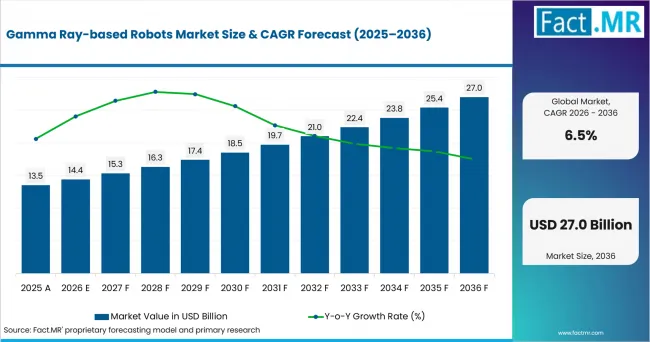
Gamma Ray Based Robots Market Value Analysis | Source: Fact.MR
What are the defining numbers behind Gamma Ray-based Robots Market growth?
An absolute opportunity of USD 12.6 billion is expected between 2026 and 2036.
- Demand Drivers in the Market
- Remote operation reduces the need for personnel to enter radiological environments. The International Atomic Energy Agency documents growing use of remotely operated and autonomous systems for characterization, scanning, waste handling and decommissioning, creating demand for robots that combine sensing with controlled manipulation.
- Nuclear cleanup programs are moving robotic systems into field operations. The U.S. Department of Energy Office of Environmental Management reports deployment of robotic inspection, remote manipulation, intelligent sensing and AI-enabled decision support to reduce worker entry into hazardous and radiological areas.
- Healthcare investment supports automation around imaging, positioning and radiation treatment. WHO guidance treats radiotherapy devices as long-life clinical assets that require accurate operation and lifecycle management, while the IAEA tracks gamma cameras and other nuclear-medicine equipment across member states.
- AI and machine vision are increasing the autonomy of radiation-zone systems. Image recognition, source localization and navigation can reduce continuous manual steering and improve inspection coverage, extending the role of autonomous robots in hazardous environments.
- Long-duration nuclear decommissioning programs create repeat demand for specialized hardware, remote monitoring and recoverable manipulation. Current projects in Japan, the UK and the USA are using robotics to reduce direct human entry and perform repetitive work in contaminated or high-radiation areas.
- Key Segments Analyzed
- Artificial Intelligence accounts for 36.9% of Technology in 2026. Perception, navigation and decision-support functions help robots interpret radiation-zone data and complete remote tasks with less continuous manual control.
- Healthcare represents 29.7% of End Use in 2026, supported by precision requirements around radiotherapy, nuclear medicine and gamma-based imaging workflows.
- Medical Imaging and Radiotherapy holds 44.2% of Application in 2026. These workflows depend on controlled positioning, repeatability and coordination with clinical planning and imaging systems.
- Direct Industrial Sales account for 41.7% of Distribution Channel in 2026 because radiation-capable robotic systems commonly require site-specific engineering, validation and integration before deployment.
- Analyst Opinion at Fact.MR
- Shambhu Nath Jha, Principal Consultant, Fact.MR
- “Gamma ray-based robots are purchased for tasks where distance, repeatability and radiation exposure materially affect how work is performed. Demand therefore depends on integrating sensing, manipulation and software with the safety controls already used by hospitals, nuclear operators and industrial facilities. Systems that reduce human exposure while producing traceable operating data have a clear operational role through 2036.”
- Strategic Implications
- Suppliers should design platforms around specific radiation-zone tasks such as inspection, source localization, remote handling and patient-positioning support rather than relying on a general-purpose robotics proposition.
- Healthcare-focused vendors need integration with imaging, treatment-planning and safety workflows because hospitals purchase complete clinical capability rather than isolated robotic motion.
- Nuclear-sector suppliers should prioritize radiation tolerance, maintainability and remote recovery. The same engineering priorities influence industrial robotics used in hazardous environments, where a failed robot can create an additional recovery problem.
- Direct sales teams should involve application engineers early in procurement because payload, shielding, sensing, communication architecture and robot control systems vary by facility and operating environment.
How does the Gamma Ray-based Robots Market break down by segment?
The market is segmented by Technology, End Use, Application and Distribution Channel.
Why does Artificial Intelligence lead Technology?
Artificial Intelligence accounts for a 36.9% share of Technology in 2026.
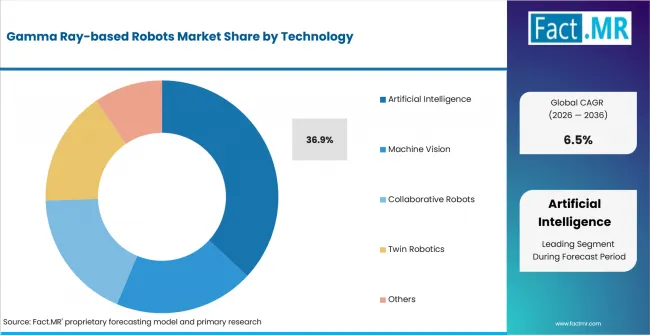
Gamma Ray Based Robots Market Analysis By Technology | Source: Fact.MR
Radiation-zone robots often have to interpret sensor feeds while direct human access is restricted. Image recognition can identify objects and inspection points, while autonomous navigation reduces the amount of low-level steering required from an operator.
The commercial value comes from supporting defined tasks while retaining human oversight. U.S. Department of Energy cleanup programs are combining robotics with intelligent sensing and decision support, and Japan is developing physical-AI robotics for remote operations in severe environments.
Why does Healthcare lead End Use?
Healthcare accounts for a 29.7% share of End Use in 2026.
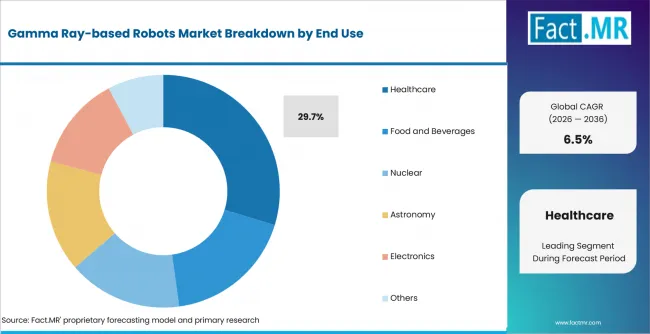
Gamma Ray Based Robots Market Analysis By End Use | Source: Fact.MR
Radiation-based diagnosis and treatment require precise positioning and repeatable workflows around sensitive equipment. Robotic assistance can support patient positioning, imaging alignment and controlled treatment delivery while reducing variation between procedures.
WHO guidance emphasizes safe and accurate radiotherapy operation across the equipment lifecycle. Brazil is also expanding radiotherapy capacity through PERSUS II, which replaces obsolete equipment and adds capacity in underserved areas, increasing the installed base around which positioning and workflow automation can be integrated.
Why does Medical Imaging and Radiotherapy lead Application?
Medical Imaging and Radiotherapy accounts for a 44.2% share of Application in 2026.
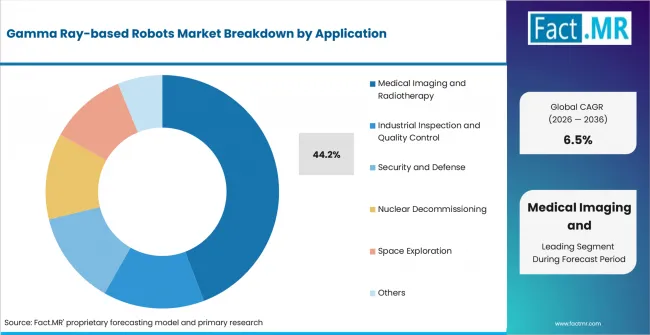
Gamma Ray Based Robots Market Analysis By Application | Source: Fact.MR
Gamma-radiation workflows depend on accurate spatial control. In nuclear medicine, gamma cameras detect radiation emitted by administered radiopharmaceuticals, while radiotherapy systems require planned geometry and controlled delivery to protect surrounding tissue.
The IAEA Nuclear Medicine Database tracks gamma cameras and related equipment, while WHO provides technical specifications and lifecycle guidance for radiotherapy facilities. These established clinical workflows create demand for positioning, monitoring and automation that can be integrated with radiation equipment.
Why do Direct Industrial Sales lead Distribution Channel?
Direct Industrial Sales account for a 41.7% share of Distribution Channel in 2026.
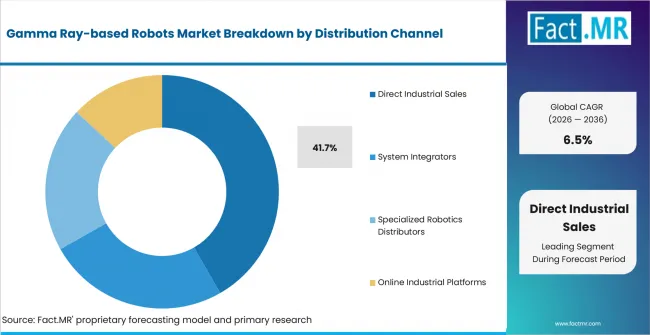
Gamma Ray Based Robots Market Analysis By Distribution Channel | Source: Fact.MR
Radiation-capable robots are rarely plug-and-play purchases. Hospitals, nuclear operators and research facilities can require different payloads, shielding arrangements, sensors, communication systems and validation procedures, so suppliers need direct technical engagement before installation.
The same channel supports training, maintenance and configuration control. These requirements matter in regulated environments where operators document service history, software changes and safe operating limits throughout the system lifecycle.
What is accelerating Gamma Ray-based Robots Market adoption, and what is holding it back?
Adoption is being supported by remote operation in radiation zones, healthcare equipment modernization and AI-enabled inspection. Growth is constrained by radiation-hardening costs, qualification requirements and the engineering effort required to integrate robotic systems with existing facilities.
Drivers Impact Analysis
| Factor | (~) % Impact on CAGR | Geographic Relevance | Impact Timeline |
|---|---|---|---|
| Remote operation in radiation zones | +1.6% | Global | Short term (≤ 2 years) |
| Radiotherapy and nuclear-medicine modernization | +1.4% | Brazil, USA and Germany | Short term (≤ 2 years) |
| AI-enabled inspection and navigation | +1.1% | USA, Germany and Japan | Medium term (2–4 years) |
| Nuclear decommissioning programs | +0.9% | Germany, UK and Japan | Medium term (2–4 years) |
| Remote inspection efficiency gains | +0.6% | Global | Long term (≥ 4 years) |
Source: Fact.MR analysis. Updated Sep 3, 2026
Opportunity Impact Analysis
| Factor | (~) % Impact on CAGR | Geographic Relevance | Impact Timeline |
|---|---|---|---|
| Digital-twin-linked remote robotics | +1.0% | Global | Medium term (2–4 years) |
| Radiation-tolerant autonomous platforms | +0.8% | USA, Germany and Japan | Medium term (2–4 years) |
| Direct engineering and integration services | +0.7% | Global | Long term (≥ 4 years) |
| Expansion of oncology equipment capacity | +0.5% | Brazil, USA and Germany | Long term (≥ 4 years) |
Source: Fact.MR analysis. Updated Sep 3, 2026
Restraints Impact Analysis
| Factor | (~) % Impact on CAGR | Geographic Relevance | Impact Timeline |
|---|---|---|---|
| Radiation hardening and system complexity | -1.1% | Global | Short term (≤ 2 years) |
| Safety validation and regulatory checks | -0.9% | USA, Germany and UK | Short term (≤ 2 years) |
| Lower-cost manual or teleoperated alternatives | -0.7% | Cost-sensitive markets | Medium term (2–4 years) |
| Long qualification and procurement cycles | -0.5% | Global | Long term (≥ 4 years) |
Source: Fact.MR analysis. Updated Sep 3, 2026
Which countries are scaling the Gamma Ray-based Robots Market through 2036?
- Germany is developing automated and teleoperated concepts for radioactive-waste management. BGE’s AutoMat project evaluates remote operation of underground repository systems, supporting engineering demand for robotics used where routine human access is undesirable.
- Brazil is expanding and modernizing radiotherapy capacity through PERSUS II. Replacement of obsolete systems and installation of new equipment increase the clinical infrastructure around which positioning, imaging support and workflow automation can be deployed.
- The USA is applying robotic inspection, manipulation and AI-enabled sensing across Department of Energy cleanup programs. These projects create demand for rugged platforms that can inspect and handle materials while reducing worker entry into radiological areas.
- The U.K. is moving robotics into radioactive-waste handling and contamination monitoring. Current work at Oldbury and Sellafield demonstrates practical use of teleoperated arms and mobile robots in decommissioning environments.
- Japan continues to develop remote robotics for severe environments associated with nuclear decommissioning. METI’s physical-AI program explicitly addresses confined spaces, high-radiation areas and poor visibility where direct human work is difficult.
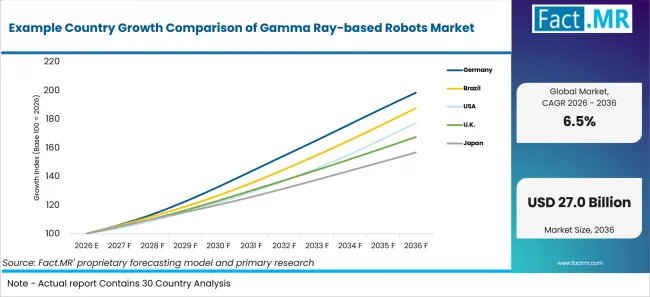
Example Country Growth Comparison Of Gamma Ray Based Robots Market | Source: Fact.MR
Country CAGR (2026-2036)
| Country | CAGR (2026-2036) |
|---|---|
| Germany | 7.1% |
| Brazil | 6.5% |
| USA | 5.9% |
| U.K. | 5.3% |
| Japan | 4.6% |
Source: Fact.MR analysis. Updated Sep 3, 2026
What is driving Germany’s growth through 2036?
Germany is forecast to expand at a 7.1% CAGR from 2026 to 2036.
Long-duration radioactive-waste management creates a clear use case for automation that reduces worker exposure. BGE’s AutoMat project, running through 2026, evaluates automated and teleoperated operation of underground equipment and processes for a high-level radioactive-waste repository.
Facilities designed around remote operation require robotic platforms, compatible sensing, control architecture and integration engineering before equipment can be accepted for controlled-area use. This converts repository and decommissioning planning into demand for specialized automation capability.
What is driving Brazil’s growth through 2036?
Brazil is forecast to expand at a 6.5% CAGR from 2026 to 2036.
Brazil’s growth is linked to oncology infrastructure. PERSUS II is designed to replace obsolete radiotherapy equipment, install systems in prepared treatment rooms and expand capacity in regions with limited access.
As radiotherapy capacity expands, hospitals require positioning, imaging support, equipment integration and repeatable treatment workflows. This creates a direct procurement route for radiation-linked automation around oncology services.
What is driving USA’s growth through 2036?
The USA is forecast to expand at a 5.9% CAGR from 2026 to 2036.
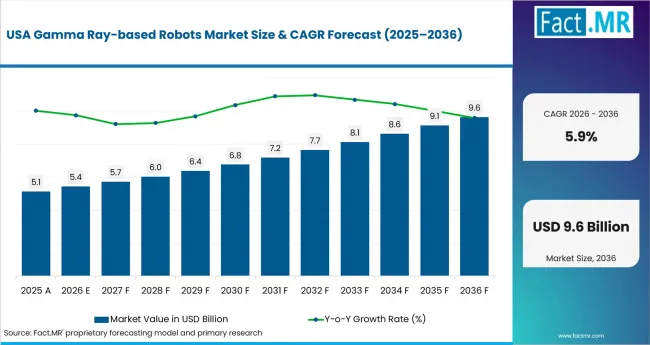
Gamma Ray Based Robots Market Country Value Analysis | Source: Fact.MR
The U.S. Department of Energy Office of Environmental Management is deploying robotics and AI to reduce worker entry into hazardous and radiological environments. Current activity includes remote inspection, robotic manipulation, intelligent sensing and characterization support.
Demand therefore extends beyond the robot platform to sensors, end-effectors, remote-control interfaces and data systems that document conditions before and during intervention. Suppliers that can integrate these elements into field-ready systems address a practical cleanup requirement.
What is driving the U.K.’s growth through 2036?
The U.K. is forecast to expand at a 5.3% CAGR from 2026 to 2036.
The Nuclear Decommissioning Authority is supporting robotic systems for waste sorting, remote handling and autonomous work. In 2026, Nuclear Restoration Services reported teleoperated robotic-arm trials at Oldbury, while Sellafield trialled a robot-mounted contamination swabbing tool in an area containing radioactive material.
These projects create demand for manipulation, contamination monitoring and remote supervision that can be adapted to different decommissioning tasks. Reusable platforms reduce the need to engineer a new robotic architecture for every work package.
What is driving Japan’s growth through 2036?
Japan is forecast to expand at a 4.6% CAGR from 2026 to 2036.
Remote operations remain important in severe nuclear environments where confined spaces, poor visibility and accumulated radiation can limit direct human access. METI’s 2026 program for robots equipped with physical AI specifically targets these operating conditions.
The resulting demand is for radiation-tolerant cameras, sensing, manipulation and control systems that can combine autonomous assistance with teleoperation. This supports continued engineering work around decommissioning and other high-radiation applications.
Who Leads the Gamma Ray-based Robots Market?
Key players in the Gamma Ray-based Robots Market include Varian, a Siemens Healthineers company, Elekta, Accuray Incorporated, Best Theratronics Ltd., Brainlab AG and KUKA AG.
Competition spans radiation-treatment systems, gamma-based therapy equipment, robotic radiosurgery, patient-positioning technology and radiation-zone robotics. Buyers compare treatment or task accuracy, radiation tolerance, integration capability, service support, validation requirements and the ability to recover or maintain equipment remotely.
Elekta has direct gamma-radiation exposure through Leksell Gamma Knife, while Best Theratronics supplies Cobalt-60 gamma therapy systems. Accuray competes through the CyberKnife robotic radiosurgery platform. Brainlab supports radiotherapy positioning and monitoring, Varian operates within Siemens Healthineers across radiotherapy workflows, and KUKA has deployed robotic systems for nuclear decommissioning and remote waste handling.
Which companies are the key providers?
Key Companies include Varian, a Siemens Healthineers company; Elekta; Accuray Incorporated; Best Theratronics Ltd.; Brainlab AG; KUKA AG
- Varian, a Siemens Healthineers company
- Elekta
- Accuray Incorporated
- Best Theratronics Ltd.
- Brainlab AG
- KUKA AG
Bibliography
- Bundesgesellschaft für Endlagerung. (2026). Forschung und Entwicklung: AutoMat - Bewertung der Automatisier- und Fernbedienbarkeit von Betriebsabläufen in einem Endlager für hochradioaktive Abfälle. BGE.
- Government of Brazil, Ministry of Health. (2025). Plano de Expansão da Radioterapia no Sistema Único de Saúde II (PERSUS II). Ministry of Health.
- International Atomic Energy Agency. (2023). Nuclear Decommissioning: New and Emerging Technologies and Robotics. IAEA Bulletin.
- International Atomic Energy Agency. (n.d.). Nuclear Medicine Database. IAEA.
- Japan Ministry of Economy, Trade and Industry. (2026). Development of Utilization Technology for Robots Equipped with Physical AI in Remote Operations under Severe Environments. METI.
- Nuclear Decommissioning Authority. (2026). NDA Business Plan 2026 to 2029. UK Government.
- Nuclear Decommissioning Authority and Nuclear Restoration Services. (2026). Innovative Robotics Trialled to Tackle Nuclear Waste Challenges. UK Government.
- Sellafield Ltd and Nuclear Decommissioning Authority. (2026). New Robot Swabbing Technology Trialled for the First Time at Sellafield. UK Government.
- U.S. Department of Energy, Office of Environmental Management. (2026). Technology Partnerships & Innovation: Robotics and Artificial Intelligence. U.S. Department of Energy.
- World Health Organization. (2021). Technical Specifications of Radiotherapy Equipment for Cancer Treatment. WHO.
- World Health Organization and International Atomic Energy Agency. (2023). Sustainable Management of Radiotherapy Facilities and Equipment. WHO.
- Siemens Healthineers. (2021). Siemens Healthineers Completes Acquisition of Varian. Siemens Healthineers.
- Elekta. (2026). Leksell Gamma Knife and Stereotactic Radiosurgery. Elekta.
- Accuray Incorporated. (2026). CyberKnife S7 Robotic Radiosurgery System. Accuray.
- Best Theratronics Ltd. (2026). GammaBeam 100-80 Cobalt-60 Teletherapy System. Best Theratronics.
- Brainlab AG. (2026). ExacTrac Dynamic: Patient Positioning and Monitoring for SRS and SBRT. Brainlab.
- KUKA AG. (n.d.). Nuclear Decommissioning: Robotic Systems for Remote Waste Handling. KUKA.
This Report Answers
- Which technologies are shaping gamma ray-based robotic systems?
- Which end uses create operational demand for radiation-linked robotics?
- How are medical imaging, radiotherapy and nuclear applications creating demand?
- How do direct sales and system integration affect supplier selection?
- How are Germany, Brazil, the USA, the U.K. and Japan developing through 2036?
- Which capabilities differentiate current suppliers across radiation treatment and radiation-zone robotics?
What does the Gamma Ray-based Robots Market cover?
The Gamma Ray-based Robots Market covers robotic systems and integrated automation used in workflows involving gamma-radiation imaging, treatment, sensing, inspection or work inside radiation-controlled environments. Revenue includes robot platforms, integrated manipulators and application-specific systems sold for these functions.
What is included in the scope?
The market includes AI-powered robotics, machine-vision systems, collaborative robots, twin-robotics platforms, remote-controlled robots, semi-autonomous robots and hybrid robotic systems when used in gamma-radiation or radiological workflows. End uses include healthcare, food and beverages, nuclear, astronomy, electronics, defense, industrial facilities and research institutions.
Applications include medical imaging and radiotherapy, industrial inspection and quality control, security and defense, nuclear decommissioning, space exploration and research uses. Commercial routes include direct industrial sales, system integrators, specialized robotics distributors and online industrial platforms.
What is excluded from the scope?
The market excludes general-purpose robots sold without a gamma-radiation or radiological application, standalone gamma detectors or imaging systems that contain no robotic or integrated automation component, and conventional industrial automation used only for non-radiological production tasks.
Radiotherapy equipment, nuclear instruments, drones and manipulators are counted only when they form part of an integrated robotic system within the defined applications. Standalone engineering, inspection or maintenance services are excluded when they do not contribute to the commercial robotic system.
How Was the Analysis Built?
The analysis draws on more than 120 public and technical sources, over 35 company portfolios and more than 20 industry interviews across at least 25 countries.
- Primary Research:
- Interviews with radiation-system manufacturers, robotics integrators, hospital technology teams, nuclear operators, decommissioning specialists, industrial inspection users and technical distributors examine application requirements, procurement routes, radiation tolerance, integration needs, qualification cycles and service requirements.
- Desk Research:
- The review covers nuclear-safety and decommissioning publications, radiotherapy and nuclear-medicine guidance, government procurement programs, company technical information and public evidence of robotics deployment in radiation-controlled environments.
- Market Sizing and Forecasting:
- Estimates combine end-use demand, installed radiation-system activity, robotic system content, application mix, country growth, system pricing and direct-versus-integrated procurement patterns.
- Data Validation and Update Cycle:
- Market estimates are cross-checked against public program activity, supplier portfolios, application evidence and primary interviews. Updates incorporate healthcare equipment investment, nuclear decommissioning schedules, robotics deployment, pricing changes and corporate ownership changes that affect active market participation.
Segmentation
What is the report's scope and coverage?
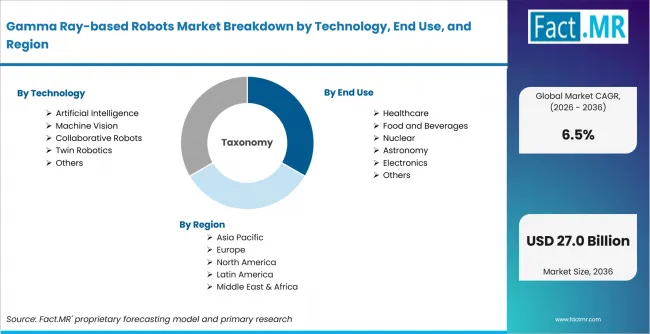
Gamma Ray Based Robots Market Breakdown By Technology, End Use, And Region | Source: Fact.MR
| Attribute | Details |
|---|---|
| Quantitative Units | USD billion |
| Market Definition | Robotic systems and integrated automation used in gamma-radiation imaging, treatment, sensing, inspection and radiation-controlled workflows |
| Segments Covered | Technology; End Use; Application; Distribution Channel |
| Regions Covered | North America; Latin America; Europe; East Asia; South Asia and Pacific; Middle East and Africa |
| Countries Covered | Germany; Brazil; USA; U.K.; Japan |
| Key Companies Profiled | Varian, a Siemens Healthineers company; Elekta; Accuray Incorporated; Best Theratronics Ltd.; Brainlab AG; KUKA AG |
| Forecast Period | 2026 to 2036 |
| Base Year | 2025 |
| Market Value, 2026 | USD 14.4 billion |
| Market Value, 2036 | USD 27.0 billion |
| CAGR, 2026-2036 | 6.5% |
| Absolute Opportunity | USD 12.6 billion |
| Approach | Hybrid demand-side and supply-side analysis using application demand, segment shares, country growth, system pricing, supplier portfolios and primary interviews |
Source: Fact.MR analysis. Updated Sep 3, 2026
How is the market segmented?
-
By Technology
- Artificial Intelligence
- AI Powered Robotics
- Intelligent Automation
- Cognitive Robotics
- Machine Vision
- Image Recognition Systems
- Inspection Vision Systems
- Visual Navigation Systems
- Collaborative Robots
- Human Robot Collaboration
- Safety Integrated Robots
- Flexible Automation Systems
- Twin Robotics
- Digital Twin Systems
- Remote Monitoring Robots
- Predictive Maintenance Systems
- Others
- Remote Controlled Robots
- Semi Autonomous Robots
- Hybrid Robotics
- Artificial Intelligence
-
By End Use
- Healthcare
- Diagnostic Centers
- Hospitals
- Research Institutions
- Food and Beverages
- Food Processing Facilities
- Beverage Manufacturing
- Cold Storage Facilities
- Nuclear
- Nuclear Power Plants
- Nuclear Waste Management
- Nuclear Research Facilities
- Astronomy
- Space Research Centers
- Observatories
- Satellite Research Facilities
- Electronics
- Semiconductor Manufacturing
- Electronic Assembly Plants
- Research Laboratories
- Others
- Defense Facilities
- Industrial Facilities
- Academic Institutions
- Healthcare
-
By Application
- Medical Imaging and Radiotherapy
- Diagnostic Imaging
- Radiotherapy Applications
- Nuclear Medicine
- Industrial Inspection and Quality Control
- Non Destructive Testing
- Manufacturing Quality Control
- Pipeline and Infrastructure Inspection
- Security and Defense
- Border Security Systems
- Military Applications
- Public Security Systems
- Nuclear Decommissioning
- Reactor Decommissioning
- Waste Handling Applications
- Site Inspection Systems
- Space Exploration
- Planetary Exploration
- Satellite Inspection
- Deep Space Missions
- Others
- Research Applications
- Educational Applications
- Custom Industrial Applications
- Medical Imaging and Radiotherapy
-
By Distribution Channel
- Direct Industrial Sales
- Government Procurement Contracts
- Enterprise Robotics Sales
- System Integrators
- Robotics Integration Firms
- Defense Technology Integrators
- Specialized Robotics Distributors
- Industrial Robotics Dealers
- Online Industrial Platforms
- B2B Robotics Marketplaces
- OEM Digital Channels
- Direct Industrial Sales
-
By Region
- North America
- Latin America
- Western Europe
- Eastern Europe
- East Asia
- South Asia and Pacific
- Middle East & Africa
Frequently Asked Questions
What is the Gamma Ray-based Robots Market value in 2026?
At what CAGR is the market projected to grow?
What is the projected market value by 2036?
Which Technology leads the market?
Which End Use leads the market?
Which Application leads the market?
Which Distribution Channel leads the market?
What CAGR is projected for Germany?
What is the primary driver in this market?
What is the main restraint?
Which companies are active in the market?
Who worked on this report


Preview the report firsthand - request a free sample
Free SampleGet the brochure for pricing and purchase details
Download PDF