- Base Value(2025): 21.3 Bn
- Estimated Value(2026): 23.5 Bn
- Forecast Value (2036): 61.4 Bn
- CAGR (2026 - 2036): 10.1%
Nuclear Medicine Market Analysis and Forecast by Fact.MR
- The global nuclear medicine market is estimated at US$ 21.3 billion in 2025 and has been forecast to expand at a CAGR of 10.1% to reach US$ 61.4 billion by 2036.
- Nuclear medicine encompasses diagnostic radiopharmaceuticals, therapeutic radiopharmaceuticals, and imaging equipment used to diagnose and treat disease through radioactive isotope-based agents.
- Diagnostic radiopharmaceuticals, primarily technetium-99m-based imaging agents, account for the largest product share. Oncology is the dominant application, with PET-CT imaging for tumor detection and staging representing the fastest-growing procedure category.
- Hospitals and diagnostic imaging centers form the primary end use, with direct institutional sales as the leading distribution channel.
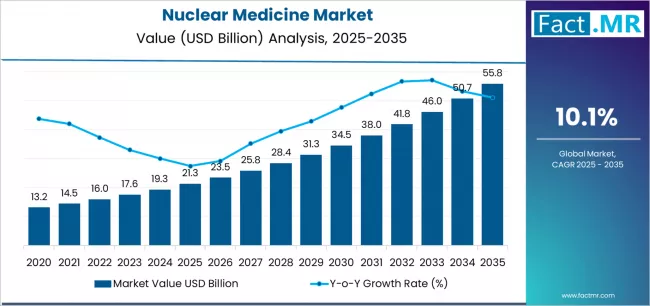
Nuclear Medicine Market Market Value Analysis | Source: Fact.MR
Summary of Nuclear Medicine Market
- Market Snapshot
- In 2025, the global Nuclear Medicine Market was valued at approximately USD 21.3 billion.
- The market is estimated to reach USD 23.5 billion in 2026 and is projected to attain USD 61.4 billion by 2036.
- The nuclear medicine market is likely to expand at a CAGR of 10.1% during the forecast period.
- The market is anticipated to create an absolute dollar opportunity of USD 37.9 billion between 2026 and 2036.
- Diagnostic Radiopharmaceuticals accounts for 47.3% of product share in 2026.
- China (12.4%) and India (11.7%) are the key growth markets during the forecast period.
- Demand and Growth Drivers
- Theranostic adoption, combining diagnostic imaging with targeted radionuclide therapy, is creating a premium treatment paradigm that generates demand for both diagnostic and therapeutic radiopharmaceuticals.
- Lutetium-177 PSMA therapy for metastatic prostate cancer, following FDA approval of Pluvicto (Novartis), is generating large-scale therapeutic radiopharmaceutical demand and radiopharmacy infrastructure investment.
- PET-CT procedure volume growth for oncology staging, restaging, and treatment response assessment is sustaining demand for F-18 FDG and emerging PET tracers.
- Cyclotron and radiopharmacy capacity expansion is improving geographic access to short-half-life radiopharmaceuticals in previously underserved markets.
- Gallium-68 and copper-64 PET tracer development for neuroendocrine tumors, prostate cancer, and infection imaging is broadening the clinical indication base beyond F-18 FDG.
- Product and Segment View
- Diagnostic Radiopharmaceuticals accounts for 47.3% of the product segment in 2026, supported by strong installed base and continued procurement across primary end use channels.
- Oncology accounts for 42.6% of the application segment in 2026, reflecting concentrated demand across established application areas.
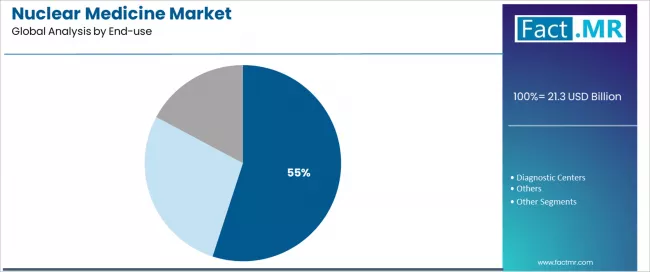
- Hospitals accounts for 48.9% of the end use segment in 2026, with adoption rising across both developed and emerging markets.
- Key segmentation includes:
- Product: Diagnostic Radiopharmaceuticals, Therapeutic Radiopharmaceuticals, Equipment
- Application: Oncology, Cardiology, Neurology
- End Use: Hospitals, Diagnostic Imaging Centers, Research Institutes
- Technology: Hybrid Imaging Technology, Positron Emission Tomography Technology, Single Photon Emission Computed Tomography Technology
- These systems enable:
- Targeted procurement and specification alignment across buyer segments
- Performance benchmarking across product and application categories
- Regional demand mapping across 30 plus countries
- Geography and Competitive Outlook
- North America accounts for a large share of global demand, supported by established procurement channels and a mature buyer base.
- Europe shows stable demand, with Germany (9.6%) contributing through regulatory compliance and institutional procurement for nuclear medicine products.
- Asia Pacific demand is led by China (12.4%) and India (11.7%).
- China (12.4%) and India (11.7%) are the fastest growing country markets during the forecast period.
- Leading companies include GE Healthcare, Jubilant Life Sciences, Nordion, Bracco Imaging, IRE.
- Analyst Opinion
- Shambhu Nath Jha, Principal Consultant at Fact.MR, says 'The nuclear medicine market is undergoing its most significant transformation in decades, driven by theranostic adoption, therapeutic radiopharmaceutical pipeline expansion, and emerging isotope technologies. GE Healthcare leads in imaging equipment, while Novartis has established the dominant theranostic franchise through Pluvicto. The market growth trajectory depends on three factors: therapeutic radiopharmaceutical pipeline success, radioisotope supply security, and institutional infrastructure investment. Companies that build integrated positions spanning imaging equipment, radiopharmaceutical production, and radiopharmacy distribution will capture the highest long-term value.'
Key Growth Drivers, Constraints, and Opportunities
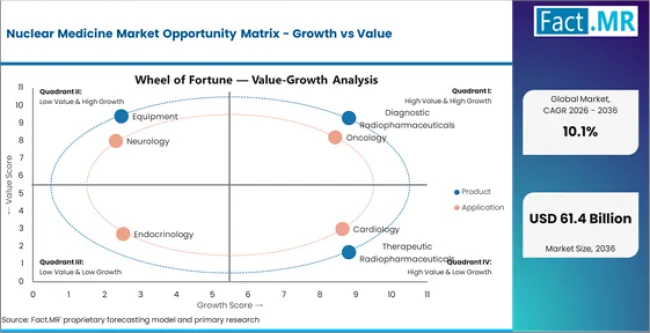
Nuclear Medicine Market Opportunity Matrix Growth Vs Value | Source: Fact.MR
Key Factors Driving Growth
- Theranostic adoption, combining diagnostic imaging with targeted radionuclide therapy, is creating a premium treatment paradigm that generates demand for both diagnostic and therapeutic radiopharmaceuticals.
- Lutetium-177 PSMA therapy for metastatic prostate cancer, following FDA approval of Pluvicto (Novartis), is generating large-scale therapeutic radiopharmaceutical demand and radiopharmacy infrastructure investment.
- PET-CT procedure volume growth for oncology staging, restaging, and treatment response assessment is sustaining demand for F-18 FDG and emerging PET tracers.
Key Market Constraints
- Radioisotope supply chain vulnerability, particularly for molybdenum-99/technetium-99m dependent on aging research reactor production, creates procurement uncertainty.
- High capital cost of PET-CT scanners and cyclotron installations limits equipment access to large hospitals and dedicated imaging centers.
- Radiation safety regulatory requirements and waste management obligations add operational complexity and cost to nuclear medicine department operations.
Key Opportunity Areas
- Actinium-225 alpha therapy development for multiple cancer types is creating a next-generation therapeutic radiopharmaceutical category with high tumor-killing efficacy.
- AI-assisted nuclear medicine image analysis for PET and SPECT studies is improving diagnostic accuracy and enabling quantitative treatment response assessment.
- Emerging market nuclear medicine infrastructure development in India, Brazil, and Southeast Asia is creating first-time equipment and radiopharmaceutical procurement demand.
Segment-wise Analysis of the Nuclear Medicine Market
- Diagnostic Radiopharmaceuticals holds 47.3% of the product segment in 2026, supported by established demand channels and continued procurement across primary end use applications.
- Oncology holds 42.6% of the application segment in 2026, supported by established demand channels and continued procurement across primary end use applications.
- Hospitals holds 48.9% of the end use segment in 2026, supported by established demand channels and continued procurement across primary end use applications.
The nuclear medicine market is segmented by product, application, end use, technology, and region.
By product, the market covers Diagnostic Radiopharmaceuticals, Therapeutic Radiopharmaceuticals, Equipment.
By application, coverage includes Oncology, Cardiology, Neurology.
Which Product Segment Dominates the Nuclear Medicine Market?
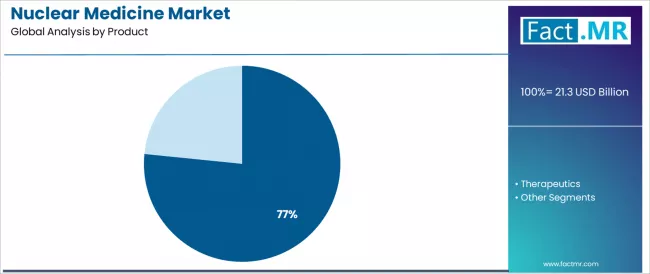
Nuclear Medicine Market Analysis By Product | Source: Fact.MR
Diagnostic Radiopharmaceuticals is expected to account for 47.3% of the product segment in 2026. Within this category, Technetium Based Radiopharmaceuticals, Technetium Cardiology Imaging Agents, Technetium Oncology Imaging Agents represent the primary sub-segments generating procurement activity. The depth of the diagnostic radiopharmaceuticals installed base across product applications sustains replacement demand and limits share erosion from newer alternatives in the nuclear medicine market.
Therapeutic Radiopharmaceuticals is the second largest category in the product segment, with demand concentrated in Beta Emitters and Iodine Therapy Agents. Growth in therapeutic radiopharmaceuticals reflects shifting buyer requirements within the nuclear medicine market toward this category.
Which Application Segment Dominates the Nuclear Medicine Market?
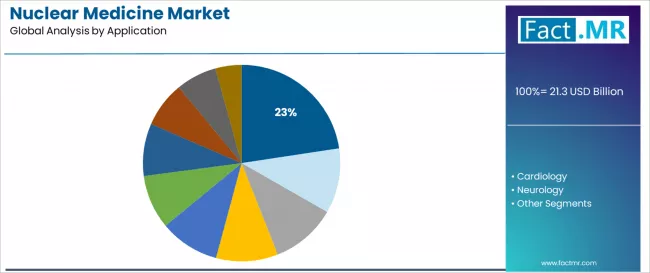
Nuclear Medicine Market Analysis By Application | Source: Fact.MR
Oncology is expected to account for 42.6% of the application segment in 2026. Within this category, Tumor Detection, Solid Tumor Imaging, Metastasis Detection represent the primary sub-segments generating procurement activity. The depth of the oncology installed base across application applications sustains replacement demand and limits share erosion from newer alternatives in the nuclear medicine market.
Cardiology is the second largest category in the application segment, with demand concentrated in Myocardial Perfusion Imaging and Stress Testing Imaging. Growth in cardiology reflects shifting buyer requirements within the nuclear medicine market toward this category.
Which End Use Segment Dominates the Nuclear Medicine Market?
Nuclear Medicine Market Analysis By End Use | Source: Fact.MR
Hospitals is expected to account for 48.9% of the end use segment in 2026. Within this category, Public Hospitals, Private Hospitals represent the primary sub-segments generating procurement activity. The depth of the hospitals installed base across end use applications sustains replacement demand and limits share erosion from newer alternatives in the nuclear medicine market.
Diagnostic Imaging Centers is the second largest category in the end use segment, with demand concentrated in Independent Imaging Centers and Hospital Affiliated Imaging Centers. Growth in diagnostic imaging centers reflects shifting buyer requirements within the nuclear medicine market toward this category.
Which Product Trend is Shaping the Next Phase of Growth in the Nuclear Medicine Market?
Theranostics, the integration of diagnostic imaging and targeted radionuclide therapy, is the structural trend reshaping the nuclear medicine market. The theranostic approach uses a diagnostic companion isotope (typically gallium-68) to identify patients whose tumors express specific targets, then treats those patients with a therapeutic isotope (lutetium-177 or actinium-225) linked to the same targeting molecule. Novartis Pluvicto (Lu-177 PSMA-617) for prostate cancer is the first major commercial theranostic product, and the pipeline is expanding rapidly.
The commercial impact of theranostics extends across the nuclear medicine value chain: diagnostic PET tracers identify eligible patients, therapeutic radiopharmaceuticals deliver treatment, follow-up imaging monitors response, and radiopharmacy infrastructure supports preparation and dispensing. For companies positioned across this chain, theranostics creates a recurring revenue cycle per patient that is substantially higher than standalone diagnostic or therapeutic use. Novartis, GE Healthcare, and Bayer are investing heavily in theranostic pipeline and infrastructure development.
Regional Outlook Across Key Markets
.webp "Top Country Growth Comparison Nuclear Medicine Market Cagr (2026 2036)")
Top Country Growth Comparison Nuclear Medicine Market Cagr (2026 2036) | Source: Fact.MR
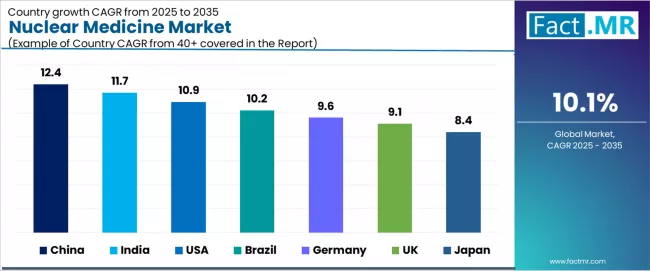
- China is growing at 12.4%, supported by PET-CT installation expansion, government cyclotron investment, and theranostic development.
- India is growing at 11.7%, supported by BARC isotope production, PET-CT infrastructure growth, and Lu-177 therapy adoption.
- USA is growing at 10.9%, supported by PET-CT utilization leadership, Pluvicto theranostic demand, and radiopharmacy expansion.
- Brazil is growing at 10.2%, supported by CNEN isotope production, PET-CT growth, and theranostic program development.
CAGR Table
| Country | CAGR (%) |
|---|---|
| China | 12.4% |
| India | 11.7% |
| USA | 10.9% |
| Brazil | 10.2% |
| Germany | 9.6% |
| UK | 9.1% |
| Japan | 8.4% |
Source: Fact.MR analysis. Updated May 27, 2026
Source: Fact MR (FMR) analysis, based on proprietary forecasting model and primary research.
Nuclear Medicine Market Cagr Analysis By Country | Source: Fact.MR
Market Outlook for Nuclear Medicine in China
The China Nuclear Medicine market is projected to grow at a CAGR of 12.4% through 2036. China is the fastest-growing nuclear medicine market, driven by PET-CT installation expansion and government cyclotron investment.
- PET-CT scanner installation is growing rapidly in Chinese tier-1 and tier-2 city hospitals, expanding diagnostic nuclear medicine capacity.
- Government cyclotron facility investment is improving domestic F-18 FDG production capability and reducing import dependence.
- Theranostic program development at leading cancer hospitals is creating early demand for Lu-177 and other therapeutic radiopharmaceuticals.
Nuclear Medicine Demand Trends in India
The India Nuclear Medicine market is projected to grow at a CAGR of 11.7% through 2036. India is a high-growth nuclear medicine market supported by BARC radioisotope production and expanding PET-CT infrastructure.
- BARC (Bhabha Atomic Research Centre) produces medical isotopes including technetium-99m generators and iodine-131 for domestic distribution.
- PET-CT installation growth in private hospital chains and dedicated imaging centers is expanding diagnostic nuclear medicine access.
- Theranostic Lu-177 PSMA therapy adoption at Tata Memorial Hospital and other cancer centers is creating therapeutic radiopharmaceutical demand.
USA Nuclear Medicine Market Growth Outlook
Nuclear Medicine Market Country Value Analysis | Source: Fact.MR
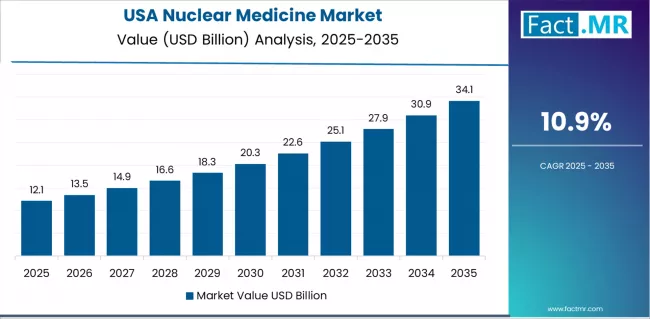
The USA Nuclear Medicine market is projected to grow at a CAGR of 10.9% through 2036. The U.S. is the largest nuclear medicine market globally, driven by PET-CT utilization, theranostic adoption, and radiopharmacy infrastructure.
- CMS reimbursement for PET-CT imaging across oncology, cardiology, and neurology indications sustains high diagnostic procedure volumes.
- Novartis Pluvicto launch has created significant therapeutic radiopharmaceutical demand and radiopharmacy preparation infrastructure investment.
- Cyclotron and radiopharmacy network expansion by Jubilant, PharmaLogic, and SOFIE Biosciences is improving geographic access.
Brazil Nuclear Medicine Market Demand Analysis
The Brazil Nuclear Medicine market is projected to grow at a CAGR of 10.2% through 2036. Nuclear medicine infrastructure expansion and CNEN isotope production support market growth in Brazil.
- CNEN (Comissao Nacional de Energia Nuclear) operates medical isotope production facilities supporting domestic radiopharmaceutical supply.
- PET-CT installation growth in private hospital networks and diagnostic imaging centers is expanding nuclear medicine access.
- Theranostic program development at Hospital Sirio-Libanes and other cancer centers is creating early demand for targeted radionuclide therapy.
Nuclear Medicine Market Growth Assessment in Germany
The Germany Nuclear Medicine market is projected to grow at a CAGR of 9.6% through 2036. Clinical research strength and established imaging infrastructure sustain nuclear medicine demand in Germany.
- University hospital nuclear medicine departments maintain advanced theranostic programs including Lu-177 PSMA and Ac-225 alpha therapy research.
- German Society of Nuclear Medicine (DGN) guidelines define evidence-based imaging and therapy protocols.
- Radiopharmacy production capability at research centers and commercial facilities supports domestic radiopharmaceutical supply.
Nuclear Medicine Market Opportunity Outlook in UK
The UK Nuclear Medicine market is projected to grow at a CAGR of 9.1% through 2036. NHS nuclear medicine modernization and theranostic program development support market growth in the United Kingdom.
- NHS England nuclear medicine modernization investment is upgrading PET-CT scanner capacity across NHS hospital trusts.
- Theranostic Lu-177 PSMA therapy adoption through NHS specialist commissioning is creating therapeutic radiopharmaceutical demand.
- BNMS (British Nuclear Medicine Society) guidelines inform clinical practice for diagnostic and therapeutic nuclear medicine procedures.
Demand Landscape for Nuclear Medicine in Japan
Nuclear Medicine Market Japan Market Share Analysis By Product | Source: Fact.MR
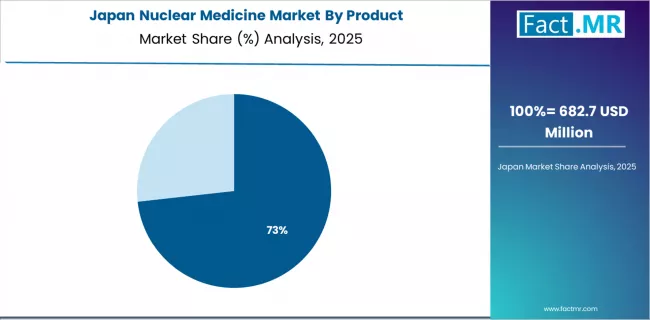
The Japan Nuclear Medicine market is projected to grow at a CAGR of 8.4% through 2036. Established nuclear medicine infrastructure and aging demographics sustain market demand in Japan.
- Aging population demographics create high cardiac perfusion imaging volumes using technetium-99m-based radiopharmaceuticals.
- JSNM (Japanese Society of Nuclear Medicine) guidelines define evidence-based imaging protocols for oncology and cardiology applications.
- Cyclotron and radiopharmacy networks operated by Nihon Medi-Physics and FUJIFILM RI Pharma support domestic PET tracer supply.
Competitive Benchmarking and Company Positioning
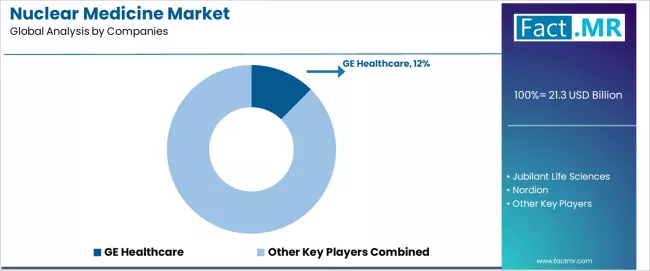
Nuclear Medicine Market Analysis By Company | Source: Fact.MR
Nuclear Medicine Market Analysis By Company
- GE Healthcare, Jubilant Life Sciences, Nordion, Bracco Imaging hold established positions in the global nuclear medicine market through broad product portfolios, geographic reach, and growing capabilities in higher specification categories.
- IRE, ANSTO, NTP Radioisotopes, Eczacıbaşı-Monrol participate across specific price tiers, end use segments, and regional channels, with competition shaped by product quality, service support, and distribution access.
- Radiopharmaceutical production and distribution network, imaging equipment installed base, theranostic pipeline depth, and cyclotron/radiopharmacy infrastructure reach are the primary competitive differentiators.
GE Healthcare leads the nuclear medicine market through its imaging equipment portfolio and radiopharmaceutical production. Jubilant Life Sciences holds a major position in nuclear medicine radiopharmacy distribution. Nordion (Sotera Health) is a leading radioisotope supplier. Bracco Imaging serves diagnostic radiopharmaceutical and contrast media segments. IRE (Institute for Radioelements) provides medical isotope supply from European production facilities.
Competition spans imaging equipment companies (GE, Siemens, Philips), radiopharmaceutical producers (Jubilant, Curium, Lantheus), pharmaceutical companies with theranostic pipelines (Novartis, Bayer), and radioisotope suppliers (Nordion, IRE, ANSTO). The theranostic frontier is creating a new competitive layer where pharmaceutical pipeline capability intersects with radiopharmacy logistics. Companies that control both the diagnostic and therapeutic components of theranostic pairs hold structural advantages.
Key Companies in the Nuclear Medicine Market
GE Healthcare, Jubilant Life Sciences, Nordion, Bracco Imaging are among the leading players in the nuclear medicine market globally, supported by strong brand visibility and broad product portfolios.
IRE, ANSTO, NTP Radioisotopes, Eczacıbaşı-Monrol hold established positions across specific categories, supported by durable products and regional distribution.
Recent Industry Developments
- GE Healthcare - Alpha Therapy Program (January 2026)
- GE Healthcare advanced its actinium-225 targeted alpha therapy program into Phase 2 clinical trials for neuroendocrine tumors, building on the theranostic approach validated by Lu-177 PSMA therapy.
- Jubilant Life Sciences - Digital PET Platform (2025)
- Jubilant Life Sciences launched a next-generation digital PET-CT scanner with improved sensitivity and resolution, reducing patient radiation dose while enhancing diagnostic image quality for oncology staging.
- Nordion - Radiopharmacy Expansion (2025)
- Nordion opened 3 new radiopharmacy production and distribution centers, expanding geographic coverage for time-sensitive radiopharmaceutical delivery to hospital nuclear medicine departments.
- Bracco Imaging - Ga-68 Tracer Approval (February 2026)
- Bracco Imaging received regulatory approval for a gallium-68 PSMA PET tracer for prostate cancer imaging, completing the diagnostic companion to its therapeutic Lu-177 PSMA product in the theranostic pathway.
Leading Companies Shaping the Nuclear Medicine Market
- GE Healthcare
- Jubilant Life Sciences
- Nordion
- Bracco Imaging
- IRE
- ANSTO
- NTP Radioisotopes
- Eczacıbaşı-Monrol
- Lantheus Medical Imaging
- Eckert & Ziegler
Sources and Research References
- GE Healthcare. Product portfolio and corporate announcements.
- Jubilant Life Sciences. Product portfolio and corporate announcements.
- Nordion. Product portfolio and corporate announcements.
- Industry association statistics, regulatory publications, trade databases, and company product catalogs.
- Primary interviews with manufacturers, distributors, buyers, and institutional users.
This bibliography is provided for reader reference and is not exhaustive. The full report contains the complete reference list and detailed citations.
Key Questions This Report Addresses
- What is the current and future size of the Nuclear Medicine Market?
- How fast is the Nuclear Medicine Market expected to grow between 2026 and 2036?
- Which product is likely to lead the market by 2026?
- Which application segment is expected to account for the highest demand by 2026?
- What factors are driving demand in this market globally?
- How is technology adoption influencing the market structure?
- Which countries are projected to show the fastest growth through 2036?
- What is driving market expansion in China and India?
- Who are the key companies active in the Nuclear Medicine Market?
- How does Fact.MR estimate and validate the market forecast?
Nuclear Medicine Market Definition
The nuclear medicine market covers products, technologies, and services associated with product, application, end use categories. The scope includes global and regional market size and forecasts for 2026 to 2036 across product, application, end use, technology, and region.
Nuclear Medicine Market Inclusions
- The scope covers global and regional market size and forecasts for 2026 to 2036 across product, application, end use, technology, and region.
- It includes regional demand analysis across major geographies, based on factors such as technology adoption, regulatory requirements, institutional spending, and commercial demand patterns.
- The report includes pricing and cost analysis across entry-level, mid-range, and premium categories, including hardware, software, and service components where applicable.
- It covers technology trends, market drivers and constraints, and the competitive landscape, including product portfolios, pricing strategy, geographic reach, and distribution expansion of leading players.
Nuclear Medicine Market Exclusions
- The scope excludes adjacent categories, general-purpose alternatives, and products not specifically classified under the nuclear medicine market taxonomy.
- It excludes custom-built in-house solutions, informal unbranded products with low market visibility, and rental or leasing services without direct product sales.
- The report excludes military or defense-grade variants, industrial systems outside the defined scope, and non-commercial applications without market transaction data.
- It also excludes software-only platforms sold independently from hardware, unless they are part of the defined product or service taxonomy.
Nuclear Medicine Market Research Methodology
- The methodology combines secondary research, primary interviews, and forecast modelling.
- It draws on 120 plus secondary sources and benchmarks 65 plus company product portfolios.
- Market sizing covers 30 plus countries through a demand-side model, supported by top-down validation.
- Key inputs include end use adoption rates, technology penetration, pricing benchmarks, and regional procurement patterns.
- The model cross-checks demand with shipments, pricing trends, channel mix, and product launches.
- Primary validation includes 25 plus interviews across manufacturers, distributors, buyers, and institutional users.
- Final estimates go through trade-flow checks, sales-pattern review, and sensitivity testing.
Segmentation
Scope of Analysis
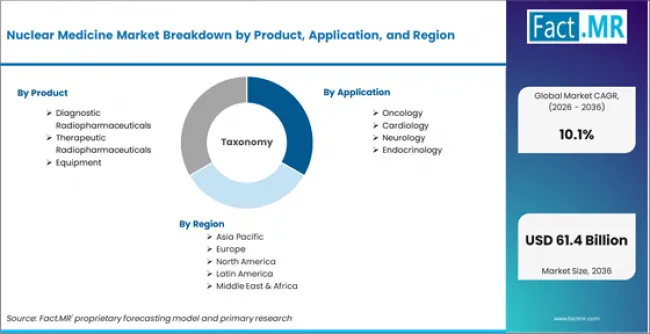
Nuclear Medicine Market Breakdown By Product, Application, And Region | Source: Fact.MR
| Parameter | Details |
|---|---|
| Quantitative Units | USD 23.5 billion to USD 61.4 billion, at a CAGR of 10.1% |
| Market Definition | The Nuclear Medicine Market covers products, technologies, and services across product, application, end use categories for commercial, institutional, and consumer applications. |
| Regions Covered | North America, Latin America, Europe, East Asia, South Asia and Pacific, Middle East and Africa |
| Countries Covered | USA, Canada, UK, Germany, China, India, 30 plus countries |
| Key Companies | GE Healthcare, Jubilant Life Sciences, Nordion, Bracco Imaging, IRE, ANSTO, NTP Radioisotopes, Eczacıbaşı-Monrol, Lantheus Medical Imaging, Eckert & Ziegler |
| Forecast Period | 2026 to 2036 |
| Approach | Hybrid demand-side and top-down methodology built on country-level application demand, product benchmarking, pricing analysis, shipment validation, and primary interviews across manufacturers, distributors, and end users |
Source: Fact.MR analysis. Updated May 27, 2026
Nuclear Medicine Market Segmentation
-
Nuclear Medicine Market Segmented by Product:
- Diagnostic Radiopharmaceuticals
- Technetium Based Radiopharmaceuticals
- Technetium Cardiology Imaging Agents
- Technetium Oncology Imaging Agents
- Technetium Bone Imaging Agents
- Positron Emission Tomography Radiopharmaceuticals
- Fluorine Based Radiopharmaceuticals
- Gallium Based Radiopharmaceuticals
- Carbon Based Radiopharmaceuticals
- Iodine Based Radiopharmaceuticals
- Iodine Thyroid Imaging Agents
- Iodine Neuro Imaging Agents
- Xenon Based Radiopharmaceuticals
- Xenon Lung Imaging Agents
- Technetium Based Radiopharmaceuticals
- Therapeutic Radiopharmaceuticals
- Beta Emitters
- Iodine Therapy Agents
- Lutetium Therapy Agents
- Yttrium Therapy Agents
- Alpha Emitters
- Radium Therapy Agents
- Actinium Therapy Agents
- Brachytherapy Radioisotopes
- Iridium Therapy Sources
- Cesium Therapy Sources
- Beta Emitters
- Equipment
- Positron Emission Tomography Systems
- Standalone Positron Emission Tomography Systems
- Hybrid Positron Emission Tomography Systems
- Single Photon Emission Computed Tomography Systems
- Standalone Single Photon Emission Computed Tomography Systems
- Hybrid Single Photon Emission Computed Tomography Systems
- Planar Scintigraphy Systems
- Fixed Scintigraphy Systems
- Portable Scintigraphy Systems
- Dose Preparation and Dispensing Systems
- Automated Dispensing Systems
- Manual Dispensing Systems
- Positron Emission Tomography Systems
- Diagnostic Radiopharmaceuticals
-
Nuclear Medicine Market Segmented by Application:
- Oncology
- Tumor Detection
- Solid Tumor Imaging
- Metastasis Detection
- Therapy Planning
- Targeted Radionuclide Therapy
- Response Monitoring
- Tumor Detection
- Cardiology
- Myocardial Perfusion Imaging
- Stress Testing Imaging
- Resting Imaging
- Cardiac Function Assessment
- Ejection Fraction Measurement
- Wall Motion Analysis
- Myocardial Perfusion Imaging
- Neurology
- Brain Imaging
- Neurodegenerative Disease Diagnosis
- Epilepsy Localization
- Functional Brain Studies
- Cognitive Function Assessment
- Neuroreceptor Imaging
- Brain Imaging
- Endocrinology
- Thyroid Imaging
- Hyperthyroidism Assessment
- Thyroid Cancer Detection
- Other Gland Imaging
- Parathyroid Imaging
- Adrenal Imaging
- Thyroid Imaging
- Oncology
-
Nuclear Medicine Market Segmented by End Use:
- Hospitals
- Public Hospitals
- Private Hospitals
- Diagnostic Imaging Centers
- Independent Imaging Centers
- Hospital Affiliated Imaging Centers
- Research Institutes
- Academic Research Institutes
- Clinical Research Organizations
- Hospitals
-
Nuclear Medicine Market Segmented by Technology:
- Hybrid Imaging Technology
- Positron Emission Tomography Computed Tomography
- Single Photon Emission Computed Tomography Computed Tomography
- Positron Emission Tomography Technology
- Analog Positron Emission Tomography
- Digital Positron Emission Tomography
- Single Photon Emission Computed Tomography Technology
- Conventional Single Photon Emission Computed Tomography
- Advanced Single Photon Emission Computed Tomography
- Radiochemistry Technology
- Cyclotron Based Production
- Generator Based Production
- Hybrid Imaging Technology
-
Nuclear Medicine Market Segmented by Distribution Channel:
- Direct Sales
- Hospital Direct Procurement
- Institutional Supply Contracts
- Indirect Sales
- Radiopharmacy Networks
- Third Party Distributors
- Direct Sales
-
Nuclear Medicine Market by Region:
- North America
- USA
- Canada
- Mexico
- Latin America
- Brazil
- Chile
- Rest of Latin America
- Western Europe
- Germany
- UK
- Italy
- Spain
- France
- Nordic
- BENELUX
- Rest of Western Europe
- Eastern Europe
- Russia
- Poland
- Hungary
- Balkan & Baltic
- Rest of Eastern Europe
- East Asia
- China
- Japan
- South Korea
- South Asia and Pacific
- India
- ASEAN
- Australia & New Zealand
- Rest of South Asia and Pacific
- Middle East & Africa
- Kingdom of Saudi Arabia
- Other GCC Countries
- Turkiye
- South Africa
- Other African Union
- Rest of Middle East & Africa
- North America
Frequently Asked Questions
How big is the nuclear medicine market in 2026?
What will be the size of nuclear medicine market in 2036?
How much will be the nuclear medicine market growth between 2026 and 2036?
What are the key product types in the nuclear medicine market?
Which application segment is expected to contribute significant share in the nuclear medicine market in 2026?
Who worked on this report


Preview the report firsthand - request a free sample
Free SampleGet the brochure for pricing and purchase details
Download PDF