- Market Value (2025): USD 4.4 Bn
- Estimated Value (2026): USD 4.7 Bn
- Forecast Value (2036): USD 7.4 Bn
- CAGR (2026-2036): 4.7%
What is the Gasoline Performance Additives Market forecast to be worth by 2036?
USD 4.7 billion in 2026 to USD 7.4 billion by 2036 at a 4.7% CAGR.
- The Gasoline Performance Additives Market reached USD 4.4 billion in 2025.
- Demand is projected to increase from USD 4.7 billion in 2026 to USD 7.4 billion by 2036.
- The market is forecast to record 4.7% CAGR from 2026 to 2036.
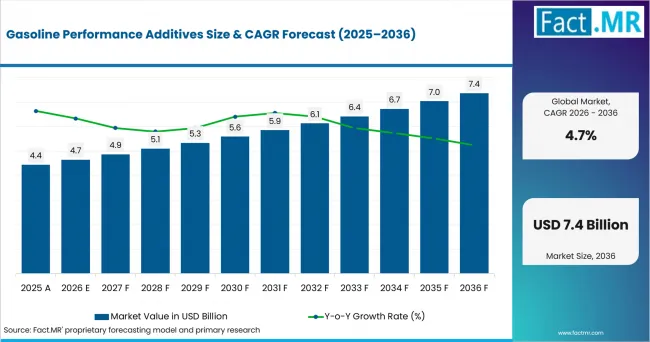
Gasoline Performance Additives Value Analysis | Source: Fact.MR
What are the defining numbers behind Gasoline Performance Additives Market growth?
An absolute opportunity of USD 2.7 billion is expected between 2026 and 2036.
- Demand Drivers in the Market
- Refineries need detergent packages that pass registered fuel-additive requirements and remain stable during blending. The U.S. Energy Information Administration reported on April 10, 2026 that U.S. motor gasoline consumption averaged 8.9 million barrels per day in 2025.
- Fuel marketers need visible deposit-control claims for branded gasoline programs. Better intake-valve and injector cleanliness helps premium offers carry a technical claim that service-station customers can understand at the pump.
- Terminal operators need additive packages that mix consistently at low treat rates. Stable handling is expected to carry weight where gasoline moves from refinery supply into regional storage and retail delivery.
- Aftermarket brands need chemistry that supports both port fuel injection and gasoline direct injection engines. Direct injection creates higher sensitivity to injector deposits, so cleaning claims require clearer test support.
- Ethanol-blended gasoline needs corrosion-control and oxidation-stability support. Higher alcohol content changes the handling environment, making additive compatibility a more visible formulation requirement.
- Key Segments Analyzed
- By Additive Function: Deposit-control detergents are expected to hold 34.0% share in 2026 because injector and intake-valve cleanliness remains the main purchase reason for treated gasoline.
- By Fuel Grade: Regular gasoline is projected to account for 39.0% share in 2026 since regular grades carry the largest treatment base across high-volume retail fuel networks.
- By Customer: Refineries are anticipated to capture 37.0% share in 2026 owing to their role in blending fuel at scale before terminal distribution.
- By Chemistry: Polyetheramine / amine detergents are estimated to represent 29.0% share in 2026 due to their established use in deposit-control formulations for gasoline engines.
- Analyst Opinion at Fact.MR
- Shambhu Nath Jha, Principal Consultant at Fact.MR, states: “Gasoline additives are drawing attention through fuel cleanliness proof and retail brand claims. Demand is expected to favor suppliers that connect chemistry performance with engine test evidence and stable blending behavior. The better commercial position belongs to companies that combine detergent depth with regulatory familiarity and regional supply support.”
- Strategic Implications
- Refiners should align additive package selection with certified detergent rules and ethanol-blend handling, so gasoline quality remains consistent before fuel leaves the refinery gate.
- Fuel marketers should tune premium gasoline programs around efficient engine platforms.
- Terminal operators should prioritize additive packages with clear dosing guidance, storage stability and compatibility across regular and premium gasoline grades.
- Aftermarket brands should connect bottle claims to engine-cleanliness testing, since drivers compare injector-cleaner products against branded treated gasoline at retail.
Germany is anticipated to record 5.6% CAGR through a large gasoline car base and retail fuel branding. The United Kingdom is forecast to post 5.2% CAGR, supported by recovering road traffic and E10 petrol. Brazil is projected to reach 4.8% CAGR as gasoline C blending lifts attention to ethanol-compatible additives. The USA is estimated to hold 3.9% CAGR through certified detergent rules and large finished gasoline use. France is expected to record 3.6% CAGR, shaped by gasoline share gains within road fuels.
How does the Gasoline Performance Additives Market break down by segment?
Regular gasoline is projected to lead Fuel Grade at 39.0% share in 2026; while Refineries lead Customer at 37.0% share.
Which Additive Function dominates?
Deposit-control detergents are expected to hold 34.0% share in 2026.
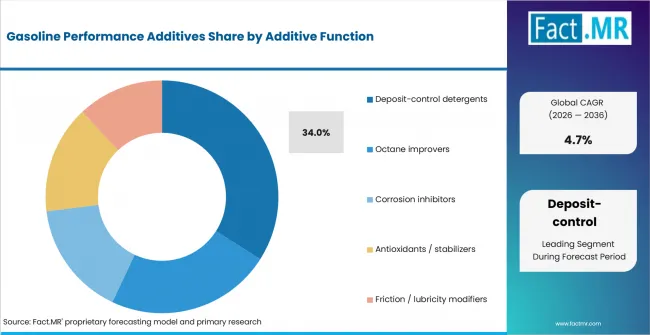
Gasoline Performance Additives Analysis By Additive Function | Source: Fact.MR
Deposit-control detergents lead because they address the engine cleanliness problem buyers associate most directly with treated gasoline. Injector and intake-valve deposits can affect fuel spray quality and combustion behavior. Detergent packages therefore remain closest to the performance promise made by branded gasoline and aftermarket cleaners.
BASF announced its next-generation Keropur® Gasoline Performance Additive Series on September 17, 2025. BASF stated that the series was certified for the U.S. TOP TIER+™ standard, engineered to meet and exceed EPA Lowest Additive Concentration requirements, and expected to receive CARB approval.
What leads the Fuel Grade segment?
Regular gasoline is projected to account for 39.0% share in 2026.
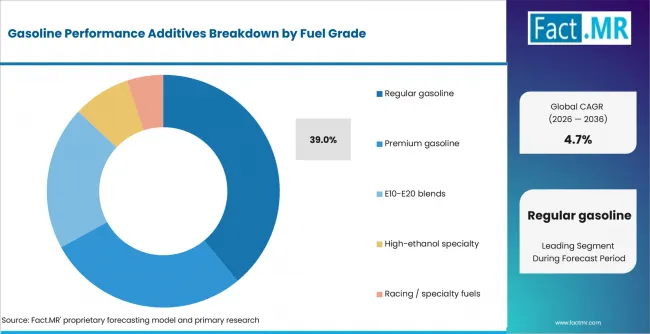
Gasoline Performance Additives Analysis By Fuel Grade | Source: Fact.MR
Regular gasoline leads because it carries the broadest retail treatment base. Even where premium gasoline receives stronger marketing, regular gasoline gives additive suppliers the largest pool of gallons to treat. Cost control and low-dose consistency therefore become decisive formulation needs.
Fuel marketers use additive packages in regular gasoline to maintain baseline engine cleanliness and to meet detergent expectations across high-volume forecourts. Premium gasoline creates margin upside, while regular gasoline anchors recurring package volume.
How does Customer shape demand?
Refineries are anticipated to capture 37.0% share in 2026.
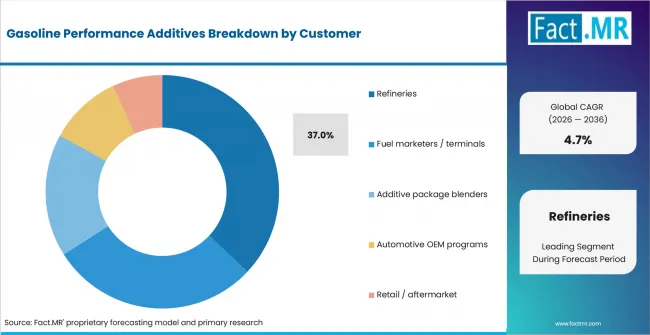
Gasoline Performance Additives Analysis By Customer | Source: Fact.MR
Refineries lead because additive treatment can be integrated before gasoline enters larger distribution channels. Centralized blending supports consistent quality control and lowers the need for repeated downstream handling. Refineries can align detergent packages with sulfur, oxygenate and volatility requirements before fuel moves into terminals.
Fuel marketers and terminals remain influential because branded programs often require local differentiation. The refinery channel, however, is expected to retain the largest share where gasoline is treated at scale and moved through established logistics networks.
What supports Polyetheramine / amine detergents within Chemistry?
Polyetheramine / amine detergents are estimated to represent 29.0% share in 2026.
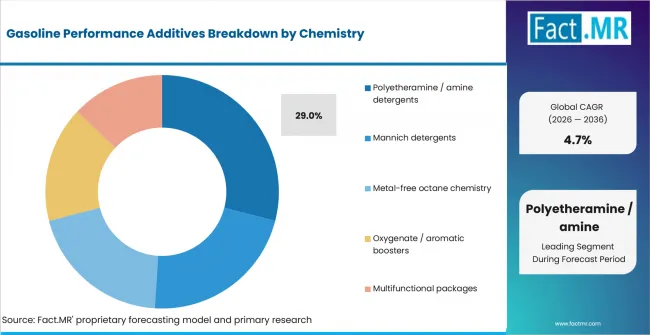
Gasoline Performance Additives Analysis By Chemistry | Source: Fact.MR
Polyetheramine and amine detergents lead because they are established deposit-control chemistries for gasoline engines. Formulators value them for cleaning performance across injectors and intake systems. Their position is reinforced by gasoline direct injection engines, where deposit control receives closer technical review.
Mannich detergents, metal-free octane chemistry and oxygenate boosters remain part of the wider formulation set. Polyetheramine / amine detergents retain the clearest link to the main customer promise of cleaner gasoline performance.
What is accelerating Gasoline Performance Additives Market adoption, and what is holding it back?
Demand is expected to rise through certified detergent rules, gasoline direct injection engines and ethanol-blend compatibility. Growth is moderated by fuel-efficiency gains, additive-cost sensitivity and qualification testing needs.
Drivers Impact Analysis
| DRIVER | (~) % IMPACT ON CAGR | GEOGRAPHIC RELEVANCE | IMPACT TIMELINE |
|---|---|---|---|
| Certified detergent requirements and branded fuel standards | +1.1% | North America, Europe | Short term (<= 2 years) |
| Gasoline direct injection deposit-control needs | +0.9% | Global | Medium term (2-4 years) |
| Ethanol-blend stability and corrosion-control needs | +0.8% | Brazil, USA, Europe | Medium term (2-4 years) |
| Premium and aftermarket fuel-cleaning claims | +0.6% | North America, Western Europe | Long term (>= 4 years) |
- Certified detergent requirements and branded fuel standards: Fuel marketers and refiners place higher value on additive packages that support clean-engine claims and meet documented gasoline detergent expectations.
- Gasoline direct injection deposit-control needs: GDI engines make injector cleanliness more visible to drivers and automakers. That visibility is expected to support higher detergent performance claims.
- Ethanol-blend stability and corrosion-control needs: E10, E20 and higher blends create a stronger need for packages that handle water sensitivity, oxidation and storage behavior.
Opportunity Impact Analysis
| OPPORTUNITY | (~) % IMPACT ON CAGR | GEOGRAPHIC RELEVANCE | IMPACT TIMELINE |
|---|---|---|---|
| TOP TIER+ aligned detergent packages | +0.7% | USA, Canada, Japan | Short term (<= 2 years) |
| Terminal-ready multifunctional packages | +0.5% | Global | Medium term (2-4 years) |
| Ethanol-compatible branded gasoline programs | +0.4% | Brazil, USA, Europe | Long term (>= 4 years) |
- TOP TIER+ aligned detergent packages: Certified higher-detergency offers are expected to give fuel marketers a clearer way to separate premium gasoline from basic retail grades.
- Terminal-ready multifunctional packages: Blenders can gain adoption when one package supports detergency, corrosion control and stability within a clear dosing window.
- Ethanol-compatible branded gasoline programs: Fuel marketers in blend-heavy markets can build premium claims around fuel-system cleanliness and stable storage performance.
Restraints Impact Analysis
| RESTRAINT | (~) % IMPACT ON CAGR | GEOGRAPHIC RELEVANCE | IMPACT TIMELINE |
|---|---|---|---|
| Fuel-efficiency pressure on gallons treated | -0.5% | North America, Europe | Medium term (2-4 years) |
| Additive-cost sensitivity in regular gasoline | -0.4% | Global | Short term (<= 2 years) |
| Qualification work for new chemistry | -0.3% | Global | Long term (>= 4 years) |
- Fuel-efficiency pressure on gallons treated: Improved vehicle efficiency is expected to temper gasoline volume growth, which limits the additive gallons available for treatment.
- Additive-cost sensitivity in regular gasoline: Regular-grade fuel leaves less room for higher treat costs, so suppliers need performance proof that justifies the package price.
- Qualification work for new chemistry: New detergents and octane-support chemistries require testing before wide blending, which can slow switching by large fuel networks.
Which countries are scaling the Gasoline Performance Additives Market through 2036?
- The country comparison spans 2.0 percentage points and forms three practical growth bands across the forecast period.
- Germany remains 0.4 percentage point above the United Kingdom through a large passenger-car base and premium fuel branding.
- The United Kingdom remains 0.4 percentage point above Brazil as higher road mileage keeps petrol-treatment demand visible.
- Brazil remains 0.9 percentage point above the USA through gasoline C blending and ethanol-compatible additive needs.
- The USA remains 0.3 percentage point above France as certified detergent rules support baseline additive use.
- France closes the displayed range through gasoline share gains inside a regulated road-fuel pool.
Comparable CAGRs create different entry conditions due to refinery structure, ethanol content, fuel-quality rules and retail brand behavior. Full report coverage includes North America, Latin America, Western Europe, Eastern Europe, East Asia, South Asia & Pacific, Middle East & Africa.
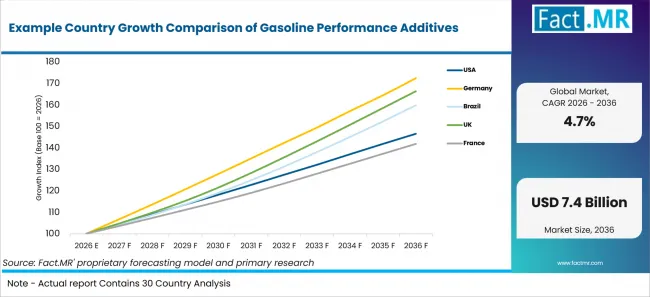
Example Country Growth Comparison Of Gasoline Performance Additives | Source: Fact.MR
| Country | CAGR |
|---|---|
| Germany | 5.6% |
| United Kingdom | 5.2% |
| Brazil | 4.8% |
| USA | 3.9% |
| France | 3.6% |
What supports Germany adoption?
5.6% CAGR, supported by a large gasoline car base and branded fuel programs.
Germany has a deep passenger-car base that sustains recurring demand for detergent-treated gasoline. The Federal Environment Agency reported in May 2026 that Germany had 49.5 million passenger cars at the start of 2026. Fuel retailers and refineries can therefore use deposit-control packages across a broad installed vehicle base while premium gasoline programs target drivers seeking cleaner fuel-system performance.
What supports the United Kingdom’s growth?
5.2% CAGR, backed by higher road traffic and regular petrol treatment needs.
The United Kingdom’s fuel network benefits from a wide forecourt base and rising vehicle movement. The Department for Transport reported in May 2026 that motor vehicle traffic in Great Britain reached 342.6 billion vehicle miles in 2025. That road-use base supports gasoline additive demand through E10 petrol, branded fuel offers and regular detergency claims across retail channels.
How is Brazil scaling demand?
4.8% CAGR, driven by gasoline C blending and ethanol-compatible additive packages.
Brazil is a blend-sensitive gasoline market where additive packages must support fuel quality across gasoline C distribution. ANP reported that common and additized gasoline C moved from 27% to 30% anhydrous ethanol in August 2025. From August 1, 2026, CNPE Resolution No. 9/2026 temporarily raised these grades to 32% (E32) for 180 days, with one possible equal extension; premium gasoline remains at 25%. The higher blend increases the importance of fuel-formulation compatibility.
What supports USA adoption?
3.9% CAGR, supported by certified detergent rules and a large gasoline treatment base.
The USA provides a clear regulatory base for gasoline detergent use. The U.S. Environmental Protection Agency list dated July 30, 2026 states that gasoline must contain detergent additives certified under 40 CFR 80, Subpart G. That rule framework supports continuing demand for registered additive packages across refinery blending, terminal treatment and branded gasoline programs.
How does France perform?
3.6% CAGR, led by gasoline share gains and SP95-E10 retail demand.
France is forecast to grow at 3.6% CAGR, supported by rising gasoline share and SP95-E10 demand. Official French Ministry for Ecological Transition data show that gasoline sales in continental France reached 14.76 Mm³ in 2024, up 7.4% year on year and representing 30.9% of total road-fuel sales; SP95-E10 accounted for 8.88 Mm³.
Who leads the Gasoline Performance Additives Market?
Afton publishes gasoline performance additives for light-duty vehicles, including keep-clean and clean-up products designed for gasoline direct-injection and port-fuel-injection platforms.
BASF publishes gasoline performance additives tied to the TOP TIER+™ standard and EPA Lowest Additive Concentration requirements.
Lubrizol, Innospec and Chevron Oronite maintain gasoline and fuel-additive portfolios covering deposit control, injector and fuel-system cleanliness, and engine-performance benefits. The U.S. EPA’s registered fuel-additives database also lists numerous products under Infineum USA.
Which companies are the key providers?
Key companies include Afton Chemical, Infineum, Lubrizol, BASF, Innospec and Chevron Oronite.
- Afton Chemical
- Infineum
- Lubrizol
- BASF
- Innospec
- Chevron Oronite
Bibliography
- U.S. Energy Information Administration. (2026, April 10). Increasing fuel efficiency leads to decreasing gasoline consumption.
- U.S. Environmental Protection Agency. (2026, February). The 2025 EPA Automotive Trends Report: Fuel economy and technology since 1975 (EPA-420-R-26-001).
- Department for Transport. (2026, May 20). Road traffic estimates in Great Britain: 2025.
- Umweltbundesamt. (2026, May 15). Verkehrsinfrastruktur und Fahrzeugbestand.
- Agência Nacional do Petróleo, Gás Natural e Biocombustíveis. (2026, June 30). ANP divulga dados consolidados do setor regulado em 2025.
- Agência Nacional do Petróleo, Gás Natural e Biocombustíveis. (2026, July 31). E32: gasolina com 32% de etanol passa a valer, temporariamente, a partir de amanhã (1/8).
- Service des données et études statistiques. (2025, October 9). Chiffres clés de l’énergie - Édition 2025.
- BASF. (2025, September 17). BASF launches Keropur® Gasoline Performance Additive Series certified for new U.S. TOP TIER+™ Standard.
- Afton Chemical Corporation. (2025, August 25). Afton Chemical launches HiTEC® 65522 Gasoline Performance Additive Series approved for TOP TIER+™ gasoline.
This Report Answers
- The report explains where gasoline performance additives are used across additive function and fuel grade. Coverage includes customer channel and chemistry, together with country demand patterns.
- Segment analysis identifies the leading subsegments and the operating reasons fuel marketers and refineries prioritize them.
- Country analysis examines the listed markets and the fuel-quality mechanisms supporting additive use.
- Competitive analysis reviews current providers across detergent chemistry, fuel-system cleanliness and branded fuel packages.
- Application analysis assesses how gasoline additives, specialty fuel additives and low-sulfur fuel additives connect with refinery and terminal blending decisions.
What does the Gasoline Performance Additives Market cover?
The Gasoline Performance Additives Market covers additive packages used to improve the performance and handling of gasoline. It includes detergents that clean injectors and intake valves, additives that support octane behavior, and inhibitors that protect fuel systems during storage and use.
The assessment covers regular gasoline and premium gasoline. Coverage extends to E10-E20 blends, high-ethanol specialty fuels and racing fuels. Coverage aligns with adjacent views on automotive additives and friction modifiers where engine cleanliness and efficiency claims overlap.
What is included in the scope?
The scope includes additive packages blended into gasoline at refineries, terminals or by fuel marketers.
It includes deposit-control detergents and octane improvers. Coverage includes corrosion inhibitors and antioxidants. Stabilizers, lubricity modifiers and multifunctional packages are included for branded gasoline and aftermarket treatment.
It includes chemistry groups such as polyetheramine / amine detergents and Mannich detergents. Coverage extends to metal-free octane chemistry and oxygenate / aromatic boosters. Multifunctional packages are included when used in fuel-quality or additive formulation contexts. Related scope areas include alkylate and sulphonate additives when used in fuel-quality or additive formulation contexts.
What is excluded from the scope?
The scope excludes bulk gasoline sold as a finished fuel and crude oil.
The scope excludes refinery catalysts and lubricating oil additives sold for engine oil. Diesel-only cold-flow improvers and marine-only fuel additives remain outside this assessment. Retail fuel equipment and engine hardware remain outside the assessment.
The assessment excludes automotive fuels where performance claims come from fuel grade alone. It covers additive chemistry and additive packages that create a measurable gasoline-performance function.
How Was the Analysis Built?
The analysis draws on 120+ sources, 35+ company portfolios, 25+ countries, and more than 20 industry interviews.
- Primary Research: Primary research includes discussions with manufacturers, service providers, technology developers, distributors, end users, and subject-matter experts. These conversations examine purchasing priorities, product adoption, operational challenges, approval requirements, competitive positioning, and the factors that influence wider market acceptance.
- Desk Research: Desk research covers government statistics, regulatory publications, company filings, trade data, technical studies, industry associations, standards, public policy, and other authoritative sources. Every source used in the analysis is documented in the bibliography.
- Market Sizing and Forecasting: Market estimates combine historical performance, demand indicators, pricing and volume trends, segment shares, company participation, country-level growth, adoption patterns, investment activity, and barriers to market expansion.
- Data Validation and Update Cycle: Findings are validated by comparing primary interviews with public data, company activity, regulatory changes, trade patterns, and industry developments. Regular updates review new product launches, capacity changes, partnerships, approvals, and shifts in commercial adoption.
What is the report’s scope and coverage?
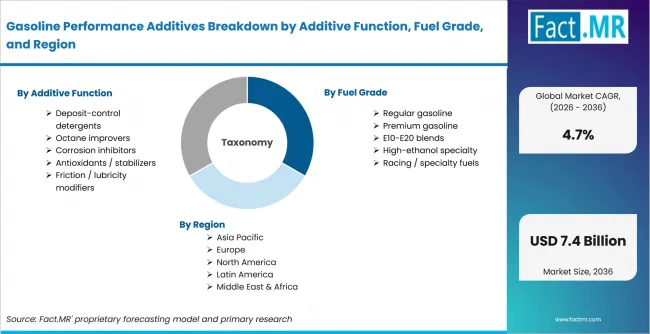
Gasoline Performance Additives Breakdown By Additive Function, Fuel Grade, And Region | Source: Fact.MR
| Attribute | Details |
|---|---|
| Quantitative Units | USD billion |
| Market Definition | Performance additive packages used in gasoline to improve deposit control, fuel-system cleanliness, corrosion protection, oxidation stability, octane support, lubricity behavior and branded fuel performance. |
| Additive Function | Deposit-control detergents; Octane improvers; Corrosion inhibitors; Antioxidants / stabilizers; Friction / lubricity modifiers |
| Fuel Grade | Regular gasoline; Premium gasoline; E10-E20 blends; High-ethanol specialty; Racing / specialty fuels |
| Customer | Refineries; Fuel marketers / terminals; Additive package blenders; Automotive OEM programs; Retail / aftermarket |
| Chemistry | Polyetheramine / amine detergents; Mannich detergents; Metal-free octane chemistry; Oxygenate / aromatic boosters; Multifunctional packages |
| Regions Covered | North America; Latin America; Western Europe; Eastern Europe; East Asia; South Asia & Pacific; Middle East & Africa |
| Countries Covered | Germany; United Kingdom; Brazil; USA; France |
| Key Companies Profiled | Afton Chemical; Infineum; Lubrizol; BASF; Innospec; Chevron Oronite |
| Forecast Period | 2026 to 2036 |
| Approach | Hybrid top-down and bottom-up approach using gasoline consumption indicators; additive-function mix; fuel-grade treatment needs; customer channels; country fuel rules; and provider portfolio review. |
How is the market segmented?
-
By Additive Function
- Deposit-control detergents
- Octane improvers
- Corrosion inhibitors
- Antioxidants / stabilizers
- Friction / lubricity modifiers
-
By Fuel Grade
- Regular gasoline
- Premium gasoline
- E10-E20 blends
- High-ethanol specialty
- Racing / specialty fuels
-
By Customer
- Refineries
- Fuel marketers / terminals
- Additive package blenders
- Automotive OEM programs
- Retail / aftermarket
-
By Chemistry
- Polyetheramine / amine detergents
- Mannich detergents
- Metal-free octane chemistry
- Oxygenate / aromatic boosters
- Multifunctional packages
-
By Region
- North America
- Latin America
- Western Europe
- Eastern Europe
- East Asia
- South Asia & Pacific
- Middle East & Africa