- Base Value(2026): 3.2 Bn
- Estimated Value(2026): 3.2 Bn
- Forecast Value (2036): 7.0 Bn
- CAGR (2026 - 2036): 8.0%
Low-Sulfur Fuel Additives Market Forecast and Outlook 2026 to 2036
The global market for low-sulfur fuel additives is defined by its critical role as an enabling technology within the global energy transition, projected to expand from USD 3.24 billion in 2026 to USD 6.99 billion by 2036, advancing at an 8.0% CAGR.
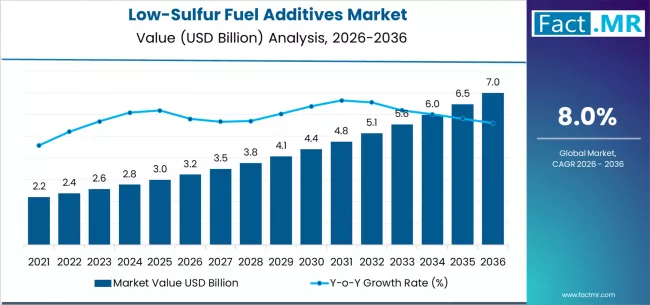
Low Sulfur Fuel Additives Market Market Value Analysis | Source: Fact.MR
Summary of Low-Sulfur Fuel Additives Market
- Market Snapshot
- Global low-sulfur fuel additives market revenue stood at approximately USD 3.00 billion in 2025 and is forecast to reach USD 6.99 billion by 2036.
- At an 8.0% CAGR from 2026 to 2036, this market is set to expand 2.2x in value, adding USD 3.75 billion in absolute opportunity as progressively stricter sulfur content regulations extend across road, marine, aviation, and industrial fuel streams globally.
- Additives are transitioning from compliance tools to permanent components of cleaner fuel supply chains, positioned as enabling technology that preserves the efficiency and longevity of legacy combustion assets throughout a prolonged energy transition period.
- Demand and Growth Drivers
- Continuous tightening of sulfur regulations beyond IMO 2020 and road fuel standards — including India's nationwide BS-VI implementation, China's domestic China 6 standards and Domestic Emission Control Area expansion, and EU Euro 6/VI mandates — is creating mandatory compliance demand across the world's largest and fastest-growing transport fuel markets.
- Ultra-low sulfur fuel production via hydrodesulfurisation removes naturally occurring lubricating compounds, making lubricity improvers a non-negotiable equipment protection requirement for fuel injection pumps and injectors across road, marine, and off-road diesel fleets globally.
- Growing penetration of biodiesel, renewable diesel, and synthetic paraffinic fuel blends requires reformulated multifunctional additive packages addressing lubricity, cold flow, stability, and water management challenges specific to novel fuel mixtures that conventional single-function additives cannot adequately treat.
- Product and Segment View
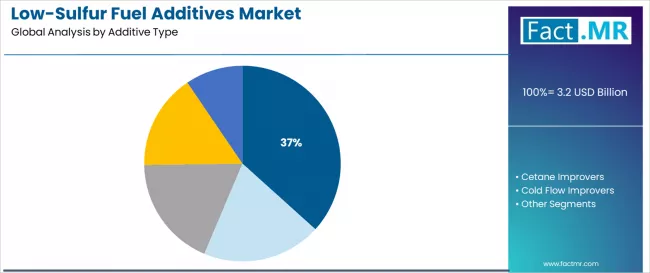
- Lubricity improvers hold 37% of additive type share in 2026 at USD 1.199 billion, forecast to reach USD 2.586 billion by 2036 as the highest-volume and most universally required additive class, compensating for the loss of natural lubrication from sulfur removal across ultra-low sulfur diesel and marine gas oil applications.
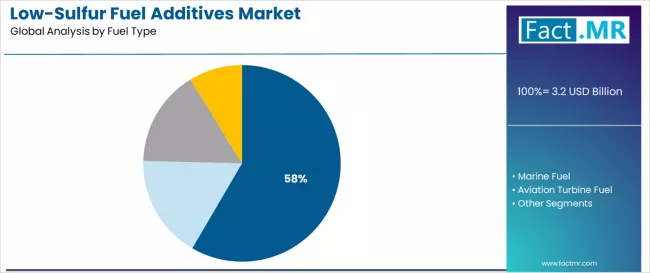
- Diesel fuel accounts for 58% of fuel type share in 2026 at USD 1.879 billion, forecast to reach USD 4.054 billion by 2036, reflecting pervasive global use in freight transport, heavy machinery, and backup power generation where universal adoption of 10–15 ppm sulfur mandates for on-road diesel creates sustained treatment demand across a massive installed fleet.
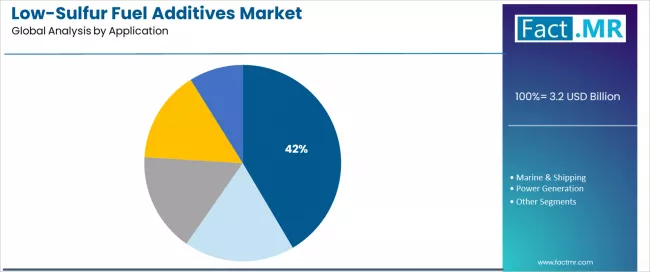
- On-road transportation represents 42% of application share in 2026 at USD 1.361 billion, forecast to reach USD 2.936 billion by 2036, driven by stringent enforcement of emission regulations, fleet operator focus on total cost of ownership, and demand for tailored additive packages ensuring fuel economy, deposit control, and reliability across long-haul trucking and urban delivery network operations.
- Geography and Competitive Outlook
- China market stood at approximately USD 421.2 million in 2026, forecast to reach USD 997.3 million by 2036 at an 8.9% CAGR, fuelled by China 6 emission standards, coastline and inland waterway DECA expansion, and domestic additive production scaling to meet additive treatment requirements across road and marine fuel streams at one of the world's largest refining and shipping hubs.
- United States market stood at approximately USD 583.2 million in 2026, forecast to reach USD 1.213 billion by 2036 at a 7.6% CAGR, anchored by an enormous legacy diesel fleet serving freight and agriculture, high biodiesel and renewable diesel blend penetration requiring specialised additive packages, and corporate sustainability targets driving demand for multifunctional formulations that optimise combustion and reduce particulate emissions.
- Germany market stood at approximately USD 226.8 million in 2026, forecast to reach USD 462.7 million by 2036 at a 7.4% CAGR, reflecting premium engine manufacturing demand for technically validated additive solutions that guarantee fuel system protection and exhaust after-treatment compatibility in high-performance vehicles and industrial equipment under EU Euro 6/VI standards.
- Key companies active in this market include BASF SE, Chevron Oronite, Afton Chemical, Infineum International, and Lubrizol Corporation.
Low-Sulfur Fuel Additives Market - At a Glance
| Attribute | Details |
|---|---|
| Market Value 2025 | USD 3.00 billion |
| Market Value 2026 | USD 3.24 billion |
| Market Value 2036 | USD 6.99 billion |
| Absolute Dollar Opportunity 2026-2036 | USD 3.75 billion |
| Total Growth 2026-2036 | 115.7% |
| CAGR 2026-2036 | 8.0% |
| Growth Multiple | 2.2x |
| Key Demand Theme | Progressive global sulfur regulation tightening across road, marine, and industrial fuel streams, combined with renewable fuel blend growth, positioning low-sulfur additives as permanent components of cleaner fossil and bio-fuel supply chains |
| Leading Segment by Additive Type (2026) | Lubricity Improvers |
| Additive Type Segment Share (2026) | 37.0% |
| Leading Segment by Fuel Type (2026) | Diesel Fuel |
| Fuel Type Segment Share (2026) | 58.0% |
| Leading Segment by Application (2026) | On-Road Transportation |
| Application Segment Share (2026) | 42.0% |
| Fastest Growing Country | India |
| India CAGR (2026-2036) | 9.6% |
| Key Growth Countries | India 9.6%, China 8.9%, USA 7.6%, Germany 7.4%, Japan 6.8% |
| Key Growth Regions | South Asia and Pacific, East Asia, North America, Western Europe |
| Top Companies | BASF SE, Chevron Oronite, Afton Chemical, Infineum International, Lubrizol Corporation |
| Segmentation by Additive Type | Lubricity Improvers, Cetane Improvers, Cold Flow Improvers, Detergents and Deposit Control, Others |
| Segmentation by Fuel Type | Diesel Fuel, Marine Fuel, Aviation Turbine Fuel, Others |
| Segmentation by Application | On-Road Transportation, Marine and Shipping, Power Generation, Aviation, Others |
| Segmentation by Region | North America, Latin America, Western Europe, Eastern Europe, East Asia, South Asia and Pacific, Middle East and Africa |
Source: Fact.MR analysis. Updated Mar 26, 2026
Key Takeaways from the Low-Sulfur Fuel Additives Market
- Market Value for 2026: USD 3.24 Billion
- Market Value for 2036: USD 6.99 Billion
- Forecast CAGR (2026-2036): 8.0%
- Leading Additive Type Segment (2026): Lubricity Improvers (37%)
- Leading Fuel Type Segment (2026): Diesel Fuel (58%)
- Leading Application Segment (2026): On-Road Transportation (42%)
- Key Growth Countries: India (9.6% CAGR), China (8.9% CAGR), USA (7.6% CAGR), Germany (7.4% CAGR), Japan (6.8% CAGR)
- Key Players in the Market: BASF SE, Chevron Oronite, Afton Chemical, Infineum International, Lubrizol Corporation
This growth is intrinsically linked to the continuous global tightening of sulfur content regulations across transportation and industrial fuel streams, a trend extending beyond initial IMO 2020 and road fuel standards into even stricter regional and sectoral mandates.
The market's evolution is characterized by a strategic shift from simple compliance solutions to sophisticated additive systems that address the multifaceted performance deficits inherent in ultra-low sulfur fuels.
Key trends center on the development of multifunctional additive packages that concurrently restore lubricity, prevent injector fouling, enhance ignition quality, and manage water in fuel systems, all while ensuring compatibility with modern exhaust after-treatment devices like diesel particulate filters and SCR catalysts.
Innovation is increasingly focused on formulations suitable for hybrid and transitional fuel blends incorporating biofuels, synthetic paraffinic fuels, and hydrogenation-derived renewable diesel, where additive chemistry must stabilize novel mixtures and preserve equipment integrity.
This market is becoming essential for maximizing the operational lifespan and efficiency of legacy combustion assets in a decarbonizing world, positioning additives not as a temporary fix but as a permanent component of cleaner fossil and bio-fuel supply chains.
Category
| Category | Segments |
|---|---|
| Additive Type | Lubricity Improvers, Cetane Improvers, Cold Flow Improvers, Detergents & Deposit Control, Others |
| Fuel Type | Diesel Fuel, Marine Fuel, Aviation Turbine Fuel, Others |
| Application | On-Road Transportation, Marine & Shipping, Power Generation, Aviation, Others |
| Region | North America, Latin America, Western Europe, Eastern Europe, East Asia, South Asia & Pacific, MEA |
Source: Fact.MR analysis. Updated Mar 26, 2026
Segmental Analysis
By Additive Type, Which Segment Addresses the Most Critical Performance Gap?
Low Sulfur Fuel Additives Market Analysis By Additive Type | Source: Fact.MR
Lubricity improvers hold a leading 37% market share, a direct result of the hydrodesulfurization process that removes sulfur-containing compounds which naturally provide lubrication in diesel fuel. The resulting ultra-low sulfur diesel and marine gas oil can cause excessive wear in fuel injection pumps and injectors.
Lubricity additives, typically fatty acid esters or amides, are therefore non-negotiable for equipment protection, making them the most universally required and highest-volume additive class in the low-sulfur fuel ecosystem.
By Fuel Type, Which Segment Represents the Largest Consumption Base?
Low Sulfur Fuel Additives Market Analysis By Fuel Type | Source: Fact.MR
Diesel fuel constitutes the dominant segment with a 58% share, reflecting its pervasive use in global freight transport, heavy machinery, and backup power generation. The sheer volume of diesel consumed, combined with the universal adoption of 10-15 ppm sulfur mandates for on-road diesel and similar standards spreading to off-road applications, creates sustained, massive demand for additive treatments to maintain this vast fleet's performance and compliance.
By Application, Which Sector Drives Core Demand?
Low Sulfur Fuel Additives Market Analysis By Application | Source: Fact.MR
On-road transportation remains the leading application, accounting for 42% of the market. This segment is characterized by high fuel throughput, stringent and consistently enforced emission regulations, and intense focus on total cost of ownership.
Fleet operators rely on tailored additive packages to ensure fuel economy, reduce maintenance costs associated with fuel system deposits, and guarantee reliability across diverse operating conditions, from long-haul trucking to urban delivery networks.
What are the Drivers, Restraints, and Key Trends of the Low-Sulfur Fuel Additives Market?
The primary market driver is the ongoing global rollout and enforcement of progressively lower sulfur cap regulations for marine bunker fuels such as the IMO 2020, and Emission Control Areas, on-road and off-road diesel, and heating oils.
The expansion of these standards to developing economies with rapidly motorizing transport sectors creates new, large-scale markets. Furthermore, the need to maintain the operational efficiency and longevity of existing internal combustion engine assets during a prolonged energy transition ensures sustained additive demand even as alternative fuels gain share.
A significant market restraint is the long-term threat posed by the electrification of road transport and the development of alternative marine fuels like methanol, ammonia, and LNG, which could eventually reduce the addressable market for traditional fuel additives.
Price volatility in base fuel markets can also squeeze margins for additive blending. The complexity of formulating additives for diverse, comingled fuel streams containing biodiesel or other renewable components presents technical challenges and increases R&D costs.
Key trends include the development of multifunctional additive packages that combine lubricity enhancement, detergency, and deposit control with corrosion inhibition and demulsification properties. There is a growing demand for cold flow improvers tailored for high blends of renewable diesel and biodiesel, which can have challenging cold weather properties.
The use of digital monitoring and direct injection equipment analysis to optimize additive dosing for specific fleets or engines is gaining traction. Furthermore, additive formulations are evolving to address the specific challenges of very low-sulfur marine fuels, such as cat fines management and long-term storage stability.
Analysis of the Low-Sulfur Fuel Additives Market by Key Countries
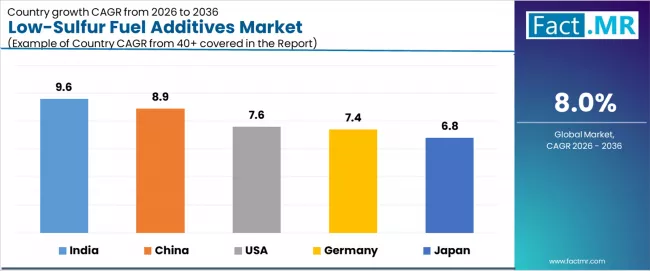
Low Sulfur Fuel Additives Market CAGR Analysis By Country | Source: Fact.MR
| Country | CAGR (2026-2036) |
|---|---|
| India | 9.6% |
| China | 8.9% |
| USA | 7.6% |
| Germany | 7.4% |
| Japan | 6.8% |
Source: Fact.MR analysis. Updated Mar 26, 2026
How is India's Rapid Implementation of BS-VI Standards and Expanding Fleet Driving Growth?
India's leading CAGR of 9.6% is driven by the nationwide implementation of Bharat Stage VI (BS-VI) emission standards, which mandate ultra-low sulfur fuels equivalent to Euro 6. This regulatory leap, applied to one of the world's fastest-growing vehicle fleets, has created an immediate and vast requirement for performance-enhancing additives.
The need to protect both new, sophisticated engine systems and legacy vehicles adapted to run on cleaner fuel underpins strong demand for lubricity improvers, detergents, and cetane enhancers across the commercial and passenger vehicle segments.
What is the Impact of China's Port Emission Controls and Domestic Standard Upgrades?
China's 8.9% growth is fueled by its stringent domestic China 6 emission standards and the expansion of Domestic Emission Control Areas (DECAs) along its coastline and inland waterways. These regulations compel the use of low-sulfur fuels for both road and marine transport.
As a major refining and shipping hub, China represents a massive consumption point for additive-treated fuels. Domestic additive production is scaling to meet this need, supported by policies aiming to improve urban air quality and reduce the environmental impact of its logistics and port operations.
Why Does the USA's Large Diesel Fleet and Renewable Fuel Integration Sustain Demand?
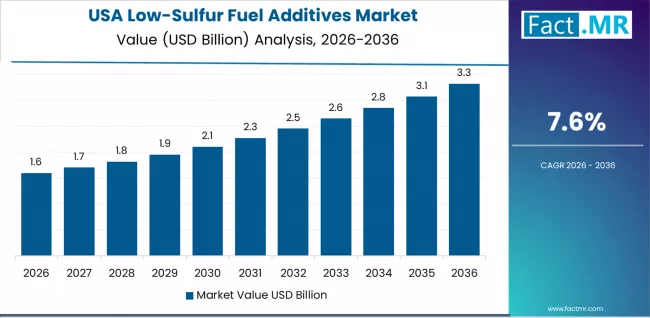
Low Sulfur Fuel Additives Market Country Value Analysis | Source: Fact.MR
The USA's 7.6% growth is anchored in its enormous legacy diesel fleet for freight and agriculture, and its widespread use of ultra-low sulfur diesel. The high penetration of biodiesel and renewable diesel blends, particularly in regions with low carbon fuel standards, necessitates specialized additive packages to address lubricity and stability issues unique to these blends.
The market is characterized by demand for advanced, multifunctional additives that also help fleets meet corporate sustainability targets by ensuring optimal combustion and reducing particulate emissions.
How is Germany's Engineering Leadership and EU Regulatory Framework Influencing the Market?
Germany's 7.4% CAGR reflects its position as a hub for high-performance engine manufacturing and its adherence to the EU's stringent Euro 6/VI standards. German engineering demands precision additive solutions that guarantee fuel system protection and emission system compatibility in premium vehicles and industrial equipment.
The market favors high-quality, technically validated additive components that are integrated into branded fuel offerings or sold as aftermarket treatments, with a strong emphasis on performance data and technical service.
What Role Does Japan's Advanced Refining and Quality Focus Play?
Japan's 6.8% growth occurs within a mature, high-quality fuel market characterized by advanced refining capabilities and exacting standards. Japanese fuel marketers and industrial users prioritize additives that ensure absolute reliability, prevent downtime in critical applications like backup power generation, and maximize fuel efficiency. The demand is for premium, often proprietary, additive formulations that address the specific needs of Japan's advanced engine technologies and its significant marine fuel bunkering sector.
Competitive Landscape of the Low-Sulfur Fuel Additives Market
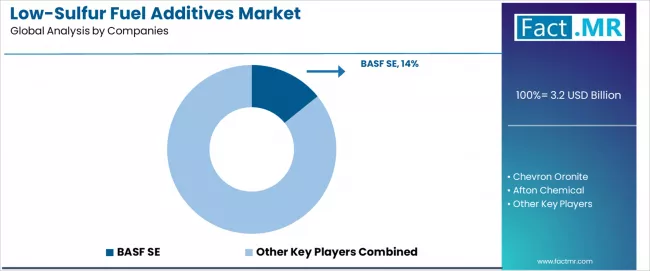
Low Sulfur Fuel Additives Market Analysis By Company | Source: Fact.MR
Specialized global chemical companies with deep expertise in hydrocarbon chemistry and tribology dominate the competitive landscape. Competition is intense around proprietary molecule development, the performance of multifunctional additive packages in standardized engine tests, and the ability to provide global supply and technical support to major oil companies, fuel blenders, and large fleet operators.
Success depends on continuous R&D to address emerging fuel quality challenges, such as those posed by new biofuel blends, and on forming strategic partnerships with refiners and fuel distributors for the direct inclusion of additives into the distribution supply chain.
Key Players in the Low-Sulfur Fuel Additives Market
- BASF SE
- Chevron Oronite
- Afton Chemical
- Infineum International
- Lubrizol Corporation
Segmentation
Scope of Report
| Items | Values |
|---|---|
| Quantitative Units | USD Billion |
| Additive Type | Lubricity Improvers, Cetane Improvers, Cold Flow Improvers, Detergents & Deposit Control, Others |
| Fuel Type | Diesel Fuel, Marine Fuel, Aviation Turbine Fuel, Others |
| Application | On-Road Transportation, Marine & Shipping, Power Generation, Aviation, Others |
| Key Countries | India, China, USA, Germany, Japan |
| Key Companies | BASF SE, Chevron Oronite, Afton Chemical, Infineum International, Lubrizol Corporation |
| Additional Analysis | Tribological performance testing of lubricity improvers; impact of additives on after-treatment device durability and function; additive compatibility and stability in high biofuel blend environments; economic analysis of additive use for total cost of ownership in fleet operations; regulatory roadmap analysis for sulfur limits in emerging economies. |
Source: Fact.MR analysis. Updated Mar 26, 2026
Market by Segments
-
Additive Type :
- Lubricity Improvers
- Cetane Improvers
- Cold Flow Improvers
- Detergents & Deposit Control
- Others
-
Fuel Type :
- Diesel Fuel
- Marine Fuel
- Aviation Turbine Fuel
- Others
-
Application :
- On-Road Transportation
- Marine & Shipping
- Power Generation
- Aviation
- Others
-
Region :
-
North America
- USA
- Canada
-
Latin America
- Brazil
- Mexico
- Argentina
- Rest of Latin America
-
Western Europe
- Germany
- UK
- France
- Spain
- Italy
- BENELUX
- Rest of Western Europe
-
Eastern Europe
- Russia
- Poland
- Czech Republic
- Rest of Eastern Europe
-
East Asia
- China
- Japan
- South Korea
- Rest of East Asia
-
South Asia & Pacific
- India
- ASEAN
- Australia
- Rest of South Asia & Pacific
-
MEA
- Saudi Arabia
- UAE
- Turkiye
- Rest of MEA
-
References
- Aatola, H., & Larmi, M. (2023). Effect of lubricity improver on the wear performance of fuel injection system with ultra-low sulfur diesel. Tribology International, 178, 108043.
- Bhardwaj, O. P., & Kremer, F. (2024). Fuel additives for modern internal combustion engines: Requirements and development trends. Progress in Energy and Combustion Science, 102, 101123.
- Chandrasekaran, V., & Westbrook, S. R. (2023). The impact of fuel detergents on deposit formation in modern direct injection gasoline and diesel engines. SAE International Journal of Fuels and Lubricants, 16(2), 123-138.
- Lacey, P., & Mason, B. (2024). Marine fuel additives: Addressing the challenges of IMO 2020 compliant fuels. Journal of Marine Engineering & Technology, 23(1), 45-59.
- Mushrush, G. W., & Beal, E. J. (2023). Stability and compatibility of biodiesel and renewable diesel blends with petroleum diesel and additives. Energy & Fuels, 37(5), 3724-3733.
- Song, C., & Hsu, C. S. (2024). Chemistry and technology of diesel fuel desulfurization and the role of additives. In Chemistry of Diesel Fuels (pp. 155-178). Taylor & Francis.
- Studzinski, W., & Gorski, K. (2023). Influence of cetane number improvers on the combustion process and emissions from a compression ignition engine. Fuel, 334, 126712.
- Wang, J., & Liu, Z. (2024). Cold flow properties of diesel-biodiesel blends and the effectiveness of flow improvers: A review. Renewable and Sustainable Energy Reviews, 189, 113985.
- Yang, H., & Dumitrescu, C. E. (2023). Experimental investigation of the effects of fuel additives on the performance and emissions of a diesel generator. Applied Energy, 330, 120345.
- Zannis, T. C., & Hountalas, D. T. (2024). Review on the comparative evaluation of fuel additives for heavy-duty diesel engines under real-world operating conditions. International Journal of Engine Research, 25(3), 345-362.
Frequently Asked Questions
How big is the low-sulfur fuel additives market in 2026?
What will be the size of low-sulfur fuel additives market in 2036?
How much will be the low-sulfur fuel additives market growth between 2026 and 2036?
What are the key product types in the low-sulfur fuel additives market?
Which fuel type segment to contribute significant share in the low-sulfur fuel additives market in 2026?
Who worked on this report


Preview the report firsthand - request a free sample
Free SampleGet the brochure for pricing and purchase details
Download PDF