Friction Modifiers Market
Friction Modifiers Market Size and Share Forecast Outlook 2026 to 2036
Friction modifiers market is projected to grow from USD 1.1 billion in 2026 to USD 1.6 billion by 2036, at a CAGR of 3.8%. Organic will dominate with a 57.3% market share, while commercial vehicles will lead the application segment with a 64.1% share.
Friction Modifiers Market Forecast and Outlook 2026 to 2036
The global friction modifiers market is projected to reach USD 1.6 billion by 2036. The market is valued at USD 1.1 billion in 2026 and is set to rise at a CAGR of 3.8% during the assessment period. The market is expected to grow by approximately 1.5 times during the same period, supported by increasing demand for fuel-efficient vehicles and stringent emission regulations worldwide, driving adoption of advanced lubricant additives across automotive and industrial applications globally.
Key Takeaways from the Friction Modifiers Market
- Friction Modifiers Market Value (2026): USD 1.1 billion
- Friction Modifiers Market Forecast Value (2036): USD 1.6 billion
- Friction Modifiers Market Forecast CAGR: 3.8%
- Leading Type in Friction Modifiers Market: Organic (57.3%)
- Key Growth Regions in Friction Modifiers Market: Asia Pacific, North America, and Europe
- Top Players in Friction Modifiers Market: INX International Ink Co., Kornit Digital, Marabu GmbH & Co. KG, Nazdar, Nutec Digital Ink, Sensient Imaging Technologies, Siegwerk Druckfarben AG & Co. KGaA, Sun Chemical, Toyo Ink Co., Ltd., Wikoff Color Corporation
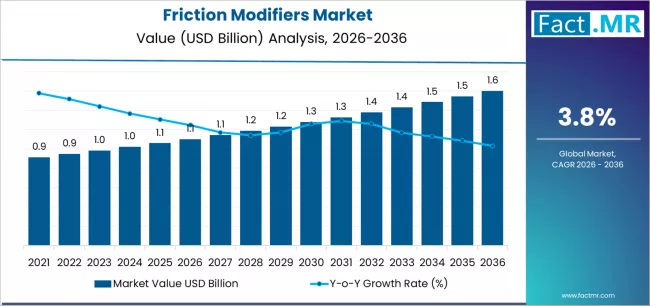
The organic friction modifiers segment dominates market activity, driven by superior performance characteristics and environmental compatibility across diverse automotive and industrial lubrication applications worldwide. Manufacturers increasingly recognize the functional benefits of organic friction modifiers, with typical product offerings providing effective friction reduction and wear protection at competitive price points through established automotive supply chains.
The commercial vehicles segment demonstrates robust growth potential, supported by rising global freight transportation demand and regulatory mandates for fuel efficiency improvements in heavy-duty vehicle operations. Asia Pacific emerges as the dominant regional market, reflecting high automotive production volumes and expanding lubricant consumption patterns in emerging economies.
Friction Modifiers Market
| Metric | Value |
|---|---|
| Market Value (2026) | USD 1.1 billion |
| Market Forecast Value (2036) | USD 1.6 billion |
| Forecast CAGR (2026-2036) | 3.8% |
Category
| Category | Segments |
|---|---|
| Type | Organic; Inorganic |
| Application | Commercial Vehicles; Passenger Vehicles; Others |
| Region | Asia Pacific; North America; Europe; Latin America; Middle East & Africa |
Segmental Analysis
By Type, Which Segment Accounts for the Dominant Market Share?
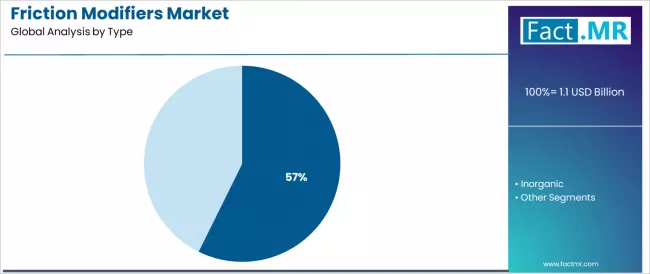
Organic friction modifiers represent the dominant force in the friction modifiers market, capturing 57.3% of total market share in 2026. This established chemical category encompasses solutions featuring molecular structures derived from fatty acids, esters, and amides that provide effective friction reduction through boundary lubrication mechanisms, including advanced formulations with tailored polarity and surface activity characteristics that enable superior performance across diverse lubricant systems and operating conditions worldwide.
By Application, Which Segment Accounts for the Largest Market Share?
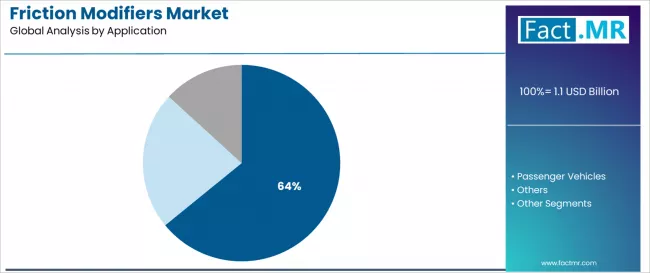
Commercial vehicles dominate the friction modifiers application landscape with a 64.1% market share in 2026, reflecting the critical role of fuel efficiency optimization in supporting cost-effective fleet operations and regulatory compliance across transportation sectors worldwide. Commercial vehicles’ market leadership is reinforced by fleet operator priorities for maximizing fuel economy, extending maintenance intervals, and reducing total cost of ownership through advanced lubrication technologies that deliver measurable operational benefits.
What are the Drivers, Restraints, and Key Trends of the Friction Modifiers Market?
The friction modifiers market is driven by rising fuel prices and operating cost pressures, increasing demand for fuel-efficient lubricants across automotive and industrial sectors. Stricter vehicle emission and fuel-economy regulations are further encouraging lubricant formulators and OEMs to adopt advanced friction modifier technologies. Industrial efficiency targets and sustainability commitments are also supporting wider use of high-performance lubrication additives that reduce energy consumption and improve equipment performance.
Market restraints include volatility in raw material prices and supply dependencies for key organic intermediates, which affect formulation costs and margin stability. Technical complexity in achieving consistent performance across different base oils, additive systems, and operating conditions presents additional challenges. Extensive performance validation, including tribological testing and field trials, can slow new product commercialization.
Key trends include increasing adoption of bio-based friction modifiers in North America and Europe, driven by sustainability goals. Another emerging trend is the development of specialized friction modifier formulations for electric vehicles, addressing unique lubrication and thermal management requirements.
Analysis of the Friction Modifiers Market by Key Countries
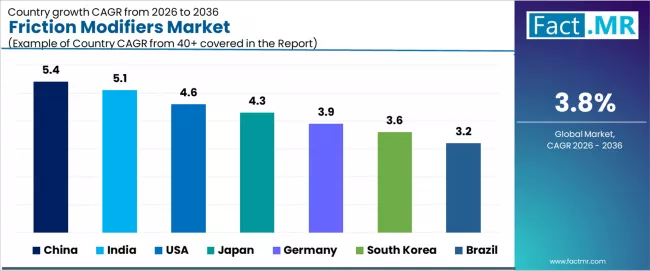
| Country | CAGR (2026-2036) |
|---|---|
| China | 5.4% |
| India | 5.1% |
| USA | 4.6% |
| Japan | 4.3% |
| Germany | 3.9% |
| South Korea | 3.6% |
| Brazil | 3.2% |
How is China Leading Global Market Expansion in Friction Modifiers?
China demonstrates the strongest growth potential in the friction modifiers market, recording a 5.4% CAGR through 2036. Leadership is driven by large-scale automotive production, expanding commercial vehicle fleets, and rising industrial lubrication demand. Adoption is concentrated in manufacturing hubs such as Guangdong, Shanghai, Jiangsu, and Zhejiang, where OEMs and lubricant blenders increasingly incorporate friction modifiers to meet fuel economy and emission requirements.
Integration within OEM supply chains, independent lubricant marketers, and industrial distributors ensures broad market reach. Ongoing implementation of China 6 emission standards and growing focus on operational efficiency continue to support sustained adoption across passenger vehicles and commercial fleet operations.
Why Is India Emerging as a High-Growth Friction Modifiers Market?
India grows at a 5.1% CAGR, supported by rising fuel costs, expanding vehicle ownership, and improving lubricant quality standards. Automotive clusters such as Pune, Chennai, Delhi NCR, and Gujarat are driving adoption across both passenger and commercial vehicles.
Fleet operators increasingly rely on friction modifiers to improve fuel efficiency and manage operating costs, while premium lubricant demand is rising among passenger vehicle owners. Implementation of Bharat Stage VI norms and growth in the automotive aftermarket continue to strengthen demand for proven additive technologies supplied by domestic and international formulators.
What drives Market Resilience in the USA?
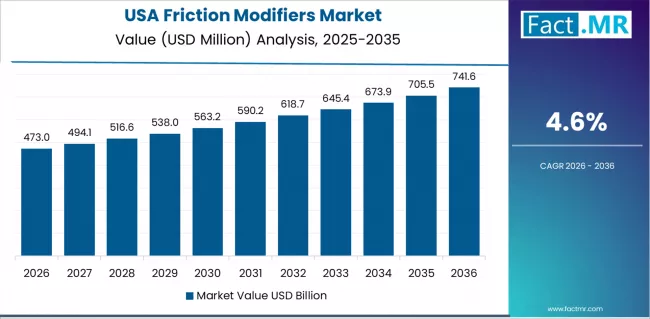
The USA records steady growth at a 4.6% CAGR supported by diverse lubricant applications across commercial transportation, industrial equipment, and passenger vehicles. Fleet operators prioritize friction modifiers that deliver consistent performance across varied climates and duty cycles.
High awareness of fuel efficiency benefits and established lubricant consumption patterns provide demand stability. Innovation from additive manufacturers and formulators continues to support premiumization trends, including extended drain intervals and sustainability-focused lubricant solutions.
How does Japan Demonstrate Technology Leadership in Friction Modifiers?
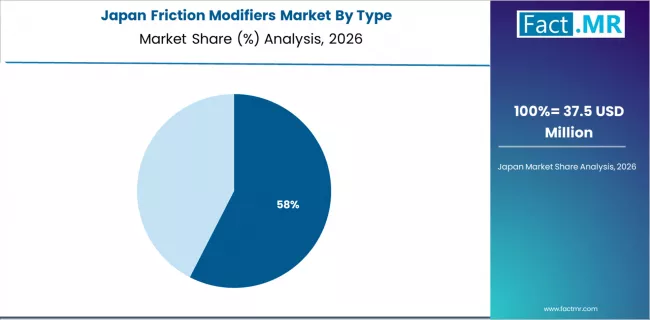
Japan grows at a 4.3% CAGR, driven by precision automotive engineering and high-performance lubricant standards. Automakers integrate friction modifiers through OEM specifications and factory-fill lubricants, particularly for hybrid and fuel-efficient gasoline vehicles.
Demand is strongest in major metropolitan areas where consumers and fleets prioritize quality, reliability, and fuel economy. Collaboration between additive suppliers and automotive manufacturers supports advanced formulation development aligned with evolving powertrain technologies.
What positions Germany for Engineering-Led Market Leadership?
Germany records a 3.9% CAGR, supported by strong automotive engineering standards and emphasis on validated performance. Friction modifiers are adopted through rigorous OEM testing and specification-led development in automotive centers such as Stuttgart, Munich, and Wolfsburg.
Premium vehicle positioning, fuel efficiency targets, and CO₂ reduction mandates continue to drive demand for advanced lubricant technologies. Long-term durability testing and technical validation remain central to adoption decisions.
How does South Korea Reflect Manufacturing Excellence in Friction Modifier Adoption?
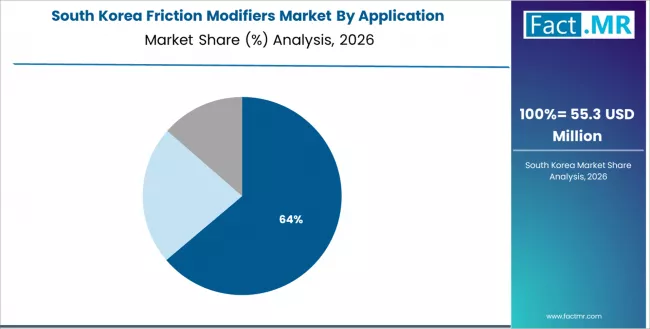
South Korea grows at a 3.6% CAGR, driven by export-oriented automotive manufacturing and continuous quality improvement initiatives. OEM production hubs integrate friction modifiers through factory-fill lubricants aligned with fuel economy and international compliance standards. Strong collaboration between Korean automakers and global additive suppliers supports formulation expertise, ensuring consistent performance across domestic and export vehicle platforms.
What Characterizes Brazil’s Developing Friction Modifiers Market?
Brazil expands at a 3.2% CAGR, supported by rising diesel costs, logistics sector growth, and improving fleet efficiency awareness. Commercial transportation fleets increasingly adopt friction modifier-enhanced lubricants to manage operating expenses, while passenger vehicle ownership growth supports premium lubricant demand. Local blending capabilities and expanding lubricant distribution networks continue to improve product accessibility and cost competitiveness across key regions.
Competitive Landscape of the Friction Modifiers Market
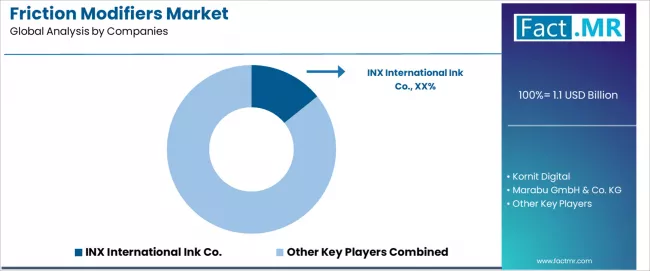
The friction modifiers market is moderately concentrated, with around 10-15 key participants accounting for a significant share of global demand through established formulation expertise, broad additive portfolios, and multi-regional manufacturing capabilities. Competition is driven primarily by formulation performance, technical service depth, and long-term relationships with lubricant formulators and automotive OEMs rather than price-led dynamics.
Leading companies such as INX International Ink Co., Kornit Digital, and Marabu GmbH & Co. KG maintain strong positions through advanced additive chemistry capabilities, validated friction control performance, and close collaboration with lubricant manufacturers. Continuous investment in research, testing, and OEM-aligned development supports their expansion into industrial lubrication and specialty fluid applications.
Challengers including Nazdar, Nutec Digital Ink, and Sensient Imaging Technologies compete through customized formulation support and strong regional partnerships. Larger chemical groups such as Siegwerk, Sun Chemical, and Toyo Ink focus on specific chemistries, including organic and sustainable friction modifiers.
Emerging players introduce competitive pressure through bio-based chemistries and novel molecular designs, particularly in fast-growing automotive and industrial markets. Overall competitiveness favors suppliers combining technical credibility, application-specific expertise, and sustainability-aligned innovation.
Key Players in the Friction Modifiers Market
- INX International Ink Co.
- Kornit Digital
- Marabu GmbH & Co. KG
- Nazdar
- Nutec Digital Ink
- Sensient Imaging Technologies
- Siegwerk Druckfarben AG & Co. KGaA
- Sun Chemical
- Toyo Ink Co., Ltd.
- Wikoff Color Corporation
Scope of the Report
| Items | Values |
|---|---|
| Quantitative Units | USD 1.1 Billion |
| Type | Organic, Inorganic |
| Application | Commercial Vehicles, Passenger Vehicles, Others |
| Regions Covered | Asia Pacific, North America, Europe, Latin America, MEA |
| Country Covered | China, India, USA, Japan, Germany, South Korea, Brazil, and 40+ countries |
| Key Companies Profiled | INX International Ink Co., Kornit Digital, Marabu GmbH & Co. KG, Nazdar, Nutec Digital Ink, Sensient Imaging Technologies, Siegwerk Druckfarben AG & Co. KGaA, Sun Chemical, Toyo Ink Co., Ltd., Wikoff Color Corporation |
| Additional Attributes | Dollar sales by type and application categories, regional adoption trends across Asia Pacific, North America, and Europe, competitive landscape with additive manufacturers and lubricant technology companies, product specifications and formulation requirements, integration with automotive OEM specifications and lubricant industry standards, innovations in bio-based chemistry and sustainable manufacturing, and development of specialized applications with performance validation and technical service capabilities. |
Friction Modifiers Market by Segments
-
Type :
- Organic
- Inorganic
-
Application :
- Commercial Vehicles
- Passenger Vehicles
- Others
-
Region :
- Asia Pacific
- China
- Japan
- South Korea
- India
- Australia
- Thailand
- Rest of Asia Pacific
- North America
- USA
- Canada
- Mexico
- Europe
- Germany
- UK
- France
- Italy
- Spain
- Denmark
- Sweden
- Norway
- Rest of Europe
- Latin America
- Brazil
- Argentina
- Rest of Latin America
- MEA
- South Africa
- Saudi Arabia
- UAE
- Kuwait
- Rest of MEA
- Asia Pacific
Table of Content
- Executive Summary
- Global Market Outlook
- Demand to side Trends
- Supply to side Trends
- Technology Roadmap Analysis
- Analysis and Recommendations
- Market Overview
- Market Coverage / Taxonomy
- Market Definition / Scope / Limitations
- Market Background
- Market Dynamics
- Drivers
- Restraints
- Opportunity
- Trends
- Scenario Forecast
- Demand in Optimistic Scenario
- Demand in Likely Scenario
- Demand in Conservative Scenario
- Opportunity Map Analysis
- Product Life Cycle Analysis
- Supply Chain Analysis
- Investment Feasibility Matrix
- Value Chain Analysis
- PESTLE and Porter’s Analysis
- Regulatory Landscape
- Regional Parent Market Outlook
- Production and Consumption Statistics
- Import and Export Statistics
- Market Dynamics
- Global Market Analysis 2021 to 2025 and Forecast, 2026 to 2036
- Historical Market Size Value (USD Million) Analysis, 2021 to 2025
- Current and Future Market Size Value (USD Million) Projections, 2026 to 2036
- Y to o to Y Growth Trend Analysis
- Absolute $ Opportunity Analysis
- Global Market Pricing Analysis 2021 to 2025 and Forecast 2026 to 2036
- Global Market Analysis 2021 to 2025 and Forecast 2026 to 2036, By Type
- Introduction / Key Findings
- Historical Market Size Value (USD Million) Analysis By Type, 2021 to 2025
- Current and Future Market Size Value (USD Million) Analysis and Forecast By Type, 2026 to 2036
- Organic
- Inorganic
- Y to o to Y Growth Trend Analysis By Type, 2021 to 2025
- Absolute $ Opportunity Analysis By Type, 2026 to 2036
- Global Market Analysis 2021 to 2025 and Forecast 2026 to 2036, By Application
- Introduction / Key Findings
- Historical Market Size Value (USD Million) Analysis By Application, 2021 to 2025
- Current and Future Market Size Value (USD Million) Analysis and Forecast By Application, 2026 to 2036
- Commercial Vehicles
- Passenger Vehicles
- Others
- Y to o to Y Growth Trend Analysis By Application, 2021 to 2025
- Absolute $ Opportunity Analysis By Application, 2026 to 2036
- Global Market Analysis 2021 to 2025 and Forecast 2026 to 2036, By Region
- Introduction
- Historical Market Size Value (USD Million) Analysis By Region, 2021 to 2025
- Current Market Size Value (USD Million) Analysis and Forecast By Region, 2026 to 2036
- North America
- Latin America
- Western Europe
- Eastern Europe
- East Asia
- South Asia and Pacific
- Middle East & Africa
- Market Attractiveness Analysis By Region
- North America Market Analysis 2021 to 2025 and Forecast 2026 to 2036, By Country
- Historical Market Size Value (USD Million) Trend Analysis By Market Taxonomy, 2021 to 2025
- Market Size Value (USD Million) Forecast By Market Taxonomy, 2026 to 2036
- By Country
- USA
- Canada
- Mexico
- By Type
- By Application
- By Country
- Market Attractiveness Analysis
- By Country
- By Type
- By Application
- Key Takeaways
- Latin America Market Analysis 2021 to 2025 and Forecast 2026 to 2036, By Country
- Historical Market Size Value (USD Million) Trend Analysis By Market Taxonomy, 2021 to 2025
- Market Size Value (USD Million) Forecast By Market Taxonomy, 2026 to 2036
- By Country
- Brazil
- Chile
- Rest of Latin America
- By Type
- By Application
- By Country
- Market Attractiveness Analysis
- By Country
- By Type
- By Application
- Key Takeaways
- Western Europe Market Analysis 2021 to 2025 and Forecast 2026 to 2036, By Country
- Historical Market Size Value (USD Million) Trend Analysis By Market Taxonomy, 2021 to 2025
- Market Size Value (USD Million) Forecast By Market Taxonomy, 2026 to 2036
- By Country
- Germany
- UK
- Italy
- Spain
- France
- Nordic
- BENELUX
- Rest of Western Europe
- By Type
- By Application
- By Country
- Market Attractiveness Analysis
- By Country
- By Type
- By Application
- Key Takeaways
- Eastern Europe Market Analysis 2021 to 2025 and Forecast 2026 to 2036, By Country
- Historical Market Size Value (USD Million) Trend Analysis By Market Taxonomy, 2021 to 2025
- Market Size Value (USD Million) Forecast By Market Taxonomy, 2026 to 2036
- By Country
- Russia
- Poland
- Hungary
- Balkan & Baltic
- Rest of Eastern Europe
- By Type
- By Application
- By Country
- Market Attractiveness Analysis
- By Country
- By Type
- By Application
- Key Takeaways
- East Asia Market Analysis 2021 to 2025 and Forecast 2026 to 2036, By Country
- Historical Market Size Value (USD Million) Trend Analysis By Market Taxonomy, 2021 to 2025
- Market Size Value (USD Million) Forecast By Market Taxonomy, 2026 to 2036
- By Country
- China
- Japan
- South Korea
- By Type
- By Application
- By Country
- Market Attractiveness Analysis
- By Country
- By Type
- By Application
- Key Takeaways
- South Asia and Pacific Market Analysis 2021 to 2025 and Forecast 2026 to 2036, By Country
- Historical Market Size Value (USD Million) Trend Analysis By Market Taxonomy, 2021 to 2025
- Market Size Value (USD Million) Forecast By Market Taxonomy, 2026 to 2036
- By Country
- India
- ASEAN
- Australia & New Zealand
- Rest of South Asia and Pacific
- By Type
- By Application
- By Country
- Market Attractiveness Analysis
- By Country
- By Type
- By Application
- Key Takeaways
- Middle East & Africa Market Analysis 2021 to 2025 and Forecast 2026 to 2036, By Country
- Historical Market Size Value (USD Million) Trend Analysis By Market Taxonomy, 2021 to 2025
- Market Size Value (USD Million) Forecast By Market Taxonomy, 2026 to 2036
- By Country
- Kingdom of Saudi Arabia
- Other GCC Countries
- Turkiye
- South Africa
- Other African Union
- Rest of Middle East & Africa
- By Type
- By Application
- By Country
- Market Attractiveness Analysis
- By Country
- By Type
- By Application
- Key Takeaways
- Key Countries Market Analysis
- USA
- Pricing Analysis
- Market Share Analysis, 2025
- By Type
- By Application
- Canada
- Pricing Analysis
- Market Share Analysis, 2025
- By Type
- By Application
- Mexico
- Pricing Analysis
- Market Share Analysis, 2025
- By Type
- By Application
- Brazil
- Pricing Analysis
- Market Share Analysis, 2025
- By Type
- By Application
- Chile
- Pricing Analysis
- Market Share Analysis, 2025
- By Type
- By Application
- Germany
- Pricing Analysis
- Market Share Analysis, 2025
- By Type
- By Application
- UK
- Pricing Analysis
- Market Share Analysis, 2025
- By Type
- By Application
- Italy
- Pricing Analysis
- Market Share Analysis, 2025
- By Type
- By Application
- Spain
- Pricing Analysis
- Market Share Analysis, 2025
- By Type
- By Application
- France
- Pricing Analysis
- Market Share Analysis, 2025
- By Type
- By Application
- India
- Pricing Analysis
- Market Share Analysis, 2025
- By Type
- By Application
- ASEAN
- Pricing Analysis
- Market Share Analysis, 2025
- By Type
- By Application
- Australia & New Zealand
- Pricing Analysis
- Market Share Analysis, 2025
- By Type
- By Application
- China
- Pricing Analysis
- Market Share Analysis, 2025
- By Type
- By Application
- Japan
- Pricing Analysis
- Market Share Analysis, 2025
- By Type
- By Application
- South Korea
- Pricing Analysis
- Market Share Analysis, 2025
- By Type
- By Application
- Russia
- Pricing Analysis
- Market Share Analysis, 2025
- By Type
- By Application
- Poland
- Pricing Analysis
- Market Share Analysis, 2025
- By Type
- By Application
- Hungary
- Pricing Analysis
- Market Share Analysis, 2025
- By Type
- By Application
- Kingdom of Saudi Arabia
- Pricing Analysis
- Market Share Analysis, 2025
- By Type
- By Application
- Turkiye
- Pricing Analysis
- Market Share Analysis, 2025
- By Type
- By Application
- South Africa
- Pricing Analysis
- Market Share Analysis, 2025
- By Type
- By Application
- USA
- Market Structure Analysis
- Competition Dashboard
- Competition Benchmarking
- Market Share Analysis of Top Players
- By Regional
- By Type
- By Application
- Competition Analysis
- Competition Deep Dive
- INX International Ink Co.
- Overview
- Product Portfolio
- Profitability by Market Segments (Product/Age /Sales Channel/Region)
- Sales Footprint
- Strategy Overview
- Marketing Strategy
- Product Strategy
- Channel Strategy
- Kornit Digital
- Marabu GmbH & Co. KG
- Nazdar
- Nutec Digital Ink
- Sensient Imaging Technologies
- Siegwerk Druckfarben AG & Co. KGaA
- Sun Chemical
- Toyo Ink Co., Ltd.
- Wikoff Color Corporation
- INX International Ink Co.
- Competition Deep Dive
- Assumptions & Acronyms Used
- Research Methodology
List Of Table
- Table 1: Global Market Value (USD Million) Forecast by Region, 2021 to 2036
- Table 2: Global Market Value (USD Million) Forecast by Type, 2021 to 2036
- Table 3: Global Market Value (USD Million) Forecast by Application, 2021 to 2036
- Table 4: North America Market Value (USD Million) Forecast by Country, 2021 to 2036
- Table 5: North America Market Value (USD Million) Forecast by Type, 2021 to 2036
- Table 6: North America Market Value (USD Million) Forecast by Application, 2021 to 2036
- Table 7: Latin America Market Value (USD Million) Forecast by Country, 2021 to 2036
- Table 8: Latin America Market Value (USD Million) Forecast by Type, 2021 to 2036
- Table 9: Latin America Market Value (USD Million) Forecast by Application, 2021 to 2036
- Table 10: Western Europe Market Value (USD Million) Forecast by Country, 2021 to 2036
- Table 11: Western Europe Market Value (USD Million) Forecast by Type, 2021 to 2036
- Table 12: Western Europe Market Value (USD Million) Forecast by Application, 2021 to 2036
- Table 13: Eastern Europe Market Value (USD Million) Forecast by Country, 2021 to 2036
- Table 14: Eastern Europe Market Value (USD Million) Forecast by Type, 2021 to 2036
- Table 15: Eastern Europe Market Value (USD Million) Forecast by Application, 2021 to 2036
- Table 16: East Asia Market Value (USD Million) Forecast by Country, 2021 to 2036
- Table 17: East Asia Market Value (USD Million) Forecast by Type, 2021 to 2036
- Table 18: East Asia Market Value (USD Million) Forecast by Application, 2021 to 2036
- Table 19: South Asia and Pacific Market Value (USD Million) Forecast by Country, 2021 to 2036
- Table 20: South Asia and Pacific Market Value (USD Million) Forecast by Type, 2021 to 2036
- Table 21: South Asia and Pacific Market Value (USD Million) Forecast by Application, 2021 to 2036
- Table 22: Middle East & Africa Market Value (USD Million) Forecast by Country, 2021 to 2036
- Table 23: Middle East & Africa Market Value (USD Million) Forecast by Type, 2021 to 2036
- Table 24: Middle East & Africa Market Value (USD Million) Forecast by Application, 2021 to 2036
List Of Figures
- Figure 1: Global Market Pricing Analysis
- Figure 2: Global Market Value (USD Million) Forecast 2021 to 2036
- Figure 3: Global Market Value Share and BPS Analysis by Type, 2026 and 2036
- Figure 4: Global Market Y to o to Y Growth Comparison by Type, 2026 to 2036
- Figure 5: Global Market Attractiveness Analysis by Type
- Figure 6: Global Market Value Share and BPS Analysis by Application, 2026 and 2036
- Figure 7: Global Market Y to o to Y Growth Comparison by Application, 2026 to 2036
- Figure 8: Global Market Attractiveness Analysis by Application
- Figure 9: Global Market Value (USD Million) Share and BPS Analysis by Region, 2026 and 2036
- Figure 10: Global Market Y to o to Y Growth Comparison by Region, 2026 to 2036
- Figure 11: Global Market Attractiveness Analysis by Region
- Figure 12: North America Market Incremental Dollar Opportunity, 2026 to 2036
- Figure 13: Latin America Market Incremental Dollar Opportunity, 2026 to 2036
- Figure 14: Western Europe Market Incremental Dollar Opportunity, 2026 to 2036
- Figure 15: Eastern Europe Market Incremental Dollar Opportunity, 2026 to 2036
- Figure 16: East Asia Market Incremental Dollar Opportunity, 2026 to 2036
- Figure 17: South Asia and Pacific Market Incremental Dollar Opportunity, 2026 to 2036
- Figure 18: Middle East & Africa Market Incremental Dollar Opportunity, 2026 to 2036
- Figure 19: North America Market Value Share and BPS Analysis by Country, 2026 and 2036
- Figure 20: North America Market Value Share and BPS Analysis by Type, 2026 and 2036
- Figure 21: North America Market Y to o to Y Growth Comparison by Type, 2026 to 2036
- Figure 22: North America Market Attractiveness Analysis by Type
- Figure 23: North America Market Value Share and BPS Analysis by Application, 2026 and 2036
- Figure 24: North America Market Y to o to Y Growth Comparison by Application, 2026 to 2036
- Figure 25: North America Market Attractiveness Analysis by Application
- Figure 26: Latin America Market Value Share and BPS Analysis by Country, 2026 and 2036
- Figure 27: Latin America Market Value Share and BPS Analysis by Type, 2026 and 2036
- Figure 28: Latin America Market Y to o to Y Growth Comparison by Type, 2026 to 2036
- Figure 29: Latin America Market Attractiveness Analysis by Type
- Figure 30: Latin America Market Value Share and BPS Analysis by Application, 2026 and 2036
- Figure 31: Latin America Market Y to o to Y Growth Comparison by Application, 2026 to 2036
- Figure 32: Latin America Market Attractiveness Analysis by Application
- Figure 33: Western Europe Market Value Share and BPS Analysis by Country, 2026 and 2036
- Figure 34: Western Europe Market Value Share and BPS Analysis by Type, 2026 and 2036
- Figure 35: Western Europe Market Y to o to Y Growth Comparison by Type, 2026 to 2036
- Figure 36: Western Europe Market Attractiveness Analysis by Type
- Figure 37: Western Europe Market Value Share and BPS Analysis by Application, 2026 and 2036
- Figure 38: Western Europe Market Y to o to Y Growth Comparison by Application, 2026 to 2036
- Figure 39: Western Europe Market Attractiveness Analysis by Application
- Figure 40: Eastern Europe Market Value Share and BPS Analysis by Country, 2026 and 2036
- Figure 41: Eastern Europe Market Value Share and BPS Analysis by Type, 2026 and 2036
- Figure 42: Eastern Europe Market Y to o to Y Growth Comparison by Type, 2026 to 2036
- Figure 43: Eastern Europe Market Attractiveness Analysis by Type
- Figure 44: Eastern Europe Market Value Share and BPS Analysis by Application, 2026 and 2036
- Figure 45: Eastern Europe Market Y to o to Y Growth Comparison by Application, 2026 to 2036
- Figure 46: Eastern Europe Market Attractiveness Analysis by Application
- Figure 47: East Asia Market Value Share and BPS Analysis by Country, 2026 and 2036
- Figure 48: East Asia Market Value Share and BPS Analysis by Type, 2026 and 2036
- Figure 49: East Asia Market Y to o to Y Growth Comparison by Type, 2026 to 2036
- Figure 50: East Asia Market Attractiveness Analysis by Type
- Figure 51: East Asia Market Value Share and BPS Analysis by Application, 2026 and 2036
- Figure 52: East Asia Market Y to o to Y Growth Comparison by Application, 2026 to 2036
- Figure 53: East Asia Market Attractiveness Analysis by Application
- Figure 54: South Asia and Pacific Market Value Share and BPS Analysis by Country, 2026 and 2036
- Figure 55: South Asia and Pacific Market Value Share and BPS Analysis by Type, 2026 and 2036
- Figure 56: South Asia and Pacific Market Y to o to Y Growth Comparison by Type, 2026 to 2036
- Figure 57: South Asia and Pacific Market Attractiveness Analysis by Type
- Figure 58: South Asia and Pacific Market Value Share and BPS Analysis by Application, 2026 and 2036
- Figure 59: South Asia and Pacific Market Y to o to Y Growth Comparison by Application, 2026 to 2036
- Figure 60: South Asia and Pacific Market Attractiveness Analysis by Application
- Figure 61: Middle East & Africa Market Value Share and BPS Analysis by Country, 2026 and 2036
- Figure 62: Middle East & Africa Market Value Share and BPS Analysis by Type, 2026 and 2036
- Figure 63: Middle East & Africa Market Y to o to Y Growth Comparison by Type, 2026 to 2036
- Figure 64: Middle East & Africa Market Attractiveness Analysis by Type
- Figure 65: Middle East & Africa Market Value Share and BPS Analysis by Application, 2026 and 2036
- Figure 66: Middle East & Africa Market Y to o to Y Growth Comparison by Application, 2026 to 2036
- Figure 67: Middle East & Africa Market Attractiveness Analysis by Application
- Figure 68: Global Market - Tier Structure Analysis
- Figure 69: Global Market - Company Share Analysis
- FAQs -
How big is the friction modifiers market in 2026?
The global friction modifiers market is estimated to be valued at USD 1.1 billion in 2026.
What will be the size of friction modifiers market in 2036?
The market size for the friction modifiers market is projected to reach USD 1.6 billion by 2036.
How much will be the friction modifiers market growth between 2026 and 2036?
The friction modifiers market is expected to grow at a 3.8% CAGR between 2026 and 2036.
What are the key product types in the friction modifiers market?
The key product types in friction modifiers market are organic and inorganic.
Which application segment to contribute significant share in the friction modifiers market in 2026?
In terms of application, commercial vehicles segment to command 64.1% share in the friction modifiers market in 2026.