- Market Value (2025): USD 2.4 Bn
- Estimated Value (2026): USD 2.5 Bn
- Forecast Value (2036): USD 4.3 Bn
- CAGR (2026-2036): 5.5%
What is the Gaucher Disease Drugs Market forecast to be worth by 2036?
USD 2.5 billion in 2026 and USD 4.3 billion by 2036 at a 5.5% CAGR.
- The Gaucher disease drugs market reached USD 2.4 billion in 2025 as diagnosed patients remained on disease-modifying therapy.
- Demand is projected to increase from USD 2.5 billion in 2026 to USD 4.3 billion by 2036.
- The market is forecast to record 5.5% CAGR from 2026 to 2036 owing to treatment persistence and specialist reimbursement pathways.
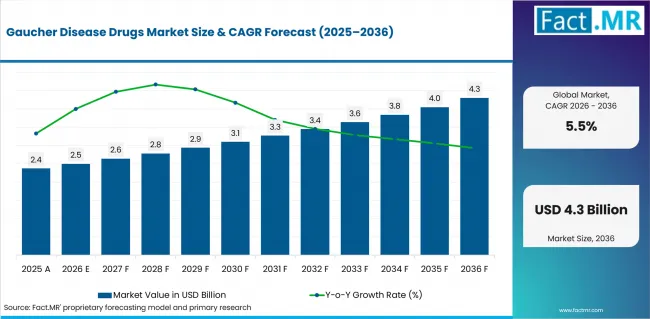
Gaucher Disease Drugs Market Value Analysis | Source: Fact.MR
What are the defining numbers behind Gaucher Disease Drugs Market growth?
A USD 1.8 billion absolute opportunity by 2036 is concentrated in Enzyme Replacement Therapy and Type 1 Gaucher Disease.
- Demand Drivers in the Market
- Long-duration therapy turns confirmed patients into recurring treatment revenue after specialist review.
- Label expansion is expected to bring more patients into documented care without making the market retail driven.
- Hospitals and specialty pharmacies are expected to stay central because therapy needs access checks and follow-up.
- Oral substrate reduction therapy is expected to help selected patients after genotype and interaction review.
- Key Segments Analyzed
- By Product Type: Enzyme Replacement Therapy is projected to hold 58.0% share in 2026 because it has the broadest approved role in Gaucher care.
- By Application: Type 1 Gaucher Disease is anticipated to account for 67.0% share in 2026 because it forms the largest treatable patient group.
- By End User: Hospitals are forecast to hold 42.0% share in 2026 as diagnosis and infusion start in specialist settings.
- Analyst Opinion at Fact.MR
- Shambhu Nath Jha, Principal Consultant at Fact.MR, states, “Revenue capture depends on reimbursed patient pathways and durable therapy delivery. Evidence must match the disease type and route of care. Enzyme replacement providers must protect supply and infusion support. Oral options reduce visits for selected patients, yet eligibility checks keep use narrow.”
- Strategic Implications
- Manufacturers should protect enzyme replacement supply before relying on new indication messaging.
- Development teams should separate systemic Gaucher control from neurological unmet need. This matters for neurological rare disease biologics because brain-directed benefit needs a separate evidence path.
- Commercial teams should treat hospitals, specialty pharmacies and home-infusion partners as one access route.
Germany is expected to record a 6.3% CAGR from 2026 to 2036 through benefit assessment and specialist prescribing. Brazil is projected to record a 5.9% CAGR as protocol-led access shapes care. The USA is anticipated to grow at 5.6% CAGR through hospital and home-infusion channels. Canada is estimated at 5.3% and Australia at 5.0%. The UK is forecast at 4.7% and Japan at 4.1% as national access controls guide use.
How does the Gaucher Disease Drugs Market break down by segment?
Enzyme Replacement Therapy holds 58.0% share in 2026. Type 1 Gaucher Disease accounts for 67.0% share in 2026.
Why does Enzyme Replacement Therapy (ERT) lead Product Type?
Enzyme Replacement Therapy (ERT) is projected to account for 58.0% share in 2026.
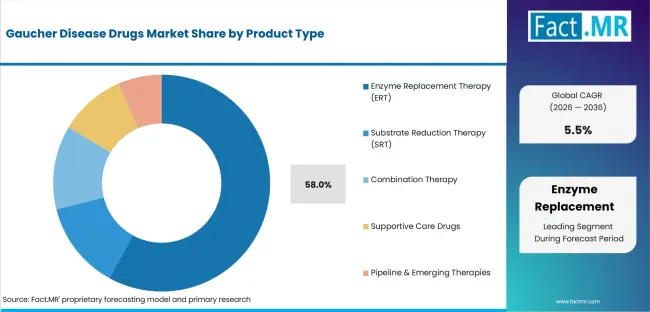
Gaucher Disease Drugs Market Analysis By Product Type | Source: Fact.MR
ERT leads through approved biologic products that replace deficient glucocerebrosidase activity and support systemic disease control. Clinicians adjust dose and frequency against severity and response.
Why does Type 1 Gaucher Disease lead Application?
Type 1 Gaucher Disease is expected to account for 67.0% share in 2026.
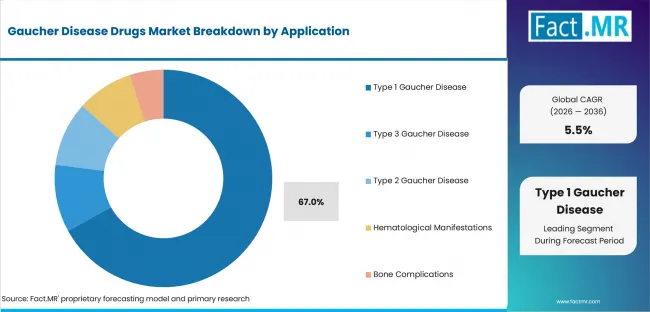
Gaucher Disease Drugs Market Analysis By Application | Source: Fact.MR
Type 1 leads through the largest treatable group and a mature systemic therapy base. Anemia and thrombocytopenia create visible treatment triggers. Bone pain reinforces the need for long-term care. The absence of primary central nervous system involvement makes this application more addressable.
Why does Hospitals lead End User?
Hospitals are anticipated to account for 42.0% share in 2026.
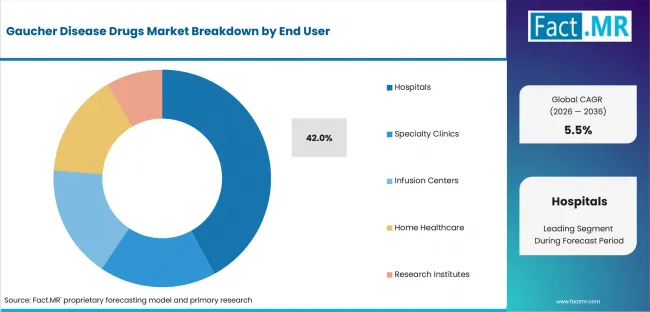
Gaucher Disease Drugs Market Analysis By End User | Source: Fact.MR
Hospitals lead because diagnosis and treatment selection meet in tertiary and specialty settings. Infusion start and emergency readiness make this setting valuable for first-line control. Pharmacy review and laboratory follow-up then support long-term administration.
What is accelerating Gaucher Disease Drugs Market adoption, and what is holding it back?
Treatment eligibility and persistence are expected to support demand. Lifetime cost and administration controls are expected to restrain access. Neuronopathic therapy development creates the most differentiated opening during the forecast period.
Drivers Impact Analysis
| DRIVER | QUALITATIVE RELEVANCE | GEOGRAPHIC RELEVANCE | IMPACT TIMELINE |
|---|---|---|---|
| Treatment eligibility and long-term persistence | High | Germany and USA | Current forecast period |
| Specialist diagnosis and reimbursement review | High | Germany, Canada and UK | Current forecast period |
| Hospital and specialty-pharmacy coordination | Medium | USA and Australia | Current forecast period |
Source: Fact.MR analysis. Updated Aug 4, 2026
- Treatment eligibility and long-term persistence: A confirmed Gaucher patient often stays on therapy after specialist review and funding approval. This makes patient retention more important than short treatment episodes.
- Specialist diagnosis and reimbursement review: Therapy use depends on documented disease type and clinical need. Clear records help payers approve repeat treatment without turning access into open retail demand.
- Hospital and specialty-pharmacy coordination: Care sites and pharmacies share the access task after prescription approval. This coordination protects continuity when patients move from infusion start to repeat supply.
Opportunity Impact Analysis
| OPPORTUNITY | QUALITATIVE RELEVANCE | GEOGRAPHIC RELEVANCE | IMPACT TIMELINE |
|---|---|---|---|
| Neuronopathic therapy development | High | USA and specialist rare-disease centers | Current forecast period |
| Oral therapy for selected patients | Medium | USA and Europe | Current forecast period |
| Home-infusion support for stable patients | Medium | USA, Canada and Australia | Current forecast period |
Source: Fact.MR analysis. Updated Aug 4, 2026
- Neuronopathic therapy development: The main opening is treatment of the neurological component of Type 3 Gaucher disease. Brain-directed benefit needs evidence beyond systemic enzyme replacement response.
- Oral therapy for selected patients: Oral options can reduce visit burden after genotype and interaction checks. The commercial opening remains focused because not every patient is eligible.
- Home-infusion support for stable patients: Homecare can protect persistence after therapy is established. The service route still needs payer approval and safety oversight before it becomes routine.
Restraints Impact Analysis
| RESTRAINT | QUALITATIVE RELEVANCE | GEOGRAPHIC RELEVANCE | IMPACT TIMELINE |
|---|---|---|---|
| Lifetime cost and funded access control | High | USA, UK, Canada and Australia | Current forecast period |
| Infusion staffing and site readiness | Medium | Hospitals and homecare channels | Current forecast period |
| Oral therapy eligibility limits | Medium | Established treatment markets | Current forecast period |
Source: Fact.MR analysis. Updated Aug 4, 2026
- Lifetime cost and funded access control: The main restraint appears between specialist recommendation and repeat use. Payers need proof that the patient fits the approved treatment pathway.
- Infusion staffing and site readiness: Intravenous therapy adds scheduling and monitoring work. Smaller care sites are expected to face slower starts when trained staff are limited.
- Oral therapy eligibility limits: Oral products reduce visit burden for selected patients. Genotype and interaction rules are expected to keep adoption narrower than the full treated base.
Which countries are scaling Gaucher Disease Drugs Market fastest?
- Germany holds the highest listed CAGR because specialist assessment gives new indications a formal review path.
- Brazil follows through public-system authorization where protocol-led care directs treatment decisions.
- The USA grows through parallel hospital, specialty-pharmacy and home-infusion channels.
- Canada remains shaped by provincial review and specialist genetic care.
- Australia depends on specialty medicine access and coordinated rare-disease care.
- The UK relies on nationally coordinated specialist services and formal access terms.
- Japan advances through specialist prescribing and careful product-specific use.
Comparable CAGRs can still create different entry conditions. Treatment timing depends on specialist capacity and funded access. Commercial readiness then reflects pharmacy coordination and homecare support.
The full report provides country-level CAGR analysis across North America; Latin America; Europe; East Asia; South Asia and Pacific; Middle East and Africa.
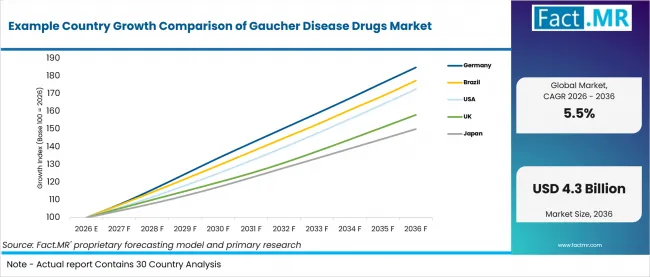
Example Country Growth Comparison Of Gaucher Disease Drugs Market | Source: Fact.MR
| Country | CAGR (2026-2036) |
|---|---|
| Germany | 6.3% |
| Brazil | 5.9% |
| USA | 5.6% |
| Canada | 5.3% |
| Australia | 5.0% |
| UK | 4.7% |
| Japan | 4.1% |
Source: Fact.MR analysis. Updated Aug 4, 2026
What is shaping Germany’s outlook through 2036?
6.3% CAGR, supported by specialist prescribing and structured benefit assessment.
Germany’s growth reflects a treatment system centered on metabolic specialists and formal reimbursement review. Patient access depends on specialist diagnosis, therapy selection and benefit approval before treatment begins. Gaucher disease drug demand is therefore expected to expand steadily as qualified centers manage long-term care.
How is Brazil scaling demand through 2036?
5.9% CAGR, driven by protocol-based specialist care and public-system authorization.
Brazil’s growth is tied to public healthcare pathways that require treatment protocols and specialist approval. Providers must guide patients through diagnosis, authorization and therapy initiation within the public system. Wider uptake is likely to depend on consistent funding and access across specialist centers.
What supports USA adoption from 2026 to 2036?
5.6% CAGR, backed by specialist treatment and multiple therapy-delivery routes.
The USA’s growth reflects care led by metabolic and hematology specialists. Hospital infusion, home infusion and specialty-pharmacy channels give patients several treatment routes. Payer review remains an important access step, so adoption depends on coverage approval and coordinated long-term therapy management.
How does Canada develop demand through 2036?
5.3% CAGR, supported by provincial funding and specialist genetic care.
Canada’s growth is shaped by provincial reimbursement decisions and specialist-led treatment. Hospital infusion programs support therapy initiation after coverage approval. Expansion is expected to remain measured because access conditions can differ across provinces and require careful coordination.
What shapes Australia’s outlook by 2036?
5.0% CAGR, driven by specialist medicine access and coordinated rare-disease services.
Australia’s growth reflects a treatment pathway built around specialist prescribing and organized rare-disease care. Funding approval remains central to therapy access. Once treatment begins, persistence and follow-up become important for maintaining long-term demand.
How does the UK’s access route shape growth?
4.7% CAGR, supported by nationally coordinated specialist services and formal access terms.
The UK’s growth is linked to centralized specialist care and structured prescribing conditions. Patients move through defined treatment pathways before therapy is approved. This coordinated model supports steady demand, although formal access requirements keep uptake controlled.
What defines Japan’s growth path through 2036?
4.1% CAGR, led by specialist centers and product-specific regulatory conditions.
Japan’s growth remains measured because treatment decisions are guided by specialist centers and strict product requirements. Switching between therapies is expected to be cautious, with close patient monitoring throughout care. Regulatory discipline and careful follow-up are likely to shape adoption through 2036.
Who leads the Gaucher Disease Drugs Market?
The market separates enzyme replacement franchises, oral substrate reduction platforms and regional rare-disease companies.
Competition depends on indication breadth and supply continuity. Hospital-facing infrastructure helps because Gaucher care needs specialist diagnosis and follow-up.
Sanofi and Takeda hold the clearest treatment relevance through established Gaucher products. Pfizer and Chiesi remain relevant through rare-disease portfolios and distribution reach. Regional companies such as ISU ABXIS and CANbridge matter where local access and approved products shape sales.
Which companies are the key providers?
Key companies include Sanofi; Takeda Pharmaceutical Company Limited; Pfizer Inc.; ISU ABXIS Co., Ltd.; CANbridge Pharmaceuticals Inc.; Protalix BioTherapeutics.
- Sanofi
- Takeda Pharmaceutical Company Limited
- Pfizer Inc.
- ISU ABXIS Co., Ltd.
- CANbridge Pharmaceuticals Inc.
- Protalix BioTherapeutics
Bibliography
- CANbridge Pharmaceuticals Inc. (2025, May 16). CANbridge Announces Marketing Approval of Velaglucerase-beta for Injection (Gaurunning), a Class 1 New Drug for Treating Type I and III Gaucher Disease, in China.
- Sanofi. (2026, May 28). Sanofi’s venglustat accepted for priority review in the US to treat type 3 Gaucher disease.
- U.S. Food and Drug Administration. (2026, January 12). Search Orphan Drug Designations and Approvals: Imiglucerase.
This Report Answers
- The report provides strategic intelligence on Product Type and Application choices that shape treatment revenue.
- Segment analysis covers Enzyme Replacement Therapy and Type 1 Gaucher Disease as the share leaders within the 2026 market.
- Country outlook evaluates Germany and Brazil alongside the USA. Canada, Australia, the UK and Japan complete the growth comparison.
- Competitive analysis profiles Sanofi and Takeda alongside Pfizer and CANbridge. The remaining companies complete the provider set.
- Access assessment covers hospitals, specialty pharmacies and homecare routes where treatment continuity affects revenue capture.
What does the Gaucher Disease Drugs Market cover?
Gaucher disease drugs are used to treat confirmed Gaucher disease where therapy replaces deficient enzyme activity or reduces substrate buildup.
The Gaucher Disease Drugs Market covers revenue from approved and commercial Gaucher-specific drugs. Coverage includes enzyme replacement therapy and substrate reduction therapy. All three disease types are included where treatment pathways have commercial visibility.
The market differs from general rare-disease treatment because value comes from Gaucher-specific therapy use. Diagnostic testing remains outside the boundary. Infusion service fees and hospital service revenue are excluded. Adjacent-disease drug revenue is excluded unless it has a direct Gaucher treatment route.
What is included in the scope?
Approved branded therapies and commercial regional products are included when they address Gaucher treatment pathways.
The scope includes Product Type and Application alongside End User, Distribution Channel and Route of Administration. It covers Enzyme Replacement Therapy and Substrate Reduction Therapy. It includes Type 1, Type 2 and Type 3 Gaucher Disease.
What is excluded from the scope?
Diagnostic testing revenue and general rare-disease service revenue remain outside the scope of this market.
The scope excludes undocumented compounded products and therapy revenue from adjacent conditions. It excludes infusion service fees, hospital service charges and downstream retail markups. Research grants are excluded unless they create Gaucher-specific drug revenue.
How Was the Analysis Built?
The analysis draws on 120+ sources, 35+ company portfolios, 25+ countries, and more than 20 industry interviews.
- Primary Research: Primary research includes discussions with manufacturers, service providers, technology developers, distributors, end users, procurement teams, and subject-matter experts. These conversations examine purchasing priorities, product adoption, operational challenges, approval requirements, competitive positioning, and the factors that influence wider market acceptance.
- Desk Research: Desk research covers government statistics, regulatory publications, company filings, trade data, technical studies, industry associations, standards, public policy, and other authoritative sources. Every source used in the analysis is documented in the bibliography.
- Market Sizing and Forecasting: Market estimates combine historical performance, demand indicators, pricing and volume trends, segment shares, company participation, country-level growth, adoption patterns, investment activity, and barriers to market expansion.
- Data Validation and Update Cycle: Findings are validated by comparing primary interviews with public data, company activity, regulatory changes, trade patterns, and industry developments. Regular updates review new product launches, capacity changes, partnerships, approvals, procurement trends, and shifts in commercial adoption.
Segmentation
What is the report’s scope and coverage?
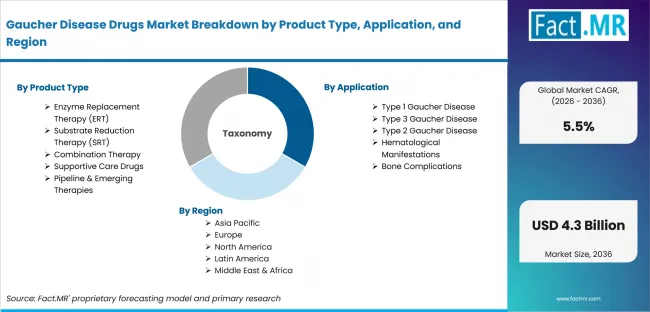
Gaucher Disease Drugs Market Breakdown By Product Type, Application, And Region | Source: Fact.MR
| Attribute | Details |
|---|---|
| Quantitative Units | USD billion in 2026 to USD billion by 2036 at CAGR |
| Market Definition | Revenue from approved Gaucher-specific drugs sold within the stated segmentation universe. |
| Product Type | Enzyme Replacement Therapy; Substrate Reduction Therapy; emerging disease-modifying therapies |
| Application | Type 1 Gaucher Disease; Type 2 Gaucher Disease; Type 3 Gaucher Disease |
| End User | Hospitals; specialty clinics; homecare settings; research institutions |
| Distribution Channel | Hospital pharmacies; specialty pharmacies; retail pharmacies; online pharmacies |
| Route of Administration | Intravenous; oral; other routes of administration |
| Regions Covered | North America; Latin America; Europe; East Asia; South Asia and Pacific; Middle East and Africa |
| Countries Covered | Germany; Brazil; USA; Canada; Australia; UK; Japan |
| Key Companies Profiled | Sanofi; Takeda Pharmaceutical Company Limited; Pfizer Inc.; ISU ABXIS Co., Ltd.; CANbridge Pharmaceuticals Inc.; Protalix BioTherapeutics; Amicus Therapeutics |
| Forecast Period | 2026 to 2036 |
| Approach | Hybrid top-down and bottom-up approach using treatment-eligible populations; therapy mix; dosing frequency; channel access; net-price bands; country-level reimbursement conditions and company portfolio review |
Source: Fact.MR analysis. Updated Aug 4, 2026
How is the market segmented?
-
By Product Type:
- Enzyme Replacement Therapy (ERT)
- Imiglucerase
- Velaglucerase Alfa
- Substrate Reduction Therapy (SRT)
- Eliglustat
- Miglustat
- Combination Therapy
- ERT with Supportive Therapy
- SRT with Supportive Therapy
- Supportive Care Drugs
- Pain Management
- Bone Disease Management
- Pipeline & Emerging Therapies
- Gene Therapy
- Novel Enzyme Therapies
- Enzyme Replacement Therapy (ERT)
-
By Application:
- Type 1 Gaucher Disease
- Treatment-Naïve Patients
- Long-Term Maintenance
- Type 3 Gaucher Disease
- Pediatric Patients
- Adult Patients
- Type 2 Gaucher Disease
- Symptomatic Management
- Palliative Care
- Hematological Manifestations
- Anemia Management
- Thrombocytopenia Management
- Bone Complications
- Bone Pain
- Osteonecrosis
- Type 1 Gaucher Disease
-
By End User:
- Hospitals
- Tertiary Care Hospitals
- Specialty Hospitals
- Specialty Clinics
- Metabolic Disease Clinics
- Genetic Disorder Clinics
- Infusion Centers
- Hospital-Based Infusion Centers
- Independent Infusion Centers
- Home Healthcare
- Home Infusion Services
- Remote Patient Monitoring
- Research Institutes
- Clinical Research Centers
- Academic Medical Centers
- Hospitals
-
By Distribution Channel:
- Hospital Pharmacies
- Inpatient Pharmacies
- Outpatient Hospital Pharmacies
- Specialty Pharmacies
- Rare Disease Pharmacies
- Biologic Drug Pharmacies
- Retail Pharmacies
- Chain Pharmacies
- Independent Pharmacies
- Online Pharmacies
- E-Pharmacy Platforms
- Home Delivery Services
- Government Procurement
- Public Health Programs
- Centralized Purchasing
- Hospital Pharmacies
-
By Route of Administration:
- Intravenous
- Hospital Infusion
- Home Infusion
- Oral
- Capsules
- Tablets
- Subcutaneous
- Self-Administration
- Clinic Administration
- Combination Administration
- Sequential Therapy
- Adjunctive Therapy
- Other Routes
- Clinical Trial Administration
- Emerging Delivery Systems
- Intravenous
-
By Region:
- North America
- Latin America
- Europe
- East Asia
- South Asia and Pacific
- Middle East and Africa
Frequently Asked Questions
Which Product Type leads the market?
Which Application leads the market?
Which End User leads the market?
Which country records the highest listed CAGR?
What is the primary driver in this market?
What is the main restraint?
Who worked on this report


Preview the report firsthand - request a free sample
Free SampleGet the brochure for pricing and purchase details
Download PDF