Disease-modifying MS Therapies Market

Disease-modifying MS Therapies Market Size and Share Forecast Outlook 2026 to 2036

Disease-modifying ms therapies market is projected to grow from USD 30.3 billion in 2026 to USD 56.2 billion by 2036, at a CAGR of 6.4%. Oral therapies will dominate with a 36.1% market share, while relapsing-remitting ms will lead the application segment with a 62.7% share.

Disease-modifying MS Therapies Market Forecast and Outlook 2026 to 2036

The global disease-modifying multiple sclerosis therapies market is projected to grow from USD 30.32 billion in 2026 to USD 56.21 billion by 2036, progressing at a CAGR of 6.4%. The market is driven by the paradigm shift towards early, high-efficacy treatment and the expansion of therapeutic options for progressive forms of MS.

Key Takeaways from the Disease-modifying MS Therapies Market

  • Market Value for 2026: USD 30.32 Billion
  • Market Value for 2036: USD 56.21 Billion
  • Forecast CAGR 2026 to 2036: 6.4%
  • Leading Product Segment (2026): Oral Therapies (36.1%)
  • Leading Application Segment (2026): Relapsing-Remitting MS (62.7%)
  • Leading End-User Segment (2026): Hospital Pharmacies (43.7%)
  • Key Growth Countries: India (8.4% CAGR), China (8.2% CAGR), Brazil (7.9% CAGR), USA (7.3% CAGR), UK (6.3% CAGR), Germany (6.2% CAGR), France (6.1% CAGR)
  • Key Players in the Market: Biogen Inc., F. Hoffmann-La Roche Ltd, Novartis AG, Sanofi, Merck KGaA
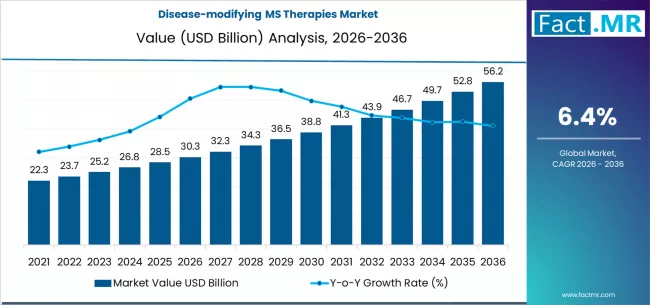
Disease Modifying Ms Therapies Market Market Value Analysis

Oral therapies represent the largest product segment with a 36.1% share, while relapsing-remitting MS is the dominant application at 62.7%. Hospital pharmacies serve as the primary distribution channel, accounting for 43.7% of sales. Geographic growth is led by India at an 8.4% CAGR, followed by China at 8.2%, Brazil at 7.9%, and the USA at 7.3%. Mature European markets show steady growth between 6.1% and 6.3%.

The competitive landscape features key players including Biogen, Roche, Novartis, Sanofi, and Merck KGaA. The market's evolution is characterized by the pursuit of greater treatment efficacy, improved safety profiles, and therapies capable of modifying the long-term progression of disability.

Metric

Metric Value
Market Value (2026) USD 30.32 Billion
Market Forecast Value (2036) USD 56.21 Billion
Forecast CAGR 2026 to 2036 6.4%

Category

Category Segments
Product Oral Therapies, Injectables, Monoclonal Antibodies
Application Relapsing-Remitting MS, Primary Progressive MS, Secondary Progressive MS
End User Hospital Pharmacies, Specialty Neurology Clinics, Retail Pharmacies
Region North America, Latin America, Western Europe, Eastern Europe, East Asia, South Asia & Pacific, Middle East & Africa

Segmental Analysis

By Product, Which Segment is driven by Patient Preference for Convenience?

Disease Modifying Ms Therapies Market Analysis By Product

Oral therapies command a leading 36.1% share, a position driven by strong patient preference for convenience over frequent injections or infusions. This segment's growth is fueled by the adoption of newer oral agents with improved efficacy and safety profiles, allowing for effective disease management outside of clinical settings. Their popularity supports treatment adherence and aligns with a growing focus on patient-centric care in chronic disease management.

By Application, Which Indication Captures the Largest Addressable Patient Population?
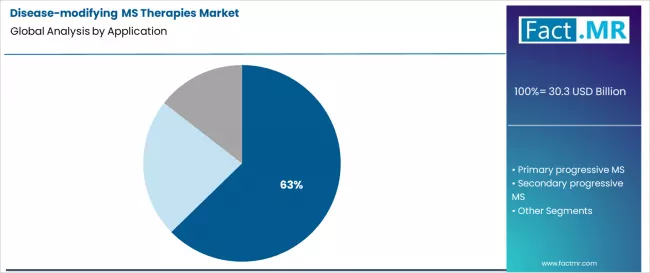
Disease Modifying Ms Therapies Market Analysis By Application

Relapsing-remitting MS constitutes the overwhelming application segment at 62.7%. This form of MS represents the most common diagnosis at disease onset, creating the largest and most immediate patient pool for initiating disease-modifying therapy.

The availability of the widest range of therapeutic options for RRMS, from moderate to high-efficacy agents, consolidates its position as the core driver of treatment volume and innovation.

By End User, Which Channel Manages the Distribution of Complex Specialty Medications?
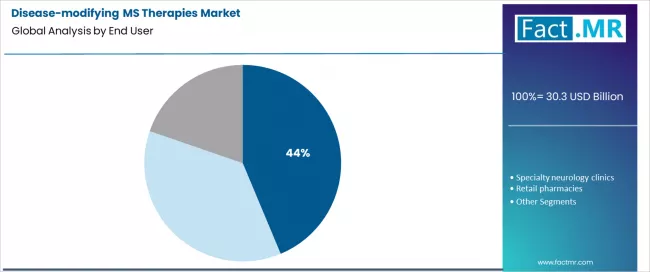
Disease Modifying Ms Therapies Market Analysis By End User

Hospital pharmacies form the dominant end-user segment at 43.7%. This reflects the complex nature of many MS therapies, particularly infused monoclonal antibodies and certain high-risk oral drugs, which require specialist oversight, patient monitoring, and often prior authorization. Hospital pharmacies are logistically equipped to handle the procurement, safe storage, and distribution of these high-cost specialty pharmaceuticals.

What are the Principal Drivers, Constraints, and Evolving Dynamics of this Market?

The primary driver is the established treatment paradigm of early intervention with high-efficacy therapies to prevent long-term disability accumulation, increasing both treatment rates and the use of premium-priced drugs. A significant constraint remains the exceptionally high annual cost of therapy, creating access barriers and imposing substantial burdens on healthcare systems and patients.

A major opportunity lies in the development and approval of effective treatments for primary progressive MS, a area of high unmet need with limited current options. The dominant trend is the intensifying focus on neuroprotection and remyelination as the next therapeutic frontier, moving beyond immunomodulation towards drugs that could potentially repair damage and restore function.

Analysis of the Disease-modifying MS Therapies Market by Key Countries
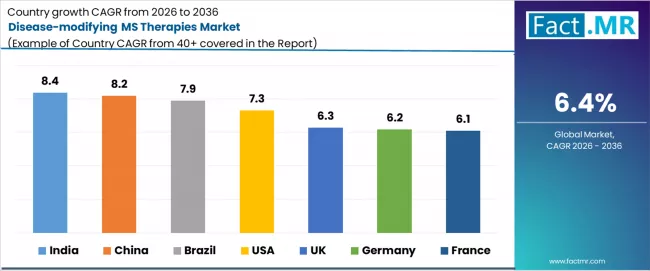
Disease Modifying Ms Therapies Market Cagr Analysis By Country

Country CAGR 2026 to 2036
India 8.4%
China 8.2%
Brazil 7.9%
USA 7.3%
UK 6.3%
Germany 6.2%
France 6.1%

Is the USA's Market Growth Synonymous with Premium-Priced, High-Efficacy Treatment Adoption?

The USA’s 7.3% CAGR is fueled by rapid uptake of the latest high-efficacy therapies, facilitated by a reimbursement environment that, while complex, often supports premium pricing for drugs with superior clinical data. Growth is characterized by a competitive landscape where newer oral and infusion therapies rapidly capture share from older injectables, with treatment decisions heavily influenced by payer formularies and specialist neurologists in hospital-affiliated clinics.

Can Brazil's Public Health System Broaden Access Beyond First-Line Therapies?

Brazil’s 7.9% CAGR is challenged by the need to expand access within its public Unified Health System (SUS). Growth is linked to the government’s capacity to negotiate and incorporate higher-efficacy therapies into public formularies for patients failing first-line treatments. The market progression often follows a tiered-access model, with newer agents available primarily in the private sector before eventual public system inclusion.

Does China's Market Expansion Rely on Improving Diagnosis and Domestic Pipeline Development?

China’s 8.2% CAGR is propelled by rising disease awareness, improving diagnostic capabilities, and the expansion of national reimbursement for several key therapies. A significant growth factor is the active domestic pipeline for biosimilars and novel MS drugs, which promises to increase competition and potentially lower costs, accelerating treatment adoption across a vast and previously underserved patient population.

Will an Evolving Private Healthcare Sector and Generic Entry define India’s Growth?

Its large, young population and a rapidly evolving private healthcare sector in urban centers drive India’s leading 8.4% CAGR. Growth is catalyzed by the increasing availability of key generics and biosimilars for older injectable therapies, making foundational treatment more accessible. The market is bifurcated, with premium private neurology centers adopting global-standard therapies while broader access gradually improves.

Is Germany's Guideline-Driven System Prioritizing Treatment Sequencing and Safety Data?

Germany’s 6.2% CAGR operates within a structured framework defined by neurological society guidelines. Growth is methodical, with new therapies adopted based on robust long-term safety and efficacy data relative to existing standards. The market emphasizes optimal treatment sequencing and is highly receptive to therapies offering superior convenience (e.g., extended dosing intervals) within its rigorous health technology assessment process.

Does France's Focus on Long-Term Real-World Evidence Shape Its Adoption Timeline?

France’s 6.1% CAGR is influenced by its requirement for demonstrated real-world effectiveness and long-term safety post-launch. This can slow initial uptake compared to other regions, as the market awaits data from French patient registries. Growth is steady and selective, with a strong emphasis on therapeutic value as assessed by the Haute Autorité de Santé, favoring treatments with sustainable benefit-risk profiles.

Is the UK's Cost-Effectiveness Hurdle the Primary Gatekeeper for New Therapy Access?

The UK’s 6.3% CAGR is fundamentally governed by cost-effectiveness assessments from the National Institute for Health and Care Excellence (NICE). Market growth for new, high-cost therapies is contingent on demonstrating sufficient quality-adjusted life year (QALY) gains to justify their price within the National Health Service (NHS) budget, often leading to restricted access or patient access schemes for the most expensive agents.

Competitive Landscape of the Disease-modifying MS Therapies Market

Disease Modifying Ms Therapies Market Analysis By Company

The competitive landscape is characterized by intense rivalry between established biotechnology firms and large pharmaceutical companies. Leaders compete through continuous life-cycle management of existing blockbusters, seeking label expansions into progressive MS or sub-populations, and by developing next-generation therapies with improved dosing or safety. A key competitive front is the development of therapies with neuroprotective or remyelination potential, which represent a paradigm shift beyond current immunomodulatory mechanisms.

Success increasingly depends on building comprehensive MS portfolios that cover the entire treatment continuum, from first-line options to high-efficacy therapies for aggressive disease. Strategic partnerships with academic institutions for biomarker discovery and with diagnostic companies for companion tests are becoming crucial. Differentiating products through superior long-term data, patient support programs, and demonstrating value to cost-constrained payers in key markets are essential strategies for maintaining market share.

Key Players in the Disease-modifying MS Therapies Market

  • Biogen Inc.
  • F. Hoffmann-La Roche Ltd
  • Novartis AG
  • Sanofi S.A.
  • Merck KGaA
  • Others

Scope of Report

Items Metrics
Quantitative Units USD Billion
Product Oral Therapies, Injectables, Monoclonal Antibodies
Application Relapsing-Remitting MS, Primary Progressive MS, Secondary Progressive MS
End User Hospital Pharmacies, Specialty Neurology Clinics, Retail Pharmacies
Key Countries India, China, Brazil, USA, Germany, France, UK
Key Companies Biogen, Roche, Novartis, Sanofi, Merck KGaA, Others
Additional Analysis Comparative analysis of treatment escalation versus early high-efficacy strategy outcomes; impact of MRI monitoring on therapy switching and market dynamics; pharmacoeconomic burden of MS; analysis of patient adherence drivers across different therapy modes.

Market by Segments

  • Product :

    • Oral Therapies
    • Injectables
    • Monoclonal Antibodies
  • Application :

    • Relapsing-Remitting MS
    • Primary Progressive MS
    • Secondary Progressive MS
  • End User :

    • Hospital Pharmacies
    • Specialty Neurology Clinics
    • Retail Pharmacies
  • Region :

    • North America

      • USA
      • Canada
    • Latin America

      • Brazil
      • Mexico
      • Argentina
      • Rest of Latin America
    • Western Europe

      • Germany
      • France
      • UK
      • Italy
      • Spain
      • BENELUX
      • Rest of Western Europe
    • Eastern Europe

      • Russia
      • Poland
      • Czech Republic
      • Rest of Eastern Europe
    • East Asia

      • China
      • Japan
      • South Korea
      • Rest of East Asia
    • South Asia & Pacific

      • India
      • ASEAN
      • Australia
      • Rest of South Asia & Pacific
    • MEA

      • GCC Countries
      • South Africa
      • Turkiye
      • Rest of MEA

Bibliography

  • European Committee for Treatment and Research in Multiple Sclerosis (ECTRIMS). (2025). Clinical Guidelines for the Use of Disease-Modifying Therapies in Multiple Sclerosis.
  • Multiple Sclerosis International Federation (MSIF). (2024). Atlas of MS: Global Epidemiology and Treatment Access.
  • National Multiple Sclerosis Society (USA). (2025). Disease Management Consensus Recommendations.
  • The Lancet Neurology. (2024). Series on the Future of MS Therapy: Beyond Immunomodulation.

Table of Content

  1. Executive Summary
    • Global Market Outlook
    • Demand to side Trends
    • Supply to side Trends
    • Technology Roadmap Analysis
    • Analysis and Recommendations
  2. Market Overview
    • Market Coverage / Taxonomy
    • Market Definition / Scope / Limitations
  3. Market Background
    • Market Dynamics
      • Drivers
      • Restraints
      • Opportunity
      • Trends
    • Scenario Forecast
      • Demand in Optimistic Scenario
      • Demand in Likely Scenario
      • Demand in Conservative Scenario
    • Opportunity Map Analysis
    • Product Life Cycle Analysis
    • Supply Chain Analysis
    • Investment Feasibility Matrix
    • Value Chain Analysis
    • PESTLE and Porter’s Analysis
    • Regulatory Landscape
    • Regional Parent Market Outlook
    • Production and Consumption Statistics
    • Import and Export Statistics
  4. Global Market Analysis 2021 to 2025 and Forecast, 2026 to 2036
    • Historical Market Size Value (USD Million) Analysis, 2021 to 2025
    • Current and Future Market Size Value (USD Million) Projections, 2026 to 2036
      • Y to o to Y Growth Trend Analysis
      • Absolute $ Opportunity Analysis
  5. Global Market Pricing Analysis 2021 to 2025 and Forecast 2026 to 2036
  6. Global Market Analysis 2021 to 2025 and Forecast 2026 to 2036, By Product
    • Introduction / Key Findings
    • Historical Market Size Value (USD Million) Analysis By Product, 2021 to 2025
    • Current and Future Market Size Value (USD Million) Analysis and Forecast By Product, 2026 to 2036
      • Oral therapies
      • Injectables
      • Monoclonal antibodies
    • Y to o to Y Growth Trend Analysis By Product, 2021 to 2025
    • Absolute $ Opportunity Analysis By Product, 2026 to 2036
  7. Global Market Analysis 2021 to 2025 and Forecast 2026 to 2036, By Application
    • Introduction / Key Findings
    • Historical Market Size Value (USD Million) Analysis By Application, 2021 to 2025
    • Current and Future Market Size Value (USD Million) Analysis and Forecast By Application, 2026 to 2036
      • Relapsing-remitting MS
      • Primary progressive MS
      • Secondary progressive MS
    • Y to o to Y Growth Trend Analysis By Application, 2021 to 2025
    • Absolute $ Opportunity Analysis By Application, 2026 to 2036
  8. Global Market Analysis 2021 to 2025 and Forecast 2026 to 2036, By End User
    • Introduction / Key Findings
    • Historical Market Size Value (USD Million) Analysis By End User, 2021 to 2025
    • Current and Future Market Size Value (USD Million) Analysis and Forecast By End User, 2026 to 2036
      • Hospital pharmacies
      • Specialty neurology clinics
      • Retail pharmacies
    • Y to o to Y Growth Trend Analysis By End User, 2021 to 2025
    • Absolute $ Opportunity Analysis By End User, 2026 to 2036
  9. Global Market Analysis 2021 to 2025 and Forecast 2026 to 2036, By Region
    • Introduction
    • Historical Market Size Value (USD Million) Analysis By Region, 2021 to 2025
    • Current Market Size Value (USD Million) Analysis and Forecast By Region, 2026 to 2036
      • North America
      • Latin America
      • Western Europe
      • Eastern Europe
      • East Asia
      • South Asia and Pacific
      • Middle East & Africa
    • Market Attractiveness Analysis By Region
  10. North America Market Analysis 2021 to 2025 and Forecast 2026 to 2036, By Country
    • Historical Market Size Value (USD Million) Trend Analysis By Market Taxonomy, 2021 to 2025
    • Market Size Value (USD Million) Forecast By Market Taxonomy, 2026 to 2036
      • By Country
        • USA
        • Canada
        • Mexico
      • By Product
      • By Application
      • By End User
    • Market Attractiveness Analysis
      • By Country
      • By Product
      • By Application
      • By End User
    • Key Takeaways
  11. Latin America Market Analysis 2021 to 2025 and Forecast 2026 to 2036, By Country
    • Historical Market Size Value (USD Million) Trend Analysis By Market Taxonomy, 2021 to 2025
    • Market Size Value (USD Million) Forecast By Market Taxonomy, 2026 to 2036
      • By Country
        • Brazil
        • Chile
        • Rest of Latin America
      • By Product
      • By Application
      • By End User
    • Market Attractiveness Analysis
      • By Country
      • By Product
      • By Application
      • By End User
    • Key Takeaways
  12. Western Europe Market Analysis 2021 to 2025 and Forecast 2026 to 2036, By Country
    • Historical Market Size Value (USD Million) Trend Analysis By Market Taxonomy, 2021 to 2025
    • Market Size Value (USD Million) Forecast By Market Taxonomy, 2026 to 2036
      • By Country
        • Germany
        • UK
        • Italy
        • Spain
        • France
        • Nordic
        • BENELUX
        • Rest of Western Europe
      • By Product
      • By Application
      • By End User
    • Market Attractiveness Analysis
      • By Country
      • By Product
      • By Application
      • By End User
    • Key Takeaways
  13. Eastern Europe Market Analysis 2021 to 2025 and Forecast 2026 to 2036, By Country
    • Historical Market Size Value (USD Million) Trend Analysis By Market Taxonomy, 2021 to 2025
    • Market Size Value (USD Million) Forecast By Market Taxonomy, 2026 to 2036
      • By Country
        • Russia
        • Poland
        • Hungary
        • Balkan & Baltic
        • Rest of Eastern Europe
      • By Product
      • By Application
      • By End User
    • Market Attractiveness Analysis
      • By Country
      • By Product
      • By Application
      • By End User
    • Key Takeaways
  14. East Asia Market Analysis 2021 to 2025 and Forecast 2026 to 2036, By Country
    • Historical Market Size Value (USD Million) Trend Analysis By Market Taxonomy, 2021 to 2025
    • Market Size Value (USD Million) Forecast By Market Taxonomy, 2026 to 2036
      • By Country
        • China
        • Japan
        • South Korea
      • By Product
      • By Application
      • By End User
    • Market Attractiveness Analysis
      • By Country
      • By Product
      • By Application
      • By End User
    • Key Takeaways
  15. South Asia and Pacific Market Analysis 2021 to 2025 and Forecast 2026 to 2036, By Country
    • Historical Market Size Value (USD Million) Trend Analysis By Market Taxonomy, 2021 to 2025
    • Market Size Value (USD Million) Forecast By Market Taxonomy, 2026 to 2036
      • By Country
        • India
        • ASEAN
        • Australia & New Zealand
        • Rest of South Asia and Pacific
      • By Product
      • By Application
      • By End User
    • Market Attractiveness Analysis
      • By Country
      • By Product
      • By Application
      • By End User
    • Key Takeaways
  16. Middle East & Africa Market Analysis 2021 to 2025 and Forecast 2026 to 2036, By Country
    • Historical Market Size Value (USD Million) Trend Analysis By Market Taxonomy, 2021 to 2025
    • Market Size Value (USD Million) Forecast By Market Taxonomy, 2026 to 2036
      • By Country
        • Kingdom of Saudi Arabia
        • Other GCC Countries
        • Turkiye
        • South Africa
        • Other African Union
        • Rest of Middle East & Africa
      • By Product
      • By Application
      • By End User
    • Market Attractiveness Analysis
      • By Country
      • By Product
      • By Application
      • By End User
    • Key Takeaways
  17. Key Countries Market Analysis
    • USA
      • Pricing Analysis
      • Market Share Analysis, 2025
        • By Product
        • By Application
        • By End User
    • Canada
      • Pricing Analysis
      • Market Share Analysis, 2025
        • By Product
        • By Application
        • By End User
    • Mexico
      • Pricing Analysis
      • Market Share Analysis, 2025
        • By Product
        • By Application
        • By End User
    • Brazil
      • Pricing Analysis
      • Market Share Analysis, 2025
        • By Product
        • By Application
        • By End User
    • Chile
      • Pricing Analysis
      • Market Share Analysis, 2025
        • By Product
        • By Application
        • By End User
    • Germany
      • Pricing Analysis
      • Market Share Analysis, 2025
        • By Product
        • By Application
        • By End User
    • UK
      • Pricing Analysis
      • Market Share Analysis, 2025
        • By Product
        • By Application
        • By End User
    • Italy
      • Pricing Analysis
      • Market Share Analysis, 2025
        • By Product
        • By Application
        • By End User
    • Spain
      • Pricing Analysis
      • Market Share Analysis, 2025
        • By Product
        • By Application
        • By End User
    • France
      • Pricing Analysis
      • Market Share Analysis, 2025
        • By Product
        • By Application
        • By End User
    • India
      • Pricing Analysis
      • Market Share Analysis, 2025
        • By Product
        • By Application
        • By End User
    • ASEAN
      • Pricing Analysis
      • Market Share Analysis, 2025
        • By Product
        • By Application
        • By End User
    • Australia & New Zealand
      • Pricing Analysis
      • Market Share Analysis, 2025
        • By Product
        • By Application
        • By End User
    • China
      • Pricing Analysis
      • Market Share Analysis, 2025
        • By Product
        • By Application
        • By End User
    • Japan
      • Pricing Analysis
      • Market Share Analysis, 2025
        • By Product
        • By Application
        • By End User
    • South Korea
      • Pricing Analysis
      • Market Share Analysis, 2025
        • By Product
        • By Application
        • By End User
    • Russia
      • Pricing Analysis
      • Market Share Analysis, 2025
        • By Product
        • By Application
        • By End User
    • Poland
      • Pricing Analysis
      • Market Share Analysis, 2025
        • By Product
        • By Application
        • By End User
    • Hungary
      • Pricing Analysis
      • Market Share Analysis, 2025
        • By Product
        • By Application
        • By End User
    • Kingdom of Saudi Arabia
      • Pricing Analysis
      • Market Share Analysis, 2025
        • By Product
        • By Application
        • By End User
    • Turkiye
      • Pricing Analysis
      • Market Share Analysis, 2025
        • By Product
        • By Application
        • By End User
    • South Africa
      • Pricing Analysis
      • Market Share Analysis, 2025
        • By Product
        • By Application
        • By End User
  18. Market Structure Analysis
    • Competition Dashboard
    • Competition Benchmarking
    • Market Share Analysis of Top Players
      • By Regional
      • By Product
      • By Application
      • By End User
  19. Competition Analysis
    • Competition Deep Dive
      • Biogen Inc.
        • Overview
        • Product Portfolio
        • Profitability by Market Segments (Product/Age /Sales Channel/Region)
        • Sales Footprint
        • Strategy Overview
          • Marketing Strategy
          • Product Strategy
          • Channel Strategy
      • F. Hoffmann-La Roche Ltd
      • Novartis AG
      • Sanofi S.A.
      • Merck KGaA
      • Others
  20. Assumptions & Acronyms Used
  21. Research Methodology

List Of Table

  • Table 1: Global Market Value (USD Million) Forecast by Region, 2021 to 2036
  • Table 2: Global Market Value (USD Million) Forecast by Product, 2021 to 2036
  • Table 3: Global Market Value (USD Million) Forecast by Application, 2021 to 2036
  • Table 4: Global Market Value (USD Million) Forecast by End User, 2021 to 2036
  • Table 5: North America Market Value (USD Million) Forecast by Country, 2021 to 2036
  • Table 6: North America Market Value (USD Million) Forecast by Product, 2021 to 2036
  • Table 7: North America Market Value (USD Million) Forecast by Application, 2021 to 2036
  • Table 8: North America Market Value (USD Million) Forecast by End User, 2021 to 2036
  • Table 9: Latin America Market Value (USD Million) Forecast by Country, 2021 to 2036
  • Table 10: Latin America Market Value (USD Million) Forecast by Product, 2021 to 2036
  • Table 11: Latin America Market Value (USD Million) Forecast by Application, 2021 to 2036
  • Table 12: Latin America Market Value (USD Million) Forecast by End User, 2021 to 2036
  • Table 13: Western Europe Market Value (USD Million) Forecast by Country, 2021 to 2036
  • Table 14: Western Europe Market Value (USD Million) Forecast by Product, 2021 to 2036
  • Table 15: Western Europe Market Value (USD Million) Forecast by Application, 2021 to 2036
  • Table 16: Western Europe Market Value (USD Million) Forecast by End User, 2021 to 2036
  • Table 17: Eastern Europe Market Value (USD Million) Forecast by Country, 2021 to 2036
  • Table 18: Eastern Europe Market Value (USD Million) Forecast by Product, 2021 to 2036
  • Table 19: Eastern Europe Market Value (USD Million) Forecast by Application, 2021 to 2036
  • Table 20: Eastern Europe Market Value (USD Million) Forecast by End User, 2021 to 2036
  • Table 21: East Asia Market Value (USD Million) Forecast by Country, 2021 to 2036
  • Table 22: East Asia Market Value (USD Million) Forecast by Product, 2021 to 2036
  • Table 23: East Asia Market Value (USD Million) Forecast by Application, 2021 to 2036
  • Table 24: East Asia Market Value (USD Million) Forecast by End User, 2021 to 2036
  • Table 25: South Asia and Pacific Market Value (USD Million) Forecast by Country, 2021 to 2036
  • Table 26: South Asia and Pacific Market Value (USD Million) Forecast by Product, 2021 to 2036
  • Table 27: South Asia and Pacific Market Value (USD Million) Forecast by Application, 2021 to 2036
  • Table 28: South Asia and Pacific Market Value (USD Million) Forecast by End User, 2021 to 2036
  • Table 29: Middle East & Africa Market Value (USD Million) Forecast by Country, 2021 to 2036
  • Table 30: Middle East & Africa Market Value (USD Million) Forecast by Product, 2021 to 2036
  • Table 31: Middle East & Africa Market Value (USD Million) Forecast by Application, 2021 to 2036
  • Table 32: Middle East & Africa Market Value (USD Million) Forecast by End User, 2021 to 2036

List Of Figures

  • Figure 1: Global Market Pricing Analysis
  • Figure 2: Global Market Value (USD Million) Forecast 2021 to 2036
  • Figure 3: Global Market Value Share and BPS Analysis by Product, 2026 and 2036
  • Figure 4: Global Market Y to o to Y Growth Comparison by Product, 2026 to 2036
  • Figure 5: Global Market Attractiveness Analysis by Product
  • Figure 6: Global Market Value Share and BPS Analysis by Application, 2026 and 2036
  • Figure 7: Global Market Y to o to Y Growth Comparison by Application, 2026 to 2036
  • Figure 8: Global Market Attractiveness Analysis by Application
  • Figure 9: Global Market Value Share and BPS Analysis by End User, 2026 and 2036
  • Figure 10: Global Market Y to o to Y Growth Comparison by End User, 2026 to 2036
  • Figure 11: Global Market Attractiveness Analysis by End User
  • Figure 12: Global Market Value (USD Million) Share and BPS Analysis by Region, 2026 and 2036
  • Figure 13: Global Market Y to o to Y Growth Comparison by Region, 2026 to 2036
  • Figure 14: Global Market Attractiveness Analysis by Region
  • Figure 15: North America Market Incremental Dollar Opportunity, 2026 to 2036
  • Figure 16: Latin America Market Incremental Dollar Opportunity, 2026 to 2036
  • Figure 17: Western Europe Market Incremental Dollar Opportunity, 2026 to 2036
  • Figure 18: Eastern Europe Market Incremental Dollar Opportunity, 2026 to 2036
  • Figure 19: East Asia Market Incremental Dollar Opportunity, 2026 to 2036
  • Figure 20: South Asia and Pacific Market Incremental Dollar Opportunity, 2026 to 2036
  • Figure 21: Middle East & Africa Market Incremental Dollar Opportunity, 2026 to 2036
  • Figure 22: North America Market Value Share and BPS Analysis by Country, 2026 and 2036
  • Figure 23: North America Market Value Share and BPS Analysis by Product, 2026 and 2036
  • Figure 24: North America Market Y to o to Y Growth Comparison by Product, 2026 to 2036
  • Figure 25: North America Market Attractiveness Analysis by Product
  • Figure 26: North America Market Value Share and BPS Analysis by Application, 2026 and 2036
  • Figure 27: North America Market Y to o to Y Growth Comparison by Application, 2026 to 2036
  • Figure 28: North America Market Attractiveness Analysis by Application
  • Figure 29: North America Market Value Share and BPS Analysis by End User, 2026 and 2036
  • Figure 30: North America Market Y to o to Y Growth Comparison by End User, 2026 to 2036
  • Figure 31: North America Market Attractiveness Analysis by End User
  • Figure 32: Latin America Market Value Share and BPS Analysis by Country, 2026 and 2036
  • Figure 33: Latin America Market Value Share and BPS Analysis by Product, 2026 and 2036
  • Figure 34: Latin America Market Y to o to Y Growth Comparison by Product, 2026 to 2036
  • Figure 35: Latin America Market Attractiveness Analysis by Product
  • Figure 36: Latin America Market Value Share and BPS Analysis by Application, 2026 and 2036
  • Figure 37: Latin America Market Y to o to Y Growth Comparison by Application, 2026 to 2036
  • Figure 38: Latin America Market Attractiveness Analysis by Application
  • Figure 39: Latin America Market Value Share and BPS Analysis by End User, 2026 and 2036
  • Figure 40: Latin America Market Y to o to Y Growth Comparison by End User, 2026 to 2036
  • Figure 41: Latin America Market Attractiveness Analysis by End User
  • Figure 42: Western Europe Market Value Share and BPS Analysis by Country, 2026 and 2036
  • Figure 43: Western Europe Market Value Share and BPS Analysis by Product, 2026 and 2036
  • Figure 44: Western Europe Market Y to o to Y Growth Comparison by Product, 2026 to 2036
  • Figure 45: Western Europe Market Attractiveness Analysis by Product
  • Figure 46: Western Europe Market Value Share and BPS Analysis by Application, 2026 and 2036
  • Figure 47: Western Europe Market Y to o to Y Growth Comparison by Application, 2026 to 2036
  • Figure 48: Western Europe Market Attractiveness Analysis by Application
  • Figure 49: Western Europe Market Value Share and BPS Analysis by End User, 2026 and 2036
  • Figure 50: Western Europe Market Y to o to Y Growth Comparison by End User, 2026 to 2036
  • Figure 51: Western Europe Market Attractiveness Analysis by End User
  • Figure 52: Eastern Europe Market Value Share and BPS Analysis by Country, 2026 and 2036
  • Figure 53: Eastern Europe Market Value Share and BPS Analysis by Product, 2026 and 2036
  • Figure 54: Eastern Europe Market Y to o to Y Growth Comparison by Product, 2026 to 2036
  • Figure 55: Eastern Europe Market Attractiveness Analysis by Product
  • Figure 56: Eastern Europe Market Value Share and BPS Analysis by Application, 2026 and 2036
  • Figure 57: Eastern Europe Market Y to o to Y Growth Comparison by Application, 2026 to 2036
  • Figure 58: Eastern Europe Market Attractiveness Analysis by Application
  • Figure 59: Eastern Europe Market Value Share and BPS Analysis by End User, 2026 and 2036
  • Figure 60: Eastern Europe Market Y to o to Y Growth Comparison by End User, 2026 to 2036
  • Figure 61: Eastern Europe Market Attractiveness Analysis by End User
  • Figure 62: East Asia Market Value Share and BPS Analysis by Country, 2026 and 2036
  • Figure 63: East Asia Market Value Share and BPS Analysis by Product, 2026 and 2036
  • Figure 64: East Asia Market Y to o to Y Growth Comparison by Product, 2026 to 2036
  • Figure 65: East Asia Market Attractiveness Analysis by Product
  • Figure 66: East Asia Market Value Share and BPS Analysis by Application, 2026 and 2036
  • Figure 67: East Asia Market Y to o to Y Growth Comparison by Application, 2026 to 2036
  • Figure 68: East Asia Market Attractiveness Analysis by Application
  • Figure 69: East Asia Market Value Share and BPS Analysis by End User, 2026 and 2036
  • Figure 70: East Asia Market Y to o to Y Growth Comparison by End User, 2026 to 2036
  • Figure 71: East Asia Market Attractiveness Analysis by End User
  • Figure 72: South Asia and Pacific Market Value Share and BPS Analysis by Country, 2026 and 2036
  • Figure 73: South Asia and Pacific Market Value Share and BPS Analysis by Product, 2026 and 2036
  • Figure 74: South Asia and Pacific Market Y to o to Y Growth Comparison by Product, 2026 to 2036
  • Figure 75: South Asia and Pacific Market Attractiveness Analysis by Product
  • Figure 76: South Asia and Pacific Market Value Share and BPS Analysis by Application, 2026 and 2036
  • Figure 77: South Asia and Pacific Market Y to o to Y Growth Comparison by Application, 2026 to 2036
  • Figure 78: South Asia and Pacific Market Attractiveness Analysis by Application
  • Figure 79: South Asia and Pacific Market Value Share and BPS Analysis by End User, 2026 and 2036
  • Figure 80: South Asia and Pacific Market Y to o to Y Growth Comparison by End User, 2026 to 2036
  • Figure 81: South Asia and Pacific Market Attractiveness Analysis by End User
  • Figure 82: Middle East & Africa Market Value Share and BPS Analysis by Country, 2026 and 2036
  • Figure 83: Middle East & Africa Market Value Share and BPS Analysis by Product, 2026 and 2036
  • Figure 84: Middle East & Africa Market Y to o to Y Growth Comparison by Product, 2026 to 2036
  • Figure 85: Middle East & Africa Market Attractiveness Analysis by Product
  • Figure 86: Middle East & Africa Market Value Share and BPS Analysis by Application, 2026 and 2036
  • Figure 87: Middle East & Africa Market Y to o to Y Growth Comparison by Application, 2026 to 2036
  • Figure 88: Middle East & Africa Market Attractiveness Analysis by Application
  • Figure 89: Middle East & Africa Market Value Share and BPS Analysis by End User, 2026 and 2036
  • Figure 90: Middle East & Africa Market Y to o to Y Growth Comparison by End User, 2026 to 2036
  • Figure 91: Middle East & Africa Market Attractiveness Analysis by End User
  • Figure 92: Global Market - Tier Structure Analysis
  • Figure 93: Global Market - Company Share Analysis

- FAQs -

How big is the disease-modifying ms therapies market in 2026?

The global disease-modifying ms therapies market is estimated to be valued at USD 30.3 billion in 2026.

What will be the size of disease-modifying ms therapies market in 2036?

The market size for the disease-modifying ms therapies market is projected to reach USD 56.2 billion by 2036.

How much will be the disease-modifying ms therapies market growth between 2026 and 2036?

The disease-modifying ms therapies market is expected to grow at a 6.4% CAGR between 2026 and 2036.

What are the key product types in the disease-modifying ms therapies market?

The key product types in disease-modifying ms therapies market are oral therapies, injectables and monoclonal antibodies.

Which application segment to contribute significant share in the disease-modifying ms therapies market in 2026?

In terms of application, relapsing-remitting ms segment to command 62.7% share in the disease-modifying ms therapies market in 2026.

Disease-modifying MS Therapies Market