- Market Value (2025): USD 546.2 Mn
- Estimated Value (2026): USD 587.7 Mn
- Forecast Value (2036): USD 1222.6 Mn
- CAGR (2026-2036): 7.6%
What is the Rare Disease Research Genomics Services Market forecast to be worth by 2036?
USD 587.7 million in 2026 to USD 1,222.6 million by 2036 at 7.6% CAGR.
- The rare disease research genomics services market crossed a valuation of USD 546.2 million in 2025, supported by research programs and specialist diagnostic pathways.
- Demand is projected to increase from USD 587.7 million in 2026 to USD 1,222.6 million by 2036.
- The market is forecast to record a 7.6% CAGR from 2026 to 2036 as service providers connect sequencing with phenotype review and defensible variant interpretation.
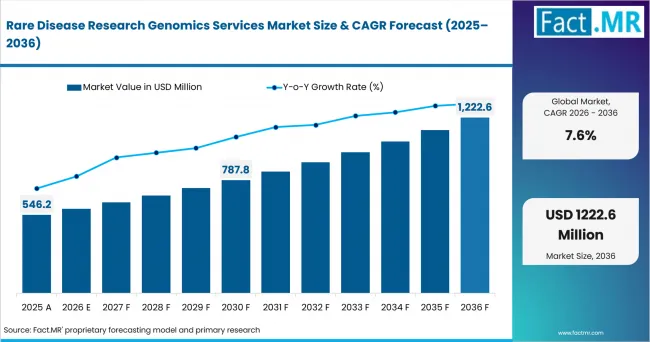
Rare Disease Research Genomics Services Market Value Analysis | Source: Fact.MR
What are the defining numbers behind Rare Disease Research Genomics Services Market growth?
USD 634.9 million absolute opportunity by 2036, led by Whole Genome Sequencing and Rare Genetic Disorders alongside Pharmaceutical & Biotechnology Companies.
- Demand Drivers in the Market
- Research sponsors look for sequencing results that prevent repeated tests with little value. The report should also show how the genetic finding leads to the next research or care decision.
- Clinical research staffs get a clearer picture when patient symptoms and family history are reviewed together. RNA findings and checks for larger DNA changes can help solve cases that remain unclear after the first test.
- Pharmaceutical and biotechnology companies use patient-group studies and long-term disease records to link genetic findings with drug targets and clinical trial plans.
- Data-sharing groups work best when laboratories and hospitals describe symptoms and genetic findings in the same way. Matching cases across countries can also help when only a small number of patients are available.
- Key Segments Analyzed
- By Service Type: Whole Genome Sequencing is expected to hold 25.0% share in 2026 because broad variant coverage suits unresolved cases.
- By Disease Category: Rare Genetic Disorders are projected to account for 25.0% share in 2026 owing to direct use in molecular diagnosis and inherited-condition research.
- By Technology: Next-Generation Sequencing (NGS) is anticipated to capture 25.0% share in 2026 due to its role across genome and exome workflows. Panel and transcriptome work add further use.
- By End User: Pharmaceutical & Biotechnology Companies are estimated to represent 30.0% share in 2026 attributable to target discovery and cohort design. Trial-support needs add further demand.
- Analyst Opinion at Fact.MR
- Shambhu Nath Jha, Senior Analyst at Fact.MR, states, “Rare-disease research clients judge genetic testing providers by how often they help solve difficult cases and guide research decisions. Partners that review patient symptoms, family history and larger DNA changes are likely to see wider use. Providers can add further value by checking unresolved cases again when new medical evidence becomes available.”
- Strategic Implications
- Service providers can set clear rules before taking a case. These rules should explain how uncertain findings will be handled and which results will be shared.
- Research sponsors benefit from funding data analysis and genetic counseling along with sequencing. Follow-up studies can then show whether the finding has real value.
- Laboratories should keep notes on data quality and the reasons an earlier case remained unsolved. This makes a later review more accurate when new evidence appears.
- Research groups can use the same terms for patient symptoms and follow common rules for sharing data. This helps combine evidence from different sites when patient numbers are small.
Germany is projected to record a 10.3% CAGR from 2026 to 2036 driven by specialist referral capacity and European research networks. Brazil is anticipated to post a 9.5% CAGR by 2036 supported by public-private genomics activity. The USA is expected to advance at an 8.7% CAGR through 2036 owing to specialized laboratories and sponsor-funded programmes. South Korea is estimated to record an 8.0% CAGR from 2026 to 2036 as concentrated hospital systems support data-rich research. The United Kingdom is forecast to expand at a 7.2% CAGR by 2036 through national genomic pathways and coordinated laboratory networks.
How does the Rare Disease Research Genomics Services Market break down by segment?
Whole Genome Sequencing leads at 25.0% by Service Type, Rare Genetic Disorders lead at 25.0% by Disease Category in 2026.
Which Service Type dominates?
Whole Genome Sequencing holds 25.0% share in 2026.
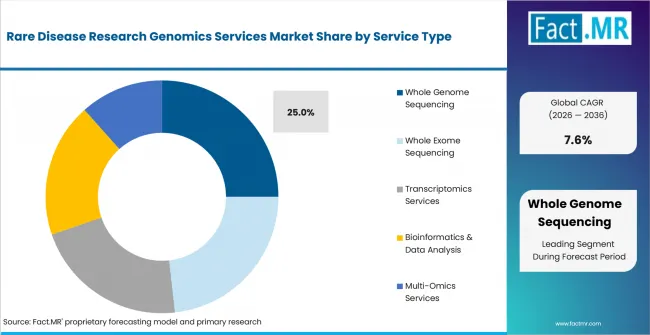
Rare Disease Research Genomics Services Market Analysis By Service Type | Source: Fact.MR
Whole Genome Sequencing gives laboratories a wider view of the patient’s DNA, including areas outside genes. This is useful in rare-disease cases where standard tests fail to explain the cause. Whole Exome Sequencing remains a lower-cost option for cases focused on gene regions. Transcriptomics Services help show how genes are working. Bioinformatics & Data Analysis helps review the findings, while Multi-Omics Services brings several types of biological data together when one test is not enough.
What leads the Disease Category segment?
Rare Genetic Disorders account for 25.0% share in 2026.
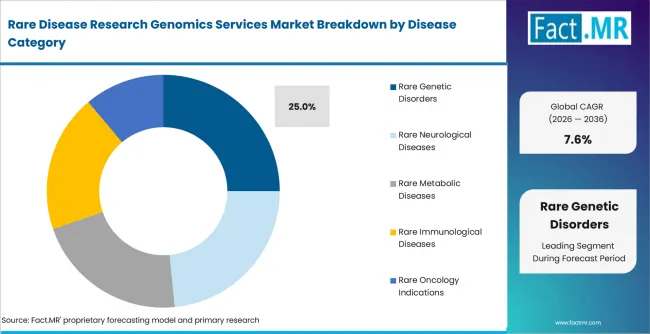
Rare Disease Research Genomics Services Market Analysis By Disease Category | Source: Fact.MR
Many rare genetic conditions cannot be fully understood without finding the inherited cause. Rare Neurological Diseases and Rare Metabolic Diseases often require a careful review of symptoms because signs can change with age and disease stage. Rare Immunological Diseases and Rare Oncology Indications also require a clear check of whether the finding was inherited or developed later. Each disease group therefore follows a different review process.
How does Technology shape demand?
Next-Generation Sequencing (NGS) leads with 25.0% share in 2026.
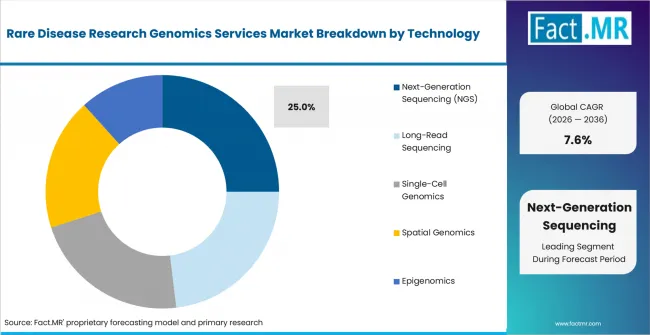
Rare Disease Research Genomics Services Market Analysis By Technology | Source: Fact.MR
NGS remains the main technology used for genome, exome, panel and RNA testing. Long-Read Sequencing becomes useful when standard short-read methods cannot clearly show repeated sections or larger DNA changes. Single-Cell Genomics studies differences between individual cells. Spatial Genomics shows where those cells are found in tissue. Epigenomics adds information on how genes are controlled, which can help in difficult cases.
What supports Pharmaceutical & Biotechnology Companies within End User?
Pharmaceutical & Biotechnology Companies are projected to hold 30.0% share in 2026.
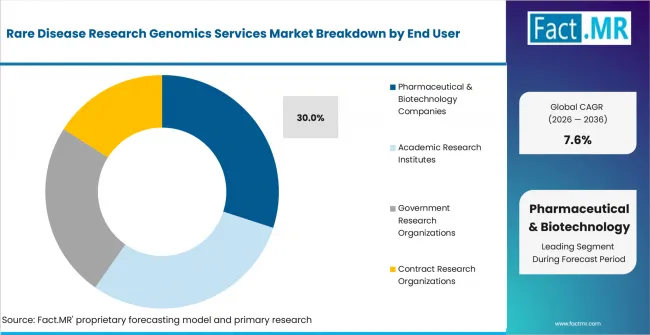
Rare Disease Research Genomics Services Market Analysis By End User | Source: Fact.MR
These companies use rare-disease genomics to find drug targets and identify patients who may respond to a treatment. Long-term patient records also help them understand how a disease changes over time. Academic Research Institutes and Government Research Organizations add specialist patient groups and detailed medical information. Contract Research Organizations help manage samples and data across several study sites. Clear sponsor reports become especially important when studies involve different hospitals or countries.
What is accelerating Rare Disease Research Genomics Services Market adoption, and what is holding it back?
Diagnostic-odyssey reduction is anticipated to drive adoption, while limited follow-up pathways restrain conversion.
Drivers Impact Analysis
| DRIVER | (~) % IMPACT ON CAGR | GEOGRAPHIC RELEVANCE | IMPACT TIMELINE |
|---|---|---|---|
| Ending the diagnostic odyssey and avoiding repeated low-yield tests | +1.3% | Germany and other high-referral academic-hospital markets | Short term (<= 2 years) |
| Escalation from exome to genome and long-read workflows | +1.0% | Brazil and public-private multi-omics build-out markets | Long term (>= 4 years) |
| Phenotype capture and periodic variant reanalysis | +0.8% | USA and specialized diagnostic-center markets | Medium term (2-4 years) |
| Cross-border data sharing across small cohorts | +0.6% | South Korea and multi-country rare-disease consortia | Medium term (2-4 years) |
| Functional confirmation of uncertain variants | +0.5% | U.K. and national genomic laboratory networks | Long term (>= 4 years) |
Source: Fact.MR analysis. Updated Jul 21, 2026
- Diagnostic-odyssey reduction: Rare-disease work converts most clearly when one well-interpreted genome replaces several narrow tests. Germany expresses this driver through university hospitals and referral networks that support deeper interpretation.
- Escalation to genome and long-read workflows: Unresolved cases move from exome review toward genome and long-read methods when structural evidence is needed. Multi-omics methods add regulatory context. Brazil shows how this shift depends on funded staff and coordinated research pathways.
- Phenotype capture and reanalysis: Providers gain repeat work when they preserve phenotype terms and earlier assumptions for later review. The USA is relevant because specialized laboratories and sponsor-funded centers have the data depth needed for structured reanalysis.
- Cross-border data sharing: Small cohorts need matching across sites before a weak signal becomes convincing. South Korea and multi-country consortia benefit when phenotype and genomic descriptions are shared in compatible formats.
- Functional confirmation: Uncertain variants need RNA or epigenomic evidence before research teams use them in development decisions. Experimental evidence strengthens the path to action. U.K. genomic laboratory networks support this driver when follow-up routes are clearly assigned.
Opportunity Impact Analysis
| OPPORTUNITY | (~) % IMPACT ON CAGR | GEOGRAPHIC RELEVANCE | IMPACT TIMELINE |
|---|---|---|---|
| Reanalysis contracts for unsolved cases | +0.5% | USA and Western Europe | Medium term (2-4 years) |
| Long-read sequencing for complex structural variants | +0.4% | Japan and South Korea | Long term (>= 4 years) |
| Newborn and natural-history sequencing programmes | +0.5% | USA and multi-omics programme markets | Medium term (2-4 years) |
| Bioinformatics review for small rare-disease cohorts | +0.3% | Brazil and research-network markets | Medium term (2-4 years) |
Source: Fact.MR analysis. Updated Jul 21, 2026
- Reanalysis contracts: Unresolved cases retain value because disease-gene links and databases change over time. Providers are projected to benefit when they document the first interpretation well enough to revisit it later.
- Newborn and natural-history programmes: Research programmes need genomic evidence that links early diagnosis with long-term observation. GeneDx reported in February 2026 that full-year 2025 exome and genome test result volume reached 97,271.
- Bioinformatics review: Small cohorts need careful interpretation because each additional case changes confidence in a candidate gene. Brazil and research networks are relevant where data harmonization improves cohort comparison.
Restraint Impact Analysis
| RESTRAINT | (~) % IMPACT ON CAGR | GEOGRAPHIC RELEVANCE | IMPACT TIMELINE |
|---|---|---|---|
| Limited reimbursement or grant funding for broad testing | -0.7% | Brazil and cost-sensitive public systems | Short term (<= 2 years) |
| Shortage of clinical genetics and bioinformatics staff | -0.6% | Germany, USA, U.K., and Japan | Medium term (2-4 years) |
| Uncertain variants without functional follow-up | -0.5% | Global research and diagnostic settings | Medium term (2-4 years) |
| Data-sharing limits across countries and institutions | -0.4% | Europe and Asia-Pacific consortia | Long term (>= 4 years) |
Source: Fact.MR analysis. Updated Jul 21, 2026
- Funding limits: Broad genomic work still needs grant support or reimbursement before a pathway expands. Sponsor funding often determines how quickly research services scale. Adoption is expected to slow where sequencing is available but interpretation and follow-up are unfunded.
- Staff shortages: Rare-disease genomics depends on clinical genetics and laboratory review. Bioinformatics staff are needed when cases require deeper interpretation. Capacity gaps delay reporting when cases require phenotype discussion and multidisciplinary sign-off.
- Uncertain variants: A variant of uncertain significance does not support a development decision without functional or segregation evidence. This restraint is strongest when no team owns the next validation step.
- Data-sharing limits: Consent rules and institutional policies restrict cohort matching across borders. These limits are consequential because rare-disease evidence often depends on finding a second or third comparable case.
Which countries are scaling Rare Disease Research Genomics Services Market fastest?
The global growth rate combines the results of every country covered in the study. Germany, Brazil, the USA and South Korea grow faster than the worldwide average. The United Kingdom and Japan grow at a slower pace. Other countries in the full study help balance these differences. The six markets shown are examples and do not cover the complete global picture.
- The main difference between these countries comes from how rare-disease genetic services develop in each market.
- Germany grows through university hospitals, specialist referral centers and cross-border research programs. Brazil follows another path. Its varied population and public-private research projects support the study of rare gene changes and several types of biological data.
- The USA benefits from specialist laboratories and sponsor-funded research. It also has clear systems for reviewing unsolved cases again when new evidence appears. South Korea depends more on large hospital groups that can connect genetic findings with detailed patient records and small research groups.
- The United Kingdom develops through national genetic testing programs and shared laboratory networks. Japan gains from long-read sequencing and specialist genetics services. These tools help find larger DNA changes that standard tests may miss.
Countries with similar growth rates can still offer very different business openings. Referral networks, funding, quality of patient records, data analysis, sharing rules and access to follow-up studies all affect when demand grows. The full report covers North America, Latin America, Western Europe, Eastern Europe, East Asia, South Asia and Pacific, and the Middle East and Africa.
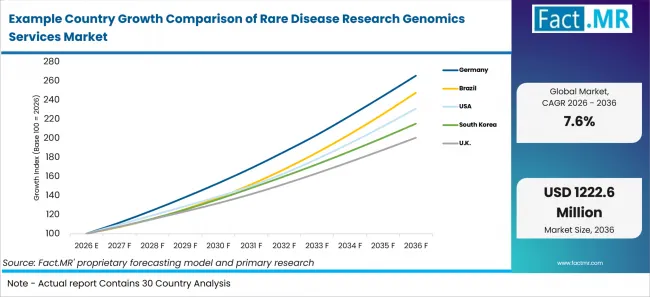
Example Country Growth Comparison Of Rare Disease Research Genomics Services Market | Source: Fact.MR
| COUNTRY | CAGR |
|---|---|
| Germany | 10.3% |
| Brazil | 9.5% |
| USA | 8.7% |
| South Korea | 8.0% |
| United Kingdom | 7.2% |
| Japan | 6.5% |
Source: Fact.MR analysis. Updated Jul 21, 2026
What is driving Germany’s growth through 2036?
10.3% CAGR, driven by university-hospital referrals and European rare-disease research networks.
Germany’s opportunity comes from specialist centers that can send unresolved cases into shared European research and clinical-review pathways. These networks bring medical symptoms, family evidence and genomic findings together when standard testing has not identified a cause. Demand is projected to grow at a 10.3% CAGR through 2036 as laboratories provide whole-genome analysis, variant reanalysis and functional follow-up for difficult cases.
How is Brazil scaling Rare Disease Research Genomics Services demand?
9.5% CAGR, supported by population diversity and coordinated rare-disease research.
Brazil offers strong research value because its diverse population can reveal rare variants that are poorly represented in international genomic databases. National sequencing programs and public-private research networks are expected to improve local reference data and support more accurate variant interpretation. Demand is anticipated to grow at a 9.5% CAGR from 2026 to 2036 as laboratories expand genome analysis, bioinformatics review and multi-omics services for unresolved cases.
What supports the USA outlook?
8.7% CAGR, led by unresolved-disease programs and advanced analysis of difficult genomic cases.
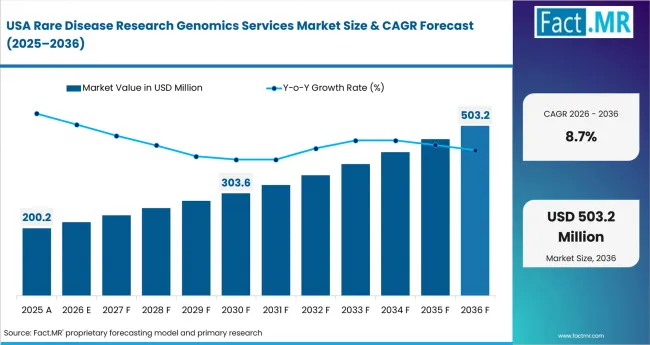
Rare Disease Research Genomics Services Market Country Value Analysis | Source: Fact.MR
The USA has a direct research pathway through the NIH Undiagnosed Diseases Program and related networks that investigate patients whose conditions remain unexplained after earlier clinical testing. These programs combine sequencing with detailed phenotype review and experimental work to identify new disease genes and mechanisms. Demand is expected to record an 8.7% CAGR through 2036 as research sponsors purchase reanalysis, structural-variant assessment and functional confirmation instead of sequencing alone.
What underpins South Korea’s growth?
8.0% CAGR, driven by designated rare-disease centers and hospital-based research capacity.
South Korea develops the market through specialist institutions responsible for rare-disease care, research and patient registration. The Korea Disease Control and Prevention Agency reported that the number of officially designated rare diseases increased from 926 in 2018 to 1,314 in 2024, widening the range of conditions requiring specialist investigation. The market is estimated to post an 8.0% CAGR through 2036 as major hospitals connect genomic analysis with patient records and use cross-site evidence to strengthens findings from small cohorts.
How is the United Kingdom developing Rare Disease Research Genomics Services demand?
7.2% CAGR, supported by whole-genome pathways and nationally coordinated rare-disease research.
The United Kingdom has converted experience from the 100,000 Genomes Project into a structured rare-disease genomics pathway. The project included more than 190 rare diseases and showed how whole-genome sequencing can uncover variants missed by narrower tests. Demand is forecast to grow at a 7.2% CAGR through 2036 as research groups connect genome results with clinical features, family data and functional evidence within coordinated laboratory networks.
Who leads the Rare Disease Research Genomics Services Market?
Illumina and Thermo Fisher Scientific lead broad platform coverage, while QIAGEN strengthen interpretation and long-read workflow depth.
Illumina provides sequencing systems and data tools for whole-genome testing. Thermo Fisher Scientific supplies laboratory equipment and testing materials for NGS, PCR and sample preparation. Both companies compete through their wide laboratory presence and their ability to keep rare-disease testing consistent across large numbers of samples.
Eurofins Scientific SE and Azenta Life Sciences offers project support. Revvity provides research tools, while BGI Genomics adds large-scale sequencing and data analysis services. GeneDx provides exome and genome testing for rare diseases. In September 2025, the company introduced GeneDx Infinity to support ExomeDx and GenomeDx testing.
Which companies are the key providers?
Illumina and Thermo Fisher Scientific are key providers. Eurofins Scientific is also profiled. Revvity, BGI Genomics and Azenta Life Sciences complete part of the company set. GeneDx add long-read and interpretation coverage.
- Illumina, Inc.
- Thermo Fisher Scientific Inc.
- Eurofins Scientific SE
- Revvity, Inc.
- BGI Genomics Co., Ltd.
- Azenta Life Sciences
- GeneDx Holdings Corp.
Bibliography
- GeneDx Holdings Corp. (2025, September 25). GeneDx Infinity™ pioneers a new era of genetic medicine with its introduction at the American Academy of Pediatrics National Conference.
- Illumina, Inc. (2025, May 29). Illumina unveils PromoterAI, a groundbreaking algorithm to accelerate insights for rare disease diagnosis.
- World Health Organization. (2025, May 24). Seventy-eighth World Health Assembly—Daily update: 24 May 2025.
This Report Addresses
- The report provides strategic intelligence on Rare Disease Research Genomics Services across Service Type and Disease Category choices that shape research and diagnostic-support programmes.
- Segment analysis covers Whole Genome Sequencing and Rare Genetic Disorders as the share within the 2026 market.
- Regional outlook evaluates Germany and Brazil alongside the USA and South Korea. The United Kingdom, Japan and broader regions complete the growth comparison.
- Competitive analysis profiles Illumina and Thermo Fisher Scientific alongside QIAGEN and Eurofins Scientific, followed by six additional active genomics providers.
- Technology assessment covers Next-Generation Sequencing (NGS) and Long-Read Sequencing. Single-Cell Genomics, Spatial Genomics and Epigenomics complete the technology view.
- Use-case assessment covers pharmaceutical and biotechnology work alongside academic demand. Government and contract research organization demand complete the end-user view.
What does the Rare Disease Research Genomics Services Market cover?
Whole Genome Sequencing and Whole Exome Sequencing used for rare-disease research. Transcriptomics Services, Bioinformatics & Data Analysis and Multi-Omics Services support interpretation.
The Rare Disease Research Genomics Services Market covers services that investigate rare-disease mechanisms and support interpretation for clinical research and development programmes. Coverage includes sequencing services and analysis workflows that connect variant evidence with phenotype. Family history and research use shape the interpretation route.
The market differs from general sequencing instrument sales because commercial value comes from service delivery and interpretation support. Project execution is part of the purchased service. Instruments and unrelated patient-care spending remain outside the boundary. Standalone software licences are excluded unless they are sold as part of the stated service workflow.
What is included in the scope?
Genomics services used in rare-disease research and diagnosis support. Cohort development and reanalysis are included across institutional service environments.
The scope includes Whole Genome Sequencing and Whole Exome Sequencing. Transcriptomics Services, Bioinformatics & Data Analysis and Multi-Omics Services are included when tied to rare-disease work. Disease coverage includes Rare Genetic Disorders and Rare Neurological Diseases. Rare Metabolic Diseases, Rare Immunological Diseases and Rare Oncology Indications complete the disease view. Technology coverage includes NGS and long-read sequencing. Single-cell genomics, spatial genomics and epigenomics are included when they are purchased as part of rare-disease research services.
What is excluded from the scope?
Standalone sequencing instruments and unrelated patient-care expenditure are outside the scope.
The scope excludes hardware-only sales and general clinical expenditure that is not tied to rare-disease genomics services. It also excludes unrelated omics services that do not address the stated disease categories or support the named service workflows.
How Was the Analysis Built?
The analysis draws on 120+ sources, 35+ company portfolios, 25+ countries, and more than 20 industry interviews.
- Primary Research: Primary research includes discussions with manufacturers, service providers, technology developers, distributors, end users, procurement teams, and subject-matter experts. These conversations examine purchasing priorities, product adoption, operational challenges, approval requirements, competitive positioning, and the factors that influence wider market acceptance.
- Desk Research: Desk research covers government statistics, regulatory publications, company filings, trade data, technical studies, industry associations, standards, public policy, and other authoritative sources. Every source used in the analysis is documented in the bibliography.
- Market Sizing and Forecasting: Market estimates combine historical performance, demand indicators, pricing and volume trends, segment shares, company participation, country-level growth, adoption patterns, investment activity, and barriers to market expansion.
- Data Validation and Update Cycle: Findings are validated by comparing primary interviews with public data, company activity, regulatory changes, trade patterns, and industry developments. Regular updates review new product launches, capacity changes, partnerships, approvals, procurement trends, and shifts in commercial adoption.
Segmentation
What is the report’s scope and coverage?
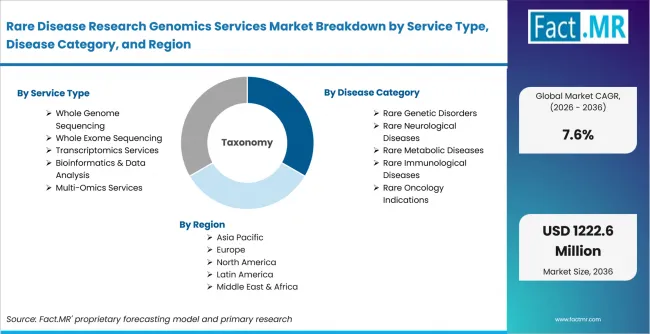
Rare Disease Research Genomics Services Market Breakdown By Service Type, Disease Category, And Region | Source: Fact.MR
| Attribute | Details |
|---|---|
| Quantitative Units | USD Million in 2026 to USD Million by 2036 at CAGR |
| Market Definition | Genomics services used to investigate rare diseases, support diagnosis, develop patient cohorts, interpret complex variants and reanalyze unresolved cases |
| Service Type | Whole Genome Sequencing; Whole Exome Sequencing; Transcriptomics Services; Bioinformatics & Data Analysis; Multi-Omics Services |
| Disease Category | Rare Genetic Disorders; Rare Neurological Diseases; Rare Metabolic Diseases; Rare Immunological Diseases; Rare Oncology Indications |
| Technology | Next-Generation Sequencing (NGS); Long-Read Sequencing; Single-Cell Genomics; Spatial Genomics; Epigenomics |
| End User | Pharmaceutical & Biotechnology Companies; Academic Research Institutes; Government Research Organizations; Contract Research Organizations |
| Regions Covered | North America; Latin America; Western Europe; Eastern Europe; East Asia; South Asia and Pacific; Middle East and Africa |
| Countries Covered | Germany; Brazil; USA; South Korea; United Kingdom; Japan |
| Key Companies Profiled | Illumina, Inc.; Thermo Fisher Scientific Inc.; Eurofins Scientific SE; Revvity, Inc.; BGI Genomics Co., Ltd.; Azenta Life Sciences; GeneDx Holdings Corp. |
| Forecast Period | 2026 to 2036 |
| Approach | Hybrid top-down and bottom-up approach using genomics service volumes; project mix; whole-genome and exome sequencing use; outsourcing rates; contract values; rare-disease research activity; phenotype review; structural-variant analysis; reanalysis demand; multi-omics adoption; disease-category demand; regional research capacity and company participation |
Source: Fact.MR analysis. Updated Jul 21, 2026
How is the market segmented?
-
By Service Type:
- Whole Genome Sequencing
- Whole Exome Sequencing
- Transcriptomics Services
- Bioinformatics & Data Analysis
- Multi-Omics Services
-
By Disease Category:
- Rare Genetic Disorders
- Rare Neurological Diseases
- Rare Metabolic Diseases
- Rare Immunological Diseases
- Rare Oncology Indications
-
By Technology:
- Next-Generation Sequencing (NGS)
- Long-Read Sequencing
- Single-Cell Genomics
- Spatial Genomics
- Epigenomics
-
By End User:
- Pharmaceutical & Biotechnology Companies
- Academic Research Institutes
- Government Research Organizations
- Contract Research Organizations
-
By Region:
- North America
- Latin America
- Western Europe
- Eastern Europe
- East Asia
- South Asia and Pacific
- Middle East and Africa
Frequently Asked Questions
Which Service Type leads the Rare Disease Research Genomics Services Market?
Which Disease Category leads the Rare Disease Research Genomics Services Market?
Which Technology leads the Rare Disease Research Genomics Services Market?
Which End User leads the Rare Disease Research Genomics Services Market?
Which country records the highest CAGR in the Rare Disease Research Genomics Services Market?
How does Brazil perform in the Rare Disease Research Genomics Services Market?
How does the USA perform in the Rare Disease Research Genomics Services Market?
How does South Korea perform in the Rare Disease Research Genomics Services Market?
What is the primary driver in the Rare Disease Research Genomics Services Market?
What is the main restraint in the Rare Disease Research Genomics Services Market?
Why is Whole Genome Sequencing significant?
Why do pharmaceutical and biotechnology companies dominate demand?
Who worked on this report


Preview the report firsthand - request a free sample
Free SampleGet the brochure for pricing and purchase details
Download PDF