- Base Value(2026): 760.0 Mn
- Estimated Value(2026): 760.0 Mn
- Forecast Value (2036): 2980.0 Mn
- CAGR (2026 - 2036): 14.6%
Generative Design Tools for Recyclable Packaging Market Forecast and Outlook 2026 to 2036
The generative design tools for recyclable packaging market is projected to reach USD 760 million in 2026 and grow to USD 2,980 million by 2036, representing a CAGR of 14.6%.
Key Takeaways from Generative Design Tools for Recyclable Packaging Market
- Generative Design Tools for Recyclable Packaging Market Value (2026): USD 760 million
- Generative Design Tools for Recyclable Packaging Market Forecast Value (2036): USD 2,980 million
- Generative Design Tools for Recyclable Packaging Market Forecast CAGR 2026 to 2036: 14.6%
- Leading Segment in Generative Design Tools for Recyclable Packaging Market: AI-driven topology optimization (60%)
- Key Growth Region in Generative Design Tools for Recyclable Packaging Market: Asia Pacific
- Key Players in Generative Design Tools for Recyclable Packaging Market: Autodesk, Siemens Digital Industries, ZWCAD, Fujitsu, PTC, Dassault Systèmes, Alibaba Cloud Design, Hexagon
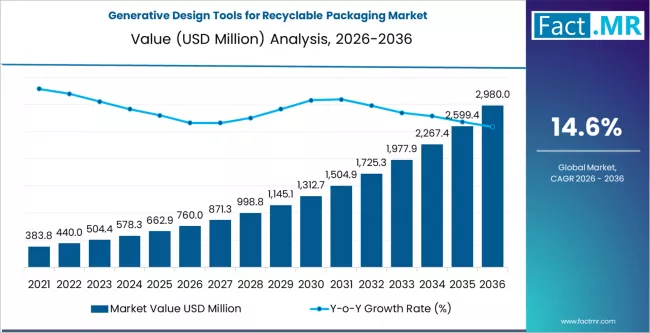
Generative Design Tools For Recyclable Packaging Market Market Value Analysis | Source: Fact.MR
Procurement priorities will increasingly be shaped by sustainability goals, with buyers focusing on tools that optimize recyclability and reduce material waste. Risk aversion will drive decisions, with many companies opting for established suppliers to minimize uncertainties. Vendor lock-in will play a key role, as switching to new tools may incur significant costs related to training, integration, and operational disruption.
These switching costs will affect buyer behavior, leading to longer-term relationships with preferred vendors. As procurement teams prioritize stability and lower risk, vendors that offer tailored, flexible solutions and strong post-purchase support are likely to maintain a competitive edge. Shifting market dynamics will place emphasis on innovation in design and packaging capabilities, steering procurement toward advanced generative design platforms.
Generative Design Tools for Recyclable Packaging Market
| Metric | Value |
|---|---|
| Estimated Value in (2026E) | USD 760 million |
| Forecast Value in (2036F) | USD 2,980 million |
| Forecast CAGR (2026 to 2036) | 14.6% |
Source: Fact.MR analysis. Updated Jan 16, 2026
Category
| Category | Segments |
|---|---|
| End-Use | FMCG & packaging design; Sustainable packaging R&D; High-volume packaging; Precision packaging; Emerging packaging startups; Regional converters |
| Tool Type | Generative CAD platforms; Design optimization software; AI-assisted CAD tools; Advanced CAD/CAE |
| Design Focus | Lightweight & mono-material design; Recyclability-first geometry; Cost & material reduction; Structural optimisation |
| Technology | AI-driven topology optimization; Physics-based simulation + AI; Cloud-native design tools; High-fidelity modelling |
| Region | North America; Europe; Asia Pacific; Latin America; Middle East & Africa |
Source: Fact.MR analysis. Updated Jan 16, 2026
Segmental Analysis
What Is the Impact of Tool Type on the Generative Design Tools for Recyclable Packaging Market?
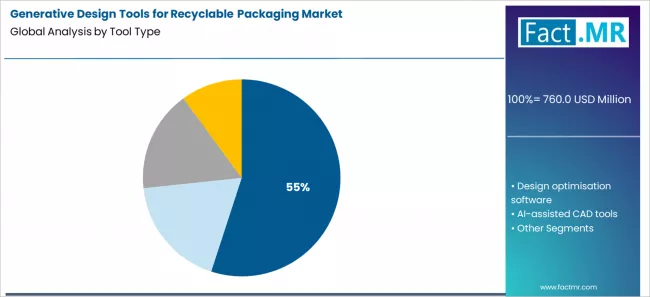
Generative Design Tools For Recyclable Packaging Market Analysis By Tool Type | Source: Fact.MR
In the generative design tools for recyclable packaging market, tool type is a critical factor in determining the technological advancements within the industry. Generative CAD platforms lead the market, holding a 55% share. These platforms enable efficient and innovative design processes, significantly enhancing the creation of packaging solutions. By automating design tasks and allowing for exploration of multiple design alternatives, generative CAD platforms provide manufacturers with the ability to produce more sustainable, cost-effective solutions. As companies increasingly adopt these platforms, the focus will likely shift toward streamlining design processes while enhancing recyclability and material efficiency.
How Does Design Focus Influence the Generative Design Tools for Recyclable Packaging Market?
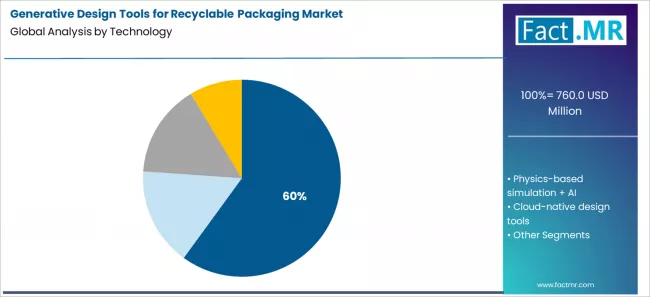
Generative Design Tools For Recyclable Packaging Market Analysis By Technology | Source: Fact.MR
Design focus is a pivotal driver in the generative design tools for recyclable packaging market, especially as sustainability becomes a primary concern in packaging solutions. Lightweight and mono-material design lead the market with a 60% share, emphasizing the importance of reducing material use while maintaining structural integrity. This design focus facilitates the creation of packaging that is both efficient and recyclable. By minimizing the complexity of materials and reducing overall weight, manufacturers can improve recyclability and optimize the environmental impact of packaging. As demand for sustainable packaging increases, lightweight and mono-material design will continue to play a central role in shaping market trends.
What are the Principal Drivers, Constraints, and Evolving Dynamics of the Generative Design Tools for Recyclable Packaging Market?
Demand for recyclable packaging has led brands and converters to explore generative design tools that optimize material use and structural performance. These tools apply algorithm driven design to reduce weight while maintaining strength. Pressure from extended producer responsibility regulations has encouraged firms to adopt design solutions that support recyclability targets.
Adoption barriers include the cost of software and limited in house expertise in advanced design methods. Small and medium packaging suppliers often lack access to trained personnel and computational resources. Compatibility issues with existing computer aided design workflows have also restricted uptake. Market activity is shifting toward collaborative ecosystems between software vendors and material scientists to improve tool accuracy and material data. Efforts to embed life cycle analysis metrics into design workflows are expanding use cases for recyclable packaging design.
Analysis of the Generative Design Tools for Recyclable Packaging Market by Key Country
| Country | CAGR (2026–2036) |
|---|---|
| USA | 13.4% |
| Germany | 12.8% |
| China | 15% |
| Japan | 10.8% |
| India | 15.6% |
| Brazil | 11.2% |
Source: Fact.MR analysis. Updated Jan 16, 2026
The report covers an in-depth analysis of 40+ countries; top-performing countries are highlighted below.
What is the Opportunity Analysis for Generative Design Tools for Recyclable Packaging in the USA?
The USA market for generative design tools for recyclable packaging is set to grow at a CAGR of 13.4% from 2026 to 2036. As the country places increased focus on sustainability and reducing packaging waste, the demand for innovative and efficient packaging solutions continues to rise. The adoption of generative design tools is expected to streamline the development of recyclable packaging, promoting more sustainable practices in the packaging industry. Increasing consumer awareness of sustainability will drive businesses to implement advanced packaging solutions that optimize material usage and minimize environmental impact.
What is the Demand Analysis for Generative Design Tools for Recyclable Packaging in India?
India is experiencing a robust growth rate in the generative design tools for recyclable packaging market, projected at a CAGR of 15.6% from 2026 to 2036. The growing focus on sustainability within the country’s manufacturing sectors and rising concerns about packaging waste are leading to a demand for innovative solutions. Generative design tools allow businesses to optimize packaging designs, reducing waste and improving recyclability. As India's manufacturing industry embraces greener practices, the adoption of these tools is likely to accelerate, aligning with both consumer demands and regulatory pressures.
What is the Sales Outlook for Generative Design Tools for Recyclable Packaging in China?
China is expected to witness strong growth in the generative design tools for recyclable packaging market, with a CAGR of 15% from 2026 to 2036. The country’s manufacturing sector is rapidly shifting toward more sustainable and environmentally conscious practices, influenced by both government regulations and market trends. As China leads in production and consumption, the adoption of generative design tools for recyclable packaging is anticipated to increase. The tools will help companies meet new packaging waste regulations, optimize material usage, and reduce the overall environmental footprint of their products.
What is the In-depth Analysis of Generative Design Tools for Recyclable Packaging in Japan?
Japan’s generative design tools for recyclable packaging market is forecast to grow at a CAGR of 10.8% from 2026 to 2036. The country's long-standing commitment to sustainability and advanced technological infrastructure makes it a key player in the adoption of innovative packaging solutions. Generative design tools can help Japan’s manufacturers optimize packaging designs for recyclability and material efficiency, which aligns with the country’s broader environmental goals. As sustainability becomes more important in consumer and business decisions, Japan’s market for these tools is expected to continue expanding.
Growth and Expansion Outlook for Generative Design Tools for Recyclable Packaging in Brazil
Brazil is projected to experience steady growth in the generative design tools for recyclable packaging market, with a CAGR of 11.2% from 2026 to 2036. The growing focus on reducing packaging waste and meeting sustainability targets is driving demand for innovative packaging design solutions. Brazilian manufacturers are increasingly adopting generative design tools to create more sustainable packaging that meets both environmental and regulatory requirements. As sustainability practices gain traction across industries in Brazil, the use of generative design tools in packaging development is expected to rise, supporting market expansion.
Competitive Landscape in the Generative Design Tools for Recyclable Packaging Market
Competition in the generative design tools for recyclable packaging market centers on software capability, integration with existing design workflows, and support for material optimization. Autodesk and Dassault Systèmes compete with mature design suites that include generative design modules tailored to packaging constraints. These offerings emphasize automated geometry creation, lightweight structures, and recyclability criteria within design parameters. Siemens Digital Industries and PTC leverage industrial design platforms with strong simulation and systems integration features that appeal to large manufacturers.
Fujitsu and Hexagon focus on tools that integrate design with data analytics to support material selection and lifecycle assessment. ZWCAD provides costeffective alternatives with core CAD features and basic generative functions. Alibaba Cloud Design differentiates through cloudnative solutions that assist distributed teams. Competitive positioning is shaped by ease of use, scalability, ecosystem support, and alignment with sustainability goals.
Key Players of the Generative Design Tools for Recyclable Packaging Market
- Autodesk
- Siemens Digital Industries
- ZWCAD
- Fujitsu
- PTC
- Dassault Systèmes
- Alibaba Cloud Design
- Hexagon
Bibliographies
- Organisation for Economic Co-operation and Development. (2023). Artificial intelligence, generative design, and sustainability in industrial production. OECD Publishing.
- World Economic Forum. (2023). AI-enabled design and innovation for circular economy packaging systems. World Economic Forum.
- European Commission. (2023). Digital product design, eco-design requirements, and packaging sustainability under the circular economy framework. European Union.
- United Nations Environment Programme. (2024). Sustainable packaging design, material efficiency, and digital innovation. UNEP.
- Elsevier Journal of Cleaner Production. (2024). Generative design and topology optimisation for recyclable and resource-efficient packaging structures. Journal of Cleaner Production.
Segmentation
Scope of the Report
| Items | Values |
|---|---|
| Quantitative Units (2026) | USD Million |
| End-use | FMCG & packaging design, Sustainable packaging R&D, High-volume packaging, Precision packaging, Emerging packaging startups |
| Tool Type | Generative CAD platforms, Design optimization software, AI-assisted CAD tools, Advanced CAD/CAE |
| Design Focus | Lightweight & mono-material design, Recyclability-first geometry, Cost & material reduction, Structural optimisation |
| Technology | AI-driven topology optimization, Physics-based simulation + AI, Cloud-native design tools, High-fidelity modelling |
| Regions Covered | North America, Europe, Asia Pacific, Latin America, Middle East & Africa |
| Countries Covered | United States, Canada, Mexico, Brazil, Germany, United Kingdom, France, Italy, Spain, China, Japan, South Korea, India, Australia & New Zealand |
| Key Companies Profiled | Autodesk, Siemens Digital Industries, ZWCAD, Fujitsu, PTC, Dassault Systèmes, Alibaba Cloud Design, Hexagon |
| Additional Attributes | Dollar revenue by end-use, tool type, design focus, and technology; regional demand trends, competitive landscape, technological advancements, product development strategies, and innovations in sustainable packaging design tools. |
Source: Fact.MR analysis. Updated Jan 16, 2026
Generative Design Tools for Recyclable Packaging Market Key Segments
-
End-use :
- FMCG & packaging design
- Sustainable packaging R&D
- High-volume packaging
- Precision packaging
- Emerging packaging startups
- Regional converters
-
Tool Type :
- Generative CAD platforms
- Design optimisation software
- AI-assisted CAD tools
- Advanced CAD/CAE
-
Design Focus :
- Lightweight & mono-material design
- Recyclability-first geometry
- Cost & material reduction
- Structural optimisation
- High-fidelity modelling
-
Technology :
- AI-driven topology optimisation
- Physics-based simulation + AI
- Cloud-native design tools
-
Region :
- North America
- U.S.
- Canada
- Mexico
- Europe
- Germany
- UK
- France
- Italy
- Spain
- Nordic Countries
- BENELUX
- Rest of Europe
- Asia Pacific
- China
- Japan
- South Korea
- India
- Australia
- Rest of Asia Pacific
- Latin America
- Brazil
- Argentina
- Rest of Latin America
- Middle East and Africa
- Kingdom of Saudi Arabia
- United Arab Emirates
- South Africa
- Rest of Middle East and Africa
- Other Regions
- Oceania
- Central Asia
- Other Markets
- North America
Frequently Asked Questions
How big is the generative design tools for recyclable packaging market in 2026?
What will be the size of generative design tools for recyclable packaging market in 2036?
How much will be the generative design tools for recyclable packaging market growth between 2026 and 2036?
What are the key product types in the generative design tools for recyclable packaging market?
Which tool type segment to contribute significant share in the generative design tools for recyclable packaging market in 2026?
Who worked on this report


Preview the report firsthand - request a free sample
Free SampleGet the brochure for pricing and purchase details
Download PDF