- Market Value (2025): USD 4.24 Bn
- Estimated Value (2026): USD 4.46 Bn
- Forecast Value (2036): USD 7.34 Bn
- CAGR (2026-2036): 5.1%
What is the Geysers Market forecast to be worth by 2036?
USD 4.46 billion in 2026 to USD 7.34 billion by 2036, at a 5.1% CAGR.
- As per Fact.MR analysis, the geysers market reached USD 4.24 billion in 2025.
- Demand will increase from USD 4.46 billion in 2026 and USD 7.34 billion by 2036.
- According to Fact.MR analysis, the market carries a 5.1% CAGR for 2026 to 2036 as buyers replace older water-heating units and assess running costs.
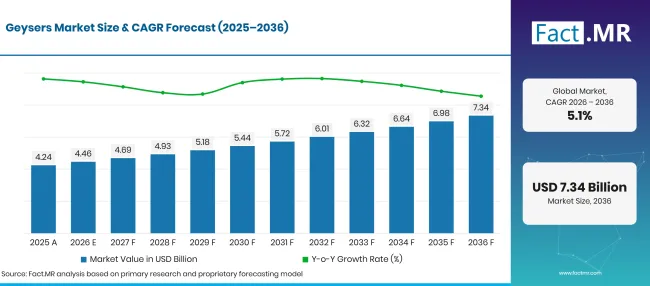
Factmr Geysers Market Forecast Global | Source: Fact.MR
| Year | Basis | Market Value (USD billion) |
|---|---|---|
| 2025 | Actual | 4.3 |
| 2026 | Estimate | 4.5 |
| 2036 | Forecast | 7.3 |
| CAGR 2026 to 2036 | Forecast period | 5.1% |
Source: Fact.MR analysis. Updated Oct 21, 2026
What are the defining numbers behind Geysers Market growth?
USD 2.8 billion in absolute expansion between 2026 and 2036, with electric geysers and residential installations forming the leading segments.
- Demand Drivers in the Market
- Households replacing old water heaters often compare purchase price with electricity or gas costs over the product life. Longer-lasting tanks and accessible service parts help buyers judge the total cost of ownership.
- Apartment buildings and newly completed homes can lead to equipment purchases. According to Destatis, Germany had approximately 44.0 million dwellings at the end of 2025 [1].
- Commercial users such as hotels and healthcare facilities often need uninterrupted hot water throughout operating hours. Sizing decisions depend on peak use rather than average consumption alone. Dedicated service contracts and access to replacement heating elements can influence selection.
- Energy-saving features can make higher-priced geysers attractive when buyers expect regular daily use. Timers and temperature controls offer ways to manage heating schedules. Solar water-heating systems may suit buildings with adequate roof exposure and suitable plumbing.
- Key Segments Analyzed
- by Product Type: Electric Geysers account for 42.3% share in 2026, supported by familiar household installation and a wide capacity range.
- by Application: Residential accounts for 58.4% share in 2026, reflecting household hot-water use and periodic equipment replacement.
- by Distribution Channel: Offline Retail represents 67.9% share in 2026, with dealer advice and installer access supporting purchase decisions.
- by Capacity: 30-100 Liters captures 51.8% share in 2026, serving households seeking stored hot water for regular use.
- Analyst Opinion at Fact.MR
- Shambhu Nath Jha, Principal Consultant at Fact.MR, states, “Geyser buyers often prioritize a reliable daily hot-water supply than on minor differences in purchase price. A supplier with clear sizing guidance and accessible installation support can simplify replacement decisions.”
- Strategic Implications
- Manufacturers can help buyers compare total running expenses by publishing consistent energy-use information for each geyser size. Such information is especially useful when customers choose between a low purchase price and a model designed for lower operating expense.
- Dealers and installers can benefit from simple sizing tools that account for household occupants and periods of heavy water use. Better guidance reduces the chance of buying a tank that is too small for daily requirements.
- Service coverage may matter more in the commercial market because equipment downtime affects several users. Suppliers that stock common spare parts close to customers may strengthen repeat business.
- Product teams can examine heating controls and insulation performance together rather than treating connectivity as the main purchase reason. The most useful features are those that improve everyday operation and make maintenance clearer. Controls for water heater control software provide a related perspective on timed heating and coordinated energy use.
Germany leads the selected countries at 6.2% CAGR. Brazil follows at 5.7% where household spending and energy supply shape buying decisions. The United States records 5.1% ahead of the United Kingdom at 4.6% and Japan at 4.1%.
How does the Geysers Market break down by segment?
Electric Geysers hold 42.3%; Residential leads with 58.4%; Offline Retail account for 67.9%.
Which Product Type dominates?
Electric Geysers hold 42.3% share in 2026.
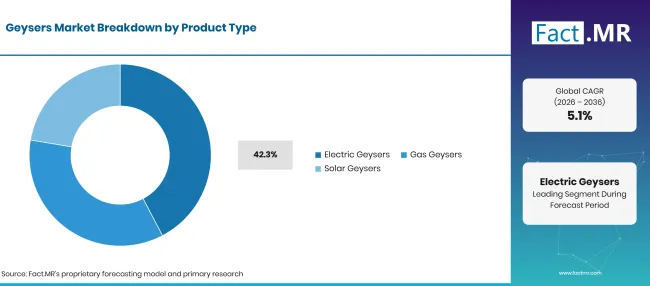
Factmr Geysers Market Breakdown Product Type | Source: Fact.MR
| Product Type | Share (2026) |
|---|---|
| Electric Geysers (Leading segment) | 42.3% |
| Other segments combined | 57.7% |
| Total | 100.0% |
Source: Fact.MR analysis. Updated Oct 21, 2026
Electric geysers fit homes with a suitable electrical connection and are sold in storage and compact formats. Buyers usually check wattage and tank capacity against bathroom use before choosing a unit. Gas geysers are another option where gas supply and ventilation arrangements are suitable. Solar geysers can reduce purchased energy for water heating when roof conditions and local weather support their use. A comparison with tankless water heater models is useful for buyers who want hot water without a large storage cylinder.
What leads the Application segment?
Residential accounts for 58.4% share in 2026.
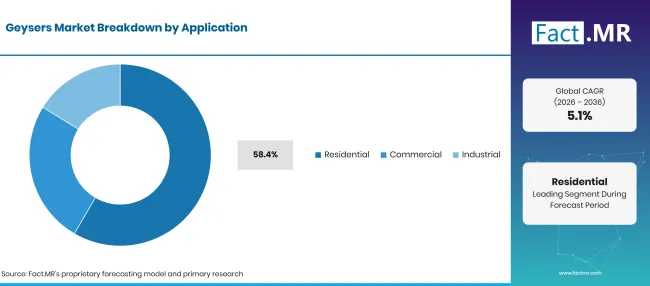
Factmr Geysers Market Breakdown Application | Source: Fact.MR
| Application | Share (2026) |
|---|---|
| Residential (Leading segment) | 58.4% |
| Other segments combined | 41.6% |
| Total | 100.0% |
Source: Fact.MR analysis. Updated Oct 21, 2026
In homes, hot-water use depends on the number of occupants and how often showers or other washing tasks occur. Replacement purchases are often made when a current tank leaks or heating becomes unreliable. Commercial buyers instead assess daily occupancy and simultaneous use across several outlets. Industrial applications need closer attention to process temperature and system design.
Which Distribution Channel serves the largest share?
Offline Retail leads with 67.9% share in 2026.
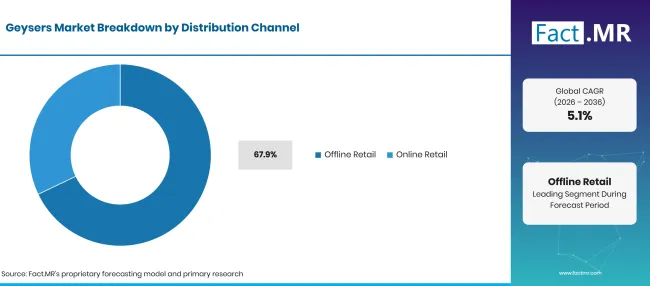
Factmr Geysers Market Breakdown Distribution Channel | Source: Fact.MR
| Distribution Channel | Share (2026) |
|---|---|
| Offline Retail (Leading segment) | 67.9% |
| Other segments combined | 32.1% |
| Total | 100.0% |
Source: Fact.MR analysis. Updated Oct 21, 2026
Many customers prefer to view heater dimensions and discuss installation with a local appliance dealer before purchase. In-person retail is useful when a buyer needs help checking electrical supply or available wall space. Online stores support price comparisons and repeat purchases where product requirements are already clear. Installers can influence either route by advising on water pressure and practical safety requirements.
Which Capacity category is preferred?
30-100 Liters represents 51.8% share in 2026.
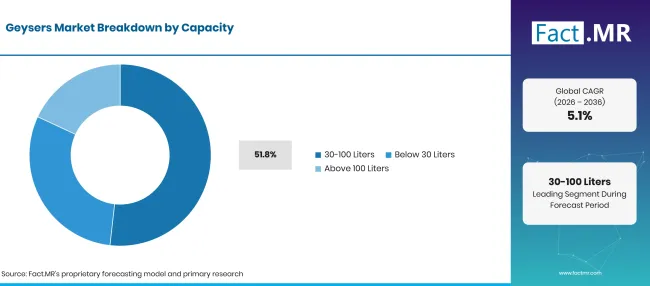
Factmr Geysers Market Breakdown Capacity | Source: Fact.MR
| Capacity | Share (2026) |
|---|---|
| 30-100 Liters (Leading segment) | 51.8% |
| Other segments combined | 48.2% |
| Total | 100.0% |
Source: Fact.MR analysis. Updated Oct 21, 2026
A 30-100 liter storage tank can serve regular household hot-water needs where several people use the heater during the day. Smaller units below 30 liters suit point-of-use tasks and rooms with little installation space. Tanks above 100 liters are more relevant where several users require hot water in a short period. Buyers need to consider heat-up time and available mounting support as well as nominal tank size.
What is accelerating Geysers Market adoption, and what is holding it back?
Equipment replacement and improved heating control may support new purchases. Upfront spending and installation requirements may slow change where existing systems remain usable.
Drivers Impact Analysis
| DRIVER | (~) % IMPACT ON CAGR | GEOGRAPHIC RELEVANCE | IMPACT TIMELINE |
|---|---|---|---|
| Residential replacement | +1.0% | Global | Medium term (2–4 years) |
| More efficient equipment | +0.8% | Europe, Japan | Medium term (2–4 years) |
| Commercial hot-water needs | +0.7% | Global | Long term (>= 4 years) |
| Local installation networks | +0.5% | Global | Short term (<= 2 years) |
| Building stock renewal | +0.4% | Europe, North America | Long term (>= 4 years) |
Source: Fact.MR analysis. Updated Oct 21, 2026
Opportunity Impact Analysis
| OPPORTUNITY | (~) % IMPACT ON CAGR | GEOGRAPHIC RELEVANCE | IMPACT TIMELINE |
|---|---|---|---|
| Better heater controls | +0.8% | Global | Medium term (2–4 years) |
| Solar-compatible installations | +0.6% | Brazil, Japan | Long term (>= 4 years) |
| Dealer-led capacity selection | +0.5% | Global | Short term (<= 2 years) |
| Service and spare parts | +0.4% | Global | Medium term (2–4 years) |
Source: Fact.MR analysis. Updated Oct 21, 2026
Restraints Impact Analysis
| RESTRAINT | (~) % IMPACT ON CAGR | GEOGRAPHIC RELEVANCE | IMPACT TIMELINE |
|---|---|---|---|
| Purchase and installation cost | -0.8% | Global | Short term (<= 2 years) |
| Ventilation and electrical requirements | -0.6% | Global | Medium term (2–4 years) |
| Slow new-home completions | -0.5% | Germany, Japan | Medium term (2–4 years) |
| Replacement postponement | -0.4% | Global | Short term (<= 2 years) |
Source: Fact.MR analysis. Updated Oct 21, 2026
Which countries are scaling the Geysers Market through 2036?
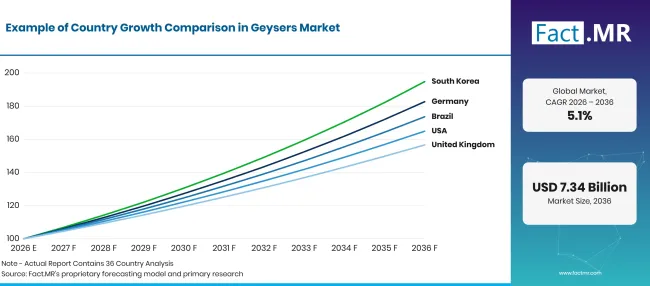
Factmr Geysers Market Growth Index | Source: Fact.MR
| Country | CAGR (2026–2036) |
|---|---|
| Germany | 6.2% |
| Brazil | 5.7% |
| United States | 5.1% |
| United Kingdom | 4.6% |
| Japan | 4.1% |
Source: Fact.MR analysis. Updated Oct 21, 2026
Why is Germany leading geyser purchases?
6.2% CAGR, shaped by equipment replacement and household efficiency decisions.
German households buying geysers often begin with the heating equipment already fitted in the property. A compatible replacement can help limit changes to plumbing and electrical connections. Destatis reported an 18.0% decline in completed dwellings in Germany during 2025 [2]. Slower housing completions may limit new-installation opportunities, while owners of existing properties continue to assess replacement options.
How is Brazil expanding geyser use?
5.7% CAGR, shaped by home hot-water preferences and available energy sources.
Brazilian households compare water heaters against the energy supplies available at home. Electric models suit installations with sufficient wiring capacity, while gas models depend on the type of gas service fitted in the building. Solar water-heating equipment can appeal to owners with suitable roof space and predictable use throughout the day.
What is shaping geyser sales in the United States?
5.1% CAGR, reflecting replacement choices and operating-cost comparisons.
In the United States, replacing a worn-out water heater is an established reason to buy new equipment. Homeowners usually compare the model’s capacity against household hot-water use and the available gas or electrical connection. In May 2026, the U.S. Census Bureau published national, state, and county housing-unit estimates covering 2020 through 2025 [3]. Dealers can help buyers compare tank dimensions and installation costs before choosing a new system.
How is the United Kingdom approaching geyser purchases?
4.6% CAGR, influenced by household replacement and building heating changes.
Heating arrangements in the United Kingdom influence how residents buy new hot-water equipment. Storage cylinders are commonly considered alongside the household heating system, especially where the property already has a dedicated hot-water tank. In August 2026, the Department for Energy Security and Net Zero reported 8,150 applications to install heat pumps under the Boiler Upgrade Scheme in July 2026 [4].
Why is Japan maintaining measured geyser growth?
4.1% CAGR, linked to product efficiency and established hot-water systems.
Japanese consumers often consider available installation space when replacing a water heater. Gas-fired instantaneous models serve homes with suitable venting and gas connections. In April 2025, Japan’s Ministry of Economy, Trade and Industry reported a 37% adoption rate for condensing gas water heaters in fiscal 2022 and used a 57% adoption assumption for the fiscal 2028 efficiency standards [5].
Who leads the Geysers Market?
A. O. Smith Corporation and Rheem Manufacturing Company compete across household water-heating products, including storage and efficiency-focused alternatives. Bradford White Corporation concentrates on water-heating equipment sold through professional channels. These suppliers compete on suitable capacity selection and the availability of installer support. Buyers comparing an electric storage geyser with a gas model need to understand local connection requirements before placing an order.
Ariston Group supply building hot-water equipment across international markets. Rinnai Corporation and Noritz Corporation are associated with gas-fired and high-efficiency water heating. Vaillant Group and Ferroli S.p.A. serve related domestic and commercial heating needs.
Which companies are the key providers?
Key companies include A.O. Smith Corporation; Rheem Manufacturing Company; Bradford White Corporation; Ariston Group; Rinnai Corporation; Noritz Corporation; Vaillant Group; and Ferroli S.p.A.
- A.O. Smith Corporation
- Rheem Manufacturing Company
- Bradford White Corporation
- Ariston Group
- Rinnai Corporation
- Noritz Corporation
- Vaillant Group
- Ferroli S.p.A.
Bibliography
- [1] Statistisches Bundesamt (Destatis). (2026, July 16). 44,0 Millionen Wohnungen in Deutschland zum Jahresende 2025.
- [2] Statistisches Bundesamt (Destatis). (2026, May 22). 18,0 % weniger fertiggestellte Wohnungen im Jahr 2025.
- [3] U.S. Census Bureau. (2026, May). National, state, and county housing unit totals: 2020–2025.
- [4] Department for Energy Security and Net Zero. (2026, August 27). Record number of heating oil households apply for a heat pump.
- [5] Ministry of Economy, Trade and Industry. (2025, April 18). Report compiled on new energy efficiency standards for gas water heaters.
This Report Answers
- The report examines how electric, gas and solar geysers fit different hot-water requirements.
- Capacity analysis explains why mid-sized storage geysers are suitable for regular household use.
- The country comparison examines energy use and replacement conditions across selected markets.
- Competitive analysis describes differences in product portfolios and installer or service support.
- Distribution analysis explains why in-person product guidance remains relevant to many buyers.
What does the Geysers Market cover?
The market covers appliances used to heat and deliver water for routine domestic use and relevant commercial or industrial facilities. It considers electric storage units and suitable gas or solar geyser systems. Equipment choice depends on the heat source available at the property and the quantity of hot water required.
What is included in the scope?
The scope includes new geysers sold through offline and online retail channels.
Residential purchases and suitable nonresidential installations are covered according to the defined product and capacity categories. Sales may arise from new installations or the replacement of equipment that has reached the end of its service life.
What is excluded from the scope?
The scope excludes complete space-heating systems when hot-water equipment cannot be separated from the wider system sale.
It also excludes stand-alone plumbing services and spare parts sold without a new geyser. Large process boilers used primarily to generate steam are outside the main product comparison.
How Was the Analysis Built?
The analysis draws on 120+ sources, 35+ company portfolios, 25+ countries, and more than 20 industry interviews.
- Primary Research: Primary research includes discussions with manufacturers, service providers, technology developers, distributors, end users, and subject-matter experts. These conversations examine purchasing priorities, product adoption, operational challenges, approval requirements, competitive positioning, and the factors that influence wider market acceptance.
- Desk Research: Desk research covers government statistics, regulatory publications, company filings, trade data, technical studies, industry associations, standards, public policy, and other authoritative sources. Every source used in the analysis is documented in the bibliography.
- Market Sizing and Forecasting: Market estimates combine historical performance, demand indicators, pricing and volume trends, segment shares, company participation, country-level growth, adoption patterns, investment activity, and barriers to market expansion.
- Data Validation and Update Cycle: Findings are validated by comparing primary interviews with public data, company activity, regulatory changes, trade patterns, and industry developments. Regular updates review new product launches, capacity changes, partnerships, approvals, and shifts in commercial adoption.
Segmentation
What is the report’s scope and coverage?
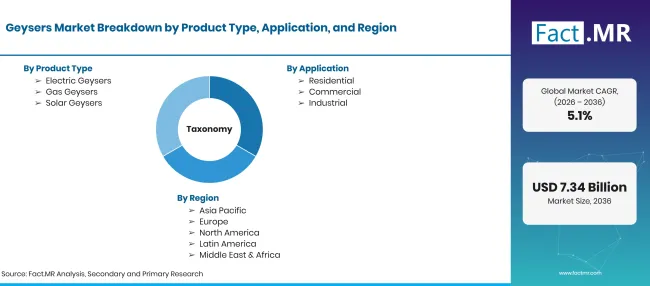
Factmr Geysers Market Taxonomy | Source: Fact.MR
| Attribute | Details |
|---|---|
| Quantitative Units | USD billion in 2026 to USD billion in 2036, at CAGR |
| Market Definition | Water-heating appliances sold as electric, gas or solar geysers for domestic and suitable commercial or industrial use. |
| Product Type | Electric Geysers; Gas Geysers; Solar Geysers |
| Application | Residential; Commercial; Industrial |
| Distribution Channel | Offline Retail; Online Retail |
| Capacity | Below 30 Liters; 30-100 Liters; Above 100 Liters |
| Regions Covered | North America; Latin America; Western Europe; Eastern Europe; East Asia; South Asia & Pacific; Middle East & Africa |
| Countries Covered | Germany; Brazil; United States; United Kingdom; Japan |
| Companies Profiled | A.O. Smith Corporation; Rheem Manufacturing Company; Bradford White Corporation; Ariston Group; Rinnai Corporation; Noritz Corporation; Vaillant Group; and Ferroli S.p.A. |
| Forecast Period | 2026 to 2036 |
| Approach | Product applications, heater capacity, retail access, official country evidence and manufacturer product portfolios |
Source: Fact.MR analysis. Updated Oct 21, 2026
How is the market segmented?
-
By Product Type
- Electric Geysers
- Gas Geysers
- Solar Geysers
-
By Application
- Residential
- Commercial
- Industrial
-
By Distribution Channel
- Offline Retail
- Online Retail
-
By Capacity
- 30-100 Liters
- Below 30 Liters
- Above 100 Liters
-
By Region
- North America
- Latin America
- Western Europe
- Eastern Europe
- East Asia
- South Asia & Pacific
- Middle East & Africa
Frequently Asked Questions
How big is the Geysers Market in 2026?
What is the CAGR of the Geysers Market from 2026 to 2036?
Which product type leads the Geysers Market?
Which application leads the Geysers Market?
Who are the leading companies in the Geysers Market?
Who worked on this report


Preview the report firsthand - request a free sample
Free SampleGet the brochure for pricing and purchase details
Download PDF