- Market Value (2025): USD 3.71 Bn
- Estimated Value (2026): USD 3.93 Bn
- Forecast Value (2036): USD 7.0 Bn
- CAGR (2026-2036): 5.9%
What is the Half Mask Respirator Market forecast to be worth by 2036?
USD 3.9 billion in 2026 to USD 7.0 billion by 2036 at a 5.9% CAGR.
- The half mask respirator market was valued at USD 3.71 billion in 2025.
- Fact.MR estimates that market revenue is projected to increase from USD 3.93 billion in 2026 to USD 7.0 billion in 2036.
- The 5.9% CAGR from 2026 to 2036 reflects purchases by industrial employers and healthcare facilities that use respiratory protection under defined exposure conditions.
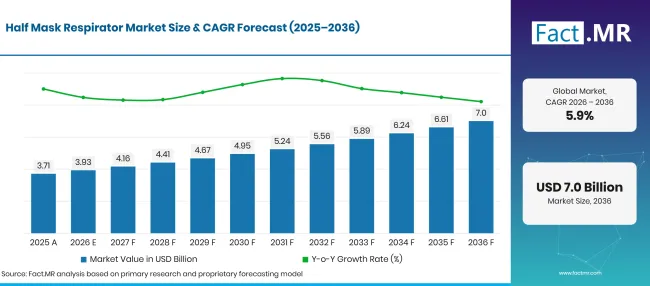
Half Mask Respirator Market Forecast Global | Source: Fact.MR
| Year | Basis | Market Value (USD billion) |
|---|---|---|
| 2025 | Actual | 3.71 |
| 2026 | Estimate | 3.93 |
| 2036 | Forecast | 7.0 |
| CAGR 2026 to 2036 | Forecast period | 5.9% |
Source: Fact.MR analysis. Updated Oct 31, 2026
What are the defining numbers behind Half Mask Respirator Market growth?
Market value is expected to increase by USD 3.1 billion between 2026 and 2036.
- Demand Drivers in the Market
- Respirator selection begins with the specific airborne contaminants and measured workplace exposure. Under 29 CFR 1910.134, OSHA assigns a protection factor of 10 to half-mask air-purifying respirators, including filtering facepieces and elastomeric half masks, when the required respiratory protection program is properly implemented [1].
- Occupational respiratory illness warrants continued review of prevention programs. The U.S. Bureau of Labor Statistics reported in January 2026 that private industry recorded 54,000 respiratory illness cases during 2024 [2].
- Industrial sites that use reusable facepieces need a predictable stock of compatible cartridges. Maintenance training and access to replacement parts also influence the service life of each unit.
- Fit and comfort affect whether workers can wear the selected equipment correctly throughout a shift. Mask size, strap adjustment and seal performance are practical considerations for a site that has workers performing different tasks during the same day.
- Construction work involving dust creates a need for task-specific controls. Employers assess exposure and use suitable respirators when other controls do not adequately reduce the risk.
- Key Segments Analyzed
- By Product Type: Reusable respirators account for 61.4% share in 2026, supported by repeat use of the facepiece with replaceable filters.
- By Application: Industrial uses lead with 38.2% share in 2026, reflecting work around particles and selected gases or vapors.
- By Distribution Channel: Specialty stores hold 41.3% share in 2026, since customers often seek help matching cartridges and facepieces.
- By Material Type: Silicone captures 36.1% share in 2026, as buyers consider soft contact surfaces and reusable mask construction.
- Analyst Opinion at Fact.MR
- Shambhu Nath Jha, Principal Consultant at Fact.MR, states, “A half mask must fit the wearer properly and provide the protection required for the task. This is a more useful selection test than appearance alone. Industrial employers assess seal quality alongside cartridge availability and training requirements.”
- Strategic Implications
- Plant safety teams should compare facepiece fit and cartridge compatibility before approving models for routine use. The wider personal protective equipment category allows distributors to support site-level safety planning.personal protective equipment
- Specialist distributors should make filter selection and replacement guidance accessible at the point of sale.
- Manufacturers should maintain clear certification information and spare-part support for reusable models.
- Healthcare employers should distinguish filtering facepieces from elastomeric reusable respirators when setting cleaning and reuse procedures.
The United Kingdom is projected to record 7.6% CAGR through 2036 as workplace fit and exposure requirements influence purchases. Brazil follows at 6.8% amid industrial safety needs. Germany is estimated at 5.1%, the USA at 4.8% and Japan at 4.4%.
How does the Half Mask Respirator Market break down by segment?
Reusable leads at 61.4%; Industrial at 38.2%; Specialty Stores at 41.3%; Silicone at 36.1%.
Which Product Type dominates?
Reusable respirators account for 61.4% of 2026 value.
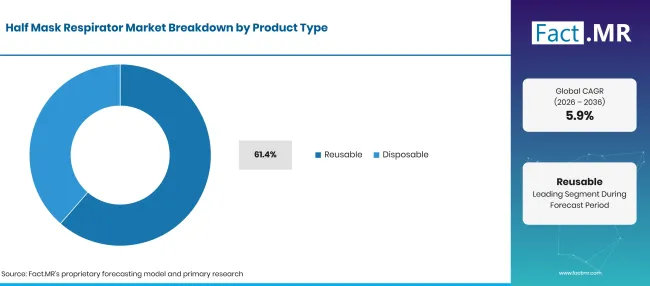
Half Mask Respirator Market Breakdown Product Type | Source: Fact.MR
| Product Types | Share (2026) |
|---|---|
| Reusable (Leading segment) | 61.4% |
| Other segments combined | 38.6% |
| Total | 100.0% |
Source: Fact.MR analysis. Updated Oct 31, 2026
Reusable half masks retain the facepiece while filters or cartridges are changed according to use and the manufacturer’s instructions. That makes fit and cleaning procedures part of the customer’s routine. Employers purchasing several units often weigh the lifetime cost of the mask against replacement media and maintenance time. Disposable filtering facepieces remain relevant for tasks where replacement after use fits workplace policy. The two categories serve different operating needs, so purchase price alone does not capture the full operating cost.
How does Application?
Industrial leads with 38.2% of 2026 value.
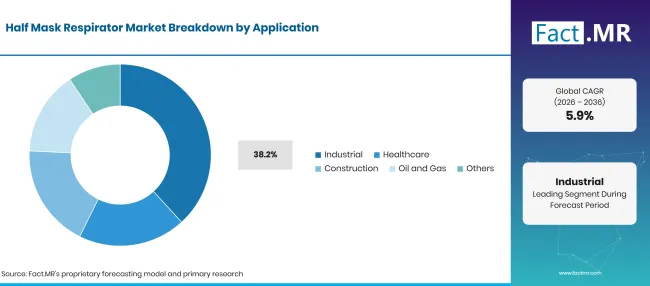
Half Mask Respirator Market Breakdown Application | Source: Fact.MR
| Application | Share (2026) |
|---|---|
| Industrial (Leading segment) | 38.2% |
| Other segments combined | 61.8% |
| Total | 100.0% |
Source: Fact.MR analysis. Updated Oct 31, 2026
Industrial work includes painting and operations that generate airborne particles. The type of filter needs to match the substance and its concentration. In healthcare, reusable elastomeric respirators may require additional cleaning and infection-control arrangements. Construction sites assess silica and other dust exposures, while oil and gas employers may face different vapor risks. The right half mask depends on exposure assessment and the limits of its approved use, not simply the sector name. Air-purifying half masks do not supply oxygen.
What leads the Distribution Channel segment?
Specialty Stores hold 41.3% of 2026 value.
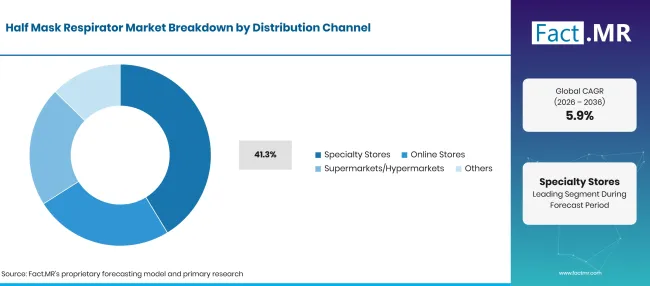
Half Mask Respirator Market Breakdown Distribution Channel | Source: Fact.MR
| Distribution Channel | Share (2026) |
|---|---|
| Specialty Stores (Leading segment) | 41.3% |
| Other segments combined | 58.7% |
| Total | 100.0% |
Source: Fact.MR analysis. Updated Oct 31, 2026
Specialist safety retailers give customers a way to compare facepiece sizes and filter ranges before ordering. Staff can explain the difference between particle filters and cartridges for specific gases, subject to manufacturer instructions. Online stores serve repeat orders when a model and size are already known. Large general retailers can carry basic filtering facepieces, but they may offer a narrower selection of replacement components. Industrial customers also order directly from authorized distributors for repeat deliveries.
Which Material Type?
Silicone captures 36.1% of 2026 value.
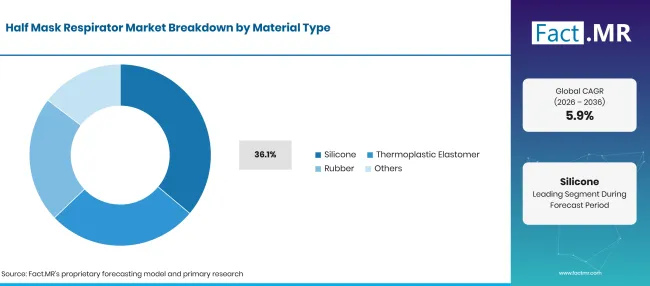
Half Mask Respirator Market Breakdown Material Type | Source: Fact.MR
| Material Type | Share (2026) |
|---|---|
| Silicone (Leading segment) | 36.1% |
| Other segments combined | 63.9% |
| Total | 100.0% |
Source: Fact.MR analysis. Updated Oct 31, 2026
Silicone is used in reusable face seals because manufacturers can design flexible surfaces that rest against the face. Thermoplastic elastomers provide another design route, while rubber continues in selected product families. Material alone does not establish a respirator’s protection level. Seal geometry, sizing and correct fit matter alongside cartridge performance.
What is accelerating Half Mask Respirator Market adoption, and what is holding it back?
Market growth will come from workplace respiratory protection and wider use of reusable facepieces. Fit-testing and specialist distribution will also support sales. Adoption will be restrained by training needs, cartridge compatibility, incorrect product selection and price pressure on disposable masks.
Drivers Impact Analysis
| DRIVER | (~) % IMPACT ON CAGR | GEOGRAPHIC RELEVANCE | IMPACT TIMELINE |
|---|---|---|---|
| Task-specific respiratory protection | +0.9% | Global industrial workplaces | Short term |
| Reusable facepieces and filter replacement | +0.7% | North America; Europe; Japan | Medium term |
| Fit-testing requirements | +0.5% | USA; UK; Europe | Short term |
| Worker comfort during long tasks | +0.4% | Global | Medium term |
| Specialist distribution support | +0.3% | Global | Medium term |
Source: Fact.MR analysis. Updated Oct 31, 2026
Opportunity Impact Analysis
| OPPORTUNITY | (~) % IMPACT ON CAGR | GEOGRAPHIC RELEVANCE | IMPACT TIMELINE |
|---|---|---|---|
| Site-wide standardized mask families | +0.6% | Industrial economies | Medium term |
| Filter and cartridge availability | +0.4% | Global | Short term |
| Fit-testing services | +0.3% | USA; Europe | Medium term |
| Facepiece comfort improvements | +0.2% | Global | Long term |
Source: Fact.MR analysis. Updated Oct 31, 2026
Restraints Impact Analysis
| RESTRAINT | (~) % IMPACT ON CAGR | GEOGRAPHIC RELEVANCE | IMPACT TIMELINE |
|---|---|---|---|
| Incorrect respirator selection | -0.5% | Global | Short term |
| Fit-testing and training effort | -0.4% | USA; Europe | Short term |
| Cartridge compatibility and availability | -0.3% | Global | Medium term |
| Price sensitivity on disposable masks | -0.2% | Global | Medium term |
Source: Fact.MR analysis. Updated Oct 31, 2026
Which countries are scaling the Half Mask Respirator Market through 2036?
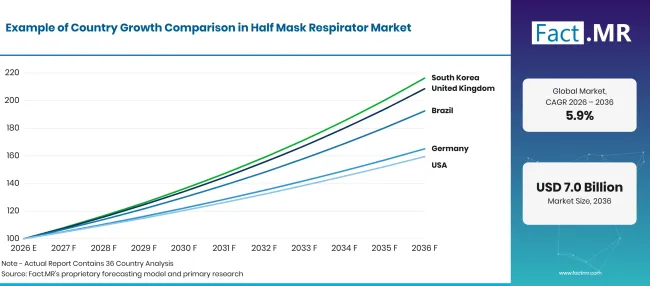
Half Mask Respirator Market Growth Index | Source: Fact.MR
| Country | CAGR (2026 to 2036) |
|---|---|
| UK | 7.6% |
| Brazil | 6.8% |
| Germany | 5.1% |
| USA | 4.8% |
| Japan | 4.4% |
Source: Fact.MR analysis. Updated Oct 31, 2026
How is the UK developing demand?
7.6% CAGR from 2026 to 2036.
In the UK, dust exposure during construction work influences the selection of respiratory equipment. The Health and Safety Executive reported in November 2025 that an estimated 53,000 workers experienced work-related breathing or lung problems in 2024/25 [8]. The Office for National Statistics recorded £139,106 million of new construction work in Great Britain in 2025 [4]. Respirator selection still depends on the exposure assessment at each job. HSE estimated about 11,000 lung disease deaths each year linked to past workplace exposure in its 2025 statistical summary [3]. The long delay between exposure and disease makes the effectiveness of present-day controls difficult to measure through current illnesses alone.
What supports Brazil’s expansion?
6.8% CAGR from 2026 to 2036.
Brazil’s social security ministry reported 313,160 occupational accidents in the industry category for 2025 [5]. Brazil’s official household survey reported approximately 13.1 million people working in general industry in its late-2025 moving-quarter results, published in January 2026 [6]. This indicates the size of the industrial workforce served by employer safety programs.
What shapes Germany’s purchasing decisions?
5.1% CAGR from 2026 to 2036.
German Social Accident Insurance reported 1,772 occupational-disease deaths in 2025 [7]. This total covers diverse causes and cannot be attributed to respiratory hazards alone. Annual safety spending also covers other protective controls, so mask purchases compete for a finite site budget. Replacement cartridges must remain available throughout the intended working life of a reusable facepiece.
How is the USA market positioned?
4.8% CAGR from 2026 to 2036.
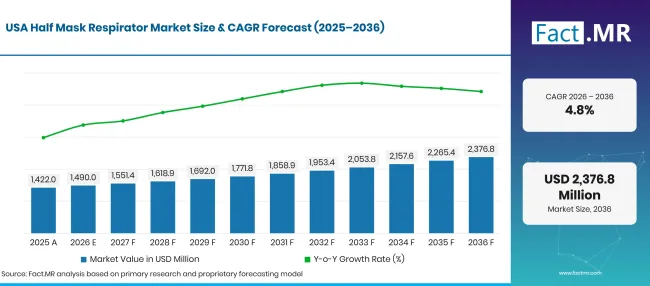
Half Mask Respirator Market Forecast Usa | Source: Fact.MR
US employers select half mask respirators under exposure-based written protection programs. The distinction between a filtering facepiece and a reusable elastomeric model affects cleaning and spare-part decisions. Annual fit-test schedules also make product continuity relevant when an organization operates many facilities. Industrial safety managers compare approved facepiece designs across several work areas before choosing a consistent range for staff training and replacement planning.
What influences Japan’s market?
4.4% CAGR from 2026 to 2036.
Japanese employers evaluate breathing protection around the dust or chemical exposure created by each process. Maintenance teams need practical guidance on when filters should be replaced. Suppliers serving precision manufacturing must also keep size options available because fit varies between individual workers. The range of dust and chemical tasks in Japanese manufacturing encourages careful filter selection. Workers using a reusable mask need a face seal that remains suitable during the actual job.
Who leads the Half Mask Respirator Market?
Suppliers include manufacturers with different approaches to facepiece design and respiratory filters. 3M, Honeywell, MSA Safety, Dräger and Moldex-Metric offer established respiratory protection product families.
GVS supplies respirators and filters, while Avon Protection focuses on specialized respiratory equipment. Product choice turns on the certified model, correct filter and availability of wearer sizes. A broad corporate safety portfolio alone does not prove that every product is a half mask.
E.D. Bullard Company, Kimberly-Clark Corporation and Alpha Pro Tech, Ltd. also participate in respiratory or related protective equipment categories. Their inclusion in a half mask comparison depends on whether the evaluated product is a qualifying half mask rather than a hood, general mask or other PPE. Facility buyers should compare current official product catalogues at the model level.
Which companies are the key providers?
Key companies include 3M Company; Honeywell International Inc.; MSA Safety Incorporated; Drägerwerk AG & Co. KGaA; Moldex-Metric Inc.; Kimberly-Clark Corporation; Avon Technologies plc (Avon Protection); GVS S.p.A.; Alpha Pro Tech, Ltd.; E.D. Bullard Company.
- 3M Company
- Honeywell International Inc.
- MSA Safety Incorporated
- Drägerwerk AG & Co. KGaA
- Moldex-Metric Inc.
- Kimberly-Clark Corporation
- Avon Technologies plc (Avon Protection)
- GVS S.p.A.
- Alpha Pro Tech, Ltd.
- E.D. Bullard Company
Bibliography
- [1] Occupational Safety and Health Administration. (n.d.). Respiratory protection, 29 CFR 1910.134
- [2] U.S. Bureau of Labor Statistics. (2026, January 22). Employer-reported workplace injuries and illnesses, 2023–2024.
- [3] Health and Safety Executive. (2025, November). Health and safety at work: Summary statistics for Great Britain 2025.
- [4] Office for National Statistics. (2026, October 23). Construction statistics, Great Britain: 2025.
- [5] Ministério da Previdência Social. (2026, October 26). 31.7 - Quantidade de acidentes do trabalho, por situação de registro e motivo, segundo o Setor de Atividade Econômica - 2023/2025.
- [6] Instituto Brasileiro de Geografia e Estatística. (2026, January 30). PNAD Contínua - Divulgação: Janeiro de 2026.
- [7] Deutsche Gesetzliche Unfallversicherung. (n.d.). Berufskrankheitengeschehen.
- [8] Health and Safety Executive. (2025, November 20). Historical picture statistics in Great Britain, 2025.
This Report Answers
- The report compares reusable and disposable half masks in terms of replacement requirements and workplace use.
- Application analysis explains how exposure hazards differ across industrial, healthcare and construction settings.
- Distribution analysis addresses the role of specialist stores in facepiece and filter selection.
- Country coverage reviews the UK, Brazil, Germany, USA and Japan against distinct workplace conditions.
- Competitive discussion assesses supplier portfolios without assigning unsupported company shares.
Facial mask products span a wider range of uses than approved workplace half masks.
What does the Half Mask Respirator Market cover?
The market covers half-face respirators used to protect wearers from specified airborne hazards. Reusable products use a facepiece with replaceable approved filters or cartridges. Disposable filtering facepieces use filtration material as a principal part of the facepiece. Both types require correct selection for the actual airborne contaminant and concentration.
What is included in the scope?
Included products are reusable elastomeric half masks and disposable filtering facepiece respirators sold for workplace use. Sales through specialist retailers and online channels are included. Industrial plants, construction contractors, healthcare facilities and oil and gas operators are covered as application groups when the products serve suitable exposure conditions.
What is excluded from the scope?
Full-face respirators, powered air-purifying hoods and self-contained breathing apparatus are outside the half mask product boundary. General face coverings without an applicable respiratory protection certification are also excluded. A half mask must not be described as suitable for oxygen-deficient atmospheres or other conditions beyond its certified limits.
How Was the Analysis Built?
The analysis draws on 120+ sources, 35+ company portfolios, 25+ countries, and more than 20 industry interviews.
- Primary Research: Primary research includes discussions with manufacturers, service providers, technology developers, distributors, end users, and subject-matter experts. These conversations examine purchasing priorities, product adoption, operational challenges, approval requirements, competitive positioning, and the factors that influence wider market acceptance.
- Desk Research: Desk research covers government statistics, regulatory publications, company filings, trade data, technical studies, industry associations, standards, public policy, and other authoritative sources. Every source used in the analysis is documented in the bibliography.
- Market Sizing and Forecasting: Market estimates combine historical performance, demand indicators, pricing and volume trends, segment shares, company participation, country-level growth, adoption patterns, investment activity, and barriers to market expansion.
- Data Validation and Update Cycle: Findings are validated by comparing primary interviews with public data, company activity, regulatory changes, trade patterns, and industry developments. Regular updates review new product launches, capacity changes, partnerships, approvals, and shifts in commercial adoption.
Segmentation
What is the report’s scope and coverage?
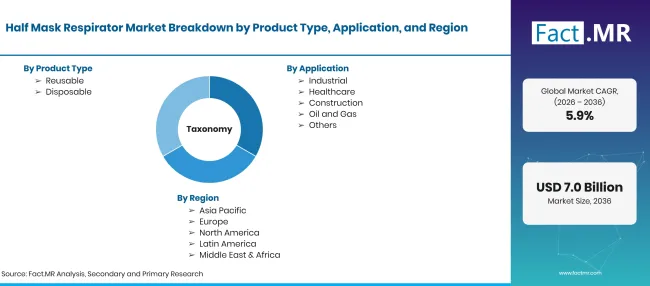
Half Mask Respirator Market Taxonomy | Source: Fact.MR
| Attribute | Details |
|---|---|
| Quantitative Units | USD billion in 2026 to USD billion by 2036 at a CAGR |
| Market Definition | Half-face respiratory protective equipment used for workplace exposure to airborne particles and selected gases or vapors, including reusable elastomeric respirators and disposable filtering facepiece respirators. |
| Product Type | Reusable; Disposable |
| Application | Industrial; Healthcare; Construction; Oil and Gas; Others |
| Distribution Channel | Specialty Stores; Online Stores; Supermarkets/Hypermarkets; Others |
| Material Type | Silicone; Thermoplastic Elastomer; Rubber; Others |
| Regions Covered | North America; Latin America; Western Europe; Eastern Europe; East Asia; South Asia & Pacific; Middle East & Africa |
| Countries Covered | UK; Brazil; Germany; USA; Japan |
| Companies Profiled | 3M Company; Honeywell International Inc.; MSA Safety Incorporated; Drägerwerk AG & Co. KGaA; Moldex-Metric Inc.; Kimberly-Clark Corporation; Avon Technologies plc (Avon Protection); GVS S.p.A.; Alpha Pro Tech, Ltd.; E.D. Bullard Company |
| Forecast Period | 2026 to 2036 |
| Approach | Market assessment by product type, application, distribution channel, material type, workplace protection requirements, fit-testing needs, filter and cartridge replacement, and supplier portfolio review. |
Source: Fact.MR analysis. Updated Oct 31, 2026
How is the market segmented?
-
By Product Type
- Reusable
- Disposable
-
By Application
- Industrial
- Healthcare
- Construction
- Oil and Gas
- Others
-
By Distribution Channel
- Specialty Stores
- Online Stores
- Supermarkets/Hypermarkets
- Others
-
By Material Type
- Silicone
- Thermoplastic Elastomer
- Rubber
- Others
-
By Region
- North America
- Latin America
- Western Europe
- Eastern Europe
- East Asia
- South Asia & Pacific
- Middle East & Africa
Frequently Asked Questions
How big is the Half Mask Respirator Market in 2026?
What is the CAGR of the Half Mask Respirator Market from 2026 to 2036?
Which product type leads the Half Mask Respirator Market?
Which application leads the Half Mask Respirator Market?
Who are the leading companies in the Half Mask Respirator Market?
Who worked on this report


Preview the report firsthand - request a free sample
Free SampleGet the brochure for pricing and purchase details
Download PDF