Indoor Climbing & Bouldering Gyms Market Size, Share, Growth and Forecast (2026 - 2036)
The Indoor Climbing & Bouldering Gyms Market is segmented by Facility Type, by Membership Type, by End User, by Revenue Stream, by Application, and Region. Forecast for 2026 to 2036.
What is the indoor climbing & bouldering gyms market forecast to be worth by 2036?
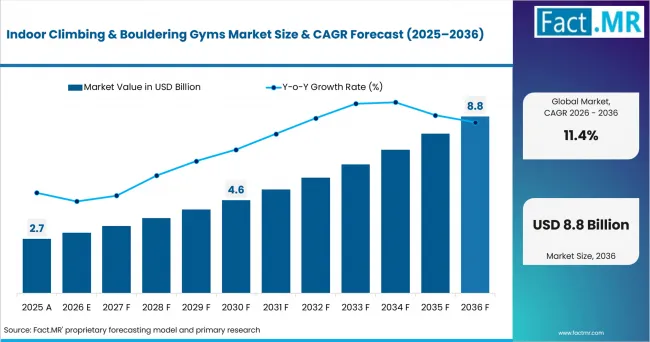
USD 3.0 billion in 2026 to USD 8.8 billion by 2036 at 11.4% CAGR.
- The Indoor Climbing & Bouldering Gyms Market was valued at USD 2.7 billion in 2025 and is projected to reach USD 3.0 billion in 2026.
- The market is forecast to expand to USD 8.8 billion by 2036, reflecting a CAGR of 11.4% during the forecast period.
- Growth is supported by rising participation in climbing sports, expansion of urban fitness centers, increasing youth engagement and growing popularity of bouldering as an accessible fitness activity.
What are the defining numbers behind indoor climbing gym growth?
USD 5.8 billion absolute opportunity by 2036 led by the United States, South Korea and Japan.
- Demand Drivers in the Market
- Olympic exposure continues expanding awareness and participation.
- Urban consumers increasingly seek social fitness experiences.
- Bouldering offers accessible entry points for new participants.
- Youth climbing programs continue strengthening long-term demand.
- Key Segments Analyzed
- By Facility Type: Bouldering Gyms are expected to hold 46.0% share in 2026.
- By Membership Type: Monthly Memberships are projected to account for 52.0% share in 2026.
- By End User: Recreational Climbers are expected to hold 61.0% share in 2026.
- By Revenue Stream: Membership Fees are expected to hold 43.0% share in 2026.
- By Application: Fitness and Recreation are projected to account for 49.0% share in 2026.
- By Geography: South Korea is projected to record 12.8% CAGR through 2036.
- Analyst Opinion at Fact.MR
- Shambhu Nath Jha, Senior Analyst at Fact.MR, states, "Indoor climbing is transitioning from a specialized recreational activity into a mainstream fitness and lifestyle category. Olympic exposure has expanded participation while operators continue opening facilities in urban markets. Demand is increasingly supported by consumers seeking social engagement and skill-based fitness experiences."
- Strategic Implications
- Expand bouldering-focused facilities to improve accessibility for first-time participants.
- Strengthen membership programs to improve retention and recurring revenue generation.
- Develop youth training initiatives to support long-term participant growth.
Indoor climbing and bouldering gyms provide controlled environments for recreational climbing, athletic training and competition preparation. Facilities increasingly combine fitness, social interaction and community experiences, creating broader appeal among consumers seeking alternatives to traditional gym memberships.
The United States remains the largest market due to extensive commercial gym networks and high recreational participation. South Korea benefits from a strong urban bouldering culture and continued gym expansion across Seoul. Japan remains a major market supported by Olympic success and established operators such as B-Pump. The United Kingdom continues expanding through established brands including Depot Climbing and The Climbing Works. Saudi Arabia is emerging as investments in sports participation and recreation infrastructure increase.
How does the indoor climbing & bouldering gyms market break down by segment?
Bouldering Gyms lead at 46.0%; Recreational Climbers lead at 61.0%.
Which facility type dominates?
Bouldering Gyms hold 46.0% share in 2026.
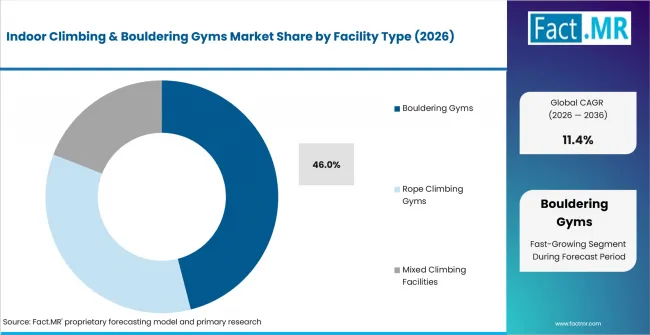
Bouldering gyms lead because they require less infrastructure than rope climbing facilities. They are easier for beginners to access and support higher participant throughput. Lower operating complexity also supports faster facility expansion. Movement Climbing, Yoga & Fitness announced the opening of a 45,000-square-foot facility in Philadelphia's Fishtown neighborhood, making it the largest indoor rock climbing gym in Pennsylvania. The gym features extensive bouldering and rope climbing terrain, fitness areas, yoga studios, and community spaces, reflecting continued investment in indoor climbing infrastructure. [1]
Which membership type dominates?
Monthly Memberships hold 52.0% share in 2026.
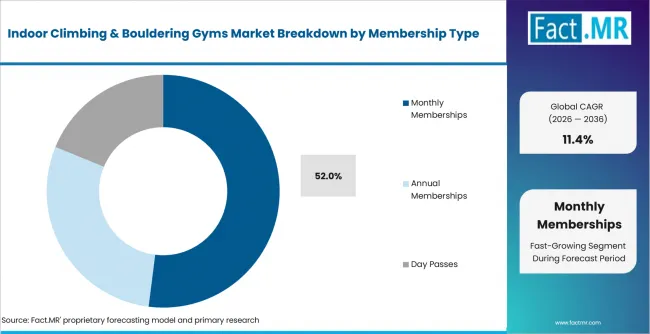
Monthly memberships dominate because regular climbers prefer flexible access and predictable costs. Operators benefit from recurring revenue and stronger customer retention. The model remains the foundation of most commercial climbing facilities. Movement partnered with The North Face for Global Climbing Day 2024, offering free climbing sessions, equipment rentals, and introductory classes across its nationwide gym network to promote participation in indoor climbing. [2]
Which end user dominates?
Recreational Climbers hold 61.0% share in 2026.
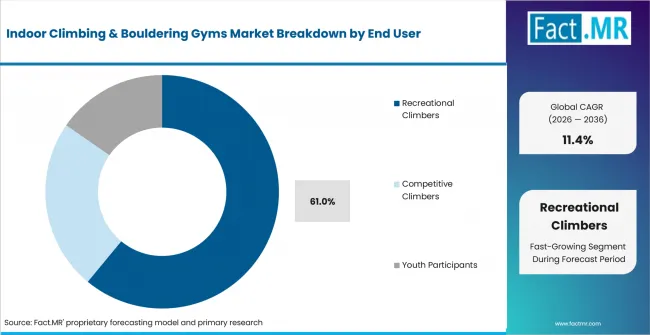
Recreational climbers dominate because most participants use climbing as a fitness and leisure activity. The segment benefits from broad demographic appeal and growing mainstream awareness. Social interaction and community engagement further support participation.
Which revenue stream dominates?
Membership Fees hold 43.0% share in 2026.
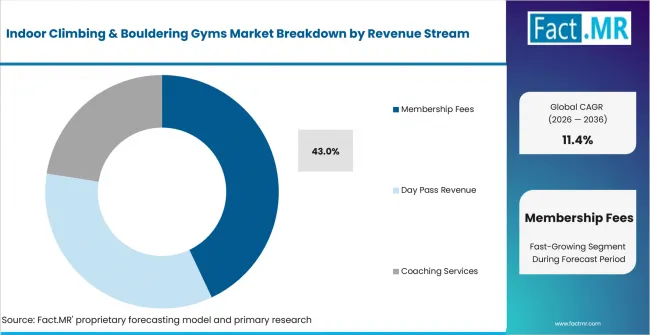
Membership fees dominate because they provide stable recurring income for operators. Frequent climbers increasingly choose subscriptions over single visits. Strong membership retention improves facility economics and long-term growth. Touchstone Climbing converted to a Public Benefit Corporation (PBC). The company said the move strengthens its commitment to environmental responsibility, community engagement, employee development, and sustainable growth. Touchstone operates 17 climbing gyms across California. [3]
Which application dominates?
Fitness and Recreation hold 49.0% share in 2026.
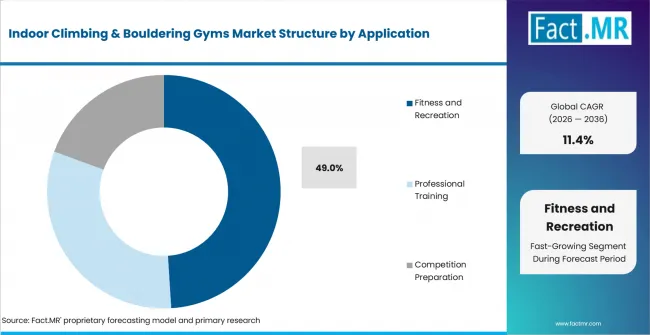
Fitness and recreation lead because climbing combines physical exercise with skill development and social interaction. Consumers increasingly view climbing as an alternative to traditional gym workouts. Recreational participation remains the largest source of demand. Central Rock Gym opened a new 20,000-square-foot indoor climbing facility in Troy, New York. The gym features 45-foot climbing walls, bouldering areas, top-rope and sport climbing routes, along with fitness and yoga spaces, expanding indoor climbing access in New York's Capital Region. [4]
What is accelerating indoor climbing gym demand and what is holding it back?
Experiential fitness participation drives demand while facility development costs restrain expansion.

The primary growth driver is increasing interest in fitness activities that combine exercise with social engagement and personal achievement. Olympic visibility has introduced climbing to a broader audience and encouraged participation across different age groups. Urban consumers continue seeking experiences beyond conventional fitness centers.
The primary restraint is the capital investment required for facility construction and climbing wall installation. Urban real estate costs can increase development expenses. Ongoing route setting and maintenance requirements also affect operating costs.
Where do the biggest indoor climbing gym opportunities sit?
Youth programs, premium fitness concepts and competition infrastructure.
- Youth Climbing Programs
- Youth climbing initiatives continue attracting new participants and building long-term engagement. Schools and sports organizations are increasingly incorporating climbing into activity programs. Early participation supports future membership growth.
- Premium Fitness Concepts
- Operators are combining climbing with wellness services and fitness amenities to create differentiated experiences. Premium facilities attract higher-spending consumers and strengthen retention. This approach supports revenue diversification.
- Competition and Training Facilities
- Growing interest in competitive climbing is increasing demand for advanced training environments. Dedicated facilities support athlete development and event hosting. Competition infrastructure also improves visibility for the sport.
Which countries are scaling indoor climbing gym adoption fastest?
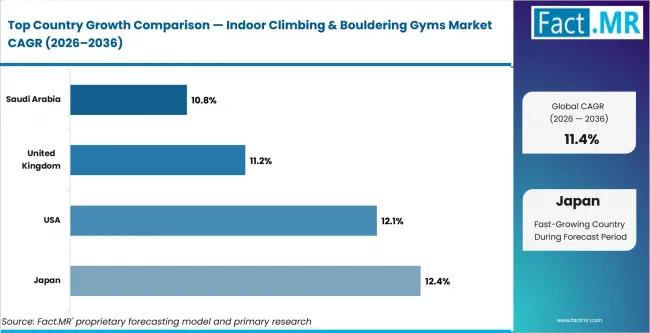
South Korea 12.8%, Japan 12.4%, United States 12.1%, United Kingdom 11.2%, Saudi Arabia 10.8%.
Based on regional analysis, the indoor climbing & bouldering gyms market is segmented into North America, Western Europe, Asia Pacific, Latin America and Middle East & Africa.
.webp)
| Country | CAGR |
|---|---|
| South Korea | 12.8% |
| Japan | 12.4% |
| United States | 12.1% |
| United Kingdom | 11.2% |
| Saudi Arabia | 10.8% |

What is driving South Korea's climbing boom?
12.8% CAGR, driven by the Seoul bouldering boom

South Korea is projected to record 12.8% CAGR through 2036 as the Seoul bouldering boom continues attracting new participants. Strong urban density and a well-established climbing culture support high facility utilization rates. Bouldering has become particularly popular among younger consumers seeking social and fitness-oriented activities. Operators continue expanding facilities and introducing new climbing formats to meet rising demand.
Why is Japan a major climbing market?
12.4% CAGR, supported by well-established indoor climbing culture

Japan is expected to post 12.4% CAGR due to Olympic medal success and strong consumer interest in climbing. Established operators such as B-Pump continue supporting market development through modern facilities and training programs. Climbing has gained greater visibility among mainstream sports audiences since the Olympics. Strong participation from both recreational and competitive climbers continues to support market growth.
How is the United States maintaining market leadership?
12.1% CAGR, fueled by continued climbing gym expansion
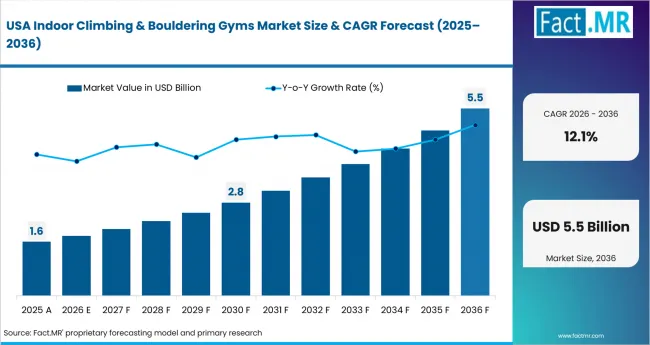
The United States is projected to register 12.1% CAGR through continued gym expansion and rising participation across all age groups. Strong investment activity and established operator networks support market growth. Large climbing gym chains continue opening facilities in major metropolitan areas and suburban markets. Growing interest in experiential fitness and outdoor recreation further strengthens demand.
What supports demand in the United Kingdom?
11.2% CAGR, supported by expanding facility networks
The United Kingdom is forecast to advance at 11.2% CAGR by 2036 as operators such as Depot Climbing and The Climbing Works continue expanding capacity. Climbing remains one of the fastest-growing recreational fitness activities in the country. Strong community engagement and accessible bouldering formats continue attracting new participants. Investment in modern facilities is supporting steady membership growth.
How is Saudi Arabia emerging in indoor climbing?
10.8% CAGR, driven by increasing investment in adventure sports
Saudi Arabia is expected to grow at 10.8% CAGR as adventure sports participation increases and new recreation infrastructure is developed. Government-backed sports initiatives continue improving awareness and accessibility. Climbing is benefiting from broader efforts to expand active lifestyle participation and diversify leisure offerings. New sports facilities and entertainment projects are expected to create additional opportunities for gym operators.
Who leads the indoor climbing & bouldering gyms landscape?
Movement Climbing, Central Rock Gym, B-Pump, Depot Climbing and The Climbing Works lead through facility scale and community engagement.

The market is characterized by competition focused on facility quality, route-setting expertise and member experience. Operators continue investing in modern gym environments, training programs and digital member engagement tools. Community building remains an important competitive differentiator as climbing gyms increasingly position themselves as social hubs rather than traditional fitness facilities.
Movement Climbing maintains a strong presence through its large facility network and diversified service offerings. B-Pump benefits from its leadership position in Japan's climbing market and strong brand recognition among climbers. Depot Climbing and The Climbing Works continue expanding across the United Kingdom through facility development, innovative route setting and active climbing communities. Several regional operators are also increasing investments in youth programs, coaching services and competition hosting capabilities to strengthen market positioning.
Competition through 2036 will depend on membership growth, facility expansion and customer engagement strategies. Operators that combine high-quality climbing experiences with strong community ecosystems will be better positioned to strengthen market share. The ability to attract new climbers while retaining experienced members will remain a key success factor. Investments in youth participation programs, premium facilities and competitive climbing infrastructure are also expected to influence long-term market leadership.
Which companies are the key players?
Movement Climbing, Central Rock Gym, B-PUMP, Depot Climbing, The Climbing Works, Touchstone Climbing, Vertical Endeavors and Climb Central
- Movement Climbing
- Central Rock Gym
- B-Pump
- Depot Climbing
- The Climbing Works
- Touchstone Climbing
- Vertical Endeavors
Bibliography
- [1] Climbing Business Journal. (2025). Movement Climbing, Yoga, and Fitness expands in Philadelphia with opening of Pennsylvania’s largest indoor rock climbing gym. Climbing Business Journal.
- [2] Movement Climbing, Yoga & Fitness. (2024). Movement and The North Face celebrate Global Climbing Day with free climbing nationwide. PR Newswire.
- [3] Climbing Business Journal. (2025). Touchstone Climbing becomes a public benefit corporation. Climbing Business Journal.
- [4] Times Union. (2026). Central Rock Gym brings indoor climbing to Troy’s River Street. Times Union.
This Report Addresses
- Market size estimates and long-term growth outlook for indoor climbing and bouldering gyms.
- Analysis of participation trends across recreational and competitive climbing segments.
- Evaluation of facility expansion strategies and membership-driven business models.
- Assessment of bouldering adoption and climbing gym development across major countries.
- Competitive benchmarking of leading gym operators and climbing facility networks.
- Analysis of growth drivers, restraints and emerging opportunities.
- Country-level demand outlook across the United States, United Kingdom, Saudi Arabia, South Korea and Japan.
- Strategic assessment of youth participation, fitness trends and competition infrastructure.
- Evaluation of operator expansion plans and investment priorities.
What does the indoor climbing & bouldering gyms market cover?
Commercial indoor climbing and bouldering facilities serving recreation, fitness, training and competition needs.
The market covers climbing gyms, bouldering facilities, mixed climbing centers and related services including memberships, coaching, competitions and recreational climbing activities.
What is included in the scope?
Indoor climbing facilities, bouldering gyms, coaching services, memberships and competition infrastructure.
The scope includes commercial climbing centers, climbing wall systems, youth programs, training facilities and climbing-related fitness services.
What is excluded from the scope?
Outdoor climbing activities and natural rock climbing destinations.
The scope excludes mountaineering activities, outdoor adventure tourism and natural climbing locations.
How was the analysis built?
100+ sources, 40+ operator assessments, 25+ countries and industry interviews.
- Primary Research:
- Interviews with gym operators, climbing associations, route setters and industry participants.
- Desk Research:
- Analysis of participation trends, gym openings, membership growth and climbing competition activity.
- Market Sizing and Forecasting:
- Estimates based on facility revenues, membership volumes and climbing participation rates.
- Data Validation and Update Cycle:
- Forecasts validated through operator benchmarking, facility assessments and participation analysis.
What is the report's scope and coverage?

| Attribute | Details |
|---|---|
| Quantitative Units | USD Billion in 2026 to USD Billion by 2036 |
| Market Definition | Commercial indoor facilities offering climbing, bouldering, training and recreational climbing experiences |
| Facility Types Covered | Bouldering Gyms, Rope Climbing Gyms, Mixed Climbing Facilities |
| Membership Types Covered | Monthly Memberships, Annual Memberships, Day Passes, Multi-Visit Packages |
| End Users Covered | Recreational Climbers, Competitive Climbers, Youth Participants, Corporate Groups |
| Revenue Streams Covered | Membership Fees, Day Pass Revenue, Coaching Services, Events & Competitions, Retail Sales |
| Applications Covered | Fitness & Recreation, Professional Training, Competition Preparation, Social Activities |
| Regions Covered | North America, Western Europe, Asia Pacific, Latin America, Middle East & Africa |
| Key Countries Covered | United States, United Kingdom, Saudi Arabia, South Korea, Japan |
| Companies Covered | Movement Climbing, Central Rock Gym, B-Pump, Depot Climbing, The Climbing Works, Touchstone Climbing, Vertical Endeavors, Climb Central |
| Approach | Hybrid top-down and bottom-up methodology using facility counts, membership trends, participation rates and operator revenues. |
How is market segmented?
-
By Facility Type
- Bouldering Gyms
- Rope Climbing Gyms
- Mixed Climbing Facilities
-
By Membership Type
- Monthly Memberships
- Annual Memberships
- Day Passes
- Multi-Visit Packages
-
By End User
- Recreational Climbers
- Competitive Climbers
- Youth Participants
- Corporate Groups
-
By Application
- Fitness and Recreation
- Professional Training
- Competition Preparation
- Social Activities
-
By Revenue Stream
- Membership Fees
- Day Pass Revenue
- Coaching Services
- Events and Competitions
- Retail and Equipment Sales
-
Region:
- North America
- United States
- Canada
- Europe
- United Kingdom
- Germany
- France
- Netherlands
- Spain
- Asia Pacific
- Australia
- Japan
- South Korea
- Singapore
- India
- Latin America
- Brazil
- Mexico
- Chile
- Middle East & Africa
- GCC Countries
- South Africa
- Israel
- North America
- Frequently Asked Questions -
Which facility type leads the market?
Bouldering gyms lead due to accessibility and efficient facility economics.
Which membership type dominates the market?
Monthly memberships dominate because they support recurring revenue and customer retention.
Which end user accounts for the largest share?
Recreational climbers account for the largest share of participation and facility usage.
What is driving demand for climbing gyms?
Experiential fitness trends and growing climbing participation continue driving demand.
Which country is growing the fastest?
South Korea is projected to record the highest CAGR through 2036.
What is the primary challenge facing operators?
Facility development costs and urban real estate expenses remain key challenges.
How are climbing gyms generating revenue?
Revenue comes primarily from memberships, coaching services, events and day passes.
Why is bouldering growing faster than traditional climbing?
Bouldering offers lower barriers to entry and requires less specialized equipment.
How is Olympic exposure influencing the market?
Olympic visibility is increasing participation and expanding consumer awareness.
What opportunities exist for gym operators?
Youth programs, premium facilities and competition infrastructure offer significant growth opportunities.
Why are investors interested in climbing gyms?
Strong membership models and growing participation create attractive recurring revenue opportunities.
How important is community engagement for operators?
Community engagement improves member retention and strengthens competitive positioning.
What is the long-term outlook for the market?
The market is expected to benefit from rising participation and continued facility expansion through 2036.
Table of Content
- Key Takeaways
- Market Size and CAGR
- Top Growth Driver
- Fastest Growing Segment
- Leading Region
- Key Companies
- Emerging Opportunities
- Executive Summary
- Global Market Outlook
- Demand-side Trends
- Supply-side Trends
- Technology Roadmap Analysis
- Analysis and Recommendations
- Analyst Perspective (What is happening? Why now? What should investors know?)
- Key Questions Answered
- How large is the market?
- What is the CAGR?
- What are key trends?
- Which region dominates?
- Who are the leaders?
- Market Overview
- Market Coverage / Taxonomy
- Market Definition / Scope / Limitations
- Research Methodology
- Chapter Orientation
- Analytical Lens and Working Hypotheses
- Market Structure, Signals, and Trend Drivers
- Benchmarking and Cross-market Comparability
- Market Sizing, Forecasting, and Opportunity Mapping
- Research Design and Evidence Framework
- Desk Research Programme (Secondary Evidence)
- Expert Input and Fieldwork (Primary Evidence)
- Tooling, Models, and Reference Databases
- Data Engineering and Model Build
- Quality Assurance and Audit Trail
- Market Background
- Market Dynamics (Drivers, Restraints, Opportunity, Trends)
- Scenario Forecast (Optimistic, Likely, Conservative)
- Impact Analysis
- AI Impact
- Sustainability Impact
- Regulatory Impact
- Technology Impact
- Consumer / Buyer Analysis
- Purchase Drivers
- Adoption Barriers
- Buyer Journey
- Opportunity Map Analysis
- Product Life Cycle Analysis
- Supply Chain Analysis
- Investment Feasibility Matrix
- Value Chain Analysis
- PESTLE and Porter's Analysis
- Regulatory Landscape
- Regional Parent Market Outlook
- Production and Consumption Statistics
- Import and Export Statistics
- Global Market Analysis and Forecast, 2021 to 2036
- Historical Market Size Value (USD Million) Analysis, 2021 to 2025
- Current and Future Market Size Value (USD Million) Projections, 2026 to 2036
- Y-o-Y Growth Trend Analysis
- Absolute $ Opportunity Analysis
- Global Market Pricing Analysis, 2021 to 2036
- Global Market Analysis and Forecast, By Facility Type, 2021 to 2036
- Introduction / Key Findings
- Historical Market Size Value (USD Million) Analysis By Facility Type, 2021 to 2025
- Current and Future Market Size Value (USD Million) Analysis and Forecast By Facility Type, 2026 to 2036
- Bouldering Gyms
- Rope Climbing Gyms
- Mixed Climbing Facilities
- Bouldering Gyms
- Y-o-Y Growth Trend Analysis By Facility Type, 2021 to 2025
- Absolute $ Opportunity Analysis By Facility Type, 2026 to 2036
- Global Market Analysis and Forecast, By Membership Type, 2021 to 2036
- Introduction / Key Findings
- Historical Market Size Value (USD Million) Analysis By Membership Type, 2021 to 2025
- Current and Future Market Size Value (USD Million) Analysis and Forecast By Membership Type, 2026 to 2036
- Monthly Memberships
- Annual Memberships
- Day Passes
- Monthly Memberships
- Y-o-Y Growth Trend Analysis By Membership Type, 2021 to 2025
- Absolute $ Opportunity Analysis By Membership Type, 2026 to 2036
- Global Market Analysis and Forecast, By End User, 2021 to 2036
- Introduction / Key Findings
- Historical Market Size Value (USD Million) Analysis By End User, 2021 to 2025
- Current and Future Market Size Value (USD Million) Analysis and Forecast By End User, 2026 to 2036
- Recreational Climbers
- Competitive Climbers
- Youth Participants
- Recreational Climbers
- Y-o-Y Growth Trend Analysis By End User, 2021 to 2025
- Absolute $ Opportunity Analysis By End User, 2026 to 2036
- Global Market Analysis and Forecast, By Revenue Stream, 2021 to 2036
- Introduction / Key Findings
- Historical Market Size Value (USD Million) Analysis By Revenue Stream, 2021 to 2025
- Current and Future Market Size Value (USD Million) Analysis and Forecast By Revenue Stream, 2026 to 2036
- Membership Fees
- Day Pass Revenue
- Coaching Services
- Membership Fees
- Y-o-Y Growth Trend Analysis By Revenue Stream, 2021 to 2025
- Absolute $ Opportunity Analysis By Revenue Stream, 2026 to 2036
- Global Market Analysis and Forecast, By Application, 2021 to 2036
- Introduction / Key Findings
- Historical Market Size Value (USD Million) Analysis By Application, 2021 to 2025
- Current and Future Market Size Value (USD Million) Analysis and Forecast By Application, 2026 to 2036
- Fitness and Recreation
- Professional Training
- Competition Preparation
- Fitness and Recreation
- Y-o-Y Growth Trend Analysis By Application, 2021 to 2025
- Absolute $ Opportunity Analysis By Application, 2026 to 2036
- Global Market Analysis and Forecast, By Region, 2021 to 2036
- Introduction
- Historical Market Size Value (USD Million) Analysis By Region, 2021 to 2025
- Current Market Size Value (USD Million) Analysis and Forecast By Region, 2026 to 2036
- North America
- Latin America
- Western Europe
- Eastern Europe
- East Asia
- South Asia and Pacific
- Middle East & Africa
- Market Attractiveness Analysis By Region
- North America Market Analysis and Forecast, By Country, 2021 to 2036
- Historical Market Size Value (USD Million) Trend Analysis By Market Taxonomy, 2021 to 2025
- Market Size Value (USD Million) Forecast By Market Taxonomy, 2026 to 2036
- By Country
- USA
- Canada
- Mexico
- By Facility Type
- By Membership Type
- By End User
- By Revenue Stream
- By Application
- By Country
- Market Attractiveness Analysis
- By Country
- By Facility Type
- By Membership Type
- By End User
- By Revenue Stream
- By Application
- Key Takeaways
- Latin America Market Analysis and Forecast, By Country
- Historical Market Size Value (USD Million) Trend Analysis By Market Taxonomy, 2021 to 2025
- Market Size Value (USD Million) Forecast By Market Taxonomy, 2026 to 2036
- By Country
- Brazil
- Chile
- Rest of Latin America
- By Facility Type
- By Membership Type
- By End User
- By Revenue Stream
- By Application
- By Country
- Market Attractiveness Analysis
- By Country
- By Facility Type
- By Membership Type
- By End User
- By Revenue Stream
- By Application
- Key Takeaways
- Western Europe Market Analysis and Forecast, By Country
- Historical Market Size Value (USD Million) Trend Analysis By Market Taxonomy, 2021 to 2025
- Market Size Value (USD Million) Forecast By Market Taxonomy, 2026 to 2036
- By Country
- Germany
- UK
- Italy
- Spain
- France
- Nordic
- BENELUX
- Rest of Western Europe
- By Facility Type
- By Membership Type
- By End User
- By Revenue Stream
- By Application
- By Country
- Market Attractiveness Analysis
- By Country
- By Facility Type
- By Membership Type
- By End User
- By Revenue Stream
- By Application
- Key Takeaways
- Eastern Europe Market Analysis and Forecast, By Country
- Historical Market Size Value (USD Million) Trend Analysis By Market Taxonomy, 2021 to 2025
- Market Size Value (USD Million) Forecast By Market Taxonomy, 2026 to 2036
- By Country
- Russia
- Poland
- Hungary
- Balkan & Baltic
- Rest of Eastern Europe
- By Facility Type
- By Membership Type
- By End User
- By Revenue Stream
- By Application
- By Country
- Market Attractiveness Analysis
- By Country
- By Facility Type
- By Membership Type
- By End User
- By Revenue Stream
- By Application
- Key Takeaways
- East Asia Market Analysis and Forecast, By Country
- Historical Market Size Value (USD Million) Trend Analysis By Market Taxonomy, 2021 to 2025
- Market Size Value (USD Million) Forecast By Market Taxonomy, 2026 to 2036
- By Country
- China
- Japan
- South Korea
- By Facility Type
- By Membership Type
- By End User
- By Revenue Stream
- By Application
- By Country
- Market Attractiveness Analysis
- By Country
- By Facility Type
- By Membership Type
- By End User
- By Revenue Stream
- By Application
- Key Takeaways
- South Asia and Pacific Market Analysis and Forecast, By Country
- Historical Market Size Value (USD Million) Trend Analysis By Market Taxonomy, 2021 to 2025
- Market Size Value (USD Million) Forecast By Market Taxonomy, 2026 to 2036
- By Country
- India
- ASEAN
- Australia & New Zealand
- Rest of South Asia and Pacific
- By Facility Type
- By Membership Type
- By End User
- By Revenue Stream
- By Application
- By Country
- Market Attractiveness Analysis
- By Country
- By Facility Type
- By Membership Type
- By End User
- By Revenue Stream
- By Application
- Key Takeaways
- Middle East & Africa Market Analysis and Forecast, By Country
- Historical Market Size Value (USD Million) Trend Analysis By Market Taxonomy, 2021 to 2025
- Market Size Value (USD Million) Forecast By Market Taxonomy, 2026 to 2036
- By Country
- Kingdom of Saudi Arabia
- Other GCC Countries
- Turkiye
- South Africa
- Other African Union
- Rest of Middle East & Africa
- By Facility Type
- By Membership Type
- By End User
- By Revenue Stream
- By Application
- By Country
- Market Attractiveness Analysis
- By Country
- By Facility Type
- By Membership Type
- By End User
- By Revenue Stream
- By Application
- Key Takeaways
- Key Countries Market Analysis
- USA
- Pricing Analysis
- Market Share Analysis, 2025
- By Facility Type
- By Membership Type
- By End User
- By Revenue Stream
- By Application
- Canada
- Pricing Analysis
- Market Share Analysis, 2025
- By Facility Type
- By Membership Type
- By End User
- By Revenue Stream
- By Application
- Mexico
- Pricing Analysis
- Market Share Analysis, 2025
- By Facility Type
- By Membership Type
- By End User
- By Revenue Stream
- By Application
- Brazil
- Pricing Analysis
- Market Share Analysis, 2025
- By Facility Type
- By Membership Type
- By End User
- By Revenue Stream
- By Application
- Chile
- Pricing Analysis
- Market Share Analysis, 2025
- By Facility Type
- By Membership Type
- By End User
- By Revenue Stream
- By Application
- Germany
- Pricing Analysis
- Market Share Analysis, 2025
- By Facility Type
- By Membership Type
- By End User
- By Revenue Stream
- By Application
- UK
- Pricing Analysis
- Market Share Analysis, 2025
- By Facility Type
- By Membership Type
- By End User
- By Revenue Stream
- By Application
- Italy
- Pricing Analysis
- Market Share Analysis, 2025
- By Facility Type
- By Membership Type
- By End User
- By Revenue Stream
- By Application
- Spain
- Pricing Analysis
- Market Share Analysis, 2025
- By Facility Type
- By Membership Type
- By End User
- By Revenue Stream
- By Application
- France
- Pricing Analysis
- Market Share Analysis, 2025
- By Facility Type
- By Membership Type
- By End User
- By Revenue Stream
- By Application
- India
- Pricing Analysis
- Market Share Analysis, 2025
- By Facility Type
- By Membership Type
- By End User
- By Revenue Stream
- By Application
- ASEAN
- Pricing Analysis
- Market Share Analysis, 2025
- By Facility Type
- By Membership Type
- By End User
- By Revenue Stream
- By Application
- Australia & New Zealand
- Pricing Analysis
- Market Share Analysis, 2025
- By Facility Type
- By Membership Type
- By End User
- By Revenue Stream
- By Application
- China
- Pricing Analysis
- Market Share Analysis, 2025
- By Facility Type
- By Membership Type
- By End User
- By Revenue Stream
- By Application
- Japan
- Pricing Analysis
- Market Share Analysis, 2025
- By Facility Type
- By Membership Type
- By End User
- By Revenue Stream
- By Application
- South Korea
- Pricing Analysis
- Market Share Analysis, 2025
- By Facility Type
- By Membership Type
- By End User
- By Revenue Stream
- By Application
- Russia
- Pricing Analysis
- Market Share Analysis, 2025
- By Facility Type
- By Membership Type
- By End User
- By Revenue Stream
- By Application
- Poland
- Pricing Analysis
- Market Share Analysis, 2025
- By Facility Type
- By Membership Type
- By End User
- By Revenue Stream
- By Application
- Hungary
- Pricing Analysis
- Market Share Analysis, 2025
- By Facility Type
- By Membership Type
- By End User
- By Revenue Stream
- By Application
- Kingdom of Saudi Arabia
- Pricing Analysis
- Market Share Analysis, 2025
- By Facility Type
- By Membership Type
- By End User
- By Revenue Stream
- By Application
- Turkiye
- Pricing Analysis
- Market Share Analysis, 2025
- By Facility Type
- By Membership Type
- By End User
- By Revenue Stream
- By Application
- South Africa
- Pricing Analysis
- Market Share Analysis, 2025
- By Facility Type
- By Membership Type
- By End User
- By Revenue Stream
- By Application
- USA
- Market Structure Analysis
- Competition Dashboard
- Competition Benchmarking
- Market Share Analysis of Top Players
- By Regional
- By Facility Type
- By Membership Type
- By End User
- By Revenue Stream
- By Application
- Emerging Startups
- Innovation Benchmarking
- Competition Analysis
- Competition Deep Dive
- Movement Climbing
- Overview
- Product Portfolio
- Profitability by Market Segments (Product/Age /Sales Channel/Region)
- Sales Footprint
- Strategy Overview
- Marketing Strategy
- Product Strategy
- Channel Strategy
- Central Rock Gym
- B-Pump
- Depot Climbing
- The Climbing Works
- Touchstone Climbing
- Vertical Endeavors
- Movement Climbing
- Competition Deep Dive
- Case Studies
- Success Stories
- Recent Developments
- Assumptions & Acronyms Used
List Of Table
- Table 1: Global Market Value (USD Million) Forecast by Region, 2021 to 2036
- Table 2: Global Market Value (USD Million) Forecast by Facility Type, 2021 to 2036
- Table 3: Global Market Value (USD Million) Forecast by Membership Type, 2021 to 2036
- Table 4: Global Market Value (USD Million) Forecast by End User, 2021 to 2036
- Table 5: Global Market Value (USD Million) Forecast by Revenue Stream, 2021 to 2036
- Table 6: Global Market Value (USD Million) Forecast by Application, 2021 to 2036
- Table 7: Global Market rma_anu Forecast by rma_anu, 2021 to 2036
- Table 8: North America Market Value (USD Million) Forecast by Country, 2021 to 2036
- Table 9: North America Market Value (USD Million) Forecast by Facility Type, 2021 to 2036
- Table 10: North America Market Value (USD Million) Forecast by Membership Type, 2021 to 2036
- Table 11: North America Market Value (USD Million) Forecast by End User, 2021 to 2036
- Table 12: North America Market Value (USD Million) Forecast by Revenue Stream, 2021 to 2036
- Table 13: North America Market Value (USD Million) Forecast by Application, 2021 to 2036
- Table 14: Latin America Market Value (USD Million) Forecast by Country, 2021 to 2036
- Table 15: Latin America Market Value (USD Million) Forecast by Facility Type, 2021 to 2036
- Table 16: Latin America Market Value (USD Million) Forecast by Membership Type, 2021 to 2036
- Table 17: Latin America Market Value (USD Million) Forecast by End User, 2021 to 2036
- Table 18: Latin America Market Value (USD Million) Forecast by Revenue Stream, 2021 to 2036
- Table 19: Latin America Market Value (USD Million) Forecast by Application, 2021 to 2036
- Table 20: Western Europe Market Value (USD Million) Forecast by Country, 2021 to 2036
- Table 21: Western Europe Market Value (USD Million) Forecast by Facility Type, 2021 to 2036
- Table 22: Western Europe Market Value (USD Million) Forecast by Membership Type, 2021 to 2036
- Table 23: Western Europe Market Value (USD Million) Forecast by End User, 2021 to 2036
- Table 24: Western Europe Market Value (USD Million) Forecast by Revenue Stream, 2021 to 2036
- Table 25: Western Europe Market Value (USD Million) Forecast by Application, 2021 to 2036
- Table 26: Eastern Europe Market Value (USD Million) Forecast by Country, 2021 to 2036
- Table 27: Eastern Europe Market Value (USD Million) Forecast by Facility Type, 2021 to 2036
- Table 28: Eastern Europe Market Value (USD Million) Forecast by Membership Type, 2021 to 2036
- Table 29: Eastern Europe Market Value (USD Million) Forecast by End User, 2021 to 2036
- Table 30: Eastern Europe Market Value (USD Million) Forecast by Revenue Stream, 2021 to 2036
- Table 31: Eastern Europe Market Value (USD Million) Forecast by Application, 2021 to 2036
- Table 32: East Asia Market Value (USD Million) Forecast by Country, 2021 to 2036
- Table 33: East Asia Market Value (USD Million) Forecast by Facility Type, 2021 to 2036
- Table 34: East Asia Market Value (USD Million) Forecast by Membership Type, 2021 to 2036
- Table 35: East Asia Market Value (USD Million) Forecast by End User, 2021 to 2036
- Table 36: East Asia Market Value (USD Million) Forecast by Revenue Stream, 2021 to 2036
- Table 37: East Asia Market Value (USD Million) Forecast by Application, 2021 to 2036
- Table 38: South Asia and Pacific Market Value (USD Million) Forecast by Country, 2021 to 2036
- Table 39: South Asia and Pacific Market Value (USD Million) Forecast by Facility Type, 2021 to 2036
- Table 40: South Asia and Pacific Market Value (USD Million) Forecast by Membership Type, 2021 to 2036
- Table 41: South Asia and Pacific Market Value (USD Million) Forecast by End User, 2021 to 2036
- Table 42: South Asia and Pacific Market Value (USD Million) Forecast by Revenue Stream, 2021 to 2036
- Table 43: South Asia and Pacific Market Value (USD Million) Forecast by Application, 2021 to 2036
- Table 44: Middle East & Africa Market Value (USD Million) Forecast by Country, 2021 to 2036
- Table 45: Middle East & Africa Market Value (USD Million) Forecast by Facility Type, 2021 to 2036
- Table 46: Middle East & Africa Market Value (USD Million) Forecast by Membership Type, 2021 to 2036
- Table 47: Middle East & Africa Market Value (USD Million) Forecast by End User, 2021 to 2036
- Table 48: Middle East & Africa Market Value (USD Million) Forecast by Revenue Stream, 2021 to 2036
- Table 49: Middle East & Africa Market Value (USD Million) Forecast by Application, 2021 to 2036
List Of Figures
- Figure 1: Global Market Pricing Analysis
- Figure 2: Global Market Value (USD Million) Forecast 2021-2036
- Figure 3: Global Market Value Share and BPS Analysis by Facility Type, 2026 and 2036
- Figure 4: Global Market Y-o-Y Growth Comparison by Facility Type, 2026-2036
- Figure 5: Global Market Attractiveness Analysis by Facility Type
- Figure 6: Global Market Value Share and BPS Analysis by Membership Type, 2026 and 2036
- Figure 7: Global Market Y-o-Y Growth Comparison by Membership Type, 2026-2036
- Figure 8: Global Market Attractiveness Analysis by Membership Type
- Figure 9: Global Market Value Share and BPS Analysis by End User, 2026 and 2036
- Figure 10: Global Market Y-o-Y Growth Comparison by End User, 2026-2036
- Figure 11: Global Market Attractiveness Analysis by End User
- Figure 12: Global Market Value Share and BPS Analysis by Revenue Stream, 2026 and 2036
- Figure 13: Global Market Y-o-Y Growth Comparison by Revenue Stream, 2026-2036
- Figure 14: Global Market Attractiveness Analysis by Revenue Stream
- Figure 15: Global Market Value Share and BPS Analysis by Application, 2026 and 2036
- Figure 16: Global Market Y-o-Y Growth Comparison by Application, 2026-2036
- Figure 17: Global Market Attractiveness Analysis by Application
- Figure 18: Global Market Value (USD Million) Share and BPS Analysis by Region, 2026 and 2036
- Figure 19: Global Market Y-o-Y Growth Comparison by Region, 2026-2036
- Figure 20: Global Market Attractiveness Analysis by Region
- Figure 21: North America Market Incremental Dollar Opportunity, 2026-2036
- Figure 22: Latin America Market Incremental Dollar Opportunity, 2026-2036
- Figure 23: Western Europe Market Incremental Dollar Opportunity, 2026-2036
- Figure 24: Eastern Europe Market Incremental Dollar Opportunity, 2026-2036
- Figure 25: East Asia Market Incremental Dollar Opportunity, 2026-2036
- Figure 26: South Asia and Pacific Market Incremental Dollar Opportunity, 2026-2036
- Figure 27: Middle East & Africa Market Incremental Dollar Opportunity, 2026-2036
- Figure 28: North America Market Value Share and BPS Analysis by Country, 2026 and 2036
- Figure 29: North America Market Value Share and BPS Analysis by Facility Type, 2026 and 2036
- Figure 30: North America Market Y-o-Y Growth Comparison by Facility Type, 2026-2036
- Figure 31: North America Market Attractiveness Analysis by Facility Type
- Figure 32: North America Market Value Share and BPS Analysis by Membership Type, 2026 and 2036
- Figure 33: North America Market Y-o-Y Growth Comparison by Membership Type, 2026-2036
- Figure 34: North America Market Attractiveness Analysis by Membership Type
- Figure 35: North America Market Value Share and BPS Analysis by End User, 2026 and 2036
- Figure 36: North America Market Y-o-Y Growth Comparison by End User, 2026-2036
- Figure 37: North America Market Attractiveness Analysis by End User
- Figure 38: North America Market Value Share and BPS Analysis by Revenue Stream, 2026 and 2036
- Figure 39: North America Market Y-o-Y Growth Comparison by Revenue Stream, 2026-2036
- Figure 40: North America Market Attractiveness Analysis by Revenue Stream
- Figure 41: North America Market Value Share and BPS Analysis by Application, 2026 and 2036
- Figure 42: North America Market Y-o-Y Growth Comparison by Application, 2026-2036
- Figure 43: North America Market Attractiveness Analysis by Application
- Figure 44: Latin America Market Value Share and BPS Analysis by Country, 2026 and 2036
- Figure 45: Latin America Market Value Share and BPS Analysis by Facility Type, 2026 and 2036
- Figure 46: Latin America Market Y-o-Y Growth Comparison by Facility Type, 2026-2036
- Figure 47: Latin America Market Attractiveness Analysis by Facility Type
- Figure 48: Latin America Market Value Share and BPS Analysis by Membership Type, 2026 and 2036
- Figure 49: Latin America Market Y-o-Y Growth Comparison by Membership Type, 2026-2036
- Figure 50: Latin America Market Attractiveness Analysis by Membership Type
- Figure 51: Latin America Market Value Share and BPS Analysis by End User, 2026 and 2036
- Figure 52: Latin America Market Y-o-Y Growth Comparison by End User, 2026-2036
- Figure 53: Latin America Market Attractiveness Analysis by End User
- Figure 54: Latin America Market Value Share and BPS Analysis by Revenue Stream, 2026 and 2036
- Figure 55: Latin America Market Y-o-Y Growth Comparison by Revenue Stream, 2026-2036
- Figure 56: Latin America Market Attractiveness Analysis by Revenue Stream
- Figure 57: Latin America Market Value Share and BPS Analysis by Application, 2026 and 2036
- Figure 58: Latin America Market Y-o-Y Growth Comparison by Application, 2026-2036
- Figure 59: Latin America Market Attractiveness Analysis by Application
- Figure 60: Western Europe Market Value Share and BPS Analysis by Country, 2026 and 2036
- Figure 61: Western Europe Market Value Share and BPS Analysis by Facility Type, 2026 and 2036
- Figure 62: Western Europe Market Y-o-Y Growth Comparison by Facility Type, 2026-2036
- Figure 63: Western Europe Market Attractiveness Analysis by Facility Type
- Figure 64: Western Europe Market Value Share and BPS Analysis by Membership Type, 2026 and 2036
- Figure 65: Western Europe Market Y-o-Y Growth Comparison by Membership Type, 2026-2036
- Figure 66: Western Europe Market Attractiveness Analysis by Membership Type
- Figure 67: Western Europe Market Value Share and BPS Analysis by End User, 2026 and 2036
- Figure 68: Western Europe Market Y-o-Y Growth Comparison by End User, 2026-2036
- Figure 69: Western Europe Market Attractiveness Analysis by End User
- Figure 70: Western Europe Market Value Share and BPS Analysis by Revenue Stream, 2026 and 2036
- Figure 71: Western Europe Market Y-o-Y Growth Comparison by Revenue Stream, 2026-2036
- Figure 72: Western Europe Market Attractiveness Analysis by Revenue Stream
- Figure 73: Western Europe Market Value Share and BPS Analysis by Application, 2026 and 2036
- Figure 74: Western Europe Market Y-o-Y Growth Comparison by Application, 2026-2036
- Figure 75: Western Europe Market Attractiveness Analysis by Application
- Figure 76: Eastern Europe Market Value Share and BPS Analysis by Country, 2026 and 2036
- Figure 77: Eastern Europe Market Value Share and BPS Analysis by Facility Type, 2026 and 2036
- Figure 78: Eastern Europe Market Y-o-Y Growth Comparison by Facility Type, 2026-2036
- Figure 79: Eastern Europe Market Attractiveness Analysis by Facility Type
- Figure 80: Eastern Europe Market Value Share and BPS Analysis by Membership Type, 2026 and 2036
- Figure 81: Eastern Europe Market Y-o-Y Growth Comparison by Membership Type, 2026-2036
- Figure 82: Eastern Europe Market Attractiveness Analysis by Membership Type
- Figure 83: Eastern Europe Market Value Share and BPS Analysis by End User, 2026 and 2036
- Figure 84: Eastern Europe Market Y-o-Y Growth Comparison by End User, 2026-2036
- Figure 85: Eastern Europe Market Attractiveness Analysis by End User
- Figure 86: Eastern Europe Market Value Share and BPS Analysis by Revenue Stream, 2026 and 2036
- Figure 87: Eastern Europe Market Y-o-Y Growth Comparison by Revenue Stream, 2026-2036
- Figure 88: Eastern Europe Market Attractiveness Analysis by Revenue Stream
- Figure 89: Eastern Europe Market Value Share and BPS Analysis by Application, 2026 and 2036
- Figure 90: Eastern Europe Market Y-o-Y Growth Comparison by Application, 2026-2036
- Figure 91: Eastern Europe Market Attractiveness Analysis by Application
- Figure 92: East Asia Market Value Share and BPS Analysis by Country, 2026 and 2036
- Figure 93: East Asia Market Value Share and BPS Analysis by Facility Type, 2026 and 2036
- Figure 94: East Asia Market Y-o-Y Growth Comparison by Facility Type, 2026-2036
- Figure 95: East Asia Market Attractiveness Analysis by Facility Type
- Figure 96: East Asia Market Value Share and BPS Analysis by Membership Type, 2026 and 2036
- Figure 97: East Asia Market Y-o-Y Growth Comparison by Membership Type, 2026-2036
- Figure 98: East Asia Market Attractiveness Analysis by Membership Type
- Figure 99: East Asia Market Value Share and BPS Analysis by End User, 2026 and 2036
- Figure 100: East Asia Market Y-o-Y Growth Comparison by End User, 2026-2036
- Figure 101: East Asia Market Attractiveness Analysis by End User
- Figure 102: East Asia Market Value Share and BPS Analysis by Revenue Stream, 2026 and 2036
- Figure 103: East Asia Market Y-o-Y Growth Comparison by Revenue Stream, 2026-2036
- Figure 104: East Asia Market Attractiveness Analysis by Revenue Stream
- Figure 105: East Asia Market Value Share and BPS Analysis by Application, 2026 and 2036
- Figure 106: East Asia Market Y-o-Y Growth Comparison by Application, 2026-2036
- Figure 107: East Asia Market Attractiveness Analysis by Application
- Figure 108: South Asia and Pacific Market Value Share and BPS Analysis by Country, 2026 and 2036
- Figure 109: South Asia and Pacific Market Value Share and BPS Analysis by Facility Type, 2026 and 2036
- Figure 110: South Asia and Pacific Market Y-o-Y Growth Comparison by Facility Type, 2026-2036
- Figure 111: South Asia and Pacific Market Attractiveness Analysis by Facility Type
- Figure 112: South Asia and Pacific Market Value Share and BPS Analysis by Membership Type, 2026 and 2036
- Figure 113: South Asia and Pacific Market Y-o-Y Growth Comparison by Membership Type, 2026-2036
- Figure 114: South Asia and Pacific Market Attractiveness Analysis by Membership Type
- Figure 115: South Asia and Pacific Market Value Share and BPS Analysis by End User, 2026 and 2036
- Figure 116: South Asia and Pacific Market Y-o-Y Growth Comparison by End User, 2026-2036
- Figure 117: South Asia and Pacific Market Attractiveness Analysis by End User
- Figure 118: South Asia and Pacific Market Value Share and BPS Analysis by Revenue Stream, 2026 and 2036
- Figure 119: South Asia and Pacific Market Y-o-Y Growth Comparison by Revenue Stream, 2026-2036
- Figure 120: South Asia and Pacific Market Attractiveness Analysis by Revenue Stream
- Figure 121: South Asia and Pacific Market Value Share and BPS Analysis by Application, 2026 and 2036
- Figure 122: South Asia and Pacific Market Y-o-Y Growth Comparison by Application, 2026-2036
- Figure 123: South Asia and Pacific Market Attractiveness Analysis by Application
- Figure 124: Middle East & Africa Market Value Share and BPS Analysis by Country, 2026 and 2036
- Figure 125: Middle East & Africa Market Value Share and BPS Analysis by Facility Type, 2026 and 2036
- Figure 126: Middle East & Africa Market Y-o-Y Growth Comparison by Facility Type, 2026-2036
- Figure 127: Middle East & Africa Market Attractiveness Analysis by Facility Type
- Figure 128: Middle East & Africa Market Value Share and BPS Analysis by Membership Type, 2026 and 2036
- Figure 129: Middle East & Africa Market Y-o-Y Growth Comparison by Membership Type, 2026-2036
- Figure 130: Middle East & Africa Market Attractiveness Analysis by Membership Type
- Figure 131: Middle East & Africa Market Value Share and BPS Analysis by End User, 2026 and 2036
- Figure 132: Middle East & Africa Market Y-o-Y Growth Comparison by End User, 2026-2036
- Figure 133: Middle East & Africa Market Attractiveness Analysis by End User
- Figure 134: Middle East & Africa Market Value Share and BPS Analysis by Revenue Stream, 2026 and 2036
- Figure 135: Middle East & Africa Market Y-o-Y Growth Comparison by Revenue Stream, 2026-2036
- Figure 136: Middle East & Africa Market Attractiveness Analysis by Revenue Stream
- Figure 137: Middle East & Africa Market Value Share and BPS Analysis by Application, 2026 and 2036
- Figure 138: Middle East & Africa Market Y-o-Y Growth Comparison by Application, 2026-2036
- Figure 139: Middle East & Africa Market Attractiveness Analysis by Application
- Figure 140: Global Market - Tier Structure Analysis
- Figure 141: Global Market - Company Share Analysis