- Market Value (2025): USD 562.0 Mn
- Estimated Value (2026): UUSD 680.0 Mn
- Forecast Value (2036): USD 4575.0 Mn
- CAGR (2026-2036): 21.0%
What is the Graphene Polymer Masterbatches Market forecast to be worth by 2036?
USD 680.0 million in 2026 to USD 4,575.0 million by 2036 at a 21.0% CAGR.
- The Graphene Polymer Masterbatches Market reached USD 562.0 million in 2025.
- Demand is projected to increase from USD 680.0 million in 2026 to USD 4,575.0 million by 2036.
- The market is forecast to record 21.0% CAGR from 2026 to 2036 as automotive, electronics and industrial compounders qualify graphene concentrates.
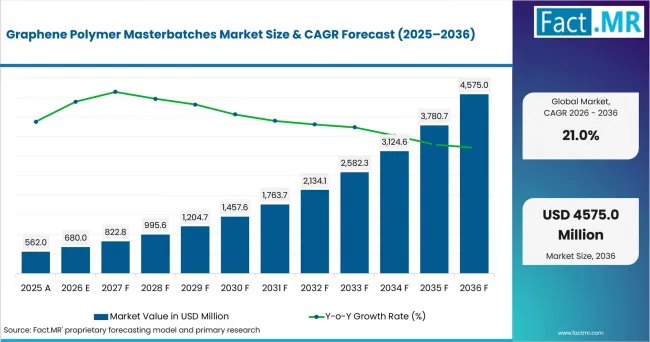
Graphene Polymer Masterbatches Market Value Analysis | Source: Fact.MR
What are the defining numbers behind Graphene Polymer Masterbatches Market growth?
USD 3,895.0 million absolute opportunity by 2036.
- Demand Drivers in the Market
- Automotive compounders need lighter conductive plastics for battery housings, sensor mounts and static-control parts in electric platforms.
- Electronics molders need stable electrical pathways inside housings and fixtures. The U.S. Census Bureau reported in July 2026 that computer and electronic product orders rose 3.1% to USD 31.1 billion in June 2026.
- Recycled-resin processors need masterbatch formats that disperse graphene consistently, so additive dosing stays familiar during compounding.
- Industrial part makers need stronger polymer composites for tooling, pipes and fixtures where conductivity or thermal movement adds value.
- Key Segments Analyzed
- By Graphene Form: Nanoplatelets are expected to hold 42.0% share in 2026 because platelet geometry supports reinforcement and conductivity at usable loading levels.
- By Carrier Matrix: Thermoplastics are projected to account for 46.0% share in 2026 as pellet handling fits established extrusion and molding routes.
- By Function: Conductivity is anticipated to capture 39.0% share in 2026 owing to measurable demand for ESD and electrically active polymer parts.
- By Application: Automotive is estimated to represent 30.0% share in 2026 supported by part-weight reduction and thermal-pathway requirements.
- Analyst Opinion at Fact.MR
- Shambhu Nath Jha, Principal Consultant at Fact.MR, states, “Graphene polymer masterbatches are moving from lab samples into converter trials because dispersion quality decides commercial value. Demand is expected to concentrate around concentrates that prove repeatable conductivity and melt-flow behavior. Better-positioned suppliers combine graphene loading guidance, carrier-resin support and application testing that shortens qualification.”
- Strategic Implications
- Graphene producers should publish loading guidance and dispersion windows so compounders can compare concentrate grades before plant trials.
- Polymer compounders should align carrier matrices with customer processing routes, especially thermoplastic molding and film extrusion.
- Additive-manufacturing material teams should test graphene masterbatch pellets beside filament and powder formats so product choices follow process route.
- Electronics manufacturers should set surface-resistivity and heat-transfer targets early so trial batches carry clear approval criteria.
Japan is forecast to post 26.8% CAGR through 2036 due to machinery investment and precision processing. Germany follows at 26.4% CAGR as electric vehicles lift technical-compound demand. The UK reaches 23.3% CAGR through zero-emission vehicle adoption. The USA records 17.7% CAGR through electronics and compounding capacity. South Korea posts 16.9% CAGR as ICT exports support technical plastics.
How does the Graphene Polymer Masterbatches Market break down by segment?
Nanoplatelets lead Graphene Form at 42.0%; Thermoplastics lead Carrier Matrix at 46.0%.
Which Graphene Form dominates?
Nanoplatelets are expected to hold 42.0% share in 2026.
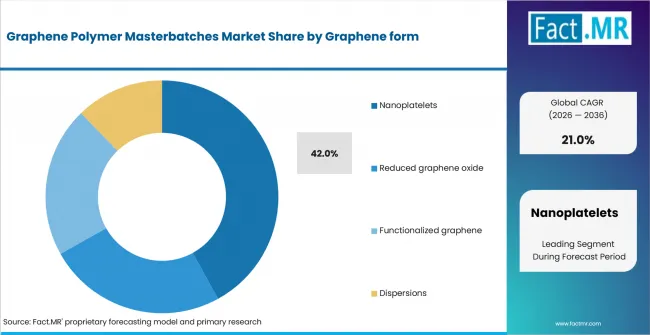
Graphene Polymer Masterbatches Market Analysis By Graphene Form | Source: Fact.MR
Nanoplatelets lead by giving compounders a practical path to tune conductivity and reinforcement inside polymer carriers. Their shape helps create conductive networks at lower loadings than many larger filler packages.
Graphene nanoplatelets applications reinforce this direction in plastics, coatings and structural materials. Processors still need stable dispersion data before a grade enters repeat production.
What leads the Carrier Matrix segment?
Thermoplastics are projected to account for 46.0% share in 2026.
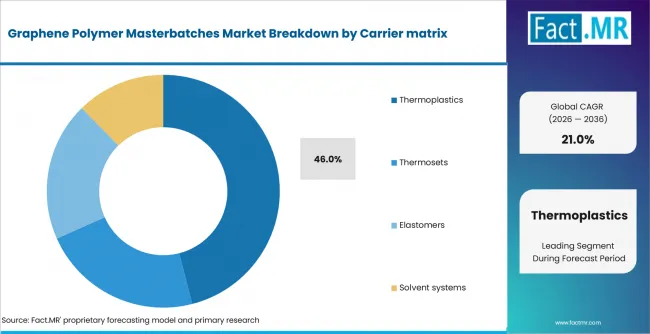
Graphene Polymer Masterbatches Market Analysis By Carrier Matrix | Source: Fact.MR
Thermoplastics lead since converters already feed pellets and additive concentrates into extrusion or injection molding lines. A graphene masterbatch can enter that route with familiar let-down testing.
How does Function shape demand?
Conductivity is anticipated to capture 39.0% share in 2026.
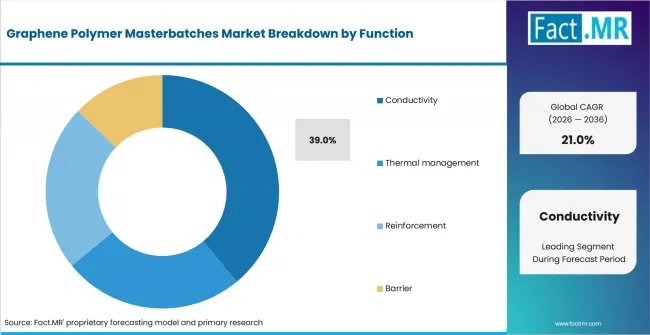
Graphene Polymer Masterbatches Market Analysis By Function | Source: Fact.MR
Conductivity leads owing to electrostatic discharge, sensing and heat pathways that are measurable targets in electronics and vehicles. Masterbatches give engineers a cleaner way to test graphene loading before a custom compound launch.
Graphene concentrates compete with conductive plastic compounds when buyers compare resistivity, mechanical behavior and color limits. Graphene gains attention where one additive package addresses multiple functional targets.
What supports Automotive within Application?
Automotive is estimated to represent 30.0% share in 2026.
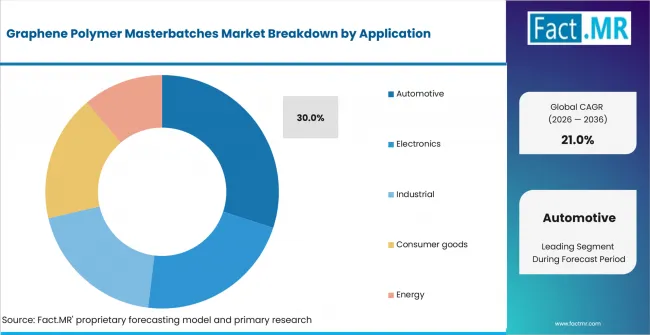
Graphene Polymer Masterbatches Market Analysis By Application | Source: Fact.MR
Automotive leads as electrified platforms use more sensors, battery-adjacent housings and thermal interfaces than conventional vehicle programs. Graphene masterbatches are evaluated where static control and strength must fit strict part-weight limits.
Graphmatech introduced a high-speed conductive C-PETG filament in March 2025 that prints 20-120% faster than traditional ESD polymer solutions.
What is accelerating Graphene Polymer Masterbatches Market adoption, and what is holding it back?
Demand is expected to rise through conductive plastics, thermoplastic processing and vehicle electrification. Growth is constrained by dispersion quality, resin compatibility and energy costs.
Drivers Impact Analysis
| DRIVER | (~) % IMPACT ON CAGR | GEOGRAPHIC RELEVANCE | IMPACT TIMELINE |
|---|---|---|---|
| Conductive and ESD polymer applications | +2.0% | North America, Europe, East Asia | Short term (<= 2 years) |
| Automotive lightweighting and EV components | +1.7% | Germany, UK, South Korea, Japan | Medium term (2-4 years) |
| Thermoplastic compounding compatibility | +1.4% | Global | Medium term (2-4 years) |
| Recycled and specialty resin formulation | +0.9% | Europe, North America | Long term (>= 4 years) |
- Conductive and ESD polymer applications: Electronics and industrial users need polymers that manage static and electrical pathways. Conductive masterbatches are evaluated against carbon black, metal fibers and other additive packages.
- Automotive lightweighting and EV components: Vehicle programs increase the need for polymer parts that reduce weight while carrying thermal or electrical functions. Graphene masterbatches support those tests when they disperse cleanly.
- Thermoplastic compounding compatibility: Pelletized concentrates are easier to dose into extrusion and molding lines.
Opportunity Impact Analysis
| OPPORTUNITY | (~) % IMPACT ON CAGR | GEOGRAPHIC RELEVANCE | IMPACT TIMELINE |
|---|---|---|---|
| Functional recycled compounds | +1.2% | Europe, North America | Medium term (2-4 years) |
| Graphene-enhanced additive manufacturing | +1.0% | Europe, East Asia | Long term (>= 4 years) |
| Thermal-management polymers | +0.8% | Global | Medium term (2-4 years) |
- Functional recycled compounds: Recycled resin processors can use concentrates to add conductivity or reinforcement while protecting familiar workflows.
- Graphene-enhanced additive manufacturing: Conductive filaments and powders let industrial users print ESD-safe fixtures, housings and tooling with fewer molding steps.
- Thermal-management polymers: Electronic housings and battery-adjacent components need plastic parts that move heat while preserving weight. Graphene coating additives show how graphene is tested for heat and barrier performance.
Restraints Impact Analysis
| RESTRAINT | (~) % IMPACT ON CAGR | GEOGRAPHIC RELEVANCE | IMPACT TIMELINE |
|---|---|---|---|
| Dispersion and batch consistency limits | -0.8% | Global | Short term (<= 2 years) |
| Resin compatibility and qualification time | -0.6% | Europe, North America, East Asia | Medium term (2-4 years) |
| Energy and input-price pressure | -0.5% | Europe, Japan, USA | Medium term (2-4 years) |
- Dispersion and batch consistency limits: Uneven graphene distribution can create hot spots, weak mechanical performance or unstable conductivity. Compounders require processing data before approving a grade.
- Resin compatibility and qualification time: A concentrate that works in one polymer may behave differently in another matrix. Testing across thermoplastics and elastomers slows wider approval.
- Energy and input-price pressure: Polymer conversion remains energy-sensitive. The U.S. Energy Information Administration reported an average industrial electricity price of 8.71 cents/kWh in May 2026, up 5.1% from May 2025.
Which countries are scaling the Graphene Polymer Masterbatches Market through 2036?
- The country comparison spans 9.9 percentage points across the forecast period.
- Japan remains 0.4 percentage point above Germany through machinery orders and precision polymer processing.
- Germany remains 3.1 percentage points above the UK as electric vehicles support conductive and thermal compounds.
- The UK remains 5.6 percentage points above the USA through zero-emission vehicles and specialty plastics demand.
- The USA remains 0.8 percentage point above South Korea through electronics-heavy durable goods and compounding capacity.
- South Korea closes the displayed range as ICT exports and vehicle platforms sustain technical-plastic demand.
Comparable CAGRs create different entry conditions due to electrification, energy costs, resin-converter depth and supplier qualification culture. Full report coverage includes North America, Latin America, Western Europe, Eastern Europe, East Asia, South Asia & Pacific, Middle East & Africa.
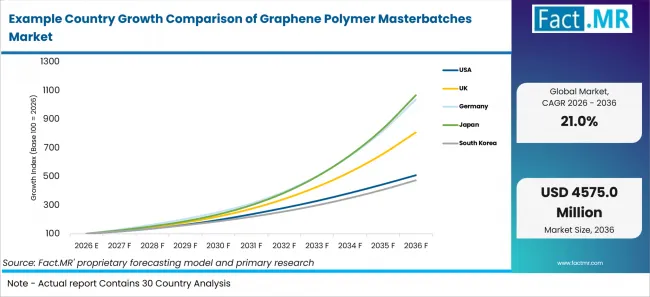
Example Country Growth Comparison Of Graphene Polymer Masterbatches Market | Source: Fact.MR
| Country | CAGR (2026-2036) |
|---|---|
| Japan | 26.8% |
| Germany | 26.4% |
| United Kingdom | 23.3% |
| United States | 17.7% |
| South Korea | 16.9% |
How does Japan perform?
26.8% CAGR, led by machinery investment and precision compounding demand.
Japan benefits from a machinery base that supports high-control polymer trials. The Cabinet Office reported in August 2026 that total machinery orders received by 280 manufacturers rose 11.3% in April-June 2026 from the previous quarter.
What is supporting Germany’s adoption?
26.4% CAGR, backed by electric vehicle demand and manufacturing depth.
Germany’s automotive materials teams are expected to remain active users of conductive and lightweight polymer compounds. The Federal Ministry for Economic Affairs and Energy reported in January 2026 that battery-electric vehicle registrations rose 43.2% to 545,142 units in 2025.
What supports the United Kingdom’s growth?
23.3% CAGR, supported by zero-emission vehicles and specialty formulation needs.
The UK market is shaped by specialty conversion runs where masterbatches help processors test conductivity and reinforcement in familiar resin lines. The Department for Transport reported in April 2026 that 528,000 zero-emission vehicles were first registered in 2025, up 24% from 2024.
What supports USA adoption?
17.7% CAGR, driven by durable-goods activity and electronics compounding.
U.S. compounders have the industrial base to test graphene concentrates across electronics, tooling and automotive applications. The Federal Reserve Board reported in August 2026 that manufacturing capacity utilization was 75.9% in June 2026, revised upward from the preliminary 75.7% estimate published in July.
How is South Korea developing demand?
16.9% CAGR, led by ICT exports and technical-plastic demand.
South Korea’s electronics export base gives graphene masterbatches a practical route into housings, fixtures and static-control parts. MOTIR and MSIT reported in August 2026 that ICT exports reached USD 53.36 billion in July 2026, up 140.6% year over year.
Who leads the Graphene Polymer Masterbatches Market?
NanoXplore is an active provider through graphene-enhanced plastic compounds and masterbatch formats for pelletized graphene integration. Directa Plus participates through G+ graphene masterbatches for thermoplastics and elastomers. First Graphene supplies PureGRAPH masterbatch grades for polymer applications, while Graphmatech uses Aros Graphene technology to improve conductive polymer performance.
Avanzare is relevant through graphene masterbatch and highly concentrated conductive-material capability. Gerdau Graphene adds a plastics route through graphene-enhanced additives and polymer masterbatch know-how. Competition centers on dispersion support, carrier-resin choice and proof that conductivity or reinforcement survives plant-scale processing.
Which companies are the key providers?
Key companies include NanoXplore Inc.; Directa Plus; First Graphene Limited; Graphmatech AB; Avanzare Innovación Tecnológica; and Gerdau Graphene.
- NanoXplore Inc.
- Directa Plus
- First Graphene Limited
- Graphmatech AB
- Avanzare Innovación Tecnológica
- Gerdau Graphene
Bibliography
- U.S. Census Bureau. (2026, July 27). Monthly advance report on durable goods manufacturers' shipments inventories and orders.
- Avanzare Materials. (2025, October 21). Avanzare Group strengthens its presence with a €10 million investment, creating 30 new jobs.
- Graphmatech AB. (2025, March 3). Introducing our groundbreaking high-speed ESD filament for 3D printing, C-PETG, developed in collaboration with Filalab UAB!.
- U.S. Energy Information Administration. (2026, July 23). Electric Power Monthly: Table 5.3. Average price of electricity to ultimate customers: Total by end-use sector, 2016–May 2026 (cents per kilowatthour).
- Economic and Social Research Institute. (2026, August 19). Machinery orders in June, 2026 and forecast for Jul.-Sep. 2026. Cabinet Office, Government of Japan.
- Federal Ministry for Economic Affairs and Energy. (2026, January 27). Great prospects for electric mobility.
- Department for Transport. (2026, April 29). Vehicle licensing statistics, United Kingdom: 2025. GOV.UK.
- Board of Governors of the Federal Reserve System. (2026, August 18). Industrial production and capacity utilization—G.17.
- Ministry of Trade, Industry and Resources, & Ministry of Science and ICT. (2026, August 14). Korea’s ICT exports reach record $53.36 billion for July.
This Report Answers
- The report explains where graphene polymer masterbatches are used across graphene form, carrier matrix, function and application.
- Segment analysis identifies the leading subsegments and the reasons compounders prioritize them.
- Country analysis examines the listed markets and the mechanisms supporting polymer masterbatch adoption.
- Competitive analysis reviews providers across graphene supply, dispersion technology and polymer concentrates.
- Application analysis assesses how conductivity, heat behavior and reinforcement influence purchase decisions.
What does the Graphene Polymer Masterbatches Market cover?
The Graphene Polymer Masterbatches Market covers pelletized or concentrated graphene additive systems used to modify polymer performance. It includes nanoplatelets, reduced graphene oxide, functionalized graphene and dispersion formats used in thermoplastics, thermosets, elastomers and solvent systems.
Coverage includes conductive, thermal-management, reinforcement and barrier functions across automotive, electronics and industrial uses. It connects with graphene composites and wider graphene materials where graphene is converted into a usable polymer-performance package.
What is included in the scope?
The scope includes graphene concentrates, custom compounded pellets, graphene-enhanced recycled resin compounds and formulation support attached to commercial sales. Related routes include 2D materials graphene used as additives for composite and coating producers.
It includes systems used for extrusion, injection molding, film production, elastomer processing and additive manufacturing feedstocks. Adjacent performance channels include PCR compatible masterbatches where additive compatibility influences compounder selection.
What is excluded from the scope?
The scope excludes loose graphene powder sold outside a polymer carrier, standalone resin sales, finished molded parts and conductive additives sold outside a graphene masterbatch transaction.
General material substitutes are treated only as comparison points during buyer evaluation. Examples include conductive carbon black and other filler systems used to benchmark cost, color and conductivity.
How Was the Analysis Built?
The analysis draws on 120+ sources, 35+ company portfolios, 25+ countries, and more than 20 industry interviews.
- Primary Research: Primary research includes discussions with manufacturers, service providers, technology developers, distributors, end users, procurement teams, and subject-matter experts. These conversations examine purchasing priorities, product adoption, operational challenges, approval requirements, competitive positioning, and the factors that influence wider market acceptance.
- Desk Research: Desk research covers government statistics, regulatory publications, company filings, trade data, technical studies, industry associations, standards, public policy, and other authoritative sources. Every source used in the analysis is documented in the bibliography.
- Market Sizing and Forecasting: Market estimates combine historical performance, demand indicators, pricing and volume trends, segment shares, company participation, country-level growth, adoption patterns, investment activity, and barriers to market expansion.
- Data Validation and Update Cycle: Findings are validated by comparing primary interviews with public data, company activity, regulatory changes, trade patterns, and industry developments. Regular updates review new product launches, capacity changes, partnerships, approvals, procurement trends, and shifts in commercial adoption.
What is the report’s scope and coverage?
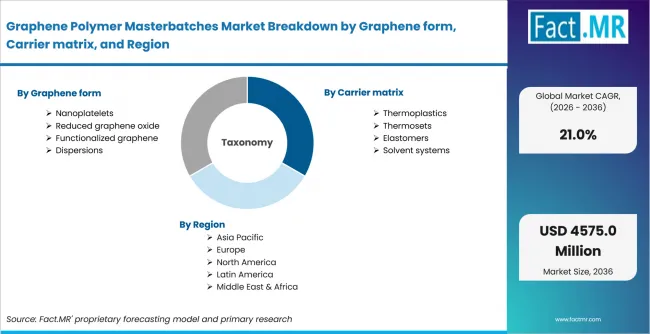
Graphene Polymer Masterbatches Market Breakdown By Graphene Form, Carrier Matrix, And Region | Source: Fact.MR
| Attribute | Details |
|---|---|
| Quantitative Units | USD million |
| Market Definition | Polymer masterbatches containing graphene forms dispersed into carrier matrices for conductivity, thermal management, reinforcement and barrier functions. |
| Graphene Form | Nanoplatelets; Reduced graphene oxide; Functionalized graphene; Dispersions |
| Carrier Matrix | Thermoplastics; Thermosets; Elastomers; Solvent systems |
| Function | Conductivity; Thermal management; Reinforcement; Barrier |
| Application | Automotive; Electronics; Industrial; Consumer goods; Energy |
| Regions Covered | North America; Latin America; Western Europe; Eastern Europe; East Asia; South Asia & Pacific; Middle East & Africa |
| Countries Covered | United States; United Kingdom; Germany; Japan; South Korea |
| Key Companies Profiled | NanoXplore Inc.; Directa Plus; First Graphene Limited; Graphmatech AB; Avanzare Innovación Tecnológica; Gerdau Graphene |
| Forecast Period | 2026 to 2036 |
| Approach | Hybrid top-down and bottom-up approach using compounding demand; graphene grade availability; segment shares; country growth; and provider portfolio review. |
How is the market segmented?
-
By Graphene Form:
- Nanoplatelets
- Reduced graphene oxide
- Functionalized graphene
- Dispersions
-
By Carrier Matrix:
- Thermoplastics
- Thermosets
- Elastomers
- Solvent systems
-
By Function:
- Conductivity
- Thermal management
- Reinforcement
- Barrier
-
By Application:
- Automotive
- Electronics
- Industrial
- Consumer goods
- Energy
-
By Region:
- North America
- Latin America
- Western Europe
- Eastern Europe
- East Asia
- South Asia & Pacific
- Middle East & Africa