- Base Value(2025): 1.4 Bn
- Estimated Value(2026): 1.6 Bn
- Forecast Value (2036): 7.9 Bn
- CAGR (2026 - 2036): 17.3%
What is the 2D materials graphene market forecast to be worth by 2036?
- The 2D materials graphene market was valued at USD 1.4 billion in 2025.
- Demand is projected to rise from USD 1.6 billion in 2026 to USD 7.9 billion by 2036.
- The market is forecast to record 17.3% CAGR from 2026 to 2036 as graphene grades move into composites and coatings.
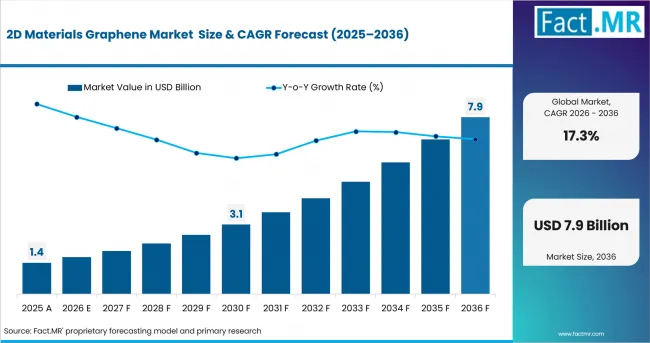
2d Materials Graphene Market Value Analysis | Source: Fact.MR
Summary of 2D Materials Graphene Market
- Demand Drivers
- Composite Reinforcement: Manufacturers use graphene to improve strength and conductivity at low loading levels.
- Energy Storage: Graphene-related materials support battery and supercapacitor research for conductivity gains.
- Industrial Scale-Up: Graphene Flagship reports growing industrial momentum across Europe’s 2D materials ecosystem.
- Key Segments Analyzed
- By Material Type: Graphene oxide is expected to hold 35.0% share in 2026 because dispersion supports formulation use.
- By Form: Powder leads bulk additive supply with 46.0% share in 2026 across composites and coatings.
- By Production Method: Liquid phase exfoliation is projected to hold 39.0% share in 2026 as scalable output suits additive-grade graphene.
- By Application: Composites lead application demand with 28.0% share in 2026 since graphene supports lightweight reinforcement.
- By End User: Electronics users are expected to hold 31.0% share in 2026 because graphene supports sensors and conductive films.
- By Geography: China leads the country outlook with 21.0% CAGR through 2036 as electronics demand expands.
- Analyst Opinion at Fact.MR
- Shambhu Nath Jha, Principal Consultant at Fact.MR, notes, “Graphene demand is moving beyond laboratory validation and entering a more disciplined commercial approval phase. The next stage of adoption will depend on supplier capability to deliver consistent grades and repeatable processing results. Industrial users are likely to approve commercial sourcing only when graphene performance remains stable across real production conditions.”
- Strategic Implications
- Grade Control: Suppliers need tighter platelet size control to meet application-specific performance needs.
- Application Proof: Material users should test graphene under real processing conditions before scaling approvals.
- Cost Discipline: Producers need lower batch variation to serve price-sensitive industrial users.
Graphene demand is becoming more dependent on commercial qualification. Material users need proof that graphene can improve performance at low loading levels. First Graphene’s PureGRAPH data sheet lists controlled platelet sizes for industrial applications. This shows why particle control and application matching are becoming important supplier evaluation points.
China is projected to record 21.0% CAGR by 2036 as electronics and battery material demand support graphene use. India is likely to post 20.2% CAGR from 2026 to 2036 as coatings and energy storage projects expand. The United States is expected to register 18.0% CAGR through 2036 because advanced materials research supports commercialization. Germany is forecast to advance at 16.2% CAGR by 2036 as automotive and industrial users test graphene-enhanced materials. The United Kingdom is set to record 15.4% CAGR through 2036 as research-to-industry programs support graphene applications.
How does the 2D materials graphene market break down by segment?
2D Materials Graphene Market Analysis by Material Type
Graphene oxide is expected to hold 35.0% share in 2026 because its oxygen groups help it mix in water-based systems. Graphene nanoplatelets support bulk reinforcement. Reduced graphene oxide supports conductive uses. Mono-layer and few-layer graphene serve higher-value electronics and sensing uses.
- Oxide Dispersion: Graphene oxide supports water-based systems that need easier mixing and surface compatibility.
- Platelet Reinforcement: Graphene nanoplatelets improve strength across polymers and coating systems with low loading.
- Reduced Conductivity: Reduced graphene oxide supports conductive films and selected electronic material applications.
2D Materials Graphene Market Analysis by Form
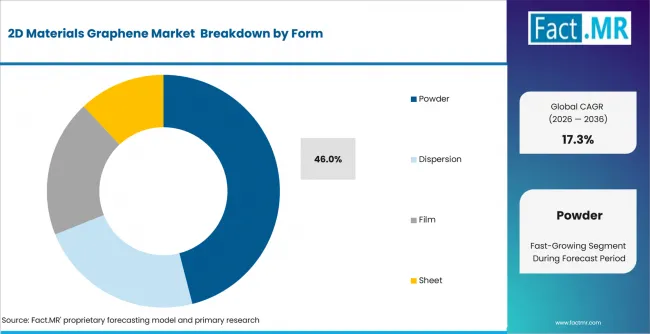
2d Materials Graphene Market Analysis By Form | Source: Fact.MR
Powder remains the preferred form for industrial compounding because it can be added to polymers and coatings. Dispersions help users reduce mixing difficulty. Powder is likely to account for 46.0% share in 2026 as composite and coating users need bulk additive supply. Films and sheets serve electronics and sensor applications that need controlled layer quality.
- Powder Dosing: Powder grades help compounders add graphene through familiar mixing equipment.
- Dispersion Ease: Dispersions reduce handling issues and improve formulation control for coating producers.
- Film Precision: Films and sheets support electronics that need controlled surface quality.
2D Materials Graphene Market Analysis by Production Method
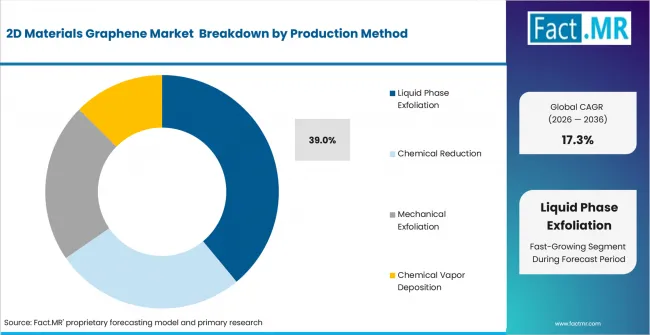
2d Materials Graphene Market Analysis By Production Method | Source: Fact.MR
Liquid phase exfoliation supports scalable additive-grade graphene output for coating and composite users. Nastran et al. stated in 2025 that graphene nanosheets from liquid suspensions are used in printable films and as fillers in composite materials, with liquid phase exfoliation identified as a leading synthesis route. Liquid phase exfoliation is projected to hold 39.0% share in 2026 because it supports larger commercial output. Chemical vapor deposition serves high-quality films for electronics and sensors. Chemical reduction supports reduced graphene oxide production.
- Exfoliation Scale: Liquid phase exfoliation supports higher-volume graphene supply for composites and coatings.
- CVD Quality: Chemical vapor deposition supports high-quality films for sensors and electronic devices.
- Reduction Route: Chemical reduction produces conductive graphene grades from graphene oxide feedstock.
2D Materials Graphene Market Analysis by Application
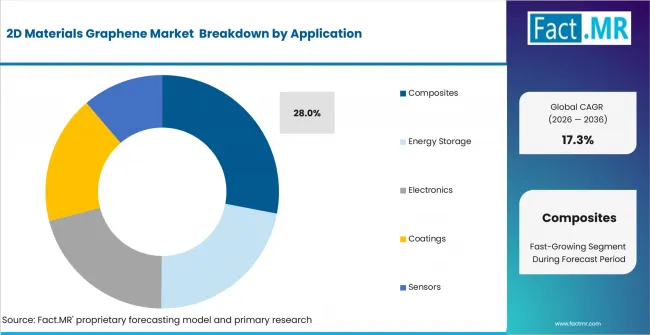
2d Materials Graphene Market Analysis By Application | Source: Fact.MR
Composites remain the main application base because graphene can improve strength and conductivity. Energy storage uses graphene in electrodes and conductive additives. Composites are anticipated to capture 28.0% share in 2026 as industrial users test graphene at low loading levels.
- Composite Strength: Graphene additives improve stiffness and durability in polymers and elastomers.
- Battery Conductivity: Energy storage users test graphene for electrode conductivity and faster charge behavior.
- Sensor Response: Sensor makers use graphene for high surface area and electrical sensitivity.
2D Materials Graphene Market Analysis by End User
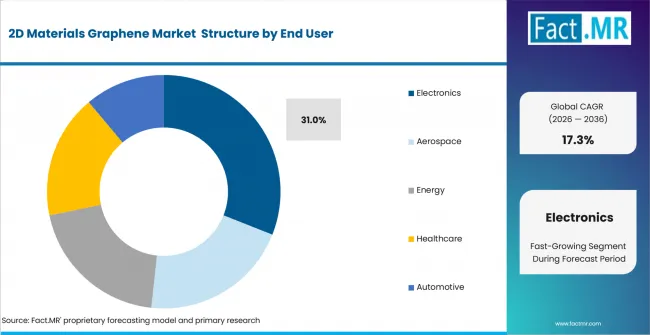
2d Materials Graphene Market Analysis By End User | Source: Fact.MR
Electronics users apply graphene in sensors and conductive films. Automotive users test graphene in lightweight composites and coatings. Electronics users are expected to hold 31.0% share in 2026 because graphene supports thermal materials and conductive surfaces. Aerospace users focus on strength-to-weight benefits. Energy users examine batteries and supercapacitors. Healthcare adoption is smaller because regulatory checks slow adoption.
- Electronics Demand: Electronics users apply graphene in sensors and thermal interface materials.
- Automotive Materials: Automotive users test graphene for lightweight parts and conductive composites.
- Energy Devices: Energy firms explore graphene for batteries and electrode material improvement.
What is accelerating 2D materials graphene adoption, and what is holding it back?
Commercial qualification is the main driver for 2D materials graphene demand. NanoXplore stated in its 2025 annual information form that product-level certification is needed for many applications, and lab data is not always representative of commercial applications. Manufacturers need proof that graphene can improve strength or conductivity without disrupting processing.
Scale-up remains the main restraint because material users still face graphene quality variation and uneven dispersion during larger production trials.
Opportunities in the 2D Materials Graphene Market
- Conductive Coatings: Producers can target coatings that need barrier protection and controlled electrical performance.
- Battery Additives: Material firms can support cell developers that need conductive additives for electrode systems.
- Sensor Platforms: Graphene suppliers can serve sensor makers that need thin material response.
Which countries are scaling 2D materials graphene demand fastest?
Based on regional analysis, the 2D materials graphene market is segmented into North America, Latin America, Europe, East Asia, South Asia & Oceania and Middle East and Africa.
| Country | CAGR 2026 to 2036 |
|---|---|
| China | 21.0% |
| India | 20.2% |
| United States | 18.0% |
| Germany | 16.2% |
| United Kingdom | 15.4% |
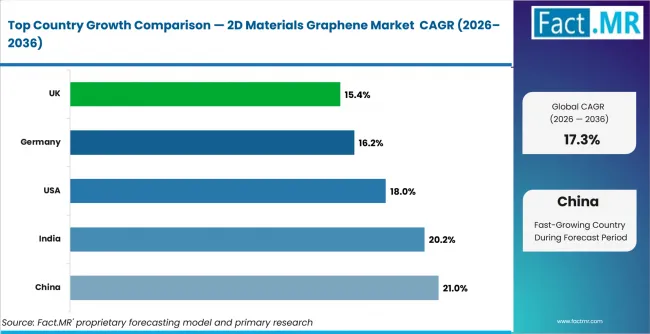
2d Materials Graphene Market Cagr Analysis By Country | Source: Fact.MR
East Asia 2D Materials Graphene Market Analysis
East Asia demand comes from electronics and batteries. China leads regional adoption because its electronics and energy storage industries can test graphene at scale. Local producers will compete on grade consistency and cost.
- China: China is projected to record 21.0% CAGR from 2026 to 2036 as electronics and battery materials support graphene demand. Producers need grades that work in conductive films and composites. Local scale can reduce supply cost. Material users will still need proof of repeatable dispersion and performance.
South Asia & Oceania 2D Materials Graphene Market Analysis
South Asia demand is supported by coatings and energy storage research. India leads regional growth because industrial users are testing advanced materials for mobility and electronics.
- India: Advanced materials base in India is growing through coatings and energy storage applications. Demand is likely to post 20.2% CAGR through 2036 as local industries test graphene-enhanced materials. Material users will need lower-cost grades that meet performance requirements. Suppliers with formulation support will gain stronger trial conversion.
North America 2D Materials Graphene Market Analysis
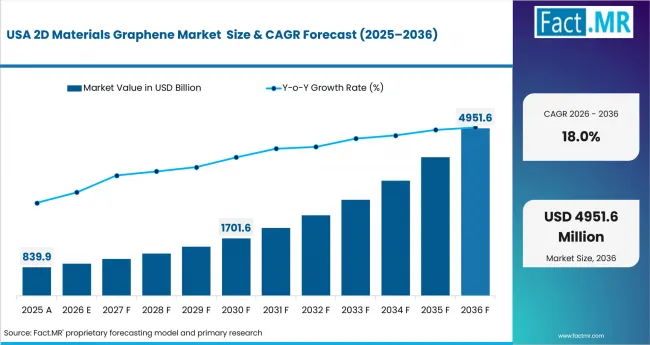
2d Materials Graphene Market Country Value Analysis | Source: Fact.MR
North America demand is led by the United States because research institutions and advanced material firms continue graphene application work. Material users need material that can pass qualification and pilot-scale testing.
- United States: The United States has a strong base of advanced materials research and graphene commercialization work. The market is forecast to register 18.0% CAGR from 2026 to 2036 as electronics and energy storage users test graphene. Material users will focus on repeatable quality and supplier reliability before scaling adoption.
Europe 2D Materials Graphene Market Analysis
Europe demand comes from research commercialization and industrial partnerships. Germany and the United Kingdom support adoption through automotive and research-to-industry programs. European users will prioritize technical validation and supply documentation.
- Germany: Automotive and industrial base in Germany supports graphene testing in composites and electronic materials. Manufacturers are assessing lightweight materials and conductive options for advanced applications. Germany is forecast to record 16.2% CAGR from 2026 to 2036. Suppliers must prove process compatibility and repeatable performance. Technical approval cycles will shape commercial progress.
- United Kingdom: The United Kingdom has strong graphene research links through universities and commercialization centers. The United Kingdom is forecast to record 15.4% CAGR from 2026 to 2036 as graphene moves into coatings and sensors. Companies with credible scale-up evidence will gain better commercial access. Application proof will matter more than material novelty.
Who leads the 2D materials graphene market landscape?
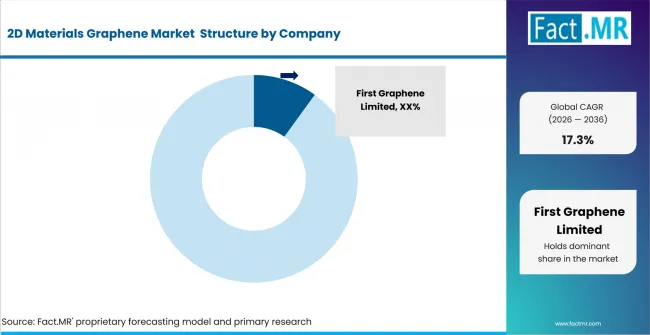
2d Materials Graphene Market Analysis By Company | Source: Fact.MR
The 2D materials graphene market is supported by graphene producers and nanomaterial specialists. First Graphene Limited supports industrial graphene use through controlled PureGRAPH grades. Haydale Graphene Industries plc and Graphenea serve customers that need graphene materials and application support. NanoXplore Inc. and The Sixth Element (Changzhou) Materials Technology Co. Ltd. support larger graphene supply needs. Directa Plus S.p.A. is active in graphene-based material applications.
Customer selection will depend on grade consistency and application proof through 2036. Composite users will prefer low-dose performance that improves material strength. Electronics users will need cleaner grades with tighter defect control. Dispersion behavior and supply reliability will also guide supplier choice.
Which companies are the key players?
- First Graphene Limited
- Haydale Graphene Industries plc
- Graphenea
- NanoXplore Inc.
- The Sixth Element (Changzhou) Materials Technology Co., Ltd.
- Directa Plus S.p.A.
Bibliography
- First Graphene Limited. (2025, February 13). PureGRAPH® graphene powders and properties.
- Graphene Flagship. (2026, April 15). Graphene Flagship Annual Report 2025: Powering Europe’s next wave of 2D innovation.
- NanoXplore Inc. (2025, September 16). Annual information form for the fiscal year ended June 30, 2025.
- NanoXplore Inc. (2026). GrapheneBlack™.
This Report Addresses
- Strategic intelligence on 2D materials graphene demand across material type, form, production method, application and end user.
- Segment analysis covering graphene oxide, powder form, liquid phase exfoliation, composites and electronics users.
- Regional outlook covering China, India, the United States, Germany and the United Kingdom.
- Competitive analysis of First Graphene Limited, Haydale Graphene Industries plc, Graphenea, NanoXplore Inc., The Sixth Element (Changzhou) Materials Technology Co., Ltd., Directa Plus S.p.A.
- Product assessment covering graphene oxide, graphene nanoplatelets, reduced graphene oxide, films and dispersions.
- Primary interviews, supplier checks, official source review and application-trial validation support the forecast.
What does the 2D materials graphene market cover?
The 2D materials graphene market covers graphene-based materials made from one or few carbon atom layers. It includes graphene oxide and graphene nanoplatelets. It also includes reduced graphene oxide and selected few-layer graphene grades. The market is distinct from graphite because graphene is used for reinforcement and conductivity improvement.
2D Materials Graphene Market Inclusions
The scope includes graphene powders and dispersions. It also includes films and sheets sold for composites and batteries. Coatings and electronics uses are included when graphene is sold as a material input. Graphene Flagship states that its work supports industrial momentum across Europe’s 2D materials ecosystem.
2D Materials Graphene Market Exclusions
The scope excludes bulk graphite and carbon black. It also excludes carbon nanotubes sold without graphene content. Finished batteries and electronic devices are outside scope. Research-only samples are excluded when they are not sold as commercial graphene products.
2D Materials Graphene Market Research Methodology
- Primary Research
- Primary research includes interviews with graphene producers and advanced materials engineers across coatings and battery applications.
- Desk Research
- Desk research reviews product data sheets and official company reports with project updates and technical filings.
- Market-Sizing and Forecasting
- Forecasting uses material type demand with form use alongside production route and end user qualification cycles.
- Data Validation and Update Cycle
- Forecasts are validated through supplier checks and scaled application-trial evidence.
Segmentation
What is the report’s scope and coverage?
| Attribute | Details |
|---|---|
| Quantitative Units | USD billion in 2026 to USD billion by 2036 at CAGR |
| Market Definition | Graphene-based two-dimensional materials used as functional additives and advanced material inputs |
| Material Type | Graphene Oxide, Graphene Nanoplatelets, Reduced Graphene Oxide, Mono-Layer Graphene, Few-Layer Graphene |
| Form | Powder, Dispersion, Film, Sheet |
| Production Method | Chemical Vapor Deposition, Liquid Phase Exfoliation, Chemical Reduction, Mechanical Exfoliation |
| Application | Composites, Energy Storage, Electronics, Coatings, Sensors |
| End User | Automotive, Electronics, Aerospace, Energy, Healthcare |
| Regions Covered | North America, Latin America, Europe, East Asia, South Asia & Oceania, Middle East and Africa |
| Countries Covered | China, India, United States, Germany, United Kingdom |
| Key Companies Profiled | First Graphene Limited, Haydale Graphene Industries plc, Graphenea, NanoXplore Inc., The Sixth Element (Changzhou) Materials Technology Co., Ltd., Directa Plus S.p.A. |
| Forecast Period | 2026 to 2036 |
| Approach | Hybrid top-down and bottom-up approach using material type demand, form use, production method, application uptake and end-user validation |
How is the market segmented?
-
By Material Type:
- Graphene Oxide
- Graphene Nanoplatelets
- Reduced Graphene Oxide
- Mono-Layer Graphene
- Few-Layer Graphene
-
By Form:
- Powder
- Dispersion
- Film
- Sheet
-
By Production Method:
- Chemical Vapor Deposition
- Liquid Phase Exfoliation
- Chemical Reduction
- Mechanical Exfoliation
-
By Application:
- Composites
- Energy Storage
- Electronics
- Coatings
- Sensors
-
By End User:
- Automotive
- Electronics
- Aerospace
- Energy
- Healthcare
-
Region:
- North America
- United States
- Canada
- Europe
- Germany
- United Kingdom
- France
- Italy
- Spain
- Asia Pacific
- China
- Japan
- South Korea
- Taiwan
- Singapore
- Latin America
- Brazil
- Mexico
- Argentina
- Middle East & Africa
- GCC Countries
- South Africa
- Israel
- North America
Frequently Asked Questions
Which material type leads the market?
Which country expands fastest in the 2D Materials Graphene Market?
How does India perform in the market?
How does the United States perform in the market?
What is the main driver in the market?
What is the main restraint in the market?
Why is graphene oxide important?
Who worked on this report


Preview the report firsthand - request a free sample
Free SampleGet the brochure for pricing and purchase details
Download PDF