- Market Value (2025): USD 105.5 Mn
- Estimated Value (2026): USD 135.0 Mn
- Forecast Value (2036): USD 1594.0 Mn
- CAGR (2026-2036): 28.0%
What is the Graphene Propeller Coatings Market forecast to be worth by 2036?
USD 135.0 million in 2026 to USD 1,594.0 million by 2036 at a 28.0% CAGR.
- The graphene propeller coatings market crossed a valuation of USD 105.5 million in 2025.
- Demand is projected to increase from USD 135.0 million in 2026 to USD 1,594.0 million by 2036.
- The market is forecast to record a 28.0% CAGR from 2026 to 2036 as commercial fleets, coating formulators and shipyards test lower-drag protective systems.
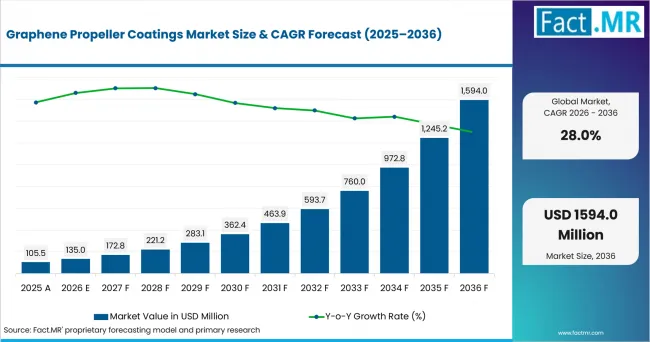
Graphene Propeller Coatings Market Value Analysis | Source: Fact.MR
What are the defining numbers behind Graphene Propeller Coatings Market growth?
USD 1,459.0 million absolute opportunity by 2036, led by bio-polyesters, hull applications and anti-fouling.
- Demand Drivers in the Market
- Vessel owners face greater focus on maintaining clean underwater surfaces after IMO approved guidance on in-water cleaning of ships’ biofouling in April 2025 and initiated development of a legally binding biofouling-control framework. The guidance also makes coating condition, service life and compatibility with cleaning systems important considerations alongside fouling-control performance.
- UN Trade and Development stated in September 2025 that over 80% of the volume of international trade in goods is carried by sea. Given the scale and frequency of vessel operations, fleet managers have a strong incentive to document fuel-efficiency performance, while IMO notes that increased hull drag raises fuel consumption and emissions.
- Coating formulators require stable graphene dispersion, and First Graphene’s February 2025 PureGRAPH® data sheet lists barrier coatings among its application fields while highlighting controlled platelet-size distribution, ease of dispersion and batch quality control. These characteristics support consistent formulation and application testing in coating systems.
- Shipyards need propeller and hull systems that fit dry-dock routines while green antifouling coatings move into cleaner vessel-maintenance specifications. Faster application and predictable curing are central to keeping docking schedules intact.
- Key Segments Analyzed
- By Material: Bio-polyester binder/matrix systems at 41.0% share in 2026; Material denotes the coating matrix carrying graphene.
- By Vessel Area: Hull at 44.0% share in 2026 since underwater coating programs often group hull and propeller surfaces.
- By Function: Anti-fouling at 44.0% share in 2026 as fouling control links directly with drag and fuel use.
- By Vessel Type: Commercial at 42.0% share in 2026 owing to repeat dry-dock cycles across cargo and service vessels.
- Analyst Opinion at Fact.MR
- Shambhu Nath Jha, Principal Consultant at Fact.MR, states, "Graphene propeller coatings are moving from material curiosity into a qualification problem. Suppliers are expected to win when they prove dispersion stability, coating adhesion and in-service cleaning behavior in one data package. Shipowners care less about the word graphene and more about whether the coating reduces drag while keeping repair risk controlled."
- Strategic Implications
- Coating formulators should document graphene loading levels, viscosity behavior and saltwater exposure results before approaching fleet accounts. The same file should explain how the additive is mixed into marine binders.
- Shipyards should test application timing during dry-dock work so coating benefits stay aligned with planned vessel-return schedules. Trial plans should include surface preparation, curing windows and inspection checkpoints.
- Fleet operators should compare propeller coating choices using fuel, fouling and cleaning records from similar routes. The strongest internal case comes from vessels with comparable operating speeds and cleaning intervals.
- Graphene suppliers should support marine coating partners with dispersion data and safety files for nanoscale additives. Technical support should cover handling, storage and quality checks before field trials begin.
Germany is expected to record 34.1% CAGR through 2036, led by seaport cargo recovery and shipyard-linked maintenance. The USA is projected to post 30.3% CAGR due to port freight scale and marine infrastructure grants. Japan is anticipated to advance at 27.6% CAGR as container throughput supports coating trials. South Korea is estimated to hold 22.0% CAGR, shaped by container-port scale and advanced shipbuilding. The UK is forecast to record 20.4% CAGR as clean maritime funding and carbon reporting guide vessel-efficiency purchasing.
How does the Graphene Propeller Coatings Market break down by segment?
Bio-polyesters lead at 41.0%; hull applications lead at 44.0%.
Which Material dominates?
Bio-polyester binder/matrix systems at 41.0% share in 2026.
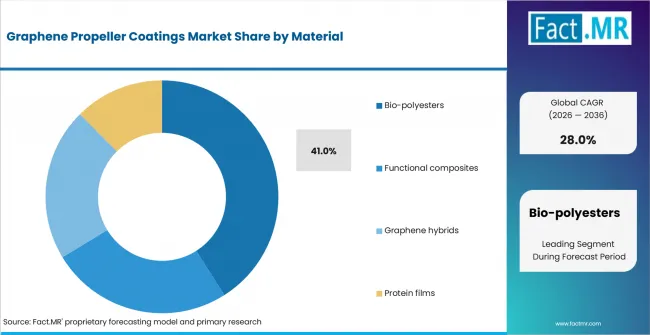
Graphene Propeller Coatings Market Analysis By Material | Source: Fact.MR
Bio-polyesters lead the material segment because coating developers are seeking polymer matrices that balance durability with lower toxicity. Graphene is evaluated inside these matrices as a barrier and reinforcement additive. Formulators still need evidence on saltwater exposure, dispersion stability and film repair. Functional composites and graphene hybrids remain relevant where operators prioritize longer service intervals and graphene-based coating additives help bridge lab testing with formulation work.
What leads the Vessel Area segment?
Hull applications at 44.0% share in 2026.
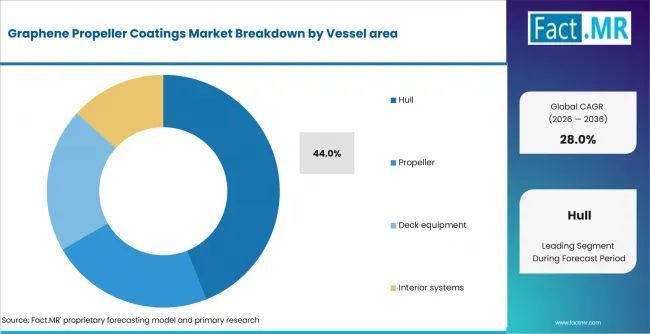
Graphene Propeller Coatings Market Analysis By Vessel Area | Source: Fact.MR
Hull applications lead because propeller coating decisions are commonly tied to wider underwater coating scopes. Vessel owners rarely evaluate the propeller surface in isolation. Hull condition influences drag across the vessel body, so bundled coating tenders give graphene-enhanced systems a larger addressable surface area. Shipyards also prefer bundled work packages because crews can manage surface preparation and inspection in one docking plan.
How does Function shape demand?
Anti-fouling at 44.0% share in 2026.
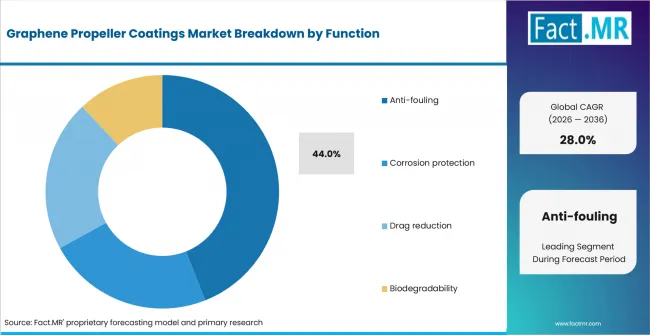
Graphene Propeller Coatings Market Analysis By Function | Source: Fact.MR
Anti-fouling leads because fouling creates operating cost and inspection pressure. IMO approved new 2025 guidance on in-water cleaning and began work on a legally binding biofouling framework. That policy direction makes coating durability during cleaning a stronger purchase factor, especially where bio anti-fouling polymers influence lower-toxicity design choices. Propeller coatings gain more attention when cleaning records show repeated fouling on high-use routes.
What supports Commercial within Vessel Type?
Commercial vessels at 42.0% share in 2026.
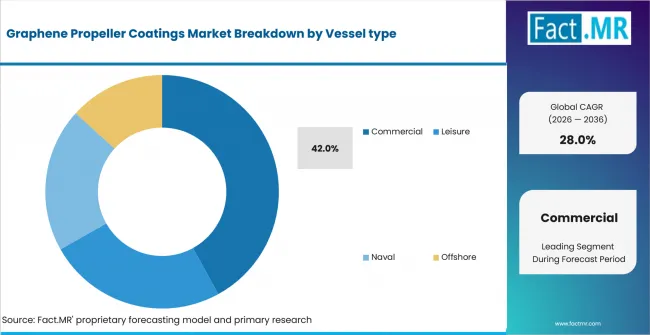
Graphene Propeller Coatings Market Analysis By Vessel Type | Source: Fact.MR
Commercial vessels lead because merchant fleets generate repeat dry-dock demand and measurable fuel-use records. UN Trade and Development reported in September 2025 that over 80% of the volume of international trade in goods is carried by sea. That scale gives commercial operators more reason to test coating systems that reduce drag or extend cleaning intervals. Contracted service schedules also create clearer windows for evaluating coating wear after a known voyage pattern.
What is accelerating Graphene Propeller Coatings Market adoption, and what is holding it back?
Adoption is supported by anti-fouling pressure and constrained by qualification cycles.
Drivers Impact Analysis
| DRIVER | (~) % IMPACT ON CAGR | GEOGRAPHIC RELEVANCE | IMPACT TIMELINE |
|---|---|---|---|
| Biofouling guidance and cleaning risk | +2.8% | Global | Short term (<= 2 years) |
| Fleet efficiency and carbon-intensity reporting | +2.2% | North America, Europe, East Asia | Medium term (2-4 years) |
| Dry-dock bundled coating specifications | +1.6% | Global | Medium term (2-4 years) |
| Graphene dispersion packages for coating formulators | +1.1% | Europe, Asia Pacific | Long term (>= 4 years) |
Source: Fact.MR analysis. Updated Aug 27, 2026
- Biofouling guidance and cleaning risk: IMO states that in-water cleaning can damage anti-fouling coatings and shorten service life. That risk raises interest in coatings with stronger barrier behavior.
- Fleet efficiency and carbon-intensity reporting: Carbon-intensity reporting gives vessel owners a practical reason to measure drag-related fuel losses. Cleaner underwater surfaces become part of efficiency work when inspection records are linked to fuel use.
- Dry-dock bundled coating specifications: Shipyards often plan hull, propeller and niche underwater surfaces together. Graphene systems gain visibility when they fit those bundled maintenance scopes.
- Graphene dispersion packages: Formulators prefer graphene additives that arrive with mixing guidance and performance data. Better dispersion support reduces trial-and-error work during coating development.
Opportunity Impact Analysis
| OPPORTUNITY | (~) % IMPACT ON CAGR | GEOGRAPHIC RELEVANCE | IMPACT TIMELINE |
|---|---|---|---|
| Propeller and hull coating bundles | +1.5% | Global | Short term (<= 2 years) |
| Biocide-reduced marine coating systems | +1.2% | Europe, North America | Medium term (2-4 years) |
| Warranty-backed performance data packages | +0.9% | Global | Long term (>= 4 years) |
Source: Fact.MR analysis. Updated Aug 27, 2026
- Propeller and hull coating bundles: Suppliers can package graphene-enhanced propeller coatings with hull maintenance programs to reach larger dry-dock budgets.
- Biocide-reduced systems: Bio-polyester matrices and graphene hybrids give formulators a route to lower-toxicity anti-fouling claims when data supports coating behavior.
- Performance data packages: Fleet accounts are likely to value coatings that link surface condition, cleaning records and fuel outcomes during a known service interval.
Restraints Impact Analysis
| RESTRAINT | (~) % IMPACT ON CAGR | GEOGRAPHIC RELEVANCE | IMPACT TIMELINE |
|---|---|---|---|
| Qualification cycles and dry-dock risk | -0.9% | Global | Short term (<= 2 years) |
| Dispersion and coating uniformity limits | -0.6% | Global | Medium term (2-4 years) |
| Documentation burden for nanoscale additives | -0.5% | Europe, North America | Long term (>= 4 years) |
Source: Fact.MR analysis. Updated Aug 27, 2026
- Qualification cycles and dry-dock risk: Vessel owners avoid coating changes that create rework during docking. Suppliers must show predictable application and repair behavior.
- Dispersion and coating uniformity limits: Graphene benefits depend on stable mixing and film quality. Poor dispersion weakens the coating case even when the additive has strong lab properties.
- Documentation burden: Nanoscale additives require safety, handling and environmental documentation. Smaller formulators may delay launches until the evidence package is complete.
Which countries are scaling the Graphene Propeller Coatings Market through 2036?
- The country comparison spans 13.7 percentage points between Germany and the UK across the forecast period.
- Germany remains 3.8 percentage points above the USA as seaport cargo recovery and shipyard service depth support coating trials.
- The USA remains 2.7 percentage points above Japan through port freight scale and a broad marine service base.
- Japan remains 5.6 percentage points above South Korea as container throughput and shipbuilding capability support formulation testing.
- South Korea remains 1.6 percentage points above the UK through container-port scale and high-value shipbuilding activity.
- The UK closes the displayed range while clean maritime funding and carbon reporting keep vessel efficiency procurement active.
Comparable CAGRs create different entry conditions due to port mix, dry-dock capacity, shipbuilding specialization and national efficiency policy. Full report coverage includes North America, Latin America, Western Europe, Eastern Europe, East Asia, South Asia & Pacific, Middle East & Africa.
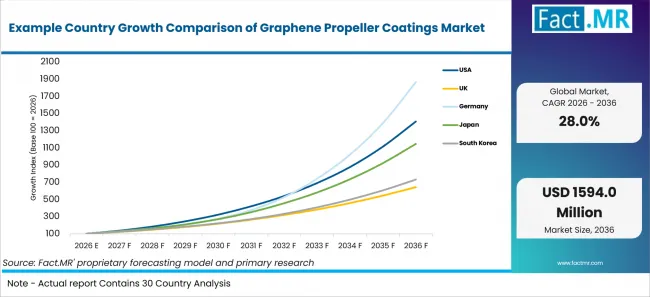
Example Country Growth Comparison Of Graphene Propeller Coatings Market | Source: Fact.MR
| Country | CAGR (2026-2036) |
|---|---|
| Germany | 34.1% |
| USA | 30.3% |
| Japan | 27.6% |
| South Korea | 22.0% |
| UK | 20.4% |
Source: Fact.MR analysis. Updated Aug 27, 2026
What supports Germany adoption?
34.1% CAGR, supported by seaport cargo recovery and shipyard maintenance depth.
German coating adoption is shaped by seaport cargo recovery and scheduled vessel-maintenance work. Destatis reported in March 2026 that German seaports handled 284.4 million tonnes of goods in 2025, up 3.8% from 2024. Eurostat reported in December 2025 that Hamburg handled 97 million tonnes of maritime freight in 2024. That freight base keeps propeller and hull coating trials tied to dry-dock planning, where shipyards need proof of adhesion, surface finish and repair behavior before wider use.
How is the USA scaling demand?
30.3% CAGR, led by port freight scale and marine infrastructure spending.
U.S. adoption is linked to a large ocean freight base and port investment. The Bureau of Transportation Statistics stated in its 2026 Port Performance Freight Statistics report that ships moved 42.4% of U.S. international freight value in 2024, equivalent to USD 2.2 trillion. MARAD announced in March 2026 that USD 488.628 million was available for FY2026 Port Infrastructure Development Program discretionary grants. That scale gives coating suppliers a route to trial propeller systems across cargo vessels, harbor fleets and service craft.
What supports Japan adoption?
27.6% CAGR, backed by container throughput and quality-focused shipbuilding.
Japan builds demand through port throughput and a shipbuilding culture that values repeatable surface performance. MLIT reported in August 2026 that Japanese ports handled 22.36 million TEU of container cargo in 2025, up 1.8% from 2024. OECD reported in April 2026 that Japan accounted for about 11% of global CGT-based shipbuilding completions in 2024. Graphene hybrids gain attention where yards seek barrier protection and smooth coating repair during planned maintenance.
How is South Korea developing demand?
22.0% CAGR, shaped by container-port scale and advanced vessel construction.
South Korea links coating demand to high-volume ports and advanced vessel construction. The Ministry of Oceans and Fisheries reported in January 2025 that Korean trade ports handled a record 31.73 million TEU of containers in 2024, up 5.3% year over year. OECD reported in April 2026 that Korea accounted for about 27% of global CGT-based shipbuilding completions in 2024. Coating suppliers gain access to owners that track lifecycle performance and surface protection on high-value vessels.
What supports the UK's growth?
20.4% CAGR, supported by clean maritime funding and carbon reporting.
UK demand is guided by clean maritime funding and emissions reporting. The Department for Transport announced £30 million of funding awards under Clean Maritime Demonstration Competition Round 6 in July 2025, following the round’s launch in January 2025. From 1 July 2026, the UK ETS covers domestic maritime emissions from ships of 5,000 GT and above. Propeller coating formulators can position graphene systems around vessel-efficiency evidence when operators compare fuel use, surface condition and compliance costs during docking decisions.
Who leads the Graphene Propeller Coatings Market?
Competition is centered on companies that connect graphene materials with coating formulation, dispersion support and marine performance evidence.
Haydale Graphene Industries, Directa Plus, First Graphene are included across graphene additives, dispersions and coating-facing material platforms. Marine coating customers want repeatable mixing behavior before they review claims about drag or corrosion. Suppliers that document corrosion resistance and barrier behavior in anti-corrosion coatings gain a clearer route into vessel trials.
Which companies are the key providers?
Key companies include Haydale Graphene Industries, Directa Plus, First Graphene, GIT Coatings, Gerdau Graphene.
- Haydale Graphene Industries
- Directa Plus
- First Graphene
- GIT Coatings
- Gerdau Graphene
Bibliography
- Bureau of Transportation Statistics. (2026). Port performance freight statistics: 2026 annual report.
- Department for Energy Security and Net Zero. (2026, July 1). Participating in the UK ETS. GOV.UK.
- Department for Transport, Innovate UK, & Kane, M. (2025, July 24). £30 million to decarbonise shipping, boost careers and deliver growth across the UK. GOV.UK.
- Eurostat. (2025, December 4). EU ports handled 3.4 bn tonnes of freight in 2024.
- International Maritime Organization. (2025, April 16). Marine Environment Protection Committee (MEPC 83), 7 to 11 April 2025.
- International Maritime Organization. (2025, April 29). Guidance on in-water cleaning of ships' biofouling (MEPC.1/Circ.918).
- Maritime Administration. (2026, April 29). Port Infrastructure Development Program. U.S. Department of Transportation.
- Ministry of Oceans and Fisheries. (2025, January 24). Korea’s ports handle record-high container volume of 31.73 million TEUs in 2024.
- National Oceanic and Atmospheric Administration. (2026, March 18). New NOAA data reveals strength of the U.S. marine economy.
- OECD. (2026, April 8). Peer review of the Japanese shipbuilding industry 2026.
- OECD. (2026, April 8). Peer review of the Korean shipbuilding industry 2026.
- Federal Statistical Office (Destatis). (2026, March 10). Seeverkehr 2025: Güterumschlag steigt um 3,8 % gegenüber dem Vorjahr [Sea transport 2025: Goods handling rises by 3.8% year on year].
- UN Trade and Development. (2025, September 24). Review of maritime transport 2025: Staying the course in turbulent waters.
- Universal Matter GBR Ltd. (2025, February). Genable® Dispersion DA 1250 [Technical data sheet].
This Report Addresses
- The report explains where graphene propeller coatings are used across material, vessel area, function and vessel type.
- Segment analysis identifies the leading subsegments and the operating reasons fleet owners prioritize them.
- Country analysis examines the listed markets and the port or shipbuilding mechanisms supporting coating trials.
- Competitive analysis reviews current providers across graphene additives, dispersions and coating-facing platforms.
- Application analysis assesses how fouling, corrosion and drag influence coating purchase decisions during dry-dock work.
What does the Graphene Propeller Coatings Market cover?
The Graphene Propeller Coatings Market covers coating systems and additive packages used on propellers and adjacent underwater surfaces. It connects marine coating chemistry with surface durability, barrier protection and drag-reduction work across vessel coating programs.
The assessment includes coating additives when they are sold into marine formulations. It also considers low friction coatings where reduced surface resistance has a direct bearing on propeller and hull performance.
What is included in the scope?
The scope includes graphene nanoplatelets, graphene hybrids, functional composites and polymer systems used to support anti-fouling and corrosion control. Upstream graphene composites are included when they move into coating formulations for vessel surfaces.
The report includes systems sold into hull and propeller coating programs, together with formulation pathways linked to anti-corrosion nanocoating. It reviews drag-reduction functions only when marine service evidence supports the application case.
What is excluded from the scope?
The scope excludes general graphene materials sold without a coating or marine-use pathway. Decorative car-care coatings and laboratory-only films fall outside coverage when a vessel-surface application route is absent.
Raw graphene additives are outside scope when they lack a formulation path into marine coating systems. Adjacent functional coating materials coverage is used only to frame directly relevant marine coating boundaries.
How Was the Analysis Built?
The analysis draws on 120+ sources, 35+ company portfolios, 25+ countries, and more than 20 industry interviews.
- Primary Research: Primary research includes discussions with manufacturers, service providers, technology developers, distributors, end users, procurement teams, and subject-matter experts. These conversations examine purchasing priorities, product adoption, operational challenges, approval requirements, competitive positioning, and the factors that influence wider market acceptance.
- Desk Research: Desk research covers government statistics, regulatory publications, company filings, trade data, technical studies, industry associations, standards, public policy, and other authoritative sources. Every source used in the analysis is documented in the bibliography.
- Market Sizing and Forecasting: Market estimates combine historical performance, demand indicators, pricing and volume trends, segment shares, company participation, country-level growth, adoption patterns, investment activity, and barriers to market expansion.
- Data Validation and Update Cycle: Findings are validated by comparing primary interviews with public data, company activity, regulatory changes, trade patterns, and industry developments. Regular updates review new product launches, capacity changes, partnerships, approvals, procurement trends, and shifts in commercial adoption.
Segmentation
What is the report's scope and coverage?
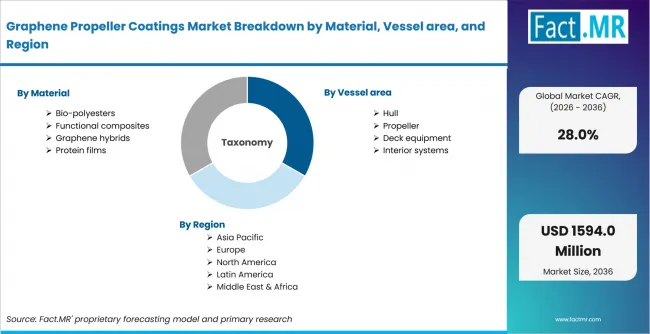
Graphene Propeller Coatings Market Breakdown By Material, Vessel Area, And Region | Source: Fact.MR
| Attribute | Details |
|---|---|
| Quantitative Units | USD million |
| Market Definition | Coating systems and coating additives applied to propellers and related underwater vessel surfaces using graphene nanoplatelets, graphene hybrids or graphene-enhanced polymer matrices to support anti-fouling, corrosion protection, drag reduction or biodegradability. |
| Material | Bio-polyesters; Functional composites; Graphene hybrids; Protein films |
| Vessel Area | Hull; Propeller; Deck equipment; Interior systems |
| Function | Anti-fouling; Corrosion protection; Drag reduction; Biodegradability |
| Vessel Type | Commercial; Leisure; Naval; Offshore |
| Regions Covered | North America; Latin America; Western Europe; Eastern Europe; East Asia; South Asia & Pacific; Middle East & Africa |
| Countries Covered | United States; United Kingdom; Germany; Japan; South Korea |
| Key Companies Profiled | Haydale Graphene Industries, Directa Plus, First Graphene, GIT Coatings, Gerdau Graphene |
| Forecast Period | 2026 to 2036 |
| Approach | Hybrid top-down and bottom-up approach using vessel coating demand, dry-dock activity, material adoption, segment shares, country growth and provider portfolio review. |
Source: Fact.MR analysis. Updated Aug 27, 2026
How is the market segmented?
-
By Material:
- Bio-polyesters
- Functional composites
- Graphene hybrids
- Protein films
-
By Vessel Area:
- Hull
- Propeller
- Deck equipment
- Interior systems
-
By Function:
- Anti-fouling
- Corrosion protection
- Drag reduction
- Biodegradability
-
By Vessel Type:
- Commercial
- Leisure
- Naval
- Offshore
-
By Region:
- North America
- Latin America
- Western Europe
- Eastern Europe
- East Asia
- South Asia & Pacific
- Middle East & Africa
Frequently Asked Questions
How big is the graphene propeller coatings market in 2026?
What is the CAGR of the graphene propeller coatings market from 2026 to 2036?
Which material leads the graphene propeller coatings market?
Which vessel area leads the graphene propeller coatings market?
Who are the leading companies in the graphene propeller coatings market?
Who worked on this report


Preview the report firsthand - request a free sample
Free SampleGet the brochure for pricing and purchase details
Download PDF