- Market Value (2025): USD 2.5 Bn
- Estimated Value (2026): USD 2.9 Bn
- Forecast Value (2036): USD 13.7 Bn
- CAGR (2026-2036): 16.8%
What is the HBM for Network Switching and Packet Processing Market forecast to be worth by 2036?
USD 2.9 billion in 2026 to USD 13.7 billion by 2036 at 16.8% CAGR.
- The HBM for network switching and packet processing market crossed a valuation of USD 2.5 billion in 2025 as AI network fabrics raised bandwidth pressure on switching silicon.
- Demand is projected to increase from USD 2.9 billion in 2026 to USD 13.7 billion by 2036.
- The market is forecast to record 16.8% CAGR from 2026 to 2036.
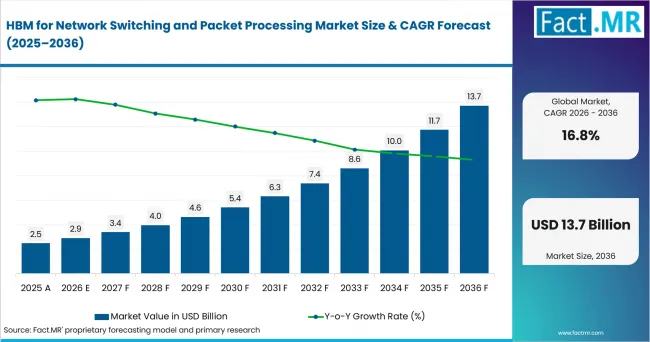
Hbm For Network Switching And Packet Processing Market Value Analysis | Source: Fact.MR
What are the defining numbers behind HBM for Network Switching and Packet Processing Market growth?
USD 10.9 billion absolute opportunity by 2036.
- Demand Drivers in the Market
- AI training and inference clusters require fast data movement between accelerators. This is expected to raise the value of HBM attached to switch and packet-processing silicon. According to the International Energy Agency’s 2025 Energy and AI report, global data center electricity use was 415 TWh in 2024 and is projected to reach around 945 TWh by 2030, with accelerated servers mainly driven by AI adoption.
- Switch ASIC designers are expected to favor HBM when packet buffers need more bandwidth than external memory can provide. Telemetry and congestion control add the same pressure. In 2025, Broadcom announced Tomahawk 6 with 102.4 Tbps of switching capacity in a single chip, showing the bandwidth level now being designed for AI networking.
- Chiplet-based network processors are expected to increase demand for through-silicon via packages where memory stacks are placed close to compute silicon.
- Key Segments Analyzed
- By HBM Memory Solution: HBM3E is expected to hold 58.0% share in 2026 because it fits current AI networking qualification needs.
- By Networking Application: High-speed Ethernet Switches are projected to account for 44.0% share in 2026 as AI fabrics need low-latency packet movement.
- By End User: Network Equipment Manufacturers are anticipated to capture 41.0% share in 2026 since they control switch and router design wins.
- By Integration Platform: Switch ASIC Integration is estimated to represent 67.0% share in 2026 due to direct memory placement near forwarding silicon.
- By Memory Packaging Technology: Through-Silicon Via Technology is forecast to hold 73.0% share in 2026 because stacked HBM depends on dense vertical interconnects.
- Analyst Opinion at Fact.MR
- Shambhu Nath Jha, Principal Consultant at Fact.MR, states, “HBM use in network switching is becoming a qualification issue for AI fabrics. Buyers are expected to examine package reliability and supply continuity before volume commitments.”
- Strategic Implications
- Networking silicon suppliers should align HBM roadmaps with switch ASIC and DPU release cycles before architecture choices become locked.
- Equipment vendors can strengthen customer acceptance by proving memory bandwidth and buffer behavior under AI traffic bursts. Congestion-control performance should be shown in the same test flow.
- Packaging partners should secure advanced IC substrates and interposer capacity early because HBM-attached network silicon uses a demanding assembly flow.
The USA leads at 17.9% CAGR through AI infrastructure buildout. South Korea follows at 17.3% through HBM production depth. Taiwan reaches 16.7% through foundry scale. Japan posts 16.1% through equipment capability. China records 15.4%. Germany reaches 14.8%. Singapore closes at 14.1%.
How does the HBM for Network Switching and Packet Processing Market break down by segment?
HBM3E is expected to lead HBM Memory Solution at 58.0% share in 2026. High-speed Ethernet Switches lead Networking Application at 44.0% share in 2026.
Why does HBM3E lead HBM Memory Solution?
HBM3E is projected to account for 58.0% share in 2026.
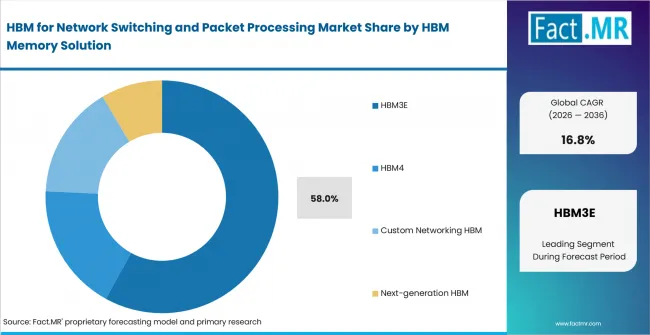
Hbm For Network Switching And Packet Processing Market Analysis By Hbm Memory Solution | Source: Fact.MR
Commercial readiness gives HBM3E an advantage in current AI networking deployments. Qualification cycles are further along, while available supply supports broader platform adoption compared with newer memory generations. In 2025, Micron shipped 36 GB 12-high HBM4 samples to multiple key customers, with more than 2.0 TB/s per memory stack, showing the next step after current HBM3E qualification cycles.
Why do High-speed Ethernet Switches lead Networking Application?
High-speed Ethernet Switches are expected to hold 44.0% share in 2026.
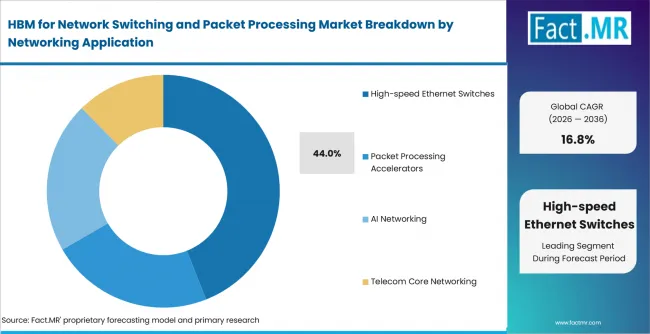
Hbm For Network Switching And Packet Processing Market Analysis By Networking Application | Source: Fact.MR
AI clusters generate heavy east-west data traffic, placing greater pressure on switch bandwidth and buffering. This makes HBM especially relevant in high-speed Ethernet systems where rapid packet handling is central to network performance.
Why do Network Equipment Manufacturers lead End User?
Network Equipment Manufacturers are anticipated to hold 41.0% share in 2026.
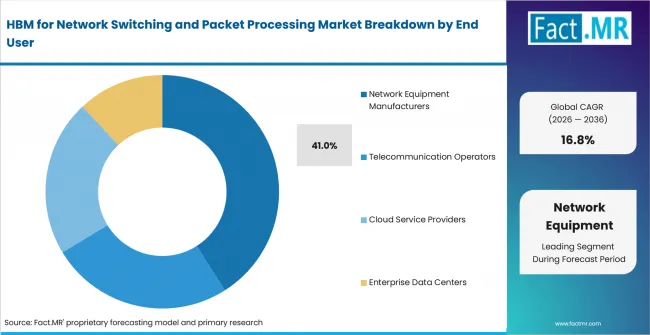
Hbm For Network Switching And Packet Processing Market Analysis By End User | Source: Fact.MR
These companies sit closest to final system deployment, integrating HBM-enabled silicon into switches and routers. As a result, their validation standards and platform roadmaps have a strong influence on supplier selection and volume purchasing.
Why does Switch ASIC Integration lead Integration Platform?
Switch ASIC Integration is estimated to account for 67.0% share in 2026.
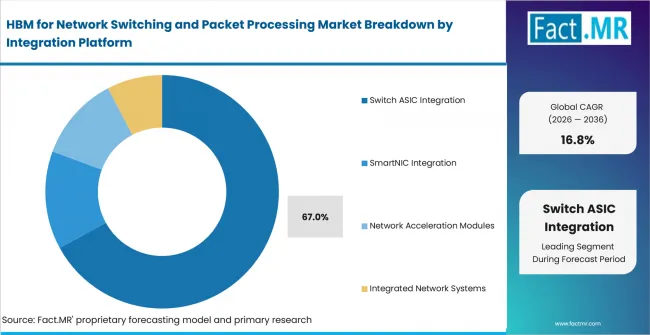
Hbm For Network Switching And Packet Processing Market Analysis By Integration Platform | Source: Fact.MR
A direct link between the switch ASIC and HBM reduces the distance data must travel during packet processing. This architecture supports larger buffer capacity and helps maintain responsive data movement in demanding networking environments.
Why does Through-Silicon Via Technology lead Memory Packaging Technology?
Through-Silicon Via Technology is forecast to represent 73.0% share in 2026.
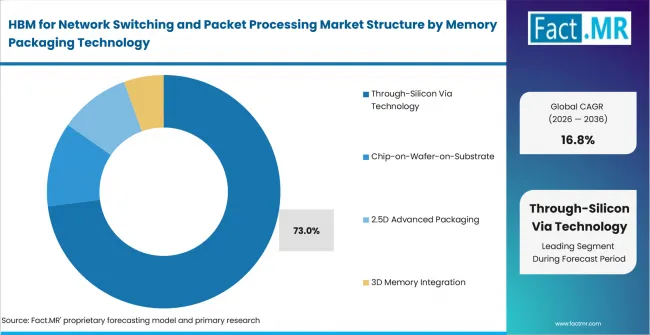
Hbm For Network Switching And Packet Processing Market Analysis By Memory Packaging Technology | Source: Fact.MR
Unlike the other segments, its leadership is tied mainly to HBM’s physical stack design. TSVs create vertical electrical connections across memory dies, making the technology fundamental to dense stacking and established HBM packaging workflows.
What is accelerating HBM for Network Switching and Packet Processing Market adoption, and what is holding it back?
Demand is expected to rise through AI fabric scaling and switch ASIC integration. Growth can be limited by packaging capacity and thermal risk.
Drivers Impact Analysis
| DRIVER | (~) % IMPACT ON CAGR | GEOGRAPHIC RELEVANCE | IMPACT TIMELINE |
|---|---|---|---|
| AI fabric bandwidth pressure | +4.1% | USA, South Korea, Taiwan | Short term (<= 2 years) |
| Switch ASIC memory integration | +3.3% | USA, Taiwan, Singapore | Short term (<= 2 years) |
| Advanced packaging qualification | +2.8% | Taiwan, South Korea, Japan | Medium term (2-4 years) |
| Hyperscale network refresh cycles | +2.2% | USA, China, Germany | Medium term (2-4 years) |
| Thermal design requirements | +1.6% | Global AI data center clusters | Long term (>= 4 years) |
Source: Fact.MR analysis. Updated Aug 11, 2026
- AI fabric bandwidth pressure: Larger accelerator clusters are expected to increase the value of packet movement that does not stall compute resources.
- Switch ASIC memory integration: Close placement of HBM near forwarding silicon is expected to improve buffer behavior and reduce external memory dependence.
- Advanced packaging qualification: Supplier selection is expected to favor partners that can prove interposer and TSV reliability before volume release.
Opportunity Impact Analysis
| OPPORTUNITY | (~) % IMPACT ON CAGR | GEOGRAPHIC RELEVANCE | IMPACT TIMELINE |
|---|---|---|---|
| AI Ethernet fabric expansion | +2.0% | USA and China | Medium term (2-4 years) |
| DPU and NPU attached memory | +1.5% | USA and Taiwan | Medium term (2-4 years) |
| Rack-level thermal co-design | +1.1% | Germany, Singapore, USA | Long term (>= 4 years) |
| Custom packet-processing ASICs | +0.9% | South Korea, Taiwan, Japan | Long term (>= 4 years) |
Source: Fact.MR analysis. Updated Aug 11, 2026
- AI Ethernet fabric expansion: HBM demand is expected to benefit where Ethernet switches handle dense accelerator-to-accelerator traffic.
- DPU and NPU attached memory: Programmable packet processors are expected to create demand for local memory that supports security and traffic steering.
- Rack-level thermal co-design: Suppliers that connect memory packages with rack cooling units are expected to reduce qualification risk for dense AI installations.
Restraints Impact Analysis
| RESTRAINT | (~) % IMPACT ON CAGR | GEOGRAPHIC RELEVANCE | IMPACT TIMELINE |
|---|---|---|---|
| HBM supply allocation | -1.7% | Global | Short term (<= 2 years) |
| Packaging yield and substrate limits | -1.3% | Taiwan, South Korea, Japan | Short term (<= 2 years) |
| Thermal and power density pressure | -1.0% | AI data center clusters | Medium term (2-4 years) |
| Customer qualification length | -0.8% | Network equipment manufacturers | Long term (>= 4 years) |
Source: Fact.MR analysis. Updated Aug 11, 2026
- HBM supply allocation: Memory suppliers are expected to prioritize large accelerator programs, which can make smaller networking designs harder to schedule.
- Packaging yield and substrate limits: Complex HBM packages need tight control of interconnect quality and substrate flatness. This raises release risk.
- Thermal and power density pressure: Dense memory and switch silicon can create package-level heat concerns that delay approval in production systems.
Which countries are scaling the HBM for Network Switching and Packet Processing Market fastest?
- The country comparison spans 3.8 percentage points and forms three practical growth bands across the forecast period.
- The USA remains 0.6 percentage point above South Korea through AI infrastructure buildout and domestic packaging activity.
- South Korea remains 0.6 percentage point above Taiwan because memory manufacturing scale supports HBM supply qualification.
- Taiwan remains 0.6 percentage point above Japan through foundry scale and nearby packaging support.
- Japan remains 0.7 percentage point above China through materials strength and semiconductor equipment depth.
- China remains 0.6 percentage point above Germany as domestic semiconductor programs support local networking silicon.
- Germany remains 0.7 percentage point above Singapore through automotive compute and industrial networking demand.
Comparable CAGRs create different entry conditions due to memory supply access and package qualification. Customer concentration and engineering depth shape each country’s adoption path.
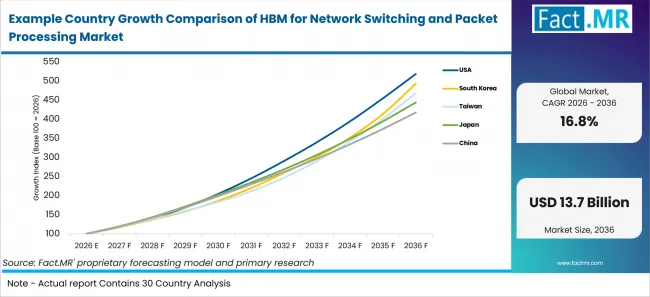
Example Country Growth Comparison Of Hbm For Network Switching And Packet Processing Market | Source: Fact.MR
| COUNTRY | CAGR (2026-2036) |
|---|---|
| USA | 17.9% |
| South Korea | 17.3% |
| Taiwan | 16.7% |
| Japan | 16.1% |
| China | 15.4% |
| Germany | 14.8% |
| Singapore | 14.1% |
Source: Fact.MR analysis. Updated Aug 11, 2026
What supports USA adoption?
17.9% CAGR, supported by AI infrastructure buildout and domestic HBM packaging investment.
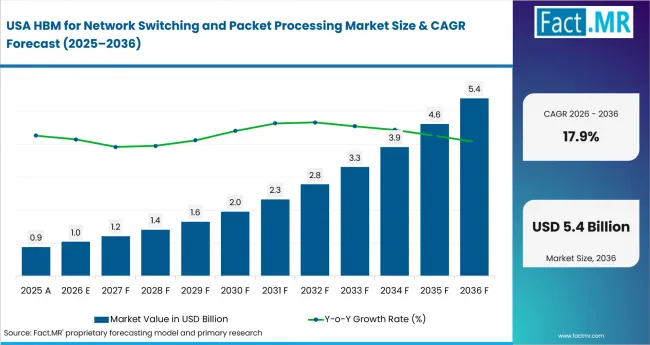
Hbm For Network Switching And Packet Processing Market Country Value Analysis | Source: Fact.MR
The USA’s growth reflects hyperscale AI networks that need high-bandwidth switching. Domestic packaging investment supports closer coordination between memory suppliers and system vendors. Lawrence Berkeley National Laboratory’s 2026 United States Data Center Energy Usage Report: 2025 Update estimates that U.S. data centers could use 649 TWh in 2030 and account for 11.8% of total U.S. electricity, supporting the country’s AI infrastructure buildout.
How is South Korea scaling demand?
17.3% CAGR, driven by memory manufacturing scale and HBM supplier depth.
South Korea’s growth is tied to its HBM production base and close customer relationships in AI hardware. Networking applications benefit when memory stacks can be qualified at scale. The Republic of Korea Ministry of Trade, Industry and Energy reported in February 2025 that January 2025 semiconductor exports reached USD 10.1 billion and memory chip exports rose 17.2% to USD 6.2 billion, helped by AI-market demand.
What is driving Taiwan’s growth from 2026 to 2036?
16.7% CAGR, backed by foundry scale and advanced packaging density.
Taiwan’s growth is supported by foundry concentration and advanced packaging depth. Local manufacturing shortens feedback between chip design and package qualification. The U.S. International Trade Administration’s 2025 Taiwan commercial guide, using Taiwan Customs and Ministry of Finance data, reported IC manufacturing and equipment exports of USD 94.9 billion in the first half of 2025, supporting local foundry and packaging depth.
How does Japan perform?
16.1% CAGR, led by materials capability and semiconductor equipment expertise.
Japan’s growth reflects materials and process equipment strength for advanced semiconductor packages. Customers are expected to value substrate quality and inspection support.
How is China developing demand?
15.4% CAGR, supported by domestic semiconductor self-sufficiency initiatives.
China’s growth is shaped by local AI infrastructure programs and domestic network silicon work. HBM access constraints can slow some high-end designs.
What supports Germany’s growth?
14.8% CAGR, supported by automotive compute and industrial networking demand.
Germany’s growth reflects industrial automation and automotive electronics demand. HBM adoption stays selective because the country is more systems-focused than memory-focused.
What supports Singapore’s growth?
14.1% CAGR, backed by regional packaging support and data center supply-chain activity.
Singapore’s growth reflects its compact semiconductor and electronics cluster. HBM-related demand is expected to concentrate around qualification work and data center equipment supply.
Who leads the HBM for Network Switching and Packet Processing Market?
SK hynix and Samsung Electronics hold the strongest memory-side positions, while Micron Technology adds further HBM3E supply depth. SK hynix supports advanced HBM deployment for AI infrastructure. In 2026, Samsung Electronics began HBM4 commercial shipments, with 11.7 Gbps transfer speed scalable to 13 Gbps and up to 3.3 TB/s bandwidth per stack.
Samsung contributes high-capacity HBM3E development, while Micron strengthens volume availability. TSMC supports advanced packaging and integration. Broadcom and Marvell extend the field through high-speed switch silicon, while NVIDIA, AMD, Intel, and Cisco connect HBM capabilities with broader AI networking platforms.
Which companies are the key providers?
Key companies include SK hynix Inc.; Samsung Electronics Co., Ltd.; Micron Technology, Inc.; Taiwan Semiconductor Manufacturing Company Limited; Broadcom Inc.; NVIDIA Corporation; Marvell Technology, Inc.; Intel Corporation; Advanced Micro Devices, Inc.; and Cisco Systems, Inc.
- SK hynix Inc.
- Samsung Electronics Co., Ltd.
- Micron Technology, Inc.
- Taiwan Semiconductor Manufacturing Company Limited
- Broadcom Inc.
- NVIDIA Corporation
- Marvell Technology, Inc.
- Intel Corporation
- Advanced Micro Devices, Inc.
- Cisco Systems, Inc.
Bibliography
- Broadcom Inc. (2025, June 3). Broadcom ships Tomahawk 6: World’s first 102.4 Tbps switch.
- Marvell Technology, Inc. (2026, June 1). Marvell announces availability of industry’s first 102.4 Tbps switch purpose-built for AI and cloud data center infrastructure.
- Micron Technology, Inc. (2024, February 26). Micron commences volume production of industry-leading HBM3E solution to accelerate the growth of AI.
- National Institute of Standards and Technology. (2024, December 19). Biden-Harris Administration announces CHIPS incentives award with SK hynix to advance U.S. technological leadership and expand capacity of chips crucial to the AI supply chain.
- Samsung Electronics Co., Ltd. (2024, February 27). Samsung develops industry-first 36GB HBM3E 12H DRAM.
- Micron Technology, Inc. (2025, June 10). Micron ships HBM4 to key customers to power next-gen AI platforms.
- Ministry of Trade, Industry and Energy. (2025, February 13). Korea’s ICT exports drop 0.4% in January.
- Samsung Electronics Co., Ltd. (2026, February 12). Samsung ships industry-first commercial HBM4 with ultimate performance for AI computing.
- Taiwan Semiconductor Manufacturing Company Limited. (2025, April 24). TSMC unveils next-generation A14 process at North America Technology Symposium.
- International Trade Administration. (2025, December 1). Taiwan - Semiconductors including chip design for AI.
This Report Answers
- The report explains how HBM3E and High-speed Ethernet Switches lead 2026 demand.
- It compares the USA and South Korea alongside Taiwan and Japan. China, Germany and Singapore complete the growth comparison.
- It profiles memory suppliers alongside switch silicon providers and networking system vendors.
- It reviews TSV packages and silicon interposers. Hybrid bonding and substrate integration complete the package view.
- It separates included HBM networking platforms from unrelated memory and network hardware.
What does the HBM for Network Switching and Packet Processing Market cover?
HBM is used near networking compute silicon when packet movement and AI fabric traffic need more bandwidth than conventional memory paths provide.
It includes packet processors and DPUs. NPUs and router line cards are included where HBM supports networking compute functions.
What is included in the scope?
HBM-enabled networking platforms are used by network equipment manufacturers and hyperscale cloud service providers. Semiconductor and ASIC designers complete the main buyer scope.
The scope includes HBM Memory Solution and Networking Application alongside End User, Integration Platform and Memory Packaging Technology. Coverage spans HBM2E through HBM4 and custom stacks. It includes high-speed Ethernet switches, AI fabric switches and packet-processing accelerators.
What is excluded from the scope?
General DRAM and unrelated network hardware remain outside the scope of this market.
The scope excludes consumer memory and standard server memory where HBM is not tied to networking functions. Optical modules are excluded unless revenue is directly connected to an HBM-enabled switch.
How Was the Analysis Built?
The analysis draws on 120+ sources and 35+ company portfolios across 25+ countries. It includes more than 20 industry interviews.
- Primary Research: Primary research includes discussions with manufacturers and technology developers. Distributors and end users are included. Procurement teams and subject-matter experts complete the interview base.
- Desk Research: Desk research covers government statistics and regulatory publications. Company filings and trade data are reviewed. Technical studies and industry associations complete the desk review.
- Market Sizing and Forecasting: Market estimates combine historical performance and demand indicators. Pricing trends and segment shares support the forecast. Company participation and adoption patterns are reviewed.
- Data Validation and Update Cycle: Findings are validated by comparing primary interviews with public data, company activity and industry developments. Regular updates review product launches, capacity changes and partnerships.
Segmentation
What is the report’s scope and coverage?
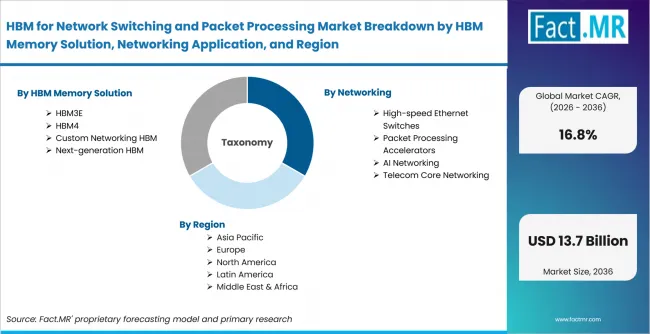
Hbm For Network Switching And Packet Processing Market Breakdown By Hbm Memory Solution, Networking Application, And Region | Source: Fact.MR
| ATTRIBUTE | DETAILS |
|---|---|
| Quantitative Units | USD billion in 2026 to USD billion by 2036 at CAGR |
| Market Definition | High bandwidth memory used with network switching, packet processing, switch ASIC, DPU, NPU and networking accelerator platforms where memory bandwidth supports high-speed traffic movement and AI fabric operation |
| HBM Memory Solution | HBM2E; HBM3; HBM3E; HBM4; custom HBM stacks |
| Networking Application | High-speed Ethernet Switches; AI fabric switches; packet processing accelerators; router line cards; SmartNIC and DPU systems |
| End User | Network Equipment Manufacturers; hyperscale cloud service providers; semiconductor and ASIC designers; telecom carriers; data center operators |
| Integration Platform | Switch ASIC Integration; DPU integration; NPU integration; accelerator module integration; multi-chip package integration |
| Memory Packaging Technology | Through-Silicon Via Technology; silicon interposers; hybrid bonding; microbump bonding; advanced substrate integration |
| Regions Covered | North America; Latin America; Europe; East Asia; South Asia and Pacific; Middle East and Africa |
| Countries Covered | USA; South Korea; Taiwan; Japan; China; Germany; Singapore |
| Key Companies Profiled | SK hynix Inc.; Samsung Electronics Co., Ltd.; Micron Technology, Inc.; Taiwan Semiconductor Manufacturing Company Limited; Broadcom Inc.; NVIDIA Corporation; Marvell Technology, Inc.; Intel Corporation; Advanced Micro Devices, Inc.; Cisco Systems, Inc. |
| Forecast Period | 2026 to 2036 |
| Approach | Hybrid top-down and bottom-up approach using HBM demand indicators; AI networking platform adoption; switch ASIC integration; packet-processing requirements; advanced packaging availability; memory supplier roadmaps; country adoption patterns and company portfolio review |
Source: Fact.MR analysis. Updated Aug 11, 2026
How is the market segmented?
-
By HBM Memory Solution
- HBM3E
- 8-Hi HBM3E
- 12-Hi HBM3E
- HBM4
- Pre-production HBM4
- Early Production HBM4
- Custom Networking HBM
- Low-latency HBM
- High-bandwidth HBM
- Next-generation HBM
- High-capacity HBM
- Energy-efficient HBM
- HBM3E
-
By Networking Application
- High-speed Ethernet Switches
- 400G Ethernet Switching
- 800G Ethernet Switching
- Packet Processing Accelerators
- Deep Packet Inspection
- Network Traffic Analytics
- AI Networking
- AI Ethernet Fabrics
- InfiniBand Switching
- Telecom Core Networking
- 5G Core Packet Processing
- Cloud-native Networking
- High-speed Ethernet Switches
-
By End User
- Network Equipment Manufacturers
- Cloud Infrastructure Providers
- Hyperscale Data Centers
- Telecommunication Operators
- 5G Infrastructure Providers
- Enterprise Networking Vendors
- Cloud Service Providers
- Internet Service Providers
- High-performance Computing Centers
- Enterprise Data Centers
- Colocation Data Centers
- Content Delivery Network Providers
- Network Equipment Manufacturers
-
By Integration Platform
- Switch ASIC Integration
- Programmable Switch ASICs
- Network Processing Units
- SmartNIC Integration
- Data Processing Units
- Programmable Network Accelerators
- Network Acceleration Modules
- Edge Network Processors
- High-performance Switching Platforms
- Integrated Network Systems
- Centralized Networking Platforms
- Software-defined Networking Platforms
- Switch ASIC Integration
-
By Memory Packaging Technology
- Through-Silicon Via Technology
- Advanced TSV Integration
- Hybrid Bonding
- Chip-on-Wafer-on-Substrate
- Micro-bump Packaging
- Fine-pitch Interconnect
- 2.5D Advanced Packaging
- High-density Silicon Interposer
- Advanced Redistribution Layer
- 3D Memory Integration
- High-density Wafer Bonding
- Heterogeneous Advanced Packaging
- Through-Silicon Via Technology
-
By Region
- North America
- Latin America
- Western Europe
- Eastern Europe
- East Asia
- South Asia and Pacific
- Middle East & Africa
Frequently Asked Questions
How big is the HBM for network switching and packet processing market in 2026?
What is the CAGR of the HBM for network switching and packet processing market from 2026 to 2036?
Which HBM memory solution leads the HBM for network switching and packet processing market?
Which networking application leads the HBM for network switching and packet processing market?
Who are the leading companies in the HBM for network switching and packet processing market?
Who worked on this report


Preview the report firsthand - request a free sample
Free SampleGet the brochure for pricing and purchase details
Download PDF