- Market Value (2025): USD 2.3 Bn
- Estimated Value (2026): USD 2.7 Bn
- Forecast Value (2036): USD 12.4 Bn
- CAGR (2026-2036): 16.5%
What is the HBM Thermal Management and TIM Market forecast to be worth by 2036?
USD 2.7 billion in 2026 to USD 12.4 billion by 2036 at 16.5% CAGR.
- The HBM Thermal Management and TIM market reached USD 2.3 billion in 2025 as AI accelerator and memory-stack qualification moved into higher-volume planning.
- Demand is forecast to increase from USD 2.7 billion in 2026 to USD 12.4 billion by 2036.
- The market is projected to record 16.5% CAGR from 2026 to 2036 as package heat density raises TIM value.
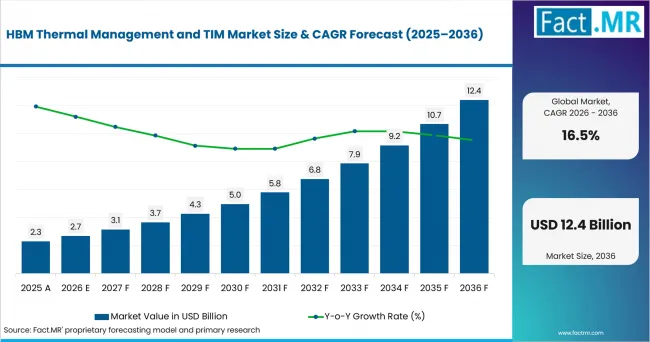
Hbm Thermal Management And Tim Market Value Analysis | Source: Fact.MR
What are the defining numbers behind HBM Thermal Management and TIM Market growth?
USD 9.7 billion absolute opportunity is expected by 2036.
- Demand Drivers in the Market
- AI training and inference workloads are expected to raise heat-density pressure around stacked HBM and GPU packages in data center systems. The U.S. Department of Energy’s 2025 update from Lawrence Berkeley National Laboratory estimates that data centers could account for 11.8% of total U.S. electricity use by 2030, with scenarios ranging from 9.5% to 15.3%.
- Chiplet designs and 3D semiconductor packaging are projected to increase demand for materials that protect signal integrity and package reliability. The U.S. Department of Commerce finalized USD 1.4 billion in January 2025 CHIPS National Advanced Packaging Manufacturing Program awards to help advanced packaging technologies move from validation to U.S. manufacturing scale.
- Hyperscale server programs are anticipated to favor direct procurement routes because thermal parts must match processor roadmaps and production schedules.
- Key Segments Analyzed
- By Thermal Solution: Thermal Interface Materials are expected to hold 48.0% share in 2026 because HBM packages need close-contact heat transfer before external cooling hardware can work effectively.
- By Application: Artificial Intelligence Accelerators are projected to account for 46.0% share in 2026 as training and inference processors concentrate power around memory stacks.
- By End User: GPU Manufacturers are anticipated to capture 42.0% share in 2026 since accelerator roadmaps decide material qualification and package thermal limits.
- By Supply Channel: Direct OEM Supply is estimated to represent 54.0% share in 2026 due to the need for platform-specific qualification and coordinated delivery.
- By Thermal Interface Technology: High-performance Thermal Grease is forecast to hold 38.0% share in 2026 as engineers use it to manage uneven package surfaces and high heat flux.
- Analyst Opinion at Fact.MR
- Shambhu Nath Jha, Principal Consultant at Fact.MR, states, “HBM thermal design is becoming a package-level qualification issue. AI accelerators need materials that keep memory stacks stable through high power cycles. Suppliers that can prove bondline control and reliability are expected to define purchasing decisions through 2036.”
- Strategic Implications
- Material suppliers should prioritize TIM formulations that maintain low thermal resistance under pressure cycling and repeated accelerator workloads.
- Cooling-system vendors can improve customer approval by combining TIM selection with cold plates and vapor chambers.
- GPU and memory manufacturers need earlier supplier coordination because late thermal-material changes can delay package qualification.
- Investors should separate direct HBM thermal exposure from broader electronics cooling since qualification cycles differ across package-level and system-level cooling.
South Korea leads at 17.6% CAGR through memory manufacturing and HBM supplier depth. Taiwan follows at 17.1% CAGR where foundry and OSAT ecosystems shape package qualification. The USA records 16.5% CAGR through AI infrastructure demand. Japan and China remain relevant through materials expertise and local semiconductor programs. Germany and Singapore add demand through automotive electronics and regional packaging support.
How does the HBM Thermal Management and TIM Market break down by segment?
Thermal Interface Materials are expected to lead Thermal Solution at 48.0% share in 2026. Artificial Intelligence Accelerators are projected to lead Application at 46.0% share in 2026.
Why do Thermal Interface Materials lead Thermal Solution?
Thermal Interface Materials are projected to account for 48.0% share in 2026.
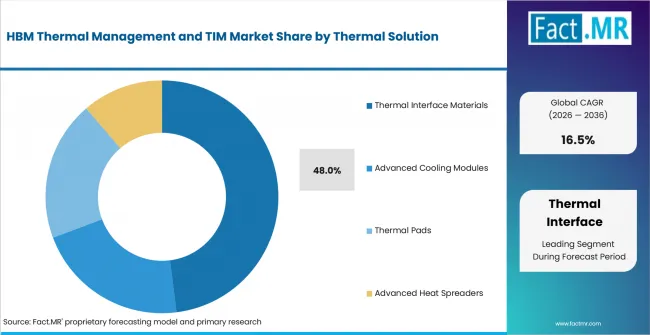
Hbm Thermal Management And Tim Market Analysis By Thermal Solution | Source: Fact.MR
HBM assemblies need a thin thermal path between memory stacks and cooling hardware. Buyers review thermal interface materials early because material behavior can affect package approval and rework risk. Henkel’s July 2026 launch of Bergquist Gap Filler TGF 6500LVO added a 6.5 W/mK thermal gap filler for fast-evolving electronics thermal-management needs.
Why do Artificial Intelligence Accelerators lead Application?
Artificial Intelligence Accelerators are expected to hold 46.0% share in 2026.
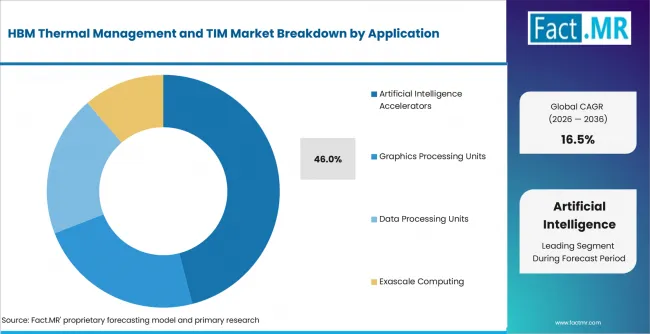
Hbm Thermal Management And Tim Market Analysis By Application | Source: Fact.MR
Edge AI high-bandwidth memory chips and data center accelerators place memory close to the compute die. This arrangement concentrates heat and raises the need for TIMs that can pass validation under training workloads.
What supports GPU Manufacturers within End User?
GPU Manufacturers are anticipated to lead End User with 42.0% share in 2026.
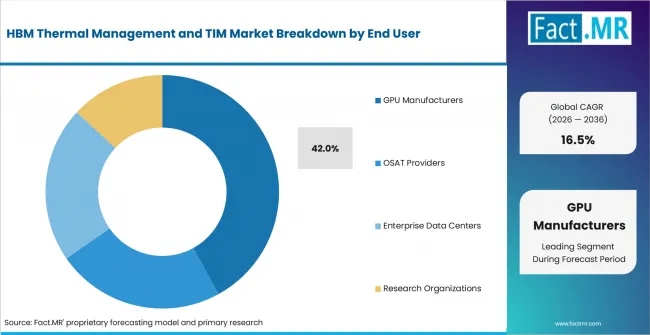
Hbm Thermal Management And Tim Market Analysis By End User | Source: Fact.MR
GPU suppliers define thermal limits before server makers finalize AI server chassis designs. Their qualification cycles decide which materials move into volume platforms.
Why does Direct OEM Supply lead Supply Channel?
Direct OEM Supply is estimated to hold 54.0% share in 2026.
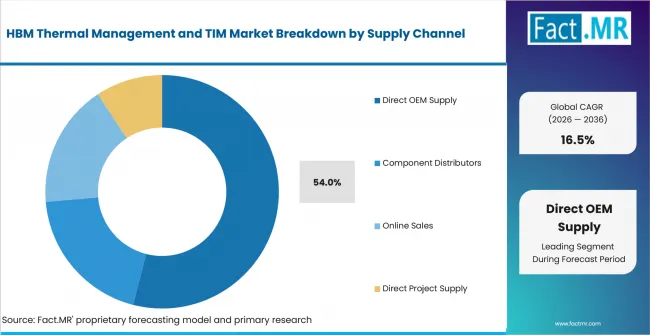
Hbm Thermal Management And Tim Market Analysis By Supply Channel | Source: Fact.MR
Direct channels fit exact package layouts and assembly processes. OEMs usually require documented behavior before HBM stack inspection and production release.
What supports High-performance Thermal Grease within Thermal Interface Technology?
High-performance Thermal Grease is forecast to represent 38.0% share in 2026.
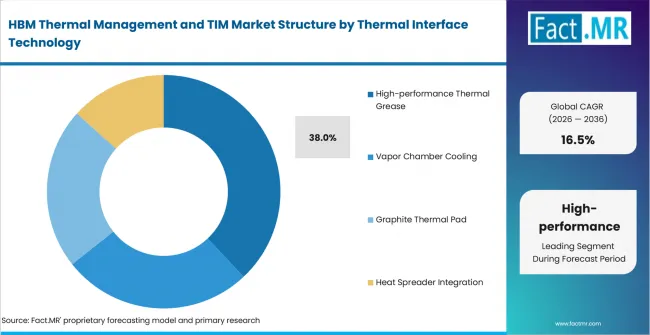
Hbm Thermal Management And Tim Market Analysis By Thermal Interface Technology | Source: Fact.MR
Thermal grease helps manage surface flatness and package warpage. It supports serviceable thermal paths and can complement microfluidic chip cooling designs.
What is accelerating HBM Thermal Management and TIM Market adoption, and what is holding it back?
Demand is expected to rise through hotter AI packages and tighter packaging release checks. Growth may be limited by qualification cost and material reliability risk. Supply coordination across GPU and memory vendors can slow approval work.
Drivers Impact Analysis
| DRIVER | (~) % IMPACT ON CAGR | GEOGRAPHIC RELEVANCE | IMPACT TIMELINE |
|---|---|---|---|
| AI accelerator heat-density growth | +3.4% | South Korea, Taiwan, USA | Short term (<= 2 years) |
| HBM and chiplet package complexity | +2.8% | East Asia and North America | Short term (<= 2 years) |
| Direct OEM thermal qualification | +2.3% | Global accelerator supply chains | Medium term (2-4 years) |
| Liquid cooling and cold-plate integration | +1.7% | USA, Germany, Singapore | Medium term (2-4 years) |
| Automotive and defense compute adjacency | +1.1% | USA, Germany, Japan | Long term (>= 4 years) |
Source: Fact.MR analysis. Updated Aug 10, 2026
- AI accelerator heat-density growth: Dense compute packages are expected to increase the value of TIMs that manage hot spots near HBM stacks.
- HBM and chiplet package complexity: Advanced packaging is expected to raise demand for materials that remain stable across interposers and lids.
- Direct OEM thermal qualification: OEMs are expected to approve fewer suppliers when material behavior affects package release and system reliability.
Opportunity Impact Analysis
| OPPORTUNITY | (~) % IMPACT ON CAGR | GEOGRAPHIC RELEVANCE | IMPACT TIMELINE |
|---|---|---|---|
| Package-level thermal co-design | +1.6% | Taiwan and South Korea | Medium term (2-4 years) |
| Microfluidic and direct-to-chip cooling routes | +1.3% | USA and Singapore | Medium term (2-4 years) |
| High-reliability automotive AI processors | +0.9% | Germany, Japan, USA | Long term (>= 4 years) |
| Service and requalification support | +0.6% | Global | Long term (>= 4 years) |
Source: Fact.MR analysis. Updated Aug 10, 2026
- Package-level thermal co-design: Suppliers that test TIMs with lids and cold plates are expected to shorten customer approval work.
- Direct-to-chip cooling routes: New cooling designs are expected to create adjacent demand for materials that handle tighter interface limits.
- High-reliability automotive AI processors: Automotive compute platforms are expected to need proven thermal paths before safety-critical electronics enter production.
Restraints Impact Analysis
| RESTRAINT | (~) % IMPACT ON CAGR | GEOGRAPHIC RELEVANCE | IMPACT TIMELINE |
|---|---|---|---|
| Long qualification cycles | -1.3% | Global | Short term (<= 2 years) |
| Material pump-out and aging risk | -1.0% | AI accelerator packages | Short term (<= 2 years) |
| Supply concentration in qualified materials | -0.8% | East Asia and North America | Medium term (2-4 years) |
| System-level cooling cost | -0.5% | Hyperscale and enterprise data centers | Long term (>= 4 years) |
Source: Fact.MR analysis. Updated Aug 10, 2026
- Long qualification cycles: A material must pass package and system checks before it can move into high-volume accelerator programs.
- Material pump-out and aging risk: TIMs that lose contact under power cycling can raise rework risk and delay approval.
- System-level cooling cost: Liquid cooling hardware and service requirements can slow adoption when customers cannot justify platform-level redesign.
Which countries are scaling the HBM Thermal Management and TIM Market fastest?
- The country comparison spans 3.7 percentage points and forms three practical growth bands across the forecast period.
- South Korea remains 0.5 percentage point above Taiwan through memory manufacturing and HBM package know-how.
- Taiwan remains 0.6 percentage point above the USA where foundry and OSAT scale supports package thermal qualification.
- The USA remains 0.6 percentage point above Japan through AI infrastructure demand and advanced packaging programs.
- Japan remains 0.7 percentage point above China because materials and equipment expertise supports supplier approval.
- China remains 0.6 percentage point above Germany as domestic semiconductor programs support local thermal-material demand.
- Germany remains 0.7 percentage point above Singapore through automotive AI processors and industrial electronics requirements.
Comparable CAGRs create different entry conditions due to memory density and local qualification depth. Full report coverage includes North America; Latin America; Europe; East Asia; South Asia and Pacific; Middle East and Africa.
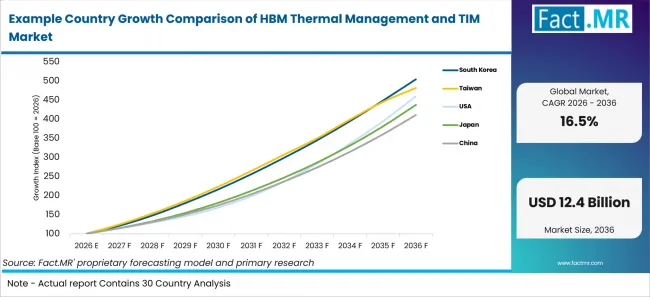
Example Country Growth Comparison Of Hbm Thermal Management And Tim Market | Source: Fact.MR
| Country | CAGR (2026-2036) |
|---|---|
| South Korea | 17.6% |
| Taiwan | 17.1% |
| USA | 16.5% |
| Japan | 15.9% |
| Germany | 14.6% |
| Singapore | 13.9% |
Source: Fact.MR analysis. Updated Aug 10, 2026
What supports South Korea adoption?
17.6% CAGR, supported by memory manufacturing and HBM supplier depth.
South Korean demand reflects its memory production base and close package-integration work. Material approval is expected to start near HBM stack design because thermal drift can affect yield and customer release. The Ministry of Trade, Industry and Resources and the Ministry of Science and ICT reported in January 2026 that Korea’s ICT exports reached USD 264.3 billion in 2025, up 12.4% year on year, with semiconductors setting a record.
How is Taiwan scaling demand?
17.1% CAGR, backed by foundry scale and advanced package qualification.
Taiwan’s buyer base is shaped by foundry and OSAT teams that move chiplet packages toward commercial production. TIM suppliers are expected to prove repeatable behavior before parts enter 3D TSV packages and similar advanced assemblies. Taiwan’s Ministry of Finance reported in 2026 that 2025 exports rose 34.9% year on year and exceeded USD 600 billion for the first time as AI, semiconductor, and ICT demand expanded.
What is driving USA growth from 2026 to 2036?
16.5% CAGR, supported by AI infrastructure and domestic advanced packaging investment.
The USA market is influenced by accelerator designers and cloud buyers that set early thermal targets. Suppliers must align package materials with data center accelerator roadmaps before server platforms scale.
How does Japan perform?
15.9% CAGR, led by advanced materials and semiconductor equipment capability.
Japan’s position reflects materials expertise and process discipline. Customers are expected to value purity and thermal stability. Verified interface behavior is expected to matter before supplier approval.
What supports Germany’s growth?
14.6% CAGR, supported by automotive semiconductor and industrial IoT demand.
Germany’s demand reflects reliable high-performance processors in automotive and industrial systems. Thermal suppliers are expected to emphasize long-life materials and documented reliability.
What supports Singapore’s growth?
13.9% CAGR, backed by advanced packaging support and regional distribution.
Singapore’s growth reflects specialty fabs and regional service activity. Customers are expected to value flexible supply and quick engineering response when package designs change.
Who leads the HBM Thermal Management and TIM Market?
Henkel AG & Co. KGaA and Shin-Etsu Chemical Co., Ltd. show direct relevance through TIM materials and electronics thermal products. Fujipoly America Corporation and Parker Hannifin Corporation add related electronics thermal portfolios. 3M Company add further electronics thermal exposure. Boyd Corporation extend the provider base through engineered thermal systems. Momentive Performance Materials Inc. add gap-filler and cold-plate capabilities.
Henkel introduced Bergquist TGF 10000 in December 2025 for demanding electronics applications. Eaton signed an agreement in November 2025 to acquire Boyd Thermal and add liquid cooling capability for data centers. ACT announced a U.S. expansion in May 2026 to scale cold plate production for AI cooling. Fujipoly America’s May 2025 PG150A live demonstration presented a high-performance thermal interface material for demanding electronics, power module, and automotive environments.
Competition is shaped by qualification evidence more than brand visibility. Customers compare thermal resistance and pump-out behavior before approving materials. Buyers assess high-speed memory signal integrity requirements when package layout and thermal performance are tested together.
Which companies are the key providers?
Key companies include Henkel AG & Co. KGaA, Shin-Etsu Chemical Co., Ltd., Fujipoly America Corporation, Parker Hannifin Corporation, 3M Company, Boyd Corporation, Momentive Performance Materials Inc.
- Henkel AG & Co. KGaA
- Shin-Etsu Chemical Co., Ltd.
- Fujipoly America Corporation
- Parker Hannifin Corporation
- 3M Company
- Boyd Corporation
- Momentive Performance Materials Inc.
Bibliography
- Eaton Corporation plc. (2025, November 3). Eaton signs agreement to acquire Boyd Thermal, expanding solutions for data center customers to include critical liquid cooling technology.
- Henkel AG & Co. KGaA. (2025, December 10). Henkel’s answer to ultra-demanding electronics applications: The Bergquist TGF 10000 thermal gap filler.
- SEMI. (2026, April 7). SEMI Reports Global Semiconductor Equipment Billings Reached $135 Billion in 2025, Up 15% Year-on-Year.
- U.S. Department of Commerce. (2025, January). U.S. Department of Commerce announces $1.4 billion in final awards to support the next generation of U.S. semiconductor advanced packaging.
- Henkel AG & Co. KGaA. (2026, July 21). Henkel launches next-generation thermal gap filler with 6.5 W/mK conductivity.
- Ministry of Trade, Industry and Resources; Ministry of Science and ICT. (2026, January 15). ICT exports post record annual performance in 2025.
- Ministry of Finance, R.O.C. (2026, February 23). Annual External Trade Report in 2025.
- National Bureau of Statistics of China. (2026, January 20). Industrial Production Operation in December 2025.
- Fujipoly America Corporation. (2025, May 21). Fujipoly showcases PG150A in Thermal Live Demo virtual event.
This Report Answers
- The report provides strategic intelligence on HBM thermal materials and package-level approval needs.
- Segment analysis covers Thermal Interface Materials and Artificial Intelligence Accelerators as the share leaders within the 2026 market.
- Country outlook evaluates South Korea and Taiwan alongside the USA and Japan. China and Germany complete the growth comparison with Singapore.
- Competitive analysis profiles Henkel alongside Shin-Etsu Chemical and Fujipoly. Parker Hannifin and Honeywell complete the provider set with 3M and Boyd. Momentive and Advanced Cooling Technologies complete the list.
- Thermal interface assessment covers High-performance Thermal Grease and Phase Change Materials. Gap Pads and Liquid Gap Fillers complete the view alongside Advanced solid TIMs.
What does the HBM Thermal Management and TIM Market cover?
HBM thermal management products are used to transfer heat away from stacked memory packages where package temperature affects performance and reliability.
The market covers materials and cooling assemblies used across AI accelerators and GPU servers. HBM packages are included where heat transfer affects reliability.
What is included in the scope?
The scope includes package-level thermal products used with HBM and AI accelerator assemblies.
Coverage includes Thermal Solution and Application alongside End User. Supply Channel and Thermal Interface Technology complete the scope. It spans GPU manufacturers, memory manufacturers, foundries and OSAT providers.
What is excluded from the scope?
General electronics cooling products remain outside the scope unless they support HBM or adjacent AI accelerator thermal paths.
The scope excludes ordinary consumer CPU thermal paste and unrelated HVAC cooling. Low-power adhesives are excluded unless they support HBM package heat transfer.
How Was the Analysis Built?
The analysis draws on 120+ sources; 35+ company portfolios; 25+ countries; and 20+ interviews.
- Primary Research: Interviews cover manufacturers and service providers. Technology developers and distributors inform purchasing checks. End users guide approval checks.
- Desk Research: Desk research covers government statistics and regulatory publications. Company filings and trade data support validation. Technical studies and standards add review depth.
- Market Sizing and Forecasting: Estimates combine historical performance and demand indicators. Pricing trends and segment shares inform the forecast. Company participation and country-level growth refine it.
- Data Validation and Update Cycle: Findings are checked against interviews and public data. Company activity supports final validation. Updates review product launches and procurement trends.
Segmentation
What is the report’s scope and coverage?
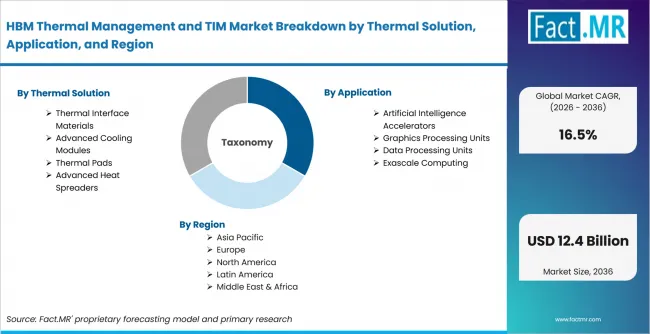
Hbm Thermal Management And Tim Market Breakdown By Thermal Solution, Application, And Region | Source: Fact.MR
| Attribute | Details |
|---|---|
| Quantitative Units | USD billion |
| Market Definition | Thermal interface materials, heat spreaders, cold plates, vapor chambers, and related cooling assemblies used to move heat away from HBM stacks and adjacent AI accelerator packages |
| Thermal Solution | Thermal Interface Materials; Heat spreaders; Liquid cooling cold plates; Vapor chambers; Heat sinks |
| Application | Artificial Intelligence Accelerators; GPU Servers; HBM Packages; HPC Systems; Automotive AI Processors |
| End User | GPU Manufacturers; Memory Manufacturers; Foundries; OSAT Providers; Hyperscale Data Centers |
| Supply Channel | Direct OEM Supply; Distributor supply; Foundry and OSAT integrated supply; Contract assembly supply; Aftermarket service supply |
| Thermal Interface Technology | High-performance Thermal Grease; Phase Change Materials; Gap Pads; Liquid Gap Fillers; Advanced solid TIMs |
| Regions Covered | North America; Latin America; Europe; East Asia; South Asia and Pacific; Middle East and Africa |
| Countries Covered | South Korea; Taiwan; USA; Japan; China; Germany; Singapore |
| Key Companies Profiled | Henkel AG & Co. KGaA; Shin-Etsu Chemical Co., Ltd.; Fujipoly America Corporation; Parker Hannifin Corporation; 3M Company; Boyd Corporation; Momentive Performance Materials Inc. |
| Forecast Period | 2026 to 2036 |
| Approach | Hybrid top-down and bottom-up approach using AI accelerator demand; HBM package qualification; semiconductor packaging activity; thermal-material product review; direct OEM procurement patterns; country adoption outlook; and company portfolio validation |
Source: Fact.MR analysis. Updated Aug 10, 2026
How is the market segmented?
-
By Thermal Solution
- Thermal Interface Materials
- Thermal Grease
- Phase Change Materials
- Advanced Cooling Modules
- Vapor Chambers
- Liquid Cooling Plates
- Thermal Pads
- Graphite Thermal Pads
- Ceramic Thermal Pads
- Advanced Heat Spreaders
- Copper Heat Spreaders
- Graphite Heat Spreaders
- Thermal Interface Materials
-
By Application
- Artificial Intelligence Accelerators
- AI Training Systems
- High-performance Computing
- Graphics Processing Units
- GPU Compute Platforms
- HBM Memory Stacks
- Data Processing Units
- AI Inference Systems
- Networking Accelerators
- Exascale Computing
- Supercomputing Systems
- High-bandwidth Memory Systems
- Artificial Intelligence Accelerators
-
By End User
- GPU Manufacturers
- Memory Manufacturers
- Semiconductor Foundries
- OSAT Providers
- Server Manufacturers
- Cloud Service Providers
- Enterprise Data Centers
- Enterprise IT Providers
- Network Equipment Manufacturers
- Research Organizations
- Government Research Laboratories
- Supercomputing Centers
- GPU Manufacturers
-
By Supply Channel
- Direct OEM Supply
- Strategic Supply Agreements
- Industrial Distributors
- Component Distributors
- System Integrators
- Value-added Resellers
- Online Sales
- E-commerce Platforms
- Authorized Distributors
- Direct Project Supply
- Custom Engineering Contracts
- Long-term Technology Partnerships
- Direct OEM Supply
-
By Thermal Interface Technology
- High-performance Thermal Grease
- Silicone-based Thermal Grease
- Phase Change Thermal Interface
- Vapor Chamber Cooling
- Copper Vapor Chamber Technology
- Direct Liquid Cooling
- Graphite Thermal Pad
- Flexible Graphite Technology
- Ceramic-filled Thermal Pad
- Heat Spreader Integration
- Precision Copper Heat Spreaders
- Pyrolytic Graphite Heat Spreaders
- High-performance Thermal Grease
-
By Region
- North America
- Latin America
- Europe
- East Asia
- South Asia and Oceania
- Middle East and Africa
Frequently Asked Questions
How big is the HBM thermal management and TIM market in 2026?
What is the CAGR of the HBM thermal management and TIM market from 2026 to 2036?
Which thermal solution leads the HBM thermal management and TIM market?
Which application leads the HBM thermal management and TIM market?
Who are the leading companies in the HBM thermal management and TIM market?
Who worked on this report


Preview the report firsthand - request a free sample
Free SampleGet the brochure for pricing and purchase details
Download PDF