- Base Value(2025): 7.8 Bn
- Estimated Value(2026): 8.1 Bn
- Forecast Value (2036): 12.5 Bn
- CAGR (2026 - 2036): 4.4%
Heart Health Supplement Market Analysis and Forecast by Fact.MR
The heart health supplement market, valued at USD 7.8 billion in 2025, is set to expand at a 4.4% CAGR to reach USD 12.526 billion by 2036. Heart health supplements include omega-3 fatty acid capsules, CoQ10 formulations, plant sterol products, magnesium-based supplements, garlic extracts, and combination cardiovascular formulas. Growth is shaped by rising cardiovascular disease prevalence globally, increasing consumer preference for preventive health measures, and expanding online retail channels that improve consumer access to specialized cardio-protective formulations across both developed and emerging economies.

Heart Health Supplement Market Market Value Analysis | Source: Fact.MR
Summary of Heart Health Supplement Market
- Market Snapshot
- The heart health supplement market is valued at USD 7.8 billion in 2025.
- The market is estimated at USD 8.143 billion in 2026 and forecast to reach USD 12.526 billion by 2036.
- A CAGR of 4.4% is projected for the 2026 to 2036 forecast period.
- Incremental opportunity of USD 4.383 billion is expected between 2026 and 2036.
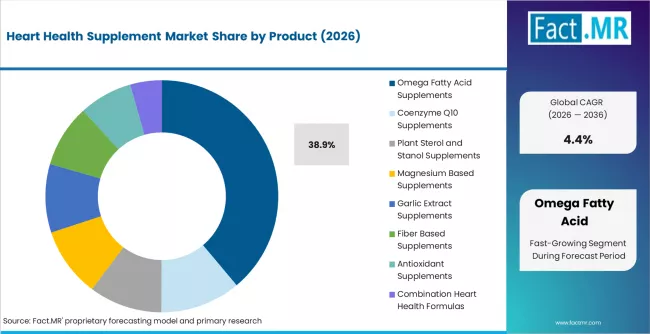
- Omega fatty acid supplements lead the product segment with a 38.9% share, while capsules dominate form at 44.2%.
- India and China are the top growth markets, with the USA contributing USD 2.92 billion in 2025.
- Demand and Growth Drivers
- Cardiovascular disease remains the leading cause of death globally, according to the WHO, creating sustained consumer interest in preventive supplementation as a complement to pharmaceutical interventions.
- Aging populations in North America, Europe, and East Asia are driving demand for daily cardio-protective supplements, with consumers over 50 years representing the largest per-capita spending cohort.
- Physician and cardiologist recommendations for omega-3 and CoQ10 supplementation are increasing as clinical evidence supporting their role in lipid management and heart function strengthens.
- Online retail and pharmacy e-commerce platforms have reduced purchase friction for heart health supplements, enabling subscription-based replenishment models that improve consumer adherence.
- Product and Segment View
- Omega fatty acid supplements hold 38.9% of the product segment, underpinned by extensive clinical evidence for EPA and DHA in cholesterol and triglyceride management.
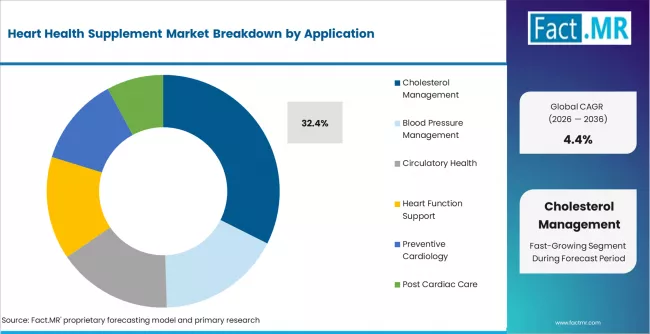
- Cholesterol management accounts for 32.4% of application demand, reflecting the large population segment managing elevated lipid levels through dietary supplementation.
- Marine-based ingredients hold 47.6% of the ingredient source segment, driven by fish oil and krill oil dominance in omega-3 supply.
- Key segmentation includes:
- Product: Omega Fatty Acid Supplements, Coenzyme Q10 Supplements, Plant Sterol and Stanol Supplements, Magnesium Based Supplements, Garlic Extract Supplements, Fiber Based Supplements, Antioxidant Supplements, Combination Heart Health Formulas
- Application: Cholesterol Management, Blood Pressure Management, Circulatory Health, Heart Function Support, Preventive Cardiology, Post Cardiac Care
- End Use: Individual Consumers, At Risk Patients, Clinical Settings, Pharmaceutical Companies, Nutraceutical Companies, Healthcare Institutions
- Distribution Channel: Online Retail, Retail Pharmacies, Supermarkets and Hypermarkets, Specialty Stores, Hospital Pharmacies, Wholesale Distribution
- Form: Capsules, Tablets, Softgels, Powders, Liquids
- Ingredient Source: Marine Based, Plant Based, Botanical Extracts, Synthetic and Bioactive Compounds
- Geography and Competitive Outlook
- North America holds the largest revenue share, with the USA contributing USD 2.92 billion in 2025, anchored by high consumer awareness of cardiovascular risk factors and established supplement consumption habits.
- South Asia and Pacific leads growth, with India recording a 7.2% CAGR supported by expanding middle-class health spending and increasing cardiologist-driven awareness campaigns.
- East Asia is a significant growth region, with China at 6.2% CAGR as urban populations increasingly adopt preventive health supplementation.
- Haleon holds an estimated 12.0% market share, followed by Bayer and Nestle Health Science in the competitive positioning.
- Analyst Opinion
- The heart health supplement market is transitioning from a broad wellness category to a clinically stratified one. Consumers are moving beyond generic omega-3 capsules toward condition-specific formulations backed by clinical data. The omega-3 segment retains dominance, but CoQ10 and plant sterol products are growing as complementary stacking options for consumers managing multiple cardiovascular risk factors. Geographic expansion in India and China offers volume growth, but requires localized pricing strategies. Brands that invest in clinical trial data and physician endorsement will establish defensible market positions as regulatory bodies tighten health claim verification across all major markets.
Key Growth Drivers, Constraints, and Opportunities
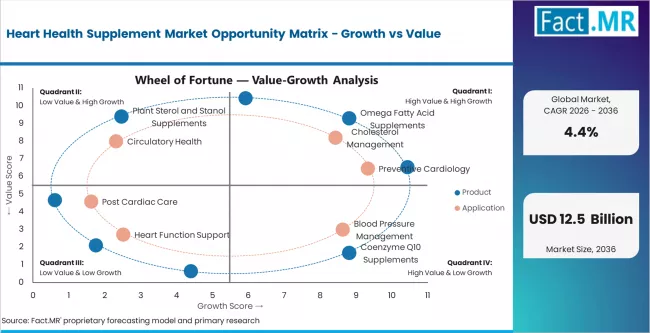
Heart Health Supplement Market Opportunity Matrix Growth Vs Value | Source: Fact.MR
Key Factors Driving Growth
- Cardiovascular disease prevalence continues to rise globally, with the WHO reporting over 17.9 million CVD-related deaths annually. This public health burden sustains consumer demand for preventive supplementation, particularly among populations with elevated cholesterol, hypertension, or family history of heart disease.
- Clinical evidence supporting omega-3 EPA/DHA for triglyceride reduction and CoQ10 for statin-associated myopathy management is strengthening physician willingness to recommend supplementation as an adjunct to pharmaceutical therapy.
- Direct-to-consumer genetic testing and cardiovascular risk profiling services are creating personalized entry points for heart health supplementation, with companies like Thorne and Persona using biomarker data to recommend tailored cardio-support stacks.
Key Market Constraints
- Omega-3 fish oil price volatility, driven by anchovy and sardine catch variability in Peru and Chile, creates margin pressure for manufacturers. Global fish oil supply is constrained by quota limits and El Nino weather patterns that disrupt fish stock availability.
- Regulatory divergence in health claim allowances creates complexity. The EU restricts most heart health claims to EPA/DHA at specific doses, while the US permits broader structure/function claims, forcing brands to maintain separate labelling for each market.
- Consumer confusion between pharmaceutical-grade and retail-grade supplements limits trust. Products with inadequate EPA/DHA concentration or poor bioavailability undermine category credibility, and third-party testing penetration remains limited outside premium brands.
Key Opportunity Areas
- Algal omega-3 (DHA and increasingly EPA from algae) is opening a plant-based cardiovascular supplement segment that serves vegan consumers and those concerned about ocean sustainability and heavy metal contamination in fish-derived oils.
- Post-cardiac event supplementation is an underpenetrated application. Patients recovering from cardiac surgery, stent placement, or heart failure diagnosis represent a defined clinical population for whom targeted heart health supplements can complement pharmaceutical regimens.
- Combination formulas that stack omega-3 with CoQ10, vitamin K2, and magnesium in a single daily dose are simplifying consumer regimens and commanding premium price points by reducing pill burden.
Segment-wise Analysis of the Heart Health Supplement Market
- Omega fatty acid supplements hold 38.9% of the product segment, driven by established clinical evidence and broad physician recommendation.
- Cholesterol management accounts for 32.4% of application demand, reflecting the large global population managing lipid-related cardiovascular risk.
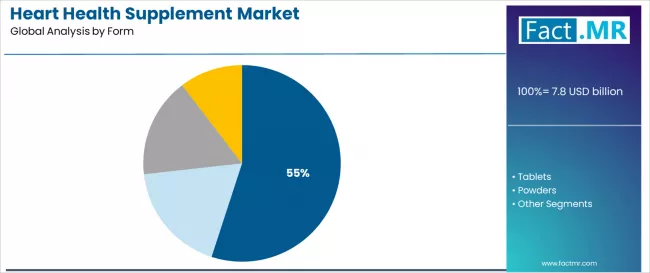
- Capsules dominate the form segment at 44.2%, favored for their convenience, dosing precision, and ability to mask fish oil taste.
Which product type dominates the Heart Health Supplement Market?
Heart Health Supplement Market Analysis By Product | Source: Fact.MR
Omega fatty acid supplements command 38.9% of the product segment. Fish oil remains the dominant raw material, with EPA and DHA concentrations varying across price tiers. Premium products offering 60 to 90% concentrate command significant retail margins compared to standard 30% fish oil capsules. Krill oil products, while smaller in volume, attract consumers willing to pay more for phospholipid-bound omega-3 delivery.
CoQ10 supplements are the second-largest product category and growing steadily. Demand is driven by statin users who experience muscle pain and fatigue as side effects, and CoQ10 supplementation is increasingly recommended by cardiologists as a complementary intervention. The ubiquinol form of CoQ10 is gaining share over ubiquinone due to superior bioavailability in older adults.
Which application leads demand in the Heart Health Supplement Market?
Heart Health Supplement Market Analysis By Application | Source: Fact.MR
Cholesterol management holds 32.4% of application-based demand. Consumers with borderline or elevated LDL cholesterol represent the primary purchase motivation for omega-3 and plant sterol products. Pharmacy-channel sales for cholesterol management supplements benefit from pharmacist recommendations, creating a higher-trust purchase environment compared to general retail.
Blood pressure management is growing as a secondary application, supported by clinical data for magnesium, CoQ10, and omega-3 in modestly reducing systolic blood pressure. Consumers seeking non-pharmaceutical approaches to mild hypertension are driving incremental demand in this segment.
Which form leads the Heart Health Supplement Market?
Heart Health Supplement Market Analysis By Form | Source: Fact.MR
Capsules account for 44.2% of the form segment, preferred for their ease of consumption, standardized dosing, and ability to encapsulate fish oil without exposing consumers to taste or odor. Enteric-coated and delayed-release capsules that minimize fishy aftertaste are a growing sub-segment within this category.
Softgels maintain a strong position as well, particularly for omega-3 products where the liquid fill format accommodates high oil volumes per unit. Powder and liquid forms are gaining modest traction in markets like India and China, where consumers are accustomed to mixing supplements into beverages or food.
Which Product Trend is Shaping the Next Phase of Growth in the Heart Health Supplement Market?
Algal-derived omega-3 supplements are shaping the next phase of growth in the heart health market. Traditional fish oil supply faces structural constraints from fishery quotas, seasonal catch variability, and increasing sustainability scrutiny from consumers and regulators. Algal DHA has been commercially available for over a decade, but recent fermentation advances now enable cost-effective algal EPA production, making plant-based omega-3 products functionally equivalent to fish-derived alternatives. Companies including DSM-Firmenich (life's OMEGA) and Corbion are scaling fermentation capacity, positioning algal omega-3 for meaningful share gains against fish oil within the forecast period.
Combination heart health formulas are emerging as a significant product trend. Rather than purchasing separate capsules for omega-3, CoQ10, vitamin K2, and magnesium, consumers are gravitating toward all-in-one daily heart health formulas. These products reduce pill burden, simplify purchasing decisions, and allow brands to command higher per-unit pricing. The combination format also creates differentiation in a category where standalone omega-3 products face heavy private-label competition. Brands that combine clinical dosing with physician endorsement for their combination formulas are establishing loyalty in a market where standalone ingredient products are increasingly commoditized.
Regional Outlook Across Key Markets
.webp "Top Country Growth Comparison Heart Health Supplement Market Cagr (2026 2036)")
Top Country Growth Comparison Heart Health Supplement Market Cagr (2026 2036) | Source: Fact.MR
- North America leads regional revenue, with the USA contributing USD 2.92 billion in 2025, supported by high cardiovascular risk awareness and established supplement habits.
- South Asia and Pacific records the fastest growth, with India at 7.2% CAGR driven by expanding cardiac care awareness and middle-class health spending.
- East Asia is a significant growth region, with China at 6.2% CAGR as preventive health supplementation expands among urban professionals.
- Europe maintains steady demand, with Germany at 3.9% CAGR shaped by strict EU health claim regulations and pharmacy-led distribution.
CAGR Table
| Country | CAGR (%) |
|---|---|
| India | 7.2% |
| China | 6.2% |
| Mexico | 4.3% |
| USA | 4.0% |
| Germany | 3.9% |
| South Korea | 3.6% |
| Japan | 3.0% |
Source: Fact.MR analysis. Updated Apr 30, 2026
Source: Fact.MR analysis, based on proprietary forecasting model and primary research.

Heart Health Supplement Market Cagr Analysis By Country | Source: Fact.MR
India: Cardiovascular risk awareness driving supplement adoption
India's heart health supplement market is growing at 7.2% CAGR, fueled by alarming cardiovascular disease statistics in the country. India accounts for a disproportionately high share of global CVD deaths relative to its population, creating urgency around preventive health measures. Urban cardiologists are increasingly recommending omega-3 and CoQ10 supplementation to patients with borderline risk profiles. Domestic brands like Himalaya Wellness and Zandu are offering competitively priced heart health formulations through pharmacy and e-commerce channels, while international brands penetrate through Amazon India and Flipkart.
- India's expanding health insurance coverage and growing employer-sponsored wellness programs are creating institutional purchase channels for heart health supplements.
China: Preventive cardiology culture strengthening in urban centers
China's market is expanding at 6.2% CAGR as urban health consciousness grows. Traditional Chinese Medicine (TCM) concepts of cardiovascular wellness intersect with modern supplement science, creating a unique consumer mindset receptive to both botanical and nutrient-based heart health products. Tmall Health and JD Health platforms are the primary purchase channels, with livestream commerce emerging as an education and sales vehicle. Local brands such as By-Health and Tangchen are competing effectively against imported products by offering formulations adapted to Chinese consumer preferences.
- China's National Health Commission focus on chronic disease prevention is providing a policy backdrop that supports supplement category growth.
USA: Mature market shifting toward clinical-grade supplementation

Heart Health Supplement Market Country Value Analysis | Source: Fact.MR
The USA contributes USD 2.92 billion in 2025, representing the single largest national market. Growth at 4.0% CAGR reflects a consumer base that is upgrading from generic fish oil to concentrated EPA/DHA products, prescription-strength omega-3 (Vascepa/icosapent ethyl crossover awareness), and clinically validated combination formulas. Pharmacy chains CVS and Walgreens maintain dedicated heart health supplement sections, and pharmacist recommendation is a meaningful purchase driver. The subscription DTC channel is growing, with brands like Thorne and Nordic Naturals building recurring revenue through auto-replenishment programs.
- US consumers increasingly seek third-party tested products (USP Verified, ConsumerLab approved), creating a quality segmentation that favors premium brands.
Germany: Pharmacy-centric distribution and EU health claim rigor
Germany's market grows at 3.9% CAGR within a regulatory framework that limits health claims to those authorized by EFSA. This creates a higher bar for market entry but also builds consumer trust in products that do carry approved claims. Pharmacy (Apotheke) distribution dominates, with pharmacists serving as trusted advisors for heart health supplementation. German consumers demonstrate strong loyalty to omega-3 brands with documented sustainability credentials, including MSC-certified fish oil and algal alternatives. DM, Rossmann, and pharmacy private labels exert pricing pressure on mid-tier products.
- Germany's aging population, with over 22% of residents aged 65 and above, creates a structurally expanding addressable market for cardiovascular supplements.
South Korea: Functional health food framework supporting category credibility
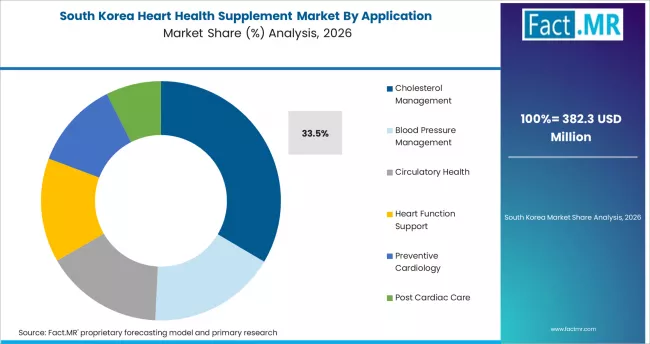
Heart Health Supplement Market South Korea Market Share Analysis By Application | Source: Fact.MR
South Korea's market is growing at 3.6% CAGR, with heart health supplements benefiting from the country's Health-Functional Food (HFF) regulatory framework administered by MFDS. Products approved under HFF carry specific health benefit claims that differentiate them from general supplements. South Korea's USD 0.207 billion market in 2025 reflects concentrated spending among health-conscious urban consumers. Olive Young and CJ OliveYoung stores serve as specialty retail access points, while Coupang dominates the e-commerce channel.
- South Korean consumer preference for premium, single-ingredient products (high-concentration omega-3, pure CoQ10) supports higher average selling prices in this market.
Japan: Aging society and functional food integration
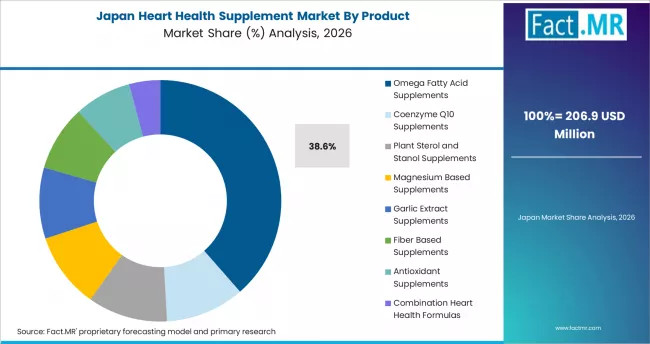
Heart Health Supplement Market Japan Market Share Analysis By Product | Source: Fact.MR
Japan's market grows at 3.0% CAGR from a USD 0.382 billion base in 2025. Japan's super-aged society, with nearly 30% of the population over 65, creates sustained demand for cardiovascular protection supplements. The Foods with Function Claims (FFC) system enables brands to make specific circulatory health and cholesterol management claims, strengthening purchase intent. Domestic companies Suntory, Fancl, and DHC dominate the category through convenience store, pharmacy, and direct mail distribution models.
- Japan's established direct-to-consumer mail-order supplement culture provides a high-retention distribution channel for heart health products targeting elderly consumers.
Mexico: Emerging awareness of cardiovascular supplementation
Mexico's market is expanding at 4.3% CAGR, driven by increasing awareness of cardiovascular disease risk in a population with high rates of obesity, diabetes, and metabolic syndrome. Pharmacy chains like Farmacias del Ahorro and Farmacias Guadalajara are the primary distribution points, with pharmacist recommendations carrying significant purchase influence. International omega-3 brands are gaining traction through cross-border e-commerce from the USA, while domestic supplement brands are developing locally priced heart health products.
- Mexico's public health campaigns targeting metabolic syndrome and diabetes management are creating awareness spillover that benefits heart health supplement category growth.
Competitive Benchmarking and Company Positioning
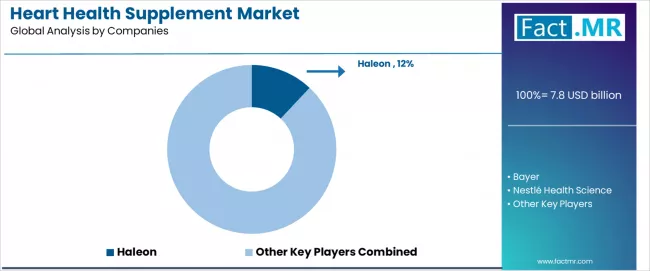
Heart Health Supplement Market Analysis By Company | Source: Fact.MR
Heart Health Supplement Market Analysis By Company
- Tier 1 (above 10% share): Haleon holds an estimated 12.0% global share through its broad cardiovascular supplement portfolio spanning multiple retail and pharmacy channels.
- Tier 2 (5 to 10% share): Bayer, Nestle Health Science, and Pfizer Consumer compete through established brand recognition, pharmacy distribution networks, and clinical positioning.
- Tier 3 (below 5% share): Amway, Herbalife, DSM-Firmenich, Blackmores, Swisse, NOW Foods, Jamieson, and regional players compete on ingredient quality, pricing, and channel-specific positioning.
The heart health supplement market is structured around three competitive models. Pharmaceutical-adjacent companies such as Haleon (spun out of GSK), Bayer, and Pfizer Consumer leverage legacy trust from their parent companies' prescription cardiovascular drug portfolios. These players benefit from pharmacy channel relationships and a clinical credibility halo that supports premium pricing.
Nutrition and wellness conglomerates including Nestle Health Science, DSM-Firmenich, and Danone approach the market from an ingredient science and vertical integration perspective. DSM-Firmenich's control of omega-3 fish oil and algal oil supply chains gives it a structural advantage in raw material access and margin management.
Direct-to-consumer and specialty brands including NOW Foods, Jamieson, Nordic Naturals, and Thorne compete through quality transparency, third-party testing certifications, and subscription models that build recurring revenue. These brands are capturing health-conscious consumers who actively research ingredient sourcing and clinical evidence before purchasing.
Key Companies in the Heart Health Supplement Market
Haleon, Bayer, Nestle Health Science, Pfizer Consumer, Amway, Herbalife, DSM-Firmenich, Blackmores, Swisse, NOW Foods, Jamieson, Nature's Bounty, Church and Dwight, Costco (Kirkland), and Danone are the primary companies shaping competitive dynamics in the heart health supplement market.
Recent Industry Developments
- Haleon: expanded heart health supplement line under Centrum brand (2025)
- Haleon launched an extended Centrum heart health range including a high-concentration omega-3 plus CoQ10 combination product targeting consumers aged 50 and above. The launch leveraged Centrum's brand recognition in the multivitamin space to cross-sell into the heart health category through pharmacy and retail channels.
- DSM-Firmenich: algal omega-3 capacity expansion (2025)
- DSM-Firmenich increased its algal omega-3 (life's OMEGA) fermentation capacity to meet growing demand from supplement brands seeking plant-based EPA and DHA sources. The expansion supports the company's positioning as a dual-source omega-3 supplier offering both fish oil and algal alternatives.
- Nestle Health Science: acquisition strengthening cardiovascular nutrition portfolio (2025)
- Nestle Health Science expanded its cardiovascular supplement portfolio through targeted brand acquisitions and new product launches under its Garden of Life and Pure Encapsulations brands, focusing on clinically substantiated heart health formulations.
- Blackmores: Asia-Pacific heart health product localization (2026)
- Blackmores launched region-specific heart health formulations for the Indian and Southeast Asian markets, adapting dosage forms and price points to local preferences while maintaining its Australian-origin quality positioning.
Leading Companies Shaping the Heart Health Supplement Market
-
Global Players
- Haleon
- Bayer
- Nestle Health Science
- Pfizer Consumer
- Amway
- DSM-Firmenich
-
Regional Players
- Blackmores
- Swisse
- Jamieson
- Nature's Bounty
- Church and Dwight
-
Emerging / Start-up Players
- NOW Foods
- Costco (Kirkland)
- Danone
- Herbalife
Sources and Research References
- World Health Organization (WHO) cardiovascular disease fact sheets and global health statistics
- Haleon Annual Report and Investor Presentation (2025)
- European Food Safety Authority (EFSA) opinions on omega-3 and CoQ10 health claims
- US FDA DSHEA structure/function claim guidance and warning letters database
- FSSAI (Food Safety and Standards Authority of India) nutraceutical and supplement regulations
- Global Organization for EPA and DHA Omega-3s (GOED) annual production and consumption reports
- Japan Consumer Affairs Agency, Foods with Function Claims notification database
All numerical data is sourced from Fact.MR proprietary research. Company-specific data is sourced from public filings and verified through primary research. No syndicated market research reports were used.
Key Questions This Report Addresses
- What is the current value and forecast for the global heart health supplement market?
- Which product type holds the largest share in the heart health supplement market?
- What CAGR is projected for the heart health supplement market from 2026 to 2036?
- Which country is the fastest-growing market for heart health supplements?
- How is algal omega-3 affecting the heart health supplement supply chain?
- What role does CoQ10 play in heart health supplement demand?
- Which companies lead the global heart health supplement market?
- What is the incremental revenue opportunity in heart health supplements between 2026 and 2036?
- How do regulatory frameworks affect heart health supplement marketing across regions?
- What distribution channels dominate heart health supplement sales?
Heart Health Supplement Market Definition
The heart health supplement market covers dietary supplements specifically formulated to support cardiovascular function, manage cholesterol and blood pressure, improve circulatory health, and reduce cardiovascular disease risk. Products include omega-3 fatty acid supplements, CoQ10 formulations, plant sterol and stanol products, magnesium supplements, garlic extracts, fiber-based supplements, antioxidant formulas, and multi-ingredient heart health combinations. These products are sold through pharmacies, online retail, supermarkets, specialty stores, and healthcare institutions.
Heart Health Supplement Market Inclusions
- Omega-3 fatty acid supplements (fish oil, krill oil, algal oil) marketed for cardiovascular health.
- CoQ10, plant sterol, magnesium, and garlic extract supplements with heart health positioning.
- Combination heart health formulas containing multiple cardio-supportive active ingredients.
- Heart health supplements distributed through retail, pharmacy, online, and clinical channels.
Heart Health Supplement Market Exclusions
- Prescription cardiovascular drugs including statins, beta-blockers, and anti-hypertensives.
- General multivitamins without specific heart health claims or cardiovascular benefit positioning.
- Medical devices for cardiac monitoring, diagnosis, or treatment.
- Functional foods and beverages with added omega-3 or plant sterols sold as food products rather than supplements.
Heart Health Supplement Market Research Methodology
- Bottom-up revenue estimation using manufacturer shipment data, pharmacy sell-through records, and retail audit databases across 40+ countries.
- Primary interviews with cardiologists, pharmacists, nutraceutical formulators, and retail category managers in major markets.
- Ingredient trade data analysis tracking omega-3 fish oil, krill oil, algal DHA, CoQ10, and plant sterol import/export volumes.
- Consumer health surveys tracking supplement usage patterns, brand preferences, and purchase channel behavior across cardiovascular risk demographics.
- Regulatory landscape analysis of health claim frameworks including EU Health Claims Regulation, US FDA structure/function claims, and FSSAI provisions.
- Competitive benchmarking using public filings, investor presentations, and product databases from Haleon, Bayer, Nestle Health Science, and 12 other profiled companies.
Segmentation
Scope of Analysis
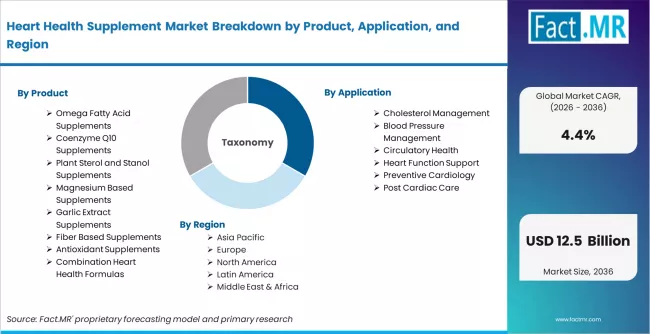
Heart Health Supplement Market Breakdown By Product, Application, And Region | Source: Fact.MR
| Parameter | Details |
|---|---|
| Report Title | Heart Health Supplement Market |
| Market Value (2025) | USD 7.8 Billion |
| Forecast Value (2036) | USD 12.526 Billion |
| CAGR (2026 to 2036) | 4.4% |
| Unit | USD Billion |
| Segments Covered | Product, Application, End Use, Distribution Channel, Form, Ingredient Source |
| Regions Covered | North America, Latin America, Europe, East Asia, South Asia and Pacific, Middle East and Africa |
| Countries Profiled | USA, India, China, Germany, Japan, South Korea, Mexico, and 40+ countries |
| Key Companies | Haleon, Bayer, Nestle Health Science, Pfizer Consumer, Amway, Herbalife, DSM-Firmenich, Blackmores, Swisse, NOW Foods, Jamieson, Nature's Bounty, Church and Dwight, Costco (Kirkland), Danone |
| Forecast Period | 2026 to 2036 |
| Base Year | 2025 |
| Methodology | Bottom-up estimation, primary interviews, ingredient trade data, consumer health surveys, regulatory analysis, competitive benchmarking |
Source: Fact.MR analysis. Updated Apr 30, 2026
Market Segmentation Analysis
-
Heart Health Supplement Market Market Segmented by Product:
- Omega Fatty Acid Supplements
- Fish Oil Supplements
- Krill Oil Supplements
- Plant Based Omega 3
- Coenzyme Q10 Supplements
- Ubiquinone Form
- Ubiquinol Form
- Plant Sterol and Stanol Supplements
- Cholesterol Lowering Blends
- Heart Health Functional Blends
- Magnesium Based Supplements
- Magnesium Citrate
- Magnesium Glycinate
- Garlic Extract Supplements
- Aged Garlic Extract
- Standardized Allicin Extracts
- Fiber Based Supplements
- Soluble Fiber Blends
- Psyllium Based Heart Formulas
- Antioxidant Supplements
- Vitamin E Blends
- Polyphenol Rich Extracts
- Combination Heart Health Formulas
- Multi Nutrient Cardiovascular Blends
- Premium Clinical Formulations
- Omega Fatty Acid Supplements
-
Heart Health Supplement Market Market Segmented by Application:
- Cholesterol Management
- LDL Reduction Support
- HDL Improvement Support
- Blood Pressure Management
- Hypertension Support Formulas
- Vascular Relaxation Support
- Circulatory Health
- Blood Flow Improvement
- Vein Health Support
- Heart Function Support
- Cardiac Muscle Support
- Energy Metabolism Support
- Preventive Cardiology
- Long Term Heart Protection
- Risk Reduction Supplements
- Post Cardiac Care
- Recovery Nutrition
- Clinical Heart Support
- Cholesterol Management
-
Heart Health Supplement Market Market Segmented by End Use:
- Individual Consumers
- Aging Population
- Health Conscious Adults
- At Risk Patients
- Diabetic Patients
- Hypertensive Patients
- Clinical Settings
- Hospitals
- Cardiology Clinics
- Pharmaceutical Companies
- Clinical Nutrition Developers
- Prescription Adjunct Formulations
- Nutraceutical Companies
- Functional Health Brands
- Supplement Manufacturers
- Healthcare Institutions
- Wellness Centers
- Rehabilitation Facilities
- Individual Consumers
-
Heart Health Supplement Market Market Segmented by Distribution Channel:
- Online Retail
- E Commerce Platforms
- Direct To Consumer Brands
- Retail Pharmacies
- Prescription Support Supplements
- OTC Cardiovascular Products
- Supermarkets and Hypermarkets
- Health Food Sections
- Specialty Stores
- Heart Health Supplement Stores
- Nutraceutical Retailers
- Hospital Pharmacies
- Clinical Distribution Channels
- Cardiology Supply Chains
- Wholesale Distribution
- Bulk Supplement Suppliers
- Food Service Health Channels
- Online Retail
-
Heart Health Supplement Market Market Segmented by Form:
- Capsules
- Gelatin Capsules
- Vegetarian Capsules
- Tablets
- Chewable Tablets
- Effervescent Tablets
- Softgels
- Fish Oil Softgels
- Omega 3 Soft Capsules
- Powders
- Heart Health Blends
- Electrolyte Cardiovascular Powders
- Liquids
- Oil Based Supplements
- Concentrated Liquid Extracts
- Capsules
-
Heart Health Supplement Market Market Segmented by Ingredient Source:
- Marine Based
- Fish Derived Omega 3
- Krill Derived Oils
- Plant Based
- Flaxseed Oil
- Chia Seed Oil
- Botanical Extracts
- Garlic
- Hawthorn Berry Extract
- Synthetic and Bioactive Compounds
- CoQ10 Synthesis
- Phospholipid Complexes
- Marine Based
-
Heart Health Supplement Market Market by Region:
- North America
- USA
- Canada
- Mexico
- Latin America
- Brazil
- Chile
- Rest of Latin America
- Western Europe
- Germany
- UK
- Italy
- Spain
- France
- Nordic
- BENELUX
- Rest of Western Europe
- Eastern Europe
- Russia
- Poland
- Hungary
- Balkan & Baltic
- Rest of Eastern Europe
- East Asia
- China
- Japan
- South Korea
- South Asia and Pacific
- India
- ASEAN
- Australia & New Zealand
- Rest of South Asia and Pacific
- Middle East & Africa
- Kingdom of Saudi Arabia
- Other GCC Countries
- Turkiye
- South Africa
- Other African Union
- Rest of Middle East & Africa
- North America
Frequently Asked Questions
What is the heart health supplement market worth in 2025?
What CAGR is projected for the heart health supplement market?
Which product type leads the heart health supplement market?
Which country is the fastest-growing heart health supplement market?
Which company leads the heart health supplement market?
What is the forecast value of the heart health supplement market in 2036?
Which form dominates heart health supplement sales?
Who worked on this report


Preview the report firsthand - request a free sample
Free SampleGet the brochure for pricing and purchase details
Download PDF