- Base Value(2026): 0.53 Bn
- Estimated Value(2026): 0.5 Bn
- Forecast Value (2036): 1.8 Bn
- CAGR (2026 - 2036): 12.9%
Heat Pump Cabin Dehumidifiers Market Forecast and Outlook 2026 to 2036
Heat pump cabin dehumidifiers market is likely to be valued at USD 0.53 billion in 2026 and is projected to reach USD 1.76 billion by 2036, reflecting a 12.9% CAGR, according to Fact.MR analysis.
Summary of Heat Pump Cabin Dehumidifiers Market - Key Takeaways
- The heat pump cabin dehumidifiers market comprises energy efficient humidity control systems integrated into automotive and commercial cabins to improve visibility, comfort, and HVAC performance across EV and conventional platforms.
- The global market is estimated at USD 0.53 billion in 2026 and is projected to reach USD 1.76 billion by 2036, expanding at a 12.9% CAGR based on Fact.MR analysis aligned with EV penetration and advanced cabin climate control adoption.
- By dehumidification type, heat pump assisted systems lead with a 54% share, supported by scalable integration with HVAC architectures, repeatable OEM procurement, and predictable high volume deployment.
- By use case, defog and defrost applications account for a 42% share, reflecting their essential role in vehicle safety, regulatory compliance, and standardized deployment across vehicle platforms.
- China and Brazil record the fastest growth at 14.9% and 14.7% CAGR respectively, driven by large scale EV manufacturing, energy efficiency mandates, and consumer demand for advanced cabin comfort solutions.
- Competition is led by suppliers such as MAHLE, Denso, and Valeo, where thermal efficiency validation, system integration capability, and close OEM alignment define long term competitive positioning.
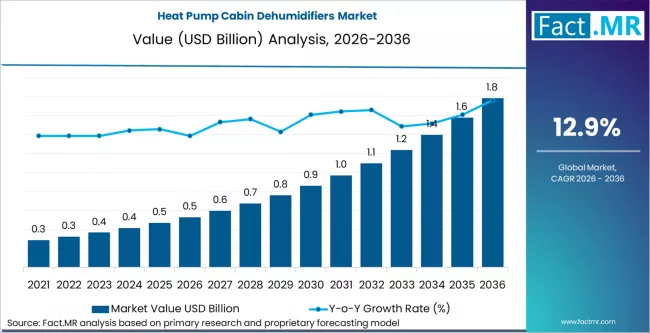
Heat Pump Cabin Dehumidifiers Market Market Value Analysis | Source: Fact.MR
Market growth is being driven by the integration of energy-efficient dehumidification solutions in commercial and passenger cabins, where precise humidity control improves comfort, safety, and operational efficiency. Adoption is influenced by the need for standardized system performance, scalable production, and compatibility with automated climate control platforms across multiple vehicle and aircraft models.
Suppliers are assessed based on material durability, thermal performance consistency, and multi-region deployment capability. Operational alignment with logistics and installation processes ensures minimal downtime and predictable system reliability. Competitive differentiation arises from companies offering advanced heat pump designs with rapid response, lower energy consumption, and adaptive control. The market trajectory reflects a structural shift toward predictive, energy-efficient cabin environmental management, enhancing both passenger experience and fleet operational performance.
Heat Pump Cabin Dehumidifiers Market
| Metric | Value |
|---|---|
| Market Value (2026) | USD 0.53 billion |
| Forecast Value (2036) | USD 1,760 billion |
| Forecast CAGR (2026-2036) | 12.9% |
Source: Fact.MR analysis. Updated Feb 13, 2026
Category
| Category | Segments |
|---|---|
| By Dehumidification Type | Heat pump assisted; Desiccant-based; Dedicated dehumidifier module; Other |
| By Use Case | Defog/defrost; Cabin comfort humidity control; Battery/pack drying support; Other |
| By Vehicle Segment | Passenger EVs; Premium/Luxury EVs; LCV EVs; Other |
| By Integration | Integrated HVAC; Standalone module; Aftermarket; Other |
| Region | North America; Europe; Asia Pacific; Latin America; Middle East & Africa |
Source: Fact.MR analysis. Updated Feb 13, 2026
Segmental Analysis
By Dehumidification Type, Why Do Heat Pump Assisted Systems Lead the Market?
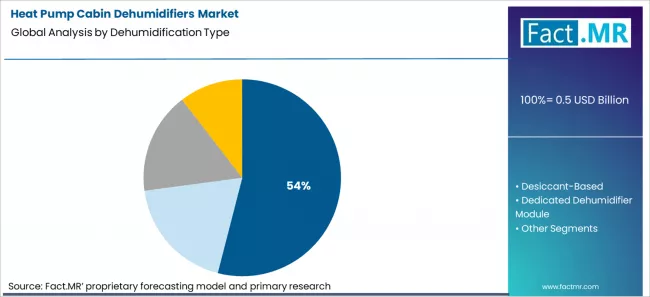
Heat Pump Cabin Dehumidifiers Market Analysis By Dehumidification Type | Source: Fact.MR
Heat pump assisted systems lead the market with 54% share, reflecting widespread adoption across automotive OEMs, commercial fleets, and electric vehicle platforms where repeatable procurement and high-volume deployment drive predictable demand. Market dynamics emphasize operational efficiency, scalable integration, and standardized logistics for installation and maintenance. Suppliers benefit from recurring orders, predictable production cycles, and multi-platform compatibility. Segment prominence is shaped by structural market drivers such as workflow repeatability, supply chain efficiency, and volume adoption rather than the technical mechanism of dehumidification. High-frequency deployment and standardized integration anchor this segment’s market dominance.
By Use Case, Why Does Defog/Defrost Represent the Largest Segment?
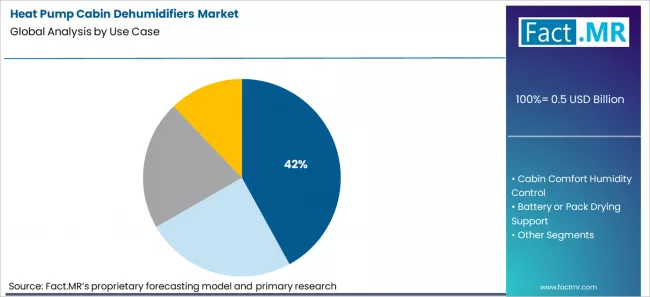
Heat Pump Cabin Dehumidifiers Market Analysis By Use Case | Source: Fact.MR
Defog or defrost applications account for 42% share, reflecting the market’s focus on critical, high-volume functionality that supports predictable demand across automotive and commercial vehicle fleets. Procurement cycles prioritize operational reliability, multi-site distribution, and repeatable system deployment. Suppliers benefit from standardized manufacturing, recurring orders, and streamlined logistics. Segment prominence arises from structural market characteristics such as repeatable workflows, supply chain consistency, and high-frequency adoption rather than the specific use mechanics. Defog/defrost dominates as the central driver of market activity due to its essential role in vehicle operation and predictable integration across platforms.
Country/Region
| Country/Region | Driver | Restraint | Trend |
|---|---|---|---|
| USA | Rising demand for energy-efficient cabin climate systems → drives adoption of heat pump dehumidifiers | OEM safety and regulatory certification → increases CapEx and slows small supplier entry | Growth of AI-enabled heat pump dehumidifiers for passenger comfort |
| Germany | Expansion of EV and premium vehicle production → fuels adoption of cabin dehumidification systems | EU automotive system regulations → increases testing and compliance costs | Adoption of AI-driven multi-zone thermal and humidity optimization |
| India | Growing EV and connected vehicle adoption → accelerates penetration of heat pump dehumidifiers | Limited access to advanced sensors and heat pump technology → slows rollout for smaller suppliers | Growth of locally manufactured, cost-effective cabin dehumidification solutions |
| China | Large-scale automotive and EV manufacturing → drives demand for smart cabin dehumidification | Regional quality and safety standard variability → delays approvals for new systems | Expansion of automated production lines for heat pump cabin dehumidifiers |
| Brazil | Automotive localization policies → increase demand for efficient cabin dehumidifiers | Import restrictions and compliance requirements → raise production and integration costs | Growth of locally sourced, energy-efficient cabin dehumidification solutions |
Source: Fact.MR analysis. Updated Feb 13, 2026
Analysis of the Heat Pump Cabin Dehumidifiers Market by Key Country
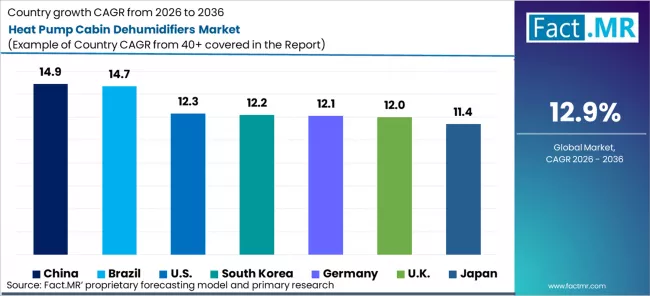
Heat Pump Cabin Dehumidifiers Market Cagr Analysis By Country | Source: Fact.MR
| Country | CAGR (2026-2036) |
|---|---|
| U.S. | 12.3% |
| Japan | 11.4% |
| South Korea | 12.2% |
| Germany | 12.1% |
| China | 14.9% |
| U.K. | 12.0% |
| Brazil | 14.7% |
Source: Fact.MR analysis. Updated Feb 13, 2026
The report covers an in-depth analysis of 40+ countries; top-performing countries are highlighted below.
How Is Demand for Heat Pump Cabin Dehumidifiers Growing in the United States?
Demand for heat pump cabin dehumidifiers in the United States grows at 12.3% CAGR through 2036. Automotive manufacturers increasingly integrate advanced dehumidification systems to optimize cabin air quality, comfort, and HVAC efficiency. Operational improvements focus on sensor accuracy, system calibration, and assembly line integration. Urban production hubs adopt automated testing protocols and predictive maintenance for installation efficiency. Market expansion is driven by consumer expectations for indoor comfort, growth in electric and hybrid vehicle segments, and regulatory incentives promoting energy-efficient HVAC systems. Adoption spans both premium and mid-tier vehicles, reflecting a balance of performance and technological sophistication.
What Is the Growth in Adoption of Heat Pump Cabin Dehumidifiers in Japan?
Growth in adoption of heat pump cabin dehumidifiers in Japan reaches 11.4% CAGR through 2036. Automotive OEMs implement energy-efficient cabin dehumidification to improve comfort, reduce condensation, and enhance battery longevity in EVs. Operational improvements include precise sensor integration, predictive system controls, and quality assurance protocols. Urban and regional manufacturing facilities adopt automated calibration for consistent performance. Premium and functional vehicle segments lead adoption. Market growth reflects consumer demand for advanced climate control, government support for energy-efficient mobility solutions, and operational optimization that reduces production and maintenance costs.
How Is the Heat Pump Cabin Dehumidifiers Market Shaping in South Korea?
Adoption of heat pump cabin dehumidifiers in South Korea grows at 12.2% CAGR through 2036. OEMs integrate smart dehumidification solutions to enhance cabin air quality, energy efficiency, and EV performance. Manufacturers focus on sensor reliability, predictive algorithms, and automated system testing. Operational improvements emphasize assembly line integration, quality control, and supply chain synchronization. Urban production hubs drive adoption, particularly for electric and hybrid vehicle platforms. Market expansion is fueled by consumer expectations for comfort and convenience, regulatory energy efficiency requirements, and competitive differentiation through high-performance HVAC and dehumidification systems.
What Is the Outlook on Heat Pump Cabin Dehumidifiers in Germany?
Outlook on heat pump cabin dehumidifiers in Germany grows at 12.1% CAGR through 2036. Automotive manufacturers adopt energy-efficient climate control systems to improve passenger comfort and EV battery performance. Operational improvements focus on sensor calibration, predictive dehumidification, and quality assurance. Urban production hubs integrate automated assembly and testing protocols. Market expansion is driven by consumer demand for advanced cabin comfort, stringent energy efficiency standards, and adoption in both premium and mass-market vehicle segments. Manufacturers invest in R&D and operational optimization to ensure system reliability, regulatory compliance, and consistent performance across diverse climatic conditions.
How Is the Heat Pump Cabin Dehumidifiers Market Growing in China?
Growth in the heat pump cabin dehumidifiers market in China reaches 14.9% CAGR through 2036. OEMs prioritize advanced cabin climate management to enhance energy efficiency, comfort, and EV battery performance. Manufacturers invest in predictive dehumidification algorithms, high-precision sensors, and automated testing protocols. Operational improvements focus on regional distribution, supply chain efficiency, and integration with assembly lines. Urban production hubs lead adoption. Market growth is fueled by rapid EV adoption, government incentives for energy-efficient automotive technologies, and consumer demand for functional, technologically advanced cabin systems. Premium and mid-tier vehicles incorporate these systems to meet evolving performance and comfort expectations.
What Are the Growth Patterns in Heat Pump Cabin Dehumidifiers in the United Kingdom?
Growth patterns in the heat pump cabin dehumidifiers market in the United Kingdom reach 12.0% CAGR through 2036. Automotive manufacturers integrate predictive dehumidification to optimize cabin air quality, passenger comfort, and energy efficiency. Operational improvements include system calibration, predictive algorithm deployment, and assembly line integration. Urban manufacturing hubs emphasize quality assurance, component standardization, and supply chain reliability. Premium vehicle segments lead adoption, supported by consumer demand for functional comfort and climate-responsive systems. Market expansion is gradual yet steady, reflecting adoption across EVs, hybrids, and conventional vehicles, driven by energy efficiency regulation and operational excellence.
How Is the Heat Pump Cabin Dehumidifiers Market Developing in Brazil?
Outlook on the heat pump cabin dehumidifiers market in Brazil grows at 14.7% CAGR through 2036. OEMs implement advanced cabin dehumidification systems to improve comfort, reduce condensation, and optimize energy use in electric and hybrid vehicles. Operational improvements focus on sensor precision, predictive control integration, and quality validation. Urban and industrial production hubs adopt automated calibration and assembly processes. Market growth is driven by rising EV adoption, consumer preference for comfortable cabin environments, and government incentives promoting energy efficiency. Premium and mid-tier vehicles incorporate predictive dehumidifiers as standard features, reflecting operational and technological differentiation in the Brazilian automotive industry.
How Are Thermal Efficiency, System Integration, and OEM Validation Creating Competitive Moats in the Heat Pump Cabin Dehumidifiers Market?
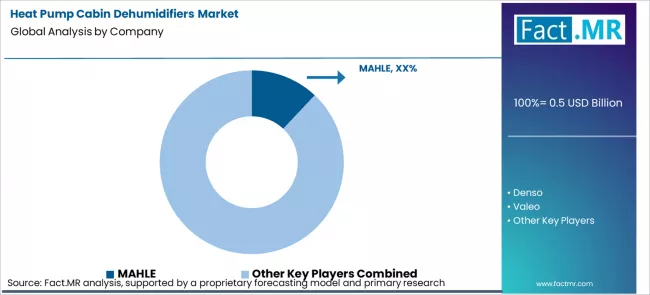
Heat Pump Cabin Dehumidifiers Market Analysis By Company | Source: Fact.MR
As per Fact.MR analysis, the heat pump cabin dehumidifiers market in 2026 is defined by the shift from basic humidity removal modules to integrated thermal management solutions where validated system efficiency, cross domain integration, and original equipment manufacturer (OEM) alignment determine sustainable competitive advantage. MAHLE and Denso leverage deep expertise in heat pump technology and validated dehumidification architectures, which strengthens adoption with global automakers seeking consistent interior climate quality and energy efficiency. Valeo and Hanon Systems emphasise modular integration with air conditioning and heat pump loops, which increases flexibility across vehicle platforms and reduces calibration cycles. Sanden and Eberspächer focus on optimized compressor and vapor compression system interfaces, which improves dehumidification performance under variable load conditions. Bosch and Marelli provide multi domain control frameworks that coordinate thermal, battery, and HVAC subsystems, which enhances overall vehicle energy utilisation. Modine and Gentherm integrate compact heat exchanger designs with validated simulation toolchains, which reduces development risk and supports rapid production readiness. Across the market, system performance validation, integrated architectures, and strong OEM collaborations form enduring competitive moats that outweigh isolated component claims.
Recent Industry Developments
- Eberspaecher to showcase integrated thermal management solutions - At Agritechnica 2025, the company will present its Dualtronic heat pump cabin climate system for electric off-highway vehicles, offering rapid temperature control and energy-efficient heat pump-based cabin conditioning.
- Eberspaecher presents heat pump HVAC technologies at bauma 2025 - The firm announced its Dualtronic heat pump version with low energy consumption and fast window clearing for EV cabins, highlighting energy-efficient cabin air conditioning.
- LG showcases advanced heat pump & HVAC technologies at ISH 2025 - LG Electronics displayed high-efficiency heat pump heat/cooling solutions and HVAC lineup emphasizing energy-efficient climate control at the International Trade Fair (ISH).
Key Players in Heat Pump Cabin Dehumidifiers Market
- MAHLE
- Denso
- Valeo
- Hanon Systems
- Sanden
- Eberspächer
- Bosch
- Marelli
- Modine
- Gentherm
References
- European Parliament & Council of the European Union. (2023). Regulation (EU) 2019/631 setting CO₂ emission performance standards for new passenger cars and vans (consolidated version). Official Journal of the European Union.
- International Organization for Standardization. (2024). ISO 21448: Safety of the Intended Functionality (SOTIF) - Application to vehicle control systems. ISO.
- United Nations Economic Commission for Europe. (2023). UN Regulation No. 155: Cybersecurity and software update requirements (consolidated version). UNECE WP.29.
- Ministry of Industry and Information Technology, Ministry of Finance, & State Taxation Administration. (2023). Announcement No. 32 [2023]: Adjusting the technical requirements for new energy vehicle products eligible for vehicle acquisition tax reduction and exemption. People’s Republic of China.
Segmentation
Scope of the Report
| Items | Values |
|---|---|
| Quantitative Units (2026) | USD 0.53 billion |
| By Dehumidification Type | Heat Pump Assisted, Desiccant-Based, Dedicated Dehumidifier Module, Other |
| By Use Case | Defog / Defrost, Cabin Comfort Humidity Control, Battery / Pack Drying Support, Other |
| By Vehicle Segment | Passenger EVs, Premium / Luxury EVs, LCV EVs, Other |
| By Integration | Integrated HVAC, Standalone Module, Aftermarket, Other |
| Region | Asia Pacific, Europe, North America, Latin America, Middle East & Africa |
| Countries Covered | China, Japan, South Korea, India, Australia & New Zealand, ASEAN, Rest of Asia Pacific, Germany, UK, France, Italy, Spain, Nordic, BENELUX, Rest of Europe, USA, Canada, Mexico, Brazil, Chile, Rest of Latin America, KSA, Other GCC, Turkey, South Africa, Other African Union, Rest of Middle East & Africa |
| Key Companies Profiled | MAHLE, Denso, Valeo, Hanon Systems, Sanden, Eberspächer, Bosch, Marelli, Modine, Gentherm |
| Additional Attributes | Dollar by sales by dehumidification type, use case, vehicle segment, and integration type; validated thermal efficiency; predictive dehumidification control; integration with HVAC and cabin electronics; energy-efficient performance; rapid defog/defrost cycles; adaptive control algorithms; multi-platform compatibility; automated calibration and testing; supply chain efficiency; OEM alignment; deployment in EV, hybrid, and conventional vehicles; operational reliability; regulatory compliance; scalable production; repeatable performance across high-volume assembly lines. |
Source: Fact.MR analysis. Updated Feb 13, 2026
Heat Pump Cabin Dehumidifiers Market Segmentation
-
By Dehumidification Type :
- Heat Pump Assisted
- Desiccant-Based
- Dedicated Dehumidifier Module
- Other
-
By Use Case :
- Defog or Defrost
- Cabin Comfort Humidity Control
- Battery or Pack Drying Support
- Other
-
By Vehicle Segment :
- Passenger EVs
- Premium or Luxury EVs
- LCV EVs
- Other
-
By Integration :
- Integrated HVAC
- Standalone Module
- Aftermarket
- Other
-
Region :
- Asia Pacific
- China
- Japan
- South Korea
- India
- Australia & New Zealand
- ASEAN
- Rest of Asia Pacific
- Europe
- Germany
- United Kingdom
- France
- Italy
- Spain
- Nordic
- BENELUX
- Rest of Europe
- North America
- United States
- Canada
- Mexico
- Latin America
- Brazil
- Chile
- Rest of Latin America
- Middle East & Africa
- Kingdom of Saudi Arabia
- Other GCC Countries
- Turkey
- South Africa
- Other African Union
- Rest of Middle East & Africa
- Asia Pacific
Frequently Asked Questions
How big is the heat pump cabin dehumidifiers market in 2026?
What will be the size of heat pump cabin dehumidifiers market in 2036?
How much will be the heat pump cabin dehumidifiers market growth between 2026 and 2036?
What are the key product types in the heat pump cabin dehumidifiers market?
Which use case segment to contribute significant share in the heat pump cabin dehumidifiers market in 2026?
Who worked on this report


Preview the report firsthand - request a free sample
Free SampleGet the brochure for pricing and purchase details
Download PDF