- Base Value(2025): 3.9 Bn
- Estimated Value(2026): 4.2 Bn
- Forecast Value (2036): 7.3 Bn
- CAGR (2026 - 2036): 5.7%
Pump Jack Market Forecast and Outlook 2026 to 2036
In 2025, the pump jack market was valued at USD 3.9 billion. Based on Fact.MR analysis, demand for pump jacks is estimated to grow to USD 4.2 billion in 2026 and USD 7.3 billion by 2036. FACT.MR projects a CAGR of 5.7% during the forecast period.
The absolute dollar growth from 2026 to 2036 represents an incremental gain of USD 3.1 billion. Growth is sustained by the structural reality that approximately 90% of all producing wells require artificial lift at some stage in their lifecycle, yet it is moderated by the energy transition, oil price volatility, and OPEC+ supply management decisions that cap upstream capital expenditure cycles.
As Travis Stice, the CEO of Diamondback Energy, stated that "It is likely that U.S. onshore oil production has peaked and will begin to decline this quarter. This will have a meaningful impact on our industry and our country."
Country-level CAGR reflects oilfield maturity profiles and energy investment priorities. South Korea leads at 8.9% CAGR, supported by refinery infrastructure upgrades and industrial oil production equipment modernization. The United Kingdom follows at 7.7%, driven by North Sea mature field redevelopment and enhanced recovery mandates under the UK North Sea Transition Deal. Japan registers 7.5% growth anchored by domestic oilfield equipment adoption and industrial maintenance demand. China records 6.9% through continued onshore oil production expansion in Xinjiang and Sichuan basins under state enterprise directives. The United States grows at 6.5%, reflecting steady Permian Basin and Eagle Ford well servicing, moderated by a large installed base of existing pump units requiring replacement and efficiency upgrade rather than net new installation.
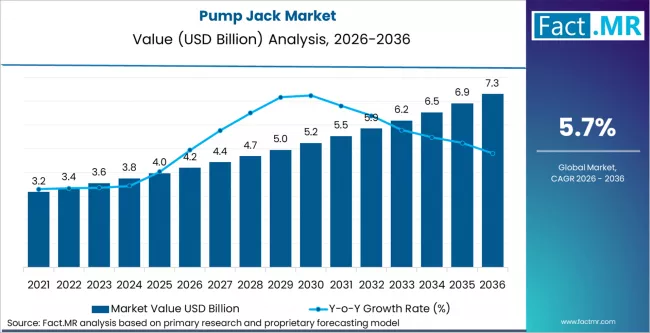
Pump Jack Market Market Value Analysis | Source: Fact.MR
| Metric | Value |
|---|---|
| Estimated Value in 2026 | USD 4.2 billion |
| Forecast Value in 2036 | USD 7.3 billion |
| Forecast CAGR (2026 to 2036) | 5.7% |
Source: Fact.MR analysis. Updated Feb 25, 2026
Market Definition
Market Definition
The pump jack market encompasses the design, manufacture, installation, and servicing of reciprocating surface pump units used to lift crude oil from low-pressure onshore wells. These mechanical systems, widely known as nodding donkeys or beam pumps, convert rotary motor output into vertical reciprocating motion that drives subsurface pump rods and plungers. The market includes electric, conventional, and hydraulic pump jack variants.
Market Inclusions
The report covers global and regional pump jack market size and revenue forecasts from 2026 to 2036, segmented by type, operations mode, capacity, end use, and geography. Analysis includes electric versus conventional adoption curves, automation integration trends, and capacity-tier pricing differentials. Regional breakdowns address North America, Europe, Asia Pacific, Latin America, and the Middle East and Africa, with country-level forecast and market attractiveness scoring.
Market Exclusions
The scope excludes electric submersible pumps (ESPs), progressive cavity pumps (PCPs), and gas lift systems unless directly integrated into pump jack hybrid assemblies. Offshore platform lift equipment and subsea extraction systems are excluded. The report does not cover downstream refining or pipeline pump infrastructure, focusing strictly on surface reciprocating pump units and their immediate servicing and monitoring technologies for onshore production.
Research Methodology
- Primary Research: Structured interviews were conducted with oilfield equipment procurement managers, pump jack service engineers, E&P operations directors, and artificial lift technology specialists across North America, the Middle East, and Asia Pacific.
- Desk Research: Public data sources included U.S. Energy Information Administration (EIA) production statistics, IEA upstream investment reports, SEC filings and earnings transcripts from SLB, Baker Hughes, Halliburton, NOV, and Weatherford International, and national oil company investment disclosures.
- Market-Sizing and Forecasting: A hybrid top-down and bottom-up model was applied. Top-down inputs included global onshore crude oil production volumes and active well counts. Bottom-up inputs incorporated unit pricing by type and capacity tier, replacement cycles, and automation upgrade revenues from primary interviews and company disclosures.
- Data Validation and Update Cycle: Outputs were cross-validated against quarterly earnings guidance from major oilfield equipment suppliers, rig count trends from Baker Hughes, and active well statistics from the EIA. Forecasts are subject to annual review and update upon material shifts in crude price or upstream capital expenditure guidance.
Summary
- Market Definition
- Pump jacks are reciprocating surface lift systems that extract crude oil from mature, low-pressure onshore wells, with the market defined by unit sales, installation, and aftermarket servicing of electric, conventional, and hydraulic pump jack types.
- Demand Drivers
- Accelerating depletion of reservoir pressure in mature North American and Middle Eastern oilfields is increasing reliance on artificial lift solutions, with pump jacks serving as the lowest-cost entry point for well operators managing production declines.
- Growing regulatory pressure to reduce methane emissions and energy consumption at wellheads is driving transition from gas-engine conventional units to electric pump jacks with real-time monitoring and variable frequency drives, expanding per-unit revenue.
- E&P operators in China and Southeast Asia are investing in enhanced oil recovery programs across aging onshore fields, creating new installation demand for pump jacks in basins where reservoir pressure support has become economically mandatory.
- Key Segments Analyzed
- By Type: Electric Pump Jacks hold an estimated 40.2% share in the base year, commanding a premium over conventional units due to lower operating costs, reduced emissions, and compatibility with digital monitoring platforms.
- By Operations: Automated systems lead with an estimated 43.7% share, reflecting operator demand for remote well control, predictive maintenance alerts, and optimization of pump stroke rates without on-site labour.
- By Capacity: The up-to-100 BPD tier holds an estimated 35.2% share, representing the dominant segment for mature stripper well operations across North America and the Middle East where low-rate production from aging reservoirs is the primary use case.
- By End Use: Oil and Gas Industry accounts for an estimated 37% share in the base year, reflecting the market's core dependence on upstream crude production servicing as its primary commercial driver.
- By Geography: North America remains the largest regional market, with the United States anchoring demand through the Permian Basin, Eagle Ford, and Bakken shale plays, while Asia Pacific emerges as the fastest-growing region.
- Analyst Opinion at FACT.MR
- Shambhu Nath Jha, Principal Consultant at Fact.MR, opines, “CXOs will find this report essential for understanding how the shift from mechanical to electric and automated pump jack architectures is reshaping supplier economics. Digitally capable manufacturers are capturing significant aftermarket monitoring revenues as a result of this transition.
- Strategic Implications
- Pump jack manufacturers should accelerate integration of variable frequency drives and IoT connectivity into product lines to capture the aftermarket monitoring and optimization revenue that increasingly differentiates digital-capable suppliers from commodity mechanical competitors.
- Service providers should develop field electrification bundling strategies targeting gas-engine pump jack replacement, leveraging the EPA's methane regulations and state-level emissions mandates as conversion catalysts in North American onshore basins.
- Distributors and regional service companies in Asia Pacific should position for the anticipated volume growth in China's Xinjiang and Sichuan basins by establishing local maintenance partnerships with national oil companies rather than relying solely on export logistics models.
- Methodology
- Market sizing combined active onshore well counts with pump jack penetration rates and average unit pricing across type and capacity tiers, validated against revenue disclosures from SLB, Halliburton, and Weatherford International.
- Automation and electric adoption curves were benchmarked against published programme data from Baker Hughes and NOV artificial lift divisions and Permian Basin Operator CapEx guidance.
- Regional forecasts incorporated crude oil production growth projections from the IEA World Energy Outlook 2024, supplemented by country-level national energy investment plans and E&P operator procurement disclosures.
Segmental Analysis
Pump Jack Market Analysis by Type
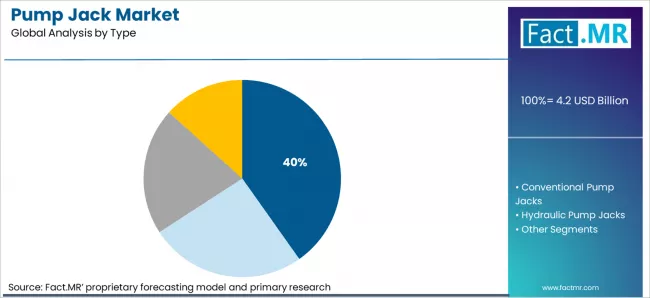
Pump Jack Market Analysis By Type | Source: Fact.MR
According to Fact.MR, electric pump jacks are expected to account for 40.2% of the market in 2026. Their dominance stems from eliminating fuel costs and emissions associated with gas engines, while enabling integration with variable frequency drives and remote monitoring systems. For operators managing large well portfolios, the operational savings over a 10-year lifecycle outweigh the higher upfront cost.
- SLB-ChampionX Artificial Lift Integration: SLB completed its acquisition of ChampionX in September 2025, integrating artificial lift systems into its Production Systems division. The deal is projected to generate approximately $400 million in annual pretax synergies within three years, with electric pump jacks and digital solutions central to the combined portfolio. [1]
- NOV Extract Acquisition for ESP and Pump Technology: In January 2024, NOV acquired Extract to expand its artificial lift portfolio, particularly in electric submersible pump technology. The move strengthens NOV’s ability to offer integrated electric-drive pump jack and ESP solutions for multi-well pad operations. [5]
- Flowco Valiant ESP Acquisition for Permian Expansion: In February 2026, Flowco Holdings announced a $200 million agreement to acquire Valiant Artificial Lift Solutions, expanding into ESP applications that complement its pump jack and plunger lift offerings across key North American basins. [6]
Pump Jack Market Analysis by Operations
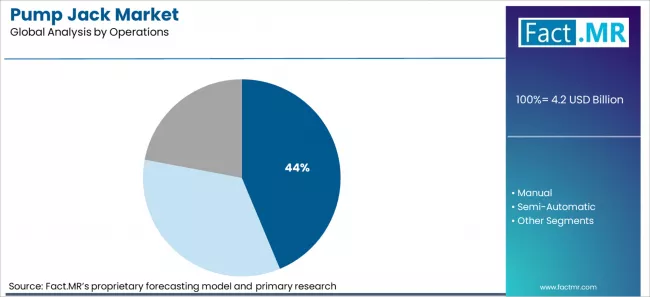
Pump Jack Market Analysis By Operations | Source: Fact.MR
Fact.MR estimates automated pump jacks will hold 43.7% market share in 2026. Automation is increasingly essential as operators manage 50 to 500 wells with lean field teams. Remote monitoring and automated stroke optimization reduce labor intensity and improve uptime, making manual systems less viable at scale.
- Flowco Monitoring Platform Deployment: Flowco Production Solutions launched a multi-well controller capable of managing up to 16 wells across different lift technologies, aligning with the shift toward centralized and automated operations.
- Baker Hughes Artificial Lift Digital Expansion: Baker Hughes has expanded its AEVITAS digital artificial lift platform, using machine learning to optimize pump jack performance and predict failures. The system is deployed in mature basins including the Permian and North Sea. [7]
- Industrial IoT Penetration in Oilfield Equipment: EIA data indicates a significant rise in remote monitoring adoption across U.S. onshore wells, driven by labor optimization and ESG reporting requirements. This structural shift continues to support automated pump jack penetration regardless of short-term oil price volatility. [2]
Drivers, Restraints, and Opportunities
Fact.MR analysis shows that the pump jack market has historically moved in close alignment with onshore crude production and mature field depletion trends. Today’s USD 3.9 billion valuation reflects more than six decades of installed equipment across North America, the former Soviet Union, the Middle East, and China.
The key shift underway is from conventional mechanical beam pumps to electric and digitally automated systems. While many legacy units are fully depreciated, environmental regulations such as EPA methane reporting rules, tighter state-level emissions standards, and corporate decarbonization goals are accelerating the retirement of gas-engine units.
- Mature Field Artificial Lift Dependency: The U.S. EIA reports that domestic crude production from onshore low-productivity wells remained above 4 million barrels per day through 2024, reinforcing continued reliance on pump jacks. At the same time, IEA data shows global upstream spending on maintenance and enhanced recovery increased by roughly 8% in 2024, directly supporting replacement and upgrade cycles.
- EPA Methane Regulation Conversion Catalyst: The EPA’s Subpart OOOOb methane regulations, effective November 2024, introduced stricter monitoring and emissions standards for wellsite equipment, including gas-engine pump jacks. This has accelerated replacement cycles in basins such as the Permian and DJ, benefiting electric pump jack and digital monitoring suppliers. [3]
- Asia Pacific Production Infrastructure Build-Out: China’s 2024 national energy work report highlights sustained investment in mature oilfields such as Daqing, Xinjiang, and Sichuan, all heavily dependent on artificial lift. Ongoing procurement tenders from CNPC and Sinopec provide a stable demand pipeline relatively insulated from global oil price volatility. [4]
Regional Analysis
The pump jack market is analysed across North America, Europe, Asia Pacific, Latin America, and Middle East and Africa, with each region assessed by active well count, artificial lift penetration rates, and investment in automation and electric conversion. Country-level coverage includes the United States, United Kingdom, Japan, China, and South Korea. The full report provides market attractiveness analysis benchmarked against oilfield maturity, regulatory environment, and digital infrastructure readiness.
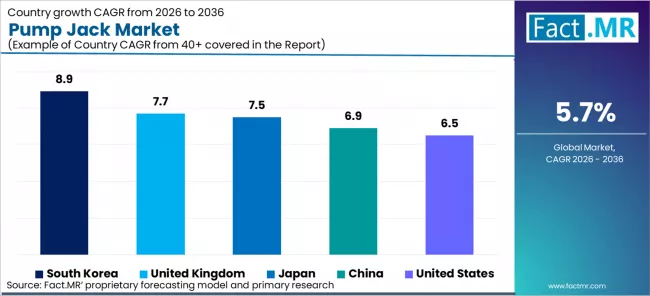
Pump Jack Market Cagr Analysis By Country | Source: Fact.MR
| Country | CAGR (2026-2036) |
|---|---|
| South Korea | 8.9% |
| United Kingdom | 7.7% |
| Japan | 7.5% |
| China | 6.9% |
| United States | 6.5% |
Source: Fact.MR analysis. Updated Feb 25, 2026
Source: Fact.MR (FACT.MR) analysis, based on proprietary forecasting model and primary research
Asia Pacific Pump Jack Market Analysis
Asia Pacific is the fastest growing region in the global pump jack market. Growth is driven by government backed investment in mature oilfields, rising energy security priorities, and national oil company mandates to sustain production from aging onshore basins. Companies such as CNPC, Sinopec, INPEX, and Korea National Oil Corporation are expanding artificial lift programs, creating steady procurement demand that is less exposed to short term oil price swings.
- South Korea: Demand for pump jacks in South Korea is projected to rise at 8.9% CAGR through 2036. Growth is supported by KNOC’s continued investment in overseas oil assets that require artificial lift, along with domestic modernization programs in oil production and refining. The Ministry of Trade, Industry and Energy’s 2024 roadmap includes support for smart oilfield equipment, encouraging adoption of automated pump jack systems. Strong local engineering capabilities also support domestic manufacturing participation.
- Japan: Demand for pump jacks in Japan is projected to rise at 7.5% CAGR through 2036. INPEX continues to invest in artificial lift for mature assets, while JOGMEC supports domestic oilfield productivity initiatives. METI’s 2024 energy guidelines prioritize maximizing output from existing fields, creating a steady replacement and upgrade cycle. Additional demand from industrial water and geothermal applications provides diversification beyond upstream oil and gas.
- China: Demand for pump jacks in China is projected to rise at 6.9% CAGR through 2036. CNPC and Sinopec operate one of the world’s largest installed bases across Daqing, Shengli, and Xinjiang oilfields. China’s 2024 energy work program emphasizes higher domestic crude output, supporting artificial lift modernization.
FACT.MR’s Asia Pacific analysis covers South Korea, Japan, China, Australia and New Zealand, India, ASEAN, and Rest of Asia Pacific, with detailed insights into procurement trends and artificial lift programs.
Europe Pump Jack Market Analysis
Europe’s pump jack market is concentrated in the United Kingdom North Sea, Norway, and selected Eastern European onshore fields. The region is shaped by strict emissions regulations, decommissioning programs, and a strong push toward electrification as part of net zero commitments. Major service providers such as Weatherford and Halliburton maintain artificial lift operations across the region.
- United Kingdom: Demand for pump jacks in the United Kingdom is projected to rise at 7.7% CAGR through 2036. The North Sea Transition Deal requires significant emissions intensity reductions by 2030, encouraging operators to replace gas engine systems with electric alternatives. Government data confirms continued revenue from oil and gas production, supporting ongoing investment despite the energy transition.
FACT.MR’s European analysis covers the United Kingdom, Norway, Germany, France, Spain, Netherlands, Nordics, and Rest of Europe, including emissions compliance timelines and artificial lift investment strategies.
North America Pump Jack Market Analysis
North America is the largest revenue generating region for pump jacks globally, supported by extensive mature fields in the Permian Basin, Eagle Ford, Bakken, and Midcontinent. The market is led by major service companies including SLB, Halliburton, Weatherford, and NOV. Competition is increasingly centered on digital platforms and service contract consolidation to manage large multi well portfolios more efficiently.
- United States: Demand for pump jacks in the United States is projected to rise at 6.5% CAGR through 2036. The country has roughly 400,000 active artificial lift wells, most of which use beam pump systems. EPA methane regulations effective November 2024 are accelerating conversion from gas engine units to electric alternatives, particularly in the Permian and DJ basins.
FACT.MR’s North American analysis covers the United States, Canada, and Mexico, with insights into regulatory timelines, basin level investment trends, and electric pump jack adoption benchmarks.
Competitive Aligners for Market Players
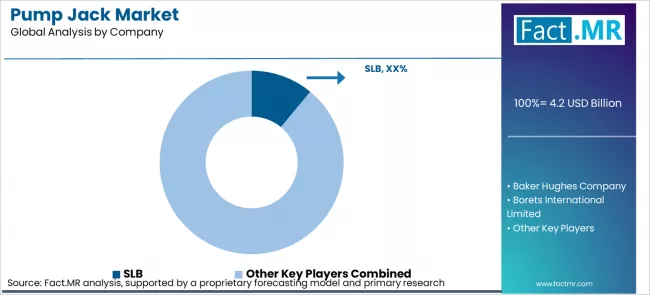
Pump Jack Market Analysis By Company | Source: Fact.MR
The global pump jack market is moderately concentrated at the technology and integrated services level. SLB following its ChampionX acquisition, Halliburton, Baker Hughes through Lufkin, NOV, and Weatherford account for a large share of premium artificial lift revenues. At the manufacturing level, however, the market is far more fragmented, with many regional suppliers in the United States, China, and the Middle East competing mainly on price. In the premium segment, digital capability is the key differentiator.
Companies that can offer real time monitoring, predictive maintenance, and automated optimization within bundled service contracts hold a clear advantage over equipment only suppliers. Firms with vertical integration across manufacturing, field services, and digital platforms are best positioned. SLB combines artificial lift hardware, production chemistry, and digital technologies under unified contracts.
Baker Hughes integrates controller systems with pump jack hardware, strengthening long term service ties. Halliburton leverages its global well services network to deliver integrated lift programs. While large E and P operators use multi supplier strategies to manage pricing, digital platforms increasingly create switching costs that favor technology driven providers over commodity manufacturers.
Recent Development
- In 2025, Baker Hughes announced that it will supply advanced artificial lift solutions to enhance production capability in Kuwait Oil Company’s fields, reflecting expansion of product offerings in electric and digital lift systems.
- In 2024, Weatherford revealed its acquisition of Datagration Solutions, aimed at enhancing its integrated data, analytics, and machine learning capabilities to support improved well lifecycle decision making.
Key Players
- SLB
- Baker Hughes Company
- Borets International Limited
- Dover Corporation
- Halliburton Company
- Lufkin Industries LLC
- NOV Inc.
- Tenaris S.A.
- Weatherford International plc
- Flowco Production Solutions
Bibliography
- [1] SLB. (2025, September). SLB Completes Acquisition of ChampionX. SLB Newsroom and Investor Relations.
- [2] U.S. Energy Information Administration (EIA). (2024). Petroleum and Other Liquids: Crude Oil Production. Monthly Energy Review.
- [3] U.S. Environmental Protection Agency (EPA). (2024, November). Oil and Natural Gas: Subpart OOOOb Methane Emission Standards. Federal Register Final Rule.
- [4] International Energy Agency (IEA). (2024). World Energy Outlook 2024: Upstream Investment and Production Outlook. IEA Publications.
- [5] NOV Inc. (2024, January). NOV Announces Acquisition of Extract to Strengthen Artificial Lift Portfolio. NOV Newsroom and Investor Relations.
- [6] Flowco Holdings Inc. (2026, February). Flowco Broadens Production Optimization Portfolio Through Strategic Acquisition of Valiant. Business Wire.
- [7] Baker Hughes Company. (2024). Lufkin Artificial Lift and AEVITAS Digital Platform: Production Optimisation for Mature Fields. Baker Hughes Product and Technology Disclosures.
This Report Addresses
- Market intelligence to enable structured strategic decision making across oilfield equipment procurement and artificial lift programme planning for E&P operators, OFS companies, and investors.
- Market size estimation and 10-year revenue forecasts from 2026 to 2036, supported by active well count analysis, unit pricing benchmarks, and upstream capital expenditure guidance from major E&P operators.
- Growth opportunity mapping across electric and automated pump jack adoption, with emphasis on the regulatory and economic drivers converting conventional gas-engine units in North American and European mature fields.
- Segment and regional revenue forecasts covering type, operations mode, capacity tier, end use industry, and country-level demand, with market attractiveness scoring across all covered geographies.
- Competition strategy assessment including vertical integration models, digital monitoring platform differentiation, multi-year service contract economics, and competitive positioning of SLB, Halliburton, Baker Hughes, NOV, Weatherford, and Flowco.
- Product and technology tracking covering electric pump jack VFD integration, IoT monitoring platform adoption, and automated stroke rate optimisation systems across major supplier product lines.
- Regulatory impact analysis covering EPA methane emission rules, North Sea Transition Deal compliance programmes, and national oil company procurement mandates that are reshaping artificial lift equipment purchasing decisions.
- Market report delivery in PDF, Excel, PowerPoint, and interactive dashboard formats for executive strategy, investor relations, and operational planning teams.
Segmentation
Scope of Report
| Items | Values |
|---|---|
| Quantitative Units | USD 4.2 billion (2026) to USD 7.3 billion (2036), at a CAGR of 5.7% |
| Market Definition | The pump jack market encompasses the design, manufacture, installation, and servicing of reciprocating surface pump units used to lift crude oil from low-pressure onshore wells. |
| Type Segmentation | Electric Pump Jacks, Conventional Pump Jacks, Hydraulic Pump Jacks, Others |
| Operations Segmentation | Automated, Manual, Semi-Automatic |
| Capacity Segmentation | Up to 100 BPD, 100 to 500 BPD, 500 to 1,000 BPD, Above 1,000 BPD |
| End Use Coverage | Oil and Gas Industry, Mining Industry, Agriculture, Others |
| Distribution Channel | Direct, Indirect |
| Regions Covered | North America, Latin America, Europe, East Asia, South Asia & Pacific, Middle East & Africa |
| Countries Covered | United States, Canada, Mexico, Brazil, Argentina, United Kingdom, Germany, France, Italy, Spain, China, Japan, South Korea, India, ASEAN, Australia & New Zealand and 40 plus countries |
| Key Companies Profiled | SLB, Baker Hughes Company, Borets International Limited, Dover Corporation, Halliburton Company, Lufkin Industries LLC, NOV Inc., Tenaris S.A., Weatherford International plc, Flowco Production Solutions |
| Forecast Period | 2026 to 2036 |
| Approach | Hybrid top-down and bottom-up market modeling triangulating installed base replacement cycles, electrification retrofit rates, and automation attach ratios, validated through primary interviews with OEMs, upstream operators, and publicly traceable upstream activity data. |
Source: Fact.MR analysis. Updated Feb 25, 2026
Pump Jack Market by Segment
-
Type
- Electric Pump Jacks
- Conventional Pump Jacks
- Hydraulic Pump Jacks
- Others
-
Operations
- Automated
- Manual
- Semi-Automatic
-
Capacity
- Up to 100 BPD
- 100 to 500 BPD
- 500 to 1,000 BPD
- Above 1,000 BPD
-
End Use
- Oil and Gas Industry
- Mining Industry
- Agriculture
- Others
-
Region
- North America
- United States
- Canada
- Mexico
- Europe
- United Kingdom
- Germany
- France
- Norway
- Spain
- Netherlands
- Nordics
- Rest of Europe
- Asia Pacific
- China
- Japan
- South Korea
- India
- Australia and New Zealand
- ASEAN
- Rest of Asia Pacific
- Latin America
- Brazil
- Argentina
- Colombia
- Rest of Latin America
- Middle East and Africa
- Kingdom of Saudi Arabia
- United Arab Emirates
- Iraq
- South Africa
- Rest of Middle East and Africa
- North America
Frequently Asked Questions
How large is the pump jack market in 2026?
What will the market size be by 2036?
What is the expected CAGR for the pump jack market from 2026 to 2036?
Which type segment is poised to lead the pump jack market?
Which operations segment holds the largest share?
How significant is the oil and gas industry end use segment?
What is the expected growth rate of the pump jack market in the United Kingdom?
How fast is Japan’s pump jack market expected to grow during the forecast period?
What is the anticipated CAGR for China’s pump jack market?
What growth rate is forecast for the United States pump jack market?
What is the growth outlook for South Korea?
What is excluded from the pump jack market scope?
Who worked on this report


Preview the report firsthand - request a free sample
Free SampleGet the brochure for pricing and purchase details
Download PDF