
- Market Value (2025): USD 278.6 Mn
- Estimated Value (2026): USD 300.0 Mn
- Forecast Value (2036): USD 629.9 Mn
- CAGR (2026-2036): 7.7%
High-Energy-Efficiency Mixers Market Forecast and Outlook 2026 to 2036
According to the Fact.MR analysis, the high-energy-efficiency mixers market crossed the valuation of USD 278.6 million in 2025 and is projected to grow from USD 300.0 million in 2026 to USD 629.9 million by 2036. Demand for high-energy-efficiency mixers is likely to grow at a CAGR of 7.7% over the forecast period.
Demand for high-energy-efficiency mixers is rising as food plants cut electricity use in blending doughs, powders, seasonings and batters. Efficient mixers use better impeller design, premium-efficiency motors and variable-speed drives to blend faster with less power. For example, EU Ecodesign rules for electric motors (Regulation (EU) 2019/1781) required IE3 efficiency for most motors from 2021 and IE4 for many larger motors from July 2023. Similar efficiency rules are projected to drive sales of high-energy-efficiency mixers through 2036.
Key Takeaways from the High-Energy-Efficiency Mixers Market
- High-Energy-Efficiency Mixers Market Value (2025): USD 278.6 million
- High-Energy-Efficiency Mixers Market Value (2026): USD 300.0 million
- High-Energy-Efficiency Mixers Market Forecast Value (2036): USD 629.9 million
- High-Energy-Efficiency Mixers Market Forecast CAGR (2026-2036): 7.7%
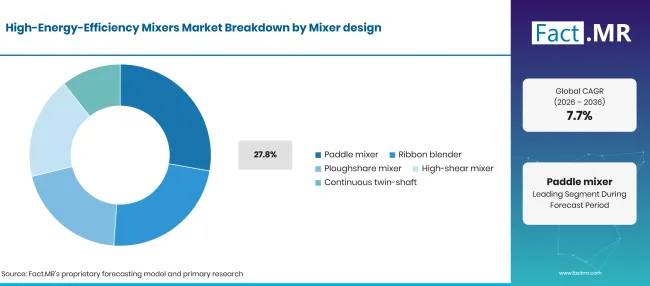
- Leading Mixer design: Paddle mixer (27.8%)
- Key Market Participants: GEA, JBT Marel, Silverson Machines, Bühler, Baker Perkins, IKA
- Key Growth Regions: United States, China, Italy, Germany, Japan
In January 2025, JBT completed its acquisition of Marel, creating a larger supplier of food processing equipment that includes mixing and grinding. Demand for high-energy-efficiency mixers is growing as processors buy complete lines from fewer suppliers. Suppliers are offering energy data with each mixer. Similar consolidation is projected to shape sales of high-energy-efficiency mixers worldwide.
High-Energy-Efficiency Mixers Market
| Metric | Value |
|---|---|
| Estimated Value in (2026) | USD 300.0 million |
| Forecast Value in (2036) | USD 629.9 million |
| Forecast CAGR (2026 to 2036) | 7.7% |
Source: Fact.MR analysis.
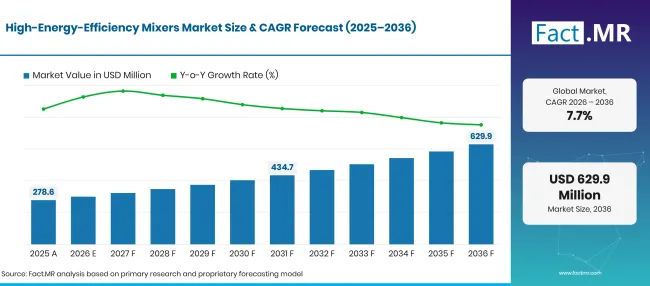
High Energy Efficiency Mixers Forecast Global | Source: Fact.MR
Category
| Category | Segments |
|---|---|
| Mixer design | Ribbon blender, Paddle mixer, Ploughshare mixer, High-shear mixer, Continuous twin-shaft |
| Processing scale | Pilot / lab, Small commercial, Mid-scale, High-throughput, Ultra-high-throughput |
| Operating configuration | Batch, Semi-continuous, Continuous, Modular skid, Integrated line |
| Food / process application | Bakery / wafers, Confectionery / cocoa, Snacks / seasoning, Brewing / grains, Other food / industrial |
| Region | United States; China; Italy; Germany; Japan |
Source: Fact.MR analysis.
Segmental Analysis
What makes paddle mixers the preferred design for energy-efficient mixing demand?
High Energy Efficiency Mixers Breakdown Mixer Design | Source: Fact.MR
Demand for paddle mixers hold a 27.8% revenue share in 2026, about USD 83.4 million, as food processors seek uniform blending without excessive energy consumption or damage to delicate ingredients. This demand is supported by India's expanding food manufacturing base. According to the Government of India's June 2026 update, investments under the Production Linked Incentive Scheme have created 34 lakh metric tonnes per annum of additional food processing capacity. Higher processing volumes are encouraging equipment buyers to consider energy-efficient paddle mixers for seasoning, ingredient preparation and bulk blending.
Which factors are strengthening high-throughput mixer sales across large-scale processing facilities?
High Energy Efficiency Mixers Breakdown Processing Scale | Source: Fact.MR
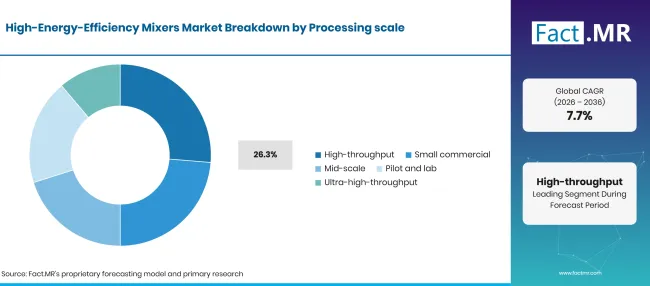
Sales of high-throughput mixer segment captures 26.3% of market revenue in 2026, reaching USD 78.9 million, as large food manufacturing facilities prioritize higher batch volumes and lower energy consumption per tonne. India's Index of Industrial Production, published by the Ministry of Statistics and Programme Implementation, recorded a food products manufacturing index of 105.1 in September 2026, compared with 97.5 in September 2025. This increase indicates stronger manufacturing activity and reinforces the need for high-capacity mixing equipment that can support extended production schedules.
How is semi-continuous processing creating additional demand for energy-efficient mixers?
High Energy Efficiency Mixers Breakdown Operating Configuration | Source: Fact.MR
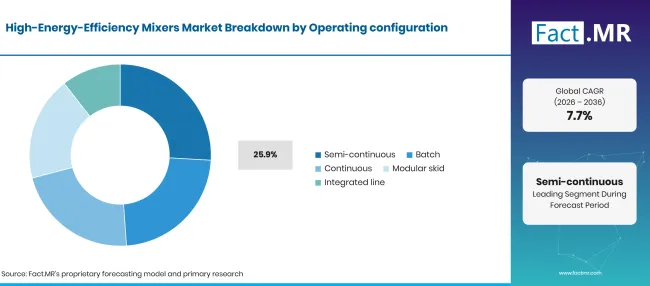
Demand for semi-continuous operation represents 25.9% of revenue in 2026, about USD 77.7 million, as manufacturers increasingly coordinate repeated mixing batches with downstream processing and packaging operations. Government data published in 2026 shows that 1,256 food processing and post-harvest infrastructure projects had been completed or become operational under PMKSY by June 2026. The resulting expansion in processing infrastructure creates opportunities for mixers that integrate with ingredient dosing, material transfer and automated production systems.
What is driving snack and seasoning applications to generate the highest mixer demand?
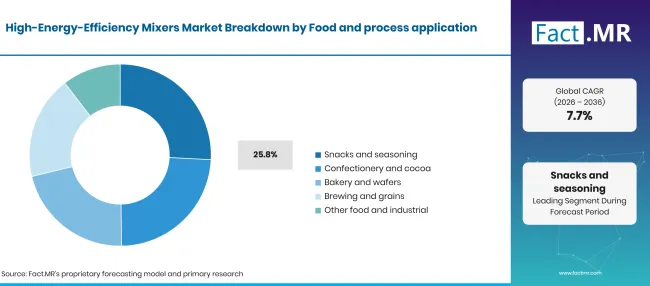
High Energy Efficiency Mixers Breakdown Food And Process Application | Source: Fact.MR
Snacks and seasoning applications account for 25.8% of market revenue in 2026, about USD 77.4 million, supported by recurring requirements for blending spice powders, seasoning coatings, snack ingredients and dough preparations. India's processed food exports reached USD 8.03 billion in FY 2025–26, according to APEDA, with cereal preparations contributing USD 1.01 billion and miscellaneous preparations generating USD 1.49 billion. These export categories cover products beyond snacks alone, but demonstrate the commercial scale of processed food manufacturing that supports demand for efficient industrial mixing equipment.
High-Energy-Efficiency Mixers Market-Drivers, Restraints & Trends
Drivers: Growing Industrial Focus on Energy Efficiency
Demand for high-energy-efficiency mixers is increasing as manufacturers seek to reduce electricity consumption and improve production efficiency. Industrial decarbonization targets are encouraging processors to invest in energy-efficient motors, optimized drive systems and automated mixing equipment. According to India's Ministry of Statistics and Programme Implementation, the Annual Survey of Industries 2024–25, released in September 2026, recorded 10.54% growth in fixed capital and 7.81% growth in industrial output across registered manufacturing establishments. Additionally, India's National Mission for Enhanced Energy Efficiency dashboard reported ₹76,485 crore in investments mobilized for industrial energy efficiency as of September 2026. These developments indicate stronger industrial investment in efficient production technologies, supporting demand for mixers with lower energy requirements.
Restraints: Long Replacement Cycles of Existing Mixing Equipment
Sales of high-energy-efficiency mixers faces limitations from the long operating life and replacement costs associated with existing industrial mixing equipment. Manufacturers may continue using conventional mixers when their equipment remains operational, delaying investments in new energy-efficient systems. Retrofitting motors, installing variable-frequency drives and upgrading control systems can provide alternatives to complete equipment replacement. India's Annual Survey of Industries 2024–25, released in September 2026, recorded 10.54% growth in fixed capital, indicating continued investment in manufacturing assets. The financial commitment involved in replacing machinery, alongside the availability of existing equipment, can encourage processors to prioritize selective upgrades rather than purchasing entirely new mixing systems.
Opportunity: Increasing Adoption of Variable-Speed Drive Retrofits
Demand for variable-speed drive retrofits is increasing as manufacturers seek to improve the energy performance of existing mixing equipment without replacing complete systems. Variable-frequency drives allow operators to adjust motor speeds according to batch requirements, reducing unnecessary electricity consumption during mixing operations. India's Ministry of Statistics and Programme Implementation reported that manufacturing output increased by 9.0% year over year in August 2026. The same release recorded 30.9% growth in electrical equipment manufacturing, indicating expanding activity in an important equipment supply category. Furthermore, the U.S. Department of Energy identifies adjustable-speed drives as an industrial energy-saving opportunity, particularly for applications requiring variable operating speeds. These developments support opportunities for retrofit-compatible motors and drive packages.
Trend: Growing Integration of Mixing Data and Recipe Control
Demand for high-energy-efficiency mixers with digital monitoring and recipe-control capabilities is increasing as processors seek better visibility into batch performance and electricity consumption. Manufacturers are integrating sensors, programmable controls and monitoring systems to record mixing duration, motor loads and operating conditions. Such capabilities help operators identify inefficient production cycles and maintain consistent product quality. India's Ministry of Statistics and Programme Implementation released Energy Statistics India 2026 in March 2026, incorporating industry-level electricity consumption data using Annual Survey of Industries information. This development highlights the growing importance of detailed industrial energy measurement. Additionally, India's National Mission for Enhanced Energy Efficiency reported 1,333 designated consumers under the Perform, Achieve and Trade framework as of September 2026, reinforcing industrial energy-management priorities
High-Energy-Efficiency Mixers Market by Analysis by Key Country
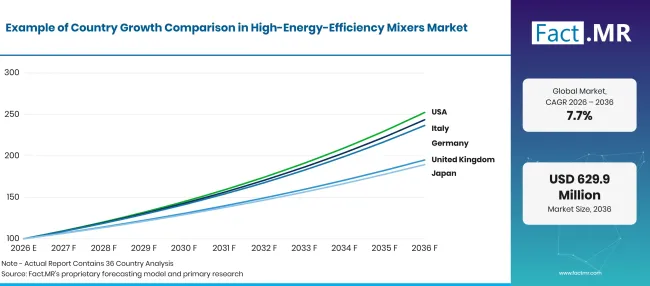
High Energy Efficiency Mixers Growth Index | Source: Fact.MR
| Country | CAGR (2026-2036) |
|---|---|
| United States | 9.7% |
| China | 9.3% |
| Italy | 9.2% |
| Germany | 9.0% |
| Japan | 6.6% |
Source: Fact.MR analysis.
Why is the United States the fastest-growing market for high-energy-efficiency mixers?
Demand in the United States is estimated to record at a 9.7% CAGR, the fastest among the five key countries, as snack and bakery makers expand plants and utility rebate programs support efficient motors and drives.
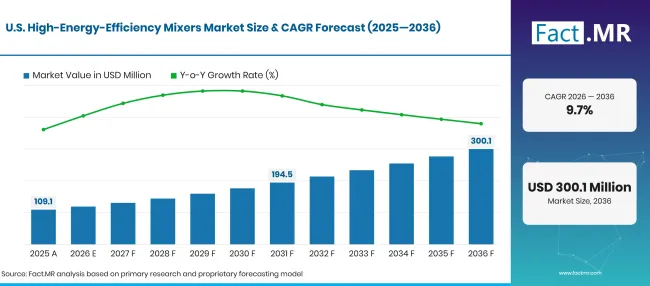
High Energy Efficiency Mixers Forecast Usa | Source: Fact.MR
The Federal Reserve reported that food, beverage and tobacco manufacturing capacity utilization reached 77.6% in October 2026. Overall U.S. industrial production increased 2.1% year over year during the same month. These manufacturing conditions support demand for efficient mixing systems, particularly among food processors seeking to improve equipment utilization and control electricity consumption
What is driving high-energy-efficiency mixer demand in China?
Sales in China are projected to increase at a 9.3% CAGR as standard GB 18613-2020 raised minimum efficiency for small and medium motors, and food plants expand capacity for prepared meals.
Mixer suppliers are fitting high-efficiency motors and variable-speed drives to meet the standard. China's National Bureau of Statistics reported that food manufacturing capacity utilization reached 70.8% in the third quarter of 2026, increasing 0.7 percentage points year over year. Manufacturing capacity utilization stood at 73.3%. Continued utilization of industrial processing capacity creates opportunities for mixer suppliers offering high-efficiency motors and variable-speed drives.
How are industrial incentives influencing high-energy-efficiency mixer demand in Italy?
Demand in Italy is estimated to grow at a 9.2% CAGR as pasta, bakery and confectionery producers upgrade equipment under national industrial incentives.
Transizione 5.0 tax credits reward investments that cut energy use, and Barilla and other producers are upgrading lines. According to Istat's November 2026 industrial production report, food, beverage and tobacco manufacturing output increased 1.2% month over month in September 2026, although it declined 1.8% year over year. This mixed performance highlights the importance of productivity improvements and operating-cost management. Efficient mixers with optimized motors and automated controls can support these objectives.
What is shaping high-energy-efficiency mixer demand in Germany?
Demand in Germany is anticipated to represent a 9.0% CAGR as the Energy Efficiency Act requires large users to act on audits.
Rules adopted in 2023 require firms using over 7.5 GWh a year to run energy management systems, and mixers with efficient drives help meet savings plans. Destatis reported in November 2026 that German industry consumed 3,248 petajoules of energy in 2025, representing a 2.9% decline from 2024. The Energy Efficiency Act also requires companies with average annual energy consumption exceeding 7.5 GWh over the preceding three years to establish an energy or environmental management system. These requirements encourage manufacturers to evaluate efficient motors, variable-speed drives and lower-energy mixing equipment.
Why is high-energy-efficiency mixer growth slower in Japan?
Demand in Japan is projected to grow at a 6.6% CAGR, the slowest among the five key countries, as plants already use efficient equipment and food output is flat as the population declines.
Top Runner efficiency standards for motors have kept the installed base efficient. Japan's Statistics Bureau estimated the country's population at 122.85 million on June 1, 2026, representing a decline of 530,000 people, or 0.43%, from the previous year. A shrinking domestic population can constrain long-term food consumption growth, limiting expansion opportunities for some processing facilities. Equipment replacement and energy-saving upgrades are therefore important sources of future mixer demand.
Competitive Landscape for High-Energy-Efficiency Mixers Market
The high-energy-efficiency mixers market is characterized by competition between integrated processing equipment manufacturers and specialized mixing technology suppliers. GEA, Bühler and JBT Marel compete through industrial mixing systems, integrated processing lines and process automation solutions. Baker Perkins focuses on specialized mixing equipment for bakery and food applications, while Silverson Machines and IKA strengthen competition through high-shear mixing, dispersion and homogenization technologies. These manufacturers differentiate their offerings through motor efficiency, processing speed, mixing consistency, equipment flexibility and reduced operating requirements.
Competition is increasingly influenced by manufacturers' efforts to improve energy performance without compromising product quality or production throughput. Suppliers are emphasizing optimized mixing cycles, variable-speed operation, automated process controls and equipment configurations that reduce unnecessary processing time. Buyers increasingly consider lifecycle operating costs, cleanability, maintenance requirements and technical support when selecting equipment. Manufacturers with application-specific engineering capabilities and measurable energy-performance improvements are better positioned to secure industrial contracts.
The competitive landscape also reflects differences in application expertise and equipment design. GEA emphasizes variable-speed twin-shaft mixing and automated process integration, while JBT Marel offers programmable industrial mixers with capacities ranging from 500 to 7,000 liters. Bühler competes through rapid batch mixing and integrated processing technologies. Silverson Machines and IKA target customers requiring precise high-shear dispersion and homogenization, whereas Baker Perkins serves specialized food-processing applications.
Recent Developments
- On November 4, 2025, Bühler introduced CompactMix, a new integrated mixing and grinding system for chocolate, confectionery spreads, fillings and coatings. The equipment combines the ShearMix mixing system, spiral agitator and Aurora ball mill to deliver consistent particle sizes below 20 microns. According to Bühler, CompactMix consumes up to 30% less energy than conventional models. Its modular production capacity ranges from 400 kg/h to 3,000 kg/h, making it suitable for different industrial production requirements.
- On May 7, 2026, At Interpack 2026, Bühler announced improvements to its food-processing portfolio, including an upgraded ELK S Edition 26 single-shaft conche with enhanced automation, hygiene and production efficiency. The company also highlighted CompactMix as part of its energy-efficient processing portfolio.
- In January 2025, JBT completed its acquisition of Marel on January 2, 2025, combining two food-processing technology businesses under JBT Marel Corporation. The transaction brought together complementary equipment portfolios, processing technologies and global service capabilities. JBT Marel subsequently expanded its integrated food-processing solutions, including automated mixing lines for frozen and individually quick-frozen (IQF) food applications.
Key Players in High-Energy-Efficiency Mixers Market
Key companies operating in the market include GEA, Bühler, JBT Marel, Baker Perkins, Silverson Machines, and IKA.
- GEA
- Bühler
- JBT Marel
- Baker Perkins
- Silverson Machines
- IKA
Bibliography
- Bureau of Energy Efficiency. (2026, October 1). Perform, Achieve and Trade (PAT) objective. Ministry of Power, Government of India.
- Bühler Group. (2025, November 4). Bühler introduces CompactMix – Precision, flexibility, and energy efficiency for delicious results.
- Federal Reserve Board. (2026, November 17). Industrial production and capacity utilization: G.17 (Table 7).
- Statistisches Bundesamt (Destatis). (2026, November 16). Energieverbrauch der Industrie 2025 um 2,9 % gesunken [Industrial energy consumption decreased by 2.9% in 2025].
- Istituto Nazionale di Statistica. (2026, November 11). Produzione industriale – Settembre 2026 [Industrial production – September 2026].
- JBT Marel Corporation. (2025, January 2). JBT Corporation completes settlement of its voluntary takeover offer of Marel hf. and commences trading as JBT Marel Corporation.
- Ministry of Statistics and Programme Implementation. (2026, November 4). Annual Survey of Industries (ASI) 2024–25: Press note on detailed publications and summary results. Government of India.
- Ministry of Statistics and Programme Implementation. (2026, March 30). Release of publication “Energy Statistics India 2026”. Government of India.
- National Bureau of Statistics of China. (2026, October 20). Industrial capacity utilization rate in the third quarter of 2026.
- Statistics Bureau of Japan. (2026, June 19). Population estimates: June 2026. Ministry of Internal Affairs and Communications, Government of Japan.
Segmentation
Scope of Report
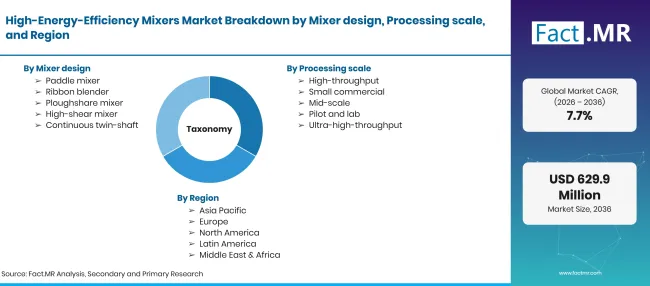
High Energy Efficiency Mixers Taxonomy | Source: Fact.MR
| Items | Values |
|---|---|
| Quantitative Units (2026) | USD 300.0 Million |
| Mixer design | Ribbon blender, Paddle mixer, Ploughshare mixer, High-shear mixer, Continuous twin-shaft |
| Processing scale | Pilot / lab, Small commercial, Mid-scale, High-throughput, Ultra-high-throughput |
| Operating configuration | Batch, Semi-continuous, Continuous, Modular skid, Integrated line |
| Food / process application | Bakery / wafers, Confectionery / cocoa, Snacks / seasoning, Brewing / grains, Other food / industrial |
| Regions Covered | North America, Europe, Asia Pacific, Latin America, Middle East & Africa |
| Countries Covered | United States, China, Italy, Germany, Japan, and other countries |
| Key Companies Profiled | GEA Bühler JBT Marel Baker Perkins Silverson Machines IKA |
| Additional Attributes | Dollar revenue in the High-Energy-Efficiency Mixers Market is segmented by mixer design (ribbon blender, paddle mixer, ploughshare mixer, high-shear mixer, continuous twin-shaft); processing scale (pilot / lab, small commercial, mid-scale, high-throughput, ultra-high-throughput); operating configuration (batch, semi-continuous, continuous, modular skid, integrated line); food / process application (bakery / wafers, confectionery / cocoa, snacks / seasoning, brewing / grains, other food / industrial) and region. |
Source: Fact.MR analysis.
High-Energy-Efficiency Mixers Market by Segments
-
Mixer design
- Ribbon blender
- Paddle mixer
- Ploughshare mixer
- High-shear mixer
- Continuous twin-shaft
-
Processing scale
- Pilot / lab
- Small commercial
- Mid-scale
- High-throughput
- Ultra-high-throughput
-
Operating configuration
- Batch
- Semi-continuous
- Continuous
- Modular skid
- Integrated line
-
Food / process application
- Bakery / wafers
- Confectionery / cocoa
- Snacks / seasoning
- Brewing / grains
- Other food / industrial
-
Region:
- North America
- United States
- Canada
- Mexico
- Europe
- Germany
- United Kingdom
- France
- Italy
- Spain
- Rest of Europe
- Asia Pacific
- China
- India
- Japan
- South Korea
- Australia
- Rest of Asia Pacific
- Latin America
- Brazil
- Mexico
- Argentina
- Rest of Latin America
- Middle East & Africa
- GCC Countries
- South Africa
- Rest of Middle East & Africa
- North America
Table of Contents
Key Takeaways
- Market Size and CAGR
- Top Growth Driver
- Fastest Growing Segment
- Leading Region
- Key Companies
- Emerging Opportunities

