
- Market Value (2025): USD 141.6 Mn
- Estimated Value (2026): USD 150.0 Mn
- Forecast Value (2036): USD 266.1 Mn
- CAGR (2026-2036): 5.9%
Modular Grinding Platforms Market Forecast and Outlook 2026 to 2036
The modular grinding platforms market is projected to grow from USD 150.0 million in 2026 to USD 266.1 million by 2036. The forecast implies a compound annual growth rate of 5.9% over the forecast period.
Powder processors use modular grinding systems to change milling methods or expand capacity without rebuilding complete production lines. Systems may combine interchangeable grinding units with common feeding, control and dust-handling equipment. Hosokawa Alpine’s multi-processing platform supports different milling technologies through replaceable modules, while other suppliers integrate mills with conveying, classification and process controls.
Market figures and highlights: Modular Grinding Platforms Market
- Sales of modular grinding platforms stood at USD 141.6 million in 2025
- Modular Grinding Platforms Market Value (2026): USD 150.0 million
- Modular Grinding Platforms Market Forecast Value (2036): USD 266.1 million
- Modular Grinding Platforms Market Forecast CAGR (2026-2036): 5.9%
- Leading Product Type: Hammer mill modules (27.4%)
- Key Market Participants: Hosokawa Micron, NETZSCH, Bühler, Prater Industries, Schutte-Buffalo Hammermill, Bauermeister
- Key Growth Regions: United States, France, Germany, Japan, United Kingdom
In November 2026, Evonik reported stronger third-quarter earnings, reflecting conditions in part of the chemicals industry. Such financial results are not a direct measure of purchases of modular grinding systems. Equipment selection depends on powder properties, required capacity, installation space and changeover costs.
Modular Grinding Platforms Market
| Metric | Value |
|---|---|
| Estimated Value in (2026) | USD 150.0 million |
| Forecast Value in (2036) | USD 266.1 million |
| Forecast CAGR (2026 to 2036) | 5.9% |
Source: Fact.MR analysis.
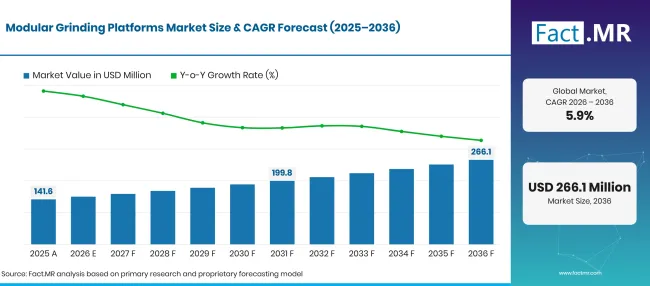
Modular Grinding Platforms Forecast Global | Source: Fact.MR
Category
| Category | Segments |
| Product Type | Hammer mill modules, Hybrid modular grinding, Roller mill modules, Disc mill modules, Pin mill modules |
| Operating Mode | Modular inline, Turnkey integrated, Continuous, Semi-continuous, Batch |
| Capacity Tier | High throughput, Small commercial, Custom high-capacity, Medium throughput, Pilot and laboratory |
| Customer Industry | Chemicals, Other industrial, General manufacturing, Food and beverage, Pharmaceutical |
| Region | United States; France; Germany; Japan; United Kingdom |
Source: Fact.MR analysis.
Segmental Analysis
Why do hammer mill modules lead product demand in the Modular Grinding Platforms Market?
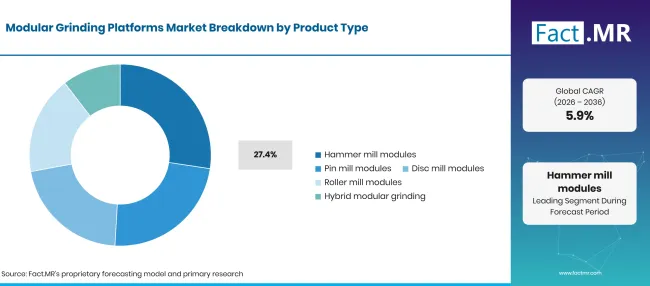
Modular Grinding Platforms Breakdown Product Type | Source: Fact.MR
Hammer mill modules account for 27.4% of revenue in 2026, approximately USD 41.1 million. Their impact-based size reduction is suited to grains, biomass and selected industrial materials. Replaceable screens and adjustable operating conditions allow operators to vary particle size. Prater and Schutte Hammermill offer industrial hammer mills that can be incorporated into larger material-handling and size-reduction lines.impact mills market
How is modular inline operation leading demand in the Modular Grinding Platforms Market?
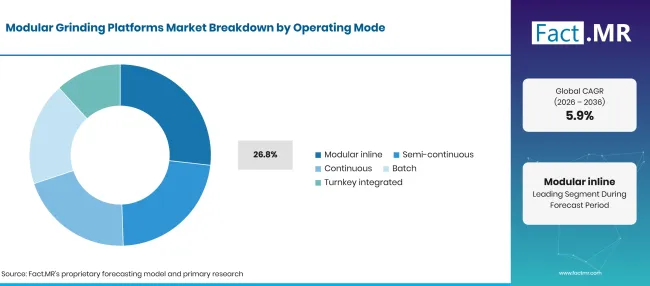
Modular Grinding Platforms Breakdown Operating Mode | Source: Fact.MR
Modular inline operation represents 26.8% of revenue in 2026, valued at approximately USD 40.2 million. Manufacturers use configurable milling arrangements when production lines must accommodate different materials. Hosokawa Alpine’s multi-processing systems allow compatible process modules, including the UPZ 100 III fine impact mill, to be installed on a shared platform.
Why does high throughput lead capacity demand in the Modular Grinding Platforms Market?
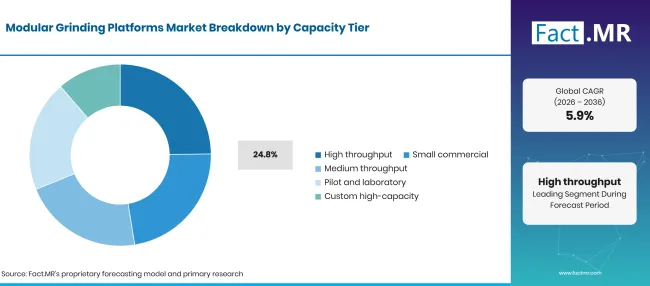
Modular Grinding Platforms Breakdown Capacity Tier | Source: Fact.MR
High-throughput platforms hold 24.8% of revenue in 2026, equivalent to approximately USD 37.2 million. Plants handling larger powder volumes need steady feeding, controlled particle size and planned maintenance. Capacity depends on the material, mill configuration and ancillary equipment. Operators can connect grinding units with classification, dust collection and product-transfer systems to match production requirements.
How is the chemicals industry leading customer demand in the Modular Grinding Platforms Market?
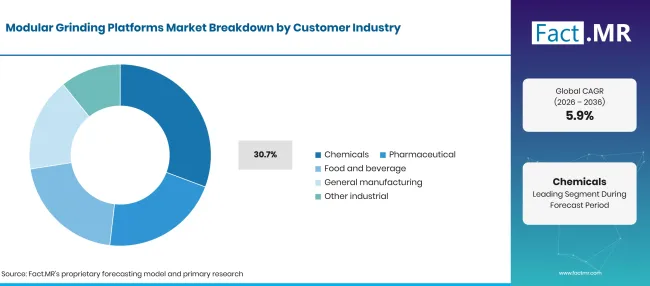
Modular Grinding Platforms Breakdown Customer Industry | Source: Fact.MR
Chemical manufacturers contribute 30.7% of revenue in 2026, approximately USD 46.1 million. Pigment, resin and specialty powder production requires mills selected for material hardness, temperature sensitivity and target particle size. Some facilities also require suitable dust-containment and explosion-protection measures. Modular equipment can help processors change process configurations while limiting changes to the surrounding line.
Modular Grinding Platforms Market: Drivers, Restraints and Trends
Drivers
Powder producers are considering modular grinding layouts where recipe changes and limited floor space complicate equipment replacement. Hosokawa Alpine introduced the UPZ 100 III as an additional module in its multi-processing system in July 2026, showing how a shared process platform can accommodate more than one milling arrangement.
Restraints
Purchasing decisions depend on the cost of process validation, controls integration and material-handling equipment. A module suitable for one powder may not meet another product’s fineness, cleaning or safety requirements. These constraints can reduce the benefit of interchangeability, particularly for abrasive, heat-sensitive or combustible materials.
Trend:
Reconfigurable Process Lines. Producers with changing product specifications are evaluating systems that accept different process modules. Hosokawa Alpine expanded its multi-processing platform with the UPZ 100 III fine impact mill in July 2026, using a common mounting solution to support flexible milling applications.
Trend
Digital Monitoring and Energy Efficiency. Equipment suppliers are combining mill controls with monitoring of operating conditions, wear and product consistency. Energy use and changeover time vary by material and configuration. Buyers compare these measures alongside cleaning access, explosion protection and the cost of connecting modules to existing lines.
Modular Grinding Platforms Market: Country Analysis
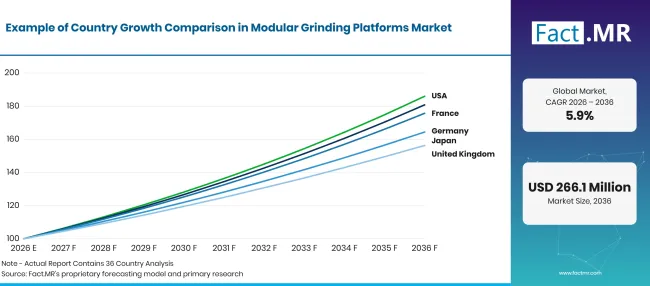
Modular Grinding Platforms Growth Index | Source: Fact.MR
| Country | CAGR (2026-2036) |
|---|---|
| United States | 6.4% |
| France | 6.1% |
| Germany | 5.8% |
| Japan | 5.1% |
| United Kingdom | 4.6% |
Source: Fact.MR analysis.
What is driving modular grinding platforms demand in the United States?
Demand for modular grinding platforms in the United States is forecast to rise at a 6.4% CAGR through 2036, the fastest among the five countries.
Chemical, agricultural and food processors use mills suited to different powders and operating conditions. Prater Industries and Schutte Hammermill manufacture size-reduction equipment for these applications. Buyers may prefer arrangements that fit existing conveying and dust-control systems when production requirements change.
How is the chemicals sector supporting modular grinding platforms sales in France?
Sales of modular grinding platforms in France are forecast to rise at a 6.1% CAGR through 2036.
Food ingredient, pharmaceutical and specialty chemical processors require different milling methods depending on product characteristics. Modular process equipment can support development work and production changeovers, although each application requires suitable engineering and validation.
What is shaping modular grinding platforms demand in Germany?
Demand for modular grinding platforms in Germany is forecast to advance at a 5.8% CAGR through 2036.
German equipment companies NETZSCH and Bauermeister supply grinding technologies for industrial powders. Chemical and food manufacturers assess fineness, wear, cleaning and safety requirements when deciding whether to introduce modular or integrated milling systems.
How is capital spending shaping modular grinding platforms sales in Japan?
Sales of modular grinding platforms in Japan are forecast to increase at a 5.1% CAGR through 2036.
Precision powder processing is important for chemical, food and advanced-material applications. Hosokawa Micron supplies process equipment for these industries. Customers considering modular installations must evaluate material compatibility and the ability to reproduce process results when switching equipment.
Why is growth slower for modular grinding platforms in the United Kingdom?
Demand for modular grinding platforms in the United Kingdom is forecast to increase at a 4.6% CAGR through 2036, the slowest among the five countries.
Food, pharmaceutical and specialty chemical plants may need compact installations that allow recipe changes without extensive rebuilding. Equipment purchases depend on validation requirements, maintenance access, facility layout and capital budgets.
Competitive Landscape for Modular Grinding Platforms Market
For manufacturers operating several powder-processing lines, the decision to purchase modular grinding equipment often begins with production constraints rather than machine capacity alone. Limited factory space, frequent material changes and costly shutdowns create different opportunities for equipment suppliers. Hosokawa Alpine addresses these challenges through multi-processing systems that accommodate several grinding technologies within a common framework. NETZSCH provides modular grinding and processing plants for chemical and mineral applications, while Prater Industries specializes in integrating mills with classification and pneumatic conveying equipment. Schutte Hammermill serves processors requiring complete size-reduction systems for feed, biomass and industrial materials.
Suppliers differ in how much engineering is needed when customers change milling arrangements. In July 2026, Hosokawa Alpine introduced the UPZ 100 III fine impact mill for its multi-processing systems, using a universal mounting arrangement. NETZSCH designs integrated grinding and processing equipment, while Prater combines selected mills with air classification and materials handling. Buyers compare particle-size performance, cleaning requirements and process integration.
Recent Developments
- In November 2026, Hosokawa Alpine introduced a containment option for its Picoline modular laboratory processing platform. The isolator supports work with sensitive materials while remaining compatible with Picoline process modules.
- In July 2026, Hosokawa Alpine expanded its multi-processing systems with the UPZ 100 III fine impact mill. The unit uses a universal mounting solution and extends the platform’s range of processing applications.
Key Players in Modular Grinding Platforms Market
Key companies operating in the market include Hosokawa Micron, NETZSCH, Bühler, Prater Industries, Schutte-Buffalo Hammermill, and Bauermeister.
- Hosokawa Micron
- NETZSCH
- Bühler
- Prater Industries
- Schutte-Buffalo Hammermill
- Bauermeister
Bibliography
- ABB Ltd. (2026). Q3 2026 results.
- Dow Inc. (2026, October 22). Dow reports third quarter 2026 results. Midland, MI: Dow Inc.
- Evonik Industries AG. (2026, November 3). Quarterly Financial Statement Q3 2026.
- Hosokawa Alpine. (2026, November 17). Picoline now also available for sensitive products.
- Istat. (2026, November 11). Produzione industriale – Settembre 2026.
- Japan Machine Tool Builders’ Association. (2026, November 11). Machine Tool Orders: October 2026 preliminary results.
- Siemens AG. (2026, November 12). Outstanding fiscal 2026 performance – Industrial AI to drive future growth.
- Evonik Industries AG. (2026, November 3). Evonik more optimistic after strong third quarter.
- Hosokawa Alpine. (2026, July 23). Hosokawa Alpine expands its multi-processing systems.
- Hosokawa Alpine. (2026, November 17). Picoline now also available for sensitive products.
- Hosokawa Alpine. (2026). Multi-processing systems for flexible production.
Segmentation
Scope of Report
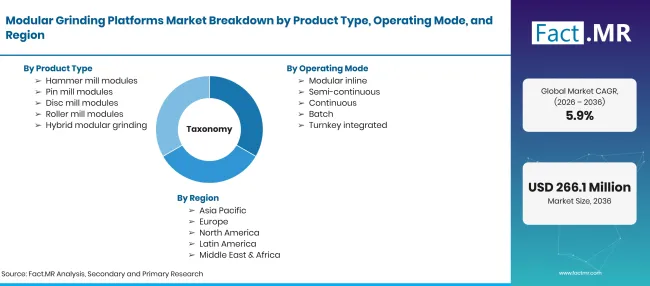
Modular Grinding Platforms Taxonomy | Source: Fact.MR
| Items | Values |
|---|---|
| Quantitative Units (2026) | USD million |
| Product Type | Hammer mill modules, Hybrid modular grinding, Roller mill modules, Disc mill modules, Pin mill modules |
| Operating Mode | Modular inline, Turnkey integrated, Continuous, Semi-continuous, Batch |
| Capacity Tier | High throughput, Small commercial, Custom high-capacity, Medium throughput, Pilot and laboratory |
| Customer Industry | Chemicals, Other industrial, General manufacturing, Food and beverage, Pharmaceutical |
| Regions Covered | North America, Latin America, Europe, East Asia, South Asia and Pacific, Middle East & Africa |
| Countries Covered | United States, France, Germany, Japan, United Kingdom, and other countries |
| Key Companies Profiled | Hosokawa Micron, NETZSCH, Bühler, Prater Industries, Schutte-Buffalo Hammermill, Bauermeister |
| Additional Attributes | Dollar revenue in the Modular Grinding Platforms Market is segmented by product type (hammer mill, hybrid modular, roller mill, disc mill, pin mill modules), operating mode, capacity tier, customer industry and region. |
Source: Fact.MR analysis. Updated Nov 24, 2026
Modular Grinding Platforms Market by Segments
-
Product Type
- Hammer mill modules
- Hybrid modular grinding
- Roller mill modules
- Disc mill modules
- Pin mill modules
-
Operating Mode
- Modular inline
- Turnkey integrated
- Continuous
- Semi-continuous
- Batch
-
Capacity Tier
- High throughput
- Small commercial
- Custom high-capacity
- Medium throughput
- Pilot and laboratory
-
Customer Industry
- Chemicals
- Other industrial
- General manufacturing
- Food and beverage
- Pharmaceutical
-
Region:
- North America
- United States
- Canada
- Mexico
- Europe
- Germany
- United Kingdom
- France
- Italy
- Spain
- Rest of Europe
- Asia Pacific
- China
- India
- Japan
- South Korea
- Australia
- Rest of Asia Pacific
- Latin America
- Brazil
- Argentina
- Rest of Latin America
- Middle East & Africa
- GCC Countries
- South Africa
- Rest of Middle East & Africa
- North America
Table of Contents
Key Takeaways
- Market Size and CAGR
- Top Growth Driver
- Fastest Growing Segment
- Leading Region
- Key Companies
- Emerging Opportunities

