
- Market Value (2025): USD 351.7 Mn
- Estimated Value (2026): USD 389.4 Mn
- Forecast Value (2036): USD 1077.1 Mn
- CAGR (2026-2036): 10.7%
Nasal Wellness Devices Market Forecast and Outlook 2026 to 2036
The global nasal wellness devices market was valued at USD 351.7 million in 2025 and reached USD 389.4 million in 2026. The market will reach USD 1077.1 million by 2036, expanding at a CAGR of 10.7% during the 2026 to 2036 assessment period.
Interest in nasal wellness devices is rising as consumers look for non-medicated ways to improve breathing, manage congestion and sleep better. Products such as magnetic nasal dilators, powered irrigators and nasal airflow support devices are moving beyond specialist online stores into mainstream retail and clinical settings. In October 2026, Intake Breathing raised USD 62 million, backed by KIND founder Daniel Lubetzky, to expand retail access to its patented magnetic nasal dilator. This investment signals stronger commercial interest in everyday nasal care products.
Key Takeaways from the Nasal Wellness Devices Market
- Sales of nasal wellness devices stood at USD 351.7 million in 2025
- Nasal Wellness Devices Market Value (2026): USD 389.4 million
- Nasal Wellness Devices Market Forecast Value (2036): USD 1077.1 million
- Nasal Wellness Devices Market Forecast CAGR (2026-2036): 10.7%
- Device Function: Breathing resistance training, irrigation / cleansing, nasal light therapy, nasal airflow support, humidity / filtration
- Key Market Participants: NeilMed Pharmaceuticals, Naväge (RhinoSystems), Intake Breathing, Prestige Consumer Healthcare (Breathe Right), Rhinomed
- Key Growth Regions: China, South Korea, United States, Japan, Germany
Consumers are showing greater interest in portable nasal care products that fit into daily routines, travel and seasonal allergy management. In October 2026, Naväge added a portable nose cleaner and portable nebulizer to its respiratory relief portfolio, extending its range beyond home irrigation systems. Such product launches point to a wider shift towards convenient nasal hygiene formats across North America, East Asia and Europe.
Nasal Wellness Devices Market
| Metric | Value |
|---|---|
| Estimated Value in (2025) | USD 351.7 million |
| Estimated Value in (2026) | USD 389.4 million |
| Forecast Value in (2036) | USD 1077.1 million |
| Forecast CAGR (2026 to 2036) | 10.7% |
Source: Fact.MR analysis. Updated Nov 24, 2026
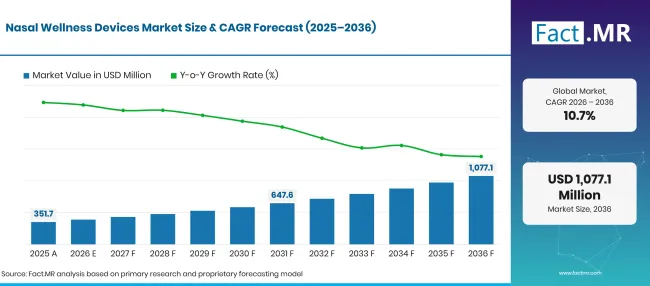
Nasal Wellness Devices Market Forecast Global | Source: Fact.MR
Category
| Category | Segments |
|---|---|
| Device Function | Breathing resistance training, Irrigation / cleansing, Nasal light therapy, Nasal airflow support, Humidity / filtration |
| Sales Channel | Clinical / professional, Retail electronics, Pharmacy / wellness retail, Brand direct online, B2B / institutional |
| Region | China; South Korea; United States; Japan; Germany |
Source: Fact.MR analysis. Updated Nov 24, 2026
Segmental Analysis
Why is breathing resistance training included in the Nasal Wellness Devices Market?
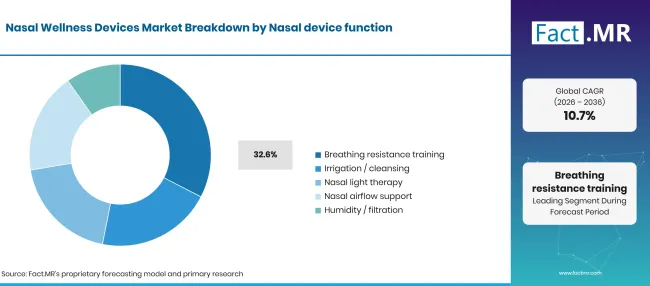
Nasal Wellness Devices Market Breakdown Nasal Device Function | Source: Fact.MR
Breathing resistance training is included as a device function category for products specifically designed to support nasal breathing and airflow management. However, respiratory muscle trainers that operate through oral mouthpieces should not be included in this category because they train inspiratory and expiratory muscles through the mouth rather than providing nasal wellness functionality. Airofit's official product information describes its devices as respiratory muscle trainers used through a mouthpiece. Therefore, the segment's original revenue and percentage contribution need to be recalculated after excluding products that do not meet the nasal-device definition. Nasal irrigation systems, nasal dilators and other qualifying products also contribute to the broader nasal wellness category.
How are clinical and professional channels leading sales in the Nasal Wellness Devices Market?
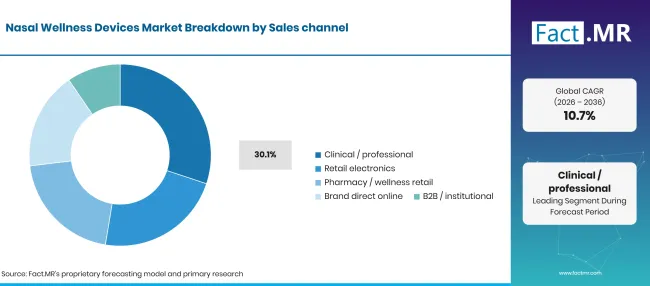
Nasal Wellness Devices Market Breakdown Sales Channel | Source: Fact.MR
Clinical and professional channels hold 30.1% of market revenue in 2026, equivalent to approximately USD 117.2 million. Recommendations from ENT specialists, allergists and respiratory therapists help consumers choose suitable irrigation systems and nasal airflow support products, particularly when symptoms affect sleep or daily activities. Other channels, including pharmacies and online retail, are also gaining ground through wider access to home-use nasal care products. Victoria's October 2026 clinical protocol specifically recognises saline nasal irrigation and sprays for managing congestion and allergic rhinitis symptoms.
Nasal Wellness Devices Market-Drivers, Restraints & Trends
Drivers: Earlier and More Intense Allergy Seasons:
Longer and more intense pollen seasons are bringing nasal care into everyday health routines because people with allergic rhinitis seek ways to manage congestion, sneezing and nasal irritation. In April 2026, AOK Rheinland/Hamburg reported a 51% year-on-year increase in hay fever-related sick leave during the second week of March. This creates a wider customer base for nasal irrigation, filtration and dilator devices, particularly during seasonal allergy peaks.
Restraints: Limited Clinical Evidence and Consumer Trust:
The market faces a credibility problem because some nasal wellness products make claims that exceed available clinical evidence. Consumers may spend on dilators or breathing trainers without receiving the promised improvement, leading to dissatisfaction and weaker repeat purchases. A January 2026 systematic review found no significant improvement in objective sleep-disordered breathing outcomes from nasal dilators. Such findings can make clinicians cautious and discourage purchases when product claims are poorly explained.
Trend: Nasal Breathing Enters Mainstream Sleep and Wellness Routines:
Nasal breathing is moving beyond specialist respiratory care as sleep, fitness and stress-management communities take greater interest in breathing habits. The Global Wellness Institute included nasal breathing and mouth taping for sleep among its 2025 breathing trends. For the market, this creates an opportunity to reach consumers through sleep wellness, fitness and preventive healthcare channels. Wider clinical education and clearer evidence around nasal airflow management could open new customer groups beyond traditional allergy care.
Trend: Saline Irrigation Becomes Part of Routine Nasal Care:
Nasal irrigation is gaining relevance as people look for practical ways to clear pollen, dust and other irritants after outdoor exposure. Victoria's October 2026 clinical protocol recognises saline sprays and irrigation as options for relieving nasal congestion and clearing irritants. This creates opportunities for sales growth through home-care routines, clinical recommendations and recurring purchases of saline solutions and irrigation accessories. Adoption can extend beyond allergy sufferers to people managing everyday nasal irritation.
Nasal Wellness Devices Market Analysis by Key Country
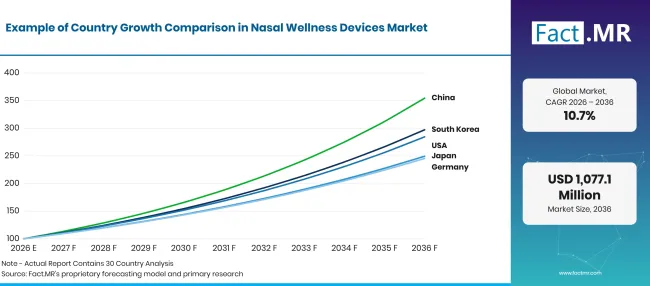
Nasal Wellness Devices Market Growth Index | Source: Fact.MR
| Country | CAGR (2026-2036) |
|---|---|
| China | 13.5% |
| South Korea | 11.5% |
| United States | 11.0% |
| Japan | 9.6% |
| Germany | 9.4% |
Source: Fact.MR analysis. Updated Nov 24, 2026
What is driving nasal wellness devices demand in China?
China's nasal wellness devices market is set to expand at a 13.5% CAGR through 2036, helped by seasonal allergy concerns and greater attention to nasal hygiene.
In March 2026, China Daily reported that allergy medicine sales across the country had increased 60.4% week over week as spring pollen arrived. This seasonal pattern creates opportunities for nasal irrigation and other non-medicated care options, particularly through China's established e-commerce channels. Wider consumer awareness of preventive nasal care could also encourage purchases outside the peak allergy season.
How is air quality supporting nasal wellness devices sales in South Korea?
South Korea's market is set to expand at an 11.5% CAGR as recurring fine dust episodes keep respiratory and nasal health concerns in public focus.
A Korean cohort study published in May 2026 linked higher prolonged PM2.5 exposure with an increased risk of allergic rhinitis. This connection creates room for nasal irrigation and filtration devices among consumers seeking additional ways to manage nasal irritation alongside conventional treatment. Greater attention to indoor air quality and pollution exposure could bring nasal care products to more consumers.
What is shaping nasal wellness devices demand in the United States?
The United States market is set to grow at an 11.0% CAGR as nasal care moves into mainstream retail rather than relying solely on specialist health stores.
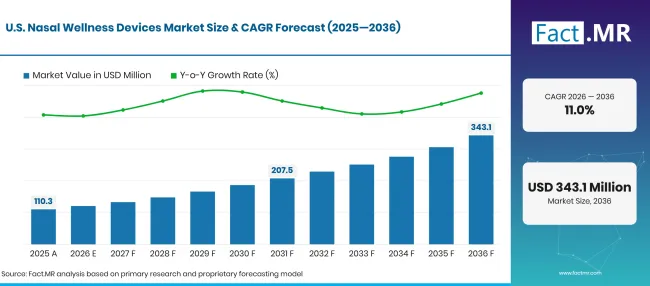
Nasal Wellness Devices Market Forecast Usa | Source: Fact.MR
Intake Breathing's USD 62 million funding round in October 2026 highlighted investor interest in expanding access to nasal wellness products. Wider pharmacy, online and mass-retail distribution could bring these devices to more consumers interested in sleep quality, exercise performance and non-medicated congestion management. Retail expansion also creates opportunities to reach customers who previously had limited exposure to specialised nasal care products.
Why is pollen exposure shaping nasal wellness devices demand in Japan?
Japan's nasal wellness devices market is set to register a 9.6% CAGR, with recurring cedar and cypress pollen seasons keeping nasal hygiene relevant to everyday life.
Weathernews estimated in early 2026 that pollen levels would be around 28% above the annual average following an unusually hot summer. Such seasonal exposure creates opportunities for nasal irrigation and filtration products among commuters and outdoor workers seeking convenient ways to manage pollen-related discomfort. Seasonal purchasing patterns could also encourage manufacturers to strengthen distribution ahead of Japan's annual spring allergy season.
How are allergies supporting nasal wellness devices demand in Germany?
Germany's market is set to grow at a 9.4% CAGR as allergy-related nasal symptoms sustain interest in non-medicated care.
Estimates cited by Die Zeit in February 2026 placed the number of people affected by allergies in Germany at 20 to 30 million. An earlier start to the 2026 hay fever season also brought nasal hygiene into focus. Pharmacy distribution and professional recommendations could help irrigation systems and nasal dilators reach more consumers. Consumer preference for familiar pharmacy-based purchasing may improve acceptance of these devices as part of routine allergy management.
Competitive Landscape for Nasal Wellness Devices Market
Competition in the nasal wellness devices market is fragmented across irrigation, dilation and nasal airflow support categories. NeilMed Pharmaceuticals and Naväge compete in saline and powered nasal irrigation, Intake Breathing focuses on magnetic nasal dilators, Prestige Consumer Healthcare markets Breathe Right nasal strips, and Rhinomed competes in internal nasal airflow support. Buyers select products based on comfort, ease of use, evidence of benefit, price and availability in pharmacy and online channels.
From 2025 onward, competition shifted toward retail scale and portfolio breadth. Intake Breathing raised USD 62 million in October 2026 to expand its retail presence, Naväge added portable irrigation and nebulizer products in October 2026, and Prestige Consumer Healthcare expanded its consumer healthcare portfolio through the acquisition of Breathe Right in June 2026. Companies with clinical backing, product differentiation and broad retail distribution are positioned to compete as nasal wellness moves into mainstream consumer health.
Recent Developments
- On October 14, 2026, Naväge launched the Portable Nose Cleaner and Portable Nebulizer, expanding its respiratory wellness portfolio with travel-friendly nasal care and breathing products.
- On October 28, 2026, Intake Breathing received a USD 62 million investment from Camino Partners, founded by Daniel Lubetzky, to expand its team, retail presence and nasal breathing product portfolio.
- On June 12, 2026, Prestige Consumer Healthcare completed the acquisition of Breathe Right and certain other consumer healthcare brands from Foundation Consumer Brands for USD 1,044.9 million.
- In 2026, Rhinomed reported that its Rhinoswab and Rhinoswab Junior products were beginning to receive regulatory approvals, supporting the company's expansion in nasal healthcare products.
Key Players in Nasal Wellness Devices Market
Key companies operating in the market include NeilMed Pharmaceuticals, Naväge (RhinoSystems), Intake Breathing, Prestige Consumer Healthcare (Breathe Right), and Rhinomed.
- NeilMed Pharmaceuticals
- Naväge (RhinoSystems)
- Intake Breathing
- Prestige Consumer Healthcare (Breathe Right)
- Rhinomed
Bibliography
- AOK Rheinland/Hamburg. (2026, April 10). Heuschnupfen-Saison 2026 beginnt früher, mehr Betroffene als im Vorjahr.
- Beijing Municipal Center for Disease Control and Prevention. (2026, March 16). Spring pollen season arrives early: How to prevent pollen allergies and manage symptoms. Beijing Municipal People's Government.
- Centers for Disease Control and Prevention. (2026, November 16). How to safely rinse sinuses.
- Federal Ministry of Health. (n.d.). Hay fever: Diagnosis, treatment and therapy. gesund.bund.de.
- Ministry of Climate, Energy and Environment, Republic of Korea. (2026, January 15). Emergency reduction measures for high-concentration fine dust to be implemented in Chungcheong and Jeonbuk regions on January 16.
- Ministry of the Environment, Japan. (2026). Pollen information site.
- Ministry of the Environment, Japan. (2026, March 4). Environmental perspectives on living with hay fever.
- Prestige Consumer Healthcare Inc. (2026). Quarterly report on Form 10-Q. U.S. Securities and Exchange Commission.
- Robert Koch Institute. (2024, February 16). Allergies and atopic diseases.
- Victorian Department of Health. (2026, October). Protocol for management of allergic and non-allergic rhinitis.
- World Health Organization. (2025, June). Clinical management of COVID-19: Living guideline.
Segmentation
Scope of Report
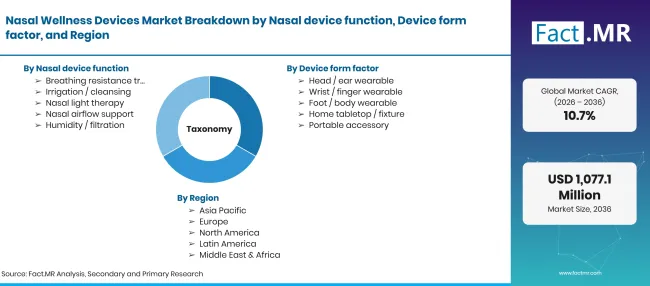
Nasal Wellness Devices Market Taxonomy | Source: Fact.MR
| Items | Values |
|---|---|
| Quantitative Units (2026) | USD 389.4 Million |
| Device Function | Breathing resistance training, Irrigation / cleansing, Nasal light therapy, Nasal airflow support, Humidity / filtration |
| Sales Channel | Clinical / professional, Retail electronics, Pharmacy / wellness retail, Brand direct online, B2B / institutional |
| Regions Covered | North America, Latin America, Europe, Asia Pacific, Middle East & Africa |
| Countries Covered | China, South Korea, United States, Japan, Germany, and other countries |
| Key Companies Profiled | NeilMed Pharmaceuticals, Naväge (RhinoSystems), Intake Breathing, Prestige Consumer Healthcare (Breathe Right), Rhinomed |
| Additional Attributes | Dollar revenue in the Nasal Wellness Devices Market is segmented by device function (breathing resistance training, irrigation / cleansing, nasal light therapy, nasal airflow support, humidity / filtration), sales channel and region. |
Source: Fact.MR analysis. Updated Nov 24, 2026
Nasal Wellness Devices Market by Segments
-
Device Function
- Breathing resistance training
- Irrigation / cleansing
- Nasal light therapy
- Nasal airflow support
- Humidity / filtration
-
Sales Channel
- Clinical / professional
- Retail electronics
- Pharmacy / wellness retail
- Brand direct online
- B2B / institutional
-
Region
- North America
- United States
- Canada
- Mexico
- Europe
- Germany
- United Kingdom
- France
- Italy
- Spain
- Rest of Europe
- Asia Pacific
- China
- India
- Japan
- South Korea
- Australia
- Rest of Asia Pacific
- Latin America
- Brazil
- Argentina
- Rest of Latin America
- Middle East & Africa
- GCC Countries
- South Africa
- Rest of Middle East & Africa
- North America
Table of Contents
Key Takeaways
- Market Size and CAGR
- Top Growth Driver
- Fastest Growing Segment
- Leading Region
- Key Companies
- Emerging Opportunities

