
- Market Value (2025): USD 169.5 Mn
- Estimated Value (2026): USD 178.0 Mn
- Forecast Value (2036): USD 289.9 Mn
- CAGR (2026-2036): 5.0%
Servomotor Malt Processing Units Market Forecast and Outlook 2026 to 2036
According to the Fact.MR analysis, the servomotor malt processing units market crossed a valuation of USD 169.5 million in 2025 and is projected to grow from USD 178.0 million in 2026 to USD 289.9 million by 2036. Demand for servomotor malt processing units is likely to grow at a CAGR of 5.0% over the forecast period.
Demand for servomotor malt processing units is rising as maltsters, brewers and grain processors replace fixed-speed motors and manual gap settings with servo drives that position rolls, meter feed and synchronize speeds precisely. Servo control lets a mill change settings by recipe in seconds and log every batch. For example, Japan completed the final step of its liquor tax unification in October 2026, bringing beer, happoshu and new-genre beer to one rate and prompting brewers to rework product portfolios. Similar product shifts are projected to drive sales of servomotor malt processing units through 2036.
Key Takeaways from the Servomotor Malt Processing Units Market
- Servomotor Malt Processing Units Market Value (2025): USD 169.5 million
- Servomotor Malt Processing Units Market Value (2026): USD 178.0 million
- Servomotor Malt Processing Units Market Forecast Value (2036): USD 289.9 million
- Servomotor Malt Processing Units Market Forecast CAGR (2026-2036): 5.0%
- Leading Servo-driven mill function: Roll-gap positioning (30.7%)
- Key Market Participants: Siemens, Bosch Rexroth, Yaskawa, Mitsubishi Electric, Rockwell Automation, Beckhoff
- Key Growth Regions: Japan, Germany, United States, China, Belgium
Automation suppliers such as Siemens, Rockwell Automation and Beckhoff offer brewery control platforms that link servo drives to recipe management and plant data. Demand for servomotor malt processing units is growing as brewers connect milling to brewhouse automation. Suppliers are offering drives with built-in safety and Ethernet communication. Similar digitalization is projected to drive sales of servo units across brewing and grain processing.
Servomotor Malt Processing Units Market
| Metric | Value |
|---|---|
| Estimated Value in (2026) | USD 178.0 million |
| Forecast Value in (2036) | USD 289.9 million |
| Forecast CAGR (2026 to 2036) | 5.0% |
Source: Fact.MR analysis.
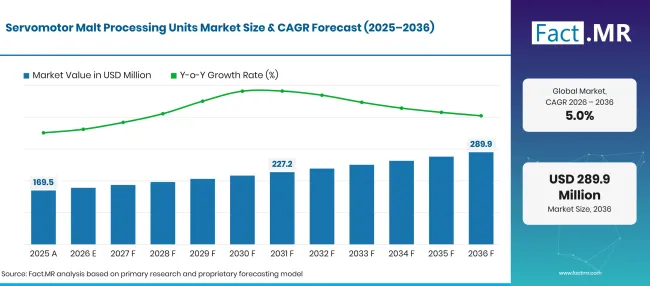
Servomotor Malt Processing Units Forecast Global | Source: Fact.MR
Category
| Category | Segments |
|---|---|
| Servo-driven mill function | Roll-gap positioning, Feed-rate control, Speed synchronization, Torque management, Integrated recipe control |
| Installation type | Machine-integrated, Skid / cell, Portable maintenance, Fixed production line, Modular retrofit |
| End use | Food / beverage, Automotive, Chemicals, Pharmaceuticals, General manufacturing |
| Control interface | Standalone, Analog / digital, Fieldbus, Industrial Ethernet, Wireless / cloud |
| Region | Japan; Germany; United States; China; Belgium |
Source: Fact.MR analysis.
Segmental Analysis
What is strengthening demand for roll-gap positioning in servomotor malt processing units?
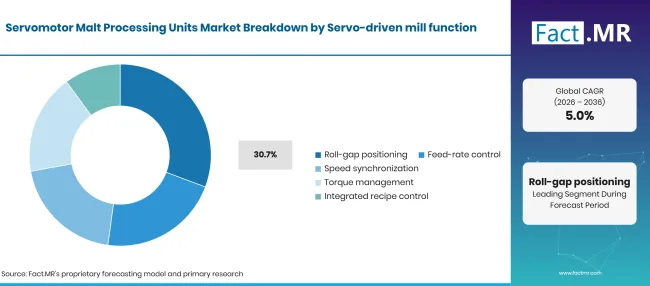
Servomotor Malt Processing Units Breakdown Servo Driven Mill Function 1 | Source: Fact.MR
Demand for roll-gap positioning accounts for 30.7% of market revenue in 2026, about USD 54.6 million, as maltsters and breweries require consistent grist sizes to improve extract recovery and lautering performance.The U.S. Alcohol and Tobacco Tax and Trade Bureau updated its national beer production and brewery-size datasets in July and June 2026, respectively, providing current indicators of brewing activity across different production scales. As breweries manage different malt varieties and recipes, servo actuators with absolute encoders offer opportunities to automate roller-gap settings, reduce manual adjustments and improve milling repeatability.
Which investment patterns are supporting fixed production line installations?
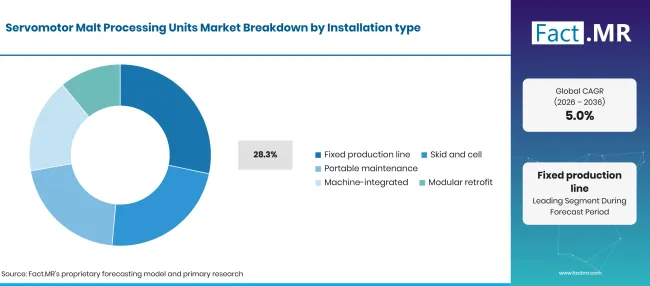
Servomotor Malt Processing Units Breakdown Installation Type | Source: Fact.MR
Sales of fixed production line segment to represent 28.3% of market revenue in 2026, about USD 50.4 million, as malt processing facilities integrate servo drives into permanent roller mills, grain conveyors and material-handling equipment.India's Ministry of Statistics and Programme Implementation reported in November 2026 that gross value of plant and machinery in registered manufacturing increased 7.25% during FY 2024–25. Manufacturing corporate investment and factory operations also expanded during the period. This industrial investment environment supports opportunities for integrated servo installations, particularly where malt processors modernize existing milling lines rather than purchase standalone equipment.
How is food and beverage manufacturing activity influencing end-use demand?
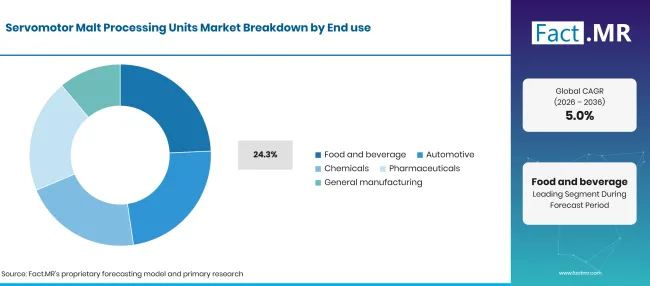
Servomotor Malt Processing Units Breakdown End Use | Source: Fact.MR
Food and beverage applications holds 24.3% of market revenue in 2026, reaching USD 43.3 million, as breweries, malt houses and grain-processing facilities require accurate motor control across milling and material-handling operations.The Reserve Bank of India reported in July 2026 that the food-products manufacturing production index reached 105.0 in FY 2025–26, compared with 101.8 in FY 2024–25, using a 2022–23 base of 100. The beverage manufacturing index stood at 116.3. These figures indicate sustained industrial activity and support opportunities for servo-driven malt processing equipment.
What is encouraging industrial Ethernet adoption in servomotor malt processing units?
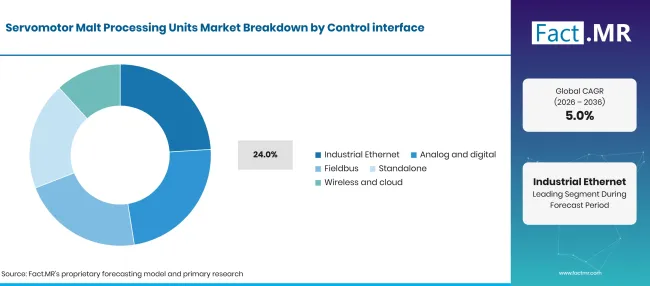
Servomotor Malt Processing Units Breakdown Control Interface | Source: Fact.MR
Adoption of industrial Ethernet accounts for 24.0% of market revenue in 2026, about USD 42.7 million, as malt processing facilities increasingly connect servo drives with programmable controllers, production monitoring and automated recipe-management systems.India's September 2026 Index of Industrial Production, released by MoSPI, recorded 33.9% year-over-year growth in electrical equipment manufacturing. Overall manufacturing output increased 7.6% in September 2026, according to the same release. These figures demonstrate expansion in relevant manufacturing and electrical-control supply chains, supporting opportunities for servo systems compatible with PROFINET, EtherCAT and EtherNet/IP.
Servomotor Malt Processing Units Market-Drivers, Restraints & Trends
Drivers: Energy efficiency and reduced malt-processing costs
Demand for servomotor malt processing units is increasing as breweries and maltsters seek better control over electricity consumption, grain handling and milling consistency. India's Ministry of Statistics and Programme Implementation released Energy Statistics India 2026 in March 2026, reporting that total final energy consumption reached 608,578 Ktoe in FY 2024–25, an increase of 30.41% from FY 2015–16. The publication also incorporates industry-level electricity consumption data. This growing industrial energy requirement strengthens the commercial case for efficient motor-driven equipment, including servo systems that adjust power and speed according to processing requirements.
Restraints: High installation costs and technical requirements
Sales of servomotor malt processing units face adoption barriers because servo drives, encoders, controllers and programming requirements can increase initial investment compared with conventional motors. These costs can be particularly challenging for smaller breweries with limited engineering resources. India's Annual Survey of Industries 2024–25, published by MoSPI in November 2026, reported a 7.25% increase in the gross value of plant and machinery in registered manufacturing over the previous year. Suppliers can address these barriers through preconfigured drive packages, simplified commissioning and maintenance support.
Opportunity: Ethernet-Connected Drives
Demand for Ethernet-connected servomotor drives is gaining momentum as malt processors integrate milling equipment with programmable logic controllers, automated recipes and centralized production monitoring. India's MoSPI reported in October 2026 that electrical equipment manufacturing output increased 33.9% year over year in September 2026, while overall manufacturing production increased 7.6%. The growth in electrical equipment manufacturing indicates expanding industrial activity in a relevant automation supply category. Servo suppliers such as Beckhoff and Siemens are addressing connectivity requirements through industrial communication platforms, including EtherCAT and PROFINET, enabling coordinated machine control and production-data exchange.
Trend: Predictive maintenance and condition monitoring
Predictive maintenance is becoming relevant to servomotor malt processing units as breweries seek to identify abnormal torque, motor loading and mechanical wear before equipment failure interrupts production. MoSPI's Annual Survey of Industries 2024–25, released in November 2026, recorded a 3.45% increase in operating factories and 7.57% growth in persons engaged in the manufacturing corporate sector. Expanding factory operations strengthen the importance of equipment availability and maintenance planning. Servo manufacturers are incorporating diagnostic functions and condition-monitoring capabilities to support maintenance decisions.
Servomotor Malt Processing Units Market by Analysis by Key Country
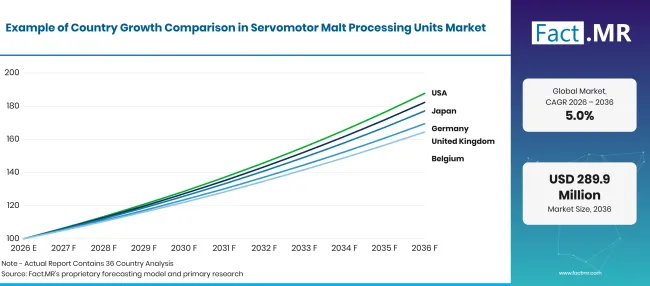
Servomotor Malt Processing Units Growth Index | Source: Fact.MR
| Country | CAGR (2026-2036) |
|---|---|
| Japan | 9.5% |
| Germany | 8.2% |
| United States | 6.9% |
| China | 6.6% |
| Belgium | 5.1% |
Source: Fact.MR analysis.
What is accelerating demand for servomotor malt processing units in Japan?
Demand for servomotor malt processing units in Japan is projected to increase at a 9.5% CAGR through 2036, supported by brewery portfolio adjustments and production-line modernization.
Japan's Ministry of Finance confirms that beer-related beverage tax rates were unified from October 1, 2026, at JPY 155,000 per kilolitre for beer-category beverages. This reform creates an incentive for manufacturers to reassess product classifications and production configurations. Asahi, Kirin, Sapporo and Suntory can benefit from flexible processing systems as product portfolios evolve. Servo-driven equipment from Yaskawa and Mitsubishi Electric offers programmable motor control for accurate malt handling and repeatable processing.
Which industrial developments are encouraging servomotor malt unit sales in Germany?
Sales of servomotor malt processing units in Germany are anticipated to grow at an 8.2% CAGR as maltsters and breweries prioritize energy management and production efficiency.
Destatis reported on November 16, 2026, that industrial energy consumption declined 2.9% in 2025 to 3,248 petajoules, reflecting pressure on manufacturers to control energy expenditure. Separately, Germany recorded 1,415 operating breweries in 2025, down 3.6% year over year. These conditions encourage existing facilities to improve equipment utilization rather than depend entirely on capacity expansion. Weyermann and other malt processors can consider servo-controlled drives from Siemens, Bosch Rexroth and Beckhoff for precise motor operation.
How are brewery modernization and raw-material requirements influencing servomotor malt unit demand in the United States?
The United States is expected to register a 6.9% CAGR in servomotor malt processing unit sales through 2036, as maltsters and large breweries seek greater control over grain preparation.
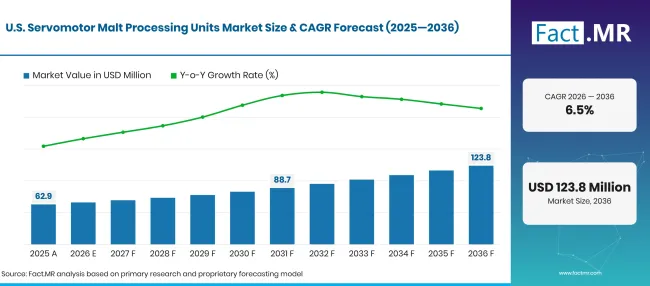
Servomotor Malt Processing Units Forecast Usa | Source: Fact.MR
The USDA's November 2026 production estimates place U.S. barley output at 2.52 million metric tonnes for 2026–27, down 18.85% from the previous year. This tighter raw-material supply increases the importance of controlling malt losses and processing consistency. The Alcohol and Tobacco Tax and Trade Bureau also updated its national beer statistics on July 31, 2026. Rahr, Briess and larger breweries represent potential modernization customers for servo-based processing systems.
What is creating opportunities for servomotor malt processing unit suppliers in China?
Sales in China's servomotor malt processing unit market is projected to expand at a 6.6% CAGR through 2036, supported by automation investments among large breweries and malt processors.
The USDA's November 2026 grain estimates forecast global barley production of 161.05 million metric tonnes in 2026–27, representing a 4.31% increase over 2025–26. Greater global grain availability supports opportunities for malt processing and brewing supply chains, including China's large-scale beverage industry. COFCO Malt and major brewing groups can benefit from automated material handling and controlled milling operations. Inovance, Siemens and Yaskawa offer relevant motion-control technologies for equipment modernization and production consistency.
Which market conditions are limiting servomotor malt unit sales growth in Belgium?
Demand in Belgium is forecast to record a 5.1% CAGR in servomotor malt processing unit demand through 2036, reflecting its established brewing and malting infrastructure.
Eurostat reported on August 31, 2026, that EU beer production reached 34.4 billion litres in 2025, declining 0.7% year over year. However, Belgium remained the EU's largest beer exporter, shipping approximately 1.5 billion litres in 2025, according to Eurostat's August 7 release. This established export position supports ongoing requirements for production consistency rather than extensive new capacity. Boortmalt and AB InBev can prioritize selective equipment upgrades, creating opportunities for servo systems that improve motor control and operational efficiency.
Competitive Landscape for Servomotor Malt Processing Units Market
Competition in the servomotor malt processing units market is led by industrial automation groups. Siemens, Bosch Rexroth, Yaskawa, Mitsubishi Electric, Rockwell Automation and Beckhoff compete on servo drives, controllers and software. Buyers select on precision, connectivity, reliability and support.
From 2024 onward, competition shifted toward connected drives and recipe integration. Suppliers with brewery software partnerships are best placed to grow.
Recent Developments
- In October 2026, Japan completed its liquor tax unification for beer-type drinks.
- In October 2026, Siemens introduced the SINAMICS G200, G210C, G210 and G210X drive models on October 28, 2026. The new portfolio offers a unified drive platform for continuous-motion industrial applications, with integrated safety, cybersecurity and digital monitoring capabilities. These systems can support industrial material handling and processing machinery used in malt production.
- In October 2025, Siemens launched the SINAMICS S220 high-performance drive system on October 15, 2025. The system introduced the CU320-3 control unit and software version 6.6, alongside improved connectivity, simulation and analysis capabilities. It expands Siemens' industrial drive technology portfolio for demanding automation applications.
- In July 2025, Siemens completed its acquisition of ebm-papst's Industrial Drive Technology division on July 1, 2025. The acquired business had approximately 650 employees and supplied integrated mechatronic and drive systems for industrial transport applications. The transaction strengthened Siemens' factory automation and digitalization portfolio.
- In March 2026, Bosch Rexroth announced its MS2E synchronous servo motor for potentially explosive environments on March 23, 2026. The motor is designed for Zone 2 gas and Zone 22 dust environments, with a single-cable connection carrying power, encoder and temperature signals. It offers maximum torque of up to 360 Nm and overload capacity of up to four times rated torque. Its dust-zone certification makes this development particularly relevant to grain and malt processing facilities where combustible dust management is important.
- In February 2025, Bosch Rexroth introduced its ctrlX DRIVE cabinet-free servo drive system on February 27, 2025. The IP65-rated modular solution reduces installation space and cabling requirements by up to 90%. The design supports decentralized machine configurations and can benefit equipment manufacturers developing compact automated processing systems.
- In September 2026, Yaskawa announced the CPU-14U controller on September 29, 2026, expanding its MPX1000 machine-controller series. The new controller supports synchronized control of up to 256 servomotor axes and provides faster processing capabilities. The launch is relevant to complex automated processing lines requiring coordinated motor movement, grain transfer and machinery synchronization.
- In October 2026, Mitsubishi Electric announced new 400 V models for its EM-A sensorless servo motor series on October 13, 2026. The expanded lineup covers 0.4 kW to 7.5 kW and is designed for industrial automation, material handling, HVAC, water and wastewater, and general manufacturing. The motors combine permanent-magnet technology with sensorless control to deliver precise speed regulation and positioning.
- In November 2024, Beckhoff introduced the AX1000 economy servo drive on November 12, 2024. The compact drive supports single-axis and dual-axis configurations and is compatible with AM8000 synchronous servomotors featuring One Cable Technology. It integrates with TwinCAT automation software and EtherCAT networking, offering machine manufacturers a cost-effective solution for automated processing applications. The development can support compact malt grinding and grain-handling machinery through its servo-control capabilities.
Key Players in Servomotor Malt Processing Units Market
Key companies operating in the market include Siemens, Bosch Rexroth, Yaskawa, Mitsubishi Electric, Rockwell Automation, and Beckhoff.
- Siemens
- Bosch Rexroth
- Yaskawa
- Mitsubishi Electric
- Rockwell Automation
- Beckhoff
Bibliography
- Beckhoff Automation. (2025). Brewery automation.
- Beckhoff Automation. (2026). AX1206-3101-0000: Economy servo drive, three-phase, dual-axis module.
- Bosch Rexroth. (2026, March 23). Bosch Rexroth simplifies automation in Ex zones with single cable technology.
- International Energy Agency. (2025). Energy efficiency 2025.
- Mitsubishi Electric Automation, Inc. (2025, June 9). Mitsubishi Electric Automation, Inc. launches multi-network capability to its existing MELSERVO-J5 servo amplifier.
- Ministry of Statistics and Programme Implementation. (2026, March). Energy statistics India 2026. Government of India.
- Ministry of Statistics and Programme Implementation. (2026, November 4). Publications (Volume I and Summary Results of Factory Sector) of Annual Survey of Industries (ASI) 2024–25. Press Information Bureau, Government of India.
- Ministry of Statistics and Programme Implementation. (2026, October 28). Quick estimates of Index of Industrial Production and use-based index for the month of September 2026. Press Information Bureau, Government of India.
- Reserve Bank of India. (2026, July 22). Index of industrial production.
- Siemens AG. (2025). Annual report 2025.
- U.S. Alcohol and Tobacco Tax and Trade Bureau. (2026). Beer reports and statistics. U.S. Department of the Treasury.
- Yaskawa Electric Corporation. (2025, May 19). Yaskawa to start sales of AC servo drive Σ-X Series 400 V input models.
Segmentation
Scope of Report
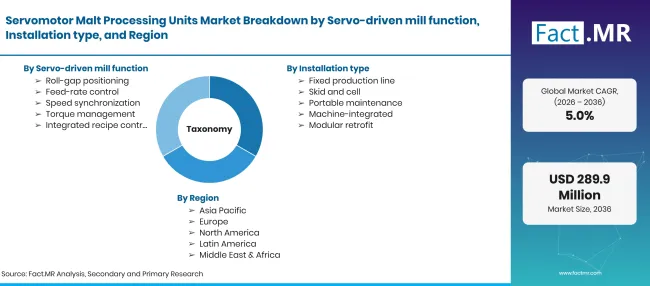
Servomotor Malt Processing Units Taxonomy | Source: Fact.MR
| Items | Values |
|---|---|
| Quantitative Units (2026) | USD 178.0 Million |
| Servo-driven mill function | Roll-gap positioning, Feed-rate control, Speed synchronization, Torque management, Integrated recipe control |
| Installation type | Machine-integrated, Skid / cell, Portable maintenance, Fixed production line, Modular retrofit |
| End use | Food / beverage, Automotive, Chemicals, Pharmaceuticals, General manufacturing |
| Control interface | Standalone, Analog / digital, Fieldbus, Industrial Ethernet, Wireless / cloud |
| Regions Covered | North America, Latin America, Europe, East Asia, South Asia and Pacific, Middle East & Africa |
| Countries Covered | Japan, Germany, United States, China, Belgium, and other countries |
| Key Companies Profiled | Siemens, Bosch Rexroth, Yaskawa, Mitsubishi Electric, Rockwell Automation, Beckhoff |
| Additional Attributes | Dollar revenue in the Servomotor Malt Processing Units Market is segmented by servo-driven mill function (roll-gap positioning, feed-rate control, speed synchronization, torque management, integrated recipe control); installation type (machine-integrated, skid / cell, portable maintenance, fixed production line, modular retrofit); end use (food / beverage, automotive, chemicals, pharmaceuticals, general manufacturing); control interface (standalone, analog / digital, fieldbus, industrial ethernet, wireless / cloud) and region. |
Source: Fact.MR analysis.
Servomotor Malt Processing Units Market by Segments
-
Servo-driven mill function
- Roll-gap positioning
- Feed-rate control
- Speed synchronization
- Torque management
- Integrated recipe control
-
Installation type
- Machine-integrated
- Skid / cell
- Portable maintenance
- Fixed production line
- Modular retrofit
-
End use
- Food / beverage
- Automotive
- Chemicals
- Pharmaceuticals
- General manufacturing
-
Control interface
- Standalone
- Analog / digital
- Fieldbus
- Industrial Ethernet
- Wireless / cloud
-
Region:
- North America
- United States
- Canada
- Mexico
- Europe
- Germany
- United Kingdom
- France
- Italy
- Spain
- Rest of Europe
- Asia Pacific
- China
- India
- Japan
- South Korea
- Australia
- Rest of Asia Pacific
- Latin America
- Brazil
- Mexico
- Argentina
- Rest of Latin America
- Middle East & Africa
- GCC Countries
- South Africa
- Rest of Middle East & Africa
- North America
Table of Contents
Key Takeaways
- Market Size and CAGR
- Top Growth Driver
- Fastest Growing Segment
- Leading Region
- Key Companies
- Emerging Opportunities

