
- Market Value (2025): USD 93.2 Mn
- Estimated Value (2026): USD 100.0 Mn
- Forecast Value (2036): USD 202.3 Mn
- CAGR (2026-2036): 7.3%
Hygienic Twin-Screw Extruders Market Forecast and Outlook 2026 to 2036
The hygienic twin-screw extruders market is projected to grow from USD 100.0 million in 2026 to USD 202.3 million by 2036, representing a compound annual growth rate of approximately 7.3% over the forecast period.
Food and pet food processors use twin-screw extrusion systems to manufacture snacks, cereals, textured proteins and formulated feeds. Hygienic equipment selection considers cleanable surfaces, accessible barrel sections, contamination controls and the design of adjacent equipment. Manufacturers offer stainless-steel processing components, modular screw configurations and cleaning arrangements suited to the product and plant.
Market Summary: Hygienic Twin-Screw Extruders Market
- Sales of hygienic twin-screw extruders stood at USD 93.2 million in 2025
- Hygienic Twin-Screw Extruders Market Value (2026): USD 100.0 million
- Hygienic Twin-Screw Extruders Market Forecast Value (2036): USD 202.3 million
- Hygienic Twin-Screw Extruders Market Forecast CAGR (2026-2036): 7.3%
- Leading Product Type: Co-rotating twin screw (27.5%)
- Key Market Participants: Coperion, Bühler, Clextral, Wenger Manufacturing
- Key Growth Regions: United States, Netherlands, Japan, Switzerland, United Kingdom
At Petfood Forum on April 28, 2026, a Coperion specialist presented extruder hood designs intended to improve sanitary handling after the extrusion cooking stage. Post-extrusion equipment is part of the hygienic production system, although this presentation does not establish orders for twin-screw extruders.
Hygienic Twin-Screw Extruders Market
| Metric | Value |
|---|---|
| Estimated Value in (2026) | USD 100.0 million |
| Forecast Value in (2036) | USD 202.3 million |
| Forecast CAGR (2026 to 2036) | 7.3% |
Source: Fact.MR analysis.
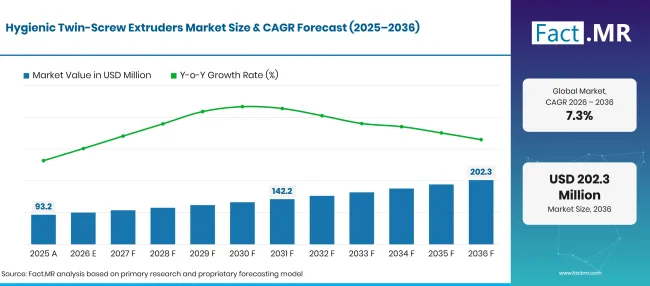
Hygienic Twin Screw Extruders Forecast Global | Source: Fact.MR
Category
| Category | Segments |
|---|---|
| Product Type | Co-rotating twin screw, Counter-rotating twin screw, Food-grade high-torque twin screw, Sanitary quick-release twin screw, Modular hygienic twin screw |
| Operating Mode | Semi-continuous, Turnkey integrated, Batch, Modular inline, Continuous |
| Capacity Tier | Custom high-capacity, Pilot and laboratory, Small commercial, Medium throughput, High throughput |
| Customer Industry | General manufacturing, Chemicals, Food and beverage, Pharmaceutical, Other industrial |
| Region | United States; Netherlands; Japan; Switzerland; United Kingdom |
Source: Fact.MR analysis. Updated Nov 24, 2026
Segmental Analysis
Why do co-rotating twin-screw extruders lead product demand in the Hygienic Twin-Screw Extruders Market?
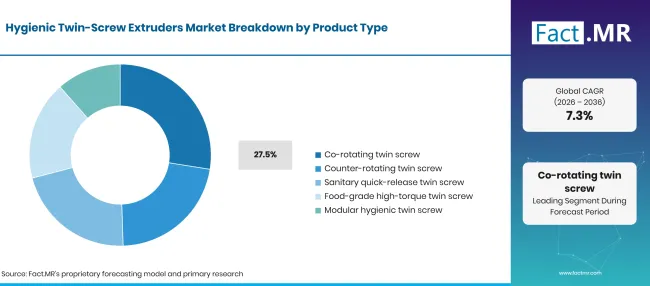
Hygienic Twin Screw Extruders Breakdown Product Type | Source: Fact.MR
Co-rotating twin-screw extruders account for 27.5% of revenue in 2026, approximately USD 27.5 million. Intermeshing screws support mixing, conveying and controlled residence time in food and feed extrusion. Bühler’s Nutrex 7 Series provides a relevant food and feed application, with hygienic construction and access for cleaning. Buyers assess screw configuration, temperature control and cleaning procedures for each recipe.
How is semi-continuous operation leading demand in the Hygienic Twin-Screw Extruders Market?
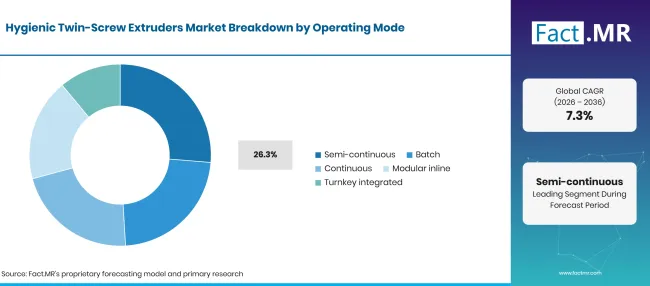
Hygienic Twin Screw Extruders Breakdown Operating Mode | Source: Fact.MR
Semi-continuous operation represents 26.3% of reported 2026 revenue, approximately USD 26.3 million. Some plants run continuous extrusion during individual production campaigns, with planned stops for recipe changes and cleaning. Clextral’s EVOLUM+ range is designed for hygienic food processing. Operating-mode classifications should distinguish material flow through the extruder from the scheduling of production campaigns.
Why does custom high-capacity equipment lead demand in the Hygienic Twin-Screw Extruders Market?
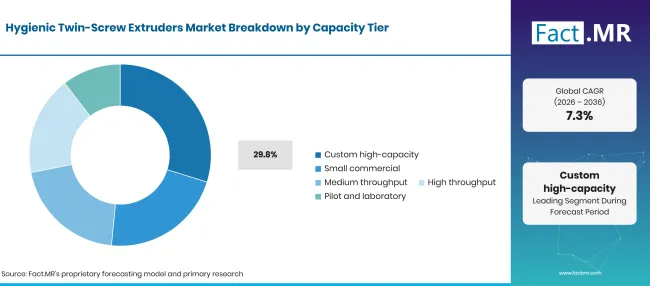
Hygienic Twin Screw Extruders Breakdown Capacity Tier | Source: Fact.MR
Custom high-capacity machines hold 29.8% of revenue in 2026, equivalent to approximately USD 29.8 million, as large food processors require extrusion lines matched to specific recipes and production volumes. Wenger offers twin-screw equipment integrated with preconditioners and drying systems. Engineering requirements extend beyond the extruder to feeding, moisture control and downstream handling. Buyers assess line capacity, operating efficiency and equipment integration.
How is general manufacturing leading customer demand in the Hygienic Twin-Screw Extruders Market?
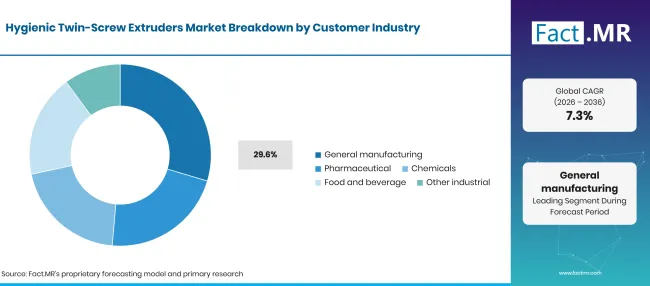
Hygienic Twin Screw Extruders Breakdown Customer Industry | Source: Fact.MR
General manufacturing accounts for a reported 29.6% of revenue in 2026, approximately USD 29.6 million. This category covers applications outside the separately identified food and beverage, pharmaceutical and chemical customer groups. Producers consider material compatibility, cleaning access, process consistency and product-change requirements when selecting extrusion equipment.
Hygienic Twin-Screw Extruders Market: Drivers, Restraints and Trends
Drivers
Food processors are evaluating extruders that accommodate varied protein, cereal and pet food formulations. Bühler launched its Nutrex 7 Series in May 2026, highlighting hygienic construction and shorter cleaning processes. The product announcement demonstrates available equipment technology rather than confirmed market-wide sales growth.
Restraints
Hygienic twin-screw extrusion lines can require substantial investment in equipment, utilities, downstream handling and cleaning procedures. Manufacturers also face product-development and compliance costs. Regulatory discussions about ultra-processed foods should not be treated as established restrictions on extrusion equipment purchases.
Trend
High-Moisture Protein Extrusion. Manufacturers use twin-screw extrusion with controlled cooling to develop fibrous plant-protein textures. Cleaning access, product consistency and energy consumption influence equipment design. The Good Food Institute published a plant-based meat techno-economic analysis in November 2026, examining production cost drivers rather than measuring extruder purchases.
Trend
Complete Hygienic Lines. At Petfood Forum 2026, Coperion presented technology for integrated pet food processing and discussed hygienic hood design. Producers assess contamination controls across extrusion, conveying, drying and downstream handling rather than evaluating the barrel alone.
Hygienic Twin-Screw Extruders Market: Country Analysis
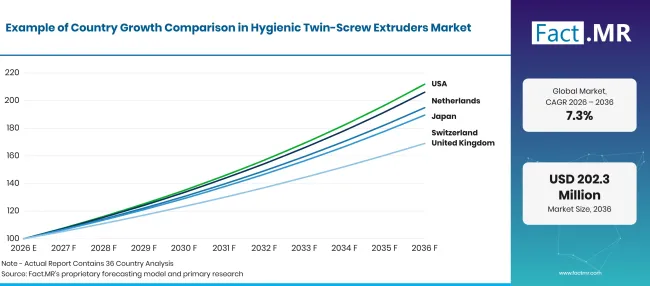
Hygienic Twin Screw Extruders Growth Index | Source: Fact.MR
| Country | CAGR (2026-2036) |
|---|---|
| United States | 7.8% |
| Netherlands | 7.5% |
| Japan | 6.9% |
| Switzerland | 6.6% |
| United Kingdom | 5.4% |
Source: Fact.MR analysis.
What is driving hygienic twin-screw extruders demand in the United States?
Demand for hygienic twin-screw extruders in the United States carries a 7.8% CAGR through 2036, the fastest among the five countries.
Pet food producers are examining sanitary equipment designs to reduce contamination risks during processing. At Petfood Forum 2026, Coperion highlighted how improved extruder hood construction could limit microbial recontamination after extrusion. Wenger Manufacturing offers twin-screw systems with hygienic support frames and accessible processing components. American food processors will prioritize cleanable surfaces, product safety, equipment accessibility and reliable operation when upgrading snack and pet food production lines.
How is plant-based production supporting hygienic twin-screw extruders sales in the Netherlands?
Sales of hygienic twin-screw extruders in the Netherlands are forecast to rise at a 7.5% CAGR through 2036, reflecting opportunities in plant-based ingredient development and specialized food manufacturing.
GFI Europe's June 2026 analysis showed mixed Dutch plant-based retail performance, although selected product categories recorded volume increases. Food manufacturers are exploring extrusion processes that accommodate different protein sources and moisture levels. Equipment suppliers can support these activities through flexible screw configurations and controlled processing conditions. Investment will depend on commercial product demand, formulation performance and efficient equipment cleaning.
What is shaping hygienic twin-screw extruders demand in Japan?
Demand for hygienic twin-screw extruders in Japan is forecast to increase at a 6.9% CAGR through 2036.
Snack and specialty food manufacturers consider extrusion equipment that provides stable cooking conditions and supports different formulations. Compact layouts and accessible processing components can help established plants modernize production. Equipment decisions depend on cleaning time, product uniformity, energy consumption and compatibility with existing lines.
How are equipment makers shaping hygienic twin-screw extruders sales in Switzerland?
Sales of hygienic twin-screw extruders in Switzerland are likely to expand at a 6.6% CAGR through 2036, supported by specialized food processing and equipment engineering capabilities.
In May 2026, Bühler introduced its Nutrex 7 Series, featuring improvements in hygienic construction, process efficiency and digital integration. The development illustrates how equipment manufacturers are addressing sanitation alongside production performance. Swiss food and nutrition producers can benefit from easier maintenance and controlled extrusion conditions. Investment decisions will reflect cleaning requirements, process reliability, equipment durability and compatibility with established manufacturing operations.
Why is growth slower for hygienic twin-screw extruders in the United Kingdom?
Demand for hygienic twin-screw extruders in the United Kingdom is forecast to increase at a 5.4% CAGR through 2036, the slowest among the five countries.
UK restrictions on advertising identifiable less healthy food products took effect on January 5, 2026. These rules concern advertising rather than extrusion technology, though some manufacturers may review affected product ranges. Equipment purchases will depend on production economics, recipe flexibility and hygiene requirements.
Competitive Landscape for Hygienic Twin-Screw Extruders Market
The challenge of preventing product contamination during extrusion creates different opportunities for equipment suppliers serving food, pet food and pharmaceutical manufacturers. Bühler competes through its Nutrex systems, which emphasize accessible construction and process control. Clextral's EVOLUM+ range addresses hygienic processing through stainless steel construction and equipment accessibility. Wenger Manufacturing brings specialized pet food expertise, including twin-screw systems designed for demanding ingredient mixtures.
Sanitation improvements are increasingly being designed around the complete extrusion process rather than the screw barrel alone. At Petfood Forum 2026, Coperion presented sanitary extruder hood designs intended to reduce microbial recontamination after cooking. Bühler introduced the Nutrex 7 Series in May 2026 with particular attention to equipment hygiene, maintenance and digital controls. Wenger offers another approach through stainless steel support frames and accessible barrel components.
Recent Developments
- In May 2026, Bühler launched its Nutrex 7 Series twin-screw extrusion platform, incorporating hygienic design, modular configurations, integrated automation, and advanced cleaning features to support efficient food, pet food, and feed manufacturing.
Key Players in Hygienic Twin-Screw Extruders Market
Key companies operating in the market include Coperion, Bühler, Clextral, and Wenger Manufacturing.
- Coperion
- Bühler
- Clextral
- Wenger Manufacturing
Bibliography
- Bühler Group. (2026, May 6). Bühler ushers in a new era of extrusion systems with Nutrex 7 Series.
- Bühler Group. (2026, May 7). Bühler launches innovations and releases major upgrades to its Grains & Food portfolio.
- Clextral. (2026). EVOLUM+ profitable, smart, clean.
- Coperion. (2026). Championing pets, people and progress at Petfood Forum.
- Good Food Institute. (2026, November 16). Plant-based meat techno-economic analysis
- UK Government. (2026). Less healthy food or drink: Advertising and promotions restrictions.
Segmentation
Scope of Report
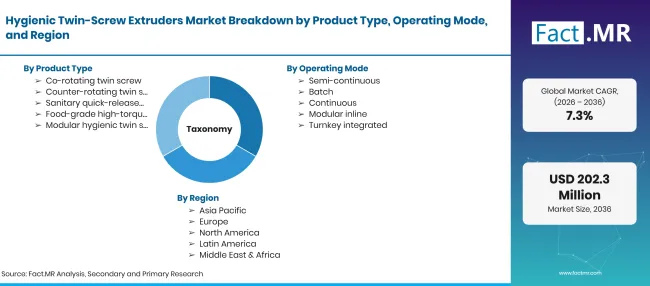
Hygienic Twin Screw Extruders Taxonomy | Source: Fact.MR
| Items | Values |
|---|---|
| Quantitative Units | USD million |
| Product Type | Co-rotating twin screw, Counter-rotating twin screw, Food-grade high-torque twin screw, Sanitary quick-release twin screw, Modular hygienic twin screw |
| Operating Mode | Semi-continuous, Turnkey integrated, Batch, Modular inline, Continuous |
| Capacity Tier | Custom high-capacity, Pilot and laboratory, Small commercial, Medium throughput, High throughput |
| Customer Industry | General manufacturing, Chemicals, Food and beverage, Pharmaceutical, Other industrial |
| Regions Covered | North America, Latin America, Europe, East Asia, South Asia and Pacific, Middle East & Africa |
| Countries Covered | United States, Netherlands, Japan, Switzerland, United Kingdom, and other countries |
| Key Companies Profiled | Coperion, Bühler, Clextral, Wenger Manufacturing |
| Additional Attributes | Dollar revenue in the Hygienic Twin-Screw Extruders Market is segmented by product type (co-rotating, counter-rotating, food-grade high-torque, sanitary quick-release, modular hygienic), operating mode, capacity tier, customer industry and region. |
Source: Fact.MR analysis. Updated Nov 24, 2026
Hygienic Twin-Screw Extruders Market by Segments
-
Product Type
- Co-rotating twin screw
- Counter-rotating twin screw
- Food-grade high-torque twin screw
- Sanitary quick-release twin screw
- Modular hygienic twin screw
-
Operating Mode
- Semi-continuous
- Turnkey integrated
- Batch
- Modular inline
- Continuous
-
Capacity Tier
- Custom high-capacity
- Pilot and laboratory
- Small commercial
- Medium throughput
- High throughput
-
Customer Industry
- General manufacturing
- Chemicals
- Food and beverage
- Pharmaceutical
- Other industrial
-
Region:
- North America
- United States
- Canada
- Mexico
- Europe
- Germany
- United Kingdom
- France
- Italy
- Spain
- Rest of Europe
- Asia Pacific
- China
- India
- Japan
- South Korea
- Australia
- Rest of Asia Pacific
- Latin America
- Brazil
- Argentina
- Rest of Latin America
- Middle East & Africa
- GCC Countries
- South Africa
- Rest of Middle East & Africa
Table of Contents
Key Takeaways
- Market Size and CAGR
- Top Growth Driver
- Fastest Growing Segment
- Leading Region
- Key Companies
- Emerging Opportunities

