- Market Value (2025): USD 2.2 Bn
- Estimated Value (2026): USD 2.4 Bn
- Forecast Value (2036): USD 6.2 Bn
- CAGR (2026-2036): 10.0%
What is the High-Performance Circular Polyesters Market forecast to be worth by 2036?
USD 2.4 billion in 2026 to USD 6.2 billion by 2036, at a 10.0% CAGR.
- The High-Performance Circular Polyesters Market reached USD 2.2 billion in 2025.
- Demand is projected to increase from USD 2.4 billion in 2026 to USD 6.2 billion by 2036.
- The market is forecast to record a 10.0% CAGR from 2026 to 2036 as packaging and technical users qualify circular polyester grades against existing performance specifications.
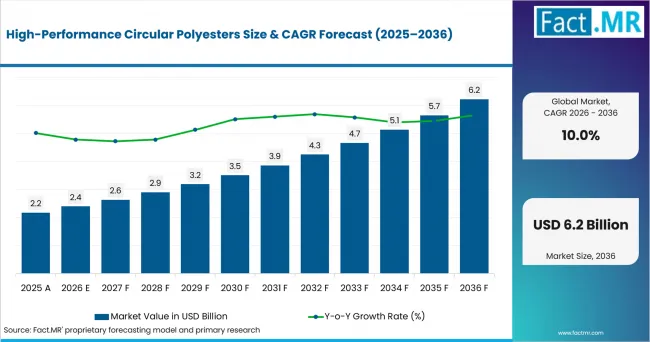
High Performance Circular Polyesters Value Analysis | Source: Fact.MR
What are the defining numbers behind High-Performance Circular Polyesters Market growth?
USD 3.8 billion absolute opportunity by 2036, led by chemically recycled PET and packaging applications.
- Demand Drivers in the Market
- Packaging converters need circular polyester that retains clarity and processing consistency. Eurostat reported in October 2025 that the EU recycled 42.1% of generated plastic packaging waste in 2023. Higher recovery volumes are expected to widen the feedstock base for packaging-grade circular polyester.
- Polyester recyclers need feedstock beyond clean bottle flakes. Depolymerization is expected to widen the usable stream by converting difficult polyester waste into purified building blocks for new resin production. This route is particularly relevant where color or prior processing makes direct mechanical reuse harder. Commercial value is expected to depend on purification quality and stable monomer recovery.
- Automotive and electronics teams need circular polyester with stable heat response and mechanical performance. Application-specific testing is expected to favor grades that maintain repeatable properties across recovered feedstock batches. Engineering teams are likely to compare circular grades against incumbent resin specifications before platform approval. Consistent processing windows are expected to carry as much weight as recycled-content claims.
- Manufacturers need traceable secondary materials at scale. Clear chain-of-custody records are expected to separate physical recycled content from mass-balance and biomass-balanced pathways during material qualification. This distinction helps brands align material claims with the actual route used. Resin suppliers are therefore expected to pair technical data with transparent feedstock attribution across each commercial grade.
- Key Segments Analyzed
- By Polyester Route: Chemically recycled PET is expected to hold 33.0% share in 2026 because depolymerization can return polyester waste to molecular building blocks for high-specification resin production.
- By Feedstock: Food-waste-derived diols are projected to account for 30.0% share in 2026 as circular carbon sourcing expands beyond post-consumer polymer waste into renewable and recovered chemical inputs.
- By Application: Packaging is anticipated to capture 40.0% share in 2026 due to recycled-content rules and food-contact quality requirements. Large PET material flows are expected to support scale.
- By Performance: High IV / strength grades are estimated to represent 35.0% share in 2026 owing to mechanical-performance requirements. Bottle and fiber uses are expected to support demand alongside molded components.
- Analyst Opinion at Fact.MR
- Fact.MR Principal Consultant Shambhu Nath Jha states: “Circular polyester purchasing is becoming a performance qualification exercise alongside recycled-content assessment. Growth is expected to favor grades that preserve processing behavior and end-use properties across changing feedstock streams. Suppliers should combine credible circular claims with stable material performance and clear traceability.”
- Strategic Implications
- Polyester producers should distinguish mechanical and chemical recycling routes from bio-based and mass-balance pathways so material teams can compare circular-content claims clearly. Product data sheets should connect the route to the resulting resin properties. This is expected to make grade selection easier across packaging and technical applications.
- Packaging converters should qualify circular grades against food-contact and clarity requirements before raising recycled content across commercial packaging programs. Testing should cover processing stability and appearance across repeat production runs. These checks are expected to reduce reformulation work when circular content increases.
- SK chemicals announced in February 2025 that it would establish a Recycle Innovation Center in Ulsan linking recycled BHET pilot production with existing copolyester facilities. Material teams should track how this integration improves circular-grade development and qualification.
- Recyclers and resin suppliers should secure cleaner feedstock and auditable chain-of-custody data because commercial value depends on material quality and credible circular attribution. Consistent sorting is expected to improve yield across recycling routes. Better feedstock control should also support narrower property variation in finished polyester grades.
South Korea is forecast to post 11.5% CAGR through 2036, supported by policy measures intended to expand recycled-material use in beverage PET packaging. The USA is projected to record 10.3% as molecular recycling expands. Italy is anticipated to reach 9.6% reflecting broad circular-material use. Germany is estimated at 9.0% supported by established packaging recovery. Japan is forecast at 8.3% owing to design-for-recycling policy and PET collection.
How does the High-Performance Circular Polyesters Market break down by segment?
Packaging leads Application at 40.0%; High IV / strength leads Performance at 35.0%.
Which Polyester Route dominates?
Chemically recycled PET is expected to hold 33.0% share in 2026.
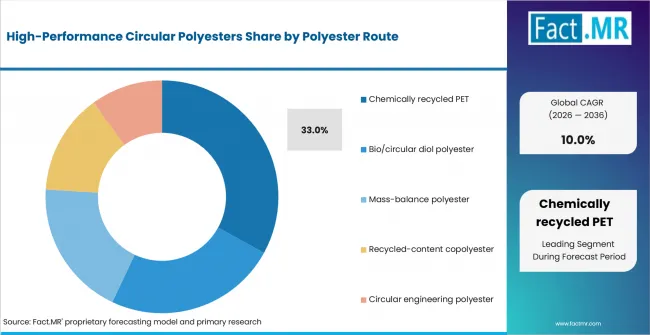
High Performance Circular Polyesters Analysis By Polyester Route | Source: Fact.MR
Chemically recycled PET is expected to lead because depolymerization can return polyester waste to reusable molecular building blocks. Bio/circular diol polyester and mass-balance polyester are expected to broaden feedstock options. Recycled-content copolyester and circular engineering polyester are projected to serve applications requiring defined mechanical or thermal performance. Route selection is expected to depend on waste quality and the property target of the finished grade.
What leads the Feedstock segment?
Food-waste-derived diols are projected to account for 30.0% share in 2026.
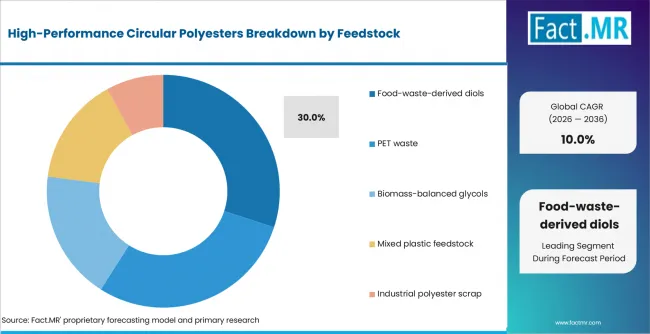
High Performance Circular Polyesters Analysis By Feedstock | Source: Fact.MR
Food-waste-derived diols are projected to lead because they create a circular route beyond post-consumer PET. PET waste remains central to packaging and textile recycling. Biomass-balanced glycols are expected to support attributed renewable input while mixed plastic feedstock and industrial polyester scrap provide additional recovery routes. Feedstock choice is expected to influence purification needs and claim structure across commercial products.
How does Application shape demand?
Packaging is anticipated to hold 40.0% share in 2026.
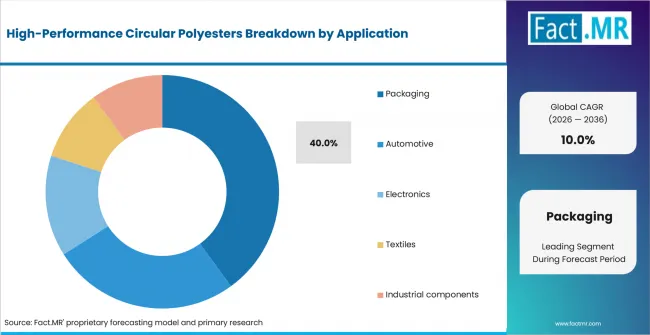
High Performance Circular Polyesters Analysis By Application | Source: Fact.MR
Packaging is anticipated to lead because PET already has a broad base in bottles and rigid formats. SK chemicals highlighted CLARO-CR70 in May 2025 as a grade delivering the same performance as CLARO while incorporating recycled content. This development is expected to support circular-material qualification where appearance and processing stability remain central.
What supports High IV / strength within Performance?
High IV / strength grades are estimated to represent 35.0% share in 2026.
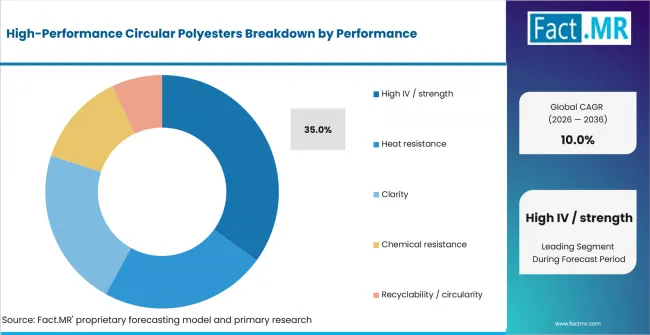
High Performance Circular Polyesters Analysis By Performance | Source: Fact.MR
High IV / strength grades are estimated to lead because circular applications require stable mechanical performance. Heat-resistant grades are expected to serve demanding thermal conditions. Clarity remains relevant to visible packaging while chemical resistance supports technical components. Recyclability and circularity features are expected to influence material selection across all four performance groups.
What is accelerating High-Performance Circular Polyesters Market adoption, and what is holding it back?
Recycled-content rules and feedstock recovery support adoption; feedstock quality and qualification effort shape the pace.
Drivers Impact Analysis
| DRIVER | (~) % IMPACT ON CAGR | GEOGRAPHIC RELEVANCE | IMPACT TIMELINE |
|---|---|---|---|
| Recycled-content and packaging circularity rules | +1.8% | Europe, East Asia, North America | Short term (<= 2 years) |
| Chemical recycling of difficult polyester streams | +1.4% | North America, Europe, East Asia | Medium term (2-4 years) |
| High-specification packaging and component demand | +1.1% | Global | Medium term (2-4 years) |
| Traceability and mass-balance adoption | +0.8% | Europe, North America, East Asia | Long term (>= 4 years) |
Opportunity Impact Analysis
| OPPORTUNITY | (~) % IMPACT ON CAGR | GEOGRAPHIC RELEVANCE | IMPACT TIMELINE |
|---|---|---|---|
| Textile-to-textile polyester recycling | +1.2% | Europe, East Asia | Medium term (2-4 years) |
| Food-contact and high-clarity circular PET | +1.0% | Global | Short term (<= 2 years) |
| Circular automotive and electronics components | +0.8% | Germany, Japan, South Korea, USA | Long term (>= 4 years) |
Restraints Impact Analysis
| RESTRAINT | (~) % IMPACT ON CAGR | GEOGRAPHIC RELEVANCE | IMPACT TIMELINE |
|---|---|---|---|
| Feedstock contamination and inconsistent waste quality | -0.7% | Global | Short term (<= 2 years) |
| Cost of depolymerization, purification and certification | -0.6% | Global | Medium term (2-4 years) |
| Application requalification and claim documentation | -0.4% | Europe, North America, East Asia | Medium term (2-4 years) |
Which countries are scaling the High-Performance Circular Polyesters Market through 2036?
- The country comparison spans 3.2 percentage points from South Korea at 11.5% to Japan at 8.3%.
- South Korea remains 1.2 percentage points above the USA alongside policy measures targeting recycled-material use among large beverage PET users.
- The USA remains 0.7 percentage point above Italy as molecular recycling capacity broadens circular polyester qualification.
- Italy remains 0.6 percentage point above Germany reflecting broad circular-material use across manufacturing.
- Germany remains 0.7 percentage point above Japan through established packaging recovery and technical polymer qualification.
- Japan closes the displayed range through PET collection and design-for-recycling policy.
Comparable CAGRs can create different entry conditions due to feedstock quality and local recovery systems. Full report coverage includes North America; Latin America; Western Europe; Eastern Europe; East Asia; South Asia & Pacific; and Middle East & Africa.
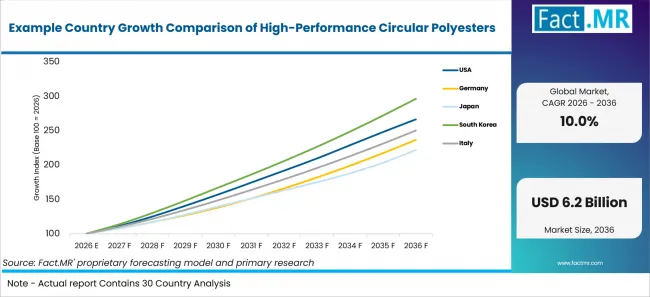
Example Country Growth Comparison Of High Performance Circular Polyesters | Source: Fact.MR
| Country | CAGR (2026-2036) |
|---|---|
| South Korea | 11.5% |
| USA | 10.3% |
| Italy | 9.6% |
| Germany | 9.0% |
| Japan | 8.3% |
How is South Korea scaling demand?
11.5% CAGR, supported by policy measures to expand recycled-material use and domestic circular-material development.
South Korea’s beverage packaging market is expected to create a direct qualification route for circular PET and related high-performance polyester grades. In February 2025, the Ministry of Environment announced a legislative notice proposing to shift recycled-plastic raw-material obligations to bottled-water and other non-alcoholic beverage manufacturers using more than 5,000 tons of PET annually. The 11.5% CAGR is projected to reflect this policy direction and domestic circular-material development. Suppliers with traceable feedstock and repeatable mechanical performance are expected to gain broader use across packaging and technical applications.
What supports USA adoption?
10.3% CAGR, led by molecular recycling investment and high-specification packaging demand.
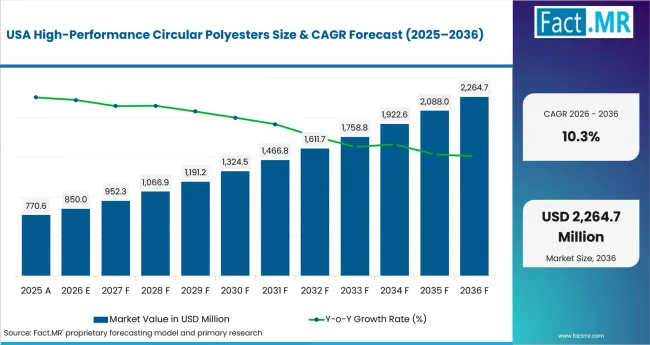
High Performance Circular Polyesters Country Value Analysis | Source: Fact.MR
U.S. packaging converters are expected to favor circular polyester where recovered feedstock can retain clarity and intrinsic viscosity while meeting food-contact performance. The U.S. Department of Energy lists Eastman Chemical Company's Polyethylene Terephthalate Recycling Decarbonization Project in Longview, Texas, with a federal cost share of up to USD 375 million; the planned molecular-recycling facility is designed to convert hard-to-recycle polyester waste into virgin-quality PET. The 10.3% CAGR is projected to reflect molecular recycling scale-up and higher-value packaging applications. Resin producers that pair feedstock recovery with stable specification control are expected to gain wider qualification across packaging and technical uses.
What supports Italy adoption?
9.6% CAGR, backed by high circular material use and packaging recovery.
Italy’s converters are expected to benefit from a manufacturing base that already uses secondary materials across multiple value chains. Eurostat reported in November 2025 that Italy’s circular material use rate reached 21.6% in 2024. The 9.6% CAGR is anticipated to reflect packaging recovery and wider circular-material integration. Polyester suppliers that maintain clarity and mechanical consistency are expected to gain qualification across packaging and industrial applications.
What supports Germany adoption?
9.0% CAGR, driven by packaging recovery and industrial polymer qualification.
Germany’s packaging and industrial users are expected to place greater weight on circular polyester that combines traceable feedstock with stable processing. The German Environment Agency reported in May 2026 that the recycling rate for packaging reached 69.4% in 2023. The 9.0% CAGR is projected to benefit from established converter capability and application testing in automotive and electronics. Suppliers that translate recovered polyester into consistent resin properties are expected to move more easily through technical qualification.
How is Japan developing demand?
8.3% CAGR, shaped by PET collection and design-for-recycling policy.
Japan’s packaging system is expected to favor polyester grades designed around clear recovery pathways and repeatable bottle-to-bottle performance. The Ministry of Economy, Trade and Industry reported in February 2026 that 41 plastic-product designs received the first certifications under the Plastic Resource Circulation Act. The 8.3% CAGR is forecast to reflect design-for-recycling policy and established PET collection. Material producers that combine high clarity with stable processing are expected to gain deeper acceptance in packaging and technical applications.
Who leads the High-Performance Circular Polyesters Market?
Eastman competes through polyester renewal technology, which uses methanolysis to depolymerize hard-to-recycle polyester waste into monomers for new materials, alongside recycled-content copolyester grades. SK chemicals adds chemically recycled copolyester capability based on depolymerization technology and production infrastructure spanning recycled BHET, PET and copolyester.
Indorama Ventures combines polyester recycling capabilities with polyester fiber operations. In November 2025, the company announced a joint venture with Jiaren Chemical Recycling designed to unlock up to 100,000 tonnes of textile-recycled PET spinning capacity annually. The initiative links chemical polyester recycling with the production of recycled PET for textile applications.
BASF contributes engineering-polyester expertise through its Ultradur® PBT portfolio and supports circular-material strategies through recycled-content, biomass-balance and mass-balance feedstock approaches. Toray Industries combines polyester-fiber and PET-film capabilities with recycling systems for PET-based fibers and films.
Across these portfolios, relevant competitive factors include access to suitable recycled feedstocks, recycling and depolymerization capabilities, material traceability, and the ability to maintain consistent processing and performance in packaging and technical applications.
Which companies are the key providers?
Key companies include Eastman; Indorama Ventures; SK chemicals; BASF; and Toray Industries.
- Eastman
- Indorama Ventures
- SK chemicals
- BASF
- Toray Industries
Bibliography
- Eurostat. (2025, October 22). Plastic packaging waste in the EU: 35.3 kg per person.
- SK chemicals. (2025, February 19). SK chemicals to establish waste plastic recycling innovation center in Korea.
- SK chemicals. (2025, May 15). SK chemicals strengthens position in cosmetics packaging with circular materials at China Beauty Expo.
- Ministry of Environment, Republic of Korea. (2025, February 20). Full-scale use of recycled materials in bottled water and beverage PET bottles.
- Eurostat. (2025, November 19). Over 12% of materials in the EU come from recycling.
- Indorama Ventures. (2025, November 11). Indorama Ventures’ Fibers business and Jiaren Chemical Recycling form joint venture to enhance global textile circularity.
- Toray Industries, Inc. (2025). Sustainability report 2025.
This Report Answers
- The report explains how circular polyester demand differs by route and feedstock origin. It connects the analysis with adjacent recycled polyester and circular polymers categories.
- Segment analysis identifies the principal subsegments and explains why chemically recycled PET and packaging carry the principal listed shares. Related material context includes recycled plastic resins and plastic chemical recycling catalysts.
- Country analysis compares the USA and four European or Asian markets using the stated CAGRs and country-specific recovery evidence. Packaging context is extended through sustainable plastic packaging and sustainable packaging coverage.
- Competitive analysis reviews six material companies across polyester recycling and circular feedstock development. Company positioning is discussed through technology and application capability.
- Application analysis considers qualification needs across packaging and technical uses. Adjacent demand is tracked through polyester film and recycled plastic categories.
What does the High-Performance Circular Polyesters Market cover?
The High-Performance Circular Polyesters Market covers polyester materials that use recovered or circular feedstock while retaining demanding application properties. The boundary includes routes aligned with bio-based polyester and biomass-balanced polymers where polyester chemistry and circular feedstock attribution overlap.
The assessment covers packaging and automotive applications alongside electronics and textiles. Industrial components are included where circular polyester must retain defined mechanical or thermal performance.
What is included in the scope?
The scope includes polyester resin and copolyester demand where circular feedstock or recycled content is a defined material attribute. Fiber-grade and film-grade polyester are covered alongside sheet and engineering grades when performance qualification is part of material selection.
What is excluded from the scope?
The market boundary focuses on polyester that carries recycled or circular feedstock attribution. Waste collection enters the assessment when it produces usable polyester feedstock. Adjacent polymers are considered only where they directly affect circular polyester qualification or application substitution.
How Was the Analysis Built?
The analysis draws on 120+ sources, 35+ company portfolios, 25+ countries, and more than 20 industry interviews.
- Primary Research: Primary research includes discussions with manufacturers, service providers, technology developers, distributors, end users, and subject-matter experts. These conversations examine purchasing priorities, product adoption, operational challenges, approval requirements, competitive positioning, and the factors that influence wider market acceptance.
- Desk Research: Desk research covers government statistics, regulatory publications, company filings, trade data, technical studies, industry associations, standards, public policy, and other authoritative sources. Every source used in the analysis is documented in the bibliography.
- Market Sizing and Forecasting: Market estimates combine historical performance, demand indicators, pricing and volume trends, segment shares, company participation, country-level growth, adoption patterns, investment activity, and barriers to market expansion.
- Data Validation and Update Cycle: Findings are validated by comparing primary interviews with public data, company activity, regulatory changes, trade patterns, and industry developments. Regular updates review new product launches, capacity changes, partnerships, approvals, and shifts in commercial adoption.
What is the report’s scope and coverage?
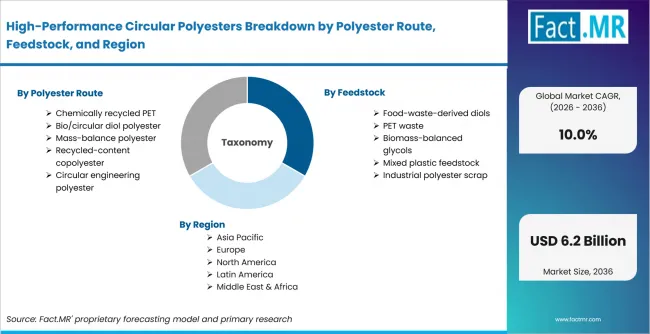
High Performance Circular Polyesters Breakdown By Polyester Route, Feedstock, And Region | Source: Fact.MR
| Attribute | Details |
|---|---|
| Quantitative Units | USD billion |
| Market Definition | High-performance polyester materials using recycled or circular feedstocks while retaining application-relevant strength, viscosity, clarity, heat resistance, chemical resistance, or recyclability. |
| Polyester Route | Chemically recycled PET; Bio/circular diol polyester; Mass-balance polyester; Recycled-content copolyester; Circular engineering polyester |
| Feedstock | Food-waste-derived diols; PET waste; Biomass-balanced glycols; Mixed plastic feedstock; Industrial polyester scrap |
| Application | Packaging; Automotive; Electronics; Textiles; Industrial components |
| Performance | High IV / strength; Heat resistance; Clarity; Chemical resistance; Recyclability / circularity |
| Regions Covered | North America; Latin America; Western Europe; Eastern Europe; East Asia; South Asia & Pacific; Middle East & Africa |
| Countries Covered | USA; Germany; Japan; South Korea; Italy |
| Companies Profiled | Eastman; Indorama Ventures; SK chemicals; BASF; Toray Industries |
| Forecast Period | 2026 to 2036 |
| Approach | Hybrid top-down and bottom-up assessment using polyester route; circular feedstock availability; application qualification; performance requirements; recycling infrastructure; regulation; and provider portfolio review. |
How is the market segmented?
-
By Polyester Route
- Chemically recycled PET
- Bio/circular diol polyester
- Mass-balance polyester
- Recycled-content copolyester
- Circular engineering polyester
-
By Feedstock
- Food-waste-derived diols
- PET waste
- Biomass-balanced glycols
- Mixed plastic feedstock
- Industrial polyester scrap
-
By Application
- Packaging
- Automotive
- Electronics
- Textiles
- Industrial components
-
By Performance
- High IV / strength
- Heat resistance
- Clarity
- Chemical resistance
- Recyclability / circularity
-
By Region
- North America
- Latin America
- Western Europe
- Eastern Europe
- East Asia
- South Asia & Pacific
- Middle East & Africa