- Market Value (2025): USD 363.3 Mn
- Estimated Value (2026): USD 384.7 Mn
- Forecast Value (2036): USD 681.2 Mn
- CAGR (2026-2036): 5.9%
What is the High Purity Germanium Market forecast to be worth by 2036?
USD 384.7 million in 2026 to USD 681.2 million by 2036 at a 5.9% CAGR.
- As per the Fact.MR market analysis, the high purity germanium market was valued at USD 363.3 million in 2025.
- Demand is forecast to increase from USD 384.7 million in 2026 to USD 681.2 million by 2036.
- The forecast records a 5.9% CAGR from 2026 to 2036, reflecting demand for high-purity materials used in radiation detection, semiconductor manufacturing, and infrared optical systems.
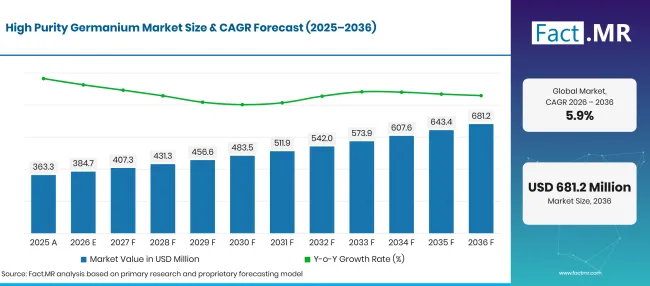
High Purity Germanium Market Forecast Global | Source: Fact.MR
| Year | Basis | Market Value (USD million) |
|---|---|---|
| 2025 | Estimated | 363.3 |
| 2026 | Estimate | 384.7 |
| 2036 | Forecast | 681.2 |
| CAGR 2026 to 2036 | Forecast period | 5.9% |
Source: Fact.MR analysis. Updated Oct 27, 2026
What are the defining numbers behind High Purity Germanium Market growth?
USD 296.5 million absolute opportunity between 2026 and 2036.
- Demand Drivers in the Market
- Radiation detection requirements drive the demand for high purity germanium due to its excellent energy resolution and ability to identify gamma rays accurately in nuclear monitoring and scientific research applications. High-purity germanium detectors are used for gamma-ray spectroscopy and applications requiring high-resolution radiation measurement. The U.S. Geological Survey’s Mineral Commodity Summaries 2026 identifies high-purity germanium radiation detectors as an established use of germanium metal [1]. [1]
- Semiconductor and optical applications drive the market as high purity germanium supports specialized electronic components and infrared optical systems that require precise material properties and reliable performance.
- Research and specialist equipment drive the market as high purity germanium is used in advanced scientific instruments and analytical systems that require accurate radiation detection and reliable measurement performance. Research laboratories and specialist equipment makers require materials that meet specific purity, crystal, and detector-performance requirements.
- Key Segments Analyzed
- By Product Type: Crystals will account for 48.5% of the market in 2026, reflecting the importance of crystal material for detector and specialist semiconductor applications.
- By Application: Radiation Detection leads the market with 25.4% share in 2026.
- By End-User Industry: Electronics holds 35.6% share in 2026, supported by the use of germanium in specialised electronic and optical systems.
- Analyst Opinion at Fact.MR
- Shambhu Nath Jha, Principal Consultant at Fact.MR, states, “High-purity germanium demand is closely linked to the performance requirements of specialised detectors, optical systems, and semiconductor applications. Buyers need consistent material quality and traceable specifications because impurities and crystal characteristics can affect device performance. Reliable supply and application-specific processing remain important considerations for manufacturers.”
- Strategic Implications
- Material producers should focus on documented purity grades, traceability, consistent crystal quality, and reliable delivery.
- Detector manufacturers can assess crystal specifications against energy resolution, detector geometry, and operating requirements.
- Semiconductor and optical suppliers must evaluate germanium products based on their electrical, thermal, and infrared optical properties.
- Research institutions specify material characteristics that match their measurement or experimental requirements.
- Procurement teams prioritize supply reliability through diversified sourcing, recycling opportunities and long-term material availability while balancing cost considerations.
Germany is set to record a 7.6% CAGR through 2036. Brazil is forecast to post 6.9%, followed by the USA at 6.3%. The UK is estimated to advance at 5.6%, while Japan is forecast at 5.0%.
How does the High Purity Germanium Market break down by segment?
Fact.MR analysis based on the segmentation identifies Crystals as the leading Product Type at 48.5%, Radiation Detection as the leading Application at 25.4%, and Electronics as the leading End-User Industry at 35.6% in 2026.
Which Product Type dominates?
Crystals are set to hold a 48.5% share in 2026.
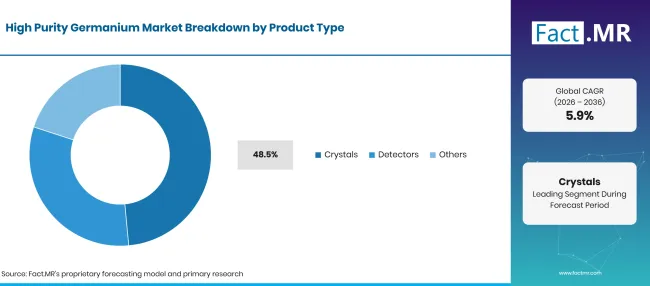
High Purity Germanium Market Breakdown Product Type | Source: Fact.MR
| Product Type | Share (2026) |
|---|---|
| Crystals (Leading segment) | 48.5% |
| Other segments combined | 51.5%* |
| Total | 100.0% |
Source: Fact.MR analysis. Updated Oct 27, 2026
High-purity germanium crystals are used in specialised detector and semiconductor applications where material quality affects performance. Crystal growth and processing require control over purity and material properties. Detectors and other product categories serve different roles in the value chain, and their market shares depend on the precise product classification used in the underlying market model.
What leads the Application segment?
Radiation Detection is set to represent 25.4% share in 2026.
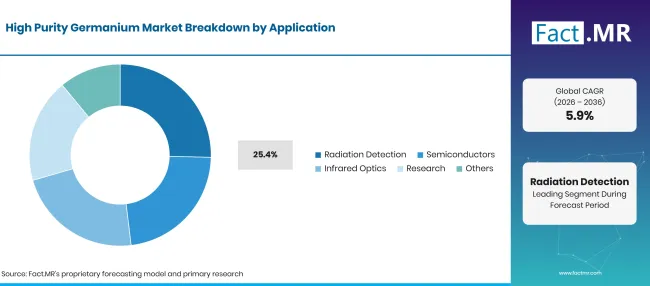
High Purity Germanium Market Breakdown Application | Source: Fact.MR
| Application | Share (2026) |
|---|---|
| Radiation Detection (Leading segment) | 25.4% |
| Other segments combined | 74.6%* |
| Total | 100.0% |
Source: Fact.MR analysis. Updated Oct 27, 2026
The radiation detection segment leads the high purity germanium market due to its superior energy resolution and high accuracy in identifying gamma rays. Demand from nuclear facilities and environmental monitoring programs further supports segment growth alongside applications in nuclear security and scientific research. High-purity germanium is used in radiation detectors that measure gamma-ray energies with high resolution. Semiconductor applications, infrared optics, research, and other uses create additional demand, but each application requires its own material and performance specifications.
How does End-User Industry shape demand?
Electronics is likely to account for 35.6% share in 2026.
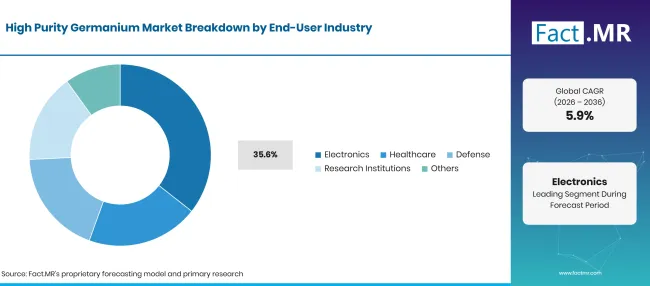
High Purity Germanium Market Breakdown End User Industry | Source: Fact.MR
| End-User Industry | Share (2026) |
|---|---|
| Electronics (Leading segment) | 35.6% |
| Other segments combined | 64.4%* |
| Total | 100.0% |
Source: Fact.MR analysis. Updated Oct 27, 2026
Electronics-related demand includes specialised semiconductor and optical applications where germanium’s properties offer benefits in specific devices. Healthcare, defense, and research institutions also use equipment and systems that may incorporate germanium-based products. The relevance of each end-user depends on the specific device, material grade, and application; not every electronic or radiation-related product uses high-purity germanium.
What is accelerating High Purity Germanium Market adoption, and what is holding it back?
Demand is supported by specialised detector systems and semiconductor technologies as well as infrared optical applications, while concentrated supply and complex processing requirements create procurement challenges.
Drivers Impact Analysis
| DRIVER | (~) % IMPACT ON CAGR | GEOGRAPHIC RELEVANCE | IMPACT TIMELINE |
|---|---|---|---|
| Demand for high-resolution radiation detectors | +1.0% | Global | Medium term (2–4 years) |
| Specialised semiconductor applications | +0.9% | Asia, Europe, Americas | Medium term (2–4 years) |
| Infrared optics and sensing systems | +0.7% | Global | Medium term (2–4 years) |
| Research and scientific instrumentation | +0.5% | Global | Long term (≥ 4 years) |
| Material recovery and recycling | +0.4% | Europe, Americas, Asia | Long term (≥ 4 years) |
Source: Fact.MR analysis. Updated Oct 27, 2026
Opportunity Impact Analysis
| OPPORTUNITY | (~) % IMPACT ON CAGR | GEOGRAPHIC RELEVANCE | IMPACT TIMELINE |
|---|---|---|---|
| High-purity crystal processing | +0.8% | Global | Medium term (2–4 years) |
| Detector-grade material supply | +0.7% | Global | Medium term (2–4 years) |
| Infrared optical component demand | +0.6% | Americas, Europe, Asia | Long term (≥ 4 years) |
| Recovery from manufacturing scrap | +0.5% | Global | Long term (≥ 4 years) |
| Supply-chain diversification | +0.4% | Europe, Americas, Asia | Medium term (2–4 years) |
Source: Fact.MR analysis. Updated Oct 27, 2026
Restraints Impact Analysis
| RESTRAINT | (~) % IMPACT ON CAGR | GEOGRAPHIC RELEVANCE | IMPACT TIMELINE |
|---|---|---|---|
| Concentrated supply and trade restrictions | -0.8% | Global | Short term (≤ 2 years) |
| High-purity processing requirements | -0.6% | Global | Medium term (2–4 years) |
| Limited public production data | -0.4% | Global | Short term (≤ 2 years) |
| High material and processing costs | -0.5% | Global | Medium term (2–4 years) |
| Application-specific qualification requirements | -0.4% | Global | Long term (≥ 4 years) |
Source: Fact.MR analysis. Updated Oct 27, 2026
Which countries are scaling the High Purity Germanium Market through 2036?
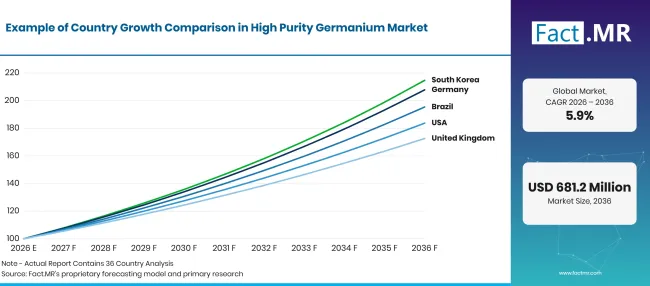
High Purity Germanium Market Growth Index | Source: Fact.MR
| Country | CAGR (2026–2036) |
|---|---|
| Germany | 7.6% |
| Brazil | 6.9% |
| USA | 6.3% |
| UK | 5.6% |
| Japan | 5.0% |
Source: Fact.MR analysis. Updated Oct 27, 2026
What supports adoption in Germany?
7.6% CAGR, supported by the country’s industrial electronics and optical technology base.
Germany’s position in the high purity germanium market is supported by its advanced semiconductor and precision engineering industries, established scientific research infrastructure and demand for high-performance radiation detection equipment. Investments in nuclear research and industrial measurement technologies further support the use of high purity germanium in specialized applications. On October 19, 2026, Germany’s Federal Statistical Office reported that the price-adjusted order backlog for computers, electronic and optical products increased by 1.4% in August 2026 compared with July 2026 after seasonal and calendar adjustment [2]. This is a wider sector indicator, not a measure of germanium demand. [2]
How is Brazil developing high-purity germanium adoption?
6.9% CAGR, driven by potential demand from specialised electronics and research applications.
Potential Brazilian applications for high-purity germanium include gamma-ray spectroscopy, radiation monitoring and scientific instrumentation; Brazil-specific demand growth requires separate market evidence. Applications in medical research and industrial inspection further contribute to demand for high-resolution radiation detection equipment. Brazil’s potential demand depends on investment in electronics, scientific instrumentation, and specialist equipment rather than on a broad consumer-electronics relationship with germanium alone.
What supports adoption in the United States?
6.3% CAGR, shaped by established applications in radiation detection and specialised semiconductor materials.
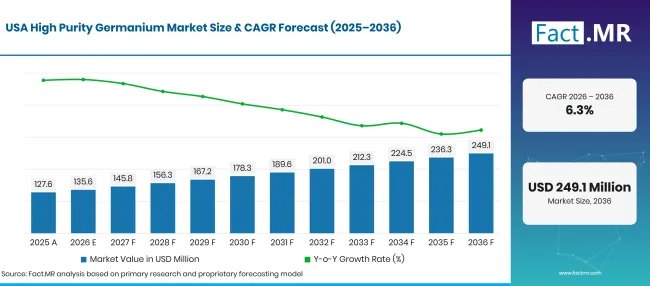
High Purity Germanium Market Forecast Usa | Source: Fact.MR
Germanium is used in radiation detectors, semiconductor applications and infrared optics, as described by the USGS [1]. The forecast growth rate of the narrower U.S. high-purity germanium market remains an estimate based on the Fact.MR market model. Federal research programs and demand from national laboratories also support the adoption of high purity germanium detectors for nuclear monitoring and scientific applications.
How is the United Kingdom building adoption?
5.6% CAGR, led by the UK's nuclear research capabilities and demand for advanced radiation monitoring equipment in scientific and industrial applications.
The UK Department for Science, Innovation and Technology’s Semiconductor Sector Study 2026 identified 703 companies active in the UK semiconductor sector, comprising 295 dedicated and 408 diversified companies. It estimated £10.6 billion in revenue and approximately 16,350 employees at dedicated companies in 2025 [3]. These values concern the wider semiconductor industry, not high-purity germanium demand. [3]
What supports adoption in Japan?
5.0% CAGR, backed by Japan’s role in specialised electronics and materials manufacturing.
Japan’s high purity germanium market is supported by its advanced electronics industry and strong capabilities in semiconductor research and precision instrumentation. Demand for high-resolution radiation detectors in nuclear safety monitoring and scientific research further supports market growth alongside investments in specialized measurement technologies.
Who leads the High Purity Germanium Market?
Companies active in germanium-related materials, semiconductor products and advanced-materials processing may participate in the wider value chain. Direct competition in detector-grade high-purity germanium requires manufacturer-level evidence of grade, format and commercial supply.
Umicore is associated with germanium materials and specialised materials processing. Indium Corporation supplies advanced materials for electronics and semiconductor-related applications. Teck Resources is relevant to the wider metals and materials supply chain, but its inclusion as a direct supplier of high-purity germanium products needs product-level confirmation. 5N Plus operates in specialty semiconductors and performance materials, while AXT focuses on compound semiconductor substrates; its inclusion should be verified against the specific germanium product category being measured.
Commercial competition depends on purity specifications, crystal quality, processing capabilities, material traceability, supply continuity, and qualification requirements. Customers in radiation detection and semiconductor applications may require different material formats and performance characteristics.
Which companies are the key providers?
The key companies include:
- Umicore NV/SA
- Indium Corporation
- Teck Resources Limited
- 5N Plus Inc.
- AXT, Inc.
Bibliography
- [1] U.S. Geological Survey. (2026, May 27). Germanium. In Mineral commodity summaries 2026 (Version 1.3). U.S. Geological Survey. https://pubs.usgs.gov/periodicals/mcs2026/mcs2026-germanium.pdfUSGS Germanium chapter
- [2] Statistisches Bundesamt (Destatis). (2026, October 19). Stock of orders in manufacturing in August 2026: +0.5% on the previous month. Destatis release
- [3] Department for Science, Innovation and Technology. (2026, September 2). Semiconductor sector study 2026. GOV.UK. https://www.gov.uk/government/publications/semiconductor-sector-study-2026/semiconductor-sector-study-2026Semiconductor sector study 2026Semiconductor sector study 2026Semiconductor sector study 2026
- [4] U.S. Geological Survey. (2025). About the 2025 list of critical minerals.
- [5] European Commission. (2026, February 9). EU invests €700 million in newly opened NanoIC, Europe’s largest Chips Act pilot line.
- [6] European Commission. (2026, June 3). Proposal for the Chips Act 2.0.
This Report Answers
- The report describes high-purity germanium materials and their use in radiation detection, semiconductors, infrared optics, and research.
- Segment analysis compares the specified product types, applications, and end-user industries using the 2026 shares.
- Country analysis discusses Germany, Brazil, the USA, the UK, and Japan alongside official indicators relevant to germanium supply and related industrial sectors.
- The competitive overview covers Umicore NV/SA, Indium Corporation, Teck Resources Limited, 5N Plus Inc., and AXT, Inc., subject to verification of direct product-market participation.
- The report examines demand drivers, opportunities, and restraints associated with specialised material quality and supply.
What does the High Purity Germanium Market cover?
The market covers high-purity germanium materials and products used in specialised detector, semiconductor, infrared optical, and research applications. It follows the segmentation across crystals, detectors, and other product types. Product specifications and intended use are important because not all germanium materials meet the purity and performance requirements of high-purity applications.
What is included in the scope?
Included products are high-purity germanium materials and relevant products intended for radiation detection, semiconductor applications, infrared optics, and research. The analysis considers purity, crystal quality, application requirements, supply availability, and the role of specialist material suppliers. The market values, segment shares, and country CAGRs form the numerical basis of this draft.
What is excluded from the scope?
The analysis excludes ordinary germanium materials that do not meet the defined high-purity requirements, as well as unrelated metals and semiconductor materials. General-purpose electronic devices are outside the market boundary unless their value is specifically included in the underlying high-purity germanium market model. Other germanium end uses, such as fiber-optic materials or catalysts, should be included only where they meet the report’s product definition and valuation methodology.
How Was the Analysis Built?
The analysis draws on 120+ sources, 35+ company portfolios, 25+ countries, and more than 20 industry interviews.
- Primary Research: Primary research includes discussions with manufacturers, service providers, technology developers, distributors, end users, and subject-matter experts. These conversations examine purchasing priorities, product adoption, operational challenges, approval requirements, competitive positioning, and the factors that influence wider market acceptance.
- Desk Research: Desk research covers government statistics, regulatory publications, company filings, trade data, technical studies, industry associations, standards, public policy, and other authoritative sources. Every source used in the analysis is documented in the bibliography.
- Market Sizing and Forecasting: Market estimates combine historical performance, demand indicators, pricing and volume trends, segment shares, company participation, country-level growth, adoption patterns, investment activity, and barriers to market expansion.
- Data Validation and Update Cycle: Findings are validated by comparing primary interviews with public data, company activity, regulatory changes, trade patterns, and industry developments. Regular updates review new product launches, capacity changes, partnerships, approvals, and shifts in commercial adoption.
Segmentation
What is the report’s scope and coverage?
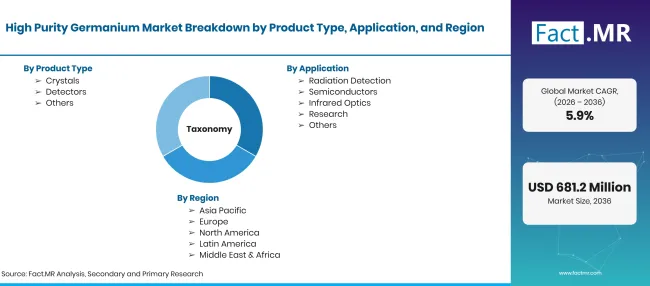
High Purity Germanium Market Taxonomy | Source: Fact.MR
| Attribute | Details |
|---|---|
| Quantitative Units | USD million in 2026 to USD million by 2036, at CAGR |
| Market Definition | The high purity germanium market comprises high-purity germanium materials and products used in radiation detection and semiconductor applications, along with infrared optics and scientific research. The market includes specialized germanium crystals and components designed to meet stringent purity requirements and deliver reliable electrical performance and precise radiation measurement. |
| Product Type | Crystals; Detectors; Others |
| Application | Radiation Detection; Semiconductors; Infrared Optics; Research; Others |
| End-User Industry | Electronics; Healthcare; Defense; Research Institutions; Others |
| Regions Covered | North America; Latin America; Western Europe; Eastern Europe; East Asia; South Asia & Pacific; Middle East & Africa |
| Countries Covered | Germany; Brazil; USA; UK; Japan |
| Companies Profiled | Umicore NV/SA; Indium Corporation; Teck Resources Limited; 5N Plus Inc.; AXT, Inc. |
| Forecast Period | 2026 to 2036 |
| Approach | Market segmentation and scenario-based analysis supported by official mineral, manufacturing, and semiconductor-sector indicators |
Source: Fact.MR analysis. Updated Oct 27, 2026
How is the market segmented?
-
By Product Type
- Crystals
- Detectors
- Others
-
By Application
- Radiation Detection
- Semiconductors
- Infrared Optics
- Research
- Others
-
By End-User Industry
- Electronics
- Healthcare
- Defense
- Research Institutions
- Others
-
By Region
- North America
- Latin America
- Western Europe
- Eastern Europe
- East Asia
- South Asia & Pacific
- Middle East & Africa
Frequently Asked Questions
How big is the High Purity Germanium Market in 2026?
What is the CAGR from 2026 to 2036?
Which product type has the largest share?
Which application leads?
Which end-user industry has the largest share?
Which country has the fastest CAGR?
Which companies are covered?
Who worked on this report


Preview the report firsthand - request a free sample
Free SampleGet the brochure for pricing and purchase details
Download PDF