- Base Value(2025): 4.8 Bn
- Estimated Value(2026): 5.2 Bn
- Forecast Value (2036): 10.6 Bn
- CAGR (2026 - 2036): 7.4%
High Purity E-Grade Acid Market Forecast and Outlook By Fact.MR
The high purity E-grade acid market was valued at USD 4.8 billion in 2025. The market is projected to reach USD 5.2 billion in 2026 and USD 10.6 billion by 2036, expanding at a CAGR of 7.4% during the forecast period. Sulfuric acid is expected to lead acid type with a 36.9% share in 2026. UP-S grade is projected to remain the leading purity grade with a 41.2% share in 2026. Semiconductor cleaning is expected to lead application demand with a 46.5% share in 2026.
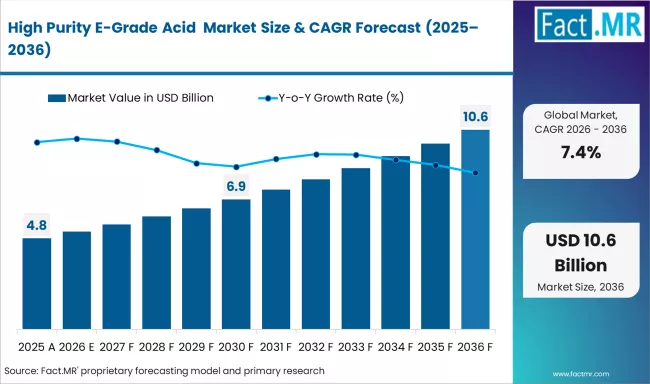
High Purity E Grade Acid Market Market Value Analysis | Source: Fact.MR
Key Drivers
- Fab expansion: New semiconductor capacity is increasing consumption of ultra-pure wet chemicals.
- Contamination control: Advanced nodes need acid purity tight enough to limit yield loss from trace impurities.
- Regional resilience: Europe and Asia are adding local chemical capacity to reduce supply-chain dependence.
Key Segments Analyzed in the Report
- Product type: sulfuric acid, hydrochloric acid, nitric acid, phosphoric acid, and others
- Workflow: UP-S, UP-SS, UP-SSS, and others
- End user: semiconductor cleaning, etching, wafer processing, display and electronics, and others
- Region: North America, Latin America, Europe, Asia Pacific, and Middle East and Africa
Analyst Opinion
Shambhu Nath Jha, Principal Consultant, Fact.MR opines, "This market rewards suppliers that can hold purity consistency at scale and stay close to fabrication clusters. Chemical volume matters, but the real differentiator is contamination discipline tied to reliable regional supply."
High Purity E-Grade Acid Market Definition
The high purity E-grade acid market includes ultra-pure mineral acids manufactured for semiconductor, electronics, and related precision cleaning applications where trace-metal contamination must be tightly controlled. It covers sulfuric acid, hydrochloric acid, nitric acid, phosphoric acid, and associated specialty acid systems supplied in electronic grades across multiple purity levels. These materials serve wafer fabs, semiconductor chemical formulators, display makers, and advanced electronics manufacturers engaged in wet-process steps and cleanroom production.
High Purity E-Grade Acid Market Inclusions
- Electronic grade acids sold for semiconductor and advanced-electronics processing
- Revenue generated from ultra-pure acid grades used in cleaning, etching, and wafer handling
- Demand across North America, Latin America, Europe, Asia Pacific, and Middle East and Africa
High Purity E-Grade Acid Market Exclusions
- Commodity industrial acids with no semiconductor-grade specification
- Finished semiconductor device sales
- Wet chemicals outside acid-class materials, except as process context
High Purity E-Grade Acid Market Research Methodology
This study evaluates the high purity E-grade acid market across acid type, purity grade, application, and region, with 2025 as the base year and forecasts extending from 2026 to 2036. Market value is expressed in USD billion. The assessment incorporates fab investment trends, company annual reports, semiconductor chemical expansion announcements, electronic-material revenue disclosures, and technical references on ultra-pure chemical handling. Triangulation aligns wafer-capacity growth, wet-bench chemical intensity, purity requirements, and supplier expansion activity to produce the market estimates.
Key Drivers, Restraints, and Trends in High Purity E-Grade Acid Market
Drivers
Semiconductor fabrication expansion is directly increasing demand for ultra-pure acids because cleaning and surface-preparation steps remain chemical-intensive. BASF announced in 2025 that it is building new semiconductor-grade sulfuric acid capacity in Ludwigshafen to serve Europe’s growing chip industry. That move is a strong signal that regional fabs need secure access to electronic chemicals close to production sites. Stella Chemifa’s fiscal 2025 results also show the semiconductor segment remains central to its high-purity chemical business, which confirms the demand base is structural, not temporary.
Restraints
Qualification cycles are long because fabs do not switch chemical suppliers casually. Purity failures can translate into yield damage, which raises approval barriers. Capital intensity is high because ultra-pure production needs specialized handling and contamination control. Geographic concentration also remains a risk when fabs and chemical plants cluster in a few regions. Logistics discipline is critical from plant to point of use.
Trends
Regional supply-chain localization is gathering speed. BASF’s investment case is explicitly tied to European semiconductor resilience. Japanese suppliers such as Stella Chemifa keep emphasizing semiconductor-linked high-purity chemicals in their medium-term plans. The market is also moving toward tighter integration between bulk chemical supply, on-site management, and customer qualification support.
Segmental Analysis
High Purity E-Grade Acid Market Analysis by Product Type
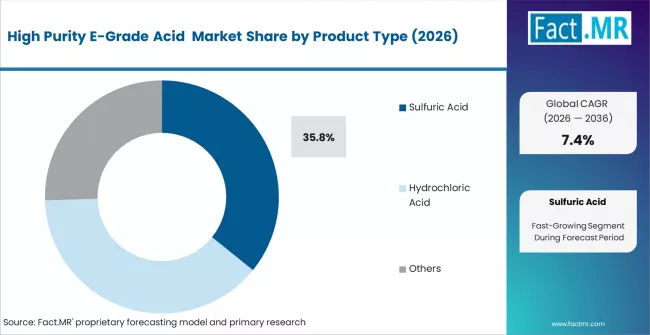
High Purity E Grade Acid Market Analysis By Product Type | Source: Fact.MR
Sulfuric acid is likely to hold 35.8% share in 2026 because it is deeply embedded in wafer cleaning flows and is used in large-volume ultra-pure chemical sequences. Demand is strong where fabs operate at scale and contamination windows are tight. BASF’s 2025 decision to build new semiconductor-grade sulfuric acid capacity in Germany underscores sulfuric acid’s central role in future electronic-chemical supply. That is a direct industrial signal, not a speculative indicator.
High Purity E-Grade Acid Market Analysis by Workflow
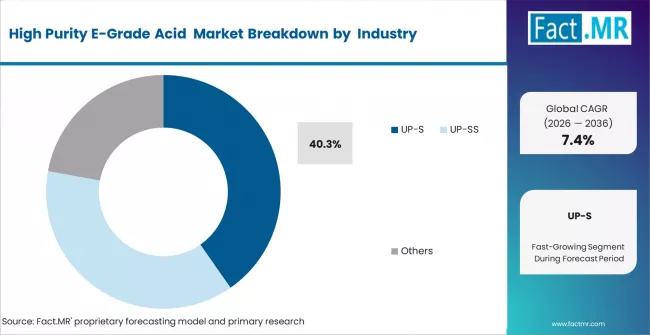
High Purity E Grade Acid Market Analysis By Workflow | Source: Fact.MR
UP-S grade is likely to account for 40.3% share in 2026 because large-volume semiconductor processes still rely on very high purity without always requiring the most extreme premium grade for every step. It solves the core need for cleanliness, repeatability, and manageable cost across mainstream wet processing. Suppliers scale this grade more broadly across fabs, which keeps it commercially dominant. Stella Chemifa’s revenue mix in high-purity chemicals supports this volume-led structure.
Competitive Aligners for Market Players
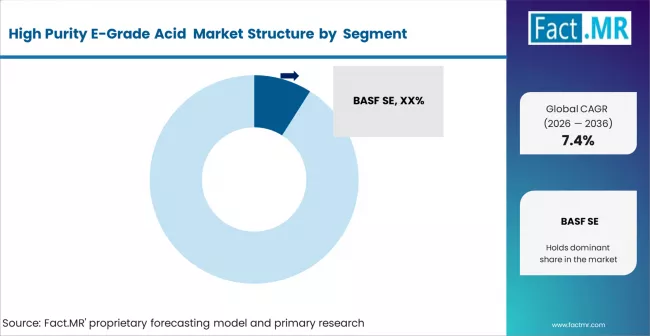
High Purity E Grade Acid Market Analysis By Company | Source: Fact.MR
Competitive advantage is not built on acid capacity alone. Buyers need purity consistency, logistics integrity, long qualification histories, and proximity to fabrication clusters. BASF is building local capacity in Germany to meet semiconductor demand and strengthen resilience in Europe. Stella Chemifa continues to anchor its business in high-purity chemicals linked to semiconductors and overseas sales expansion. Resonac remains relevant through electronic-material offerings tied to semiconductor manufacturing. Leadership is being built around supply assurance, qualification credibility, and the ability to serve fast-moving fab expansion without contamination drift.
Key Players in High Purity E-Grade Acid Market
- BASF SE
- Stella Chemifa Corporation
- Resonac Holdings Corporation
- Kanto Chemical Co., Inc.
- Entegris, Inc.
- Solvay S.A.
- Tokuyama Corporation
- OCI Company Ltd.
- Avantor, Inc.
- Mitsubishi Gas Chemical Company, Inc.
Strategic Outlook by Fact.MR on High Purity E-Grade Acid Market
The market is shifting toward localized ultra-pure chemical supply built around semiconductor cluster growth. Through 2036, the decisive factors will be fab additions, contamination tolerance, and supplier ability to qualify and deliver at scale. Companies with strong purification discipline, regional footprint, and long customer-approval histories will capture the best margins and stickiest accounts.
Bibliography
- BASF SE. 2025. BASF invests in new semiconductor-grade sulfuric acid facility.
- BASF SE. 2026. BASF Report 2025.
- Stella Chemifa Corporation. 2025. Business Results for FYE 3/2025.
- Stella Chemifa Corporation. 2025. Fourth Medium-Term Management Plan.
Segmentation
Scope of the Report
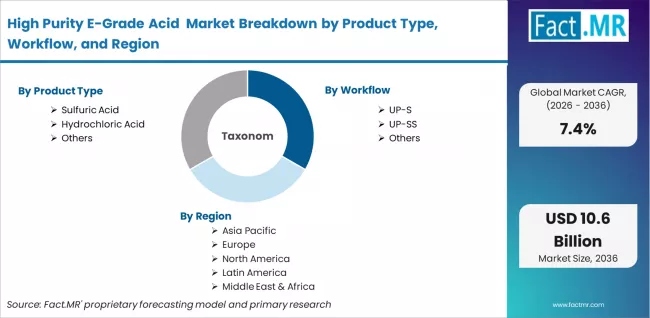
High Purity E Grade Acid Market Breakdown By Product Type, Workflow, And Region | Source: Fact.MR
| Metric | Value |
|---|---|
| Market Value | USD 4.8 billion in 2025 to USD 10.6 billion by 2036 |
| CAGR | 7.4% from 2026 to 2036 |
| Base Year | 2025 |
| Forecast Period | 2026 to 2036 |
| Product Type Segmentation | Sulfuric Acid, Hydrochloric Acid, Nitric Acid, Phosphoric Acid, Others |
| Workflow Segmentation | UP-S, UP-SS, UP-SSS, Others |
| End User Segmentation | Semiconductor Cleaning, Etching, Wafer Processing, Display and Electronics, Others |
| Regions Covered | North America, Latin America, Europe, Asia Pacific, Middle East and Africa |
Frequently Asked Questions
What is the projected size of the High Purity E-Grade Acid Market by 2036?
What is the CAGR of the High Purity E-Grade Acid Market from 2026 to 2036?
Which acid type leads the High Purity E-Grade Acid Market in 2026?
Which purity grade dominates the High Purity E-Grade Acid Market?
Which application leads the High Purity E-Grade Acid Market in 2026?
What is driving growth in the High Purity E-Grade Acid Market?
Who worked on this report


Preview the report firsthand - request a free sample
Free SampleGet the brochure for pricing and purchase details
Download PDF