- Market Value (2025): USD 1126.1 Mn
- Estimated Value (2026): USD 1250.0 Mn
- Forecast Value (2036): USD 3549.0 Mn
- CAGR (2026-2036): 11.0%
What is the High-Purity Lactic Acids Market forecast to be worth by 2036?
USD 1,250.0 million in 2026 to USD 3,549.0 million by 2036, at 11.0% CAGR.
- The high-purity lactic acids market reached USD 1,126.1 million in 2025.
- Demand is projected to increase from USD 1,250.0 million in 2026 to USD 3,549.0 million by 2036.
- The market is forecast to record 11.0% CAGR from 2026 to 2036 as polymer producers, food formulators and chemical processors qualify cleaner fermentation-based inputs.
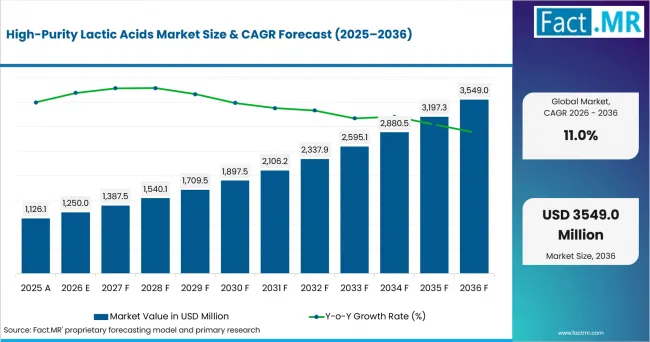
High Purity Lactic Acids Market Value Analysis | Source: Fact.MR
What are the defining numbers behind High-Purity Lactic Acids Market growth?
USD 2,299.0 million absolute opportunity by 2036, led by bio-based grade, fermentation, intermediate use and polymers.
- Demand Drivers in the Market
- Polymer producers need high optical purity and low residual impurities so PLA and lactide routes meet conversion and performance limits.
- Food ingredient manufacturers use purified lactic acid for acidity control where taste, labeling and microbial stability require tighter production control.
- Coating formulators evaluate lactic acid derivatives in solvent-replacement work where product teams need safer inputs with reliable application behavior.
- Feedstock planning is linked to starch availability. USDA ERS reported in January 2026 that the 2025/26 U.S. corn crop was elevated to 17.0 billion bushels.
- Key Segments Analyzed
- By Product: Bio-based grade is expected to hold 39.0% share in 2026 owing to use in PLA, food acidulants and clean-label industrial inputs.
- By Process: Fermentation is projected to account for 42.0% share in 2026 because it gives producers a practical route to L-lactic acid and bio-based documentation.
- By Function: Intermediate is anticipated to capture 35.0% share in 2026 since purified lactic acid feeds lactides, esters and specialty salts.
- By Application: Polymers are estimated to represent 37.0% share in 2026 as PLA users require stable monomer quality for resin consistency.
- Analyst Opinion at Fact.MR
- Shambhu Nath Jha, Principal Consultant at Fact.MR, states, “High-purity lactic acid is no longer evaluated only as an acidulant or commodity chemical. The market is expected to reward producers that combine fermentation reliability, tight purification control and clear documentation for polymer and food customers. Supply contracts are likely to favor producers with impurity control at scale and stable regional logistics.”
- Strategic Implications
- Producers should document optical purity, residual metals and microbial controls in a format technical teams can use during qualification.
- Polymer resin suppliers should lock consistent lactic acid grades early, since small impurity shifts affect lactide yield and PLA performance.
- Food ingredient teams should compare supplier audits and allergen controls with price and lead-time requirements.
- Regional distributors should build inventory plans around fermentation output cycles, import lead times and customer requalification windows.
The USA is projected to record 12.1% CAGR through 2036, supported by corn-based fermentation capacity and polymer demand. Germany is forecast to post 11.6% CAGR as chemical and plastics processing remain central to European industrial demand. Japan is anticipated to advance at 10.8% CAGR due to food export growth and specialty chemical discipline. France is estimated to reach 10.3% CAGR as food ingredients and bio-based polymer discussions shape purchasing. Brazil is projected to hold 9.9% CAGR as sugarcane feedstock depth and packaging policy support adoption.
How does the High-Purity Lactic Acids Market break down by segment?
Bio-based grade leads Product at 39.0%; Fermentation leads Process at 42.0%.
Which Product segment leads?
Bio-based grade is expected to hold 39.0% share in 2026.
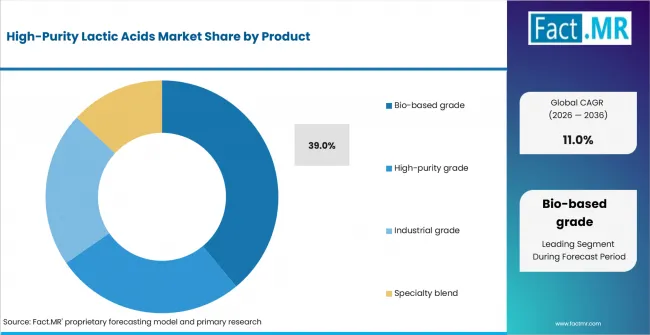
High Purity Lactic Acids Market Analysis By Product | Source: Fact.MR
Bio-based grade leads because customers want lactic acid that supports renewable-content claims while still meeting purity requirements. The segment is closely linked with PLA, food ingredients and bioplastics market applications where qualification depends on feedstock documentation and impurity control.
European Bioplastics reported in December 2025 that global biobased plastics production capacity is projected to rise from 2.31 million tonnes in 2025 to about 4.69 million tonnes by 2030.
What leads the Process segment?
Fermentation is projected to account for 42.0% share in 2026.
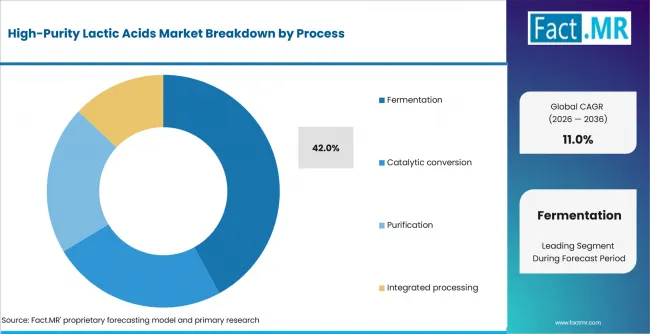
High Purity Lactic Acids Market Analysis By Process | Source: Fact.MR
Fermentation leads because it produces L-lactic acid from sugar or starch feedstocks through a route customers understand and audit. The process also aligns with renewable chemicals demand in food, polymer and industrial chemical applications.
Purification remains central to process economics. Fermentation creates the lactic acid base, while separation control determines whether a batch qualifies for polymer or regulated ingredient uses.
How does Function shape demand?
Intermediate is anticipated to capture 35.0% share in 2026.
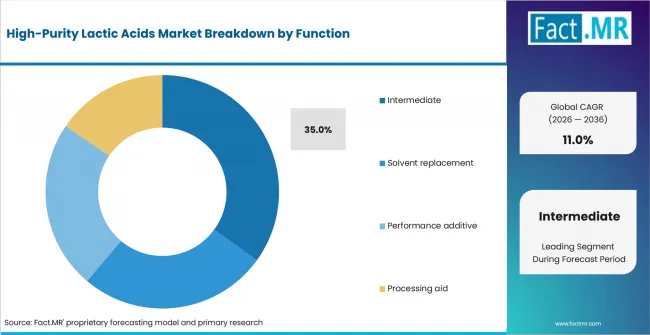
High Purity Lactic Acids Market Analysis By Function | Source: Fact.MR
Intermediate use leads because high-purity lactic acid is a building block for lactide, esters, salts and other downstream products. Processors value predictable purity because conversion yield and customer approvals depend on a stable chemical input.
Eurostat reported in December 2025 that the EU produced 224 million tonnes of chemicals in 2024.
What supports Application demand for Polymers?
Polymers are estimated to represent 37.0% share in 2026.
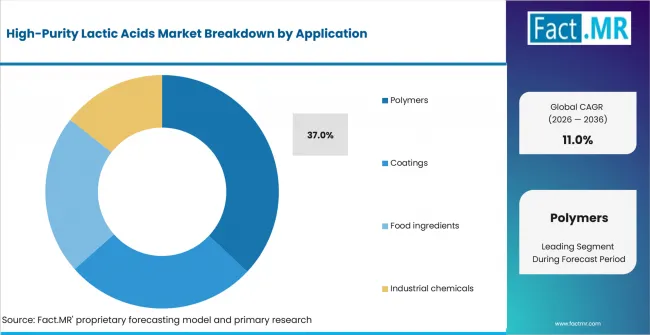
High Purity Lactic Acids Market Analysis By Application | Source: Fact.MR
Polymers lead application demand because PLA and related materials require lactic acid quality that supports lactide conversion and polymerization. Resin producers evaluate impurity levels, stereochemical consistency and long-run supply reliability before approving a supplier. Eurostat reported in October 2025 that the EU generated 35.3 kg of plastic packaging waste per person in 2023.
What is accelerating High-Purity Lactic Acids Market adoption, and what is holding it back?
Demand is expected to rise through polymer conversion, food ingredient use and bio-based chemical substitution. Growth is constrained by purification cost, feedstock variability and qualification time.
Drivers Impact Analysis
| DRIVER | (~) % IMPACT ON CAGR | GEOGRAPHIC RELEVANCE | IMPACT TIMELINE |
|---|---|---|---|
| PLA and lactide conversion requirements | +1.5% | North America, Europe, East Asia | Medium term (2-4 years) |
| Food ingredient purity and acidulant control | +1.2% | Global | Short term (<= 2 years) |
| Bio-based chemical substitution in coatings and solvents | +0.9% | Europe, Japan | Long term (>= 4 years) |
| Fermentation feedstock availability | +0.8% | USA, Brazil, France | Medium term (2-4 years) |
Source: Fact.MR analysis. Updated Aug 31, 2026
- PLA and lactide conversion requirements: Polymer producers need stable optical purity and low impurities, which raises the value of qualified high-purity grades.
- Food ingredient purity and acidulant control: Food brands use lactic acid where flavor, pH management and label requirements make supplier consistency visible.
- Bio-based chemical substitution: Coating and specialty chemical formulators use lactic acid routes in circular bio-solvents programs where testing confirms performance.
- Fermentation feedstock availability: Corn, sugarcane and starch supply support output planning, while producers still need purification capacity to capture value.
Opportunity Impact Analysis
| OPPORTUNITY | (~) % IMPACT ON CAGR | GEOGRAPHIC RELEVANCE | IMPACT TIMELINE |
|---|---|---|---|
| Polymer-grade supply for PLA expansion | +1.3% | Europe, USA, Japan | Medium term (2-4 years) |
| High-purity acidulants for processed foods | +0.8% | USA, France, Japan | Short term (<= 2 years) |
| Derivative routes for safer solvents and coatings | +0.7% | Germany, Japan | Long term (>= 4 years) |
Source: Fact.MR analysis. Updated Aug 31, 2026
- Polymer-grade supply for PLA expansion: Producers gain contracted demand by matching lactide and resin qualification protocols.
- High-purity acidulants for processed foods: Food customers reward suppliers that provide predictable taste, pH behavior and traceable production controls.
- Derivative routes for safer solvents and coatings: Chemical teams use lactic acid chemistry in replacement programs where testing confirms performance.
Restraints Impact Analysis
| RESTRAINT | (~) % IMPACT ON CAGR | GEOGRAPHIC RELEVANCE | IMPACT TIMELINE |
|---|---|---|---|
| Purification cost and yield loss | -0.6% | Global | Short term (<= 2 years) |
| Feedstock and energy price exposure | -0.5% | USA, Brazil, Europe | Medium term (2-4 years) |
| Customer qualification cycles | -0.4% | Food and polymer markets | Long term (>= 4 years) |
Source: Fact.MR analysis. Updated Aug 31, 2026
- Purification cost and yield loss: Higher-purity material requires more separation control, which reduces yield and raises operating cost.
- Feedstock and energy price exposure: Fermentation economics move with agricultural inputs, utilities and logistics, especially in export-oriented supply chains.
- Customer qualification cycles: Food, polymer and coating customers often require testing before switching grades, slowing supplier changes.
Which countries are scaling the High-Purity Lactic Acids Market through 2036?
- The country comparison spans 2.2 percentage points and forms three practical growth bands across the forecast period.
- The USA remains 0.5 percentage point above Germany due to fermentation feedstock depth and domestic polymer conversion needs.
- Germany remains 0.8 percentage point above Japan through its chemical manufacturing base and polymer processing demand.
- Japan remains 0.5 percentage point above France as specialty chemical discipline and food export applications support qualification-led buying.
- France remains 0.4 percentage point above Brazil because food ingredient demand offsets slower petrochemical activity.
- Brazil closes the displayed range as sugarcane scale supports fermentation economics and packaging policy improves the substitution case.
Comparable CAGRs create different entry conditions due to feedstock availability, polymer processing, food regulation and import dependence. Full report coverage includes North America, Latin America, Western Europe, Eastern Europe, East Asia, South Asia and Pacific, Middle East and Africa.
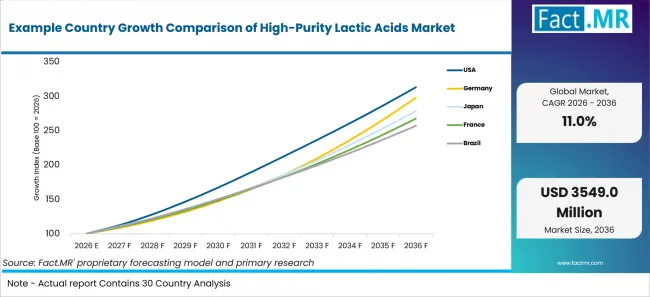
Example Country Growth Comparison Of High Purity Lactic Acids Market | Source: Fact.MR
| Country | CAGR (2026-2036) |
|---|---|
| USA | 12.1% |
| Germany | 11.6% |
| Japan | 10.8% |
| France | 10.3% |
| Brazil | 9.9% |
Source: Fact.MR analysis. Updated Aug 31, 2026
What supports USA adoption?
12.1% CAGR, supported by corn-based fermentation capacity and polymer demand.
USDA ERS reported that U.S. consumers spent 9.7% of disposable personal income on food in 2025. This spending base complements domestic fermentation capacity and supports downstream industries using polymers, coatings and other materials that can incorporate renewable chemical intermediates.
What is supporting Germany’s growth?
11.6% CAGR, shaped by chemical manufacturing scale and polymer processing demand.
Destatis recorded 342,066 employees in German chemical-product manufacturing in 2025, underscoring the scale of the country’s chemical industry. This manufacturing base supports bio-BDO adoption through established polymer-processing networks, technical expertise and demand for renewable intermediates in industrial formulations and specialty materials.
How does Japan perform?
10.8% CAGR, linked to food exports and specialty chemical quality standards.
MAFF reported in August 2026 that Japan’s agriculture, forestry, fisheries and food exports reached JPY 897.7 billion in the first half of 2026. Japan’s emphasis on consistent grades and detailed documentation supports bio-BDO qualification for specialty chemical and polymer applications.
What supports France adoption?
10.3% CAGR, led by food ingredients and bio-based substitution routes.
France combines food-processing demand with a policy environment that keeps buyers attentive to packaging and bio-based inputs. SDES reported in July 2026 that France’s petrochemical industry consumed 5.3 million tonnes of petroleum-based raw materials in 2025, down 11% from 2024.
How is Brazil developing demand?
9.9% CAGR, driven by sugarcane feedstock scale and packaging regulation.
Brazil’s opportunity is tied to feedstock depth and a maturing packaging policy framework. Conab estimated in August 2026 that Brazil’s 2026/27 sugarcane crop would reach 705.2 million tonnes. Conab also projected sugarcane-derived ethanol production at 29.98 billion litres, indicating a substantial feedstock base for fermentation applications.
Who leads the High-Purity Lactic Acids Market?
Corbion N.V. is active through lactic acid, lactic acid derivatives and high-purity lactic acid used as the foundation for PLA. Its portfolio spans food preservation, biochemical specialties and biomaterials, giving it a broad position across food and polymer uses.
Galactic S.A. competes through fermentation-derived lactic acid, lactates and derivatives serving food, personal care, animal nutrition and industrial applications. Jungbunzlauer Suisse AG adds L(+)-lactic acid produced through fermentation and strengthened its North American manufacturing presence through the acquisition of its first U.S. production facility in November 2025.
Musashino Chemical Laboratory, Ltd. supplies lactic acid, lactates and methyl lactate, supported by expertise in fermentation, chemical synthesis and high-purity specialty chemicals. Henan Jindan Lactic Acid Technology Co., Ltd. and Anhui BBCA Biochemical Co., Ltd. / BBCA Group also participate in the Asian lactic-acid value chain. Supplier assessment can consider product purity, fermentation capabilities, derivative breadth and regional technical and customer support.
Which companies are the key providers?
Key companies include Corbion N.V.; Galactic S.A.; Jungbunzlauer Suisse AG; Musashino Chemical Laboratory, Ltd.; Henan Jindan Lactic Acid Technology Co., Ltd.; and Anhui BBCA Biochemical Co., Ltd. / BBCA Group.
- Corbion N.V.
- Galactic S.A.
- Jungbunzlauer Suisse AG
- Musashino Chemical Laboratory, Ltd.
- Henan Jindan Lactic Acid Technology Co., Ltd.
- Anhui BBCA Biochemical Co., Ltd. / BBCA Group
Bibliography
- Bond, J. K., Ramsey, S., & Huang, J. (2026, January 14). Feed Outlook: January 2026 (FDS-26A). U.S. Department of Agriculture, Economic Research Service.
- Zeballos, E., & Sinclair, W. (2026, June 1). U.S. consumers spent 9.7 percent of their disposable personal income on food in 2025. U.S. Department of Agriculture, Economic Research Service.
- European Bioplastics e.V. (2025, December 2). EUBP presents the results of the 2025 Market Data Report.
- Eurostat. (2025, December 16). EU chemical production: -15% over 10 years.
- Eurostat. (2025, October 22). Plastic packaging waste in the EU: 35.3 kg per person.
- Federal Statistical Office (Destatis). (2026, July 22). Beschäftigte und Umsatz der Betriebe im Verarbeitenden Gewerbe: Deutschland, Jahre, Wirtschaftszweige (WZ2008 2-/3-/4-Steller) (Table 42271-0002) [Data table]. GENESIS-Online.
- Service des données et études statistiques. (2026, July 23). L’activité de la pétrochimie en France baisse de 11 % en 2025.
- Companhia Nacional de Abastecimento. (2026, August 20). Nova estimativa de cana-de-açúcar traz produção de 705,2 milhões de toneladas na safra 2026/27.
- Jungbunzlauer. (2025, November 6). Jungbunzlauer closes acquisition of Illinois facility to launch U.S. manufacturing operations.
This Report Answers
- The report explains where high-purity lactic acid is used across product, process, function and application categories.
- Segment analysis identifies the principal subsegments and the technical reasons buyers prioritize them.
- Country analysis examines the listed markets and the feedstock, policy or application mechanisms supporting demand.
- Competitive analysis reviews active producers across fermentation, purification, acidulants and lactic acid derivative routes.
- Application analysis assesses how polymer conversion, food acidulation and solvent replacement influence supplier selection.
What does the High-Purity Lactic Acids Market cover?
The High-Purity Lactic Acids Market covers lactic acid sold for uses that require tighter impurity control, bio-based documentation and application-grade consistency. It includes materials used in food ingredients and polymer conversion. Coatings and industrial chemical intermediates are covered when adjacent lactic acid market applications depend on purity and process route.
The assessment covers fermentation and purification-led supply. It also covers derivative demand tied to acidulants market use and bio-based chemical conversion. Demand is assessed through the product, process, function and application segmentation.
What is included in the scope?
The scope includes bio-based grade and high-purity grade lactic acid sold to food, polymer and industrial customers. Industrial grade and specialty blend supply are covered where they support bio-based platform chemicals. Customer substitution work also overlaps with green chemicals.
Application coverage includes polymers, coatings, food ingredients and industrial chemicals. The scope also connects high-purity lactic acid with acidulants and derivative systems such as circular bio-solvents.
What is excluded from the scope?
Commodity lactic acid grades where purity control is secondary fall outside the scope. Finished PLA resins, finished food products, standalone packaging articles and general chemicals sold without a lactic acid basis are treated as adjacent markets.
Raw agricultural feedstocks, generic fermentation equipment and unrelated chemical intermediates are outside the scope. The report discusses fermentation chemicals and organic acids only where they frame the boundary of high-purity lactic acid demand.
How Was the Analysis Built?
The analysis draws on 120+ sources, 35+ company portfolios, 25+ countries, and more than 20 industry interviews.
- Primary Research: Primary research includes discussions with manufacturers, service providers, technology developers, distributors, end users, and subject-matter experts. These conversations examine purchasing priorities, product adoption, operational challenges, approval requirements, competitive positioning, and the factors that influence wider market acceptance.
- Desk Research: Desk research covers government statistics, regulatory publications, company filings, trade data, technical studies, industry associations, standards, public policy, and other authoritative sources. Every source used in the analysis is documented in the bibliography.
- Market Sizing and Forecasting: Market estimates combine historical performance, demand indicators, pricing and volume trends, segment shares, company participation, country-level growth, adoption patterns, investment activity, and barriers to market expansion.
- Data Validation and Update Cycle: Findings are validated by comparing primary interviews with public data, company activity, regulatory changes, trade patterns, and industry developments. Regular updates review new product launches, capacity changes, partnerships, approvals, and shifts in commercial adoption.
Segmentation
What is the report’s scope and coverage?
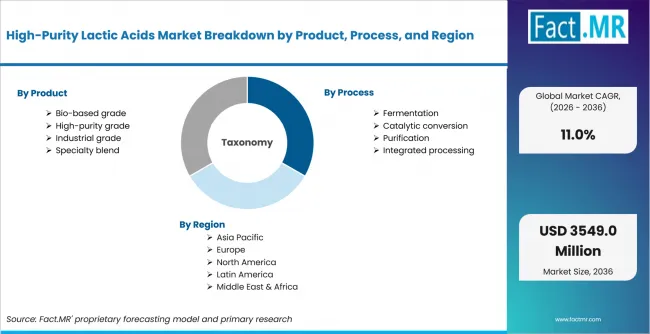
High Purity Lactic Acids Market Breakdown By Product, Process, And Region | Source: Fact.MR
| Attribute | Details |
|---|---|
| Quantitative Units | USD million |
| Market Definition | High-purity lactic acid used where impurity control, optical purity, fermentation route and application-grade consistency are required. |
| Product | Bio-based grade; High-purity grade; Industrial grade; Specialty blend |
| Process | Fermentation; Catalytic conversion; Purification; Integrated processing |
| Function | Intermediate; Solvent replacement; Performance additive; Processing aid |
| Application | Polymers; Coatings; Food ingredients; Industrial chemicals |
| Regions Covered | North America; Latin America; Western Europe; Eastern Europe; East Asia; South Asia and Pacific; Middle East and Africa |
| Countries Covered | USA; Germany; Japan; France; Brazil |
| Key Companies Profiled | Corbion N.V.; Galactic S.A.; Jungbunzlauer Suisse AG; Musashino Chemical Laboratory, Ltd.; Henan Jindan Lactic Acid Technology Co., Ltd.; Anhui BBCA Biochemical Co., Ltd. / BBCA Group |
| Forecast Period | 2026 to 2036 |
| Approach | Hybrid top-down and bottom-up approach using fermentation feedstock indicators, polymer application demand, food ingredient use, country-level adoption and provider portfolio review. |
Source: Fact.MR analysis. Updated Aug 31, 2026
How is the market segmented?
-
By Product:
- Bio-based grade
- High-purity grade
- Industrial grade
- Specialty blend
-
By Process:
- Fermentation
- Catalytic conversion
- Purification
- Integrated processing
-
By Function:
- Intermediate
- Solvent replacement
- Performance additive
- Processing aid
-
By Application:
- Polymers
- Coatings
- Food ingredients
- Industrial chemicals
-
By Region:
- North America
- Latin America
- Western Europe
- Eastern Europe
- East Asia
- South Asia and Pacific
- Middle East and Africa
Frequently Asked Questions
How big is the high-purity lactic acids market in 2026?
What is the CAGR of the high-purity lactic acids market from 2026 to 2036?
Which product leads the high-purity lactic acids market?
Which process leads the high-purity lactic acids market?
Who are the leading companies in the high-purity lactic acids market?
Who worked on this report


Preview the report firsthand - request a free sample
Free SampleGet the brochure for pricing and purchase details
Download PDF