- Market Value (2025): USD 376.8 Mn
- Estimated Value (2026): USD 396.1 Mn
- Forecast Value (2036): USD 651.3 Mn
- CAGR (2026-2036): 5.1%
High Velocity Burners Market Forecast and Outlook 2026 to 2036
The global high velocity burners market was valued at USD 376.8 million in 2025 and reached USD 396.1 million in 2026. The market is forecast to reach USD 651.3 million by 2036, expanding at a CAGR of 5.1% during the 2026 to 2036 assessment period.
The European Union's Carbon Border Adjustment Mechanism entered its definitive phase on January 1, 2026, introducing carbon-related obligations for imports of covered goods. Alongside changes to the EU Emissions Trading System, this is increasing the financial importance of emission reduction across energy-intensive industries. High velocity burners are gaining attention in industrial kilns, furnaces and ovens because they circulate combustion gases rapidly and help maintain temperature uniformity in densely loaded chambers. Manufacturers are refining burner designs with recuperative heat recovery, low-NOx combustion and alternative-fuel compatibility to address industrial efficiency and emission concerns (European Commission, n.d.).
Key Takeaways from the High Velocity Burners Market
- High Velocity Burners Market Value (2025): USD 376.8 million
- High Velocity Burners Market Value (2026): USD 396.1 million
- High Velocity Burners Market Forecast Value (2036): USD 651.3 million
- High Velocity Burners Market CAGR (2026-2036): 5.1%
- Leading Product Type: Natural Gas Burners (48.7%)
- Key Market Participants: Honeywell International Inc., Fives Group, Bloom Engineering, Selas Heat Technology Company, Hauck Manufacturing and Industrial Combustion
- Key Growth Regions: Germany, Brazil, United States, United Kingdom and Japan
Industrial decarbonization initiatives are creating opportunities for high velocity burner manufacturers, particularly across metals, glass and ceramics production. The US Department of Energy's industrial technology research programmes include dedicated work on fuel-flexible combustion and high-efficiency process heating. These initiatives are encouraging manufacturers to examine combustion performance, alternative fuel use and furnace modernization. Such industrial priorities are creating commercial opportunities for high velocity burners across heat-intensive applications (U.S. Department of Energy, n.d.).
High Velocity Burners Market
| Metric | Value |
|---|---|
| Market Value (2025) | USD 376.8 million |
| Market Value (2026) | USD 396.1 million |
| Forecast Value (2036) | USD 651.3 million |
| CAGR (2026 to 2036) | 5.1% |
Source: Fact.MR analysis. Updated Nov 20, 2026
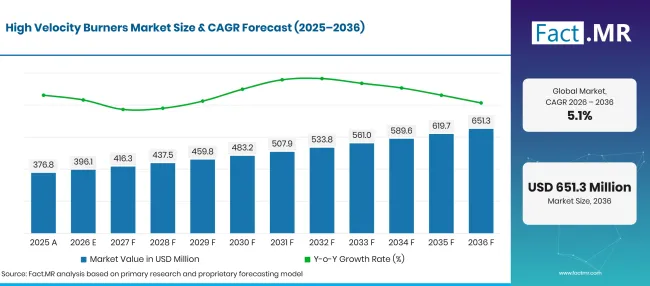
High Velocity Burners Market Forecast Global | Source: Fact.MR
Category
| Category | Segments |
|---|---|
| Product Type | Natural Gas Burners, Oil-Fired Burners, Dual Fuel Burners |
| Application | Industrial Furnaces, Kilns, Boilers, Ovens, Others |
| End-User Industry | Metals and Metallurgy, Ceramics, Glass, Chemical, Food Processing, Others |
| Countries Covered | Germany, Brazil, United States, United Kingdom, Japan |
Source: Fact.MR analysis. Updated Nov 20, 2026
Segmental Analysis
Why do natural gas burners lead product demand in the High Velocity Burners Market?
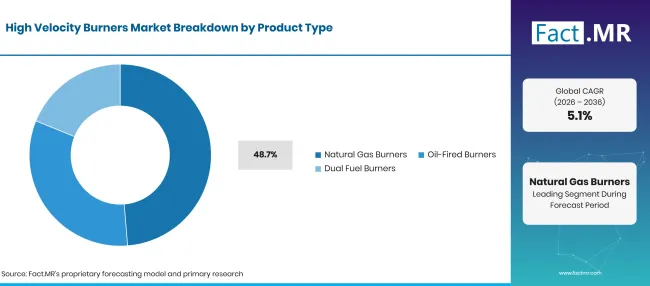
High Velocity Burners Market Breakdown Product Type | Source: Fact.MR
Natural gas burners capture 48.7% of market revenue in 2026, supported by their extensive use in ceramic kilns, industrial furnaces and continuous heating lines. Consistent combustion and integration with existing gas infrastructure make them suitable for high-temperature operations. Oil-fired burners retain relevance at facilities with limited gas connectivity, while dual-fuel variants attract plants seeking greater fuel flexibility. Industrial efforts to improve combustion efficiency and accommodate alternative fuel blends are also influencing burner upgrades.
Why do industrial furnaces lead application demand in the High Velocity Burners Market?
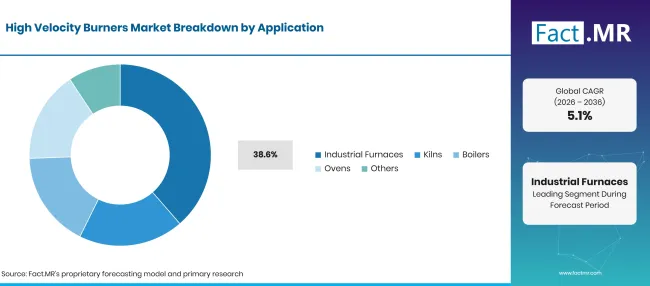
High Velocity Burners Market Breakdown Application | Source: Fact.MR
Industrial furnaces represent 38.6% of application revenue in 2026, driven by their use in metal heating, annealing and heat-treatment processes. High-velocity combustion improves hot-gas circulation across furnace chambers, helping maintain uniform temperatures. Kilns and ovens contribute through ceramic firing, glass treatment and industrial drying, while boilers serve process-heating operations. India's Ministry of Steel reported provisional crude steel production of 168.42 million tonnes in FY 2025-26, highlighting the scale of heat-intensive metal processing activity (Ministry of Steel, 2026a).
Why does metals and metallurgy lead end-user demand in the High Velocity Burners Market?
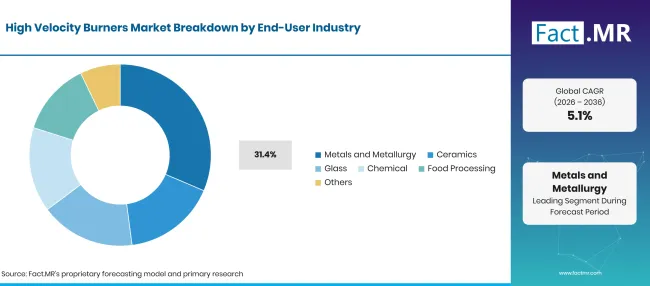
High Velocity Burners Market Breakdown End User Industry | Source: Fact.MR
Metals and metallurgy contribute 31.4% of market revenue in 2026, reflecting extensive burner use in steelmaking, forging, annealing and heat treatment. These operations depend on rapid heat transfer and consistent temperature control. Ceramics and glass manufacturers use high-velocity burners for firing and melting, while chemical and food processing facilities apply them in controlled heating operations. India's crude steel production reached a provisional 168.42 million tonnes in FY 2025-26, reinforcing the importance of industrial heating equipment across metal processing facilities (Ministry of Steel, 2026a).
High Velocity Burners Market: Drivers, Restraints and Trends
Driver: Industrial Energy Efficiency and Emission Reduction:
The European Union's Carbon Border Adjustment Mechanism entered its definitive phase in January 2026, increasing the importance of carbon efficiency across covered industrial supply chains. This is encouraging industrial operators to review furnace performance because fuel consumption directly influences production costs and emissions. High velocity burners help improve heat circulation and reduce uneven heating within industrial chambers. As manufacturers focus on lowering energy consumption per tonne of output, modernization of industrial heating operations is creating wider market opportunities (European Commission, n.d.).
Restraint: High Installation Costs and Slow Industrial Upgrades:
High initial installation costs remain a barrier for smaller industrial operators, particularly when existing furnace systems still meet production requirements. Retrofitting also involves production downtime, combustion-system modifications and compatibility checks. Smaller ceramics and metal-processing units may postpone upgrades when operating margins are tight. These financial and operational hurdles can delay burner replacement, even where newer systems offer better thermal efficiency.
Trend: Industrial Transition Towards Hydrogen-Based Heating;
In January 2026, India's government highlighted five pilot projects examining hydrogen applications in the steel sector under the National Green Hydrogen Mission. These initiatives are encouraging industrial manufacturers to explore alternative fuels and lower-carbon production methods. As steel, ceramics, glass and chemical producers examine ways to reduce fossil fuel consumption, hydrogen-compatible industrial heating is gaining attention. This transition creates opportunities for high velocity burners as manufacturers modernize thermal operations and explore alternative fuel requirements (Ministry of New and Renewable Energy, 2026).
Trend: Greater Focus on Digital Combustion Management:
The US Department of Energy's FY 2025-2027 laboratory selection programme includes the Burner Laboratories to Advance Fuel UtiliZation for Thermal Energy (BLAZE) project, led by the National Energy Technology Laboratory in collaboration with Argonne National Laboratory. The USD 10 million initiative focuses on fuel-flexible combustion testing, industrial furnace configurations, burner technologies, sensors and modelling. This research highlights the increasing role of data-led monitoring in industrial heating. Manufacturers are focusing on real-time combustion analysis, oxygen monitoring and automated temperature adjustments to improve furnace performance and limit fuel wastage (U.S. Department of Energy, n.d.).
High Velocity Burners Market Analysis by Key Country
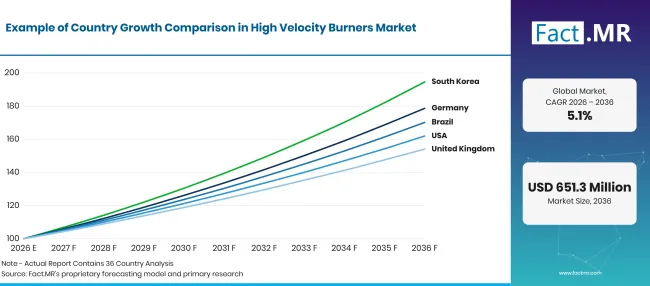
High Velocity Burners Market Growth Index | Source: Fact.MR
| Country | CAGR (2026-2036) |
|---|---|
| Germany | 6.0% |
| Brazil | 5.5% |
| United States | 4.9% |
| United Kingdom | 4.4% |
| Japan | 3.9% |
Source: Fact.MR analysis. Updated Nov 20, 2026
Why is Germany the fastest-growing market for high velocity burners?
On November 6, 2025, the German government convened a steel industry dialogue focused on reducing industrial energy costs and accelerating climate-friendly production.
These priorities are encouraging steelmakers and other energy-intensive manufacturers to improve furnace efficiency and combustion performance. Germany's strong metallurgical, ceramics and glass manufacturing base creates a wider customer base for high velocity burners. Industrial modernization and the need for consistent heat distribution across high-temperature processes are further supporting sales (Federal Government of Germany, 2025).
What is driving high velocity burner adoption in Brazil?
On September 18, 2026, BNDES announced R$5.4 billion in financing with the World Bank for industrial decarbonization projects across steel, chemicals, aluminium and other industrial sectors.
This initiative is creating opportunities to modernize energy-intensive production facilities. Brazilian manufacturers are examining ways to reduce fuel consumption and improve industrial heating efficiency. Furnace upgrades across metal processing, ceramics and glass manufacturing are strengthening the scope for high velocity burner adoption (Banco Nacional de Desenvolvimento Econômico e Social, 2026).
Why is the United States witnessing steady growth in the High Velocity Burners Market?
The US Department of Energy's industrial laboratory selection programme includes a USD 10 million BLAZE project led by NETL and Argonne National Laboratory.
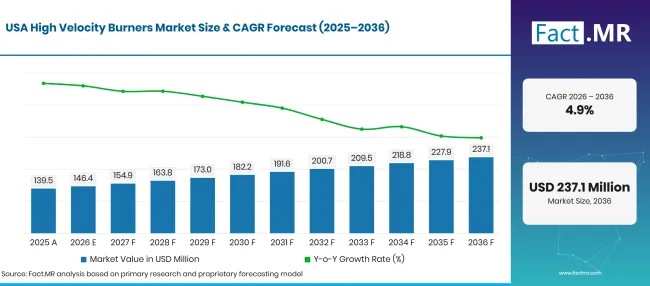
High Velocity Burners Market Forecast Usa | Source: Fact.MR
The programme focuses on fuel flexibility, advanced combustion technologies, sensors and industrial furnace testing. Such initiatives highlight the importance of modernizing industrial heating across metals, glass, chemicals and food processing. Manufacturers' focus on furnace efficiency and alternative fuels is creating opportunities for high velocity burners (U.S. Department of Energy, n.d.).
What is supporting high velocity burner demand in the United Kingdom?
The UK government's Energy Consumption in the UK 2026 report, published on September 24, 2026, found that industrial heat represented 50% of industry energy consumption in 2025.
Very-high-temperature processes accounted for 39% of industrial heat use. This dependence on thermal operations creates opportunities across metalworking, glass production and chemical processing. Manufacturers are focusing on efficient combustion systems and furnace modernization to manage energy consumption and improve temperature consistency (Department for Energy Security and Net Zero, 2026).
Why is Japan investing in advanced industrial heating systems?
On September 28, 2026, Japan's New Energy and Industrial Technology Development Organization announced an 85% ammonia co-firing achievement in a naphtha cracking furnace using newly developed ammonia-fired burners.
This demonstration highlights the country's efforts to adapt high-temperature manufacturing to alternative fuels. Japan's petrochemical, automotive, steel and ceramics industries offer opportunities for high velocity burner applications. Investment in alternative-fuel combustion, furnace modernization and precise temperature management is supporting market development (New Energy and Industrial Technology Development Organization, 2026).
Competitive Landscape for High Velocity Burners Market
The high velocity burners market features manufacturers with expertise in industrial combustion, furnace heating and customized thermal processing systems. Honeywell International Inc. offers an extensive combustion portfolio through its Eclipse, Maxon and Hauck brands, covering industrial heating, heat recovery and low-emission applications. Fives Group focuses on high-velocity and low-NOx burners designed for temperature uniformity and stable furnace operation.
Bloom Engineering specializes in engineered combustion systems for steel, aluminium and other high-temperature processes. Selas Heat Technology Company addresses industrial heating through specialized burner systems and fuel-saving technologies, while Industrial Combustion serves industrial burner and combustion equipment requirements. Across these companies, market positioning increasingly depends on combustion efficiency, emissions performance, fuel flexibility and the ability to integrate upgraded burners into existing furnace infrastructure.
Recent Developments
- On June 9, 2025, Honeywell International Inc. completed the acquisition of Sundyne for USD 2.16 billion, expanding its portfolio of engineered pumps, gas compressors and process industry solutions.
- On September 10, 2025, Fives Group launched its ITAS Invistableflame burner at Gastech 2025. The new flameless burner supports hydrogen fuel and reduces NOx emissions by up to 30% compared with conventional low-NOx burners.
- On January 2, 2025, Wabtec announced the integration of Bloom Engineering into its Freight and Industrial Components Group following its USD 69 million acquisition, expanding its industrial burner and combustion system portfolio.
Key Players in High Velocity Burners Market
Key companies operating in the market include Honeywell International Inc., Fives Group, Bloom Engineering, Selas Heat Technology Company, Hauck Manufacturing, and Industrial Combustion.
- Honeywell International Inc.
- Fives Group
- Bloom Engineering
- Selas Heat Technology Company
- Hauck Manufacturing
- Industrial Combustion
Bibliography
- Banco Nacional de Desenvolvimento Econômico e Social. (2026, September 18). Com R$ 5,4 bi, Banco Mundial vai financiar a descarbonização da indústria brasileira em parceria com BNDES. Agência BNDES de Notícias.
- Department for Energy Security and Net Zero. (2026, September 24). Energy consumption in the UK (ECUK) 2026. GOV.UK.
- European Commission. (n.d.). Carbon Border Adjustment Mechanism: Definitive regime. Directorate-General for Taxation and Customs Union.
- Federal Government of Germany. (2025, November 6). Making the steel industry fit for the future: Press statement after the steel dialogue in the Federal Chancellery.
- Ministry of New and Renewable Energy. (2026). Building a green hydrogen ecosystem: Progress under the National Green Hydrogen Mission. Government of India.
- Ministry of Steel. (2026a). An overview of steel sector (March 2026). Government of India.
- New Energy and Industrial Technology Development Organization. (2026, September 28). World-class 85% ammonia co-firing achieved in a naphtha cracking furnace.
- U.S. Department of Energy. (n.d.). FY 2025–FY 2027 laboratory call selections: Industrial technology office.
Segmentation
Scope of Report
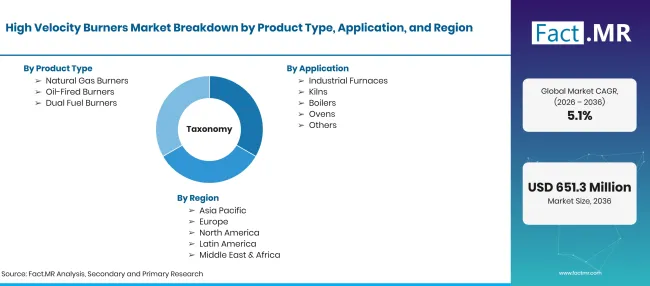
High Velocity Burners Market Taxonomy | Source: Fact.MR
| Items | Values |
|---|---|
| Quantitative Units (2026) | USD 396.1 million |
| Product Type | Natural Gas Burners, Oil-Fired Burners, Dual Fuel Burners |
| Application | Industrial Furnaces, Kilns, Boilers, Ovens, Others |
| End-User Industry | Metals and Metallurgy, Ceramics, Glass, Chemical, Food Processing, Others |
| Regions Covered | North America, Latin America, Europe, East Asia, South Asia and Pacific, Middle East and Africa |
| Countries Covered | United States, Germany, Japan, United Kingdom, Brazil and other countries |
| Key Companies Profiled | Honeywell International Inc., Fives Group, Bloom Engineering, Selas Heat Technology Company, Hauck Manufacturing, Industrial Combustion |
| Additional Attributes | Dollar revenue in the High Velocity Burners Market is segmented by product type (natural gas burners, oil-fired burners and dual fuel burners); application (industrial furnaces, kilns, boilers and ovens); end-user industry (metals and metallurgy, ceramics, glass, chemical and food processing); and region. |
Source: Fact.MR analysis. Updated Nov 20, 2026
High Velocity Burners Market by Segments
-
Product Type
- Natural Gas Burners
- Oil-Fired Burners
- Dual Fuel Burners
-
Application
- Industrial Furnaces
- Kilns
- Boilers
- Ovens
- Others
-
End-User Industry
- Metals and Metallurgy
- Ceramics
- Glass
- Chemical
- Food Processing
- Others
-
Region
- North America
- United States
- Canada
- Mexico
- Europe
- Germany
- United Kingdom
- France
- Italy
- Spain
- Rest of Europe
- Asia Pacific
- China
- India
- Japan
- South Korea
- Australia
- Rest of Asia Pacific
- Latin America
- Brazil
- Mexico
- Argentina
- Rest of Latin America
- Middle East and Africa
- GCC Countries
- South Africa
- Rest of Middle East and Africa
- North America
Frequently Asked Questions
How big is the global High Velocity Burners Market in 2026?
What will be the size of the High Velocity Burners Market by 2036?
How fast will the High Velocity Burners Market grow during the assessment period?
Which product type segment leads the High Velocity Burners Market?
Who worked on this report


Preview the report firsthand - request a free sample
Free SampleGet the brochure for pricing and purchase details
Download PDF